

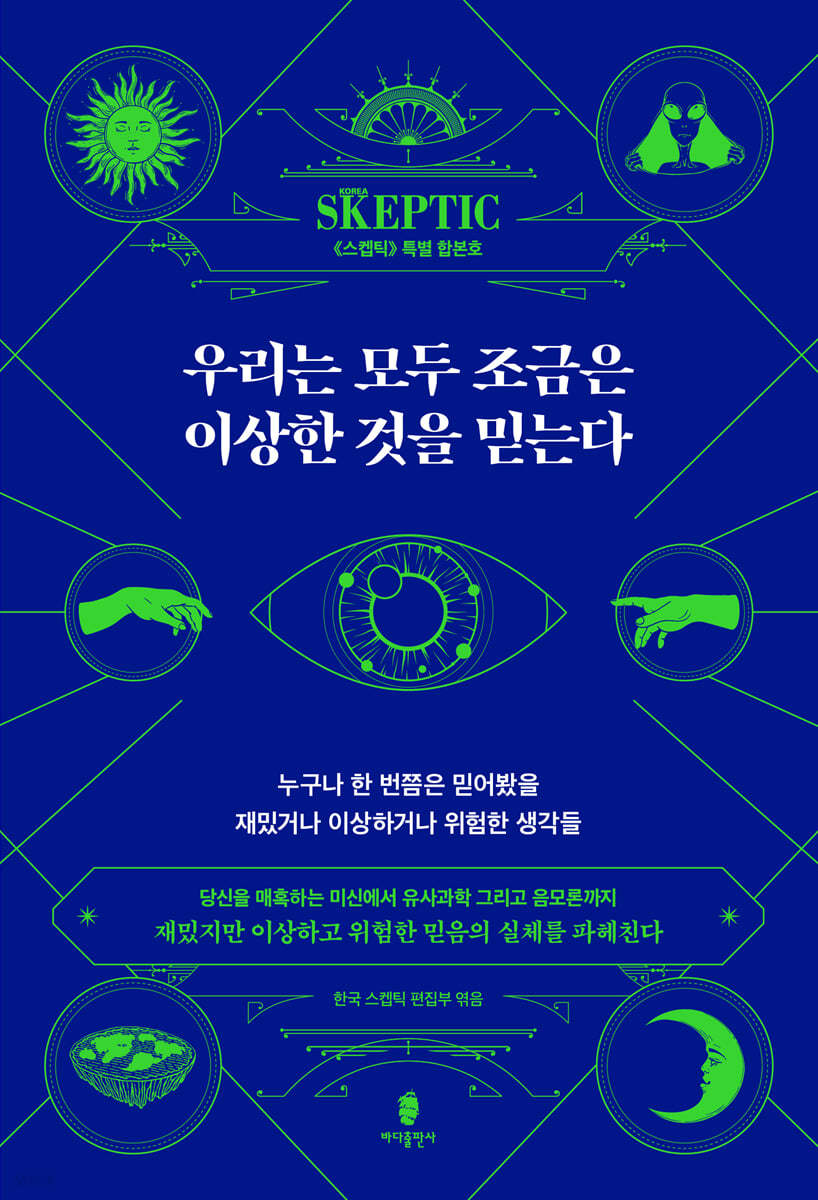
We all believe in something a little strange
 |
Description
Book Introduction
MBTI, fortune telling, out-of-body experiences, etc.
Discover humanity's most bizarre beliefs in one volume.
Even in this age of cutting-edge science—MBTI, blood type personality theory, destiny, four pillars of destiny, yin-yang, and the Five Elements—some people still believe these strange and dangerous stories.
Perhaps these stories are the starting point for understanding us humans.
Our brains, long designed to find patterns in an uncertain world, are vulnerable to bizarre beliefs.
In fact, strange beliefs have been a common, central, and universal feature of human history.
The Korean Skeptic editorial team, which has been critically examining our society from a scientific perspective for the past eight years, has compiled stories about 25 interesting but strange beliefs that tempt us, such as MBTI, blood type personality theory, fate, four pillars of destiny, yin-yang and five elements, millennium doomsday theory, aliens, geocentrism, negative ions, heaven and hell, psychic photography, precognitive dreams, near-death experiences, out-of-body experiences, astrology, and the flat earth theory.
These engaging stories, sometimes absurd, sometimes funny, and sometimes infuriating, will help you understand how our minds perceive the world and distort reality.
Discover humanity's most bizarre beliefs in one volume.
Even in this age of cutting-edge science—MBTI, blood type personality theory, destiny, four pillars of destiny, yin-yang, and the Five Elements—some people still believe these strange and dangerous stories.
Perhaps these stories are the starting point for understanding us humans.
Our brains, long designed to find patterns in an uncertain world, are vulnerable to bizarre beliefs.
In fact, strange beliefs have been a common, central, and universal feature of human history.
The Korean Skeptic editorial team, which has been critically examining our society from a scientific perspective for the past eight years, has compiled stories about 25 interesting but strange beliefs that tempt us, such as MBTI, blood type personality theory, fate, four pillars of destiny, yin-yang and five elements, millennium doomsday theory, aliens, geocentrism, negative ions, heaven and hell, psychic photography, precognitive dreams, near-death experiences, out-of-body experiences, astrology, and the flat earth theory.
These engaging stories, sometimes absurd, sometimes funny, and sometimes infuriating, will help you understand how our minds perceive the world and distort reality.
- You can preview some of the book's contents.
Preview
index
Entering
Part 1: Strange Beliefs About Character and Destiny
Too complex a human, too simple MBTI / Park Jin-young
Your Blood Type Doesn't Have You / Rebecca Buckner, John Buckner
Pisces are altruistic / Charles S.
Reikart
The Fatalist Dilemma / David Zeigler
7 Reasons Why You Shouldn't Trust the I Ching / Lee Ji-hyung
Part 2: Strange Beliefs About Science in Our Everyday Lives
Water Knows the Answer / Nicolas Goubrit, Stanislas Francfort
Can Cell Phones Cause Cancer? / Bernard Leykind
You can heal your brain with food / Choi Nak-eon
A Society Obsessed with the Negative Ion Illusion / Lee Deok-hwan
The Girl Who Smelled Blue / Jesse Bering
Part 3: Strange Beliefs About Hidden Truths
How Cognitive Dissonance Distorts Reality / Daniel Loxton
Three Hypotheses About UFOs / Michael Shermer
People Who Want to Put Earth at the Center of the Universe / Donald Prothero
People Who Believe the Earth is Flat / Daniel Loxton
A Fantastic Journey into the Empty Space / Daniel Roxton
Part 4: Strange Beliefs About the Afterlife
Signals from My Dead Mother / Jesse Bering
How Science Explains Precognitive Dreams / Richard Wiseman
Everyone's Seen a Different Heaven / Corey Markham
On Electrical Brain Stimulation and Out-of-Body Experiences / James Alan Chain
The Secret of Psychic Photography / Daniel Loxton
About the Author
About the Translator
Part 1: Strange Beliefs About Character and Destiny
Too complex a human, too simple MBTI / Park Jin-young
Your Blood Type Doesn't Have You / Rebecca Buckner, John Buckner
Pisces are altruistic / Charles S.
Reikart
The Fatalist Dilemma / David Zeigler
7 Reasons Why You Shouldn't Trust the I Ching / Lee Ji-hyung
Part 2: Strange Beliefs About Science in Our Everyday Lives
Water Knows the Answer / Nicolas Goubrit, Stanislas Francfort
Can Cell Phones Cause Cancer? / Bernard Leykind
You can heal your brain with food / Choi Nak-eon
A Society Obsessed with the Negative Ion Illusion / Lee Deok-hwan
The Girl Who Smelled Blue / Jesse Bering
Part 3: Strange Beliefs About Hidden Truths
How Cognitive Dissonance Distorts Reality / Daniel Loxton
Three Hypotheses About UFOs / Michael Shermer
People Who Want to Put Earth at the Center of the Universe / Donald Prothero
People Who Believe the Earth is Flat / Daniel Loxton
A Fantastic Journey into the Empty Space / Daniel Roxton
Part 4: Strange Beliefs About the Afterlife
Signals from My Dead Mother / Jesse Bering
How Science Explains Precognitive Dreams / Richard Wiseman
Everyone's Seen a Different Heaven / Corey Markham
On Electrical Brain Stimulation and Out-of-Body Experiences / James Alan Chain
The Secret of Psychic Photography / Daniel Loxton
About the Author
About the Translator
Detailed image

Publisher's Review
We are all in uncertain situations.
I am a storyteller who finds patterns.
Everyone has probably had a memory of shivering while watching a ghost story TV program at least once.
I was worried that a resentful spirit might come looking for me.
We lament our timid Type A personality and envy the good-natured Type O people, we lament that our personalities don't match because our zodiac signs don't match with our lovers, and we pray that the end of the millennium will come and turn off our computers.
Yes, that's right.
We all believe in a little bit of weird stuff.
You think you're smart and rational? Don't be so conceited.
Because we all have brains that are vulnerable to strange beliefs.
You, who live in this day and age, are no exception.
The 16th-century skeptic Reginald Scott lamented the Renaissance man's preoccupation with ghosts and demons, predicting that all illusions would soon vanish by the grace of God.
But contrary to his prediction, even after about five centuries, we still believe in this strange belief.
In fact, throughout human history, strange beliefs have always enjoyed popularity.
Scott's predictions failed not because we are less scientifically enlightened, but because that's just how our minds work.
Strange beliefs are built into human software.
Michael Shermer calls this the “belief engine.”
The ability to find patterns and create stories from uncertain information has given rise to great scientific achievements like relativity and quantum mechanics, but it has also given rise to alternative worlds of conspiracy theories and supernatural beliefs.
We are a species that imagines and dreams.
As storytellers, we will always be surrounded by strange beliefs.
Everyone must have believed it at least once
Funny, but strange and dangerous ideas
When you think of a blood type B man, what image comes to mind? A charming bad boy? If so, you might be a blood type personality theorist.
Sure, you once believed it, but now you don't, thinking it's childish and unscientific? What about the MBTI? You trust it because it's scientific? You say no test has ever revealed you better? And while you may not believe in saju (four pillars of destiny), have you ever looked up your daily horoscope in the newspaper, suspected alien visitation after seeing objects floating in the sky, or bought and tried a bestseller claiming you can heal your brain with food? Or have you ever paid extra for a negative ion product, claiming it's good for your health? If you're nodding along as you read this, this book is probably for you.
In this book, you will encounter some of the most representative and strange beliefs of humanity, such as flat-earthers who insist that the Earth is flat, alien believers who believe that UFOs are evidence of aliens visiting Earth, blood type personality theorists who ask who you are based on your blood type, millennial doomsday theorists who lost all their money because they thought the end was coming, and near-death experiencers who claim to have experienced the afterlife.
Beyond mere fun and laughter, these stories will give you a glimpse into what our belief engines are and how our minds work.
Understanding strange beliefs will deepen your understanding of yourself and of us as humans.
To understand humanity, we must understand strange beliefs.
Let's say your grandmother falls for some scam.
By the time you realize this, you've handed over a lot of money to a scammer.
You may try to convince your grandmother, but it won't be easy.
You'll give a long speech about the facts, but Grandma won't listen.
Why on earth does Grandma do that? Tavris and Aronson explain:
“If you understand cognitive dissonance, you can understand why.
“Saying, ‘What’s wrong with you, Grandma?’ is the same thing as saying, ‘Are you stupid, Grandma?’ and it’s bound to backfire.” As long as Grandma’s self-image as an intelligent and sensible person is threatened, she won’t admit to her mistakes.
Carl Sagan once said that the least effective way to attract the attention of intelligent, curious people is to belittle their beliefs or to show arrogance by disguising humility.
Skeptic Daniel Loxton also said that you can't change someone's mind without acknowledging that they deserve respect, are intelligent, curious, and have normal thoughts.
This is why we need to listen to stories of strange beliefs rather than cynicism and criticism.
As I said before, we all have some strange beliefs, and keep in mind that you are no exception.
I am a storyteller who finds patterns.
Everyone has probably had a memory of shivering while watching a ghost story TV program at least once.
I was worried that a resentful spirit might come looking for me.
We lament our timid Type A personality and envy the good-natured Type O people, we lament that our personalities don't match because our zodiac signs don't match with our lovers, and we pray that the end of the millennium will come and turn off our computers.
Yes, that's right.
We all believe in a little bit of weird stuff.
You think you're smart and rational? Don't be so conceited.
Because we all have brains that are vulnerable to strange beliefs.
You, who live in this day and age, are no exception.
The 16th-century skeptic Reginald Scott lamented the Renaissance man's preoccupation with ghosts and demons, predicting that all illusions would soon vanish by the grace of God.
But contrary to his prediction, even after about five centuries, we still believe in this strange belief.
In fact, throughout human history, strange beliefs have always enjoyed popularity.
Scott's predictions failed not because we are less scientifically enlightened, but because that's just how our minds work.
Strange beliefs are built into human software.
Michael Shermer calls this the “belief engine.”
The ability to find patterns and create stories from uncertain information has given rise to great scientific achievements like relativity and quantum mechanics, but it has also given rise to alternative worlds of conspiracy theories and supernatural beliefs.
We are a species that imagines and dreams.
As storytellers, we will always be surrounded by strange beliefs.
Everyone must have believed it at least once
Funny, but strange and dangerous ideas
When you think of a blood type B man, what image comes to mind? A charming bad boy? If so, you might be a blood type personality theorist.
Sure, you once believed it, but now you don't, thinking it's childish and unscientific? What about the MBTI? You trust it because it's scientific? You say no test has ever revealed you better? And while you may not believe in saju (four pillars of destiny), have you ever looked up your daily horoscope in the newspaper, suspected alien visitation after seeing objects floating in the sky, or bought and tried a bestseller claiming you can heal your brain with food? Or have you ever paid extra for a negative ion product, claiming it's good for your health? If you're nodding along as you read this, this book is probably for you.
In this book, you will encounter some of the most representative and strange beliefs of humanity, such as flat-earthers who insist that the Earth is flat, alien believers who believe that UFOs are evidence of aliens visiting Earth, blood type personality theorists who ask who you are based on your blood type, millennial doomsday theorists who lost all their money because they thought the end was coming, and near-death experiencers who claim to have experienced the afterlife.
Beyond mere fun and laughter, these stories will give you a glimpse into what our belief engines are and how our minds work.
Understanding strange beliefs will deepen your understanding of yourself and of us as humans.
To understand humanity, we must understand strange beliefs.
Let's say your grandmother falls for some scam.
By the time you realize this, you've handed over a lot of money to a scammer.
You may try to convince your grandmother, but it won't be easy.
You'll give a long speech about the facts, but Grandma won't listen.
Why on earth does Grandma do that? Tavris and Aronson explain:
“If you understand cognitive dissonance, you can understand why.
“Saying, ‘What’s wrong with you, Grandma?’ is the same thing as saying, ‘Are you stupid, Grandma?’ and it’s bound to backfire.” As long as Grandma’s self-image as an intelligent and sensible person is threatened, she won’t admit to her mistakes.
Carl Sagan once said that the least effective way to attract the attention of intelligent, curious people is to belittle their beliefs or to show arrogance by disguising humility.
Skeptic Daniel Loxton also said that you can't change someone's mind without acknowledging that they deserve respect, are intelligent, curious, and have normal thoughts.
This is why we need to listen to stories of strange beliefs rather than cynicism and criticism.
As I said before, we all have some strange beliefs, and keep in mind that you are no exception.
GOODS SPECIFICS
- Publication date: July 22, 2022
- Page count, weight, size: 384 pages | 592g | 152*225*24mm
- ISBN13: 9791166890987
- ISBN10: 1166890988
You may also like
카테고리
korean


korean

![GQ KOREA Mark (Monthly): December [2025]](http://librairie.coreenne.fr/cdn/shop/files/8ef265dbbfbf186523ed75ba7319009d.jpg?v=1765340328&width=3840)


