

Your brain wants to optimize
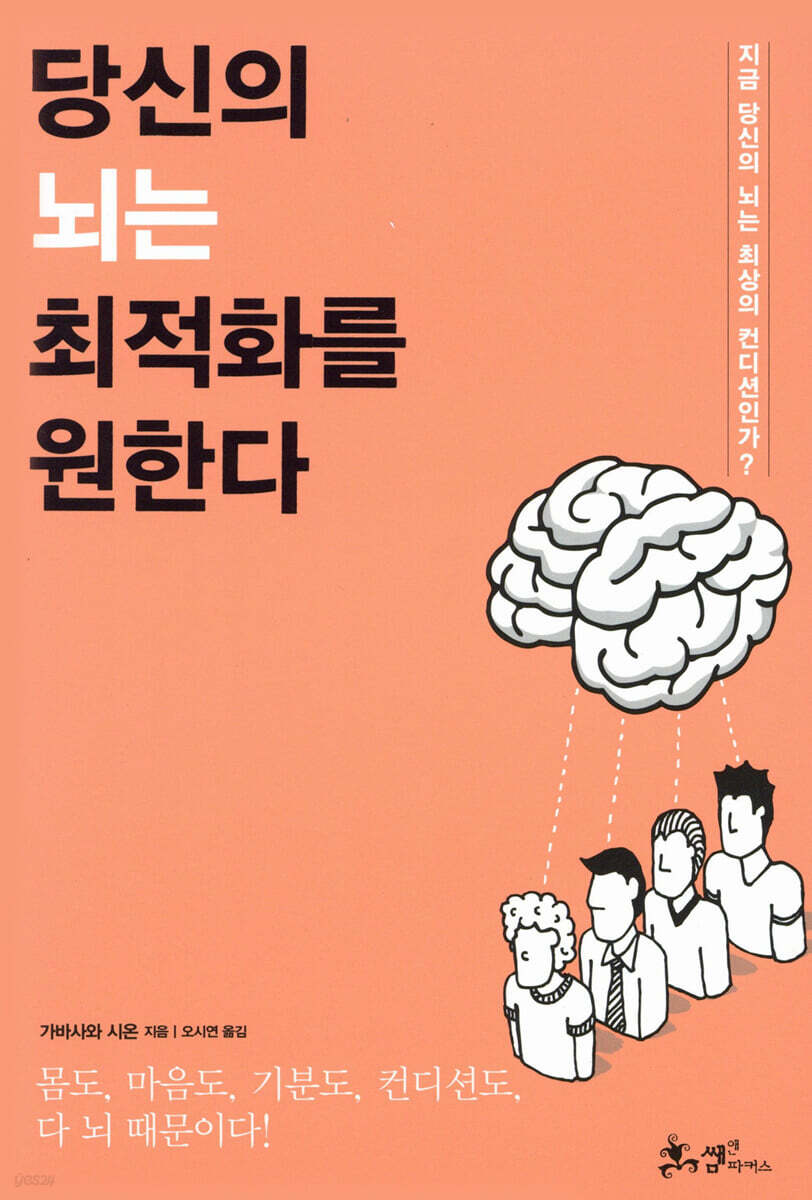 |
Description
Book Introduction
Is your brain in peak condition right now?
Specific practices to optimize seven brain hormones, including dopamine, serotonin, and melatonin.
Whether employed or self-employed, most of us rely on our brains to make a living. Yet, perhaps we're so ignorant of our brains that we overwork them without even realizing it. This book explores the functions and roles of seven key neurotransmitters in our brains, including dopamine, adrenaline, and serotonin. It also details lifestyle, eating habits, and work styles that can be switched on and off as needed.
If you want to regain your motivation, passion, and happiness, dopamine / When you need concentration, memory, and accuracy, norepinephrine / When you need to immerse yourself, adrenaline / When you are stressed to the tips of your hair, serotonin / When your body and mind are like wet cotton due to chronic fatigue, melatonin / When you need a brilliant idea, acetylcholine / When you want to relax your body and mind, endorphin. What substance do you need most right now? This book suggests specific practices to 'optimize' the seven brain hormones according to the reader's situation.
Specific practices to optimize seven brain hormones, including dopamine, serotonin, and melatonin.
Whether employed or self-employed, most of us rely on our brains to make a living. Yet, perhaps we're so ignorant of our brains that we overwork them without even realizing it. This book explores the functions and roles of seven key neurotransmitters in our brains, including dopamine, adrenaline, and serotonin. It also details lifestyle, eating habits, and work styles that can be switched on and off as needed.
If you want to regain your motivation, passion, and happiness, dopamine / When you need concentration, memory, and accuracy, norepinephrine / When you need to immerse yourself, adrenaline / When you are stressed to the tips of your hair, serotonin / When your body and mind are like wet cotton due to chronic fatigue, melatonin / When you need a brilliant idea, acetylcholine / When you want to relax your body and mind, endorphin. What substance do you need most right now? This book suggests specific practices to 'optimize' the seven brain hormones according to the reader's situation.
- You can preview some of the book's contents.
Preview
index
To begin with - Is your brain in peak condition right now?
It's not because of the body, it's because of the brain
7 Miracle Substances That Will Change Your Life
1.
Dopamine, the happiness chemical of motivation and passion
When you get a reward, your brain dances too.
7 Steps to Achieving Your Goals That Will Make You Bulge in Happiness
The mechanism by which motivation, passion, and enthusiasm arise
Could a little change in the way you work make you happier?
Dopamine-boosting lifestyle habits that maximize "everyday happiness" after work
2.
When you need to boost your concentration and memory - norepinephrine
Why Moderate Tension Is Essential
Ultimate concentration! A one-hit reversal is possible.
What if we shared norepinephrine and dopamine?
Could my memory loss be due to depression?
Figure out how to get enough rest and regulate your norepinephrine levels.
3.
When you need physical strength and immersive energy - adrenaline
Anger, an all too familiar state of mind
Boost your physical abilities with adrenaline
Let's learn how to turn it on and off
Tension and anxiety can be controlled
4.
Serotonin - a healing substance that reduces stress
Early risers produce more serotonin.
Serotonin Mood Booster to Relieve Work Stress
How to Boost Empathy by Boosting Serotonin
How to Activate Serotonin in Everyday Life
Scary Symptoms Caused by Serotonin Deficiency
5.
Melatonin, the sleep-enhancing substance that recharges you completely
What makes someone who falls asleep quickly different?
7 Habits for a Good Night's Sleep
Melatonin, the anti-aging agent
6.
When you need inspiration and ideas - Acetylcholine
The mindset of "let's just give it a try" creates motivation.
Different jobs are suitable for different time zones.
The special lifestyle habits of people who get inspired while sleeping
Acetylcholine Lifestyle Habits That Spark Inspiration
7.
Endorphins: The Brain Drug That Doubles Your Efficiency
Why superhuman strength is demonstrated in extreme situations
Thanks to the quiet healing substance endorphin.
Simultaneously release dopamine and endorphins through 'pleasure stimulation'
Endorphins Deliver 'Best Focus'
Gratitude takes you to higher ground.
The Amazing Changes That Happen When You Optimize Your Brain
References
It's not because of the body, it's because of the brain
7 Miracle Substances That Will Change Your Life
1.
Dopamine, the happiness chemical of motivation and passion
When you get a reward, your brain dances too.
7 Steps to Achieving Your Goals That Will Make You Bulge in Happiness
The mechanism by which motivation, passion, and enthusiasm arise
Could a little change in the way you work make you happier?
Dopamine-boosting lifestyle habits that maximize "everyday happiness" after work
2.
When you need to boost your concentration and memory - norepinephrine
Why Moderate Tension Is Essential
Ultimate concentration! A one-hit reversal is possible.
What if we shared norepinephrine and dopamine?
Could my memory loss be due to depression?
Figure out how to get enough rest and regulate your norepinephrine levels.
3.
When you need physical strength and immersive energy - adrenaline
Anger, an all too familiar state of mind
Boost your physical abilities with adrenaline
Let's learn how to turn it on and off
Tension and anxiety can be controlled
4.
Serotonin - a healing substance that reduces stress
Early risers produce more serotonin.
Serotonin Mood Booster to Relieve Work Stress
How to Boost Empathy by Boosting Serotonin
How to Activate Serotonin in Everyday Life
Scary Symptoms Caused by Serotonin Deficiency
5.
Melatonin, the sleep-enhancing substance that recharges you completely
What makes someone who falls asleep quickly different?
7 Habits for a Good Night's Sleep
Melatonin, the anti-aging agent
6.
When you need inspiration and ideas - Acetylcholine
The mindset of "let's just give it a try" creates motivation.
Different jobs are suitable for different time zones.
The special lifestyle habits of people who get inspired while sleeping
Acetylcholine Lifestyle Habits That Spark Inspiration
7.
Endorphins: The Brain Drug That Doubles Your Efficiency
Why superhuman strength is demonstrated in extreme situations
Thanks to the quiet healing substance endorphin.
Simultaneously release dopamine and endorphins through 'pleasure stimulation'
Endorphins Deliver 'Best Focus'
Gratitude takes you to higher ground.
The Amazing Changes That Happen When You Optimize Your Brain
References
Detailed image

Into the book
Is it really possible to "overcome with mental fortitude" or "give it your all until the end"? Contrary to the hopes of those who emphasize mental fortitude, suppressing unpleasant emotions while working actually releases "norepinephrine."
Because the brain is programmed to unconsciously avoid unpleasant feelings, even if you muster up your 'mental power' or 'mindset' to continue doing unpleasant things, your work efficiency will never increase.
Rather, if you continue to do things you don't want to do for months, you will only become more and more stressed and your physical and mental health will deteriorate.
The brain-damaging work style is like stepping on the accelerator while applying the side brake in a car.
But what if we could get our brains to naturally secrete dopamine? This would improve motivation, work efficiency, learning ability, and memory.
In other words, if you make even a small change to your lifestyle or work style, dopamine will be secreted and your work ability will improve significantly.
Dopamine isn't the only thing that does this.
Knowing what 'brain substance' is best suited to and essential for the work I do, and utilizing it, will increase work efficiency and minimize stress.
Without harming your health or falling into depression through forced effort.
--- p.
12
To cut to the chase, dopamine is secreted when you achieve your goals.
When something goes well and I feel a sense of accomplishment, thinking, 'I did it!', dopamine is secreted and we feel happy.
For reference, dopamine is secreted from the moment you set a goal or plan.
This is why setting goals excites and motivates us.
If you're struggling because you lack motivation, be sure to try the dopamine-releasing methods I'll introduce below.
Therefore, to motivate the brain, you need to consciously reward it.
The relationship between reward and dopamine secretion is a cycle, as shown in the figure in the next chapter.
As a result, action and pleasure are linked.
The brain remembers that performing a certain action will bring about pleasure.
And then we repeat the same behavior again to get the same pleasure again.
Moreover, in the second act, they 'research' to obtain greater pleasure than before.
As a result, you get greater pleasure.
Then, the third time, you study and act harder to get a greater pleasure than the second time.
If you repeat this creative research to get pleasure, you will naturally learn a lot.
Of course, that person develops more and more.
This series of cycles is called dopamine's 'reinforcement learning'.
--- p.
31
If a boss occasionally harshly reprimands a subordinate for a mistake, the subordinate will listen to the boss's words with both body and mind tense.
But what if you just scold them every day? Your subordinates will think, "Here we go again..." and that's the end of it.
On the outside, he listens quietly, but he says, 'Oh, I'm bored.
I think, 'I should just let it go, no matter what.'
This way, norepinephrine's way of working is easy to get used to.
Even in sports, when a coach of the type called a "master" or "strongman" is brought in to help a weak team rise, they show dazzling results for the first year or two.
But it soon loses its momentum.
If you give strict guidance, such as yelling, it will increase the tension in the entire team and the players will focus more on practice.
It's a noradrenaline type motivation.
But if it continues for a long time, you get used to it and it doesn't have the same effect as the first time.
Players start to tire, and the criticism that was supposed to 'motivate' them instead causes 'lethargy'.
Many people are resistant to the idea of “going down to the countryside and working your ass off for a year” because they instinctively know that noradrenaline-type motivation does not last long.
--- p.
81
From a neuroscientific perspective, depression refers to a state in which norepinephrine or serotonin has depleted.
Norepinephrine, which is secreted when you are stressed, continues to be released when you are stressed at work or at home.
If this condition persists, norepinephrine will eventually run out.
Long-term exposure to stress can leave you stuck in a low serotonin state.
However, there is a limit to the speed at which serotonin and norepinephrine are produced.
If the state of secretion (consumption) exceeding the amount produced continues for a long period of time, it will eventually reach the bottom.
And if the state of depression persists, the speed at which norepinephrine and serotonin are produced slows down, making them more easily depleted.
Chronic stress affects both norepinephrine and serotonin.
There are individual differences in the production and secretion of substances within the brain.
Even if they work in the same workplace and experience the same level of stress, some people secrete norepinephrine and serotonin smoothly, while others do not.
Even in a workplace where people are easily stressed by the workload, some people suffer from depression, while others are barely affected.
It is natural that there are individual differences.
If you get depressed in such a workplace, you will be labeled as a 'bad person' or a 'lazy person' by your boss.
It's a really strange story, to think that there's even a job.
--- p.
94
Fortunately, the three-day holiday period has been extended thanks to the alternative holiday system.
One night, at a party held the night before a three-day holiday, I heard an entrepreneur say, "Aren't there too many holidays these days? I love working, so I want to work more."
I absolutely cannot agree with his idea.
He seems to think that people who really enjoy their work will not get depressed no matter how much they work, but he is wrong.
Because there is no good or bad about stress.
My friend B was also a voluntary workaholic.
During the week, I worked overtime every day as a matter of course, and I went to work without fail even on holidays.
In a word, it was a life of 'work supremacy'.
Every time I met B, I would advise him, “You should at least rest on the weekends,” but all he would say in return was, “I really like working.
All I could say was, “Every day is fun, so I have no stress at all!”
There was no separate wind blowing from the east.
I thought I hadn't heard from B for a while, but then one day I heard that he had been admitted to a psychiatric hospital.
It was depression.
Any mental tension, whether good or bad, is stress.
The important thing here is to secure ‘relaxation time’ to be free from stress.
Since norepinephrine is not secreted during that time, norepinephrine can be produced normally.
When working, you must be conscious of the 'speed'.
When I work, I focus hard, and when I'm not working, I rest well or play to my heart's content.
By providing this recharge time, you can prevent the tension cord that is pulled tight from snapping or stretching completely, leaving you in a state where norepinephrine continues to flow out.
--- p.
98
You may have seen on TV hammer throwers roaring before throwing the hammer.
Not only hammer throwers, but also many javelin and discus throwers shout loudly before throwing.
Why is that? Many people might think it's for psychological reasons, like "to build up motivation," but that's not actually the case.
This is to secrete adrenaline.
When you scream loudly, your brain is stimulated and adrenaline is secreted.
This 'shouting effect' has also been demonstrated in experiments.
Shouting is also used in other sports.
For example, in a volleyball game, players shout "Fighting!" right before the game ends or when the game restarts after a timeout.
Even in baseball games, cheers are given before the game starts to raise the spirits and promote unity.
Even martial arts and kendo athletes shout to instill their spirit before or during an attack.
It provides psychological unity through adrenaline while strengthening the muscles.
It is to make it rise.
Even when working, I often shout 'Fighting!' before starting a large project.
Although office workers don't use much physical strength, adrenaline also improves concentration and judgment.
Activating adrenaline through shouting is also effective at work.
However, you have to shout quite loudly to get the adrenaline flowing.
Just like athletes, you need to let out a 'roar' that surges from your stomach to release adrenaline.
So, if you are going to shout, you should shout loudly, as if you are squeezing your stomach.
Then you can get the effect of adrenaline secretion.
--- p.
112
It is a relatively well-known fact that brain waves called 'alpha waves' are produced when one is in a psychologically comfortable state.
However, among brain waves, there is also a type of brain wave called ‘Sitter wave’.
While alpha waves have a frequency of 9-12 Hz, Sitter waves have a frequency of 4-7 Hz.
In other words, sitter waves are brain waves that occur in a nodding state before entering sleep, a state of deep meditation, or a state of light dozing, with wavelengths that are slightly slower than alpha waves.
The synaptic cleft is closely related to acetylcholine.
This is because acetylcholine stimulates the hippocampus to emit Cisterna waves.
The hippocampus generates Cisterna waves on its own, but when activated by acetylcholine, it produces more Cisterna waves and synapses (connections between nerves) are more easily connected.
When synapses are easily connected, memories are easily established.
It is said that 'when synapses are connected, brilliant ideas come out', but this could also be rephrased as 'when synapses are connected, brilliant ideas come out'.
In other words, there is a correlation of ‘acetylcholine secretion → generation of Cistern waves in the hippocampus → improved memory and creative thinking ability.’
This means that if you can secrete acetylcholine smoothly and generate Citrine waves, your memory will be strengthened and you will be able to come up with excellent ideas.
In addition to taking a nap, other ways to stimulate sitter waves include 'stimulating curiosity', 'going outside', and 'moving your hands and feet while sitting'.
--- p.
212
The book "Swedish Idea Book" introduces "four places where ideas are easily generated."
Bar, bathroom, bus, bed.
The initials of each are called '4Bs of Creativity'.
all.
Ideas don't just come to you when you sit at your desk and think deeply.
Rather, it comes to me in moments of relaxation or in a daze when I am not thinking about anything.
The place that provides such psychological relaxation is the '4Bs of Creativity'.
I 100% agree that great ideas come easily in situations like when you're slightly tipsy at a bar, when you're comfortably soaking in a bathtub, when you're riding a bus or subway, or when you're about to fall asleep or while you're sleeping.
Wasn't it in a bathtub that Archimedes discovered his principle? I've also had many interesting ideas come to me while watching advertisements or observing people on the subway.
These '4Bs of Creativity' can be rephrased as '4Bs of Sitterism'.
All four locations are places where citrus waves are likely to emerge and places where acetylcholine is likely to emerge.
When you have to write a proposal due tomorrow, many people sit at their desks, thinking hard, or lock themselves in a conference room and argue fiercely.
But as I said before, from a neuroscientific perspective, this type of activity is completely counterproductive.
Of course, it is necessary to input the source of inspiration.
This means reading a lot of material or refining an idea with minimal debate.
But the really important ideas come from far away from desks and conference rooms.
--- p.
214
It has also been said that endorphins are secreted even in extreme stressful situations, but in fact, they are secreted even in situations where they are not.
It is the moment when you feel 'I have been healed' and 'I have relaxed.'
A good example of healing is contact with a pet.
Many people feel a sense of peace the moment they come home from work and meet their dog or cat.
One study found that when dog owners engage in intimate contact with their dogs, such as touching or petting them, endorphin levels in the blood of both the person and the dog increase.
When your body and mind are relaxed, alpha waves flow smoothly from your brain.
When alpha waves are released, endorphins are secreted.
Endorphins are secreted not only in stressful situations but also when we are relaxed.
Endorphins, which have a healing aspect, are secreted to relieve excessive stress.
On the contrary, the mind
It is secreted even in this state of calm relaxation.
It may seem odd that both are secreted in opposite situations, but the purpose is the same.
Endorphins give you a feeling of happiness.
It gives the brain a rest and improves various brain functions such as concentration, memory, and creativity.
When you meditate or sit in meditation, clear alpha waves are produced.
Meditation calms and soothes the mind
It allows you to increase your concentration and attention, clear your mind, and sometimes even come up with great ideas.
This is the state where endorphins are released.
In other words, this is the moment when you experience the healing and brain activation effects of endorphins.
Endorphins not only have a relaxing effect on the mind, but also have the effect of strengthening the immune system and increasing the body's ability to recover.
In addition, it has an anticancer effect, that is, it increases the activity of NK cells, which are responsible for the immune function of fighting cancer.
It heals not only the mind but also the body.
Endorphins, along with melatonin, can be called the 'best healing substances'.
Melatonin has a healing effect related to sleep, and endorphins have a healing effect related to relaxation.
Because the brain is programmed to unconsciously avoid unpleasant feelings, even if you muster up your 'mental power' or 'mindset' to continue doing unpleasant things, your work efficiency will never increase.
Rather, if you continue to do things you don't want to do for months, you will only become more and more stressed and your physical and mental health will deteriorate.
The brain-damaging work style is like stepping on the accelerator while applying the side brake in a car.
But what if we could get our brains to naturally secrete dopamine? This would improve motivation, work efficiency, learning ability, and memory.
In other words, if you make even a small change to your lifestyle or work style, dopamine will be secreted and your work ability will improve significantly.
Dopamine isn't the only thing that does this.
Knowing what 'brain substance' is best suited to and essential for the work I do, and utilizing it, will increase work efficiency and minimize stress.
Without harming your health or falling into depression through forced effort.
--- p.
12
To cut to the chase, dopamine is secreted when you achieve your goals.
When something goes well and I feel a sense of accomplishment, thinking, 'I did it!', dopamine is secreted and we feel happy.
For reference, dopamine is secreted from the moment you set a goal or plan.
This is why setting goals excites and motivates us.
If you're struggling because you lack motivation, be sure to try the dopamine-releasing methods I'll introduce below.
Therefore, to motivate the brain, you need to consciously reward it.
The relationship between reward and dopamine secretion is a cycle, as shown in the figure in the next chapter.
As a result, action and pleasure are linked.
The brain remembers that performing a certain action will bring about pleasure.
And then we repeat the same behavior again to get the same pleasure again.
Moreover, in the second act, they 'research' to obtain greater pleasure than before.
As a result, you get greater pleasure.
Then, the third time, you study and act harder to get a greater pleasure than the second time.
If you repeat this creative research to get pleasure, you will naturally learn a lot.
Of course, that person develops more and more.
This series of cycles is called dopamine's 'reinforcement learning'.
--- p.
31
If a boss occasionally harshly reprimands a subordinate for a mistake, the subordinate will listen to the boss's words with both body and mind tense.
But what if you just scold them every day? Your subordinates will think, "Here we go again..." and that's the end of it.
On the outside, he listens quietly, but he says, 'Oh, I'm bored.
I think, 'I should just let it go, no matter what.'
This way, norepinephrine's way of working is easy to get used to.
Even in sports, when a coach of the type called a "master" or "strongman" is brought in to help a weak team rise, they show dazzling results for the first year or two.
But it soon loses its momentum.
If you give strict guidance, such as yelling, it will increase the tension in the entire team and the players will focus more on practice.
It's a noradrenaline type motivation.
But if it continues for a long time, you get used to it and it doesn't have the same effect as the first time.
Players start to tire, and the criticism that was supposed to 'motivate' them instead causes 'lethargy'.
Many people are resistant to the idea of “going down to the countryside and working your ass off for a year” because they instinctively know that noradrenaline-type motivation does not last long.
--- p.
81
From a neuroscientific perspective, depression refers to a state in which norepinephrine or serotonin has depleted.
Norepinephrine, which is secreted when you are stressed, continues to be released when you are stressed at work or at home.
If this condition persists, norepinephrine will eventually run out.
Long-term exposure to stress can leave you stuck in a low serotonin state.
However, there is a limit to the speed at which serotonin and norepinephrine are produced.
If the state of secretion (consumption) exceeding the amount produced continues for a long period of time, it will eventually reach the bottom.
And if the state of depression persists, the speed at which norepinephrine and serotonin are produced slows down, making them more easily depleted.
Chronic stress affects both norepinephrine and serotonin.
There are individual differences in the production and secretion of substances within the brain.
Even if they work in the same workplace and experience the same level of stress, some people secrete norepinephrine and serotonin smoothly, while others do not.
Even in a workplace where people are easily stressed by the workload, some people suffer from depression, while others are barely affected.
It is natural that there are individual differences.
If you get depressed in such a workplace, you will be labeled as a 'bad person' or a 'lazy person' by your boss.
It's a really strange story, to think that there's even a job.
--- p.
94
Fortunately, the three-day holiday period has been extended thanks to the alternative holiday system.
One night, at a party held the night before a three-day holiday, I heard an entrepreneur say, "Aren't there too many holidays these days? I love working, so I want to work more."
I absolutely cannot agree with his idea.
He seems to think that people who really enjoy their work will not get depressed no matter how much they work, but he is wrong.
Because there is no good or bad about stress.
My friend B was also a voluntary workaholic.
During the week, I worked overtime every day as a matter of course, and I went to work without fail even on holidays.
In a word, it was a life of 'work supremacy'.
Every time I met B, I would advise him, “You should at least rest on the weekends,” but all he would say in return was, “I really like working.
All I could say was, “Every day is fun, so I have no stress at all!”
There was no separate wind blowing from the east.
I thought I hadn't heard from B for a while, but then one day I heard that he had been admitted to a psychiatric hospital.
It was depression.
Any mental tension, whether good or bad, is stress.
The important thing here is to secure ‘relaxation time’ to be free from stress.
Since norepinephrine is not secreted during that time, norepinephrine can be produced normally.
When working, you must be conscious of the 'speed'.
When I work, I focus hard, and when I'm not working, I rest well or play to my heart's content.
By providing this recharge time, you can prevent the tension cord that is pulled tight from snapping or stretching completely, leaving you in a state where norepinephrine continues to flow out.
--- p.
98
You may have seen on TV hammer throwers roaring before throwing the hammer.
Not only hammer throwers, but also many javelin and discus throwers shout loudly before throwing.
Why is that? Many people might think it's for psychological reasons, like "to build up motivation," but that's not actually the case.
This is to secrete adrenaline.
When you scream loudly, your brain is stimulated and adrenaline is secreted.
This 'shouting effect' has also been demonstrated in experiments.
Shouting is also used in other sports.
For example, in a volleyball game, players shout "Fighting!" right before the game ends or when the game restarts after a timeout.
Even in baseball games, cheers are given before the game starts to raise the spirits and promote unity.
Even martial arts and kendo athletes shout to instill their spirit before or during an attack.
It provides psychological unity through adrenaline while strengthening the muscles.
It is to make it rise.
Even when working, I often shout 'Fighting!' before starting a large project.
Although office workers don't use much physical strength, adrenaline also improves concentration and judgment.
Activating adrenaline through shouting is also effective at work.
However, you have to shout quite loudly to get the adrenaline flowing.
Just like athletes, you need to let out a 'roar' that surges from your stomach to release adrenaline.
So, if you are going to shout, you should shout loudly, as if you are squeezing your stomach.
Then you can get the effect of adrenaline secretion.
--- p.
112
It is a relatively well-known fact that brain waves called 'alpha waves' are produced when one is in a psychologically comfortable state.
However, among brain waves, there is also a type of brain wave called ‘Sitter wave’.
While alpha waves have a frequency of 9-12 Hz, Sitter waves have a frequency of 4-7 Hz.
In other words, sitter waves are brain waves that occur in a nodding state before entering sleep, a state of deep meditation, or a state of light dozing, with wavelengths that are slightly slower than alpha waves.
The synaptic cleft is closely related to acetylcholine.
This is because acetylcholine stimulates the hippocampus to emit Cisterna waves.
The hippocampus generates Cisterna waves on its own, but when activated by acetylcholine, it produces more Cisterna waves and synapses (connections between nerves) are more easily connected.
When synapses are easily connected, memories are easily established.
It is said that 'when synapses are connected, brilliant ideas come out', but this could also be rephrased as 'when synapses are connected, brilliant ideas come out'.
In other words, there is a correlation of ‘acetylcholine secretion → generation of Cistern waves in the hippocampus → improved memory and creative thinking ability.’
This means that if you can secrete acetylcholine smoothly and generate Citrine waves, your memory will be strengthened and you will be able to come up with excellent ideas.
In addition to taking a nap, other ways to stimulate sitter waves include 'stimulating curiosity', 'going outside', and 'moving your hands and feet while sitting'.
--- p.
212
The book "Swedish Idea Book" introduces "four places where ideas are easily generated."
Bar, bathroom, bus, bed.
The initials of each are called '4Bs of Creativity'.
all.
Ideas don't just come to you when you sit at your desk and think deeply.
Rather, it comes to me in moments of relaxation or in a daze when I am not thinking about anything.
The place that provides such psychological relaxation is the '4Bs of Creativity'.
I 100% agree that great ideas come easily in situations like when you're slightly tipsy at a bar, when you're comfortably soaking in a bathtub, when you're riding a bus or subway, or when you're about to fall asleep or while you're sleeping.
Wasn't it in a bathtub that Archimedes discovered his principle? I've also had many interesting ideas come to me while watching advertisements or observing people on the subway.
These '4Bs of Creativity' can be rephrased as '4Bs of Sitterism'.
All four locations are places where citrus waves are likely to emerge and places where acetylcholine is likely to emerge.
When you have to write a proposal due tomorrow, many people sit at their desks, thinking hard, or lock themselves in a conference room and argue fiercely.
But as I said before, from a neuroscientific perspective, this type of activity is completely counterproductive.
Of course, it is necessary to input the source of inspiration.
This means reading a lot of material or refining an idea with minimal debate.
But the really important ideas come from far away from desks and conference rooms.
--- p.
214
It has also been said that endorphins are secreted even in extreme stressful situations, but in fact, they are secreted even in situations where they are not.
It is the moment when you feel 'I have been healed' and 'I have relaxed.'
A good example of healing is contact with a pet.
Many people feel a sense of peace the moment they come home from work and meet their dog or cat.
One study found that when dog owners engage in intimate contact with their dogs, such as touching or petting them, endorphin levels in the blood of both the person and the dog increase.
When your body and mind are relaxed, alpha waves flow smoothly from your brain.
When alpha waves are released, endorphins are secreted.
Endorphins are secreted not only in stressful situations but also when we are relaxed.
Endorphins, which have a healing aspect, are secreted to relieve excessive stress.
On the contrary, the mind
It is secreted even in this state of calm relaxation.
It may seem odd that both are secreted in opposite situations, but the purpose is the same.
Endorphins give you a feeling of happiness.
It gives the brain a rest and improves various brain functions such as concentration, memory, and creativity.
When you meditate or sit in meditation, clear alpha waves are produced.
Meditation calms and soothes the mind
It allows you to increase your concentration and attention, clear your mind, and sometimes even come up with great ideas.
This is the state where endorphins are released.
In other words, this is the moment when you experience the healing and brain activation effects of endorphins.
Endorphins not only have a relaxing effect on the mind, but also have the effect of strengthening the immune system and increasing the body's ability to recover.
In addition, it has an anticancer effect, that is, it increases the activity of NK cells, which are responsible for the immune function of fighting cancer.
It heals not only the mind but also the body.
Endorphins, along with melatonin, can be called the 'best healing substances'.
Melatonin has a healing effect related to sleep, and endorphins have a healing effect related to relaxation.
--- p.
246
246
Publisher's Review
It's a wonder my brain, which has been worked so hard today, is still intact?
Office worker A squeezes his brain juices out every day by writing plans for idea meetings, competing in PT, etc.
I drink or work overtime three days a week, and my mood and condition are always terrible on the way home from work.
Once I get home, I eat something, take a hot shower, and go straight to bed, but my mind is wide awake.
I habitually scroll through social media, then fall asleep on the sofa with the TV on and my smartphone in my hand… .
One morning when the alarm rings and I can't wake up, I go to work in a daze, as if I didn't even sleep, and pour myself an Americano with three shots, but I still can't come to my senses.
These days, living on the power of nicotine and caffeine during the day and the power of alcohol at night, Mr. A has become increasingly irritable, lethargic, and has lost concentration.
Because I keep forgetting things and making ridiculous mistakes, I get scared and nervous about even the smallest things.
What is this feeling of being 'dead-as-nails'? Could something be seriously wrong?
Body, mind, mood, and condition are all due to the brain!
My mind is listless, distracted, and dazed. Can't I 'optimize' it like putting together a piece of scrapbook?
To us who live such difficult lives, both physically and mentally, psychiatrist Shion Gabasawa warns us as follows:
"Lifestyle habits that torment the brain so much? The way we work is like stepping on the accelerator while applying the side brake in a car." Whether we are employed or self-employed, most of us live off our "brains," yet aren't we overworking them so carelessly because we don't know enough about them? This book introduces the functions and roles of seven representative "neurotransmitters" in our brains, such as dopamine, adrenaline, and serotonin, and explains in detail the lifestyle, eating habits, and work styles that can be turned on and off like a switch as needed.
If you want to regain your motivation, passion, and happiness, dopamine / When you need concentration, memory, and accuracy, norepinephrine / When you need to immerse yourself, adrenaline / When you are stressed to the tips of your hair, serotonin / When your body and mind are like wet cotton due to chronic fatigue, melatonin / When you need a brilliant idea, acetylcholine / When you want to relax your body and mind, endorphin. What substance do you need most right now? This book suggests specific practices to 'optimize' the seven brain hormones according to the reader's situation.
Is your brain in peak condition right now?
How to Maximize Your Mood, Condition, and Performance with 7 Miracle Substances
o Serotonin - Mentally count 'one, two, one, two' while walking or climbing stairs, walk for more than 10 minutes before eating lunch, read aloud, do deep breathing, neck rotation exercises, and raise your body temperature with a morning shower.
o Melatonin - Keep your bedroom completely dark, and avoid fluorescent lights, smartphones, and computers before bed.
Get some sun in the morning.
o Endorphins - contact with pets, spicy foods? fatty foods? eating chocolate, bathing in water hotter than 40 degrees Celsius, acupuncture.
o Turn off your adrenaline switch - shower with water below 40 degrees, avoid working late, meet people unrelated to work, and avoid strenuous exercise in the evening.
Work is important, but the health of your body and mind comes first.
If you know the characteristics of the brain, you can look back on the lifestyle, eating habits, and work methods that have been abusing the brain.
By slightly changing the order of our tasks or adding even simple lifestyle habits, we can work more efficiently, more happily, and less stressed.
Is your brain in peak condition right now? This book will be a valuable supplement to your brain, which struggles every day to generate more brilliant and brilliant ideas.
Office worker A squeezes his brain juices out every day by writing plans for idea meetings, competing in PT, etc.
I drink or work overtime three days a week, and my mood and condition are always terrible on the way home from work.
Once I get home, I eat something, take a hot shower, and go straight to bed, but my mind is wide awake.
I habitually scroll through social media, then fall asleep on the sofa with the TV on and my smartphone in my hand… .
One morning when the alarm rings and I can't wake up, I go to work in a daze, as if I didn't even sleep, and pour myself an Americano with three shots, but I still can't come to my senses.
These days, living on the power of nicotine and caffeine during the day and the power of alcohol at night, Mr. A has become increasingly irritable, lethargic, and has lost concentration.
Because I keep forgetting things and making ridiculous mistakes, I get scared and nervous about even the smallest things.
What is this feeling of being 'dead-as-nails'? Could something be seriously wrong?
Body, mind, mood, and condition are all due to the brain!
My mind is listless, distracted, and dazed. Can't I 'optimize' it like putting together a piece of scrapbook?
To us who live such difficult lives, both physically and mentally, psychiatrist Shion Gabasawa warns us as follows:
"Lifestyle habits that torment the brain so much? The way we work is like stepping on the accelerator while applying the side brake in a car." Whether we are employed or self-employed, most of us live off our "brains," yet aren't we overworking them so carelessly because we don't know enough about them? This book introduces the functions and roles of seven representative "neurotransmitters" in our brains, such as dopamine, adrenaline, and serotonin, and explains in detail the lifestyle, eating habits, and work styles that can be turned on and off like a switch as needed.
If you want to regain your motivation, passion, and happiness, dopamine / When you need concentration, memory, and accuracy, norepinephrine / When you need to immerse yourself, adrenaline / When you are stressed to the tips of your hair, serotonin / When your body and mind are like wet cotton due to chronic fatigue, melatonin / When you need a brilliant idea, acetylcholine / When you want to relax your body and mind, endorphin. What substance do you need most right now? This book suggests specific practices to 'optimize' the seven brain hormones according to the reader's situation.
Is your brain in peak condition right now?
How to Maximize Your Mood, Condition, and Performance with 7 Miracle Substances
o Serotonin - Mentally count 'one, two, one, two' while walking or climbing stairs, walk for more than 10 minutes before eating lunch, read aloud, do deep breathing, neck rotation exercises, and raise your body temperature with a morning shower.
o Melatonin - Keep your bedroom completely dark, and avoid fluorescent lights, smartphones, and computers before bed.
Get some sun in the morning.
o Endorphins - contact with pets, spicy foods? fatty foods? eating chocolate, bathing in water hotter than 40 degrees Celsius, acupuncture.
o Turn off your adrenaline switch - shower with water below 40 degrees, avoid working late, meet people unrelated to work, and avoid strenuous exercise in the evening.
Work is important, but the health of your body and mind comes first.
If you know the characteristics of the brain, you can look back on the lifestyle, eating habits, and work methods that have been abusing the brain.
By slightly changing the order of our tasks or adding even simple lifestyle habits, we can work more efficiently, more happily, and less stressed.
Is your brain in peak condition right now? This book will be a valuable supplement to your brain, which struggles every day to generate more brilliant and brilliant ideas.
GOODS SPECIFICS
- Date of issue: May 25, 2018
- Page count, weight, size: 276 pages | 468g | 145*214*21mm
- ISBN13: 9788965706342
- ISBN10: 8965706343
You may also like
카테고리
korean


korean

![GQ KOREA Mark (Monthly): December [2025]](http://librairie.coreenne.fr/cdn/shop/files/8ef265dbbfbf186523ed75ba7319009d.jpg?v=1765340328&width=3840)


