

Words in the picture
 |
Description
Book Introduction
“Becoming an adult means
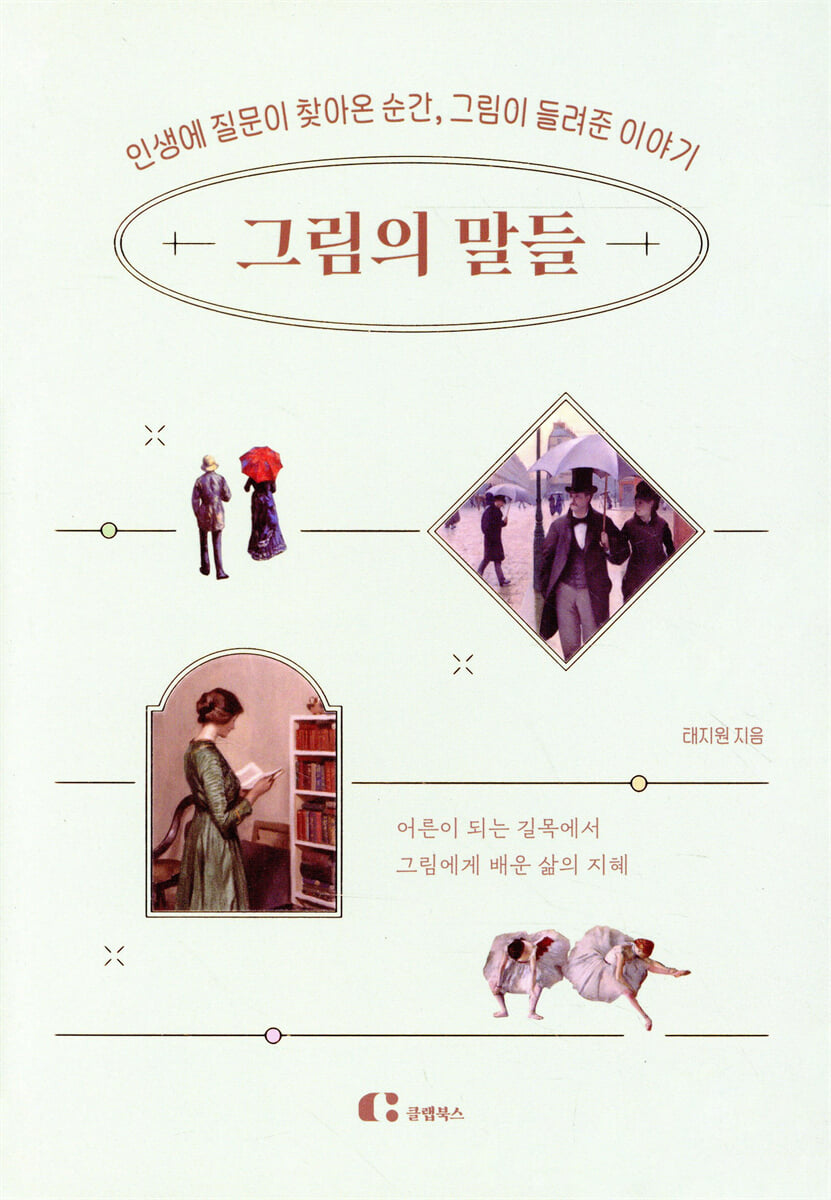
The difficult questions life poses “It is a process of constant confrontation and shaking!” To you who questions relationships, desires, and happiness Words spoken by characters in famous paintings The second masterpiece humanities essay, 『Words of Painting』, by Tae Ji-won, who writes weekly for Brunch under the pen name of 'Wandering Teacher' and won the grand prize in the 8th Brunch Book Publishing Project for the magazine 『A Night of Comforting Myself with Painting』, has been published. While both are similar in that they offer comfort and insight by looking at famous paintings and the lives of artists, this book focuses on finding answers to life's questions and moving forward while maintaining focus, unlike the previous work, which primarily dealt with the story of uncovering and embracing emotional wounds. The author introduces this book as “a book containing the wisdom of life learned from paintings on the path to adulthood.” Becoming an adult is a process of constantly facing and being shaken by the difficult questions life throws at you, and the artist says that he was able to find answers in his paintings at each such moment. He says that although it is impossible to be steadfast or detached from everything, he realized that the process of becoming an adult is to keep your center and move forward one step at a time even in the midst of uncertainty. He shares the 32 insights and wisdom he gained through his paintings in the hope that they will be of help to anyone who, like him, is wavering before the questions life poses. Talent, self-esteem, choices, relationships, burnout, stereotypes, desires, comparisons, evaluations, emotions, the gaze of others, choices, aging… . The questions that the writer faces in life are ones that everyone ponders at least once. As you read the author's writing, which provides essential advice by finding the perfect picture for various concerns, much like a "Drawing Counseling Center," you will also find answers to the problems you have been struggling with. |
- You can preview some of the book's contents.
Preview
index
prolog.
Pictures I encountered on the path to adulthood
Chapter 1.
Things to know when your heart wavers
Should I give up on my dreams because I lack talent?
How to Wait for Good Luck in Life
A Tale of Two Sisters, a Reinterpretation of Life
How to Deal with Lazy Perfectionism's Apathy
The art of editing that makes life shine
To avoid being swayed by other people's evaluations
So what if it's a bit of a hassle?
The fact that there is no one in the stands
Chapter 2.
If I want to get along well with myself
How to Live in a World That Promotes Self-Esteem
What you see when you take off your mask
The moment when you have to break the rules in your heart
If you're wondering if you're the only one who's abnormal
Can I change who I was born with?
Finding your balance in a society that encourages pretense
Being proud of your own desires
It's okay if it's not okay
Chapter 3.
A proper distance makes a relationship beautiful.
MBTI: The Beginning of Another Prejudice
Are there different levels of taste?
The fantasy of perfect relationships
One way to avoid becoming a jerk
The fact that no one lives for a playground
If you want to turn your wounds into love
How to overcome loneliness
Why Balance Sheets Are Necessary in Relationships
Chapter 4.
How to get back up even when you're tired and worn out
Hwayangyeonhwa isn't over yet
On a gloomy day, a gloomy hope
Don't let passion turn into burnout
Attitude toward coping with life's challenges
It's not that I'm weak, it's that I'm getting stronger.
The moment of choice, what we need
Don't let poverty swallow your head
The moment I said goodbye to the familiar me
References
Pictures I encountered on the path to adulthood
Chapter 1.
Things to know when your heart wavers
Should I give up on my dreams because I lack talent?
How to Wait for Good Luck in Life
A Tale of Two Sisters, a Reinterpretation of Life
How to Deal with Lazy Perfectionism's Apathy
The art of editing that makes life shine
To avoid being swayed by other people's evaluations
So what if it's a bit of a hassle?
The fact that there is no one in the stands
Chapter 2.
If I want to get along well with myself
How to Live in a World That Promotes Self-Esteem
What you see when you take off your mask
The moment when you have to break the rules in your heart
If you're wondering if you're the only one who's abnormal
Can I change who I was born with?
Finding your balance in a society that encourages pretense
Being proud of your own desires
It's okay if it's not okay
Chapter 3.
A proper distance makes a relationship beautiful.
MBTI: The Beginning of Another Prejudice
Are there different levels of taste?
The fantasy of perfect relationships
One way to avoid becoming a jerk
The fact that no one lives for a playground
If you want to turn your wounds into love
How to overcome loneliness
Why Balance Sheets Are Necessary in Relationships
Chapter 4.
How to get back up even when you're tired and worn out
Hwayangyeonhwa isn't over yet
On a gloomy day, a gloomy hope
Don't let passion turn into burnout
Attitude toward coping with life's challenges
It's not that I'm weak, it's that I'm getting stronger.
The moment of choice, what we need
Don't let poverty swallow your head
The moment I said goodbye to the familiar me
References
Detailed image

Into the book
As you pursue your dreams in any field, there are times when you begin to doubt your talents.
Because in each field, those with shining talents are bound to stand out.
If you define talent as a single, fixed, unchanging mass, you will end up comparing yourself to others around you.
Mental distress arises and anxiety arises.
So, shouldn't we look at the scope and spectrum of the word talent more broadly?
Before judging yourself by whether you have talent or not.
---From "Should I give up on my dreams because I have no talent?"
The moment you focus on a small task with a devout mind, that moment of stillness brings peace of mind.
Most of the times when I've been lazy and lethargic, it's because I've forgotten the importance of those little moments.
Apathy often comes when you want to achieve something great but are afraid of failure.
I felt confused by the thought that it would be difficult to achieve the results I had hoped for, and I also felt helpless as I lost the direction of my life.
After organizing my thoughts, I realized that there was a key to bringing the direction of my life back to me.
---From "How to Deal with Apathy as a Lazy Perfectionist"
Looking back at Rousseau's story, we can see that the artist built his own world, contrary to what others thought.
The evaluation of others constantly tests me.
This testing ground is not a space where I have the initiative.
If you can't completely free yourself from this space, if you're swayed by even the slightest criticism from others, one way is to create a new testing ground where you take the initiative.
---From "How to avoid being swayed by others' evaluations"
Looking at Lautrec's self-portrait, I think about self-esteem.
Let go of the distorted lenses that reduce or enlarge reality, and look at and accept reality as it is.
Isn't this something we should do before we exaggerate the slogan "Love me" or fall into self-loathing?
(Omitted) After realizing this fact, I started focusing on ‘building realistic expectations’ rather than ‘raising self-esteem.’
I felt better after letting go of the obsession that I must be unique, special, and valuable in the world.
---From "How to Live in a World That Promotes Self-Esteem"
What happens when we label something we are born with as a 'bad trait' and hide behind it?
When I spend time and energy hating my temperament, I have less energy left over for the things I want to do.
Sometimes, we use our negative temperament as an excuse to avoid taking on new challenges.
Because my mind and actions are not natural, I sometimes get tired easily.
Since I can't live as myself, it's hard to feel happiness as myself.
So, it would be good to consider the merits of being born this way at least once.
It takes practice to interpret your innate temperament in a positive way.
---From "Can I Change My Innate Self?"
Looking at Duchamp's work, you realize how important a question mark (?) that comes after critical thinking is, rather than an exclamation mark (!) that accepts and admires something without thinking.
Surprisingly, many people accept without much criticism the logic of those who are considered mainstream or possess intellectual authority.
A similar situation repeats itself in the private realm of personal taste.
There seems to be a stereotype in our society about what tastes are appropriate for a certain age group.
There is a mindset that you should like certain types of music depending on your age, such as in your teens, twenties, or thirties, and that you should pursue music that is considered more mature and serious as you age.
Are the stereotypes that growing older necessarily comes with "maturity" and "seriousness," and the prejudice that a certain age group must like a certain culture to be considered normal, justifiable ways of thinking?
---From "Are there different levels of taste?"
Even in an intimate relationship, one cannot become completely one.
For example, spouses who meet as adults are bound to have different temperaments, tastes, and upbringings.
The same goes for the relationship between parents and children.
Parents may have grown up in their own unique era and background, but their children grew up in a different environment.
Even siblings who grew up together under the same parents are bound to have different ways of thinking and attitudes toward life due to their different birth order and temperaments.
We often forget this fact and invade each other's territories, hoping that your heart and mine will be the same.
This results in giving and receiving hurt.
---From "The Illusion of Perfect Human Relationships"
Diego's "The Flower Girl" makes us think about the responsibility and suffering that humans must bear in life.
There is no way for others to easily judge that weight.
The lives of others, whom we envy, are scenes we see rarely from afar.
It's easy to think of our own lives as shabby, just as we think of other people's lives as flower songs.
Feelings of inferiority and self-loathing are bound to follow.
It is dangerous to judge someone's life from a distance.
---From "The fact that there is no one for whom life is a playground"
Looking at Larsson's paintings, I realize:
That while childhood experiences may crumple one end of your life, they don't completely destroy it.
It won't be a mess that's beyond recovery.
There will be countless trials and failures, and it will require painful efforts, but there will always be an option that overcomes them.
It is relatively easy to choose cynicism, ridicule, inferiority complex, and projection of hurt.
But instead of this option, you can also choose words like love, warmth, warmth or happiness.
---From "If you want to turn wounds into love"
It is clear that 'sacrifice' is a beautiful word.
However, sacrifices that are not made voluntarily but are made at the unilateral request of one party only leave the sacrificer with resentment later on.
If one party must constantly give something to the other to maintain the relationship, it is not an intimate relationship, but rather an exploitative relationship.
If you ever feel resentment creeping into your relationship, it's time to take a look at your relationship balance sheet.
---From "Why a Balance Sheet is Needed in Human Relationships"
The eyes of the weary people in Hodler's work contain emptiness.
Where does emptiness come from?
It often comes when you lose your clear direction in life.
It is important to set a specific goal and move forward to achieve it.
But as we run towards our destination, we sometimes make mistakes.
I narrow my vision and whip myself like a horse running with both eyes covered.
This is the moment when progress toward a goal degenerates into blind running.
Because in each field, those with shining talents are bound to stand out.
If you define talent as a single, fixed, unchanging mass, you will end up comparing yourself to others around you.
Mental distress arises and anxiety arises.
So, shouldn't we look at the scope and spectrum of the word talent more broadly?
Before judging yourself by whether you have talent or not.
---From "Should I give up on my dreams because I have no talent?"
The moment you focus on a small task with a devout mind, that moment of stillness brings peace of mind.
Most of the times when I've been lazy and lethargic, it's because I've forgotten the importance of those little moments.
Apathy often comes when you want to achieve something great but are afraid of failure.
I felt confused by the thought that it would be difficult to achieve the results I had hoped for, and I also felt helpless as I lost the direction of my life.
After organizing my thoughts, I realized that there was a key to bringing the direction of my life back to me.
---From "How to Deal with Apathy as a Lazy Perfectionist"
Looking back at Rousseau's story, we can see that the artist built his own world, contrary to what others thought.
The evaluation of others constantly tests me.
This testing ground is not a space where I have the initiative.
If you can't completely free yourself from this space, if you're swayed by even the slightest criticism from others, one way is to create a new testing ground where you take the initiative.
---From "How to avoid being swayed by others' evaluations"
Looking at Lautrec's self-portrait, I think about self-esteem.
Let go of the distorted lenses that reduce or enlarge reality, and look at and accept reality as it is.
Isn't this something we should do before we exaggerate the slogan "Love me" or fall into self-loathing?
(Omitted) After realizing this fact, I started focusing on ‘building realistic expectations’ rather than ‘raising self-esteem.’
I felt better after letting go of the obsession that I must be unique, special, and valuable in the world.
---From "How to Live in a World That Promotes Self-Esteem"
What happens when we label something we are born with as a 'bad trait' and hide behind it?
When I spend time and energy hating my temperament, I have less energy left over for the things I want to do.
Sometimes, we use our negative temperament as an excuse to avoid taking on new challenges.
Because my mind and actions are not natural, I sometimes get tired easily.
Since I can't live as myself, it's hard to feel happiness as myself.
So, it would be good to consider the merits of being born this way at least once.
It takes practice to interpret your innate temperament in a positive way.
---From "Can I Change My Innate Self?"
Looking at Duchamp's work, you realize how important a question mark (?) that comes after critical thinking is, rather than an exclamation mark (!) that accepts and admires something without thinking.
Surprisingly, many people accept without much criticism the logic of those who are considered mainstream or possess intellectual authority.
A similar situation repeats itself in the private realm of personal taste.
There seems to be a stereotype in our society about what tastes are appropriate for a certain age group.
There is a mindset that you should like certain types of music depending on your age, such as in your teens, twenties, or thirties, and that you should pursue music that is considered more mature and serious as you age.
Are the stereotypes that growing older necessarily comes with "maturity" and "seriousness," and the prejudice that a certain age group must like a certain culture to be considered normal, justifiable ways of thinking?
---From "Are there different levels of taste?"
Even in an intimate relationship, one cannot become completely one.
For example, spouses who meet as adults are bound to have different temperaments, tastes, and upbringings.
The same goes for the relationship between parents and children.
Parents may have grown up in their own unique era and background, but their children grew up in a different environment.
Even siblings who grew up together under the same parents are bound to have different ways of thinking and attitudes toward life due to their different birth order and temperaments.
We often forget this fact and invade each other's territories, hoping that your heart and mine will be the same.
This results in giving and receiving hurt.
---From "The Illusion of Perfect Human Relationships"
Diego's "The Flower Girl" makes us think about the responsibility and suffering that humans must bear in life.
There is no way for others to easily judge that weight.
The lives of others, whom we envy, are scenes we see rarely from afar.
It's easy to think of our own lives as shabby, just as we think of other people's lives as flower songs.
Feelings of inferiority and self-loathing are bound to follow.
It is dangerous to judge someone's life from a distance.
---From "The fact that there is no one for whom life is a playground"
Looking at Larsson's paintings, I realize:
That while childhood experiences may crumple one end of your life, they don't completely destroy it.
It won't be a mess that's beyond recovery.
There will be countless trials and failures, and it will require painful efforts, but there will always be an option that overcomes them.
It is relatively easy to choose cynicism, ridicule, inferiority complex, and projection of hurt.
But instead of this option, you can also choose words like love, warmth, warmth or happiness.
---From "If you want to turn wounds into love"
It is clear that 'sacrifice' is a beautiful word.
However, sacrifices that are not made voluntarily but are made at the unilateral request of one party only leave the sacrificer with resentment later on.
If one party must constantly give something to the other to maintain the relationship, it is not an intimate relationship, but rather an exploitative relationship.
If you ever feel resentment creeping into your relationship, it's time to take a look at your relationship balance sheet.
---From "Why a Balance Sheet is Needed in Human Relationships"
The eyes of the weary people in Hodler's work contain emptiness.
Where does emptiness come from?
It often comes when you lose your clear direction in life.
It is important to set a specific goal and move forward to achieve it.
But as we run towards our destination, we sometimes make mistakes.
I narrow my vision and whip myself like a horse running with both eyes covered.
This is the moment when progress toward a goal degenerates into blind running.
---From "How to Prevent Passion from Turning into Burnout"
Publisher's Review
“Learn a strong and affectionate attitude toward life through painting!”
The value of life found in famous paintings, the courage to take a step forward
The power of a single painting to help you see life from a different perspective
I want to hold on to my center and live my life authentically, but it's not easy these days. We live in an age where we can easily feel our own lives diminished by the glamorous success and glamorous lifestyles we witness in real time through social media and the internet.
Some say that you have to make yourself known and stand out as someone special to be successful, while others shout that you have to invest fiercely in stocks or real estate to survive.
When you hear countless pieces of advice, counsel, and warnings floating around the world, at some point you start to feel anxious and wonder, "Am I living the wrong way?"
Tae Ji-won, the author of 『Words of Pictures』, looked at paintings whenever his heart wavered or he faced difficult questions.
He says that a quiet picture can be more helpful than a thousand words from someone.
The artist's life is surprisingly not far removed from our everyday concerns, so examining the situations in the painting and the artist's life allows us to look at those concerns from a different perspective, broadening our frame of thought.
As we follow the paintings and stories he tells, readers, like him, will find answers to their own concerns through the paintings and gain the strength to solve those problems on their own.
Claude Monet, Van Gogh, Auguste Renoir, Toulouse-Lautrec, Alphonse Mucha…
Pictures provide answers to your life's worries!
What are you worried about right now?
In the prologue, the author mentions Jean-François Millet's The Gleaners.
He says that whenever he feels shabby because of his plain appearance and worries that he may be living a wrong life, he takes out this painting and looks at it, and every time he feels like Millet is quietly telling him a story.
The saying, "Even an honest, upright, and simple life has its own meaning," and the answer, "In an age where people focus on a life that is flashy and glamorous, if you are struggling to live while carrying the weight of life that has been given to you, that in itself is a meaningful life," seem to give them the strength to stay centered and live.
Through Alphonse Mucha, who did not give up despite being told to find something else because he had no talent, and expanded the realm of artistic expression, we learn the wisdom of not giving up on your dreams and finding your own path. Through Toulouse-Lautrec, who did not glamorize his self-portraits despite his inferiority complex about his body, we learn the wisdom of accepting yourself as you are. Through Carl Larsson, who captured the warmth of his family on canvas despite the wounds of his childhood, we learn the wisdom of creating your own warmth.
Also, through the paintings of Paul Cézanne, it conveys how to look at problems from various perspectives, through the paintings of Auguste Renoir, it conveys the wisdom of finding the right distance in human relationships, through the paintings of Joaquin Sorolla, it conveys how to remember life brightly, through the works of Marcel Duchamp, it conveys the wisdom of confronting stereotypes about taste, through the paintings of Claude Monet, it conveys the truth that this moment is the only truth and everything changes, through the paintings of Diego Rivera, it conveys the wisdom of not comparing one's life to that of others, and through the paintings of Paul Gauguin, it conveys the insight that all human lives are individual yet surprisingly universal.
“It’s okay to be shaken.
“It’s okay if you fall!”
32 Life Lessons Learned from Painting on the Path to Adulthood This book is largely divided into four parts.
Chapter 1, “Things to Know When Your Heart Shakes,” contains ways to view life from a more colorful perspective through paintings, and Chapter 2, “If You Want to Get Along Well with Yourself,” discusses ways to understand yourself and take care of your heart through famous paintings.
Chapter 3, “The Right Distance Makes Relationships Beautiful,” explores solutions to various problems that can arise in human relationships.
Chapter 4, “How to Get Back Up When You’re Tired and Tired,” talks about how to encourage yourself and get back up again when you face difficult moments in life, without giving up.
As we live, there are many moments when we worry because life doesn't go our way.
Sometimes, relationships go awry, and sometimes, my self-esteem and confidence crumble. Sometimes, I feel lost, unable to figure out what I want or how to live my life going forward.
In such a case, let's take a look at the picture as the author of this book guides us.
If you look at the lives of the artists who painted the pictures and listen to the words of the people in the pictures, you will gain the wisdom and courage to encourage yourself and solve your problems.
The value of life found in famous paintings, the courage to take a step forward
The power of a single painting to help you see life from a different perspective
I want to hold on to my center and live my life authentically, but it's not easy these days. We live in an age where we can easily feel our own lives diminished by the glamorous success and glamorous lifestyles we witness in real time through social media and the internet.
Some say that you have to make yourself known and stand out as someone special to be successful, while others shout that you have to invest fiercely in stocks or real estate to survive.
When you hear countless pieces of advice, counsel, and warnings floating around the world, at some point you start to feel anxious and wonder, "Am I living the wrong way?"
Tae Ji-won, the author of 『Words of Pictures』, looked at paintings whenever his heart wavered or he faced difficult questions.
He says that a quiet picture can be more helpful than a thousand words from someone.
The artist's life is surprisingly not far removed from our everyday concerns, so examining the situations in the painting and the artist's life allows us to look at those concerns from a different perspective, broadening our frame of thought.
As we follow the paintings and stories he tells, readers, like him, will find answers to their own concerns through the paintings and gain the strength to solve those problems on their own.
Claude Monet, Van Gogh, Auguste Renoir, Toulouse-Lautrec, Alphonse Mucha…
Pictures provide answers to your life's worries!
What are you worried about right now?
In the prologue, the author mentions Jean-François Millet's The Gleaners.
He says that whenever he feels shabby because of his plain appearance and worries that he may be living a wrong life, he takes out this painting and looks at it, and every time he feels like Millet is quietly telling him a story.
The saying, "Even an honest, upright, and simple life has its own meaning," and the answer, "In an age where people focus on a life that is flashy and glamorous, if you are struggling to live while carrying the weight of life that has been given to you, that in itself is a meaningful life," seem to give them the strength to stay centered and live.
Through Alphonse Mucha, who did not give up despite being told to find something else because he had no talent, and expanded the realm of artistic expression, we learn the wisdom of not giving up on your dreams and finding your own path. Through Toulouse-Lautrec, who did not glamorize his self-portraits despite his inferiority complex about his body, we learn the wisdom of accepting yourself as you are. Through Carl Larsson, who captured the warmth of his family on canvas despite the wounds of his childhood, we learn the wisdom of creating your own warmth.
Also, through the paintings of Paul Cézanne, it conveys how to look at problems from various perspectives, through the paintings of Auguste Renoir, it conveys the wisdom of finding the right distance in human relationships, through the paintings of Joaquin Sorolla, it conveys how to remember life brightly, through the works of Marcel Duchamp, it conveys the wisdom of confronting stereotypes about taste, through the paintings of Claude Monet, it conveys the truth that this moment is the only truth and everything changes, through the paintings of Diego Rivera, it conveys the wisdom of not comparing one's life to that of others, and through the paintings of Paul Gauguin, it conveys the insight that all human lives are individual yet surprisingly universal.
“It’s okay to be shaken.
“It’s okay if you fall!”
32 Life Lessons Learned from Painting on the Path to Adulthood This book is largely divided into four parts.
Chapter 1, “Things to Know When Your Heart Shakes,” contains ways to view life from a more colorful perspective through paintings, and Chapter 2, “If You Want to Get Along Well with Yourself,” discusses ways to understand yourself and take care of your heart through famous paintings.
Chapter 3, “The Right Distance Makes Relationships Beautiful,” explores solutions to various problems that can arise in human relationships.
Chapter 4, “How to Get Back Up When You’re Tired and Tired,” talks about how to encourage yourself and get back up again when you face difficult moments in life, without giving up.
As we live, there are many moments when we worry because life doesn't go our way.
Sometimes, relationships go awry, and sometimes, my self-esteem and confidence crumble. Sometimes, I feel lost, unable to figure out what I want or how to live my life going forward.
In such a case, let's take a look at the picture as the author of this book guides us.
If you look at the lives of the artists who painted the pictures and listen to the words of the people in the pictures, you will gain the wisdom and courage to encourage yourself and solve your problems.
GOODS SPECIFICS
- Publication date: September 21, 2022
- Page count, weight, size: 332 pages | 544g | 145*210*19mm
- ISBN13: 9791197889165
- ISBN10: 1197889167
You may also like
카테고리
korean


korean

![GQ KOREA Mark (Monthly): December [2025]](http://librairie.coreenne.fr/cdn/shop/files/8ef265dbbfbf186523ed75ba7319009d.jpg?v=1765340328&width=3840)


