

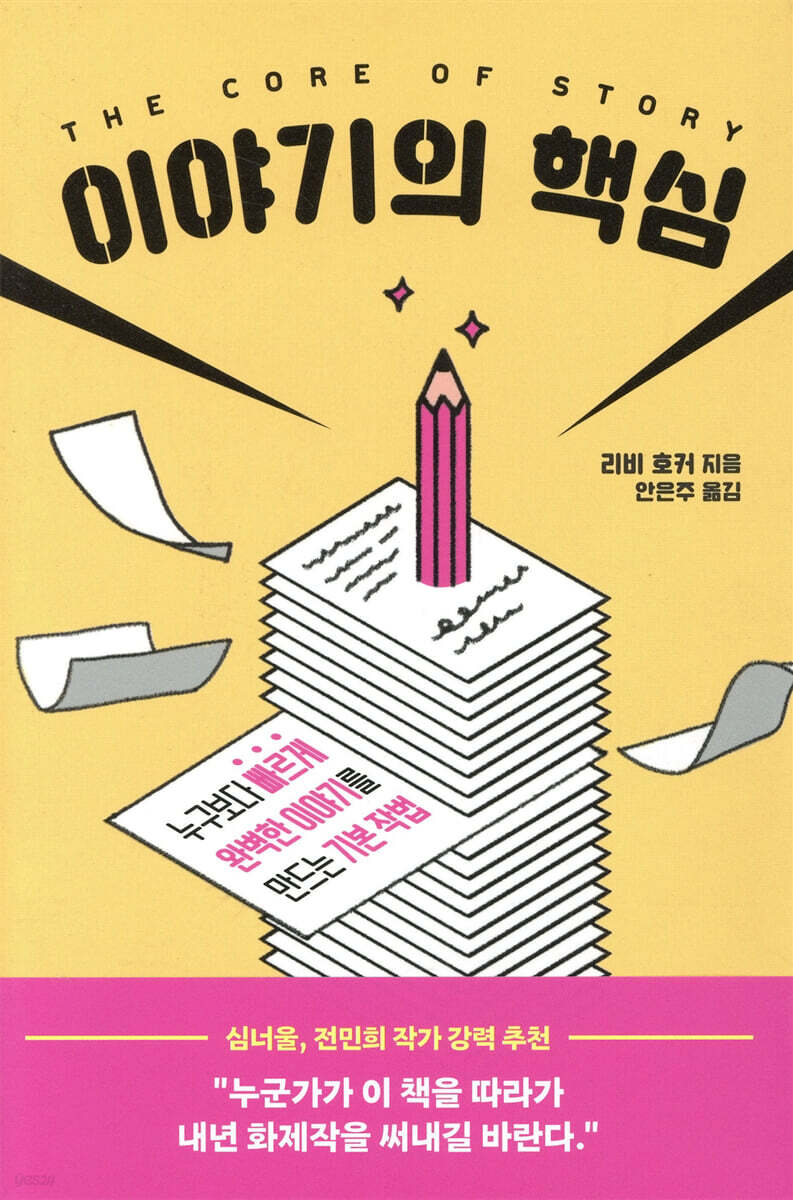
The core of the story
 |
Description
Book Introduction
Recommended by Sim Neul and Jeon Min-hee!
“I hope someone follows this book and writes a hit book next year.”
A story that catches your eye
The secret to writing quickly and perfectly
It's in the core and skeleton of the story!
A hot topic that fellow writers immediately applied to their writing and sent countless thank-you letters!
"The Core of the Story" is a practical, basic writing guide that anyone can immediately apply to actual manuscript writing.
It is different from a manual that only lists theories.
Libby Hawker, who has written 26 novels since 2011, sometimes completing one in three weeks, reveals her secret to writing: "How to create a story structure."
By grasping the "essence of a story," which is a collection of creative secrets discovered by a professional writer while writing, and learning "how to create a story framework," anyone can instantly and perfectly complete a captivating story!
“I hope someone follows this book and writes a hit book next year.”
A story that catches your eye
The secret to writing quickly and perfectly
It's in the core and skeleton of the story!
A hot topic that fellow writers immediately applied to their writing and sent countless thank-you letters!
"The Core of the Story" is a practical, basic writing guide that anyone can immediately apply to actual manuscript writing.
It is different from a manual that only lists theories.
Libby Hawker, who has written 26 novels since 2011, sometimes completing one in three weeks, reveals her secret to writing: "How to create a story structure."
By grasping the "essence of a story," which is a collection of creative secrets discovered by a professional writer while writing, and learning "how to create a story framework," anyone can instantly and perfectly complete a captivating story!
- You can preview some of the book's contents.
Preview
index
Preface_Can you write a novel in three weeks?
Before we begin_What type of writer are you?
CHAPTER 1.
What's at the heart of a compelling story?
Every story has five core elements.
The three axes of the story framework that support the core elements
The center of the story, the character arc
Why is the protagonist's flaw necessary?
Core Strengthening 01
CHAPTER 2.
The core of the story, character arcs and themes
Establish the protagonist, flaws, ending, and external goals first.
Set up an antagonist to make the protagonist stand out.
Create an assistant to push the protagonist forward.
If you choose the right topic, you can improve the quality of your work.
Core Strengthening 02
CHAPTER 3.
The Secret to Creating the Perfect Story: Plot
The plot is the journey the protagonist takes.
- First scene / Triggering incident / External goal discovered / Flaw presented / Goal rush / Antagonist appears / Frustration #1 / Flaw recognized / New goal rush / Antagonist attack / Frustration #2 / Goal revised / Helper attack / Strengthening resolve / Final battle / Death / Result
What does the story framework we've created so far look like?
Core Strengthening 03
CHAPTER 4.
The secret to captivating readers to the end: the pace of the plot
Good works have the same story form.
Make the protagonist move along an inverted triangle structure.
Ring the cymbals at the top
How to flesh out a story's skeleton and create details
Core Strengthening 04
CHAPTER 5.
How do you create a story framework in a situation like this?
What if I were to write a book with multiple main characters?
What is the character arc in the series?
Core Strengthening 05
Conclusion: Set a direction and become more free.
Before we begin_What type of writer are you?
CHAPTER 1.
What's at the heart of a compelling story?
Every story has five core elements.
The three axes of the story framework that support the core elements
The center of the story, the character arc
Why is the protagonist's flaw necessary?
Core Strengthening 01
CHAPTER 2.
The core of the story, character arcs and themes
Establish the protagonist, flaws, ending, and external goals first.
Set up an antagonist to make the protagonist stand out.
Create an assistant to push the protagonist forward.
If you choose the right topic, you can improve the quality of your work.
Core Strengthening 02
CHAPTER 3.
The Secret to Creating the Perfect Story: Plot
The plot is the journey the protagonist takes.
- First scene / Triggering incident / External goal discovered / Flaw presented / Goal rush / Antagonist appears / Frustration #1 / Flaw recognized / New goal rush / Antagonist attack / Frustration #2 / Goal revised / Helper attack / Strengthening resolve / Final battle / Death / Result
What does the story framework we've created so far look like?
Core Strengthening 03
CHAPTER 4.
The secret to captivating readers to the end: the pace of the plot
Good works have the same story form.
Make the protagonist move along an inverted triangle structure.
Ring the cymbals at the top
How to flesh out a story's skeleton and create details
Core Strengthening 04
CHAPTER 5.
How do you create a story framework in a situation like this?
What if I were to write a book with multiple main characters?
What is the character arc in the series?
Core Strengthening 05
Conclusion: Set a direction and become more free.
Detailed image
.jpg)
Into the book
When creating a new story, if you build your narrative around these five core elements, your work will captivate readers and keep them glued to the story.
--- p.30
Publisher's Review
Authors acknowledged
The power of practical basic writing
Shim Neul, a promising young science fiction writer, recommends this book, saying, “This kind of writing methodology is not something you can easily find anywhere.
“While reading this book, I was able to immediately apply it to my work,” he said.
Jeon Min-hee, a world-renowned fantasy novelist, wrote in a letter of recommendation, “I hope someone follows this book and writes a hit work next year.”
In fact, immediately after the book was published, Hawker received countless emails of thanks from fellow writers.
Jane Healy, who writes female spy novels, Piper Huguley, a contemporary romance writer, Sydney Swanson, a science fiction writer, and Paulette Kennedy, a gothic mystery writer, have all readily acknowledged their contributions to this book.
Rebecca Bradley, a crime novelist, also commented that she was able to complete a novel within a tight deadline by applying the methods presented in this book, saying, “If you’ve never written a story before, or if you want to know how active writers do it, I recommend reading this book.”
"The Essence of a Story" explains, step by step, concisely and easily, how to quickly write a compelling story, how to create the actual story framework, and what story core information you need to know to create the framework.
It is clear and concise, and includes the author's own experiences while writing, so readers just need to follow Hawker's explanations and turn each page.
As you learn how to create a story skeleton by looking at the story skeleton chart that Hawker actually wrote, you will be amazed at who on earth could show the process of writing a novel so meticulously.
Taking a closer look at and following Hawker's writing secrets, which he must have acquired over a long period of time, will be of great help to those who have been struggling with whether their writing style is right, whether their writing will resonate with readers, or who have been stuck after spending a long time writing.
How can I do it faster,
Can you write a high-quality piece?
"The Essence of the Story" is a writing guide written with essential content for those who write as a hobby, as well as those who want to publish a book under their own name and continue their career as a full-time writer.
As it presents efficient methods for producing high-quality writing in a short period of time, it is a writing guide that is especially necessary and urgent for those who understand the importance of speed.
The power of the basic writing techniques taught in this work is proven by the author's track record of publishing numerous books at a rapid pace and receiving acclaim.
Hawker is a Washington Post bestselling author who has published 26 novels since 2011. He has been a finalist for the Washington State Book Award and his representative works have received nearly 5-star ratings from over 10,000 Amazon reviews, earning him high praise from both readers and the literary community.
As a full-time writer, Hawker offers a clear diagnosis of how to survive in today's publishing market.
“In these days when works are pouring out at a frightening pace, it is true that even long-established authors at established publishing houses are having a hard time keeping up with the rapid pace of publishing in the market.
To break into this market and survive as a writer, you need to be able to write well at a fast pace.” If you are an aspiring writer, the more you challenge yourself with multiple works, the higher your chances of getting a contract. If you are already a published author, you can make more money by quickly releasing multiple works.
However, if you don't know the specific method, speed and completeness seem to be incompatible at first glance.
Aspiring writers often find themselves lost, weighing both sides, unable to decide whether to shift to meticulously planning and writing in advance, or to actively surrender to inspiration.
To help solve these problems, Libby Hawker revealed her own writing secrets that allow her to write a novel in just three weeks.
How to create a story skeleton that Hawker 'shows'!
Hawker asserts that writing is much faster when you first outline and plan your story before you begin.
The important thing is to create a 'story framework' rather than a 'plot' for the entire story.
If you create the "story framework" that Hawker talks about, you can incorporate the wonderful inspiration that comes to you into your story as it comes, unlike the worries you have when planning and writing, and you can have the opportunity to refine and evaluate the completeness of your work based on the "story framework," and you can even control the speed.
Hawker doesn't speak vaguely about the basic techniques that make all this possible.
He uses his own work as an example to show how he actually goes about writing a manuscript, using a concrete 'story skeleton writing chart'.
This book explains the elements calculated when composing the work 『Tidewater』, which was published in 2015 and sold about 200,000 copies and was recognized, the writing order, and things to keep in mind when creating the framework. It also shows the ‘process of creating a story framework’ that was used before the actual writing, so readers can easily apply Hawker’s writing method to their writing.
Also, Hawker's writing style is a basic writing style, so it does not follow any genre.
Even if you just look at the authors who have used, admired, and recommended their works, the length of their main works varies from short stories to long stories, and the genres are also diverse.
A major advantage of this book is that it can be applied to the web novel genre in addition to the various genres of paper fiction books.
In the web novel genre, which is gradually moving towards longer stories, writers are struggling with how to quickly and interestingly portray the stories of many characters in addition to the main character without straying from the main plot.
Chapter 5, the final chapter of this book, teaches you how to easily and solidly build a story using Hawker's "How to Create a Story Skeleton" before writing a long story, with topics such as "What should I do when writing a book with multiple main characters?" and "What is a character arc in a series?"
Focus on rich examples and concrete writing techniques.
Decide on a direction for your writing and become more free.
Hawker uses famous masterpieces such as Lolita, Charlotte's Web, Harry Potter and the Sorcerer's Stone, and To Kill a Mockingbird to explain what the core elements of a compelling story are, why they are important, and how these elements draw readers in.
Also, since it clearly explains how the elements are included in the 'story skeleton writing table', anyone can easily understand the writing method.
Now you can write quickly under tight deadlines, avoid having to cut out work you've spent countless hours working on, and confidently write high-quality work that will turn into a good book.
Now, as author Jeon Min-hee said, I hope that someone will write a hit book next year right after reading this book!
The power of practical basic writing
Shim Neul, a promising young science fiction writer, recommends this book, saying, “This kind of writing methodology is not something you can easily find anywhere.
“While reading this book, I was able to immediately apply it to my work,” he said.
Jeon Min-hee, a world-renowned fantasy novelist, wrote in a letter of recommendation, “I hope someone follows this book and writes a hit work next year.”
In fact, immediately after the book was published, Hawker received countless emails of thanks from fellow writers.
Jane Healy, who writes female spy novels, Piper Huguley, a contemporary romance writer, Sydney Swanson, a science fiction writer, and Paulette Kennedy, a gothic mystery writer, have all readily acknowledged their contributions to this book.
Rebecca Bradley, a crime novelist, also commented that she was able to complete a novel within a tight deadline by applying the methods presented in this book, saying, “If you’ve never written a story before, or if you want to know how active writers do it, I recommend reading this book.”
"The Essence of a Story" explains, step by step, concisely and easily, how to quickly write a compelling story, how to create the actual story framework, and what story core information you need to know to create the framework.
It is clear and concise, and includes the author's own experiences while writing, so readers just need to follow Hawker's explanations and turn each page.
As you learn how to create a story skeleton by looking at the story skeleton chart that Hawker actually wrote, you will be amazed at who on earth could show the process of writing a novel so meticulously.
Taking a closer look at and following Hawker's writing secrets, which he must have acquired over a long period of time, will be of great help to those who have been struggling with whether their writing style is right, whether their writing will resonate with readers, or who have been stuck after spending a long time writing.
How can I do it faster,
Can you write a high-quality piece?
"The Essence of the Story" is a writing guide written with essential content for those who write as a hobby, as well as those who want to publish a book under their own name and continue their career as a full-time writer.
As it presents efficient methods for producing high-quality writing in a short period of time, it is a writing guide that is especially necessary and urgent for those who understand the importance of speed.
The power of the basic writing techniques taught in this work is proven by the author's track record of publishing numerous books at a rapid pace and receiving acclaim.
Hawker is a Washington Post bestselling author who has published 26 novels since 2011. He has been a finalist for the Washington State Book Award and his representative works have received nearly 5-star ratings from over 10,000 Amazon reviews, earning him high praise from both readers and the literary community.
As a full-time writer, Hawker offers a clear diagnosis of how to survive in today's publishing market.
“In these days when works are pouring out at a frightening pace, it is true that even long-established authors at established publishing houses are having a hard time keeping up with the rapid pace of publishing in the market.
To break into this market and survive as a writer, you need to be able to write well at a fast pace.” If you are an aspiring writer, the more you challenge yourself with multiple works, the higher your chances of getting a contract. If you are already a published author, you can make more money by quickly releasing multiple works.
However, if you don't know the specific method, speed and completeness seem to be incompatible at first glance.
Aspiring writers often find themselves lost, weighing both sides, unable to decide whether to shift to meticulously planning and writing in advance, or to actively surrender to inspiration.
To help solve these problems, Libby Hawker revealed her own writing secrets that allow her to write a novel in just three weeks.
How to create a story skeleton that Hawker 'shows'!
Hawker asserts that writing is much faster when you first outline and plan your story before you begin.
The important thing is to create a 'story framework' rather than a 'plot' for the entire story.
If you create the "story framework" that Hawker talks about, you can incorporate the wonderful inspiration that comes to you into your story as it comes, unlike the worries you have when planning and writing, and you can have the opportunity to refine and evaluate the completeness of your work based on the "story framework," and you can even control the speed.
Hawker doesn't speak vaguely about the basic techniques that make all this possible.
He uses his own work as an example to show how he actually goes about writing a manuscript, using a concrete 'story skeleton writing chart'.
This book explains the elements calculated when composing the work 『Tidewater』, which was published in 2015 and sold about 200,000 copies and was recognized, the writing order, and things to keep in mind when creating the framework. It also shows the ‘process of creating a story framework’ that was used before the actual writing, so readers can easily apply Hawker’s writing method to their writing.
Also, Hawker's writing style is a basic writing style, so it does not follow any genre.
Even if you just look at the authors who have used, admired, and recommended their works, the length of their main works varies from short stories to long stories, and the genres are also diverse.
A major advantage of this book is that it can be applied to the web novel genre in addition to the various genres of paper fiction books.
In the web novel genre, which is gradually moving towards longer stories, writers are struggling with how to quickly and interestingly portray the stories of many characters in addition to the main character without straying from the main plot.
Chapter 5, the final chapter of this book, teaches you how to easily and solidly build a story using Hawker's "How to Create a Story Skeleton" before writing a long story, with topics such as "What should I do when writing a book with multiple main characters?" and "What is a character arc in a series?"
Focus on rich examples and concrete writing techniques.
Decide on a direction for your writing and become more free.
Hawker uses famous masterpieces such as Lolita, Charlotte's Web, Harry Potter and the Sorcerer's Stone, and To Kill a Mockingbird to explain what the core elements of a compelling story are, why they are important, and how these elements draw readers in.
Also, since it clearly explains how the elements are included in the 'story skeleton writing table', anyone can easily understand the writing method.
Now you can write quickly under tight deadlines, avoid having to cut out work you've spent countless hours working on, and confidently write high-quality work that will turn into a good book.
Now, as author Jeon Min-hee said, I hope that someone will write a hit book next year right after reading this book!
GOODS SPECIFICS
- Date of issue: September 7, 2022
- Page count, weight, size: 184 pages | 252g | 135*205*12mm
- ISBN13: 9791160075953
- ISBN10: 1160075956
You may also like
카테고리
korean


korean

![GQ KOREA Mark (Monthly): December [2025]](http://librairie.coreenne.fr/cdn/shop/files/8ef265dbbfbf186523ed75ba7319009d.jpg?v=1765340328&width=3840)


