

90 Nights of Art: Italy
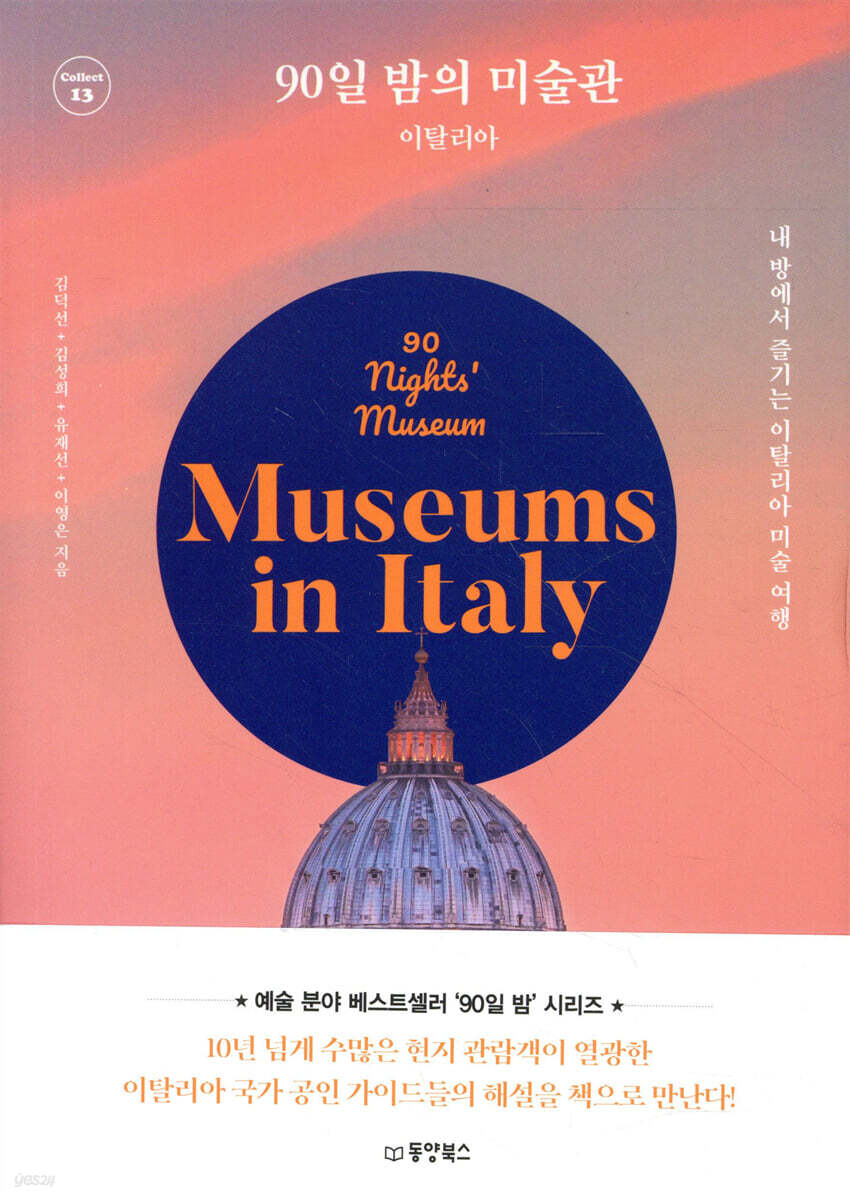 |
Description
Book Introduction
An art journey to Italy, the center of Western art history.
Over 10 years, countless travelers have been impressed
Local art gallery tours by Italian state-certified guides
The beloved '90 Days of Night' series, released every time a new book is released, now heads to Italy, the heart of Western art history.
Let's take a closer look at the works of art housed in art galleries and cathedrals in nine cities, including Rome, Florence, Milan, and Venice, with the help of four Italian government-certified guides who have worked in Italian art galleries for over 10 years.
The vivid illustrations of over 100 beautiful artworks alone make the museum worth owning, and the commentary provided by guides who have interacted with diverse visitors for many years is vivid and clear.
Over 10 years, countless travelers have been impressed
Local art gallery tours by Italian state-certified guides
The beloved '90 Days of Night' series, released every time a new book is released, now heads to Italy, the heart of Western art history.
Let's take a closer look at the works of art housed in art galleries and cathedrals in nine cities, including Rome, Florence, Milan, and Venice, with the help of four Italian government-certified guides who have worked in Italian art galleries for over 10 years.
The vivid illustrations of over 100 beautiful artworks alone make the museum worth owning, and the commentary provided by guides who have interacted with diverse visitors for many years is vivid and clear.
- You can preview some of the book's contents.
Preview
index
Entrance
Rome
Vatican Museums, Palazzo Barberini, Doria Pamphilj Gallery, Villa Farnesina, Borghese Gallery, National Gallery of Modern Art, Basilica of Santa Maria della Vittoria
DAY 01: A Damaged Sculpture Becomes an Independent Artwork [Author Unknown, Belvedere Torso]
DAY 02 Vatican Palace Collection No. 1 [Agesander, Polydorus, Athenodorus, Laocoön and the Group]
DAY 03 Disorderly conduct, but holy [Filippo Lippi, Coronation of Marsupini]
DAY 04 The Painter Who Painted Beautiful Angels [Melozzo da Forli, The Musical Angel]
DAY 05 The Painter Called by the Pope [Perugino, The Giving of the Keys]
DAY 06: An Accidental Discovery [Da Vinci, St. Jerome]
DAY 07 Painting the Virgin in her Old Age [Crivelli, Pieta]
DAY 08: A Place to Meet Genius [Michelangelo, Ceiling Painting]
DAY 09: Renaissance People Who Became the Faces of Philosophers [Raphael, The School of Athens]
DAY 10 Completing Renaissance Art [Raphael, Transfiguration of Christ]
DAY 11 Raphael in Northern Italy [Veronese, Saint Helena]
DAY 12 A dramatic painting from a dramatic life [Caravaggio, The Burial of Christ]
DAY 13 The Martyrdom of a Humane Saint [Guido Reni, The Crucifixion of St. Peter]
DAY 14: The Suffering That Comes After Peace [Wenzel Peter, Adam and Eve in the Garden of Eden]
DAY 15 The Great Sculptor Who Fascinated Napoleon [Canova, Perseus with the Head of Medusa]
DAY 16 Heroes Who Left Behind Constellations and Alcohol [Jan Matejko, Jan Sobieski, Who Conquered the Ottomans at the Vienna Gate]
DAY 17 Van Gogh's religious painting just before his death [Van Gogh, Pieta]
DAY 18 Such a rustic Virgin Mary [Fontana, Madonna]
DAY 19 The Painter Who Painted the Pope [Bacon, Pope Study 2]
DAY 20 Raphael's Devotion to a Departed Lover [Raphael, La Fornarina]
DAY 21 Her serenity makes us sadder [Portrait of Beatrice Cenci, Guido Reni]
DAY 22 Gombrich's Praise for the Renaissance's Greatest Masterpiece [Raphael, The Triumph of Galatea]
DAY 23 The Hidden Truth Behind Children's Fights [Guido Reni, The Fight of the Footies]
DAY 24: The Birth of Landscape Painting [Annibale Carracci, The Flight into Egypt]
DAY 25 Master of Spanish Portraiture [Velázquez, Portrait of Pope Innocent X]
DAY 26 Sick Self-Portrait [Caravaggio, Sick Bacchus]
DAY 27 A sculpture that perfectly expresses the story of transformation [Bernini, Apollo and Daphne]
DAY 28: A Genius Falls from the Abyss and Rises Again [Bernini, The Ecstasy of St. Teresa]
DAY 29 Pioneer of Realism [Courbet, The Wave]
DAY 30 Love in the Eyes [Modigliani, Portrait of Anna Zborowska]
[Florence]
Uffizi Gallery, Duomo Opera Museum, San Marco Monastery, Santa Maria Novella, Accademia Gallery, Bargello National Gallery, Palazzo Medici Riccardi
DAY 31 The Mother Who Gave Birth to God [Giotto, Maesta]
DAY 32 The pinnacle of international Gothic [Fabrian, Adoration of the Magi]
DAY 33 The Monk Whose Forbidden Love [Filippo Lippi, Madonna and Child with Two Angels]
DAY 34: Is a masterpiece illegal? [Verrocchio and Da Vinci, The Baptism of Christ]
DAY 35 The location where you should look at the painting has been decided [Da Vinci, Annunciation]
DAY 36 Pioneers of Realistic Portraiture [Portrait of Francesca and the Duke and Duchess of Urbino]
DAY 37: The Medici Family Pays Obeisance? [Botticelli, Adoration of the Magi]
DAY 38 Encountering the Works of Flemish Masters [Huiho van der Goes, Portinari Altarpiece]
DAY 39: Spring in Florence: A Blend of Classicism and Imagination [Botticelli, Primavera]
DAY 40: The Idealized Beauty, Botticelli's Muse [Botticelli, The Birth of Venus]
DAY 41 Muscular Madonna [Michelangelo, Doni Tondo]
DAY 42 The Painter Who Perfected Ordinariness [Raphael, Madonna of the Blackbird]
DAY 43: A 500-Year-Old Guide to Love [Titian, Heavenly Love and Earthly Love]
DAY 44: I'm the Best at Portraits [Raphael, Pope Leo X and the Cardinals]
DAY 45 Dinner in the Monastery Refectory [Pontormo, Supper at Emmaus]
DAY 46: The Sensual Human Body in the Bible [Cranach, Adam and Eve]
DAY 47 Fall in Love with Mannerism [Parmigianino, Madonna with the Long Neck]
DAY 48 Venus Comes to Life [Titian, Venus of Urbino]
DAY 49 Self-Portrait of Shock and Horror [Caravaggio, Medusa]
DAY 50 In the Name of Woman [Gentileschi, Judith Beheading Holofernes]
DAY 51: Is Ugly Beauty Possible? [Donatello, The Repentant Magdalene]
DAY 52 The Revival of Renaissance Perspective [Masaccio, Holy Trinity]
DAY 53 Angel's Message [Beato Angelico, Annunciation]
DAY 54: Creating a Masterpiece from Scrap Rock [Michelangelo, David]
DAY 55 Medici Procession [Gozzoli, Procession of the Magi]
DAY 56 Ending the Gothic and Opening the Renaissance [Donatello, St. George]
DAY 57 Meet the Master of Terracotta [Luca della Robbia, Madonna with Apples]
DAY 58 The Sleek New Mercury [Gambologna, Mercury]
[Milan]
Brera Art Gallery, Ambrosiana Gallery, Sforzesco Castle, Santa Maria delle Grazie Church, Novecento Gallery
DAY 59 Pieta, a work of lyrical humanity [Giovanni Bellini, Pieta]
DAY 60 Theoretical Pioneers of the Renaissance [Francesca, Madonna of Brera]
DAY 61 The Death of Christ, Intensified by Innovative Techniques [Mantegna, The Dead Christ]
DAY 62 A Disciple Worse Than His Master [Raphael, The Marriage of the Virgin Mary]
DAY 63 Brothers representing Venice [Gentile Bellini and Giovanni Bellini, The Sermon of Saint Mark in Alexandria]
DAY 64 The Duality of a Genius Painter [Caravaggio, The Supper at Emmaus]
DAY 65 The most popular star painter in the art market [Rubens, The Last Supper]
DAY 66 The Secret Behind a Romantic Kiss [Hayes, Kiss]
DAY 67 Leonardo da Vinci's Only Portrait of a Male [Portrait of a Musician]
DAY 68 The World's Most Holy Family Painting [Luni, Holy Family with Saint Anne and John the Baptist]
DAY 69: The first still life painting that pioneered another genre [Caravaggio, Basket of Fruit]
DAY 70: Perfect Beauty Achieved Through Imperfection [Michelangelo, Rondanini Pietà]
DAY 71 The Dramatic Last Supper [Da Vinci, The Last Supper]
DAY 72 Expressing the Beauty of Speed, Faster and Faster [Bocconi, Elasticity]
DAY 73: Is a torn canvas really art? [Fontana, Spatial Concept]
[Venice]
Accademia Gallery, Basilica di Santa Maria Gloriosa dei Frari, Basilica di San Rocco, Peggy Guggenheim Museum
DAY 74 The Founder of the Venetian School [Giovanni Bellini, Madonna and Child with Two Saints]
DAY 75 The First Western Landscape [Giorgione, The Tempest]
DAY 76 Mannerism in Venice [Tintoretto, The Body of Saint Mark Brought to Venice]
DAY 77 Painting with a title changed due to the Inquisition [Veronese, The Feast of the Levites]
DAY 78 A Complete Work in the Venetian Style [Titian, Assumption of the Virgin Mary]
DAY 79: The Bright and Lively Master of Rococo [Tiepolo, Hagar and Ishmael]
DAY 80: A Dreamer Expressing Fantasy [Chagall, Rain]
DAY 81: The Mystery of the Destruction of Everyday Life [Kiriko, The Red Tower]
DAY 82 A World That Doesn't Exist [Magritte, Empire of Light]
[Other regions]
National Archaeological Museum, Capodimonte Art Gallery, Palazzo Abatellis, Alla Ponzone Civica Gallery, Ricci Oddi Modern Art Gallery, Morandi Gallery
DAY 83 The Hero Who Awoke with a Sleeping City [Author Unknown, Alexander and Darius III at the Battle of Issus]
DAY 84 Even Heroes Need Rest [Glycon, Farnese's Hercules]
DAY 85 A Painting Satirizing the World [Brueghel, The Pessimist]
DAY 86 The Man from Greece [El Greco, Boy Blowing Sparks to Light a Candle]
DAY 87: The Annunciation That Broke the Form [Antonello da Messina, The Annunciation]
DAY 88: The Creator of Double Painting [Arcimboldo, The Vegetable Gardener]
DAY 89: A Painter Who Resisted the Times Between Obscenity and Art [Klimt, Portrait of a Lady]
DAY 90 A painter who dedicated his life to still lifes in search of essence [Morandi, Still Life]
Browse by author
Rome
Vatican Museums, Palazzo Barberini, Doria Pamphilj Gallery, Villa Farnesina, Borghese Gallery, National Gallery of Modern Art, Basilica of Santa Maria della Vittoria
DAY 01: A Damaged Sculpture Becomes an Independent Artwork [Author Unknown, Belvedere Torso]
DAY 02 Vatican Palace Collection No. 1 [Agesander, Polydorus, Athenodorus, Laocoön and the Group]
DAY 03 Disorderly conduct, but holy [Filippo Lippi, Coronation of Marsupini]
DAY 04 The Painter Who Painted Beautiful Angels [Melozzo da Forli, The Musical Angel]
DAY 05 The Painter Called by the Pope [Perugino, The Giving of the Keys]
DAY 06: An Accidental Discovery [Da Vinci, St. Jerome]
DAY 07 Painting the Virgin in her Old Age [Crivelli, Pieta]
DAY 08: A Place to Meet Genius [Michelangelo, Ceiling Painting]
DAY 09: Renaissance People Who Became the Faces of Philosophers [Raphael, The School of Athens]
DAY 10 Completing Renaissance Art [Raphael, Transfiguration of Christ]
DAY 11 Raphael in Northern Italy [Veronese, Saint Helena]
DAY 12 A dramatic painting from a dramatic life [Caravaggio, The Burial of Christ]
DAY 13 The Martyrdom of a Humane Saint [Guido Reni, The Crucifixion of St. Peter]
DAY 14: The Suffering That Comes After Peace [Wenzel Peter, Adam and Eve in the Garden of Eden]
DAY 15 The Great Sculptor Who Fascinated Napoleon [Canova, Perseus with the Head of Medusa]
DAY 16 Heroes Who Left Behind Constellations and Alcohol [Jan Matejko, Jan Sobieski, Who Conquered the Ottomans at the Vienna Gate]
DAY 17 Van Gogh's religious painting just before his death [Van Gogh, Pieta]
DAY 18 Such a rustic Virgin Mary [Fontana, Madonna]
DAY 19 The Painter Who Painted the Pope [Bacon, Pope Study 2]
DAY 20 Raphael's Devotion to a Departed Lover [Raphael, La Fornarina]
DAY 21 Her serenity makes us sadder [Portrait of Beatrice Cenci, Guido Reni]
DAY 22 Gombrich's Praise for the Renaissance's Greatest Masterpiece [Raphael, The Triumph of Galatea]
DAY 23 The Hidden Truth Behind Children's Fights [Guido Reni, The Fight of the Footies]
DAY 24: The Birth of Landscape Painting [Annibale Carracci, The Flight into Egypt]
DAY 25 Master of Spanish Portraiture [Velázquez, Portrait of Pope Innocent X]
DAY 26 Sick Self-Portrait [Caravaggio, Sick Bacchus]
DAY 27 A sculpture that perfectly expresses the story of transformation [Bernini, Apollo and Daphne]
DAY 28: A Genius Falls from the Abyss and Rises Again [Bernini, The Ecstasy of St. Teresa]
DAY 29 Pioneer of Realism [Courbet, The Wave]
DAY 30 Love in the Eyes [Modigliani, Portrait of Anna Zborowska]
[Florence]
Uffizi Gallery, Duomo Opera Museum, San Marco Monastery, Santa Maria Novella, Accademia Gallery, Bargello National Gallery, Palazzo Medici Riccardi
DAY 31 The Mother Who Gave Birth to God [Giotto, Maesta]
DAY 32 The pinnacle of international Gothic [Fabrian, Adoration of the Magi]
DAY 33 The Monk Whose Forbidden Love [Filippo Lippi, Madonna and Child with Two Angels]
DAY 34: Is a masterpiece illegal? [Verrocchio and Da Vinci, The Baptism of Christ]
DAY 35 The location where you should look at the painting has been decided [Da Vinci, Annunciation]
DAY 36 Pioneers of Realistic Portraiture [Portrait of Francesca and the Duke and Duchess of Urbino]
DAY 37: The Medici Family Pays Obeisance? [Botticelli, Adoration of the Magi]
DAY 38 Encountering the Works of Flemish Masters [Huiho van der Goes, Portinari Altarpiece]
DAY 39: Spring in Florence: A Blend of Classicism and Imagination [Botticelli, Primavera]
DAY 40: The Idealized Beauty, Botticelli's Muse [Botticelli, The Birth of Venus]
DAY 41 Muscular Madonna [Michelangelo, Doni Tondo]
DAY 42 The Painter Who Perfected Ordinariness [Raphael, Madonna of the Blackbird]
DAY 43: A 500-Year-Old Guide to Love [Titian, Heavenly Love and Earthly Love]
DAY 44: I'm the Best at Portraits [Raphael, Pope Leo X and the Cardinals]
DAY 45 Dinner in the Monastery Refectory [Pontormo, Supper at Emmaus]
DAY 46: The Sensual Human Body in the Bible [Cranach, Adam and Eve]
DAY 47 Fall in Love with Mannerism [Parmigianino, Madonna with the Long Neck]
DAY 48 Venus Comes to Life [Titian, Venus of Urbino]
DAY 49 Self-Portrait of Shock and Horror [Caravaggio, Medusa]
DAY 50 In the Name of Woman [Gentileschi, Judith Beheading Holofernes]
DAY 51: Is Ugly Beauty Possible? [Donatello, The Repentant Magdalene]
DAY 52 The Revival of Renaissance Perspective [Masaccio, Holy Trinity]
DAY 53 Angel's Message [Beato Angelico, Annunciation]
DAY 54: Creating a Masterpiece from Scrap Rock [Michelangelo, David]
DAY 55 Medici Procession [Gozzoli, Procession of the Magi]
DAY 56 Ending the Gothic and Opening the Renaissance [Donatello, St. George]
DAY 57 Meet the Master of Terracotta [Luca della Robbia, Madonna with Apples]
DAY 58 The Sleek New Mercury [Gambologna, Mercury]
[Milan]
Brera Art Gallery, Ambrosiana Gallery, Sforzesco Castle, Santa Maria delle Grazie Church, Novecento Gallery
DAY 59 Pieta, a work of lyrical humanity [Giovanni Bellini, Pieta]
DAY 60 Theoretical Pioneers of the Renaissance [Francesca, Madonna of Brera]
DAY 61 The Death of Christ, Intensified by Innovative Techniques [Mantegna, The Dead Christ]
DAY 62 A Disciple Worse Than His Master [Raphael, The Marriage of the Virgin Mary]
DAY 63 Brothers representing Venice [Gentile Bellini and Giovanni Bellini, The Sermon of Saint Mark in Alexandria]
DAY 64 The Duality of a Genius Painter [Caravaggio, The Supper at Emmaus]
DAY 65 The most popular star painter in the art market [Rubens, The Last Supper]
DAY 66 The Secret Behind a Romantic Kiss [Hayes, Kiss]
DAY 67 Leonardo da Vinci's Only Portrait of a Male [Portrait of a Musician]
DAY 68 The World's Most Holy Family Painting [Luni, Holy Family with Saint Anne and John the Baptist]
DAY 69: The first still life painting that pioneered another genre [Caravaggio, Basket of Fruit]
DAY 70: Perfect Beauty Achieved Through Imperfection [Michelangelo, Rondanini Pietà]
DAY 71 The Dramatic Last Supper [Da Vinci, The Last Supper]
DAY 72 Expressing the Beauty of Speed, Faster and Faster [Bocconi, Elasticity]
DAY 73: Is a torn canvas really art? [Fontana, Spatial Concept]
[Venice]
Accademia Gallery, Basilica di Santa Maria Gloriosa dei Frari, Basilica di San Rocco, Peggy Guggenheim Museum
DAY 74 The Founder of the Venetian School [Giovanni Bellini, Madonna and Child with Two Saints]
DAY 75 The First Western Landscape [Giorgione, The Tempest]
DAY 76 Mannerism in Venice [Tintoretto, The Body of Saint Mark Brought to Venice]
DAY 77 Painting with a title changed due to the Inquisition [Veronese, The Feast of the Levites]
DAY 78 A Complete Work in the Venetian Style [Titian, Assumption of the Virgin Mary]
DAY 79: The Bright and Lively Master of Rococo [Tiepolo, Hagar and Ishmael]
DAY 80: A Dreamer Expressing Fantasy [Chagall, Rain]
DAY 81: The Mystery of the Destruction of Everyday Life [Kiriko, The Red Tower]
DAY 82 A World That Doesn't Exist [Magritte, Empire of Light]
[Other regions]
National Archaeological Museum, Capodimonte Art Gallery, Palazzo Abatellis, Alla Ponzone Civica Gallery, Ricci Oddi Modern Art Gallery, Morandi Gallery
DAY 83 The Hero Who Awoke with a Sleeping City [Author Unknown, Alexander and Darius III at the Battle of Issus]
DAY 84 Even Heroes Need Rest [Glycon, Farnese's Hercules]
DAY 85 A Painting Satirizing the World [Brueghel, The Pessimist]
DAY 86 The Man from Greece [El Greco, Boy Blowing Sparks to Light a Candle]
DAY 87: The Annunciation That Broke the Form [Antonello da Messina, The Annunciation]
DAY 88: The Creator of Double Painting [Arcimboldo, The Vegetable Gardener]
DAY 89: A Painter Who Resisted the Times Between Obscenity and Art [Klimt, Portrait of a Lady]
DAY 90 A painter who dedicated his life to still lifes in search of essence [Morandi, Still Life]
Browse by author
Detailed image

Into the book
Ranke said, “Rome is like a lake.
“All history before Rome flowed into Rome, and all history after Rome flowed out of Rome.”
As he said, you can't discuss history and art without mentioning Italy.
So, Italy itself can be said to be the charm of Europe.
I fell in love with its charm and ended up working in Italy for about 10 years.
--- p.5, from “Author Interview”
Italy was the center of European art from the Middle Ages to the Baroque.
This was possible because Italy was the center of religion.
So I focused on writing so that religion and art could be understood together.
From International Gothic pieces filled with ornate and decorative elements to works by artists influenced by the Flemish style and those who played a leading role in the Renaissance, and even Baroque pieces, we introduced works of art using various techniques without limiting them to paintings.
--- p.11, from “Author Interview”
Renaissance artists depicted the Virgin Mary as a woman in her most beautiful years.
In fact, when people saw Michelangelo's Pieta and said that Jesus' mother was too young, Michelangelo replied, "A virtuous woman never grows old."
Carlo Crivelli's Pietà features three women with Jesus.
Can you spot which of the women in the painting is Jesus' mother? Yes, you are right.
The woman in the center has her head wrapped in blue cloth.
But her face is full of wrinkles.
Carlo Crivelli created his own unique portrayal of Maria.
--- p.67, from “Drawing the Virgin Mary in Old Age”
It is not easy to acknowledge the skills of a rival, learn his techniques, and apply them to your own paintings.
Raphael, who was loved enough for his genius talent alone, knew how to put aside the title of genius and accept it when he had something to learn from someone.
His ability to perfect Renaissance art was probably a result of constant self-reflection.
--- p.85, from “Completing Renaissance Art”
When Raphael died, his disciple Giulio Romano had one worry.
The various symbols expressed in “La Fornarina” revealed that Raphael was in a romantic relationship with Margherita, the daughter of a baker, and this was feared to tarnish the reputation of the deceased teacher.
Ultimately, Giulio Romano paints over the ring on Margherita's ring finger, which symbolizes their engagement, among the symbols depicted in the painting.
The erased ring was discovered in 2001 during the restoration of a Raphael painting.
How about confirming their love for each other by looking for signs left by Raphael other than the ring?
--- p.134, from “Raphael’s Innocence Dedicated to a Departed Lover”
The Uffizi Gallery is a place where you can take pictures without using the camera flash.
After looking at the Annunciation from the front, take a picture. Then, move to the right side of the painting, bend your knees slightly, look at the painting, and then take a picture.
Comparing the two photos, you can see the difference in the length of Mary's arm and the size of the marble decorations on the building.
This is a way to remember the strange difference for a long time, where parts that look unnatural when viewed from the front change when viewed from the right side.
--- p.216, from “The position where you should look at the picture has been decided”
This work is an attempt by da Vinci to complement the shortcomings of frescoes with his creativity and experimental spirit.
Some may call this challenge a failure, but the work's survival despite many hardships and adversities is very similar to his challenging spirit.
“All history before Rome flowed into Rome, and all history after Rome flowed out of Rome.”
As he said, you can't discuss history and art without mentioning Italy.
So, Italy itself can be said to be the charm of Europe.
I fell in love with its charm and ended up working in Italy for about 10 years.
--- p.5, from “Author Interview”
Italy was the center of European art from the Middle Ages to the Baroque.
This was possible because Italy was the center of religion.
So I focused on writing so that religion and art could be understood together.
From International Gothic pieces filled with ornate and decorative elements to works by artists influenced by the Flemish style and those who played a leading role in the Renaissance, and even Baroque pieces, we introduced works of art using various techniques without limiting them to paintings.
--- p.11, from “Author Interview”
Renaissance artists depicted the Virgin Mary as a woman in her most beautiful years.
In fact, when people saw Michelangelo's Pieta and said that Jesus' mother was too young, Michelangelo replied, "A virtuous woman never grows old."
Carlo Crivelli's Pietà features three women with Jesus.
Can you spot which of the women in the painting is Jesus' mother? Yes, you are right.
The woman in the center has her head wrapped in blue cloth.
But her face is full of wrinkles.
Carlo Crivelli created his own unique portrayal of Maria.
--- p.67, from “Drawing the Virgin Mary in Old Age”
It is not easy to acknowledge the skills of a rival, learn his techniques, and apply them to your own paintings.
Raphael, who was loved enough for his genius talent alone, knew how to put aside the title of genius and accept it when he had something to learn from someone.
His ability to perfect Renaissance art was probably a result of constant self-reflection.
--- p.85, from “Completing Renaissance Art”
When Raphael died, his disciple Giulio Romano had one worry.
The various symbols expressed in “La Fornarina” revealed that Raphael was in a romantic relationship with Margherita, the daughter of a baker, and this was feared to tarnish the reputation of the deceased teacher.
Ultimately, Giulio Romano paints over the ring on Margherita's ring finger, which symbolizes their engagement, among the symbols depicted in the painting.
The erased ring was discovered in 2001 during the restoration of a Raphael painting.
How about confirming their love for each other by looking for signs left by Raphael other than the ring?
--- p.134, from “Raphael’s Innocence Dedicated to a Departed Lover”
The Uffizi Gallery is a place where you can take pictures without using the camera flash.
After looking at the Annunciation from the front, take a picture. Then, move to the right side of the painting, bend your knees slightly, look at the painting, and then take a picture.
Comparing the two photos, you can see the difference in the length of Mary's arm and the size of the marble decorations on the building.
This is a way to remember the strange difference for a long time, where parts that look unnatural when viewed from the front change when viewed from the right side.
--- p.216, from “The position where you should look at the picture has been decided”
This work is an attempt by da Vinci to complement the shortcomings of frescoes with his creativity and experimental spirit.
Some may call this challenge a failure, but the work's survival despite many hardships and adversities is very similar to his challenging spirit.
--- p.398, from “The Dramatic Last Supper”
Publisher's Review
Michelangelo, Raphael, Caravaggio, etc.
A place filled with the brilliant works of geniuses who have illuminated the history of art!
Take a leisurely look around with an Italian nationally certified guide
One Artwork a Day: An Intensive Tour of Italian Art Museums
The immediate bestsellers "90 Nights at the Museum" and "90 Nights at the Museum: The Louvre" introduced exquisite works of art from museums across Europe, but there is one important country that has not yet been covered in either volume.
This is Italy, the very beginning and center of Western art history.
Italy is a country where each city, such as Rome, Florence, and Milan, has its own unique history, personality, and unique painting style, making it a shame to visit just one city.
It is also a place where Renaissance artists such as Michelangelo, Raphael, and Leonardo da Vinci created outstanding philosophy and art.
Rome, Florence, Milan, Venice, etc.
Must-see works from each city in one volume!
This book was carefully selected by four Italian government-certified guides who have been working in Italy for over 10 years, and allows you to enjoy one work at a time over 90 days.
It is organized by city, such as Rome, Florence, and Milan, so you can read it as if you were traveling.
Rome is the eternal city with 2,800 years of history. You can feel the breath of history and art everywhere you go, including in Vatican City, the center of Catholicism.
In particular, at the Vatican Museums, considered one of the three greatest art museums in Europe, you can see over 70,000 works of art spanning centuries, including the jaw-droppingly magnificent Sistine Chapel ceiling paintings.
In addition, there is the Galleria Doria Pamphilj, the largest private art museum in Rome, the Villa Farnesina with its beautiful frescoes, and the Basilica of Santa Maria della Vittoria, famous for Bernini's The Ecstasy of Saint Teresa.
Florence, whose name means 'city of flowers', is a city where the Renaissance flourished.
The Uffizi Gallery boasts the world's largest collection of Renaissance paintings, and here you can see works by Leonardo da Vinci, Raphael Sanzio, Sandro Botticelli, Michelangelo, and others.
You can't miss the 'Duomo Opera Museum' behind the Florence Cathedral and the 'Accademia Gallery' which houses Michelangelo's sculpture 'David'.
At the Monastery of San Marco and the Basilica of Santa Maria Novella, you can see works that transcend religion and leave a mark on Western painting.
Milan, the largest city in northern Italy, is a global center of fashion and design.
It is also a place where you can appreciate a wide range of art, including the famous Leonardo da Vinci's 'The Last Supper' and Michelangelo's 'Rondanini Pietà', as well as the recently built Museum of Modern Art.
Don't miss out on discovering the trials and tribulations that "The Last Supper" endured over the years to achieve its current form, and the joy of encountering the fascinating attempts of modern artists.
In Venice, the city of romance, there was the Venetian School of painting, which expressed brilliant light and rich colors.
You can experience the unique atmosphere of Venice through the works of representative painters such as Giovanni Bellini, Giorgione, and Titian.
At the Peggy Guggenheim Museum, you can see paintings by Marc Chagall, Giorgio de Chirico, and René Magritte that depict familiar subjects in strange ways, offering a unique perspective among works that span hundreds of years.
In addition, we will explore paintings housed in various historic art museums and distinctive modern art galleries in Naples, Sicily, Cremona, Piacenza, and Bologna.
The passion of artists reflected in their works
A book filled with the time and effort of authors who emulate that passion.
“Anyone who doesn’t believe in genius, or doesn’t know what genius is, should look at Michelangelo.”
- Romain Rolland
“If people knew how hard I work, they wouldn’t call me a genius.”
- Michelangelo
The conversation between the two people, which at first glance seems like a conversation, makes us think about how great Michelangelo's work was and how much effort and pain it took to create it.
Indeed, the Sistine Chapel ceiling has been delivering an unforgettable and amazing experience to those who have stood beneath it for over 500 years.
Of course, it's not just Michelangelo.
The passion of painters and sculptors who have transcended time and reached us is far beyond the scope of the single title of "genius."
The four authors of this book traveled to distant Italy with the sole desire to share the stories of these artists with as many people as possible.
I've watched and studied the same work thousands of times to provide in-depth commentary that's easy for anyone to understand.
By talking with a variety of audiences, I was able to gain a wide range of appreciation experiences.
This book is the culmination of the time and effort of these authors.
Enjoy a 90-day Italian art tour through the book, hoping to soon be able to travel to see the original paintings.
"90 Nights at the Museum: The Louvre" is the thirteenth book in the "Collect" series, which Dongyang Books started with the goal of creating books that readers would want to keep by their side for a long time.
Discover over 100 beautiful works of art from across Italy that have inspired us for centuries!
A place filled with the brilliant works of geniuses who have illuminated the history of art!
Take a leisurely look around with an Italian nationally certified guide
One Artwork a Day: An Intensive Tour of Italian Art Museums
The immediate bestsellers "90 Nights at the Museum" and "90 Nights at the Museum: The Louvre" introduced exquisite works of art from museums across Europe, but there is one important country that has not yet been covered in either volume.
This is Italy, the very beginning and center of Western art history.
Italy is a country where each city, such as Rome, Florence, and Milan, has its own unique history, personality, and unique painting style, making it a shame to visit just one city.
It is also a place where Renaissance artists such as Michelangelo, Raphael, and Leonardo da Vinci created outstanding philosophy and art.
Rome, Florence, Milan, Venice, etc.
Must-see works from each city in one volume!
This book was carefully selected by four Italian government-certified guides who have been working in Italy for over 10 years, and allows you to enjoy one work at a time over 90 days.
It is organized by city, such as Rome, Florence, and Milan, so you can read it as if you were traveling.
Rome is the eternal city with 2,800 years of history. You can feel the breath of history and art everywhere you go, including in Vatican City, the center of Catholicism.
In particular, at the Vatican Museums, considered one of the three greatest art museums in Europe, you can see over 70,000 works of art spanning centuries, including the jaw-droppingly magnificent Sistine Chapel ceiling paintings.
In addition, there is the Galleria Doria Pamphilj, the largest private art museum in Rome, the Villa Farnesina with its beautiful frescoes, and the Basilica of Santa Maria della Vittoria, famous for Bernini's The Ecstasy of Saint Teresa.
Florence, whose name means 'city of flowers', is a city where the Renaissance flourished.
The Uffizi Gallery boasts the world's largest collection of Renaissance paintings, and here you can see works by Leonardo da Vinci, Raphael Sanzio, Sandro Botticelli, Michelangelo, and others.
You can't miss the 'Duomo Opera Museum' behind the Florence Cathedral and the 'Accademia Gallery' which houses Michelangelo's sculpture 'David'.
At the Monastery of San Marco and the Basilica of Santa Maria Novella, you can see works that transcend religion and leave a mark on Western painting.
Milan, the largest city in northern Italy, is a global center of fashion and design.
It is also a place where you can appreciate a wide range of art, including the famous Leonardo da Vinci's 'The Last Supper' and Michelangelo's 'Rondanini Pietà', as well as the recently built Museum of Modern Art.
Don't miss out on discovering the trials and tribulations that "The Last Supper" endured over the years to achieve its current form, and the joy of encountering the fascinating attempts of modern artists.
In Venice, the city of romance, there was the Venetian School of painting, which expressed brilliant light and rich colors.
You can experience the unique atmosphere of Venice through the works of representative painters such as Giovanni Bellini, Giorgione, and Titian.
At the Peggy Guggenheim Museum, you can see paintings by Marc Chagall, Giorgio de Chirico, and René Magritte that depict familiar subjects in strange ways, offering a unique perspective among works that span hundreds of years.
In addition, we will explore paintings housed in various historic art museums and distinctive modern art galleries in Naples, Sicily, Cremona, Piacenza, and Bologna.
The passion of artists reflected in their works
A book filled with the time and effort of authors who emulate that passion.
“Anyone who doesn’t believe in genius, or doesn’t know what genius is, should look at Michelangelo.”
- Romain Rolland
“If people knew how hard I work, they wouldn’t call me a genius.”
- Michelangelo
The conversation between the two people, which at first glance seems like a conversation, makes us think about how great Michelangelo's work was and how much effort and pain it took to create it.
Indeed, the Sistine Chapel ceiling has been delivering an unforgettable and amazing experience to those who have stood beneath it for over 500 years.
Of course, it's not just Michelangelo.
The passion of painters and sculptors who have transcended time and reached us is far beyond the scope of the single title of "genius."
The four authors of this book traveled to distant Italy with the sole desire to share the stories of these artists with as many people as possible.
I've watched and studied the same work thousands of times to provide in-depth commentary that's easy for anyone to understand.
By talking with a variety of audiences, I was able to gain a wide range of appreciation experiences.
This book is the culmination of the time and effort of these authors.
Enjoy a 90-day Italian art tour through the book, hoping to soon be able to travel to see the original paintings.
"90 Nights at the Museum: The Louvre" is the thirteenth book in the "Collect" series, which Dongyang Books started with the goal of creating books that readers would want to keep by their side for a long time.
Discover over 100 beautiful works of art from across Italy that have inspired us for centuries!
GOODS SPECIFICS
- Date of issue: January 3, 2022
- Page count, weight, size: 516 pages | 756g | 148*210*26mm
- ISBN13: 9791157687725
- ISBN10: 1157687725
You may also like
카테고리
korean


korean

![ELLE 엘르 A형 (여성월간) : 1월 [2026]](http://librairie.coreenne.fr/cdn/shop/files/3b70e1cf77cf67d6da56e0eb041901e8.jpg?v=1767265322&width=3840)


