

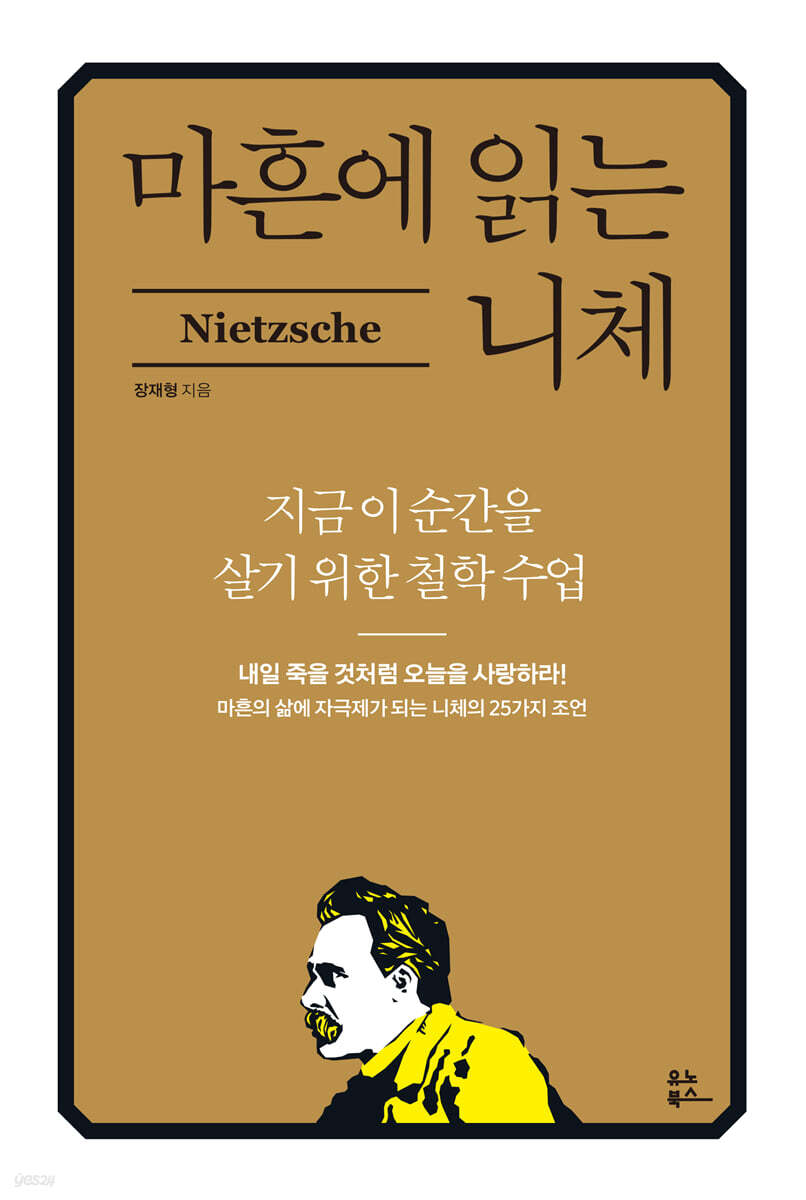
Reading Nietzsche at Forty
 |
Description
Book Introduction
Love today as if you were to die tomorrow!
25 Stimulating Tips from Nietzsche for Your Forty Years
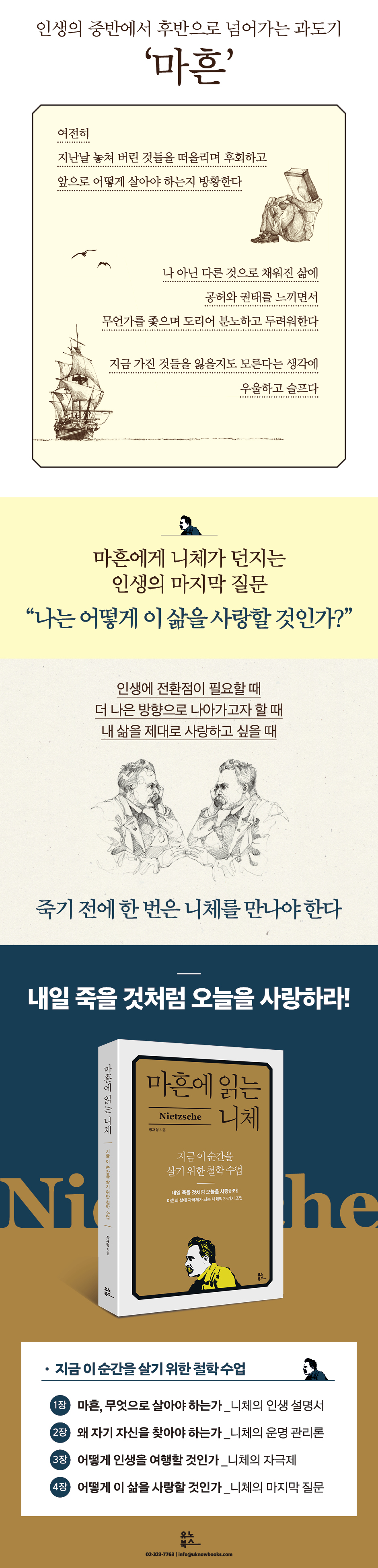
Forty is a transitional age between mid-life and late life.
I thought I would have a stable life in my forties, but I still feel unstable.
I regret things I missed in the past and wander about how I should live in the future.
Feeling empty and bored with a life filled with things other than myself, I chase after something and instead become angry and afraid.
I feel depressed and sad at the thought that I might lose what I have now.
Nietzsche asks you, at the age of forty, the last question of your life.
“How can I love this life?”
When you need a turning point in your life, when you want to move in a better direction, when you want to love your life properly, meet Nietzsche once before you die.
Then your life path will change.
Nietzsche's philosophy provides the enlightenment and method to love one's life proactively and enthusiastically, without compromising, no matter how futile, painful, and fearful the present life may be.
Nietzsche lost both his parents and family at a young age, suffered from illness throughout his life, and lived a difficult life, being shunned by his loved ones.
But I also looked at these difficulties in life as beautiful and shouted positive affirmations every morning.
The phrase "Amor Fati," which means "love your destiny," contains the message that we, who have experienced countless failures and frustrations, should accept life and ourselves as they are, use them as opportunities for growth, and continue to dream actively.
『Reading Nietzsche at Forty』 contains 25 philosophical thoughts that are especially important to our lives, among those left behind by Nietzsche as he pondered how to live this one life.
From Nietzsche, the foremost physician and psychologist who addressed the health of the human body and mind, you can learn everything from how to build a framework for life in your forties to how to transcend your true destiny, how to expand the scope of your life, and ultimately how to live your best life.
This will be a great stimulus and guidance to those in their forties at an important time in their lives.
If you are in your forties, approaching your forties, or looking back, the words of Nietzsche's philosophy, which sought to lead life proactively while acknowledging reality and limitations, will be a source of great comfort and encouragement.
It will also help you understand the true meaning of Nietzsche's philosophy.
Through Nietzsche's life lessons, I hope you can shake off all your worries and seize the key to passion and happiness that will allow you to love today as if you were going to die tomorrow.
25 Stimulating Tips from Nietzsche for Your Forty Years
Forty is a transitional age between mid-life and late life.
I thought I would have a stable life in my forties, but I still feel unstable.
I regret things I missed in the past and wander about how I should live in the future.
Feeling empty and bored with a life filled with things other than myself, I chase after something and instead become angry and afraid.
I feel depressed and sad at the thought that I might lose what I have now.
Nietzsche asks you, at the age of forty, the last question of your life.
“How can I love this life?”
When you need a turning point in your life, when you want to move in a better direction, when you want to love your life properly, meet Nietzsche once before you die.
Then your life path will change.
Nietzsche's philosophy provides the enlightenment and method to love one's life proactively and enthusiastically, without compromising, no matter how futile, painful, and fearful the present life may be.
Nietzsche lost both his parents and family at a young age, suffered from illness throughout his life, and lived a difficult life, being shunned by his loved ones.
But I also looked at these difficulties in life as beautiful and shouted positive affirmations every morning.
The phrase "Amor Fati," which means "love your destiny," contains the message that we, who have experienced countless failures and frustrations, should accept life and ourselves as they are, use them as opportunities for growth, and continue to dream actively.
『Reading Nietzsche at Forty』 contains 25 philosophical thoughts that are especially important to our lives, among those left behind by Nietzsche as he pondered how to live this one life.
From Nietzsche, the foremost physician and psychologist who addressed the health of the human body and mind, you can learn everything from how to build a framework for life in your forties to how to transcend your true destiny, how to expand the scope of your life, and ultimately how to live your best life.
This will be a great stimulus and guidance to those in their forties at an important time in their lives.
If you are in your forties, approaching your forties, or looking back, the words of Nietzsche's philosophy, which sought to lead life proactively while acknowledging reality and limitations, will be a source of great comfort and encouragement.
It will also help you understand the true meaning of Nietzsche's philosophy.
Through Nietzsche's life lessons, I hope you can shake off all your worries and seize the key to passion and happiness that will allow you to love today as if you were going to die tomorrow.
- You can preview some of the book's contents.
Preview
index
To begin with, how will I love this life?
Chapter 1: Forty: What Should We Live By? / Nietzsche's Guide to Life
01 Live Dangerously_The Death of God
-We are in this world, not that world.
Break away from familiarity and live as you want to be.
02 Rather, we need boredom _ Nihilism
-Why do you feel like life is worthless?
-Emotions that melt the frozen will to live
03 Man is something to be overcome _ Superman
-Become a human beyond human.
-How to live completely as yourself
-A person who has discovered the meaning of his own existence
04 Become a person who can be motivated _ Will to power
- Actions and reactions that occur in the mind
-Life is the will to power
-Listen to the inner voice calling you.
05 Set Fire to Your Cabin _ The Evangelization of All Values
-How long will you follow other people's principles?
-How to break free from the shackles
06 Love Your Fate _ Amor Fati
-Fate, how to truly love yourself
-I am who I am today, a product of the choices I made yesterday.
07 Beyond Eternity, Untiring, Once Again from the Beginning _Eternal Return
-Can I live this life over and over again?
-Existence begins in every moment.
-The best affirmation that transcends time
Chapter 2: Why We Must Find Ourselves / Nietzsche's Theory of Managing Fate
01 The Need for Holy Affirmation - Three Stages of Mental Change
-Three changes in mental development
-The answer to all problems lies within me.
-How can a person live as he or she is?
02 Be Yourself _ Body
-Is it me, my mind or my body?
-About the conscious me and the unconscious me
-How to find your true self
03 You can't swing a ladder far with just one ladder - Attempts and Questions
-What despair and suffering gave to Nietzsche
-Don't be afraid to try and ask questions.
04 Become a proper human being _ Human species
-The difference between a truly good human being and a mere human being
05 You must encounter a headwind to sail against any wind _ Downfall
-A great moment of contempt and downfall
-There is no life that only rises, and no life that only falls.
06 Nothing is already decided _ Chance and necessity
-Three events that changed Nietzsche's life
-Every moment the dice are thrown is our life.
Chapter 3: How to Travel Life / Nietzsche's Stimulant
01 You must be the master of your own life _Free Spirit
-The process of finding a free spirit
02 Become a noble nobleman _ Pathos of the streets
-The noble aspect of a human being
-Become a noble person who creates his own value.
03 Cut and crush like a flash of lightning _Hammer
-The world inside the cave and the world outside the cave
-The philosopher with a hammer, destroying the world
-How not to be deceived by vain things
04 What makes happiness happy is forgetting _ Forgetting and Memory
-The power of forgetting
-Two essential tools for living a healthy life
05 Write with Fatigue _ Aphorism
-The writing that created Nietzsche
06 Art is the great stimulant of life _Apollonian and Dionysian
-Apollonian art and Dionysian art
-How Art Changes Life
Chapter 4: How to Love This Life / Nietzsche's Last Question
01 The prescription for pain is pain _Pain
-How to be free from the pain of life
02 Show your strength to handle loneliness _ Solitude
-Travel is a process of finding yourself.
-Life realized while walking the road
03 I don't know what is good and what is evil _Resentment
-The thoughts of the ruler and the ruled
-The view that the strong are evil and the weak are good
-From slave to master
04 Create Your Own Little Garden of Happiness _ Nietzsche's Theory of Happiness
-Two types of happy people
-How to live happily ever after
05 Learn to Face Death _Death
-Death as viewed by Munch and Nietzsche
-To become a person worth existing
06 Accept the world as it is - Dionysian affirmation
-The Dionysian attitude to life
-Face the best life you can achieve
References
Chapter 1: Forty: What Should We Live By? / Nietzsche's Guide to Life
01 Live Dangerously_The Death of God
-We are in this world, not that world.
Break away from familiarity and live as you want to be.
02 Rather, we need boredom _ Nihilism
-Why do you feel like life is worthless?
-Emotions that melt the frozen will to live
03 Man is something to be overcome _ Superman
-Become a human beyond human.
-How to live completely as yourself
-A person who has discovered the meaning of his own existence
04 Become a person who can be motivated _ Will to power
- Actions and reactions that occur in the mind
-Life is the will to power
-Listen to the inner voice calling you.
05 Set Fire to Your Cabin _ The Evangelization of All Values
-How long will you follow other people's principles?
-How to break free from the shackles
06 Love Your Fate _ Amor Fati
-Fate, how to truly love yourself
-I am who I am today, a product of the choices I made yesterday.
07 Beyond Eternity, Untiring, Once Again from the Beginning _Eternal Return
-Can I live this life over and over again?
-Existence begins in every moment.
-The best affirmation that transcends time
Chapter 2: Why We Must Find Ourselves / Nietzsche's Theory of Managing Fate
01 The Need for Holy Affirmation - Three Stages of Mental Change
-Three changes in mental development
-The answer to all problems lies within me.
-How can a person live as he or she is?
02 Be Yourself _ Body
-Is it me, my mind or my body?
-About the conscious me and the unconscious me
-How to find your true self
03 You can't swing a ladder far with just one ladder - Attempts and Questions
-What despair and suffering gave to Nietzsche
-Don't be afraid to try and ask questions.
04 Become a proper human being _ Human species
-The difference between a truly good human being and a mere human being
05 You must encounter a headwind to sail against any wind _ Downfall
-A great moment of contempt and downfall
-There is no life that only rises, and no life that only falls.
06 Nothing is already decided _ Chance and necessity
-Three events that changed Nietzsche's life
-Every moment the dice are thrown is our life.
Chapter 3: How to Travel Life / Nietzsche's Stimulant
01 You must be the master of your own life _Free Spirit
-The process of finding a free spirit
02 Become a noble nobleman _ Pathos of the streets
-The noble aspect of a human being
-Become a noble person who creates his own value.
03 Cut and crush like a flash of lightning _Hammer
-The world inside the cave and the world outside the cave
-The philosopher with a hammer, destroying the world
-How not to be deceived by vain things
04 What makes happiness happy is forgetting _ Forgetting and Memory
-The power of forgetting
-Two essential tools for living a healthy life
05 Write with Fatigue _ Aphorism
-The writing that created Nietzsche
06 Art is the great stimulant of life _Apollonian and Dionysian
-Apollonian art and Dionysian art
-How Art Changes Life
Chapter 4: How to Love This Life / Nietzsche's Last Question
01 The prescription for pain is pain _Pain
-How to be free from the pain of life
02 Show your strength to handle loneliness _ Solitude
-Travel is a process of finding yourself.
-Life realized while walking the road
03 I don't know what is good and what is evil _Resentment
-The thoughts of the ruler and the ruled
-The view that the strong are evil and the weak are good
-From slave to master
04 Create Your Own Little Garden of Happiness _ Nietzsche's Theory of Happiness
-Two types of happy people
-How to live happily ever after
05 Learn to Face Death _Death
-Death as viewed by Munch and Nietzsche
-To become a person worth existing
06 Accept the world as it is - Dionysian affirmation
-The Dionysian attitude to life
-Face the best life you can achieve
References
Detailed image
Into the book
'How should I live the rest of my life?'
'Does everything I have make me happy?'
'Have I ever truly enjoyed my life?'
'Am I the master of my own life or a slave?'
If these questions resonate with you, it's time to ask a new question.
There is nothing in this world that does not change.
If there's one thing that doesn't change, it's that we all die someday.
Therefore, whether you live one more day or 50 more years, what matters is that you seek the questions, not the answers, of life.
--- p.5, from “How will I love this life?”
“Man is something that must always overcome himself.”
Now we need to practice letting go of the familiar.
Familiar things are things that we have believed in from the past to the present.
--- p.22, from “Live Dangerously_The Death of God”
Nietzsche's philosophy provides us with powerful mental weapons to improve our lives by pointing out our weaknesses.
His thoughts are on what is most important in life, how to achieve worthwhile goals, and how to endure and overcome present pain and adversity.
--- p.37, from “Humanity is something that must be overcome_Superman”
The past and the future are determined by this present moment.
It is this moment that determines whether the fact that the same thing is repeated forever is a curse or a blessing.
So, if you don't waste this moment, you can't turn back time, but you can change your life.
In other words, my fate can change.
If you truly want to change your destiny, you must focus and be faithful to the present moment.
Destiny truly comes alive when you exist in this very moment.
--- p.78, from “Beyond Eternity, Without Tire, Once Again from the Beginning _Eternal Return”
A truly well-mannered human being grows slowly over a long period of time, with pride filled with caution and ambition.
On the other hand, the human race can no longer become poor or rich.
Because for them, each and every one of them is too much of a hassle and hard work.
They only cling to what they have been doing so far and do not try to grow.
All humans simply want to live equally.
--- p.123, from “Become a truly good human being_The last of the human species”
For those in their forties, success isn't about 'what you've achieved' but 'how much you've grown'.
In life there is no eternal rise or eternal fall.
So, you just have to move forward at the pace that suits you.
--- p.133, from “You must encounter a headwind to sail against any wind_Downfall”
Smash empty dreams with Nietzsche's hammer.
Don't spend all day lost in vain fantasies and ideas.
Only those who constantly try, even when life is difficult and painful, can make their dreams come true.
--- p.177, from “Cut and crush like a flash_Hammer”
Nietzsche needed fifteen minutes of solitude to drink the strongest invigorating drink that came from his innermost well.
Solitude means having time to focus entirely on ourselves.
The reason you need to take time to focus on yourself is to get in touch with your emotions and intimacy.
But unfortunately, we cannot hear our inner voice.
So, in “Human, All Too Human II,” Nietzsche says to take 15 minutes to reflect deeply on yourself and nature.
--- p.227, from “Show the strength to endure loneliness_solitude”
The countless stains on our lives that we leave behind make us miserable.
It is natural to feel regret and pain when you fail.
But if you fall into despair and suffer from one failure, you can ruin the rest of your life.
Dionysian affirmation frees us from the bottomless swamp of despair and sets us on our own path again.
Happiness, according to Nietzsche, depends on how we can affirm life as it is.
'Does everything I have make me happy?'
'Have I ever truly enjoyed my life?'
'Am I the master of my own life or a slave?'
If these questions resonate with you, it's time to ask a new question.
There is nothing in this world that does not change.
If there's one thing that doesn't change, it's that we all die someday.
Therefore, whether you live one more day or 50 more years, what matters is that you seek the questions, not the answers, of life.
--- p.5, from “How will I love this life?”
“Man is something that must always overcome himself.”
Now we need to practice letting go of the familiar.
Familiar things are things that we have believed in from the past to the present.
--- p.22, from “Live Dangerously_The Death of God”
Nietzsche's philosophy provides us with powerful mental weapons to improve our lives by pointing out our weaknesses.
His thoughts are on what is most important in life, how to achieve worthwhile goals, and how to endure and overcome present pain and adversity.
--- p.37, from “Humanity is something that must be overcome_Superman”
The past and the future are determined by this present moment.
It is this moment that determines whether the fact that the same thing is repeated forever is a curse or a blessing.
So, if you don't waste this moment, you can't turn back time, but you can change your life.
In other words, my fate can change.
If you truly want to change your destiny, you must focus and be faithful to the present moment.
Destiny truly comes alive when you exist in this very moment.
--- p.78, from “Beyond Eternity, Without Tire, Once Again from the Beginning _Eternal Return”
A truly well-mannered human being grows slowly over a long period of time, with pride filled with caution and ambition.
On the other hand, the human race can no longer become poor or rich.
Because for them, each and every one of them is too much of a hassle and hard work.
They only cling to what they have been doing so far and do not try to grow.
All humans simply want to live equally.
--- p.123, from “Become a truly good human being_The last of the human species”
For those in their forties, success isn't about 'what you've achieved' but 'how much you've grown'.
In life there is no eternal rise or eternal fall.
So, you just have to move forward at the pace that suits you.
--- p.133, from “You must encounter a headwind to sail against any wind_Downfall”
Smash empty dreams with Nietzsche's hammer.
Don't spend all day lost in vain fantasies and ideas.
Only those who constantly try, even when life is difficult and painful, can make their dreams come true.
--- p.177, from “Cut and crush like a flash_Hammer”
Nietzsche needed fifteen minutes of solitude to drink the strongest invigorating drink that came from his innermost well.
Solitude means having time to focus entirely on ourselves.
The reason you need to take time to focus on yourself is to get in touch with your emotions and intimacy.
But unfortunately, we cannot hear our inner voice.
So, in “Human, All Too Human II,” Nietzsche says to take 15 minutes to reflect deeply on yourself and nature.
--- p.227, from “Show the strength to endure loneliness_solitude”
The countless stains on our lives that we leave behind make us miserable.
It is natural to feel regret and pain when you fail.
But if you fall into despair and suffer from one failure, you can ruin the rest of your life.
Dionysian affirmation frees us from the bottomless swamp of despair and sets us on our own path again.
Happiness, according to Nietzsche, depends on how we can affirm life as it is.
--- p.267, from “Accept this world as it is_Dionysian affirmation”
Publisher's Review
To those in their forties who are standing on the border of life
A necessary philosophy class
What kind of age is forty?
It could be said that this is the time to start taking responsibility for the things that have supported our lives for the past forty years.
So, as I get older, I want to be able to do a pretty good job in my work, relationships, and life.
But it is still difficult and unstable.
I struggle between my life dreams and realistic goals, but at the same time, I feel bored and exhausted by the thought that I've 'done enough'.
Sometimes I wonder if the person I am now is really the adult I wanted to be.
Forty is the turning point of life.
The boundary between mid-life and late-life, the boundary between the will to run forward and the helplessness that comes from running so hard, the boundary between regret for things missed in the past and the fear felt while chasing something, and the boundary between an attitude of settling for reality and a desire to live a better life.
In this way, various ambivalent feelings shake the forties.
If you are in your forties, or approaching your forties, or looking back, or if you want to live in the present moment, you need to listen to Nietzsche's words.
Nietzsche was a philosopher of the late 19th century, when the religious values that had dominated the West for 2,000 years were collapsing.
He emphasized self-esteem, overcoming fate, and self-growth, and left a message to humanity, filled with pain, despair, and emptiness, to accept and love their fate.
This also has great implications for those in their forties who have been running forward without knowing what kind of life they will lead.
Once before I die
Why You Should Meet Nietzsche
This book contains 25 points from Nietzsche's philosophy and all the records he left behind that are particularly important for our lives.
You can encounter Nietzsche's words alive throughout this book, including the story of Nietzsche's life, the framework of Nietzsche's philosophy and 19th-century philosophy, and the table of contents.
Because he thought and recorded with his whole body, his philosophy still resonates even after more than 100 years.
Nietzsche's philosophy began with the will to escape from a meaningless life.
It seems that this was because not only the circumstances of the times but also Nietzsche's personal life was difficult.
He lost his parents and siblings at a young age, was shunned by friends and loved ones, and suffered from illness throughout his life.
Nietzsche's favorite saying, for whom life was suffering itself, was 'nevertheless'.
Overcoming it, even if it's just one time suffering, is the solution he found.
And he left behind a way to love life by turning the numerous difficulties we encounter in life into opportunities.
'How should I live from now on?'
'Can't we get back what we lost in the past?'
'Can I not lose what I have now?'
'Am I the master of my own life or a slave?'
At the age of forty, when these questions arise, it is time to ask new ones.
From now on, find the answer to the last question in life that Nietzsche found.
“How will I love this life?”
Forty, this moment
I will love today as if I were to die tomorrow
In Thus Spoke Zarathustra, Zarathustra tells the dwarf to look at the path leading across a gate marked "Moment."
Behind the castle gate, the alleys of the past lead, and in front of the castle gate, the alleys of the future lead.
And we stand at this moment where past and present intersect.
Through this story, Nietzsche tells us that “there is only one present moment in our lives.”
Love yourself, constantly reflect on who you are, do what your heart leads you to, question your preconceived notions, see the world as beautiful, make room for new things, don't criticize, be a good human being, go with the flow of life, and don't forget that happiness comes slowly and gradually...
Nietzsche, while acknowledging reality and limitations, sought to live passionately and proactively at every moment, and to live life leisurely, going with the flow.
He also thought about happiness without stopping until he lost consciousness and collapsed.
The pearls of wisdom and insights gleaned from Nietzsche's life and philosophy will guide those in their forties who need a turning point in their lives, those who want to move in a better direction, and those who want to truly love their lives, on how to live well in the present moment.
A necessary philosophy class
What kind of age is forty?
It could be said that this is the time to start taking responsibility for the things that have supported our lives for the past forty years.
So, as I get older, I want to be able to do a pretty good job in my work, relationships, and life.
But it is still difficult and unstable.
I struggle between my life dreams and realistic goals, but at the same time, I feel bored and exhausted by the thought that I've 'done enough'.
Sometimes I wonder if the person I am now is really the adult I wanted to be.
Forty is the turning point of life.
The boundary between mid-life and late-life, the boundary between the will to run forward and the helplessness that comes from running so hard, the boundary between regret for things missed in the past and the fear felt while chasing something, and the boundary between an attitude of settling for reality and a desire to live a better life.
In this way, various ambivalent feelings shake the forties.
If you are in your forties, or approaching your forties, or looking back, or if you want to live in the present moment, you need to listen to Nietzsche's words.
Nietzsche was a philosopher of the late 19th century, when the religious values that had dominated the West for 2,000 years were collapsing.
He emphasized self-esteem, overcoming fate, and self-growth, and left a message to humanity, filled with pain, despair, and emptiness, to accept and love their fate.
This also has great implications for those in their forties who have been running forward without knowing what kind of life they will lead.
Once before I die
Why You Should Meet Nietzsche
This book contains 25 points from Nietzsche's philosophy and all the records he left behind that are particularly important for our lives.
You can encounter Nietzsche's words alive throughout this book, including the story of Nietzsche's life, the framework of Nietzsche's philosophy and 19th-century philosophy, and the table of contents.
Because he thought and recorded with his whole body, his philosophy still resonates even after more than 100 years.
Nietzsche's philosophy began with the will to escape from a meaningless life.
It seems that this was because not only the circumstances of the times but also Nietzsche's personal life was difficult.
He lost his parents and siblings at a young age, was shunned by friends and loved ones, and suffered from illness throughout his life.
Nietzsche's favorite saying, for whom life was suffering itself, was 'nevertheless'.
Overcoming it, even if it's just one time suffering, is the solution he found.
And he left behind a way to love life by turning the numerous difficulties we encounter in life into opportunities.
'How should I live from now on?'
'Can't we get back what we lost in the past?'
'Can I not lose what I have now?'
'Am I the master of my own life or a slave?'
At the age of forty, when these questions arise, it is time to ask new ones.
From now on, find the answer to the last question in life that Nietzsche found.
“How will I love this life?”
Forty, this moment
I will love today as if I were to die tomorrow
In Thus Spoke Zarathustra, Zarathustra tells the dwarf to look at the path leading across a gate marked "Moment."
Behind the castle gate, the alleys of the past lead, and in front of the castle gate, the alleys of the future lead.
And we stand at this moment where past and present intersect.
Through this story, Nietzsche tells us that “there is only one present moment in our lives.”
Love yourself, constantly reflect on who you are, do what your heart leads you to, question your preconceived notions, see the world as beautiful, make room for new things, don't criticize, be a good human being, go with the flow of life, and don't forget that happiness comes slowly and gradually...
Nietzsche, while acknowledging reality and limitations, sought to live passionately and proactively at every moment, and to live life leisurely, going with the flow.
He also thought about happiness without stopping until he lost consciousness and collapsed.
The pearls of wisdom and insights gleaned from Nietzsche's life and philosophy will guide those in their forties who need a turning point in their lives, those who want to move in a better direction, and those who want to truly love their lives, on how to live well in the present moment.
GOODS SPECIFICS
- Date of issue: September 1, 2022
- Page count, weight, size: 272 pages | 424g | 142*210*15mm
- ISBN13: 9791192300245
- ISBN10: 1192300246
You may also like
카테고리
korean


korean

![GQ KOREA Mark (Monthly): December [2025]](http://librairie.coreenne.fr/cdn/shop/files/8ef265dbbfbf186523ed75ba7319009d.jpg?v=1765340328&width=3840)


