

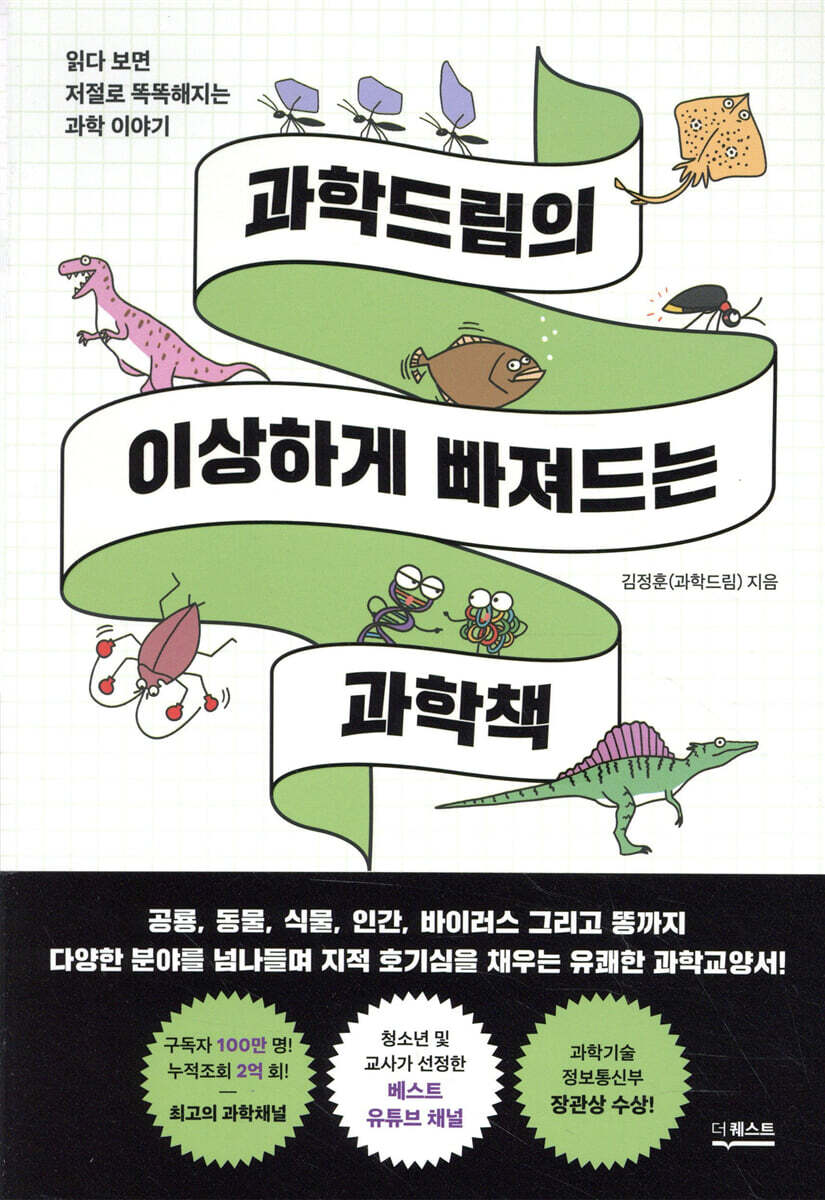
A strangely engrossing science book from Science Dream
 |
Description
Book Introduction
750,000 subscribers! 140 million cumulative views! The best science channel!
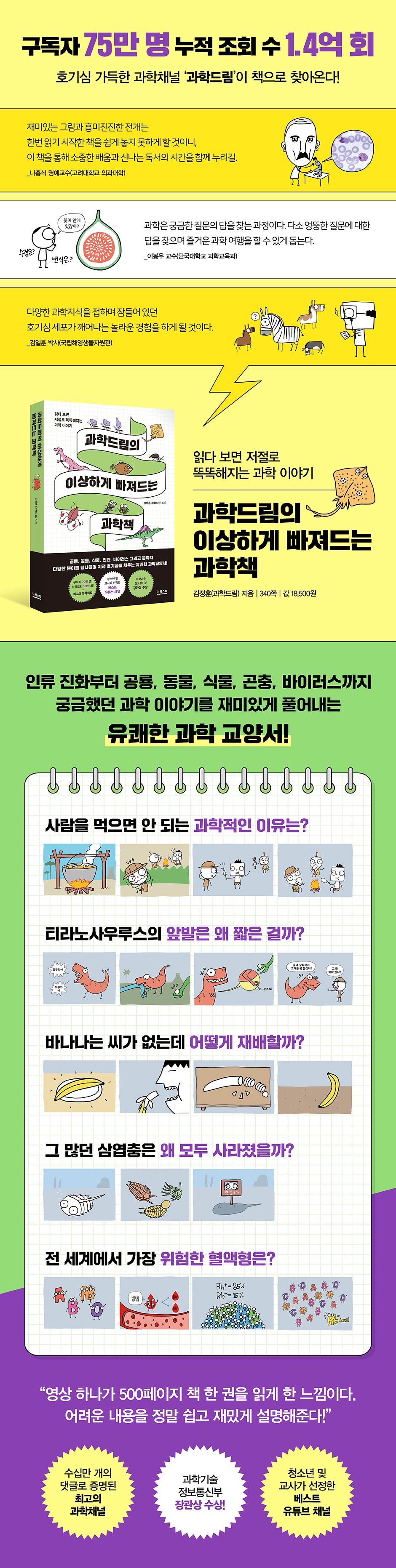
Received the Minister of Science and ICT Award! The best YouTube channels chosen by youth and teachers! Dinosaurs, animals, plants, humans, viruses, and even poop A delightful science textbook that satisfies your intellectual curiosity across diverse fields! The channel that everyone who knows a little about science knows, the famous 'Science Dream' channel with solid dictionary materials, fun photos and illustrations, accurate explanations, and endless scientific stories, is now available as a book! Just reading the titles such as 'Why did human hair disappear?', 'What is the scientific reason why we shouldn't eat people?', 'The dinosaur restoration was a real mess at first', 'Why did fish come out of the water?', 'Why is the flounder's face so ugly?', 'What happens if you feed 2,500 parasite eggs to a patient with enteritis?', etc. Stories that will pique your curiosity are organized with over 250 illustrations. Now, let's enter the world of the world's most enjoyable and easy-to-read science fiction. |
- You can preview some of the book's contents.
Preview
index
Prologue_ For those who love science, and those who will love it in the future.
Chapter 1.
Why are people like this?
Why are babies cute?
Why did human hair disappear?
Only human eyes have whites?
Why shouldn't we eat people?
Why are there fewer left-handed people than right-handed people?
What makes the human brain special?
[Strangely Engaging Science Question] What happens if you feed 2,500 parasite eggs to a patient with enteritis?
Chapter 2.
Why are dinosaurs like this?
Long ago, why did fish come up onto land?
Mesozoic Chronology: The Age of Giant Reptiles
Why were Tyrannosaurus's forelimbs so short?
What did Spinosaurus use the sail on its back for?
The Messy History of Dinosaur Restoration
Why do the creatures that emerged after the mass extinction look so strange?
Why did all the trilobites disappear?
Belly vs. Back: Which Evolved First?
[Strangely Engaging Science Questions] Where Did the First Life Come From?
Chapter 3.
Why are animals like this?
Why are bald eagles bald?
The more you know about the octopus, the more bizarre it becomes.
What's inside a rattlesnake's tail that makes a sound?
Why do zebras have stripes?
What's the real reason why a giraffe's neck is so long?
How did the flounder's face become crooked?
[Strangely engrossing science question] Is there a frog that gives birth through its mouth?
Chapter 4.
Why are insects like this?
Why are there so many insects on Earth?
Why do worker ants devote themselves to the queen and only work?
Why do fireflies glow?
Tsetse flies lay larvae, not eggs?
A parasitic wasp that even turns cockroaches into zombies?
The terrifying story of a fungus that controls fruit flies
[Strangely Engaging Science Questions] Amazing Insects That Defend Themselves with Poop
Chapter 5.
Why are plants like this?
How do you grow bananas if they don't have seeds?
Where do pineapples grow? (with walnuts and broccoli)
The ginkgo tree has broad leaves, so why is it a conifer?
Why are dead wasps found inside figs?
Long ago, there lived a fungus the size of a tree?
[Strangely Engaging Science Question 1] Where did the first virus come from?
[Strangely Engaging Science Question 2] What is the most dangerous blood type in the world?
Epilogue_Science: A Different Way of Seeing the World
References
Chapter 1.
Why are people like this?
Why are babies cute?
Why did human hair disappear?
Only human eyes have whites?
Why shouldn't we eat people?
Why are there fewer left-handed people than right-handed people?
What makes the human brain special?
[Strangely Engaging Science Question] What happens if you feed 2,500 parasite eggs to a patient with enteritis?
Chapter 2.
Why are dinosaurs like this?
Long ago, why did fish come up onto land?
Mesozoic Chronology: The Age of Giant Reptiles
Why were Tyrannosaurus's forelimbs so short?
What did Spinosaurus use the sail on its back for?
The Messy History of Dinosaur Restoration
Why do the creatures that emerged after the mass extinction look so strange?
Why did all the trilobites disappear?
Belly vs. Back: Which Evolved First?
[Strangely Engaging Science Questions] Where Did the First Life Come From?
Chapter 3.
Why are animals like this?
Why are bald eagles bald?
The more you know about the octopus, the more bizarre it becomes.
What's inside a rattlesnake's tail that makes a sound?
Why do zebras have stripes?
What's the real reason why a giraffe's neck is so long?
How did the flounder's face become crooked?
[Strangely engrossing science question] Is there a frog that gives birth through its mouth?
Chapter 4.
Why are insects like this?
Why are there so many insects on Earth?
Why do worker ants devote themselves to the queen and only work?
Why do fireflies glow?
Tsetse flies lay larvae, not eggs?
A parasitic wasp that even turns cockroaches into zombies?
The terrifying story of a fungus that controls fruit flies
[Strangely Engaging Science Questions] Amazing Insects That Defend Themselves with Poop
Chapter 5.
Why are plants like this?
How do you grow bananas if they don't have seeds?
Where do pineapples grow? (with walnuts and broccoli)
The ginkgo tree has broad leaves, so why is it a conifer?
Why are dead wasps found inside figs?
Long ago, there lived a fungus the size of a tree?
[Strangely Engaging Science Question 1] Where did the first virus come from?
[Strangely Engaging Science Question 2] What is the most dangerous blood type in the world?
Epilogue_Science: A Different Way of Seeing the World
References
Detailed image
Into the book
In 2017, Dr. James Cole, an archaeologist at the University of Brighton in the UK, conducted a rather bizarre study that analyzed human flesh nutritionally.
In his thesis, he estimated that for a 55kg male, the thighs are 13,350kcal, the upper arms are 7,450kcal, the lower arms are 1,660kcal, the heart is 650kcal, the liver is 2,570kcal, a pair of kidneys are 380kcal, the lungs are 1,600kcal, the large and small intestines are 1,260kcal, the skin is 10,280kcal, and the brain and spinal cord are 2,700kcal, and he revealed that the total calories of one human body amount to 120,000-140,000kcal.
Looking at it this way, you might think it's a 'high-calorie burger that destroys the intestines', but Dr. Cole explained that one human's flesh is only enough calories to sustain 25 men for half a day.
On the other hand, he noted that if a single mammoth, whose muscles alone amount to 3.6 million kcal, were caught, a group of the same number could last for two months.
In other words, there is no group in the history of human evolution that would routinely practice cannibalism to supplement nutrition.
--- From "Why shouldn't we eat people?"
65 million years ago, an asteroid suddenly struck Earth, causing countless reptiles to disappear from the sky, land, and sea.
Dinosaurs are no exception.
Most dinosaurs have disappeared into the back alleys of history.
Wait a minute! The word "most" is important here.
This means that not all dinosaurs went extinct.
This is because some dinosaurs, including theropods, called 'birds' survived.
Surprisingly, the pelvic bones of birds are identical in shape to those of dinosaurs.
So, in a word, birds are dinosaurs, and chickens, ducks, and pigeons are all dinosaurs.
This is currently the established theory in the dinosaur science community.
If we classify it this way, dinosaurs are included within reptiles, and birds are included within dinosaurs.
But in this case, the absurd thing happens where birds are classified as reptiles.
--- From "Mesozoic Chronology: The Age of Great Reptiles"
Flounder, commonly known as halibut, has a rather unique appearance.
Since ancient times, fish have been known to have bilateral symmetry, but the eyes of flounder and halibut are slanted to one side.
Moreover, they swim by waving their fins up and down rather than left and right.
What's interesting is that immediately after hatching, the halibut's eyes are symmetrical.
However, after three weeks, one eye begins to move to the other side, and after a month, the face becomes completely crooked.
--- From "How did the flounder's face become crooked?"
About 10 suckers (shoots that grow from the leaf axils of the underground part of the plant) grow from the banana corm to become banana grass.
If you cut this and plant it, it will grow into a banana genetically identical to its mother.
If we compare it to a person (a bit horrifying), it's like cutting off an arm and growing it back, and a person identical to that arm grows out of it.
So, bananas do not need seeds to grow.
In his thesis, he estimated that for a 55kg male, the thighs are 13,350kcal, the upper arms are 7,450kcal, the lower arms are 1,660kcal, the heart is 650kcal, the liver is 2,570kcal, a pair of kidneys are 380kcal, the lungs are 1,600kcal, the large and small intestines are 1,260kcal, the skin is 10,280kcal, and the brain and spinal cord are 2,700kcal, and he revealed that the total calories of one human body amount to 120,000-140,000kcal.
Looking at it this way, you might think it's a 'high-calorie burger that destroys the intestines', but Dr. Cole explained that one human's flesh is only enough calories to sustain 25 men for half a day.
On the other hand, he noted that if a single mammoth, whose muscles alone amount to 3.6 million kcal, were caught, a group of the same number could last for two months.
In other words, there is no group in the history of human evolution that would routinely practice cannibalism to supplement nutrition.
--- From "Why shouldn't we eat people?"
65 million years ago, an asteroid suddenly struck Earth, causing countless reptiles to disappear from the sky, land, and sea.
Dinosaurs are no exception.
Most dinosaurs have disappeared into the back alleys of history.
Wait a minute! The word "most" is important here.
This means that not all dinosaurs went extinct.
This is because some dinosaurs, including theropods, called 'birds' survived.
Surprisingly, the pelvic bones of birds are identical in shape to those of dinosaurs.
So, in a word, birds are dinosaurs, and chickens, ducks, and pigeons are all dinosaurs.
This is currently the established theory in the dinosaur science community.
If we classify it this way, dinosaurs are included within reptiles, and birds are included within dinosaurs.
But in this case, the absurd thing happens where birds are classified as reptiles.
--- From "Mesozoic Chronology: The Age of Great Reptiles"
Flounder, commonly known as halibut, has a rather unique appearance.
Since ancient times, fish have been known to have bilateral symmetry, but the eyes of flounder and halibut are slanted to one side.
Moreover, they swim by waving their fins up and down rather than left and right.
What's interesting is that immediately after hatching, the halibut's eyes are symmetrical.
However, after three weeks, one eye begins to move to the other side, and after a month, the face becomes completely crooked.
--- From "How did the flounder's face become crooked?"
About 10 suckers (shoots that grow from the leaf axils of the underground part of the plant) grow from the banana corm to become banana grass.
If you cut this and plant it, it will grow into a banana genetically identical to its mother.
If we compare it to a person (a bit horrifying), it's like cutting off an arm and growing it back, and a person identical to that arm grows out of it.
So, bananas do not need seeds to grow.
--- From "How can you grow bananas without seeds?"
Publisher's Review
Korea's best science channel, renowned for its thorough research and meticulous verification!
The best YouTube channels recommended by current science teachers!
We speak of real science, not pseudoscience, with good information, objective perspectives, and accurate theories!
“The only channel I subscribe to for science videos!”
“My head is full and I don’t feel like I’m wasting time.”
“I never knew science could be this interesting in a world of humanities and life.”
“I never wondered for a second, but I found myself watching without even realizing it.”
“I watch five videos at a time without my mom telling me to.”
I find myself unknowingly immersed in questions I've never wondered about in my life, such as, "Why do only humans have whites of the eyes?", "Why are Tyrannosaurus's forelimbs so short?", "What's the real reason giraffes' necks are so long?", "Why is the flounder's face crooked?", and "What is the most dangerous blood type in the world?"
That channel that you watch as if you were taking a major class even though you know absolutely nothing about it, that channel that science enthusiasts and students watch instead of science textbooks.
With over 750,000 subscribers and over 140 million cumulative views, Science Dream's videos are now available as a book.
It is “Science Dream’s Strangely Engrossing Science Book.”
The author, who majored in science education and worked as a journalist for a science magazine for over 10 years, is known for thoroughly researching his videos before making them.
We examine the original source and, when questions arise, directly contact experts in each field to increase the reliability and completeness of the video.
So, although the frequency of uploading videos is not short, it is famous for its solid content.
The author, who started the channel with the desire to convey science to many people in a fun and exciting way, awakens people's dormant curiosity cells and provides a new perspective that allows them to see the world from a different perspective.
A magical time to look at the world with interest,
Science stories that are more interesting when you know them
《Science Dream's Strangely Engrossing Science Book》 scientifically delves into the many stories of our daily lives that we pass by without a second thought.
For example, let's look at the question, 'Why did human hair disappear?'
Chimpanzees, gorillas, orangutans, and even humans are all apes, but humans are the only ones with less hair.
Why did human hair disappear? There's a surprising evolutionary story behind it.
Early humans appeared 4 to 5 million years ago, but it was not until about 1.8 million years ago that humans began to demonstrate their hunting abilities.
Until then, rather than hunting, they had been hiding from animals.
Early humans lived a vegetarian lifestyle, but as the climate became drier, grass became scarce, and they were forced to eat meat.
But hunting was not easy at all… The body was so covered in hair that hunting in the hot African daytime was truly hard work.
From this time on, humans began to gradually shed hair except for major areas.
And the sweat glands also began to develop.
That is, they strategically lose their fur and gain sweat for hunting.
The loss of fur made hunting possible, hunting led to carnivore consumption, carnivore consumption led to brain growth, and a larger brain led to more efficient hunting.
The brain growth that began in this way led humanity to embark on the path of an amazing revolution called civilized society.
The smooth skin we have today is a trace of the harsh survival game our ancestors fought for millions of years.
In this way, this book unfolds the hidden story of science in an exciting way.
Chapter 1.
In Chapter 2, “Why Are People Like This?”, the reasons why only humans have whites of the eye and why we should not eat people are discussed.
In “Why Are Dinosaurs Like This?”, the story of the messy restoration of dinosaurs and the evolution of various dinosaurs are told. In Chapter 3.
In “Why Are Animals Like This?”, behind-the-scenes stories of giraffes, zebras, octopuses, etc. are revealed, and in Chapter 4.
In “Why Are Insects Like This?”, there are strange stories about peculiar insects such as ants, tsetse flies, and parasitic wasps. In “Chapter 5.
“Why Are Plants Like This?” contains unique stories that cannot be found anywhere else, such as the story of the seeds of the ginkgo tree and banana, which are unique on Earth.
Over 250 illustrations, with Science Dream's signature cute and cheerful humor.
Into the fun of science!
The beginning of liking science is ‘curiosity.’
It starts from the heart that doesn't just look at what's next to me and think, 'That's how it is,' but rather wonders, 'Why on earth is that?'
For those who once loved science or who will love science in the future, the story of Science Dream helps to activate the curiosity cells that were previously forgotten.
Let's experience not only clear knowledge and information, but also curiosity and excitement through this book.
The best YouTube channels recommended by current science teachers!
We speak of real science, not pseudoscience, with good information, objective perspectives, and accurate theories!
“The only channel I subscribe to for science videos!”
“My head is full and I don’t feel like I’m wasting time.”
“I never knew science could be this interesting in a world of humanities and life.”
“I never wondered for a second, but I found myself watching without even realizing it.”
“I watch five videos at a time without my mom telling me to.”
I find myself unknowingly immersed in questions I've never wondered about in my life, such as, "Why do only humans have whites of the eyes?", "Why are Tyrannosaurus's forelimbs so short?", "What's the real reason giraffes' necks are so long?", "Why is the flounder's face crooked?", and "What is the most dangerous blood type in the world?"
That channel that you watch as if you were taking a major class even though you know absolutely nothing about it, that channel that science enthusiasts and students watch instead of science textbooks.
With over 750,000 subscribers and over 140 million cumulative views, Science Dream's videos are now available as a book.
It is “Science Dream’s Strangely Engrossing Science Book.”
The author, who majored in science education and worked as a journalist for a science magazine for over 10 years, is known for thoroughly researching his videos before making them.
We examine the original source and, when questions arise, directly contact experts in each field to increase the reliability and completeness of the video.
So, although the frequency of uploading videos is not short, it is famous for its solid content.
The author, who started the channel with the desire to convey science to many people in a fun and exciting way, awakens people's dormant curiosity cells and provides a new perspective that allows them to see the world from a different perspective.
A magical time to look at the world with interest,
Science stories that are more interesting when you know them
《Science Dream's Strangely Engrossing Science Book》 scientifically delves into the many stories of our daily lives that we pass by without a second thought.
For example, let's look at the question, 'Why did human hair disappear?'
Chimpanzees, gorillas, orangutans, and even humans are all apes, but humans are the only ones with less hair.
Why did human hair disappear? There's a surprising evolutionary story behind it.
Early humans appeared 4 to 5 million years ago, but it was not until about 1.8 million years ago that humans began to demonstrate their hunting abilities.
Until then, rather than hunting, they had been hiding from animals.
Early humans lived a vegetarian lifestyle, but as the climate became drier, grass became scarce, and they were forced to eat meat.
But hunting was not easy at all… The body was so covered in hair that hunting in the hot African daytime was truly hard work.
From this time on, humans began to gradually shed hair except for major areas.
And the sweat glands also began to develop.
That is, they strategically lose their fur and gain sweat for hunting.
The loss of fur made hunting possible, hunting led to carnivore consumption, carnivore consumption led to brain growth, and a larger brain led to more efficient hunting.
The brain growth that began in this way led humanity to embark on the path of an amazing revolution called civilized society.
The smooth skin we have today is a trace of the harsh survival game our ancestors fought for millions of years.
In this way, this book unfolds the hidden story of science in an exciting way.
Chapter 1.
In Chapter 2, “Why Are People Like This?”, the reasons why only humans have whites of the eye and why we should not eat people are discussed.
In “Why Are Dinosaurs Like This?”, the story of the messy restoration of dinosaurs and the evolution of various dinosaurs are told. In Chapter 3.
In “Why Are Animals Like This?”, behind-the-scenes stories of giraffes, zebras, octopuses, etc. are revealed, and in Chapter 4.
In “Why Are Insects Like This?”, there are strange stories about peculiar insects such as ants, tsetse flies, and parasitic wasps. In “Chapter 5.
“Why Are Plants Like This?” contains unique stories that cannot be found anywhere else, such as the story of the seeds of the ginkgo tree and banana, which are unique on Earth.
Over 250 illustrations, with Science Dream's signature cute and cheerful humor.
Into the fun of science!
The beginning of liking science is ‘curiosity.’
It starts from the heart that doesn't just look at what's next to me and think, 'That's how it is,' but rather wonders, 'Why on earth is that?'
For those who once loved science or who will love science in the future, the story of Science Dream helps to activate the curiosity cells that were previously forgotten.
Let's experience not only clear knowledge and information, but also curiosity and excitement through this book.
GOODS SPECIFICS
- Publication date: May 20, 2022
- Page count, weight, size: 340 pages | 576g | 148*215*30mm
- ISBN13: 9791165219734
- ISBN10: 1165219735
You may also like
카테고리
korean


korean

![GQ KOREA Mark (Monthly): December [2025]](http://librairie.coreenne.fr/cdn/shop/files/8ef265dbbfbf186523ed75ba7319009d.jpg?v=1765340328&width=3840)


