

Left-handed universe
 |
Description
Book Introduction
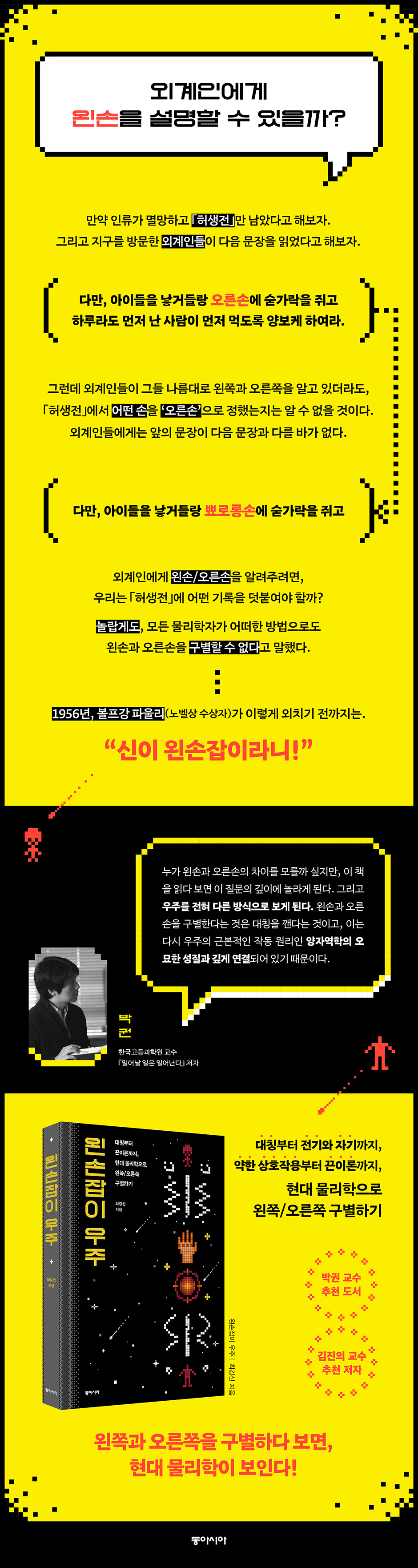
“God is left-handed!”
-Wolfgang Pauli, Nobel Prize winner in Physics
If you distinguish between left and right, you will see modern physics!
The physicist who writes the most unique and daring articles
Highly recommended by Professor Park Kwon of Korea Advanced Institute of Science and Technology
Recommended author by Professor Jin-ui Kim of Seoul National University
“Can you explain the right side?”
-Movie "Happy Dictionary"
Could you explain your left hand to an alien? Imagine if humanity were to perish, leaving only "Heosaengjeon" (The Story of a Man Who Lives).
And let's say that some intelligent beings who visited Earth deciphered the following sentence from "Heosaengjeon".
“When you have children, hold the spoon in your right hand and let the one born a day earlier eat first.” Even if they have their own concept of left and right, we will never know which hand is designated as the ‘right hand’ in “Heosaengjeon.”
For these creatures, the preceding sentence means nothing more than “If you give birth to children, hold a spoon in your hand.”
What records should we add to the "Heosaengjeon" to let them know which hand is left or right?
Amazingly, until 1956, all physicists said that no records could tell us who was left-handed.
To distinguish between left and right hands, we need to distinguish between left and right, and to know the difference between left and right requires a higher level of modern physics.
But precisely because of that, the book argues that by distinguishing between the seemingly familiar differences between left and right, we can come to understand electricity and magnetism, the four fundamental forces of nature, and even symmetry breaking, dimensionality, and the deepest secrets of the universe.
So why is the distinction between left and right so deeply intertwined with the universe? Because, as physicists and mathematicians realized in the 20th century, symmetry and its breaking are among the most fundamental principles of nature.
For example, the law of conservation of energy is derived from the time-translational symmetry of the laws of nature, and the law of conservation of momentum and the law of conservation of angular momentum are derived from the space-translational symmetry and rotational symmetry of the laws of nature, respectively.
Furthermore, in general, the (continuous) symmetries of all physical laws correspond to conservation laws.
On the other hand, spontaneous symmetry breaking in quantum mechanics is already the most important means of understanding the origin of the universe and mass.
But knowing that the left and right hands are similar is understanding symmetry, and knowing that they are different is understanding the breaking of symmetry.
The left and right hands, which seem so familiar to us, contain the operating principles of our universe.
“To put it mildly, a very slight exaggeration, physics without symmetry is nothing.” (Nobel laureate in physics Philip Anderson)
“You might wonder who wouldn’t know the difference between the left and right hands, but as you read this book, you’ll be amazed at the depth of this question.
And you start to see the universe in a completely different way.
“Distinguishing between left and right hands is a violation of symmetry, which in turn is deeply connected to the mysterious nature of quantum mechanics, the fundamental operating principle of the universe.”
Park Kwon, Professor at Korea Advanced Institute of Science and Technology and author of "What's meant to happen will happen."
-Wolfgang Pauli, Nobel Prize winner in Physics
If you distinguish between left and right, you will see modern physics!
The physicist who writes the most unique and daring articles
Highly recommended by Professor Park Kwon of Korea Advanced Institute of Science and Technology
Recommended author by Professor Jin-ui Kim of Seoul National University
“Can you explain the right side?”
-Movie "Happy Dictionary"
Could you explain your left hand to an alien? Imagine if humanity were to perish, leaving only "Heosaengjeon" (The Story of a Man Who Lives).
And let's say that some intelligent beings who visited Earth deciphered the following sentence from "Heosaengjeon".
“When you have children, hold the spoon in your right hand and let the one born a day earlier eat first.” Even if they have their own concept of left and right, we will never know which hand is designated as the ‘right hand’ in “Heosaengjeon.”
For these creatures, the preceding sentence means nothing more than “If you give birth to children, hold a spoon in your hand.”
What records should we add to the "Heosaengjeon" to let them know which hand is left or right?
Amazingly, until 1956, all physicists said that no records could tell us who was left-handed.
To distinguish between left and right hands, we need to distinguish between left and right, and to know the difference between left and right requires a higher level of modern physics.
But precisely because of that, the book argues that by distinguishing between the seemingly familiar differences between left and right, we can come to understand electricity and magnetism, the four fundamental forces of nature, and even symmetry breaking, dimensionality, and the deepest secrets of the universe.
So why is the distinction between left and right so deeply intertwined with the universe? Because, as physicists and mathematicians realized in the 20th century, symmetry and its breaking are among the most fundamental principles of nature.
For example, the law of conservation of energy is derived from the time-translational symmetry of the laws of nature, and the law of conservation of momentum and the law of conservation of angular momentum are derived from the space-translational symmetry and rotational symmetry of the laws of nature, respectively.
Furthermore, in general, the (continuous) symmetries of all physical laws correspond to conservation laws.
On the other hand, spontaneous symmetry breaking in quantum mechanics is already the most important means of understanding the origin of the universe and mass.
But knowing that the left and right hands are similar is understanding symmetry, and knowing that they are different is understanding the breaking of symmetry.
The left and right hands, which seem so familiar to us, contain the operating principles of our universe.
“To put it mildly, a very slight exaggeration, physics without symmetry is nothing.” (Nobel laureate in physics Philip Anderson)
“You might wonder who wouldn’t know the difference between the left and right hands, but as you read this book, you’ll be amazed at the depth of this question.
And you start to see the universe in a completely different way.
“Distinguishing between left and right hands is a violation of symmetry, which in turn is deeply connected to the mysterious nature of quantum mechanics, the fundamental operating principle of the universe.”
Park Kwon, Professor at Korea Advanced Institute of Science and Technology and author of "What's meant to happen will happen."
- You can preview some of the book's contents.
Preview
index
Introduction: Science helps us realize what we don't know.
one.
promise
1.
Different left and right hands
2.
The left and right hands are similar
3.
You can promise without knowing
4.
Other things that have left-hand and right-hand relationships
5.
Arecibo Message
6.
Ozma problem
two.
symmetry
7.
beauty
8.
symmetry
9.
The relationship between left and right, odd-evenness
10.
The power of symmetry
11.
broken symmetry
three.
Up, down
12.
Because objects fall down
13.
People who live hanging upside down
14.
The moon falls to the ground, gravity
15.
Up and down
16.
Shape of a living thing
17.
A world turned upside down
four.
Yang and Yin
18.
The fundamental power of nature felt in everyday life
19.
discovery of electricity
20.
Your Majesty, carry the electricity
21.
current, the flow of electricity
22.
Current flow and current
23.
two poles of a magnet
24.
Power and Yard
25.
Are there magnets with only one pole?
five.
Integration of electricity and magnetism
26.
Oersted's discovery
27.
Mach's shock
28.
Right-hand rule
29.
Unification of electromagnetic symmetry and force
30.
Electric tools
31.
Symmetry of electricity and magnetism
32.
Tools that conduct electricity
33.
There is no free lunch in nature.
34.
Maxwell and Light
six.
Other powers
35.
atoms, small magnets
36.
weak interaction
37.
Mirrors and odd-evenness
38.
Violation of odd-even rule
39.
How to define the right hand, the answer to the Ozma problem
40.
neutrino
seven.
Detailed story
41.
Angular momentum, helicity
42.
The Ugly World and the Higgs Boson
43.
How many types of transmission are there?
44.
antiparticle
45.
Mirror, Higher Dimension
46.
Time flow
References
main
one.
promise
1.
Different left and right hands
2.
The left and right hands are similar
3.
You can promise without knowing
4.
Other things that have left-hand and right-hand relationships
5.
Arecibo Message
6.
Ozma problem
two.
symmetry
7.
beauty
8.
symmetry
9.
The relationship between left and right, odd-evenness
10.
The power of symmetry
11.
broken symmetry
three.
Up, down
12.
Because objects fall down
13.
People who live hanging upside down
14.
The moon falls to the ground, gravity
15.
Up and down
16.
Shape of a living thing
17.
A world turned upside down
four.
Yang and Yin
18.
The fundamental power of nature felt in everyday life
19.
discovery of electricity
20.
Your Majesty, carry the electricity
21.
current, the flow of electricity
22.
Current flow and current
23.
two poles of a magnet
24.
Power and Yard
25.
Are there magnets with only one pole?
five.
Integration of electricity and magnetism
26.
Oersted's discovery
27.
Mach's shock
28.
Right-hand rule
29.
Unification of electromagnetic symmetry and force
30.
Electric tools
31.
Symmetry of electricity and magnetism
32.
Tools that conduct electricity
33.
There is no free lunch in nature.
34.
Maxwell and Light
six.
Other powers
35.
atoms, small magnets
36.
weak interaction
37.
Mirrors and odd-evenness
38.
Violation of odd-even rule
39.
How to define the right hand, the answer to the Ozma problem
40.
neutrino
seven.
Detailed story
41.
Angular momentum, helicity
42.
The Ugly World and the Higgs Boson
43.
How many types of transmission are there?
44.
antiparticle
45.
Mirror, Higher Dimension
46.
Time flow
References
main
Detailed image
Into the book
It may sound strange, but the goal of this book is to distinguish between left and right.
How can we tell them apart? A moment's reflection reveals that while they may seem familiar, distinguishing them isn't easy.
The amazing thing is that physics tells us how to distinguish between right and left.
--- p.4
Why do most people eat with their right hand? It's one of two things.
1. I don't know for sure, but there is a reason.
Earthlings are born with a natural ability to use their right hand better.
2. There is no reason, it is just a coincidence.
Although both hands can be used equally, more and more people have been taught and taught that they should eat with their right hand.
--- p.20
Andromedan: I don't know that letter.
Describe the shape of the letter L.
Earthling: First, draw a line segment and stand it up vertically.
Andromedan: Yeah.
(Draw a '|' and set it up.) Earthling: Then, attach a short stroke to the bottom of this line segment, and attach it so that it extends to the right.
Andromedan: Wait, right? We were talking about how right is defined.
--- p.36
However, if you apply too much ink and stamp, you can create the decalcomania that we discussed in the previous chapter.
In other words, when I fold the ballot, the ink on the box for the candidate I want to vote for may spread and stamp other boxes.
When that happens, if the voting stamp looks like the one in Figure 14, it is impossible to distinguish between the original and the flipped stamp.
This is because they all have bidirectional symmetry.
--- p.55-56
Imagine being the protagonist of a detective novel, being kidnapped by someone and being brought into a hotel blindfolded.
If you can only remove the blindfold after getting off the elevator, how can you know which floor you're on? Even if you get on the elevator with your eyes open, there are situations where you can't know.
If there are no floor markings inside the elevator, and the interior decoration of all floors outside the elevator is the same, you won't be able to tell which floor you are on even when the elevator stops and the doors open.
(…) The symmetry regarding straight line movement to the left, right, up, and down is called ‘translational symmetry.’
--- p.68-69
Even if you experiment with everything you've learned so far, you still won't know which direction the current flows.
Unfortunately, even when the concept of electric current was first defined, it was not clear what 'causes electricity to flow'.
I just made that promise without knowing anything.
Promise: Let's promise that the current flows from the (+) terminal of the battery to the (?) terminal.
(Inside the battery, it should come in through the (?) of the battery and go out to the (+) side.) Can I promise this? (…) In other words, even if you change all the (+) and (-) that have been discussed in this book so far, the contents of this book will not change!
--- p.110-111
The N pole, or the part that was at the top, turns to the left, and the S pole, or the part that was at the bottom, turns to the right.
The compass needle turned in one direction.
It could have gone the exact opposite way, so why did it only go one way? It's strange.
This is because, not only before the current flows, but also the current itself has bidirectional symmetry in terms of the left-right reversal operation.
If there is a reason to turn right, there should be a reason to turn left as well.
--- p.137
You can also memorize the direction of the North Pole using your right hand.
Wrap your right hand so that the direction of rotation matches the direction of current flow.
Then, the direction of the thumb becomes the direction that the N pole points.
You could call this the 'new right-hand rule'.
The important thing here is that the direction of the thumb is not the direction in which the current flows as before, but the direction in which the N pole rotates.
This new right-hand rule is not directly related to the right-hand rule we saw earlier.
--- p.147
If there is spin, even an uncharged particle becomes magnetized, just as a charged object would spin.
Therefore, electrically neutral neutrons and atoms are small magnets, and their orientation is determined solely by their spin.
At this time, the direction of the magnet is determined by the right-hand rule through the direction of the spin.
If you think of spin as rotation and wrap the four fingers of your right hand in the direction in which the particle rotates, the direction your thumb points is the direction of spin, which is the direction of the north pole of the magnet.
--- p.171
Now it's time to talk about an experiment to distinguish between the N and S poles.
This has to do with the violation of parity.
In 1954, many physicists were pondering the so-called 'tau-theta problem'.
Tau and theta particles decayed differently even though they had the same mass and half-life. 53 Normally, particles with the same mass and half-life are the same, but the tau particle decayed into three pi particles, and the theta particle decayed into two pi particles.
How can we tell them apart? A moment's reflection reveals that while they may seem familiar, distinguishing them isn't easy.
The amazing thing is that physics tells us how to distinguish between right and left.
--- p.4
Why do most people eat with their right hand? It's one of two things.
1. I don't know for sure, but there is a reason.
Earthlings are born with a natural ability to use their right hand better.
2. There is no reason, it is just a coincidence.
Although both hands can be used equally, more and more people have been taught and taught that they should eat with their right hand.
--- p.20
Andromedan: I don't know that letter.
Describe the shape of the letter L.
Earthling: First, draw a line segment and stand it up vertically.
Andromedan: Yeah.
(Draw a '|' and set it up.) Earthling: Then, attach a short stroke to the bottom of this line segment, and attach it so that it extends to the right.
Andromedan: Wait, right? We were talking about how right is defined.
--- p.36
However, if you apply too much ink and stamp, you can create the decalcomania that we discussed in the previous chapter.
In other words, when I fold the ballot, the ink on the box for the candidate I want to vote for may spread and stamp other boxes.
When that happens, if the voting stamp looks like the one in Figure 14, it is impossible to distinguish between the original and the flipped stamp.
This is because they all have bidirectional symmetry.
--- p.55-56
Imagine being the protagonist of a detective novel, being kidnapped by someone and being brought into a hotel blindfolded.
If you can only remove the blindfold after getting off the elevator, how can you know which floor you're on? Even if you get on the elevator with your eyes open, there are situations where you can't know.
If there are no floor markings inside the elevator, and the interior decoration of all floors outside the elevator is the same, you won't be able to tell which floor you are on even when the elevator stops and the doors open.
(…) The symmetry regarding straight line movement to the left, right, up, and down is called ‘translational symmetry.’
--- p.68-69
Even if you experiment with everything you've learned so far, you still won't know which direction the current flows.
Unfortunately, even when the concept of electric current was first defined, it was not clear what 'causes electricity to flow'.
I just made that promise without knowing anything.
Promise: Let's promise that the current flows from the (+) terminal of the battery to the (?) terminal.
(Inside the battery, it should come in through the (?) of the battery and go out to the (+) side.) Can I promise this? (…) In other words, even if you change all the (+) and (-) that have been discussed in this book so far, the contents of this book will not change!
--- p.110-111
The N pole, or the part that was at the top, turns to the left, and the S pole, or the part that was at the bottom, turns to the right.
The compass needle turned in one direction.
It could have gone the exact opposite way, so why did it only go one way? It's strange.
This is because, not only before the current flows, but also the current itself has bidirectional symmetry in terms of the left-right reversal operation.
If there is a reason to turn right, there should be a reason to turn left as well.
--- p.137
You can also memorize the direction of the North Pole using your right hand.
Wrap your right hand so that the direction of rotation matches the direction of current flow.
Then, the direction of the thumb becomes the direction that the N pole points.
You could call this the 'new right-hand rule'.
The important thing here is that the direction of the thumb is not the direction in which the current flows as before, but the direction in which the N pole rotates.
This new right-hand rule is not directly related to the right-hand rule we saw earlier.
--- p.147
If there is spin, even an uncharged particle becomes magnetized, just as a charged object would spin.
Therefore, electrically neutral neutrons and atoms are small magnets, and their orientation is determined solely by their spin.
At this time, the direction of the magnet is determined by the right-hand rule through the direction of the spin.
If you think of spin as rotation and wrap the four fingers of your right hand in the direction in which the particle rotates, the direction your thumb points is the direction of spin, which is the direction of the north pole of the magnet.
--- p.171
Now it's time to talk about an experiment to distinguish between the N and S poles.
This has to do with the violation of parity.
In 1954, many physicists were pondering the so-called 'tau-theta problem'.
Tau and theta particles decayed differently even though they had the same mass and half-life. 53 Normally, particles with the same mass and half-life are the same, but the tau particle decayed into three pi particles, and the theta particle decayed into two pi particles.
--- p.184
Publisher's Review
“A little, a little exaggerated,
“Physics without symmetry is nothing.”
Philip Anderson, Nobel Prize winner in Physics
We find beauty in symmetry.
I find beauty in the bilateral symmetry of the Taj Mahal, the rotational symmetry of ceramics, and the translational symmetry of bathroom tiles.
Physicists are no different, preferring physical laws that have symmetry, just as fish prefer symmetrical bodies as mates.
But physicists are more persistent, believing that the laws of physics must have symmetry.
One of the symmetries that physicists so revere is mirror symmetry.
In other words, physicists were very firm in their belief that nature did not discriminate between left and right, so that 'anything' that happened to the left could also happen to the right.
For example, let's take a picture of a tree that is not growing straight but is slightly twisted to the left.
And if you show someone a picture of a tree, they will never know whether it is the original or a reversed version.
Because in nature there are as many trees that are twisted to the right as there are trees that are twisted to the left.
But by 1956, things had changed dramatically.
Physicists observed tiny particles and discovered that one particle, a neutrino, only rotated to the left.
Mirror symmetry is broken.
This meant that the universe was asymmetrical at a fundamental level and that nature discriminated between left and right, which caused Wolfgang Pauli to be astonished:
“God is left-handed!”
As Pauli said, is nature truly left-handed, discriminating between left and right? "Distinguishing between left and right is one of the most entertaining games in the world, so I encourage readers to follow the book's logical progression without spoilers and find the answer for themselves."
(…) Above all, I hope you will read this book critically, as its conclusions differ from Gardner’s (in Martin Gardner’s Ambidextrous Natural World) conclusions.”
From symmetry to electricity and magnetism,
From weak interactions to string theory
If you distinguish between left and right,
Modern physics is visible!
It may sound strange, but the goal of this book is to distinguish between left and right.
In 1964, Martin Gardner gave the problem of distinguishing left from right the name "Ozma problem" and made it a more specific question.
"Is there a way to convey the meaning of 'left' in a language that can be transmitted as a pulse signal? The signal could be expressed in any language, allowing the recipients to determine this through experimentation.
However, there is one condition.
“There is no asymmetrical object or structure that we and they have in common.”
The problem is that the question explaining the left side seems so unsolvable that it “really drives my brain crazy.”
For example, it seems like it could be solved by using the asymmetry of the alphabet L to indicate right and the opposite direction as left.
Andromedan: I don't know that letter.
Describe the shape of the letter L.
Earthling: First, draw a line segment and stand it up vertically.
Andromedan: Yeah.
(Draw and set up '|'.)
Earthling: Next, attach a short stroke to the bottom of this line segment, extending to the right.
Andromedan: Wait, right? We were talking about how right is defined.
─Page 36
This book shows that not only the letter L, but also the positive and negative poles of electricity, the north and south poles of magnets, and gravity cannot distinguish left and right or up and down, and why at least a weak interaction is needed to distinguish between the two.
However, since “the relationship between the left and right hands is hidden in the relationship between electricity and magnetism,” in the process of solving the problem, various physical concepts such as mirror symmetry and various other symmetries, electric charge and magnetic charge, the right-hand rule of electricity and magnetism, Mach impulse, electrons and protons, spin, and vectors are introduced and explained together.
In other words, in the process of distinguishing between left and right, you will come to understand all the core physics concepts.
But, as befitting an author who studies particle physics and string theory, this book doesn't stop at the 1956 discovery, but goes one step further toward the profound secrets of the universe.
He discusses how symmetry and broken symmetry are connected to the origins of the universe and mass, the possibility that charge might be one thing rather than two, indirect evidence for extra dimensions and a new Ozma problem, and time-reversal symmetry that flips the past and future, all in a “staggeringly original and incredibly outrageous piece of writing.”
“Physics without symmetry is nothing.”
Philip Anderson, Nobel Prize winner in Physics
We find beauty in symmetry.
I find beauty in the bilateral symmetry of the Taj Mahal, the rotational symmetry of ceramics, and the translational symmetry of bathroom tiles.
Physicists are no different, preferring physical laws that have symmetry, just as fish prefer symmetrical bodies as mates.
But physicists are more persistent, believing that the laws of physics must have symmetry.
One of the symmetries that physicists so revere is mirror symmetry.
In other words, physicists were very firm in their belief that nature did not discriminate between left and right, so that 'anything' that happened to the left could also happen to the right.
For example, let's take a picture of a tree that is not growing straight but is slightly twisted to the left.
And if you show someone a picture of a tree, they will never know whether it is the original or a reversed version.
Because in nature there are as many trees that are twisted to the right as there are trees that are twisted to the left.
But by 1956, things had changed dramatically.
Physicists observed tiny particles and discovered that one particle, a neutrino, only rotated to the left.
Mirror symmetry is broken.
This meant that the universe was asymmetrical at a fundamental level and that nature discriminated between left and right, which caused Wolfgang Pauli to be astonished:
“God is left-handed!”
As Pauli said, is nature truly left-handed, discriminating between left and right? "Distinguishing between left and right is one of the most entertaining games in the world, so I encourage readers to follow the book's logical progression without spoilers and find the answer for themselves."
(…) Above all, I hope you will read this book critically, as its conclusions differ from Gardner’s (in Martin Gardner’s Ambidextrous Natural World) conclusions.”
From symmetry to electricity and magnetism,
From weak interactions to string theory
If you distinguish between left and right,
Modern physics is visible!
It may sound strange, but the goal of this book is to distinguish between left and right.
In 1964, Martin Gardner gave the problem of distinguishing left from right the name "Ozma problem" and made it a more specific question.
"Is there a way to convey the meaning of 'left' in a language that can be transmitted as a pulse signal? The signal could be expressed in any language, allowing the recipients to determine this through experimentation.
However, there is one condition.
“There is no asymmetrical object or structure that we and they have in common.”
The problem is that the question explaining the left side seems so unsolvable that it “really drives my brain crazy.”
For example, it seems like it could be solved by using the asymmetry of the alphabet L to indicate right and the opposite direction as left.
Andromedan: I don't know that letter.
Describe the shape of the letter L.
Earthling: First, draw a line segment and stand it up vertically.
Andromedan: Yeah.
(Draw and set up '|'.)
Earthling: Next, attach a short stroke to the bottom of this line segment, extending to the right.
Andromedan: Wait, right? We were talking about how right is defined.
─Page 36
This book shows that not only the letter L, but also the positive and negative poles of electricity, the north and south poles of magnets, and gravity cannot distinguish left and right or up and down, and why at least a weak interaction is needed to distinguish between the two.
However, since “the relationship between the left and right hands is hidden in the relationship between electricity and magnetism,” in the process of solving the problem, various physical concepts such as mirror symmetry and various other symmetries, electric charge and magnetic charge, the right-hand rule of electricity and magnetism, Mach impulse, electrons and protons, spin, and vectors are introduced and explained together.
In other words, in the process of distinguishing between left and right, you will come to understand all the core physics concepts.
But, as befitting an author who studies particle physics and string theory, this book doesn't stop at the 1956 discovery, but goes one step further toward the profound secrets of the universe.
He discusses how symmetry and broken symmetry are connected to the origins of the universe and mass, the possibility that charge might be one thing rather than two, indirect evidence for extra dimensions and a new Ozma problem, and time-reversal symmetry that flips the past and future, all in a “staggeringly original and incredibly outrageous piece of writing.”
GOODS SPECIFICS
- Date of issue: May 10, 2022
- Page count, weight, size: 240 pages | 436g | 134*195*20mm
- ISBN13: 9788962624304
- ISBN10: 8962624303
You may also like
카테고리
korean


korean

![GQ KOREA Mark (Monthly): December [2025]](http://librairie.coreenne.fr/cdn/shop/files/8ef265dbbfbf186523ed75ba7319009d.jpg?v=1765340328&width=3840)


