

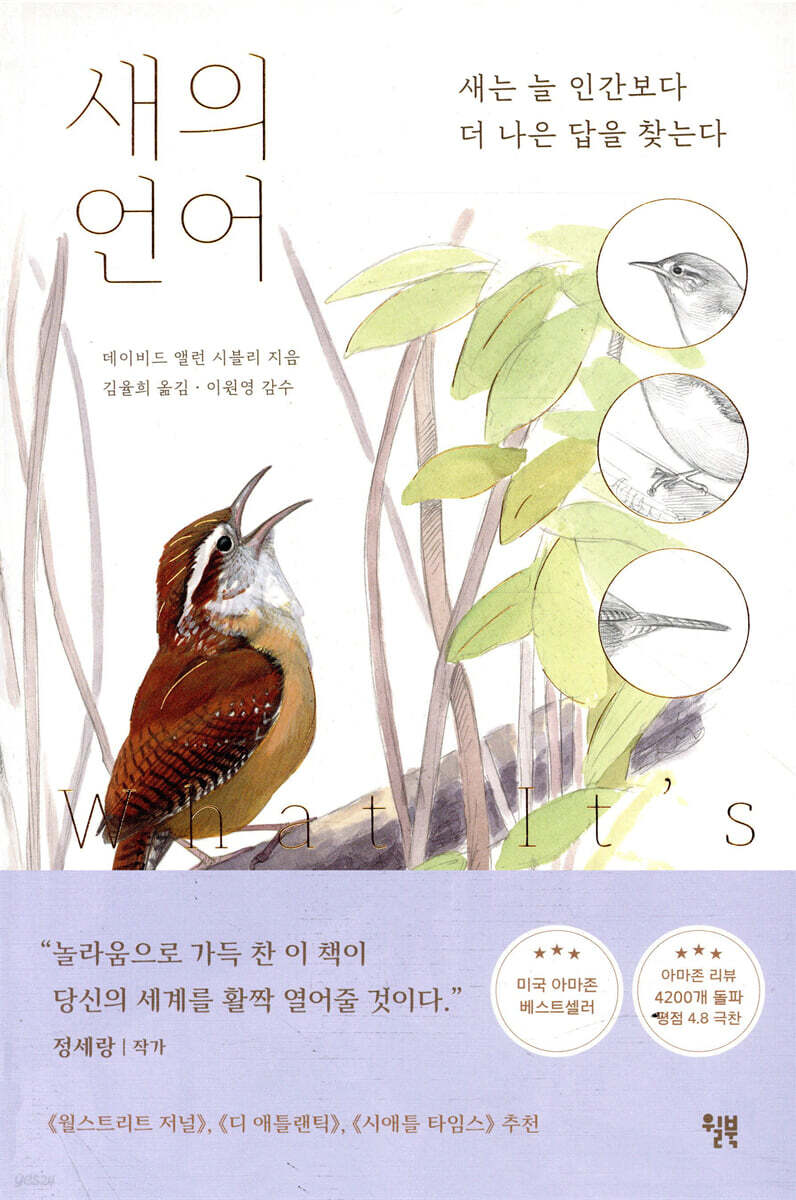
The language of birds
 |
Description
Book Introduction
- A word from MD
-
Welcome to the world of birds, full of surprises.A book that lets you experience the world of birds that you would never have known about if you hadn't read it.
Alan Sibley, a lifelong birdwatcher, vividly describes the lives of birds, capturing every sensation they experience.
This is the most amazing scientific textbook on birds, a history of evolution, and an illustrated guide with over 330 beautifully detailed illustrations.
March 30, 2021. Natural Science PD Kim Joo-ri
"How to Become a Bird and Live as a Bird," says the author, who has observed birds his entire life.
“Can birds smell?”, “Why don’t birds fall over when they stand on one leg?”, “When do migratory birds, which fly tens of thousands of kilometers without stopping, sleep?” These are questions that anyone with even a passing interest in birds has probably thought about at least once.
David Alan Sibley, a bestselling author and lifelong birder and illustrator who has been drawing birds for over 50 years since he was seven, provides a thorough explanation of our curiosity through his bird guides, which he personally drew and wrote.
In addition, it contains surprising secrets carved into various parts of the bird's body, such as its feathers and wings, as well as various interesting behind-the-scenes information about the history of humans and birds, and it also increases the educational effect by covering all the principles of how birds function as living creatures in an easy and fun way.
The Korean translation was reviewed by Dr. Won-Young Lee, a renowned domestic animal behaviorist, adding to the completeness of the book.
Dr. Lee Won-young also confessed that he has a special connection with the world of birds, having encountered David Alan Sibley's book while working in the United States as a student and assisting his advisor, which led him to delve deeper into the world of birds.
The author presents over 200 bird illustrations, each with a precise appearance, as if ready to spread its wings and take flight at any moment. He also meticulously captures the fascinating lifestyles of birds, discovered through decades of bird observation, and the scientific facts revealed through the latest research.
Although it contains a vast amount of knowledge, it is not written in technical terms, so it can be read easily by both young readers and children.
What makes this book special is that, unlike a simple picture book, it shows you how to become a bird and live as one.
This is a popular science book that vividly depicts all of a bird's senses, including sight and hearing, and allows readers to experience entering a bird's body and seeing and functioning the world. It is also a 'history of evolution' that reveals the countless wisdom birds have gained by adapting to environmental changes.
This book was praised by leading media outlets such as the Wall Street Journal, The Atlantic, and the Seattle Times as “the book that most strikingly portrays the beauty of birds.”
The recommendation written by Jeong Se-rang, a birdwatcher and bestselling author, is eye-catching.
“Can birds smell?”, “Why don’t birds fall over when they stand on one leg?”, “When do migratory birds, which fly tens of thousands of kilometers without stopping, sleep?” These are questions that anyone with even a passing interest in birds has probably thought about at least once.
David Alan Sibley, a bestselling author and lifelong birder and illustrator who has been drawing birds for over 50 years since he was seven, provides a thorough explanation of our curiosity through his bird guides, which he personally drew and wrote.
In addition, it contains surprising secrets carved into various parts of the bird's body, such as its feathers and wings, as well as various interesting behind-the-scenes information about the history of humans and birds, and it also increases the educational effect by covering all the principles of how birds function as living creatures in an easy and fun way.
The Korean translation was reviewed by Dr. Won-Young Lee, a renowned domestic animal behaviorist, adding to the completeness of the book.
Dr. Lee Won-young also confessed that he has a special connection with the world of birds, having encountered David Alan Sibley's book while working in the United States as a student and assisting his advisor, which led him to delve deeper into the world of birds.
The author presents over 200 bird illustrations, each with a precise appearance, as if ready to spread its wings and take flight at any moment. He also meticulously captures the fascinating lifestyles of birds, discovered through decades of bird observation, and the scientific facts revealed through the latest research.
Although it contains a vast amount of knowledge, it is not written in technical terms, so it can be read easily by both young readers and children.
What makes this book special is that, unlike a simple picture book, it shows you how to become a bird and live as one.
This is a popular science book that vividly depicts all of a bird's senses, including sight and hearing, and allows readers to experience entering a bird's body and seeing and functioning the world. It is also a 'history of evolution' that reveals the countless wisdom birds have gained by adapting to environmental changes.
This book was praised by leading media outlets such as the Wall Street Journal, The Atlantic, and the Seattle Times as “the book that most strikingly portrays the beauty of birds.”
The recommendation written by Jeong Se-rang, a birdwatcher and bestselling author, is eye-catching.
- You can preview some of the book's contents.
Preview
index
Recommended Article | The Moment a Bird Enters Your Life
To begin with
How to use this book
Birds featured in this book
Canada goose|Snow goose|Swans|Domesticated ducks and geese|Sleeping duck|Mandarin duck|Diving duck|Coot|Loon|Grape chick|Auk|Cormorant|Pelecanus|Heron|Egret|Spoonbill and Ibis|Crane|Plover|Great snipe|Little snipe|Screen snipe and woodcock|Gull|Tern|Buzzard|Sparrowhawk|Eagle|Eagles|Hawks|Hawks|Owls|If you want to know more about owls|Turkeys|Parrots and pheasants|Quails|Pigeons|If you want to know more about pigeons|Hummingbirds|If you want to know more about hummingbirds|Roaming birds|Kingfishers|Parrots and parakeets|Woodpeckers|Know more about woodpeckers If you want to know more about|Crow|Raven|Jay|Shrub jay|Tiny tits|Little tits|Small tits|Nutwach|Vireo|Wren|Crown warblers|Russian robin|Thrushes|Blue thrush|Northern mockingbird|White-spotted starling|Witchbird|American warblers|If you want to know more about|Turtles|Cardinals|Sweetbirds|Buntings|Turtles|Black-faced finches|Sparrows|If you want to know more about sparrows|Sparrows of Europe, Asia, and Africa|Finches|Goldfinches|Ricebirds and common larkspurs|Originals|Starling cousins|Great black starlings|Black orioles
supplement
01 Coexistence Guide: How to Live with Birds on the Road
02 Bird Notes: Almost All the Scientific Facts About Birds
References
To begin with
How to use this book
Birds featured in this book
Canada goose|Snow goose|Swans|Domesticated ducks and geese|Sleeping duck|Mandarin duck|Diving duck|Coot|Loon|Grape chick|Auk|Cormorant|Pelecanus|Heron|Egret|Spoonbill and Ibis|Crane|Plover|Great snipe|Little snipe|Screen snipe and woodcock|Gull|Tern|Buzzard|Sparrowhawk|Eagle|Eagles|Hawks|Hawks|Owls|If you want to know more about owls|Turkeys|Parrots and pheasants|Quails|Pigeons|If you want to know more about pigeons|Hummingbirds|If you want to know more about hummingbirds|Roaming birds|Kingfishers|Parrots and parakeets|Woodpeckers|Know more about woodpeckers If you want to know more about|Crow|Raven|Jay|Shrub jay|Tiny tits|Little tits|Small tits|Nutwach|Vireo|Wren|Crown warblers|Russian robin|Thrushes|Blue thrush|Northern mockingbird|White-spotted starling|Witchbird|American warblers|If you want to know more about|Turtles|Cardinals|Sweetbirds|Buntings|Turtles|Black-faced finches|Sparrows|If you want to know more about sparrows|Sparrows of Europe, Asia, and Africa|Finches|Goldfinches|Ricebirds and common larkspurs|Originals|Starling cousins|Great black starlings|Black orioles
supplement
01 Coexistence Guide: How to Live with Birds on the Road
02 Bird Notes: Almost All the Scientific Facts About Birds
References
Detailed image

Into the book
This book was completed after 15 years of twists and turns.
--- First sentence
Birds have no teeth.
Although the beak is used to crush food, most of the crushing is done
It is made from sandbags with very strong muscles developed.
--- p.71
The current appearance of the male American mandarin duck is the result of the female's choices.
When the male raises the young
Since it does not play any role, females usually mate only based on the male's physical attractiveness.
Choose.
For millions of generations, females have chosen the most striking male in the group.
The males evolved into amazingly beautiful birds in the process.
--- p.84
A heron weighing about 3 kilograms can swallow a fish weighing 0.4 kilograms.
This is equivalent to a person weighing 45 kilograms swallowing a 78 kilogram fish.
All in one.
--- p.108
The bird pretends to have a broken wing, cries pitifully, staggers, and drags one wing on the ground.
It looks so plausible that if you follow the bird, it will lure you away from the nest.
Just when we think we've brought it to a safe distance, the bird takes flight and disappears into the distance.
And later sneak back to the nest.
--- p.122
Many birds have brightly colored feathers that change color depending on the angle from which they are viewed.
In fact, this is not the color of the feather itself, but rather the color created by the microstructure on the feather surface.
The iridescent nape of the male hummingbird's neck is considered one of the most sophisticated and brilliant colors in all of nature.
The structure of the feather surface is one of light
It is angled so that it amplifies the color while reflecting it in only one direction, that is, directly in front of the bird.
--- p.176
The magpie cousin uses a strategy called 'takran'.
When this bird lays its eggs in another bird's nest, the unsuspecting adoptive parents take charge of raising the eggs, including incubating them and feeding the young starling cousins.
--- p.315
When you discover a young bird, there are two key things to know first:
The first one is most of the children
Birds don't need help, and the best thing humans can do is leave them alone.
Young birds generally do not require any structural care.
Second, only specially trained and licensed wildlife rehabilitators can properly care for injured or orphaned birds.
--- First sentence
Birds have no teeth.
Although the beak is used to crush food, most of the crushing is done
It is made from sandbags with very strong muscles developed.
--- p.71
The current appearance of the male American mandarin duck is the result of the female's choices.
When the male raises the young
Since it does not play any role, females usually mate only based on the male's physical attractiveness.
Choose.
For millions of generations, females have chosen the most striking male in the group.
The males evolved into amazingly beautiful birds in the process.
--- p.84
A heron weighing about 3 kilograms can swallow a fish weighing 0.4 kilograms.
This is equivalent to a person weighing 45 kilograms swallowing a 78 kilogram fish.
All in one.
--- p.108
The bird pretends to have a broken wing, cries pitifully, staggers, and drags one wing on the ground.
It looks so plausible that if you follow the bird, it will lure you away from the nest.
Just when we think we've brought it to a safe distance, the bird takes flight and disappears into the distance.
And later sneak back to the nest.
--- p.122
Many birds have brightly colored feathers that change color depending on the angle from which they are viewed.
In fact, this is not the color of the feather itself, but rather the color created by the microstructure on the feather surface.
The iridescent nape of the male hummingbird's neck is considered one of the most sophisticated and brilliant colors in all of nature.
The structure of the feather surface is one of light
It is angled so that it amplifies the color while reflecting it in only one direction, that is, directly in front of the bird.
--- p.176
The magpie cousin uses a strategy called 'takran'.
When this bird lays its eggs in another bird's nest, the unsuspecting adoptive parents take charge of raising the eggs, including incubating them and feeding the young starling cousins.
--- p.315
When you discover a young bird, there are two key things to know first:
The first one is most of the children
Birds don't need help, and the best thing humans can do is leave them alone.
Young birds generally do not require any structural care.
Second, only specially trained and licensed wildlife rehabilitators can properly care for injured or orphaned birds.
--- p.329
Publisher's Review
★★ US Amazon Bestseller ★★
★★ Over 4,000 Amazon reviews / 4.8 rave reviews ★★
Recommended by The Wall Street Journal, The Atlantic, and The Seattle Times
A 'original bird nerd' with 5 years of experience speaks in the 'language of birds'
To become a bird and live as a bird
The author of this book, David Alan Sibley, is a 'original bird enthusiast' who anyone interested in birds has probably heard of at least once.
The bird guides he published achieved remarkable success, selling approximately 1.75 million copies, and sparked a huge birding craze across the United States, dubbed the "Sibley Syndrome."
Why on earth do people gravitate toward Sibley's art and writing? What makes Sibley so special?
He began birdwatching with his ornithologist father when he could walk and talk, and from the age of seven, he began drawing birds on his own, keeping observation journals, and creating his own bird guide.
Not only has he been exploring, but he has also been writing guides for over 50 years.
Perhaps because he observed the birds from the perspective of a 'fanatic' full of affection, rather than from the perspective of an 'academic', with the same innocent heart he had as a child, his paintings are imbued with a unique sense of realism and liveliness.
A black-billed ibis swimming with its chicks on its back with its ‘parental face’, the expressions of Canadian cranes dancing in pairs in excitement, the determined gestures of a male wild turkey trying to steal a female from a rival male, the weary back of a brown warbler barely finding shade on a hot day…
Unlike watching a 'nature documentary' from a human perspective, it is like watching a drama and empathizing with the main character, and you can fully feel the emotions and lives of birds by following the perspective of a bird.
The book is filled with beautiful and unique insights that only David Allen Sibley can convey.
As you experience life as a bird, following the perspective that only he can show, even those who have never been interested in birds will naturally join in birding activities, and you will realize that the 'Sibley Syndrome' that swept across the United States was not an exaggeration.
Featuring over 330 colorful bird paintings,
The private lives of birds are remarkably similar to those of humans.
The author delves into the lives of birds that we previously knew nothing about in an interesting way.
He says that while working on this book, he, too, who has studied birds all his life, was amazed at how rich and complex the "bird experience" was beyond his imagination, and that while researching and writing, he was often amazed at the numerous similarities between humans and birds.
Parent gulls may scavenge for food from landfills, but when their chicks hatch, they feed them nutritious, natural food, such as fresh fish.
First-year crows stay in the nest and help raise their younger siblings when they are born the following year.
When migratory birds come to the place where they stay, American tits share information about the area as if they are welcoming their neighbors.
The black-faced spoonbill selects and stores 'cost-effective' seeds by considering their weight and composition.
In addition, when birds meet a bad person, they tell the surrounding birds about that person's appearance and characteristics to warn them to be careful.
As you read this book, which fully captures the lives of birds, which are no different from our own, with delicate brushstrokes and vivid images, you will be able to feel new emotions about the birds that passed by us today.
“Birds see further and further than we do.”
What we can learn from winged scientists who glide through the sky and underwater.
Although birds have so many similarities to humans, reading this book will surprise you by realizing how different we are.
The author meticulously captures the transcendent abilities that only birds possess.
Eagles that can see five times more detail than humans and even sixteen times more colors; herons and egrets that can target underwater prey by pointing their target at its true position rather than its refractive position in the water; frigate birds that fly non-stop for weeks at a time and sleep mid-flight; woodpeckers that can bore their beaks into hard wood without ever getting a concussion; roosters that can crow as loudly as a jet engine 60 meters away without their eardrums being damaged.
There are also stories of birds whose causes are not yet scientifically known, such as the story of the great guillemot that dives without breathing in pitch-black waters 60 meters deep where no light reaches, and the story of the Atlantic puffin that maintains its body temperature in the Arctic Ocean despite its large beak that allows heat to escape easily. These stories also attract curiosity.
This book also explains, through colorful illustrations, the scientific principles that led birds to evolve into the amazing and remarkable abilities they possess.
On the other hand, it deeply illuminates the relationship between birds and humans.
We explore how birds have influenced human development, from the creation of feathers, known as the world's best insulating material, to the application of lightweight yet durable and strong feathers to cutting-edge technology, such as carbon fiber tubes.
Meanwhile, we look back on the dark history of humans related to birds, such as the birds that were endangered due to human use of DDT, and the cases of destroying and indiscriminately killing the habitats of egrets to use their feathers as decorations, and think about what attitude we should take in the future to coexist with them.
For those who want to live well with birds
Coexistence Guide
The author suggests several ways we can live together with the birds, the main characters of this book.
It teaches us how to plant native trees to provide food and shelter for birds, and how to maintain bird feeders, while also subtly warning us about modern, reckless development that doesn't take the environment into account.
This book's special appendix, "Coexistence Guide: How to Live with Birds on the Road," also provides detailed instructions on how to deal with various situations we may encounter in our daily lives, such as when a live bird comes into the house, when a bird builds a nest on the windowsill, or when a woodpecker attacks the house.
The author also points out that blindly trying to 'rescue' a baby bird is in fact the same as 'kidnapping' it from its parent bird, and rather prevents the baby bird from surviving in the wild.
The point is that actions taken without thinking because we don't know much about birds can have a negative impact on their lives.
When you look up at the sky, you always see birds unfolding their own world.
Listen to the stories shared by a lifelong bird lover in the language of birds.
The author's hope that this will help us to properly understand and more deeply appreciate the planet we share with birds will also be deeply conveyed.
Immerse yourself in the world of birds as he explains and be amazed by their mental and physical abilities.
The Wall Street Journal
This book is easy to understand for both new professionals and general adult readers.
Interested in nature and science
Recommended for young readers too
Columbus Dispatch
If you want to learn more about birds, there is no better way than reading this book.
San Francisco Chronicle
This book is a wonderful work that reveals the true meaning of 'being a bird'.
Publisher's Weekly
A book that answers all your questions about birds
Birdwatching
No book could describe the beauty of birds in more detail than this one.
NPR
★★ Over 4,000 Amazon reviews / 4.8 rave reviews ★★
Recommended by The Wall Street Journal, The Atlantic, and The Seattle Times
A 'original bird nerd' with 5 years of experience speaks in the 'language of birds'
To become a bird and live as a bird
The author of this book, David Alan Sibley, is a 'original bird enthusiast' who anyone interested in birds has probably heard of at least once.
The bird guides he published achieved remarkable success, selling approximately 1.75 million copies, and sparked a huge birding craze across the United States, dubbed the "Sibley Syndrome."
Why on earth do people gravitate toward Sibley's art and writing? What makes Sibley so special?
He began birdwatching with his ornithologist father when he could walk and talk, and from the age of seven, he began drawing birds on his own, keeping observation journals, and creating his own bird guide.
Not only has he been exploring, but he has also been writing guides for over 50 years.
Perhaps because he observed the birds from the perspective of a 'fanatic' full of affection, rather than from the perspective of an 'academic', with the same innocent heart he had as a child, his paintings are imbued with a unique sense of realism and liveliness.
A black-billed ibis swimming with its chicks on its back with its ‘parental face’, the expressions of Canadian cranes dancing in pairs in excitement, the determined gestures of a male wild turkey trying to steal a female from a rival male, the weary back of a brown warbler barely finding shade on a hot day…
Unlike watching a 'nature documentary' from a human perspective, it is like watching a drama and empathizing with the main character, and you can fully feel the emotions and lives of birds by following the perspective of a bird.
The book is filled with beautiful and unique insights that only David Allen Sibley can convey.
As you experience life as a bird, following the perspective that only he can show, even those who have never been interested in birds will naturally join in birding activities, and you will realize that the 'Sibley Syndrome' that swept across the United States was not an exaggeration.
Featuring over 330 colorful bird paintings,
The private lives of birds are remarkably similar to those of humans.
The author delves into the lives of birds that we previously knew nothing about in an interesting way.
He says that while working on this book, he, too, who has studied birds all his life, was amazed at how rich and complex the "bird experience" was beyond his imagination, and that while researching and writing, he was often amazed at the numerous similarities between humans and birds.
Parent gulls may scavenge for food from landfills, but when their chicks hatch, they feed them nutritious, natural food, such as fresh fish.
First-year crows stay in the nest and help raise their younger siblings when they are born the following year.
When migratory birds come to the place where they stay, American tits share information about the area as if they are welcoming their neighbors.
The black-faced spoonbill selects and stores 'cost-effective' seeds by considering their weight and composition.
In addition, when birds meet a bad person, they tell the surrounding birds about that person's appearance and characteristics to warn them to be careful.
As you read this book, which fully captures the lives of birds, which are no different from our own, with delicate brushstrokes and vivid images, you will be able to feel new emotions about the birds that passed by us today.
“Birds see further and further than we do.”
What we can learn from winged scientists who glide through the sky and underwater.
Although birds have so many similarities to humans, reading this book will surprise you by realizing how different we are.
The author meticulously captures the transcendent abilities that only birds possess.
Eagles that can see five times more detail than humans and even sixteen times more colors; herons and egrets that can target underwater prey by pointing their target at its true position rather than its refractive position in the water; frigate birds that fly non-stop for weeks at a time and sleep mid-flight; woodpeckers that can bore their beaks into hard wood without ever getting a concussion; roosters that can crow as loudly as a jet engine 60 meters away without their eardrums being damaged.
There are also stories of birds whose causes are not yet scientifically known, such as the story of the great guillemot that dives without breathing in pitch-black waters 60 meters deep where no light reaches, and the story of the Atlantic puffin that maintains its body temperature in the Arctic Ocean despite its large beak that allows heat to escape easily. These stories also attract curiosity.
This book also explains, through colorful illustrations, the scientific principles that led birds to evolve into the amazing and remarkable abilities they possess.
On the other hand, it deeply illuminates the relationship between birds and humans.
We explore how birds have influenced human development, from the creation of feathers, known as the world's best insulating material, to the application of lightweight yet durable and strong feathers to cutting-edge technology, such as carbon fiber tubes.
Meanwhile, we look back on the dark history of humans related to birds, such as the birds that were endangered due to human use of DDT, and the cases of destroying and indiscriminately killing the habitats of egrets to use their feathers as decorations, and think about what attitude we should take in the future to coexist with them.
For those who want to live well with birds
Coexistence Guide
The author suggests several ways we can live together with the birds, the main characters of this book.
It teaches us how to plant native trees to provide food and shelter for birds, and how to maintain bird feeders, while also subtly warning us about modern, reckless development that doesn't take the environment into account.
This book's special appendix, "Coexistence Guide: How to Live with Birds on the Road," also provides detailed instructions on how to deal with various situations we may encounter in our daily lives, such as when a live bird comes into the house, when a bird builds a nest on the windowsill, or when a woodpecker attacks the house.
The author also points out that blindly trying to 'rescue' a baby bird is in fact the same as 'kidnapping' it from its parent bird, and rather prevents the baby bird from surviving in the wild.
The point is that actions taken without thinking because we don't know much about birds can have a negative impact on their lives.
When you look up at the sky, you always see birds unfolding their own world.
Listen to the stories shared by a lifelong bird lover in the language of birds.
The author's hope that this will help us to properly understand and more deeply appreciate the planet we share with birds will also be deeply conveyed.
Immerse yourself in the world of birds as he explains and be amazed by their mental and physical abilities.
The Wall Street Journal
This book is easy to understand for both new professionals and general adult readers.
Interested in nature and science
Recommended for young readers too
Columbus Dispatch
If you want to learn more about birds, there is no better way than reading this book.
San Francisco Chronicle
This book is a wonderful work that reveals the true meaning of 'being a bird'.
Publisher's Weekly
A book that answers all your questions about birds
Birdwatching
No book could describe the beauty of birds in more detail than this one.
NPR
GOODS SPECIFICS
- Date of issue: April 5, 2021
- Page count, weight, size: 424 pages | 770g | 152*225*25mm
- ISBN13: 9791155813454
- ISBN10: 1155813456
You may also like
카테고리
korean


korean

![GQ KOREA Mark (Monthly): December [2025]](http://librairie.coreenne.fr/cdn/shop/files/8ef265dbbfbf186523ed75ba7319009d.jpg?v=1765340328&width=3840)


