

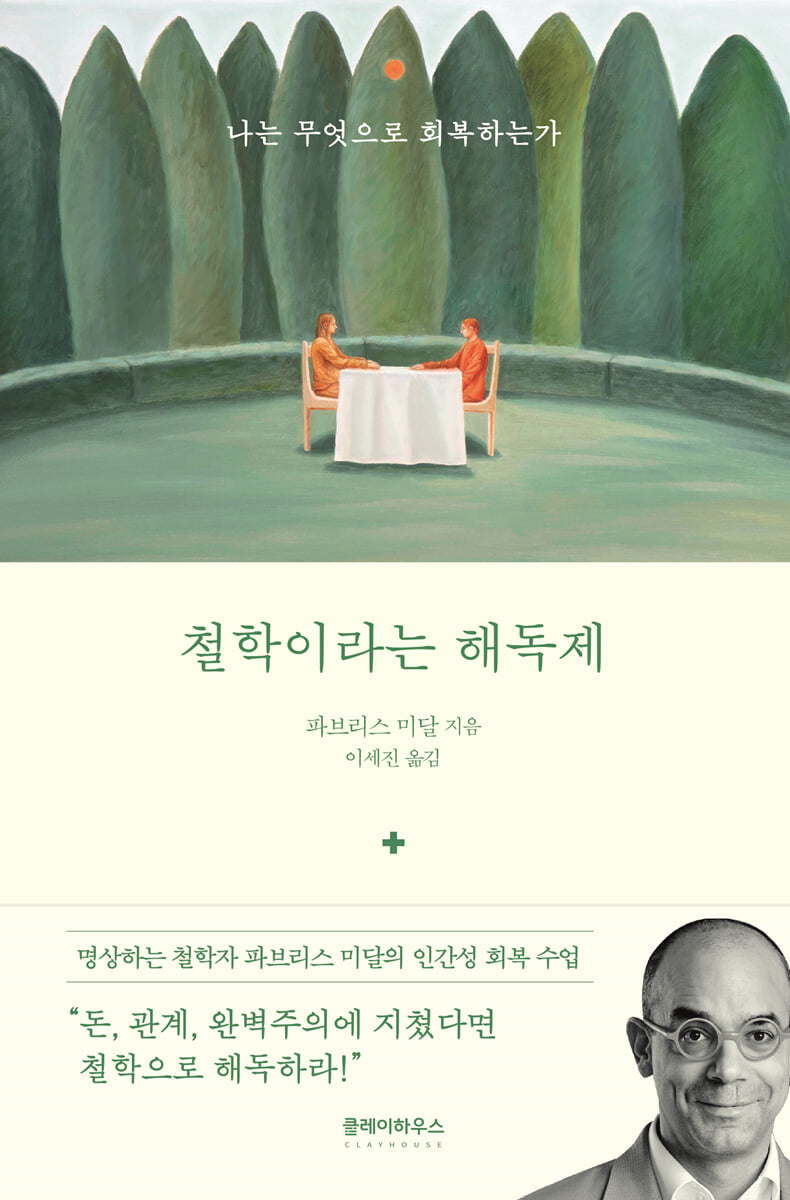
The antidote called philosophy
 |
Description
Book Introduction
A lesson in restoring humanity from the meditative philosopher Fabrice Midal
“If you’re tired of money, relationships, and perfectionism,
“Decipher it with philosophy!”
In a capitalist life where profit and calculation always come first, there is nothing as good an antidote as philosophy.
At the same time, philosophy can also help cure burnout caused by perfectionism.
This book reminds us, one by one, of the important values that we have forgotten as we live our lives as humans, through short words from philosophers, artists, poets, and novelists.
These values are a healing agent that restores our wounded and weary hearts and an antidote that removes the bad toxins that have accumulated within us.
Although it is a short book that can be read in less than 3 minutes per chapter, its power to open our eyes to new ideas is stronger than any other book.
From George Orwell's "Humanity is not by its very nature aspiring to perfection" to Ludwig Wittgenstein's "I am astonished that the world exists," the 40 sentences the author introduces are all faithful to the essence of Socratic philosophy.
In other words, it doesn't encourage us to try hard to become 'wise', but rather makes us rethink what we know by simply questioning things that seem obvious.
Readers of this book, like the ancient Greeks, will be inspired by true words to see, sense, desire, think, and love more fully.
And in a world that is becoming increasingly abstract, we will come to realize that philosophy has the power to keep us grounded in the concrete.
“If you’re tired of money, relationships, and perfectionism,
“Decipher it with philosophy!”
In a capitalist life where profit and calculation always come first, there is nothing as good an antidote as philosophy.
At the same time, philosophy can also help cure burnout caused by perfectionism.
This book reminds us, one by one, of the important values that we have forgotten as we live our lives as humans, through short words from philosophers, artists, poets, and novelists.
These values are a healing agent that restores our wounded and weary hearts and an antidote that removes the bad toxins that have accumulated within us.
Although it is a short book that can be read in less than 3 minutes per chapter, its power to open our eyes to new ideas is stronger than any other book.
From George Orwell's "Humanity is not by its very nature aspiring to perfection" to Ludwig Wittgenstein's "I am astonished that the world exists," the 40 sentences the author introduces are all faithful to the essence of Socratic philosophy.
In other words, it doesn't encourage us to try hard to become 'wise', but rather makes us rethink what we know by simply questioning things that seem obvious.
Readers of this book, like the ancient Greeks, will be inspired by true words to see, sense, desire, think, and love more fully.
And in a world that is becoming increasingly abstract, we will come to realize that philosophy has the power to keep us grounded in the concrete.
- You can preview some of the book's contents.
Preview
index
Prologue_Boldly like Socrates
The meaning of humanity
Summer in the middle of winter
Flowers blooming from stones
A child's mind
Living and moving desire
Unpretentious sincerity
Walking without knowing the way
creative fight
Recognition of limitations
Non-conforming narcissism
Courage in the Dark
Cezanne's Apples
The emotion of color
soft heart
Love for flaws
The weight of emotions
A better failure
Rejection of intelligence and generalization
Realization of ambiguity
Slow-drinking coffee
Questions to understand the past
My own sensibility
The ability to be surprised
Something that brings you to reality
Interest in myself
Complete concentration
A composition that changes perspective
A walk without a purpose
Creative Gray
The language of the poet
noble vomiting
trust in me
Reward and gratitude
Setting limits
Curiosity and uncertainty
self-forgetting
Courage to descend into hell
True feeling
Beautiful balance
A warm heart that returns to love
Translator's Note: To Become Human Again
The meaning of humanity
Summer in the middle of winter
Flowers blooming from stones
A child's mind
Living and moving desire
Unpretentious sincerity
Walking without knowing the way
creative fight
Recognition of limitations
Non-conforming narcissism
Courage in the Dark
Cezanne's Apples
The emotion of color
soft heart
Love for flaws
The weight of emotions
A better failure
Rejection of intelligence and generalization
Realization of ambiguity
Slow-drinking coffee
Questions to understand the past
My own sensibility
The ability to be surprised
Something that brings you to reality
Interest in myself
Complete concentration
A composition that changes perspective
A walk without a purpose
Creative Gray
The language of the poet
noble vomiting
trust in me
Reward and gratitude
Setting limits
Curiosity and uncertainty
self-forgetting
Courage to descend into hell
True feeling
Beautiful balance
A warm heart that returns to love
Translator's Note: To Become Human Again
Detailed image
Into the book
Eros, the god of love and desire, is the son of Penia (poverty) and Poros (abundance).
Eros is like his mother, gaunt, homeless, and penniless.
However, like his father, he always pursues beautiful and good things and wants to gain knowledge.
Isn't this a truly exquisite way to reveal the meaning of desire?
Desire is discovering what is fundamentally lacking in me and going out to find it.
Plato even went so far as to define such desire or love as philosophy.
Rather than pursuing the vague wisdom of weighing things, let us be consumed by passionate desire.
To live and move with that desire.
---From "A Living, Moving Desire"
If you only focus on the goal, the process becomes boring.
All I can think about is, I have to see the end soon, I have to finally reach my goal.
What a shame! We miss out on everything we could have learned along the way.
The benefits of travel lie in the travel itself.
So Rabbi Naham said:
“Don’t ask the one who knows the way.
“Because you will lose the opportunity to wander on the road.”
---From "Walking Without Knowing the Way"
Through one apple, one can approach the truth of life, death, or justice.
Herein lies the great lesson of modernity.
Look at everything without hierarchy.
That's true.
If I look closely at apples, I will also learn how to look at people.
People who are pushed to the margins, people who are oppressed, people who are normally invisible.
Because once you start looking, everything becomes important.
---From "Cézanne's Apples"
“The intellect has the characteristic of not being able to understand life naturally.” To understand this, let’s first think about what intellect is.
Intelligence is about ordering, about arranging.
Intelligence discovers what is constant and what is law among various phenomena.
Generalization is possible because there is intelligence.
How wonderful! This can advance our perception of reality.
The problem is that when intelligence operates in this way, the density, duration, and movement inherent in individual existence are eliminated.
What we live and feel in this morning sunlight is not the same as what intelligence has ordered.
In other words, intelligence dilutes life! Our own lives!
---From "Intellect and the Rejection of Generalization"
The philosophy that invites us to new experiences may seem abstract, but in fact it relates to us more than anything else.
Philosophy allows us to change our realm and perspective and achieve true enlightenment.
A philosophy that offers wise advice, a philosophy that claims to be practical, only traps us in error and blindness.
Rather, such a philosophy is more abstract.
Such a philosophy leaves reality completely out of reach and completely ignores our lives.
The difference between the two philosophical approaches lies in their ability to marvel at the existence of the world.
And only this adventure, which fundamentally changes our way of being, is truly philosophical.
---From "My Own Sensibility"
We are already slaves to this profit obsession.
It's the same even if you just go for a walk.
Even though walking is a very ordinary activity that can be done simply, it is no longer possible to escape this logic.
Now, if you install an app, you can see how many steps you walked and how many calories you burned.
It is not difficult to check cardiopulmonary function.
But you always fall short of your goals.
The simple happiness of walking aimlessly and then returning is nowhere to be found.
Hannah Arendt is right.
Wisdom that does not take historical reality into account cannot help us, but can only destroy us.
---From "Aimless Walk"
But how do you muster the courage to navigate hell? Simply confronting your own fears is enough.
It's actually quite simple, though scary.
A courageous person is not one who is fearless, but one who is prepared to face fear and suffer.
A coward does not want to be afraid at all.
Those who are afraid of the reality that their son is being bullied and do not want to know, and so they turn a blind eye to the situation even though they feel uneasy.
Therefore, courage means being prepared to be naked and face reality with all your might.
It means being willing to fight without denying reality.
Eros is like his mother, gaunt, homeless, and penniless.
However, like his father, he always pursues beautiful and good things and wants to gain knowledge.
Isn't this a truly exquisite way to reveal the meaning of desire?
Desire is discovering what is fundamentally lacking in me and going out to find it.
Plato even went so far as to define such desire or love as philosophy.
Rather than pursuing the vague wisdom of weighing things, let us be consumed by passionate desire.
To live and move with that desire.
---From "A Living, Moving Desire"
If you only focus on the goal, the process becomes boring.
All I can think about is, I have to see the end soon, I have to finally reach my goal.
What a shame! We miss out on everything we could have learned along the way.
The benefits of travel lie in the travel itself.
So Rabbi Naham said:
“Don’t ask the one who knows the way.
“Because you will lose the opportunity to wander on the road.”
---From "Walking Without Knowing the Way"
Through one apple, one can approach the truth of life, death, or justice.
Herein lies the great lesson of modernity.
Look at everything without hierarchy.
That's true.
If I look closely at apples, I will also learn how to look at people.
People who are pushed to the margins, people who are oppressed, people who are normally invisible.
Because once you start looking, everything becomes important.
---From "Cézanne's Apples"
“The intellect has the characteristic of not being able to understand life naturally.” To understand this, let’s first think about what intellect is.
Intelligence is about ordering, about arranging.
Intelligence discovers what is constant and what is law among various phenomena.
Generalization is possible because there is intelligence.
How wonderful! This can advance our perception of reality.
The problem is that when intelligence operates in this way, the density, duration, and movement inherent in individual existence are eliminated.
What we live and feel in this morning sunlight is not the same as what intelligence has ordered.
In other words, intelligence dilutes life! Our own lives!
---From "Intellect and the Rejection of Generalization"
The philosophy that invites us to new experiences may seem abstract, but in fact it relates to us more than anything else.
Philosophy allows us to change our realm and perspective and achieve true enlightenment.
A philosophy that offers wise advice, a philosophy that claims to be practical, only traps us in error and blindness.
Rather, such a philosophy is more abstract.
Such a philosophy leaves reality completely out of reach and completely ignores our lives.
The difference between the two philosophical approaches lies in their ability to marvel at the existence of the world.
And only this adventure, which fundamentally changes our way of being, is truly philosophical.
---From "My Own Sensibility"
We are already slaves to this profit obsession.
It's the same even if you just go for a walk.
Even though walking is a very ordinary activity that can be done simply, it is no longer possible to escape this logic.
Now, if you install an app, you can see how many steps you walked and how many calories you burned.
It is not difficult to check cardiopulmonary function.
But you always fall short of your goals.
The simple happiness of walking aimlessly and then returning is nowhere to be found.
Hannah Arendt is right.
Wisdom that does not take historical reality into account cannot help us, but can only destroy us.
---From "Aimless Walk"
But how do you muster the courage to navigate hell? Simply confronting your own fears is enough.
It's actually quite simple, though scary.
A courageous person is not one who is fearless, but one who is prepared to face fear and suffer.
A coward does not want to be afraid at all.
Those who are afraid of the reality that their son is being bullied and do not want to know, and so they turn a blind eye to the situation even though they feel uneasy.
Therefore, courage means being prepared to be naked and face reality with all your might.
It means being willing to fight without denying reality.
---From "The Courage to Descend into Hell"
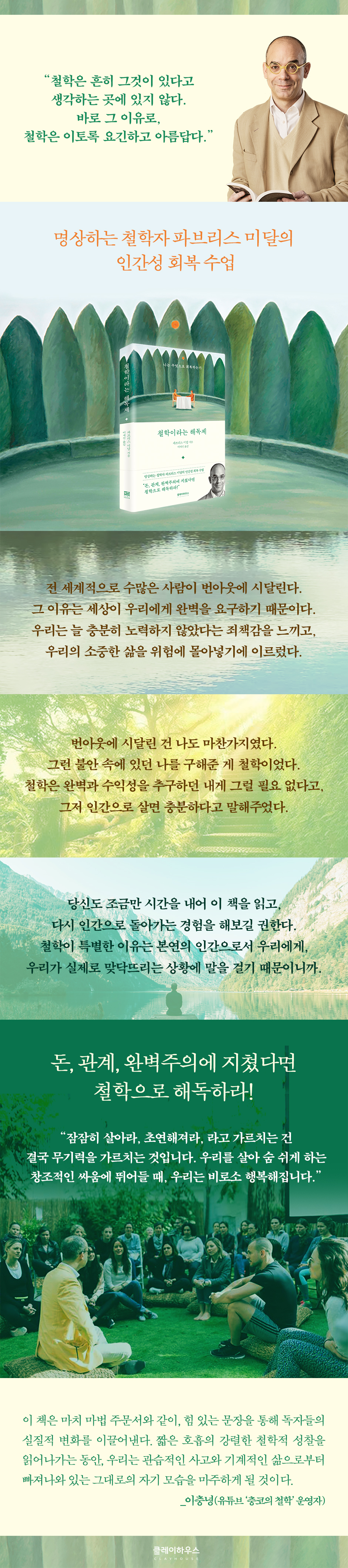
Publisher's Review
“It’s okay, we just have to be human.”
Today, burnout has become a global phenomenon.
Fabrice Midal, the author of this book, finds the reason in perfectionism.
Because this world, which prioritizes numbers and calculations, profitability and efficiency, demands perfection from us.
So we always feel guilty that we didn't try hard enough, and we end up putting our precious lives at risk.
But no matter what the world demands of us, it is ultimately we who respond to those demands.
Fabrice Midal speaks decisively.
There is absolutely no need to respond to such demands.
In fact, the author also suffered from burnout.
However, he was able to escape from such anxiety when he encountered philosophy and began meditating based on philosophy.
Because philosophy spoke like this.
Humans don't need to be perfect.
It's enough to just live as a human.
Through philosophy and meditation, I simply became human again, and negative emotions like anxiety and helplessness completely disappeared.
He wrote "The Antidote Called Philosophy" to share his experiences with the public, and immediately signed a copyright contract with 11 countries.
Additionally, the content covered in this book was broadcast on France's public radio station [France Quilture] and received much love from listeners.
If you are suffering from anxiety and lethargy right now, read this book and detoxify it with philosophy!
Detoxifying anxiety and lethargy
A collaboration of philosophy and meditation!
Fabrice Midal, a leading French meditation educator, has a unique background in that he is a philosopher who even holds a doctorate in philosophy.
As a book by such an author, "The Antidote Called Philosophy" freely crosses the boundaries between philosophy and meditation.
First, he prescribes 40 sentences that can be helpful to modern people suffering from anxiety and lethargy.
This sentence encompasses all the words left behind by philosophers, poets, novelists, and artists.
That is why he says, “Philosophy is not where it is commonly thought to be.
That is precisely why he left the words, “Philosophy is so useful and beautiful.”
He then explains various cases, his own experiences, and the context in which these words came to be, detoxifying us from the poison of anxiety and helplessness.
And at the end of each chapter, we introduce meditation techniques that cover specific methods.
It's full of concrete, practical methods that can actually help us recover, from 'going for a walk' to 'sipping coffee slowly.'
Reading the book will naturally give you a new perspective on the world and life, and if you practice the meditation suggested by the author, you will feel yourself being restored to your full self.
As the author repeatedly emphasizes, ultimately becoming human again means acknowledging one's imperfections, accepting oneself as one is, and living in relationships rather than trying to be oneself alone.
Now, through this book, let me have a special experience of returning to being human again for myself.
'A book must be an axe'
The book most faithful to Kafka's words
“A book must be an axe to break the frozen sea within us.” These words from Kafka powerfully explain the reason we read books.
I need to break the frozen sea within me so that I can escape from my current self and move into a wider world.
So what I'm saying is that the book must be an axe.
"The Antidote of Philosophy" is 120% in line with Kafka's theory of reading.
Because it delivers a powerful message that shakes our existing thinking, it instantly breaks the frozen hearts of those who live defensively in everything and feel dragged along by the world.
For example, philosopher Henri Bergson diagnosed that intellect makes our lives thin and our daily lives boring.
The idea is that intelligence, through laws and generalizations, makes the concrete and sensible abstract, and this leads us to repeat mechanical lives under the illusion that we already know everything.
So, if we want life to be more vibrant and alive, we must turn off our ever-active intellect, open ourselves wide to the life we live, and recover our senses and perceptions of what is around us as if we were seeing it for the first time.
This book, which concretely proposes a new way of life, will awaken you to a vivid sense of awakening, as if you had been hit in the back of the head.
Now, to maximize the effect, let's open this book to the first page as if we were reading it for the first time in our lives.
Today, burnout has become a global phenomenon.
Fabrice Midal, the author of this book, finds the reason in perfectionism.
Because this world, which prioritizes numbers and calculations, profitability and efficiency, demands perfection from us.
So we always feel guilty that we didn't try hard enough, and we end up putting our precious lives at risk.
But no matter what the world demands of us, it is ultimately we who respond to those demands.
Fabrice Midal speaks decisively.
There is absolutely no need to respond to such demands.
In fact, the author also suffered from burnout.
However, he was able to escape from such anxiety when he encountered philosophy and began meditating based on philosophy.
Because philosophy spoke like this.
Humans don't need to be perfect.
It's enough to just live as a human.
Through philosophy and meditation, I simply became human again, and negative emotions like anxiety and helplessness completely disappeared.
He wrote "The Antidote Called Philosophy" to share his experiences with the public, and immediately signed a copyright contract with 11 countries.
Additionally, the content covered in this book was broadcast on France's public radio station [France Quilture] and received much love from listeners.
If you are suffering from anxiety and lethargy right now, read this book and detoxify it with philosophy!
Detoxifying anxiety and lethargy
A collaboration of philosophy and meditation!
Fabrice Midal, a leading French meditation educator, has a unique background in that he is a philosopher who even holds a doctorate in philosophy.
As a book by such an author, "The Antidote Called Philosophy" freely crosses the boundaries between philosophy and meditation.
First, he prescribes 40 sentences that can be helpful to modern people suffering from anxiety and lethargy.
This sentence encompasses all the words left behind by philosophers, poets, novelists, and artists.
That is why he says, “Philosophy is not where it is commonly thought to be.
That is precisely why he left the words, “Philosophy is so useful and beautiful.”
He then explains various cases, his own experiences, and the context in which these words came to be, detoxifying us from the poison of anxiety and helplessness.
And at the end of each chapter, we introduce meditation techniques that cover specific methods.
It's full of concrete, practical methods that can actually help us recover, from 'going for a walk' to 'sipping coffee slowly.'
Reading the book will naturally give you a new perspective on the world and life, and if you practice the meditation suggested by the author, you will feel yourself being restored to your full self.
As the author repeatedly emphasizes, ultimately becoming human again means acknowledging one's imperfections, accepting oneself as one is, and living in relationships rather than trying to be oneself alone.
Now, through this book, let me have a special experience of returning to being human again for myself.
'A book must be an axe'
The book most faithful to Kafka's words
“A book must be an axe to break the frozen sea within us.” These words from Kafka powerfully explain the reason we read books.
I need to break the frozen sea within me so that I can escape from my current self and move into a wider world.
So what I'm saying is that the book must be an axe.
"The Antidote of Philosophy" is 120% in line with Kafka's theory of reading.
Because it delivers a powerful message that shakes our existing thinking, it instantly breaks the frozen hearts of those who live defensively in everything and feel dragged along by the world.
For example, philosopher Henri Bergson diagnosed that intellect makes our lives thin and our daily lives boring.
The idea is that intelligence, through laws and generalizations, makes the concrete and sensible abstract, and this leads us to repeat mechanical lives under the illusion that we already know everything.
So, if we want life to be more vibrant and alive, we must turn off our ever-active intellect, open ourselves wide to the life we live, and recover our senses and perceptions of what is around us as if we were seeing it for the first time.
This book, which concretely proposes a new way of life, will awaken you to a vivid sense of awakening, as if you had been hit in the back of the head.
Now, to maximize the effect, let's open this book to the first page as if we were reading it for the first time in our lives.
GOODS SPECIFICS
- Date of issue: July 4, 2022
- Page count, weight, size: 256 pages | 278g | 125*190*15mm
- ISBN13: 9791197768439
- ISBN10: 1197768432
You may also like
카테고리
korean


korean

![GQ KOREA Mark (Monthly): December [2025]](http://librairie.coreenne.fr/cdn/shop/files/8ef265dbbfbf186523ed75ba7319009d.jpg?v=1765340328&width=3840)


