

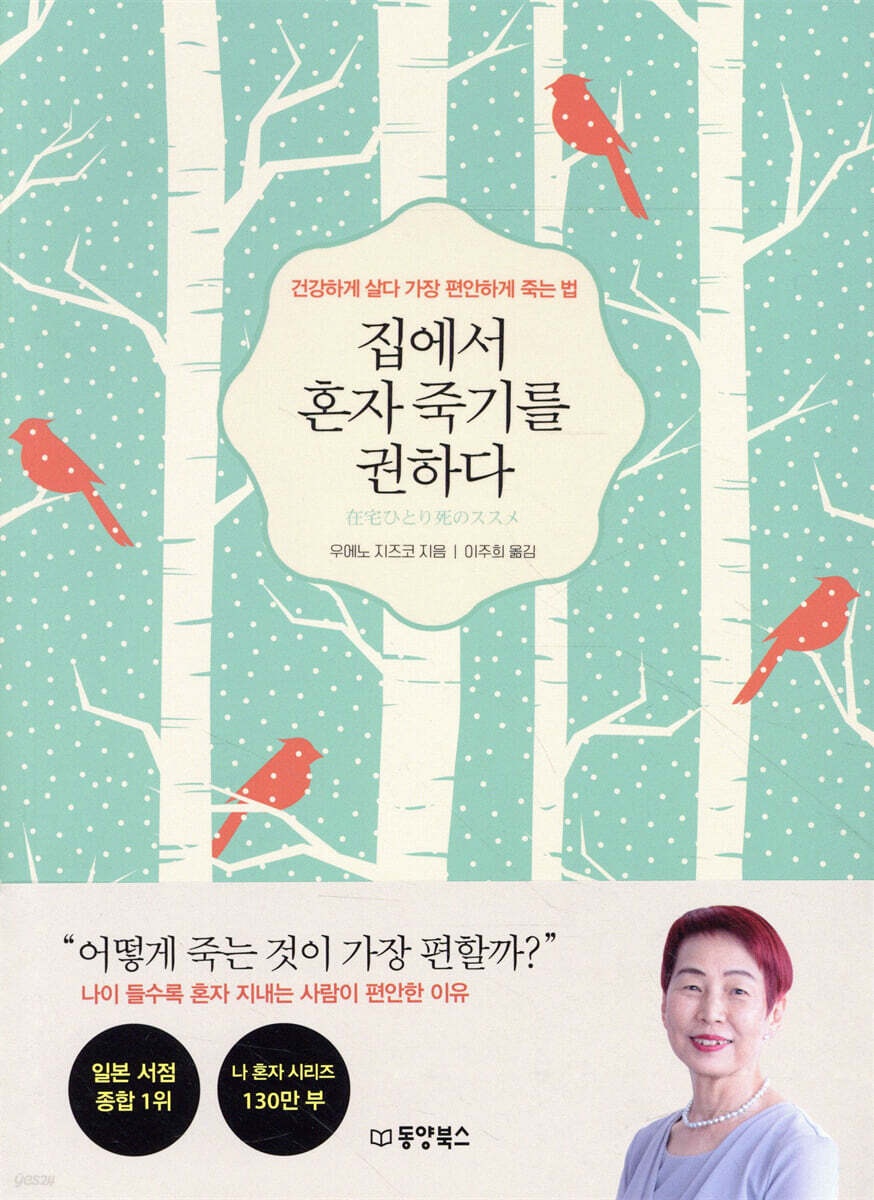
I recommend dying alone at home
 |
Description
Book Introduction
- A word from MD
-
How to die comfortably aloneOur society perceives death from loneliness as a death to be avoided and a sad ending.
This is no different in Japan, but Chizuko Ueno makes a different argument.
He says that he is happy living alone and that dying alone in his own home is a beautiful ending.
In this aging society, we seek a comfortable death.
July 8, 2022. Humanities PD Son Min-gyu
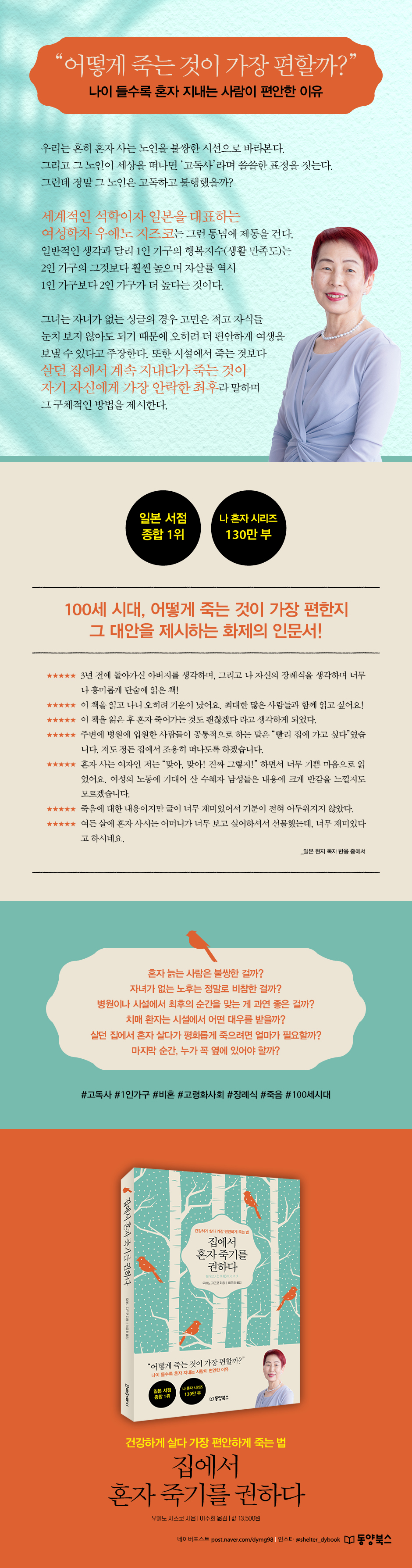
“What is the most comfortable way to die?”
“Who will take care of my body when I die?”
People who are worried that they will die alone.
A humanities book that offers solutions for them
Chizuko Ueno, a world-renowned scholar, sociologist, and godmother of Japanese feminism, has published her 2021 hit work, "Advising You to Die Alone at Home" (original title: 在宅ひとり死のススメ), published by Dongyang Books.
Author Chizuko Ueno emphasizes that common sense about old age has changed 180 degrees in the past 10 years, saying, “If you are not isolated while you are alive, there is no need to fear dying alone.”
In the past, it was considered natural to live with children, but now the way of thinking has changed 180 degrees to 'it is wise not to live with children.'
She claims that, as a result, the public's view of elderly people living alone is shifting from 'they seem pitiful' to 'they seem comfortable.'
Rather, the most unfortunate people are not those who live alone, but those who live with people they don't get along with.
Especially for women over 60, their happiness index actually rises vertically when they live alone.
The author proves, through various statistical data and survey results, that the happiness index (life satisfaction) of single-person households is much higher than that of two-person households, that the suicide rate is actually higher in two-person households than in one-person households, that the happiness index in old age is unrelated to the presence or absence of children, and that surprisingly, no one wants to die in a nursing facility or hospital.
The conclusion is that it is wisest to die comfortably in the house where you lived.
So what should you do when you become ill or need someone to care for you? The solution is the government-run long-term care insurance system (in Korea, long-term care insurance).
The author says that since the introduction of long-term care insurance, it has become common knowledge that 'care work' is not free, and that more than 70-80% of the elderly are already receiving help from long-term care insurance.
If you are recognized as needing care, a care manager (in Korea, a nursing assistant) will visit you at least twice a week to provide care, and then you will not have to worry about dying alone.
This book raises the question of "how to die most happily and peacefully," a major concern in the aging society, and has unusually risen to number one on Amazon's overall rankings as a social science book, selling over 200,000 copies to date.
Additionally, the author's 'Alone Series', including this book, is a super bestseller with a cumulative 1.3 million copies sold locally.
“Who will take care of my body when I die?”
People who are worried that they will die alone.
A humanities book that offers solutions for them
Chizuko Ueno, a world-renowned scholar, sociologist, and godmother of Japanese feminism, has published her 2021 hit work, "Advising You to Die Alone at Home" (original title: 在宅ひとり死のススメ), published by Dongyang Books.
Author Chizuko Ueno emphasizes that common sense about old age has changed 180 degrees in the past 10 years, saying, “If you are not isolated while you are alive, there is no need to fear dying alone.”
In the past, it was considered natural to live with children, but now the way of thinking has changed 180 degrees to 'it is wise not to live with children.'
She claims that, as a result, the public's view of elderly people living alone is shifting from 'they seem pitiful' to 'they seem comfortable.'
Rather, the most unfortunate people are not those who live alone, but those who live with people they don't get along with.
Especially for women over 60, their happiness index actually rises vertically when they live alone.
The author proves, through various statistical data and survey results, that the happiness index (life satisfaction) of single-person households is much higher than that of two-person households, that the suicide rate is actually higher in two-person households than in one-person households, that the happiness index in old age is unrelated to the presence or absence of children, and that surprisingly, no one wants to die in a nursing facility or hospital.
The conclusion is that it is wisest to die comfortably in the house where you lived.
So what should you do when you become ill or need someone to care for you? The solution is the government-run long-term care insurance system (in Korea, long-term care insurance).
The author says that since the introduction of long-term care insurance, it has become common knowledge that 'care work' is not free, and that more than 70-80% of the elderly are already receiving help from long-term care insurance.
If you are recognized as needing care, a care manager (in Korea, a nursing assistant) will visit you at least twice a week to provide care, and then you will not have to worry about dying alone.
This book raises the question of "how to die most happily and peacefully," a major concern in the aging society, and has unusually risen to number one on Amazon's overall rankings as a social science book, selling over 200,000 copies to date.
Additionally, the author's 'Alone Series', including this book, is a super bestseller with a cumulative 1.3 million copies sold locally.
- You can preview some of the book's contents.
Preview
index
Preface 010
Chapter 1: What's wrong with growing old alone?
Are people who grow old alone pitiful? 015
In old age, being alone is the happiest thing. 019
The satisfaction level of a two-person household is at least 023
Being alone is neither lonely nor anxious 028
Three Conditions for a Satisfactory Retirement 032
Chapter 2: Is Retirement Without Children Really Miserable?
A Society with Increasing Deaths 041
In the Age of Centenarians, Thoughts on Death Are Changing 044
The last one is not at the hospital, but at home 047
If an elderly person appears to be in critical condition, should you always call 119? 051
Leave your children only as much burden as they can handle. 056
Chapter 3: No Elderly Person Wants to Die in a Facility
There are no happy old people in the hospital 061
Would a service-based senior housing be a good option? 064
No elderly person wants to die in a facility 068
How much does it cost to prepare for death alone? 070
No Doctor Needed at the Moment of Death 075
Chapter 4: The important thing is not to be isolated while alive.
For those of you who fear dying alone 083
What is lonely death? 086
As long as there are nursing services, there will be no deaths alone. 090
Who should be by your side at the last moment? 094
Say goodbye and thank you in advance 099
What's wrong with dying alone? 102
Chapter 5: Can I die alone at home even if I have dementia?
Dementia fears are spreading 107
The era of 7 million dementia patients has arrived. 109
How will patients be treated at the facility? 111
The patient's family wants refuge 115
117 Reasons Why Dementia Patients Living Alone Are in Good Health
Chapter 6 We all grow old and sick someday.
Dementia 123: Who Can Get It?
If your family is prepared, you can live alone even with dementia. 124
Is dementia your own fault? 128
We all grow old and sick someday. 132
How do people with dementia think and feel? 136
Who should be appointed as adult guardian? 140
Society Prepares for Dementia 144
Chapter 7: Should people who are not helpful to society not be allowed to live?
Case 149: Self-Decision to Stop Dialysis
The myth that end-of-life care is expensive is a myth 152
Euthanasia Debate 155
Shouldn't people who don't contribute to society be allowed to live? 158
The Trap of "Life Meetings" 161
You can hesitate until the very end 165
Is a society that pursues euthanasia just? 168
Chapter 8: Can You Die Alone at Home?
Can you die alone at home? 175
The Dilemma of Increasingly Inconvenient Long-Term Care Insurance 177
Features of the Long-Term Care Insurance System 178
Intended Effects of Long-Term Care Insurance 189
The Unintended Effects of Long-Term Care Insurance 194
The Decline of Long-Term Care Insurance 201
Conclusion 209
Chapter 1: What's wrong with growing old alone?
Are people who grow old alone pitiful? 015
In old age, being alone is the happiest thing. 019
The satisfaction level of a two-person household is at least 023
Being alone is neither lonely nor anxious 028
Three Conditions for a Satisfactory Retirement 032
Chapter 2: Is Retirement Without Children Really Miserable?
A Society with Increasing Deaths 041
In the Age of Centenarians, Thoughts on Death Are Changing 044
The last one is not at the hospital, but at home 047
If an elderly person appears to be in critical condition, should you always call 119? 051
Leave your children only as much burden as they can handle. 056
Chapter 3: No Elderly Person Wants to Die in a Facility
There are no happy old people in the hospital 061
Would a service-based senior housing be a good option? 064
No elderly person wants to die in a facility 068
How much does it cost to prepare for death alone? 070
No Doctor Needed at the Moment of Death 075
Chapter 4: The important thing is not to be isolated while alive.
For those of you who fear dying alone 083
What is lonely death? 086
As long as there are nursing services, there will be no deaths alone. 090
Who should be by your side at the last moment? 094
Say goodbye and thank you in advance 099
What's wrong with dying alone? 102
Chapter 5: Can I die alone at home even if I have dementia?
Dementia fears are spreading 107
The era of 7 million dementia patients has arrived. 109
How will patients be treated at the facility? 111
The patient's family wants refuge 115
117 Reasons Why Dementia Patients Living Alone Are in Good Health
Chapter 6 We all grow old and sick someday.
Dementia 123: Who Can Get It?
If your family is prepared, you can live alone even with dementia. 124
Is dementia your own fault? 128
We all grow old and sick someday. 132
How do people with dementia think and feel? 136
Who should be appointed as adult guardian? 140
Society Prepares for Dementia 144
Chapter 7: Should people who are not helpful to society not be allowed to live?
Case 149: Self-Decision to Stop Dialysis
The myth that end-of-life care is expensive is a myth 152
Euthanasia Debate 155
Shouldn't people who don't contribute to society be allowed to live? 158
The Trap of "Life Meetings" 161
You can hesitate until the very end 165
Is a society that pursues euthanasia just? 168
Chapter 8: Can You Die Alone at Home?
Can you die alone at home? 175
The Dilemma of Increasingly Inconvenient Long-Term Care Insurance 177
Features of the Long-Term Care Insurance System 178
Intended Effects of Long-Term Care Insurance 189
The Unintended Effects of Long-Term Care Insurance 194
The Decline of Long-Term Care Insurance 201
Conclusion 209
Detailed image
Into the book
The loneliest people are the elderly who live with family members who don't get along.
In fact, contrary to expectations, the suicide rate among the elderly is higher among those living together than among those living alone.
--- p.31
But wow! Childless singles were the most satisfied, had fewer worries, and reported lower levels of loneliness and anxiety.
--- p.32
I have lived my life pursuing three things: ① continuing to live in the house I lived in, ② becoming rich in people rather than money, and ③ living freely without being indebted to others.
--- p.35
People who die alone have already lived isolated lives while they were alive.
An isolated life resulted in death from loneliness.
If you are not isolated while you are alive, you do not need to fear dying alone.
One could say that single women have nothing to fear at all.
Because single women, unlike single men, tend to have larger networks of friends.
--- p.84
In just 10 years, common sense about aging has changed 180 degrees.
It changed from 'It is happy to live with children' to 'It is wise not to live with children'.
It changed from ‘Living alone is pitiful’ to ‘Living alone is comfortable.’
I would like to think that I played a role in changing that ‘common sense’ to some extent (laughs).
In fact, contrary to expectations, the suicide rate among the elderly is higher among those living together than among those living alone.
--- p.31
But wow! Childless singles were the most satisfied, had fewer worries, and reported lower levels of loneliness and anxiety.
--- p.32
I have lived my life pursuing three things: ① continuing to live in the house I lived in, ② becoming rich in people rather than money, and ③ living freely without being indebted to others.
--- p.35
People who die alone have already lived isolated lives while they were alive.
An isolated life resulted in death from loneliness.
If you are not isolated while you are alive, you do not need to fear dying alone.
One could say that single women have nothing to fear at all.
Because single women, unlike single men, tend to have larger networks of friends.
--- p.84
In just 10 years, common sense about aging has changed 180 degrees.
It changed from 'It is happy to live with children' to 'It is wise not to live with children'.
It changed from ‘Living alone is pitiful’ to ‘Living alone is comfortable.’
I would like to think that I played a role in changing that ‘common sense’ to some extent (laughs).
--- p.211
Publisher's Review
Among the interviews with women in their 60s and 70s that appear in the text,
“If I live with my family, I have to suppress myself and think of my family first.
“Of course, life satisfaction will inevitably decrease.” (Woman in her 60s)
“My husband only watches TV every day.
I told you that even if you talk to him, he won't answer.
“And then he nags me about even the smallest things, it’s so annoying.” (Woman in her 70s)
“My husband doesn’t listen to other people at all.
Just do whatever you want.
“If I express an opposing opinion, he quickly starts yelling and it’s hard to have a conversation.” (Woman in her 60s)
“My husband retired, and he follows me wherever I go, so I’m tired.” (Woman in her 60s)
“My husband doesn’t care if other family members are sick, but he throws a tantrum if there’s even the slightest problem with his health.” (Woman in her 60s)
“I’m depressed because my husband hasn’t helped with the housework since he retired and only complains.
You're on the computer all day.
My husband's very existence is annoying.
“I feel depressed all day long.” (Woman in her 70s)
“I always wished my husband would just leave because we were always fighting, but now that he’s gone, I feel lonely.” (Woman in her 60s)
“Who will take care of my body when I die?”
People who are worried that they will die alone.
A humanities book that offers solutions for them
Chizuko Ueno, a world-renowned scholar, sociologist, and godmother of Japanese feminism, has published her 2021 hit work, "Advising You to Die Alone at Home" (original title: 在宅ひとり死のススメ), published by Dongyang Books.
The title itself, which is a direct translation of the original title, is unusual.
What does it mean to tell someone to die alone at home? Are they even suggesting "lonely deaths" (deaths of a person living alone, discovered late)—a phenomenon that's been making the news almost every day these days? In Japan, there are approximately 30,000 "lonely deaths" each year.
In our country too, the number is increasing every year.
The number of unclaimed deaths has been steadily increasing, from 835 in 2017 to 1,385 in 2020 (September 2021, Ministry of Health and Welfare data).
This is one of the social phenomena that is emerging as our country approaches a super-aged society (a society in which the elderly population aged 65 or older accounts for more than 20% of the total population, expected to occur by 2026).
The increase in the number of single-person households is also not unrelated to this.
The proportion of single-person households, which was 15.6% in 2000, has been steadily increasing, more than doubling to 31.7% in 2020, and is still increasing.
Given the current social climate, I'm worried that many people will end up dying alone.
Especially for people living alone, the question, "Who will take care of my body when I die?" is a major concern.
"Advising You to Die Alone at Home" offers a solution to this very problem.
Author Chizuko Ueno emphasizes that common sense about old age has changed 180 degrees in the past 10 years, saying, “If you are not isolated while you are alive, there is no need to fear dying alone.”
In the past, it was considered natural to live with children, but now the way of thinking has changed 180 degrees to 'it is wise not to live with children.'
She claims that, as a result, the public's view of elderly people living alone is shifting from 'they seem pitiful' to 'they seem comfortable.'
Rather, the most unfortunate people are not those who live alone, but those who live with people they don't get along with.
Especially for women in their 60s and older, their happiness index actually rises vertically when they live alone (see the interview with a woman in her 60s and 70s in the text above).
The author proves, through various statistical data and survey results, that the happiness index (life satisfaction) of single-person households is much higher than that of two-person households, that the suicide rate is actually higher in two-person households than in one-person households, that the happiness index in old age is unrelated to the presence or absence of children, and that surprisingly, no one wants to die in a nursing facility or hospital.
The conclusion is that it is wisest to die comfortably in the house where you lived.
So what should you do when you become ill or need someone to care for you? The solution is the government-run long-term care insurance system (in Korea, long-term care insurance).
The author says that since the introduction of long-term care insurance, it has become common knowledge that 'care work' is not free, and that more than 70-80% of the elderly are already receiving help from long-term care insurance.
If you are recognized as needing care, a care manager (in Korea, a nursing assistant) will visit you at least twice a week to provide care, and then you will not have to worry about dying alone.
The author is a leading Japanese feminist, and has consistently published not only women's studies books but also practical humanities books on "How to Live Alone."
This book is the final installment of the three volumes in the series: "Single, As Long as You're Happy", "How Men Live Alone, According to Women", and "Death in an Age Where Everyone Is Alone", which are all bestsellers with cumulative sales of 1.3 million copies.
In particular, this book, "Advising You to Die Alone at Home," raises the question of "How to Die Most Happily and Peacefully," which is the biggest concern in the aging society, and has unusually risen to number one on Amazon's overall rankings as a social science book, and has sold over 200,000 copies to date.
This phenomenon proves that the old slogan, 'the personal is political,' still holds true.
“It’s surprisingly okay to die alone!”
Why Being Alone Becomes More Comfortable as You Get Older
What words come to mind when someone says, "An elderly person who lived alone died at home"? Loneliness, solitude, the futility of life, and the severing of human relationships.
But the data presented by Ueno Chizuko suggests a completely different word.
Comfort, self-satisfaction, freedom, long-term care insurance, etc.
The author presents various data showing that single people without children have fewer worries and do not have to worry about their children's opinions, so they have a higher happiness index (life satisfaction) and feel much less loneliness and anxiety.
He also claims that the idea that old age without family will be miserable is just a stereotype from the past, saying that he practices the three principles of living a satisfactory old age: first, continue to live in the house where he lived; second, become rich in people rather than rich in money; and third, live freely without being indebted to others.
In this book, you will once again see Ueno Chizuko's specialty of challenging existing ideas and conventions and presenting the most reasonable alternatives from a new perspective.
Meanwhile, when misogyny (hatred of women) emerged as a major issue in our society following the 2016 Gangnam Station murder case, her representative work, “I Hate Misogyny,” received significant attention in Korea.
From reviews by local Japanese readers
*****I read this book in one sitting with great interest, thinking about my father who passed away three years ago, and thinking about my own funeral!
*****After reading this book, I felt more energized.
I want to read it with as many people as possible!
*****After reading this book, I thought, 'It's okay to die alone.'
*****The common thing that people who were hospitalized around me said was, “I want to go home quickly.”
I too will quietly leave the house I have grown accustomed to.
*****As a woman living alone, I read it with such joy that I thought, “That’s right, that’s right! That’s really true!”
Men who have benefited from women's labor may be very offended by the content.
*****It's about death, but the writing is so interesting that it doesn't make me feel gloomy at all.
*****I gave it to my mother, who is 80 years old and lives alone, because she missed it so much, and she said it was really fun.
“If I live with my family, I have to suppress myself and think of my family first.
“Of course, life satisfaction will inevitably decrease.” (Woman in her 60s)
“My husband only watches TV every day.
I told you that even if you talk to him, he won't answer.
“And then he nags me about even the smallest things, it’s so annoying.” (Woman in her 70s)
“My husband doesn’t listen to other people at all.
Just do whatever you want.
“If I express an opposing opinion, he quickly starts yelling and it’s hard to have a conversation.” (Woman in her 60s)
“My husband retired, and he follows me wherever I go, so I’m tired.” (Woman in her 60s)
“My husband doesn’t care if other family members are sick, but he throws a tantrum if there’s even the slightest problem with his health.” (Woman in her 60s)
“I’m depressed because my husband hasn’t helped with the housework since he retired and only complains.
You're on the computer all day.
My husband's very existence is annoying.
“I feel depressed all day long.” (Woman in her 70s)
“I always wished my husband would just leave because we were always fighting, but now that he’s gone, I feel lonely.” (Woman in her 60s)
“Who will take care of my body when I die?”
People who are worried that they will die alone.
A humanities book that offers solutions for them
Chizuko Ueno, a world-renowned scholar, sociologist, and godmother of Japanese feminism, has published her 2021 hit work, "Advising You to Die Alone at Home" (original title: 在宅ひとり死のススメ), published by Dongyang Books.
The title itself, which is a direct translation of the original title, is unusual.
What does it mean to tell someone to die alone at home? Are they even suggesting "lonely deaths" (deaths of a person living alone, discovered late)—a phenomenon that's been making the news almost every day these days? In Japan, there are approximately 30,000 "lonely deaths" each year.
In our country too, the number is increasing every year.
The number of unclaimed deaths has been steadily increasing, from 835 in 2017 to 1,385 in 2020 (September 2021, Ministry of Health and Welfare data).
This is one of the social phenomena that is emerging as our country approaches a super-aged society (a society in which the elderly population aged 65 or older accounts for more than 20% of the total population, expected to occur by 2026).
The increase in the number of single-person households is also not unrelated to this.
The proportion of single-person households, which was 15.6% in 2000, has been steadily increasing, more than doubling to 31.7% in 2020, and is still increasing.
Given the current social climate, I'm worried that many people will end up dying alone.
Especially for people living alone, the question, "Who will take care of my body when I die?" is a major concern.
"Advising You to Die Alone at Home" offers a solution to this very problem.
Author Chizuko Ueno emphasizes that common sense about old age has changed 180 degrees in the past 10 years, saying, “If you are not isolated while you are alive, there is no need to fear dying alone.”
In the past, it was considered natural to live with children, but now the way of thinking has changed 180 degrees to 'it is wise not to live with children.'
She claims that, as a result, the public's view of elderly people living alone is shifting from 'they seem pitiful' to 'they seem comfortable.'
Rather, the most unfortunate people are not those who live alone, but those who live with people they don't get along with.
Especially for women in their 60s and older, their happiness index actually rises vertically when they live alone (see the interview with a woman in her 60s and 70s in the text above).
The author proves, through various statistical data and survey results, that the happiness index (life satisfaction) of single-person households is much higher than that of two-person households, that the suicide rate is actually higher in two-person households than in one-person households, that the happiness index in old age is unrelated to the presence or absence of children, and that surprisingly, no one wants to die in a nursing facility or hospital.
The conclusion is that it is wisest to die comfortably in the house where you lived.
So what should you do when you become ill or need someone to care for you? The solution is the government-run long-term care insurance system (in Korea, long-term care insurance).
The author says that since the introduction of long-term care insurance, it has become common knowledge that 'care work' is not free, and that more than 70-80% of the elderly are already receiving help from long-term care insurance.
If you are recognized as needing care, a care manager (in Korea, a nursing assistant) will visit you at least twice a week to provide care, and then you will not have to worry about dying alone.
The author is a leading Japanese feminist, and has consistently published not only women's studies books but also practical humanities books on "How to Live Alone."
This book is the final installment of the three volumes in the series: "Single, As Long as You're Happy", "How Men Live Alone, According to Women", and "Death in an Age Where Everyone Is Alone", which are all bestsellers with cumulative sales of 1.3 million copies.
In particular, this book, "Advising You to Die Alone at Home," raises the question of "How to Die Most Happily and Peacefully," which is the biggest concern in the aging society, and has unusually risen to number one on Amazon's overall rankings as a social science book, and has sold over 200,000 copies to date.
This phenomenon proves that the old slogan, 'the personal is political,' still holds true.
“It’s surprisingly okay to die alone!”
Why Being Alone Becomes More Comfortable as You Get Older
What words come to mind when someone says, "An elderly person who lived alone died at home"? Loneliness, solitude, the futility of life, and the severing of human relationships.
But the data presented by Ueno Chizuko suggests a completely different word.
Comfort, self-satisfaction, freedom, long-term care insurance, etc.
The author presents various data showing that single people without children have fewer worries and do not have to worry about their children's opinions, so they have a higher happiness index (life satisfaction) and feel much less loneliness and anxiety.
He also claims that the idea that old age without family will be miserable is just a stereotype from the past, saying that he practices the three principles of living a satisfactory old age: first, continue to live in the house where he lived; second, become rich in people rather than rich in money; and third, live freely without being indebted to others.
In this book, you will once again see Ueno Chizuko's specialty of challenging existing ideas and conventions and presenting the most reasonable alternatives from a new perspective.
Meanwhile, when misogyny (hatred of women) emerged as a major issue in our society following the 2016 Gangnam Station murder case, her representative work, “I Hate Misogyny,” received significant attention in Korea.
From reviews by local Japanese readers
*****I read this book in one sitting with great interest, thinking about my father who passed away three years ago, and thinking about my own funeral!
*****After reading this book, I felt more energized.
I want to read it with as many people as possible!
*****After reading this book, I thought, 'It's okay to die alone.'
*****The common thing that people who were hospitalized around me said was, “I want to go home quickly.”
I too will quietly leave the house I have grown accustomed to.
*****As a woman living alone, I read it with such joy that I thought, “That’s right, that’s right! That’s really true!”
Men who have benefited from women's labor may be very offended by the content.
*****It's about death, but the writing is so interesting that it doesn't make me feel gloomy at all.
*****I gave it to my mother, who is 80 years old and lives alone, because she missed it so much, and she said it was really fun.
GOODS SPECIFICS
- Publication date: June 28, 2022
- Page count, weight, size: 216 pages | 324g | 152*210*12mm
- ISBN13: 9791157688128
- ISBN10: 1157688128
You may also like
카테고리
korean


korean

![GQ KOREA Mark (Monthly): December [2025]](http://librairie.coreenne.fr/cdn/shop/files/8ef265dbbfbf186523ed75ba7319009d.jpg?v=1765340328&width=3840)


