

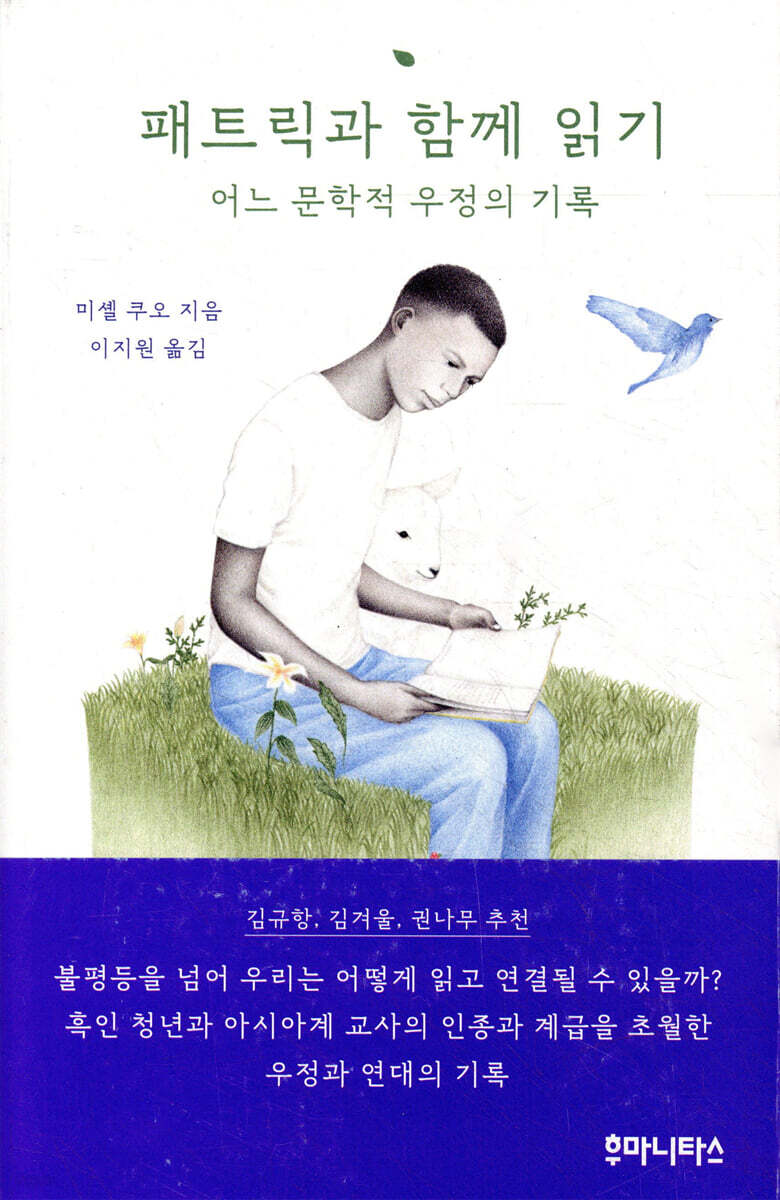
Reading with Patrick
 |
Description
Book Introduction
After graduating from Harvard University, Taiwanese-American Michelle Kuo moves to Helena, one of the poorest areas in the United States, to teach English at an alternative school for so-called "problem children."
However, the author's optimistic ideal of awakening the joy and pride of learning through literature in black students who grew up in poor environments is faced with a creaking reality.
In a poor rural village with no jobs, students had no future to think about, and the school had no intention of punishing them.
Still, Kuo devotes his utmost effort to the belief that he can change these students' lives, and even the students abandoned by the broken education system begin to stand on their own feet little by little through silent reading, reading aloud, and writing classes that awaken a sense of self.
And among them, a shy fifteen-year-old black boy named Patrick Browning discovers his literary talent and makes remarkable progress.
After leaving her students to attend law school, one day before graduation, Michelle hears the news that her favorite student, Patrick, is in prison for murder.
And she returns to the South, feeling guilty for leaving so soon, and sits down in front of Patrick.
Shocked by the sight of Patrick, who, after years of being a bright young man, could neither read nor write, the author spent seven months in jail awaiting trial, trying to get back into Patrick's mind by reading James Baldwin, Frederick Douglass, Walt Whitman, and Emily Dickinson every day.
Can Michelle truly change Patrick's life? This touching story follows two individuals as teacher and student, as they come to understand and transform their lives.
It is the story of a fifteen-year-old black boy named Patrick Browning's remarkable literary awakening, but also the story of Michelle, a second-generation Asian immigrant, growing up as a teacher and law student.
However, the author's optimistic ideal of awakening the joy and pride of learning through literature in black students who grew up in poor environments is faced with a creaking reality.
In a poor rural village with no jobs, students had no future to think about, and the school had no intention of punishing them.
Still, Kuo devotes his utmost effort to the belief that he can change these students' lives, and even the students abandoned by the broken education system begin to stand on their own feet little by little through silent reading, reading aloud, and writing classes that awaken a sense of self.
And among them, a shy fifteen-year-old black boy named Patrick Browning discovers his literary talent and makes remarkable progress.
After leaving her students to attend law school, one day before graduation, Michelle hears the news that her favorite student, Patrick, is in prison for murder.
And she returns to the South, feeling guilty for leaving so soon, and sits down in front of Patrick.
Shocked by the sight of Patrick, who, after years of being a bright young man, could neither read nor write, the author spent seven months in jail awaiting trial, trying to get back into Patrick's mind by reading James Baldwin, Frederick Douglass, Walt Whitman, and Emily Dickinson every day.
Can Michelle truly change Patrick's life? This touching story follows two individuals as teacher and student, as they come to understand and transform their lives.
It is the story of a fifteen-year-old black boy named Patrick Browning's remarkable literary awakening, but also the story of Michelle, a second-generation Asian immigrant, growing up as a teacher and law student.
- You can preview some of the book's contents.
Preview
index
19 in the header
1 A Raisin in the Sun 35
2 Free Writing 49
3 The next judgment is Fire 87
4 The Death of Ivan Ilyich 129
5 Crime and Punishment 185
6 The Lion, the Witch, and the Wardrobe 211
7 He desires the heavenly fabric 253
8 The Life of Frederick Douglass 277
9 I have read all the items listed - Guilty Plea 315
10 Late Spring, to Paula 345
11 Easter Morning 383
References 411
Acknowledgments 419
Reading Guide 430
1 A Raisin in the Sun 35
2 Free Writing 49
3 The next judgment is Fire 87
4 The Death of Ivan Ilyich 129
5 Crime and Punishment 185
6 The Lion, the Witch, and the Wardrobe 211
7 He desires the heavenly fabric 253
8 The Life of Frederick Douglass 277
9 I have read all the items listed - Guilty Plea 315
10 Late Spring, to Paula 345
11 Easter Morning 383
References 411
Acknowledgments 419
Reading Guide 430
Detailed image

Into the book
The first few months in Star's classroom were surreal.
Most of the students, who had never met an Asian before, stared at me.
“What about you, teacher?” they asked with serious expressions, asking if I was related to Jackie Chan (the more rude kids would say “Get out, you Chinese bitch”).
--- p.40-41
He spoke in a low voice, afraid that the other children might hear.
“I don’t know what to write.” “No way.” I knelt down beside the desk.
This was my favorite part of teaching.
Subtle persuasion, slowly drawing out words, moving the heart onto the paper.
--- p.67
One of the great things about silent reading was that it allowed me to discover unexpected aspects of my children.
The yearning for tranquility that one person harbored was not something that others could guess.
Kayla, who had recently been sent to juvenile detention for a fight, was the strictest silent executioner.
Whenever someone's whisper broke the silence, Kayla straightened and shot a sharp look.
The two girls Patrick had tried to break up, Rihanna and May, curled up on adjacent beanbags—a sort of truce in silence.
--- p.74
To them, my existence, especially my English, was a tribute to peace, a counterattack, and a battle cry.
My parents seemed to be saying this.
Listen to what he has to say.
He doesn't have an accent like ours, he's just like you.
To my parents, my brother and I were Americans—not Asian Americans, not Chinese Americans, just Americans.
--- p.111
I left, started over, survived, and moved on.
Now I was back as a visitor, and Patrick was alone.
The inequality between us has widened.
We both grew up, and time separated us.
He expressed his gratitude without expecting me to return.
He expected almost nothing from me or anyone else.
Maybe he had been suspecting all along that something was wrong.
So, the shock he felt was not because it happened in this way, that is, because it happened that way.
He was careful not to get into trouble and kept his distance from other children, watching them hurt each other and themselves.
He probably didn't expect to get away from it all, but he never expected to fall to rock bottom like this.
--- p.166
The terrifying question that hung like an invisible cloud over Helena's children, worrying and confusing them, was: Could I ever rise higher than those around me?
Because so much about an individual is determined long before he is born.
--- p.167
They say once a teacher, always a teacher.
It's a cliché, but there's some truth to it.
A teacher can never shake off the sense of responsibility he feels for the students he has taught.
It is the teacher's job to ask whether there could have been another path for them and to ask whether there was anything wrong with being a teacher.
A voice inside me said:
If you hadn't left, Patrick might not have ended up in jail.
You owe him.
The voice continued.
don't go.
Stop everything and stay here for a moment.
--- p.168-69
I didn't want to fill that silence with light chatter or useless comfort.
I thought that by not speaking, I was being honest about who I really was.
I wasn't one of those people who would give passionate motivational speeches, say, "You can do it, I believe in you."
By not saying anything, I wanted to say something like this.
This is the real me, the one who doesn't know what to say, the one who can't figure out what to do like you.
--- p.205
I chose fantasy because I thought it would be an escape for Patrick.
But Narnia was real to him.
What made the story special to Patrick was that Edmund could change.
--- p.251
I wanted to tell him.
It's not entirely your fault.
It's society's fault.
Poor schools, poor neighborhoods, families, history, racism, an economic structure that relied on black labor for a century and then abandoned it, now a relic.
But how can we explain this? Doesn't it mean you're not the agent of your own actions? Doesn't it mean you can't change yourself, you can't change your future?
--- p.341
Inner warmth toward oneself is not easily created.
Without it, we cannot see ourselves in other people, in heroes.
Reading Baldwin with Patrick, I finally realized:
This is why I loved Baldwin—he spoke candidly about his struggle to warm to himself.
He wrote that racial issues serve to obscure the more serious problem of self.
That doesn't mean he denied the existence of racial inequality.
But the more difficult task is to figure out who you are because of and despite such inequalities.
--- p.367
While reading with Patrick, I had moments where he seemed new to me, like someone I was just beginning to get to know.
In that brief moment, there seemed to exist between us some mysterious, radical, improbable equality.
Reading books made that possible.
Reading books has made us, even if only for a moment, unpredictable.
We are no longer objects that others can judge as "you are this type of person," but rather people for whom nothing has been predetermined.
Although I was the one who gave him the books and taught him the mechanical aspects, language moved us differently.
We heard the same bird's song, but the song had already changed when it reached each of us.
--- p.380
What on earth do humans live for? People must be meaningful to others.
If two people spend time together, working on each other and becoming more whole, then it should be meaningful.
So even if my thoughts and my dreams are wrong, it seems equally wrong not to dream at all.
I'm not saying that I could have changed Patrick's life path specifically because I was him, or that he would have reacted to me specifically because I was him.
More than that, I can't help but believe that people can have a powerful influence on each other, and even more so in certain places - places where so many have left - and certain times - before we've grown up, worn out, and hardened.
At such times and in such places, we are vulnerable and open.
Most of the students, who had never met an Asian before, stared at me.
“What about you, teacher?” they asked with serious expressions, asking if I was related to Jackie Chan (the more rude kids would say “Get out, you Chinese bitch”).
--- p.40-41
He spoke in a low voice, afraid that the other children might hear.
“I don’t know what to write.” “No way.” I knelt down beside the desk.
This was my favorite part of teaching.
Subtle persuasion, slowly drawing out words, moving the heart onto the paper.
--- p.67
One of the great things about silent reading was that it allowed me to discover unexpected aspects of my children.
The yearning for tranquility that one person harbored was not something that others could guess.
Kayla, who had recently been sent to juvenile detention for a fight, was the strictest silent executioner.
Whenever someone's whisper broke the silence, Kayla straightened and shot a sharp look.
The two girls Patrick had tried to break up, Rihanna and May, curled up on adjacent beanbags—a sort of truce in silence.
--- p.74
To them, my existence, especially my English, was a tribute to peace, a counterattack, and a battle cry.
My parents seemed to be saying this.
Listen to what he has to say.
He doesn't have an accent like ours, he's just like you.
To my parents, my brother and I were Americans—not Asian Americans, not Chinese Americans, just Americans.
--- p.111
I left, started over, survived, and moved on.
Now I was back as a visitor, and Patrick was alone.
The inequality between us has widened.
We both grew up, and time separated us.
He expressed his gratitude without expecting me to return.
He expected almost nothing from me or anyone else.
Maybe he had been suspecting all along that something was wrong.
So, the shock he felt was not because it happened in this way, that is, because it happened that way.
He was careful not to get into trouble and kept his distance from other children, watching them hurt each other and themselves.
He probably didn't expect to get away from it all, but he never expected to fall to rock bottom like this.
--- p.166
The terrifying question that hung like an invisible cloud over Helena's children, worrying and confusing them, was: Could I ever rise higher than those around me?
Because so much about an individual is determined long before he is born.
--- p.167
They say once a teacher, always a teacher.
It's a cliché, but there's some truth to it.
A teacher can never shake off the sense of responsibility he feels for the students he has taught.
It is the teacher's job to ask whether there could have been another path for them and to ask whether there was anything wrong with being a teacher.
A voice inside me said:
If you hadn't left, Patrick might not have ended up in jail.
You owe him.
The voice continued.
don't go.
Stop everything and stay here for a moment.
--- p.168-69
I didn't want to fill that silence with light chatter or useless comfort.
I thought that by not speaking, I was being honest about who I really was.
I wasn't one of those people who would give passionate motivational speeches, say, "You can do it, I believe in you."
By not saying anything, I wanted to say something like this.
This is the real me, the one who doesn't know what to say, the one who can't figure out what to do like you.
--- p.205
I chose fantasy because I thought it would be an escape for Patrick.
But Narnia was real to him.
What made the story special to Patrick was that Edmund could change.
--- p.251
I wanted to tell him.
It's not entirely your fault.
It's society's fault.
Poor schools, poor neighborhoods, families, history, racism, an economic structure that relied on black labor for a century and then abandoned it, now a relic.
But how can we explain this? Doesn't it mean you're not the agent of your own actions? Doesn't it mean you can't change yourself, you can't change your future?
--- p.341
Inner warmth toward oneself is not easily created.
Without it, we cannot see ourselves in other people, in heroes.
Reading Baldwin with Patrick, I finally realized:
This is why I loved Baldwin—he spoke candidly about his struggle to warm to himself.
He wrote that racial issues serve to obscure the more serious problem of self.
That doesn't mean he denied the existence of racial inequality.
But the more difficult task is to figure out who you are because of and despite such inequalities.
--- p.367
While reading with Patrick, I had moments where he seemed new to me, like someone I was just beginning to get to know.
In that brief moment, there seemed to exist between us some mysterious, radical, improbable equality.
Reading books made that possible.
Reading books has made us, even if only for a moment, unpredictable.
We are no longer objects that others can judge as "you are this type of person," but rather people for whom nothing has been predetermined.
Although I was the one who gave him the books and taught him the mechanical aspects, language moved us differently.
We heard the same bird's song, but the song had already changed when it reached each of us.
--- p.380
What on earth do humans live for? People must be meaningful to others.
If two people spend time together, working on each other and becoming more whole, then it should be meaningful.
So even if my thoughts and my dreams are wrong, it seems equally wrong not to dream at all.
I'm not saying that I could have changed Patrick's life path specifically because I was him, or that he would have reacted to me specifically because I was him.
More than that, I can't help but believe that people can have a powerful influence on each other, and even more so in certain places - places where so many have left - and certain times - before we've grown up, worn out, and hardened.
At such times and in such places, we are vulnerable and open.
--- p.407
GOODS SPECIFICS
- Publication date: June 20, 2022
- Page count, weight, size: 432 pages | 544g | 146*225mm
- ISBN13: 9788964374122
- ISBN10: 8964374126
You may also like
카테고리
korean


korean

![GQ KOREA Mark (Monthly): December [2025]](http://librairie.coreenne.fr/cdn/shop/files/8ef265dbbfbf186523ed75ba7319009d.jpg?v=1765340328&width=3840)


