

Choi Jae-cheon's study
 |
Description
Book Introduction
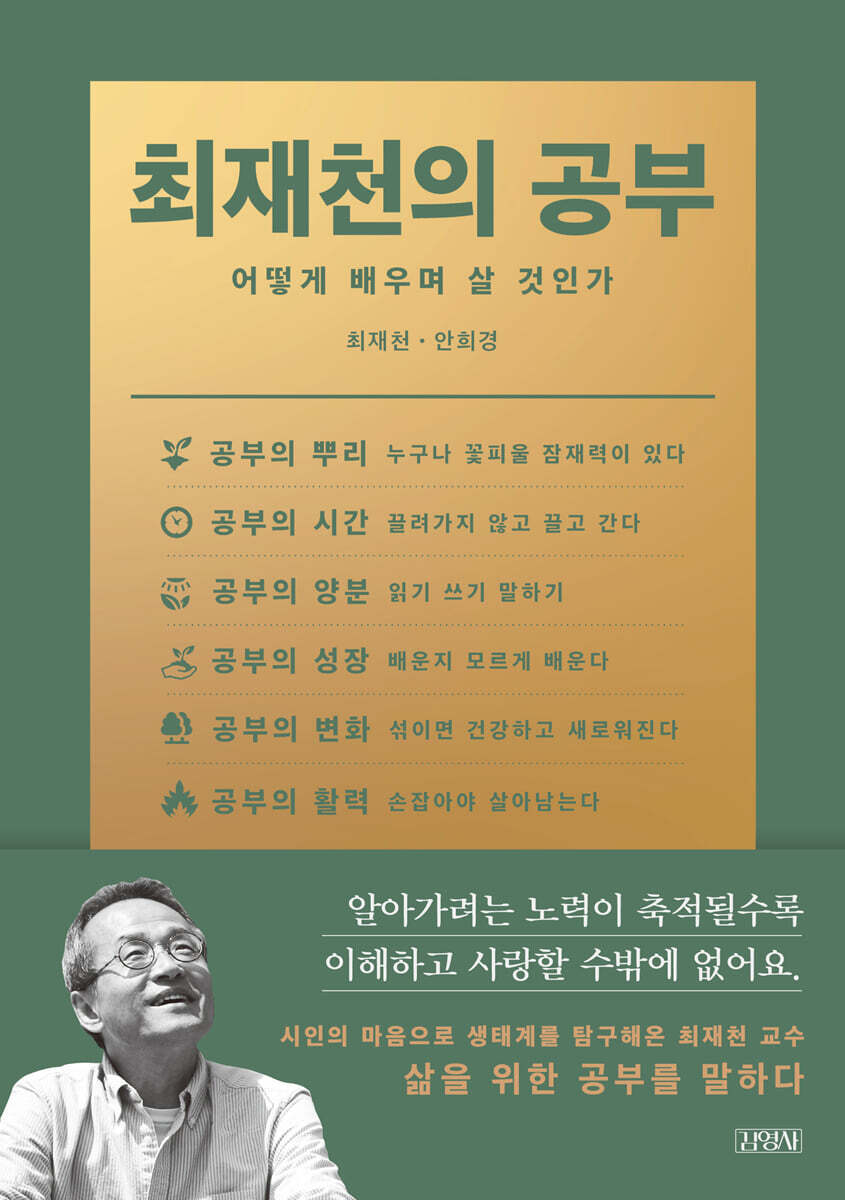
Professor Choi Jae-cheon, who has explored the ecosystem with a poet's mind Talk about studying for life "Choi Jae-cheon's Study" is a book that Professor Choi Jae-cheon, who has been deeply observing animals and humans, has wanted to write for over 10 years. It encompasses all of his thoughts on study, which is essential in this day and age. We examine why studying is important and how it impacts us throughout life, examine the reality of Korean education, which has not been properly discussed, and present a blueprint for the future. This book is based on my personal experiences during my time at Harvard University, lectures I gave while a professor at Seoul National University and Ewha Womans University, and a comprehensive perspective that crosses the boundaries between natural sciences and humanities. Countless teenagers, parents, young adults, middle-aged people, government officials, and businesses have asked Professor Choi Jae-cheon, a leading figure in the field of natural science. "How can I find work I love?" "Is there a secret to living a leisurely life while working hard?" "Is there a secret to raising children well?" "How should we survive in the face of global disaster?" "What kind of talent should we select and cultivate?" The paths of life, education, policy, and management—the paths we each seek are diverse, but they all share one thing in common. I want to learn because I want to find my way in life. “You don’t have to study flawlessly like laying bricks.” “Don’t fight for every minute and second, finish a week before the deadline.” “Reading should be a job, not a hobby.” “Teachers should not step on their students’ toes.” “Let’s educate them like animals.” “Let’s give children their lives back.” “Let’s find out what’s right through discussion.” “You can do whatever you want!” In this book, Professor Choi Jae-cheon addresses the questions we’ve been wondering about, sometimes with a soft voice, and sometimes with a firm, direct tone. It presents a map that opens the window of thought and broadens the direction of learning. |
- You can preview some of the book's contents.
Preview
index
Jeonju.
The Right to Enjoy Life - Choi Jae-cheon
Part 1.
The Roots of Learning: Everyone Has the Potential to Blossom
Time to think about education properly
Learning and Awakening in the Post-Corona Era
Let's give children their lives back.
What does studying mean to me?
See the true face of mathematics
From a math dropout to a math genius
Tests and evaluations should be different
Part 2.
Study Time: Being Pulled In, Not Dragged Out
The art of building a house of study
Find your own way and find your own direction
How to live a life without being swayed by work
Thoughts grow when you are alone
Do it a week in advance
Part 3.
The Nutrients of Study: Reading, Writing, and Speaking
A strategy to make the familiar strange
To overcome the fear of writing
The 'immunity' that blocks the room and the 'communication' that divides life.
The power that writing fosters
One axis of study is the amount of study
Writing that allows my thoughts to settle in
What and how to read
Reading is hard work
Say it with confidence
Go for it without fear
Finding out what's right through discussion
Today's homework: media literacy
Part 4.
Growth through study: Learning without even realizing it
Develop your thinking skills
Creativity comes from experience
Respect each other's antennae
Follow your heart
A teacher does not step on his student's feet.
Wake up your brain with your whole body
Part 5.
The Transformation of Study: Mixing for Health and Refreshment
21st Century Future Knowledge Map
Let's give animal-like education
Being close to nature makes you smarter at least.
Become fertilizer and become flowers
Why are we so exclusive to each other?
From winner-take-all competition to coexistence
What reforms should universities prepare for?
Part 6.
The Vitality of Study: Hand in Hand to Survive
Rice is a prescription for depression
How to communicate with children
Techniques to boost self-esteem
The secret to vigorous activity
Learning as Life
The last one.
My Study and Everyone's Life - Ahn Hee-kyung
Search
The Right to Enjoy Life - Choi Jae-cheon
Part 1.
The Roots of Learning: Everyone Has the Potential to Blossom
Time to think about education properly
Learning and Awakening in the Post-Corona Era
Let's give children their lives back.
What does studying mean to me?
See the true face of mathematics
From a math dropout to a math genius
Tests and evaluations should be different
Part 2.
Study Time: Being Pulled In, Not Dragged Out
The art of building a house of study
Find your own way and find your own direction
How to live a life without being swayed by work
Thoughts grow when you are alone
Do it a week in advance
Part 3.
The Nutrients of Study: Reading, Writing, and Speaking
A strategy to make the familiar strange
To overcome the fear of writing
The 'immunity' that blocks the room and the 'communication' that divides life.
The power that writing fosters
One axis of study is the amount of study
Writing that allows my thoughts to settle in
What and how to read
Reading is hard work
Say it with confidence
Go for it without fear
Finding out what's right through discussion
Today's homework: media literacy
Part 4.
Growth through study: Learning without even realizing it
Develop your thinking skills
Creativity comes from experience
Respect each other's antennae
Follow your heart
A teacher does not step on his student's feet.
Wake up your brain with your whole body
Part 5.
The Transformation of Study: Mixing for Health and Refreshment
21st Century Future Knowledge Map
Let's give animal-like education
Being close to nature makes you smarter at least.
Become fertilizer and become flowers
Why are we so exclusive to each other?
From winner-take-all competition to coexistence
What reforms should universities prepare for?
Part 6.
The Vitality of Study: Hand in Hand to Survive
Rice is a prescription for depression
How to communicate with children
Techniques to boost self-esteem
The secret to vigorous activity
Learning as Life
The last one.
My Study and Everyone's Life - Ahn Hee-kyung
Search
Detailed image
Into the book
I often say, “If you know, you love.”
The more you try to understand, the more you can't help but understand and love.
This is why studying and education are more important than anything else.
The content of education must be filled with the ability to discern facts.
Conflicts in society must diminish so that the words of truth-telling experts can be trusted and accepted by the general public.
For that to happen, the people in power must work hard.
The deeper the conflict, the greater the tendency to ignore the facts with partisan logic.
Above all, I believe that the love that knowledge brings is precious.
The more we humans know about facts, the more we move toward understanding and love.
--- p.39
There are definitely ways to get grades without taking tests.
However, it takes a lot more time and effort.
Testing is the simplest way.
Why did I choose to not take the exam, which took all the time and effort? It was because I was disillusioned with my reality, having failed the college entrance exam twice despite attending a good high school.
"I spent years preparing and even retaking the exam, so why is my pass or fail determined by a single exam? What if we spread this out over the course of a year?"
The thought that came to my mind was, 'The evaluation just needs to change.'
I did pretty well in the long-term, evaluation-based approach.
We can evaluate many aspects, but we evaluate them by too limited criteria.
I'm eliminating the one-on-one, one-on-one test and evaluating each student on a dozen or so aspects.
Almost daily assessments are required to produce a comprehensive evaluation for the entire semester.
I've been persistent throughout my teaching career.
--- p.68
I tried to make 'doing it in advance' a habit.
I decided to finish it a week early, but it didn't go well at first.
The thought that 'there really is a week' kept running through my head.
I practiced for a long time so it became automatic input.
'Things that need to be done by a certain date' has become 'Things that need to be done a week or two in advance.'
I'll do everything in advance.
The rest of the time, I'll do something else, and if I suddenly have 30 minutes or so to spare, I'll look at that again.
--- p.102
As you continue to expand your knowledge territory, reading as if it were your job, you'll find yourself moving effortlessly across new fields, almost as if it were a lie.
When that day comes, you will be proud and lovable.
In an age where people live to be 100, it is impossible to survive for decades with the knowledge you learned in your early 20s.
Unless you're going back to school, you'll eventually have to enter a new field by reading books.
This is not the time to be reading for fun.
Reading is a 'work' that requires planning and wrestling.
--- p.146
In my lab, and even when I was working as the director of the National Institute of Ecology, I never blamed anyone who made a mistake.
I live by the iron rule of 'don't scold someone who makes a mistake'.
It's one of my ten commandments of management.
(…) And, other people don’t really remember my mistakes.
We think that if we make a mistake, we're completely buried in that neighborhood, but my conclusion is, 'Other people don't care about me.'
My advice is, 'Don't be too scared and just go for it.'
--- p.156
Since I started talking about integration, the saying "dig one well without communication" has almost disappeared from our society.
Nowadays, most people feel that they need to blend in with those around them.
My other work has made me who I am today.
If I had only studied biology all my life, I might have lived as a very ordinary entomologist, perhaps just studying curious little insects.
No matter how much I think about it, the only thing that has allowed me to do so much with so much freedom is other things.
--- p.191
A mother chimpanzee doesn't know that her offspring is failing.
If you observe, the mother chimpanzee's expression is complicated as she sees her child's continued failures.
It's as if he's struggling with the question, 'Should I hold on to him and teach him?'
That's not true, is it?
I think you could empathize with my observations.
The mother chimpanzee continues to eat her own fruit while her failing offspring continues to struggle.
Sometimes, the baby chimpanzee steals food from its mother.
If it's taken away, there's nothing you can do, but you don't say, "Are you hungry? Mom will peel it for you."
The baby is hungry, so it will observe the mother chimpanzee more closely to learn the skill and eat it somehow.
Finally, the moment comes when you can break it all by yourself!
Aren't we rushing too hard to teach our children? If they could learn through experience, like chimpanzees do, it would be a much more powerful learning experience over a long life. Aren't we trying to cram them in too quickly? I often think about this these days.
--- p.233
Working as a dormitory tutor has taught me that listening is incredibly important.
Rather than saying that I cared for students for seven years, I was trained to listen to their stories.
It helped me a lot later when I became a professor.
While eating, he suddenly said, 'You can't do that.
There's no way I would have said, 'That's how you live life.'
You have to be good at talking to people to find out what they're doing.
Because it's not something I can figure out by talking a lot.
I was trained to listen naturally.
The more you try to understand, the more you can't help but understand and love.
This is why studying and education are more important than anything else.
The content of education must be filled with the ability to discern facts.
Conflicts in society must diminish so that the words of truth-telling experts can be trusted and accepted by the general public.
For that to happen, the people in power must work hard.
The deeper the conflict, the greater the tendency to ignore the facts with partisan logic.
Above all, I believe that the love that knowledge brings is precious.
The more we humans know about facts, the more we move toward understanding and love.
--- p.39
There are definitely ways to get grades without taking tests.
However, it takes a lot more time and effort.
Testing is the simplest way.
Why did I choose to not take the exam, which took all the time and effort? It was because I was disillusioned with my reality, having failed the college entrance exam twice despite attending a good high school.
"I spent years preparing and even retaking the exam, so why is my pass or fail determined by a single exam? What if we spread this out over the course of a year?"
The thought that came to my mind was, 'The evaluation just needs to change.'
I did pretty well in the long-term, evaluation-based approach.
We can evaluate many aspects, but we evaluate them by too limited criteria.
I'm eliminating the one-on-one, one-on-one test and evaluating each student on a dozen or so aspects.
Almost daily assessments are required to produce a comprehensive evaluation for the entire semester.
I've been persistent throughout my teaching career.
--- p.68
I tried to make 'doing it in advance' a habit.
I decided to finish it a week early, but it didn't go well at first.
The thought that 'there really is a week' kept running through my head.
I practiced for a long time so it became automatic input.
'Things that need to be done by a certain date' has become 'Things that need to be done a week or two in advance.'
I'll do everything in advance.
The rest of the time, I'll do something else, and if I suddenly have 30 minutes or so to spare, I'll look at that again.
--- p.102
As you continue to expand your knowledge territory, reading as if it were your job, you'll find yourself moving effortlessly across new fields, almost as if it were a lie.
When that day comes, you will be proud and lovable.
In an age where people live to be 100, it is impossible to survive for decades with the knowledge you learned in your early 20s.
Unless you're going back to school, you'll eventually have to enter a new field by reading books.
This is not the time to be reading for fun.
Reading is a 'work' that requires planning and wrestling.
--- p.146
In my lab, and even when I was working as the director of the National Institute of Ecology, I never blamed anyone who made a mistake.
I live by the iron rule of 'don't scold someone who makes a mistake'.
It's one of my ten commandments of management.
(…) And, other people don’t really remember my mistakes.
We think that if we make a mistake, we're completely buried in that neighborhood, but my conclusion is, 'Other people don't care about me.'
My advice is, 'Don't be too scared and just go for it.'
--- p.156
Since I started talking about integration, the saying "dig one well without communication" has almost disappeared from our society.
Nowadays, most people feel that they need to blend in with those around them.
My other work has made me who I am today.
If I had only studied biology all my life, I might have lived as a very ordinary entomologist, perhaps just studying curious little insects.
No matter how much I think about it, the only thing that has allowed me to do so much with so much freedom is other things.
--- p.191
A mother chimpanzee doesn't know that her offspring is failing.
If you observe, the mother chimpanzee's expression is complicated as she sees her child's continued failures.
It's as if he's struggling with the question, 'Should I hold on to him and teach him?'
That's not true, is it?
I think you could empathize with my observations.
The mother chimpanzee continues to eat her own fruit while her failing offspring continues to struggle.
Sometimes, the baby chimpanzee steals food from its mother.
If it's taken away, there's nothing you can do, but you don't say, "Are you hungry? Mom will peel it for you."
The baby is hungry, so it will observe the mother chimpanzee more closely to learn the skill and eat it somehow.
Finally, the moment comes when you can break it all by yourself!
Aren't we rushing too hard to teach our children? If they could learn through experience, like chimpanzees do, it would be a much more powerful learning experience over a long life. Aren't we trying to cram them in too quickly? I often think about this these days.
--- p.233
Working as a dormitory tutor has taught me that listening is incredibly important.
Rather than saying that I cared for students for seven years, I was trained to listen to their stories.
It helped me a lot later when I became a professor.
While eating, he suddenly said, 'You can't do that.
There's no way I would have said, 'That's how you live life.'
You have to be good at talking to people to find out what they're doing.
Because it's not something I can figure out by talking a lot.
I was trained to listen naturally.
--- p.280
Publisher's Review
A book written with determination by Professor Choi Jae-cheon
What is the knowledge that allows us to live?
Professor Choi Jae-cheon, a researcher who has observed nature and practiced a love of life throughout his life, and an educator who has presented insights that permeate human life, has finally published the book he has always wanted to write, "Choi Jae-cheon's Study."
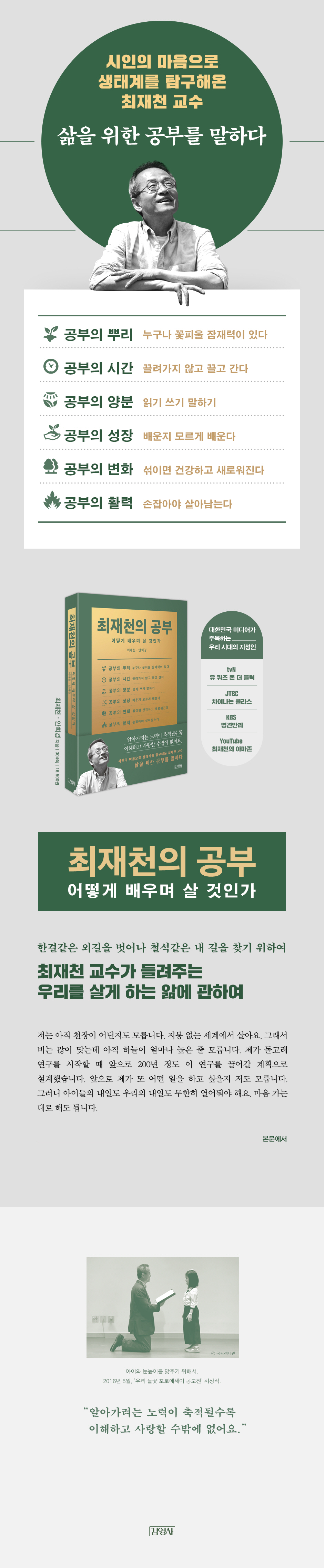
In 2016, a photo became a hot topic.
This was a photo from the awards ceremony for the 'Our Wildflower Photo Essay Contest'.
It contained a scene where he was kneeling and presenting an award to a first grade elementary school child.
The sight of him getting down to the child's eye level gave a warm feeling to many people.
The award presenter was Professor Choi Jae-cheon.
Why is Professor Choi Jae-cheon, an intellectual who has practiced humility by relinquishing his authority and viewing the world from a child's perspective, now engaging us in a conversation about "study"?
This is because of the desire to give children back their lives, the belief that it is difficult to look forward to the future if education does not change, and the determination to open a forum for discourse on what and how to learn so that “society can always function smoothly, rather than thinking of each other’s well-being when a situation arises where everyone seems to be dying” (p. 23).
There was also a reflection that we cannot continue to live in a world where we focus only on Korean, English, and math and end up dying from infectious diseases.
This book is based on a year-long conversation between journalist Hee-kyung Ahn, who interviewed Noam Chomsky, Jared Diamond, Jean Ziegler, Steven Pinker, Zygmunt Bauman, Rebecca Solnit, Martha Nussbaum, and Sister Hae-in Lee, and Professor Jae-cheon Choi, a world-renowned ecologist and animal behaviorist.
The powerful voice of Professor Choi Jae-cheon, who has been delivering the message “If you know, you love” to our society, is vividly captured.
It's time to examine the roots of study and its changes.
To break away from the monotonous path and find my own unwavering path
If you think deeply about 'how should I live', you will come to the question 'what should I learn'.
It's an era where we need books that don't give us money right away, but give us strength in life.
Professor Choi Jae-cheon says that we must now find the ultimate way to escape the misery that leads from the hell of college entrance exams to the hell of employment, and he presents an alternative.
Let's place environmental teachers in frontline educational settings to teach children "how to understand and relate to the environment" (p. 31).
Let’s create a political platform driven by “two-way deliberation, not one-sided debate” (p. 116).
As life expectancy increases, “you have to go to college seven or eight times” (p. 266). He advises that education can change as tests and evaluations change, and that schools should move beyond a space made up of straight lines and points to a space that allows for diverse movement.
Is there a way to make a living doing what I love while protecting myself? Professor Choi Jae-cheon says we need to persistently explore, probing and poking around, "looking around, poking, attending lectures, reading books" (p. 283).
They say that if you dig into this little by little, you might discover that this path is not for you.
It subtly teaches the techniques of building a house of study, and preaches that it is okay not to have a perfect blueprint for your life.
Life is not a building that is built by stacking rectangular bricks, but an organic material that is completed by balancing square stones, round stones, large stones, and small stones.
“Don’t be too afraid.
It's better to go with a slightly rough structure anyway.
"If you dive into this and that, even if you're sloppy on one side, if you study the other side deeply, eventually you'll find that the two sides meet.' The deeper you delve into the other side, the more support you gain, and you gain considerable strength." (p. 83)
In this age of "N-jobbers," is it really okay to do something else? Professor Choi Jae-cheon answers without hesitation, "Yes, it is."
The reason his words are trustworthy is because he too has gone through many failures, many challenges, and many wanderings during his youth to reach where he is today.
He said, “I also have to finish everything within a set time.
We don't live our whole lives in a rush where we have to find every solution in an hour.
He confesses that his distractions have created his current self, saying, “We have enough time to recognize and reflect on the problem” (p. 64).
What I Learned as a Dormitory Superintendent at Harvard University
My experiences and feelings as a professor from Seoul National University to Ewha Womans University
Life at Harvard University, considered one of the world's most prestigious universities, was a turning point in Professor Choi Jae-cheon's life.
There he met his mentor, Professor Edward Wilson, who supported and encouraged him, and learned the secrets of studying and working well.
Doing things that need to be done a week in advance.
He has continued the habit of finishing his work a week in advance and making small corrections several times whenever he has time.
They say that these habits help them produce better results and maintain a calm mind.
I also learned how to debate, which is the weakest point of our society, at Harvard University.
He explains that discussions that “find out what is right” (page 159), rather than discussions that “pull the other party into a corner” (page 65), are more helpful for true social development.
He believes that time spent alone is just as important as time spent thinking together, because “while there are things that need to be done together, new results come from time spent thinking, researching, and reading alone” (p. 95).
Everyone knows that the power of 'reading, writing, and speaking' is important, but his methodology is unique.
When he writes, he writes a draft a week in advance and then revises it “about 50 times” (p. 112) to create sentences that are easy to breathe.
I recommend that you focus on “planned reading” (page 147) rather than “hobby reading” (page 146).
His keen insight into what to write and how to read shines through once again in this book.
“When I give lectures about reading, I put up a picture of an elephant pooping on the screen.
Have you ever actually seen elephant dung? It's enormous.
If you put something in, won't it come out? Some people say they write quite well even though they don't read.
I don't believe that.
People who read a lot write well.
Rather than copying what you read from memory, you create your own sentences through the process of thinking while reading.
“I have rarely seen a case of someone who has never read writing being a good writer.” (p. 134)
Studying is an effort to make one person and the world live beautifully.
A book that ranges from provocative questions to comprehensive insights.
Is it only through competition, trampling on others, that survival is possible? Professor Choi Jae-cheon has for years been arguing against a winner-takes-all society, arguing, "We should rule the group, not the king." In this book, he draws parallels to the animal kingdom, illustrating the pitfalls of self-righteousness for the dominant figure and the importance of a coexistent life for all.
“In chimpanzee society, for example, several males in an alliance beat up and overthrow the existing alpha male, and then one of the males in that alliance becomes the new leader.
If the alpha chimpanzee does not share power with his cooperating fellow chimpanzees, the fellow chimpanzees will form alliances with other chimpanzees and wait for an opportunity to overthrow the alpha chimpanzee.
“Yesterday’s colleague becomes today’s enemy.” (pp. 258-259)
As disasters like COVID-19 occur, we have come to realize that the attitude of prioritizing the survival of ourselves and our families is an attitude that cannot even save ourselves and our families.
“We hate because we don’t know, we are jealous because we don’t know, and we ostracize because we don’t know.
“People who know each other well usually can’t do that.” (p. 238) “Nature is a place where those who have joined hands drive out the lone wolf who hasn’t even joined hands yet and live together” (p. 10). If you listen to his words, you will come to understand how to live together wisely.
"Choi Jae-cheon's Study" is a life study book that goes beyond mere reading and inspires action.
The book is permeated with this message:
Studying is not a simple process of learning and mastering academic subjects or skills.
It's about rebuilding my rock-bottom self-esteem by looking into who I am and what I like.
It is a willing effort to understand human society and nature, and a struggle to live with understanding and love for one another.
This book is comprised of journalist Ahn Hee-kyung's in-depth questions and Professor Choi Jae-cheon's candid answers.
As you follow the sentences in the book, you will encounter moments where the questions and answers of the two authors create a chemical reaction, and the reader will gradually find himself drawn into the book.
I hope that “his life story of listening to the teachings of nature” (p. 297) will bring about “subtle changes” (p. 297) in your daily life.
What is the knowledge that allows us to live?
Professor Choi Jae-cheon, a researcher who has observed nature and practiced a love of life throughout his life, and an educator who has presented insights that permeate human life, has finally published the book he has always wanted to write, "Choi Jae-cheon's Study."
In 2016, a photo became a hot topic.
This was a photo from the awards ceremony for the 'Our Wildflower Photo Essay Contest'.
It contained a scene where he was kneeling and presenting an award to a first grade elementary school child.
The sight of him getting down to the child's eye level gave a warm feeling to many people.
The award presenter was Professor Choi Jae-cheon.
Why is Professor Choi Jae-cheon, an intellectual who has practiced humility by relinquishing his authority and viewing the world from a child's perspective, now engaging us in a conversation about "study"?
This is because of the desire to give children back their lives, the belief that it is difficult to look forward to the future if education does not change, and the determination to open a forum for discourse on what and how to learn so that “society can always function smoothly, rather than thinking of each other’s well-being when a situation arises where everyone seems to be dying” (p. 23).
There was also a reflection that we cannot continue to live in a world where we focus only on Korean, English, and math and end up dying from infectious diseases.
This book is based on a year-long conversation between journalist Hee-kyung Ahn, who interviewed Noam Chomsky, Jared Diamond, Jean Ziegler, Steven Pinker, Zygmunt Bauman, Rebecca Solnit, Martha Nussbaum, and Sister Hae-in Lee, and Professor Jae-cheon Choi, a world-renowned ecologist and animal behaviorist.
The powerful voice of Professor Choi Jae-cheon, who has been delivering the message “If you know, you love” to our society, is vividly captured.
It's time to examine the roots of study and its changes.
To break away from the monotonous path and find my own unwavering path
If you think deeply about 'how should I live', you will come to the question 'what should I learn'.
It's an era where we need books that don't give us money right away, but give us strength in life.
Professor Choi Jae-cheon says that we must now find the ultimate way to escape the misery that leads from the hell of college entrance exams to the hell of employment, and he presents an alternative.
Let's place environmental teachers in frontline educational settings to teach children "how to understand and relate to the environment" (p. 31).
Let’s create a political platform driven by “two-way deliberation, not one-sided debate” (p. 116).
As life expectancy increases, “you have to go to college seven or eight times” (p. 266). He advises that education can change as tests and evaluations change, and that schools should move beyond a space made up of straight lines and points to a space that allows for diverse movement.
Is there a way to make a living doing what I love while protecting myself? Professor Choi Jae-cheon says we need to persistently explore, probing and poking around, "looking around, poking, attending lectures, reading books" (p. 283).
They say that if you dig into this little by little, you might discover that this path is not for you.
It subtly teaches the techniques of building a house of study, and preaches that it is okay not to have a perfect blueprint for your life.
Life is not a building that is built by stacking rectangular bricks, but an organic material that is completed by balancing square stones, round stones, large stones, and small stones.
“Don’t be too afraid.
It's better to go with a slightly rough structure anyway.
"If you dive into this and that, even if you're sloppy on one side, if you study the other side deeply, eventually you'll find that the two sides meet.' The deeper you delve into the other side, the more support you gain, and you gain considerable strength." (p. 83)
In this age of "N-jobbers," is it really okay to do something else? Professor Choi Jae-cheon answers without hesitation, "Yes, it is."
The reason his words are trustworthy is because he too has gone through many failures, many challenges, and many wanderings during his youth to reach where he is today.
He said, “I also have to finish everything within a set time.
We don't live our whole lives in a rush where we have to find every solution in an hour.
He confesses that his distractions have created his current self, saying, “We have enough time to recognize and reflect on the problem” (p. 64).
What I Learned as a Dormitory Superintendent at Harvard University
My experiences and feelings as a professor from Seoul National University to Ewha Womans University
Life at Harvard University, considered one of the world's most prestigious universities, was a turning point in Professor Choi Jae-cheon's life.
There he met his mentor, Professor Edward Wilson, who supported and encouraged him, and learned the secrets of studying and working well.
Doing things that need to be done a week in advance.
He has continued the habit of finishing his work a week in advance and making small corrections several times whenever he has time.
They say that these habits help them produce better results and maintain a calm mind.
I also learned how to debate, which is the weakest point of our society, at Harvard University.
He explains that discussions that “find out what is right” (page 159), rather than discussions that “pull the other party into a corner” (page 65), are more helpful for true social development.
He believes that time spent alone is just as important as time spent thinking together, because “while there are things that need to be done together, new results come from time spent thinking, researching, and reading alone” (p. 95).
Everyone knows that the power of 'reading, writing, and speaking' is important, but his methodology is unique.
When he writes, he writes a draft a week in advance and then revises it “about 50 times” (p. 112) to create sentences that are easy to breathe.
I recommend that you focus on “planned reading” (page 147) rather than “hobby reading” (page 146).
His keen insight into what to write and how to read shines through once again in this book.
“When I give lectures about reading, I put up a picture of an elephant pooping on the screen.
Have you ever actually seen elephant dung? It's enormous.
If you put something in, won't it come out? Some people say they write quite well even though they don't read.
I don't believe that.
People who read a lot write well.
Rather than copying what you read from memory, you create your own sentences through the process of thinking while reading.
“I have rarely seen a case of someone who has never read writing being a good writer.” (p. 134)
Studying is an effort to make one person and the world live beautifully.
A book that ranges from provocative questions to comprehensive insights.
Is it only through competition, trampling on others, that survival is possible? Professor Choi Jae-cheon has for years been arguing against a winner-takes-all society, arguing, "We should rule the group, not the king." In this book, he draws parallels to the animal kingdom, illustrating the pitfalls of self-righteousness for the dominant figure and the importance of a coexistent life for all.
“In chimpanzee society, for example, several males in an alliance beat up and overthrow the existing alpha male, and then one of the males in that alliance becomes the new leader.
If the alpha chimpanzee does not share power with his cooperating fellow chimpanzees, the fellow chimpanzees will form alliances with other chimpanzees and wait for an opportunity to overthrow the alpha chimpanzee.
“Yesterday’s colleague becomes today’s enemy.” (pp. 258-259)
As disasters like COVID-19 occur, we have come to realize that the attitude of prioritizing the survival of ourselves and our families is an attitude that cannot even save ourselves and our families.
“We hate because we don’t know, we are jealous because we don’t know, and we ostracize because we don’t know.
“People who know each other well usually can’t do that.” (p. 238) “Nature is a place where those who have joined hands drive out the lone wolf who hasn’t even joined hands yet and live together” (p. 10). If you listen to his words, you will come to understand how to live together wisely.
"Choi Jae-cheon's Study" is a life study book that goes beyond mere reading and inspires action.
The book is permeated with this message:
Studying is not a simple process of learning and mastering academic subjects or skills.
It's about rebuilding my rock-bottom self-esteem by looking into who I am and what I like.
It is a willing effort to understand human society and nature, and a struggle to live with understanding and love for one another.
This book is comprised of journalist Ahn Hee-kyung's in-depth questions and Professor Choi Jae-cheon's candid answers.
As you follow the sentences in the book, you will encounter moments where the questions and answers of the two authors create a chemical reaction, and the reader will gradually find himself drawn into the book.
I hope that “his life story of listening to the teachings of nature” (p. 297) will bring about “subtle changes” (p. 297) in your daily life.
GOODS SPECIFICS
- Date of issue: May 18, 2022
- Page count, weight, size: 304 pages | 446g | 148*210*30mm
- ISBN13: 9788934943457
- ISBN10: 8934943459
You may also like
카테고리
korean


korean

![GQ KOREA Mark (Monthly): December [2025]](http://librairie.coreenne.fr/cdn/shop/files/8ef265dbbfbf186523ed75ba7319009d.jpg?v=1765340328&width=3840)


