

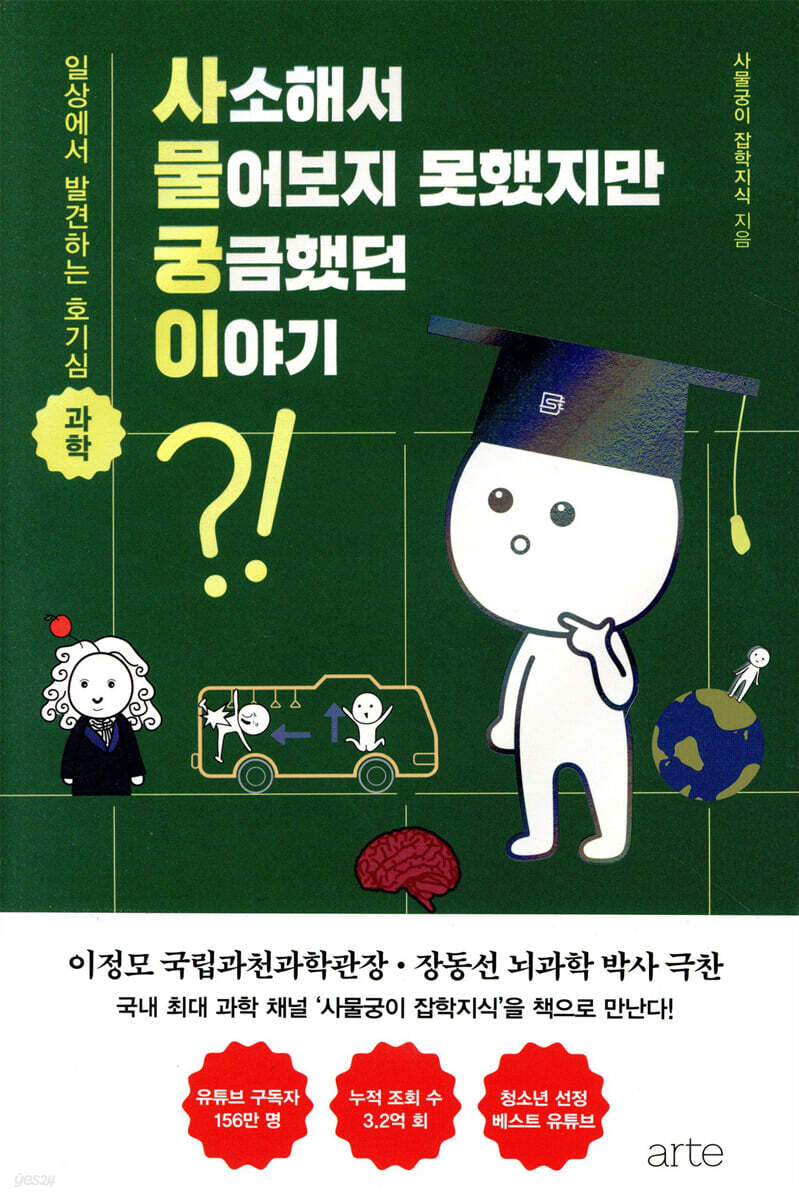
A story I was curious about but couldn't ask because it was trivial
 |
Description
Book Introduction
“I have no special talent. “I just have a passionate curiosity.” - Albert Einstein The science channel 'Samulgungi Miscellaneous Knowledge', which has captivated 1.15 million YouTube subscribers by solving trivial and absurd curiosities in everyday life, has been published as a book. The fun of Samulgungi, as ardent subscribers unanimously agree, lies in the questions themselves. It is full of unique questions that anyone would have wondered about at least once in their lives, such as, "What happens if you shoot a gun into the sky?", "Can you survive if you jump when an elevator falls?", and "Why do you suddenly flinch when you sleep?", and others that will make you wonder something you never knew you wanted to know the moment you hear them. Each topic starts with curiosity, but the process of solving it is not easy. From various papers to expert advice, we meticulously research the data to reveal the scientific principles and reasons behind the phenomenon. There's no need to worry about being ignorant. As you follow the author's easy and clear explanations along with the cute character 'Gung-i', you will find yourself moving on to the next question before you know it. Immerse yourself in the world of science relevant to everyday life, guided by YouTube's curiosity solver, Samulgungi! |
- You can preview some of the book's contents.
Preview
index
prolog
Part 1: A story about the body that was too trivial to ask about.
1 Why am I so tired right after waking up in the morning?
2 Why do I suddenly startle while sleeping?
3 What is the transparent thing on the end of the plucked hair?
4 What is the flash you see when you close your eyes and press your eyelids?
5 Why does a sound come out when I press the teardrop hill?
6 What happens if you don't cut a newborn's umbilical cord?
7. Should a person die with his eyes open or closed?
8 The outside of the body is symmetrical, but why is the inside asymmetrical?
9 Why is only one side of my nose blocked when I have a cold?
Part 2: The Odd and Exciting Palace Lab
10 What happens if you shoot a gun into the sky?
11 Can you survive if you jump when the elevator falls?
12 What happens if you jump on a moving bus?
13 Is it possible to knock someone out by cutting their throat like in the movies?
14 Why do car wheels appear to be spinning backwards?
15 Why does it feel strange when I walk down a stopped escalator?
16 How does dust accumulate on fan blades?
17 What is the principle of water sledding?
Part 3: Useful Life Questions You Should Know
18 Why are the holes in electrical outlets angled at a 45 degree angle?
19 Is the solid soap in public restrooms really clean?
20 Why are good postures uncomfortable and bad postures comfortable?
21 Why do I wake up early the day after drinking?
22 Why do the bottoms of my pants get wet even when I use an umbrella when it rains?
23 Why does the door slam shut when the window is open?
24 Is it okay to boil and eat spoiled food?
25 Why do milk cartons have a specific opening direction?
Part 4: A Story About a Curious but Unasked Animal
26 Will the anthill be flooded when it rains?
27 How do sloths survive in the wild?
28 Can fish feel pain?
29 Why do flies swarm in the air?
30 Do giraffes vomit?
What would happen if we inserted a unique human gene into a monkey?
32 How do pufferfish swell and produce deadly poison?
Part 5: Trivia you don't need to know, but somehow want to know
33 What will happen to the prisoners if war breaks out?
34 What is the identity of the triangle hanging in the middle of the escalator?
35 How do gift certificate sellers make money?
36 Can you guess the gift certificate number by randomly selecting it?
37 How can we increase viewership in important scenes?
38 Why do bowlers put spin on the ball?
39 How does a designated driver get back to his destination after arriving?
40 Why is gravel laid on the railroad tracks?
References
Part 1: A story about the body that was too trivial to ask about.
1 Why am I so tired right after waking up in the morning?
2 Why do I suddenly startle while sleeping?
3 What is the transparent thing on the end of the plucked hair?
4 What is the flash you see when you close your eyes and press your eyelids?
5 Why does a sound come out when I press the teardrop hill?
6 What happens if you don't cut a newborn's umbilical cord?
7. Should a person die with his eyes open or closed?
8 The outside of the body is symmetrical, but why is the inside asymmetrical?
9 Why is only one side of my nose blocked when I have a cold?
Part 2: The Odd and Exciting Palace Lab
10 What happens if you shoot a gun into the sky?
11 Can you survive if you jump when the elevator falls?
12 What happens if you jump on a moving bus?
13 Is it possible to knock someone out by cutting their throat like in the movies?
14 Why do car wheels appear to be spinning backwards?
15 Why does it feel strange when I walk down a stopped escalator?
16 How does dust accumulate on fan blades?
17 What is the principle of water sledding?
Part 3: Useful Life Questions You Should Know
18 Why are the holes in electrical outlets angled at a 45 degree angle?
19 Is the solid soap in public restrooms really clean?
20 Why are good postures uncomfortable and bad postures comfortable?
21 Why do I wake up early the day after drinking?
22 Why do the bottoms of my pants get wet even when I use an umbrella when it rains?
23 Why does the door slam shut when the window is open?
24 Is it okay to boil and eat spoiled food?
25 Why do milk cartons have a specific opening direction?
Part 4: A Story About a Curious but Unasked Animal
26 Will the anthill be flooded when it rains?
27 How do sloths survive in the wild?
28 Can fish feel pain?
29 Why do flies swarm in the air?
30 Do giraffes vomit?
What would happen if we inserted a unique human gene into a monkey?
32 How do pufferfish swell and produce deadly poison?
Part 5: Trivia you don't need to know, but somehow want to know
33 What will happen to the prisoners if war breaks out?
34 What is the identity of the triangle hanging in the middle of the escalator?
35 How do gift certificate sellers make money?
36 Can you guess the gift certificate number by randomly selecting it?
37 How can we increase viewership in important scenes?
38 Why do bowlers put spin on the ball?
39 How does a designated driver get back to his destination after arriving?
40 Why is gravel laid on the railroad tracks?
References
Detailed image
.jpg)
Into the book
There are times when I feel particularly tired right after waking up in the morning.
You probably think it's because you didn't get enough sleep.
However, if you force yourself to get up, wash, eat, or do other activities, you will quickly return to your normal state.
Here the question arises:
Even if you didn't get enough sleep, shouldn't you be less tired after you doze off than before? (...) Conversely, you've probably experienced feeling refreshed after only 10-20 minutes of sleep when you were so tired that you dozed off outside.
To understand the irony of feeling tired even after a long night's sleep and refreshed even after a short night's sleep, you need to understand the process of sleep.
--- pp.13~14, from “01 Why am I so tired right after waking up in the morning?”
We've all had that ominous fantasy at least once: the elevator suddenly stops working and you plummet to the floor.
If this situation actually happened to you, what would you choose? When I was a kid, I used to imagine jumping into an elevator just before it hit the ground, then settling down after the floor absorbed the impact.
I'm sure many people have had similar thoughts, but this behavior is actually very dangerous.
--- p.71, from “11 Can you survive if you jump when the elevator falls?”
The reason we wash our hands is to remove countless invisible germs, and to do that, we need to bring our hands in an unsanitary state to contact with soap.
However, given the nature of public restrooms, it is questionable to think that an unspecified number of people touch solid soap with their germ-filled hands.
If you touch soap with germ-filled hands, isn't that soap contaminated? And if you wash your hands with that soap, won't your hands get even dirtier?
--- pp.115~116, from “19 Is the solid soap in public restrooms really clean?”
What made the human brain what it is? The secret lies in a gene called ARHGAP11B, acquired by chance through a mutation about 500,000 years ago.
This gene, which is unique to humans, was first discovered in 2015 at the Max Planck Institute in Germany.
This gene alone can rapidly expand the neocortex and create wrinkles in the brain during the fetal stage.
This brain development is what makes humans different from other animals.
So what happens if we insert this gene into another animal?
--- pp.182~183, from “31 What would happen if we inserted a unique human gene into a monkey?”
When war breaks out, you must evacuate to avoid being killed or injured by shelling, etc.
However, prisoners who are under the control of prison guards are not free to move.
The average daily population of domestic correctional facilities is 40,000 to 60,000, and one correctional officer is responsible for 3 to 4 inmates.
As of 2018, Korea had the second-highest number of inmates per officer among member countries of the Organization for Economic Cooperation and Development.
In such a situation where management is difficult even in normal times, evacuating prisoners in the event of war is difficult.
(...) What will happen to the prisoners in prison when war actually breaks out?
You probably think it's because you didn't get enough sleep.
However, if you force yourself to get up, wash, eat, or do other activities, you will quickly return to your normal state.
Here the question arises:
Even if you didn't get enough sleep, shouldn't you be less tired after you doze off than before? (...) Conversely, you've probably experienced feeling refreshed after only 10-20 minutes of sleep when you were so tired that you dozed off outside.
To understand the irony of feeling tired even after a long night's sleep and refreshed even after a short night's sleep, you need to understand the process of sleep.
--- pp.13~14, from “01 Why am I so tired right after waking up in the morning?”
We've all had that ominous fantasy at least once: the elevator suddenly stops working and you plummet to the floor.
If this situation actually happened to you, what would you choose? When I was a kid, I used to imagine jumping into an elevator just before it hit the ground, then settling down after the floor absorbed the impact.
I'm sure many people have had similar thoughts, but this behavior is actually very dangerous.
--- p.71, from “11 Can you survive if you jump when the elevator falls?”
The reason we wash our hands is to remove countless invisible germs, and to do that, we need to bring our hands in an unsanitary state to contact with soap.
However, given the nature of public restrooms, it is questionable to think that an unspecified number of people touch solid soap with their germ-filled hands.
If you touch soap with germ-filled hands, isn't that soap contaminated? And if you wash your hands with that soap, won't your hands get even dirtier?
--- pp.115~116, from “19 Is the solid soap in public restrooms really clean?”
What made the human brain what it is? The secret lies in a gene called ARHGAP11B, acquired by chance through a mutation about 500,000 years ago.
This gene, which is unique to humans, was first discovered in 2015 at the Max Planck Institute in Germany.
This gene alone can rapidly expand the neocortex and create wrinkles in the brain during the fetal stage.
This brain development is what makes humans different from other animals.
So what happens if we insert this gene into another animal?
--- pp.182~183, from “31 What would happen if we inserted a unique human gene into a monkey?”
When war breaks out, you must evacuate to avoid being killed or injured by shelling, etc.
However, prisoners who are under the control of prison guards are not free to move.
The average daily population of domestic correctional facilities is 40,000 to 60,000, and one correctional officer is responsible for 3 to 4 inmates.
As of 2018, Korea had the second-highest number of inmates per officer among member countries of the Organization for Economic Cooperation and Development.
In such a situation where management is difficult even in normal times, evacuating prisoners in the event of war is difficult.
(...) What will happen to the prisoners in prison when war actually breaks out?
--- pp.195~196, from “What will happen to the prisoners in prison if war breaks out?”
Publisher's Review
1.15 million subscribers, 140 million cumulative views
Korea's largest science YouTube channel, "Samulgungi Miscellaneous Knowledge," is now available as a book!
A world of life-related science that begins with a simple curiosity
* Topics with a 200% curiosity-inducing effect, verified by the number of views
* Scientific concepts and principles that are easy to miss in videos at a glance
* The cute character 'Gung-i' that makes you curious about things you weren't curious about before
The abbreviation for 'a story that was too trivial to ask but I was curious about', 'Samulgungi', a miscellaneous knowledge, literally creates YouTube videos that solve trivial curiosities and went viral, reaching over 1 million subscribers in just one year.
The author humbly attributes all this to the YouTube algorithm, but the real secret to the popularity of the Samgungi trivia channel lies in its ingenious topic selection that makes it impossible not to click on the title the moment you see it, along with the solid scientific content that supports it.
Anyone who has ever woken up suddenly with a start will find it difficult to simply pass over the title, "Why do I suddenly startle in my sleep?"
According to the author, this is a phenomenon called sleep start, and is related to muscle relaxation and blood circulation during sleep.
If you've ever read an article about someone being killed by a gun fired into the air, you might be interested in the question, "What happens when you shoot a gun into the sky?"
To answer this question, we need to understand the terminal velocity and parabolic motion of a bullet.
Surprisingly, many people were curious about these seemingly trivial topics, and both videos garnered over 3 million views.
The book contains 40 topics, including the most viewed topics, carefully selected by the author, divided into five categories: 'Stories about the Body,' 'The Palace Laboratory,' 'Life Curiosities,' 'Stories about Animals,' and 'General Knowledge.'
Intellectual curiosity spanning physics, chemistry, medicine, and life sciences
Recommended science channels you can trust and watch
The surprising charm of Sagittarius's trivia is that even the most trivial of questions often contain reasons and scientific principles that are not trivial.
While looking for the reason why a door slams shut when a window is open, he comes across Bernoulli's principle, and learns that the 'principle of water slamming', which he had been doing for fun, was used to drop bombs during World War II.
The video, 'What would happen if we inserted a unique human gene into a monkey?', produced based on a submission by science communicator Exo (Lee Seon-ho), cited the results of an experiment recently published in the international academic journal Science.
Comments such as "shocking" and "creepy" poured in for the content that dealt with controversial topics such as human dignity and the ethics of experimentation.
Although the author is a scientist specializing in microbiology, it is not easy for him to solve questions in various fields, from physics, chemistry, medicine, to advanced life sciences, on his own.
It can take months to resolve a single question by reviewing relevant papers and consulting with experts.
Moreover, the process of creating an animation by explaining the findings in the simplest possible way so that even people without scientific background can understand them is not easy.
It's amazing how much effort is put into each piece of content and yet the channel can continue to operate.
So, it is said that in the beginning, they received support from the National Research Foundation of Korea.
However, thanks to this sincerity and high quality, Sa-mul-gung was able to establish itself as a unique and trustworthy science channel with unrivaled general knowledge in the fiercely competitive YouTube market.
The subscriber base of Sagittarius is diverse enough to encompass almost all age groups.
After providing content to G-Bus TV for a while, it became known to more people and was introduced as a recommended channel in various media and provincial education office blogs.
There is no unimportant question in the world!
There are countless examples, not only in the scientific world but also in our lives, of small curiosity and a thoughtless question leading to great discoveries and changes.
Without that initial curiosity and question, nothing might happen to us.
The author says that over the years, while trying to resolve various curiosities, he realized that when he investigated questions that he thought had obvious answers, there were still many things that were not yet known, and that even things that seemed meaningless contained very important stories.
I hope that readers of this book will also be able to look at the world around them with curious eyes after closing the book, and that their lives will become a little more interesting.
Korea's largest science YouTube channel, "Samulgungi Miscellaneous Knowledge," is now available as a book!
A world of life-related science that begins with a simple curiosity
* Topics with a 200% curiosity-inducing effect, verified by the number of views
* Scientific concepts and principles that are easy to miss in videos at a glance
* The cute character 'Gung-i' that makes you curious about things you weren't curious about before
The abbreviation for 'a story that was too trivial to ask but I was curious about', 'Samulgungi', a miscellaneous knowledge, literally creates YouTube videos that solve trivial curiosities and went viral, reaching over 1 million subscribers in just one year.
The author humbly attributes all this to the YouTube algorithm, but the real secret to the popularity of the Samgungi trivia channel lies in its ingenious topic selection that makes it impossible not to click on the title the moment you see it, along with the solid scientific content that supports it.
Anyone who has ever woken up suddenly with a start will find it difficult to simply pass over the title, "Why do I suddenly startle in my sleep?"
According to the author, this is a phenomenon called sleep start, and is related to muscle relaxation and blood circulation during sleep.
If you've ever read an article about someone being killed by a gun fired into the air, you might be interested in the question, "What happens when you shoot a gun into the sky?"
To answer this question, we need to understand the terminal velocity and parabolic motion of a bullet.
Surprisingly, many people were curious about these seemingly trivial topics, and both videos garnered over 3 million views.
The book contains 40 topics, including the most viewed topics, carefully selected by the author, divided into five categories: 'Stories about the Body,' 'The Palace Laboratory,' 'Life Curiosities,' 'Stories about Animals,' and 'General Knowledge.'
Intellectual curiosity spanning physics, chemistry, medicine, and life sciences
Recommended science channels you can trust and watch
The surprising charm of Sagittarius's trivia is that even the most trivial of questions often contain reasons and scientific principles that are not trivial.
While looking for the reason why a door slams shut when a window is open, he comes across Bernoulli's principle, and learns that the 'principle of water slamming', which he had been doing for fun, was used to drop bombs during World War II.
The video, 'What would happen if we inserted a unique human gene into a monkey?', produced based on a submission by science communicator Exo (Lee Seon-ho), cited the results of an experiment recently published in the international academic journal Science.
Comments such as "shocking" and "creepy" poured in for the content that dealt with controversial topics such as human dignity and the ethics of experimentation.
Although the author is a scientist specializing in microbiology, it is not easy for him to solve questions in various fields, from physics, chemistry, medicine, to advanced life sciences, on his own.
It can take months to resolve a single question by reviewing relevant papers and consulting with experts.
Moreover, the process of creating an animation by explaining the findings in the simplest possible way so that even people without scientific background can understand them is not easy.
It's amazing how much effort is put into each piece of content and yet the channel can continue to operate.
So, it is said that in the beginning, they received support from the National Research Foundation of Korea.
However, thanks to this sincerity and high quality, Sa-mul-gung was able to establish itself as a unique and trustworthy science channel with unrivaled general knowledge in the fiercely competitive YouTube market.
The subscriber base of Sagittarius is diverse enough to encompass almost all age groups.
After providing content to G-Bus TV for a while, it became known to more people and was introduced as a recommended channel in various media and provincial education office blogs.
There is no unimportant question in the world!
There are countless examples, not only in the scientific world but also in our lives, of small curiosity and a thoughtless question leading to great discoveries and changes.
Without that initial curiosity and question, nothing might happen to us.
The author says that over the years, while trying to resolve various curiosities, he realized that when he investigated questions that he thought had obvious answers, there were still many things that were not yet known, and that even things that seemed meaningless contained very important stories.
I hope that readers of this book will also be able to look at the world around them with curious eyes after closing the book, and that their lives will become a little more interesting.
GOODS SPECIFICS
- Date of issue: September 16, 2020
- Page count, weight, size: 240 pages | 358g | 148*215*14mm
- ISBN13: 9788950991913
- ISBN10: 8950991918
You may also like
카테고리
korean


korean

![GQ KOREA Mark (Monthly): December [2025]](http://librairie.coreenne.fr/cdn/shop/files/8ef265dbbfbf186523ed75ba7319009d.jpg?v=1765340328&width=3840)


