

Kim Min-jun's Inner Space
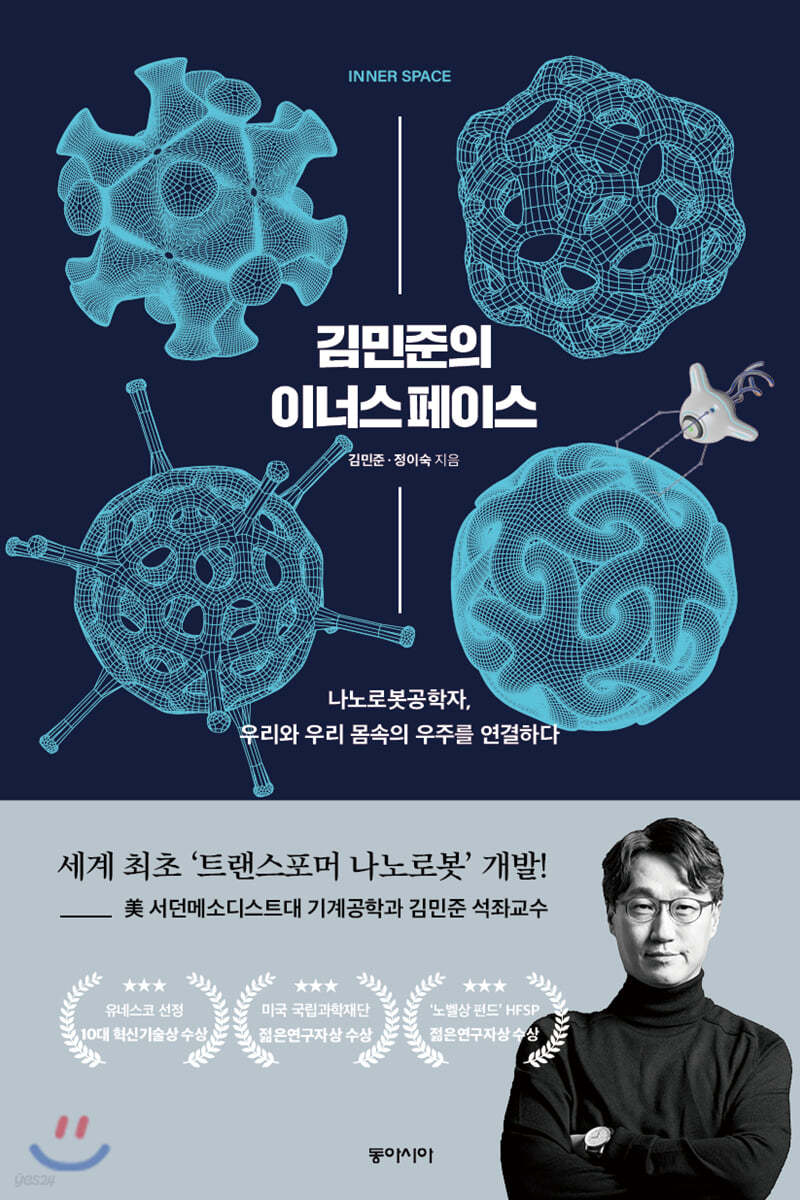 |
Description
Book Introduction
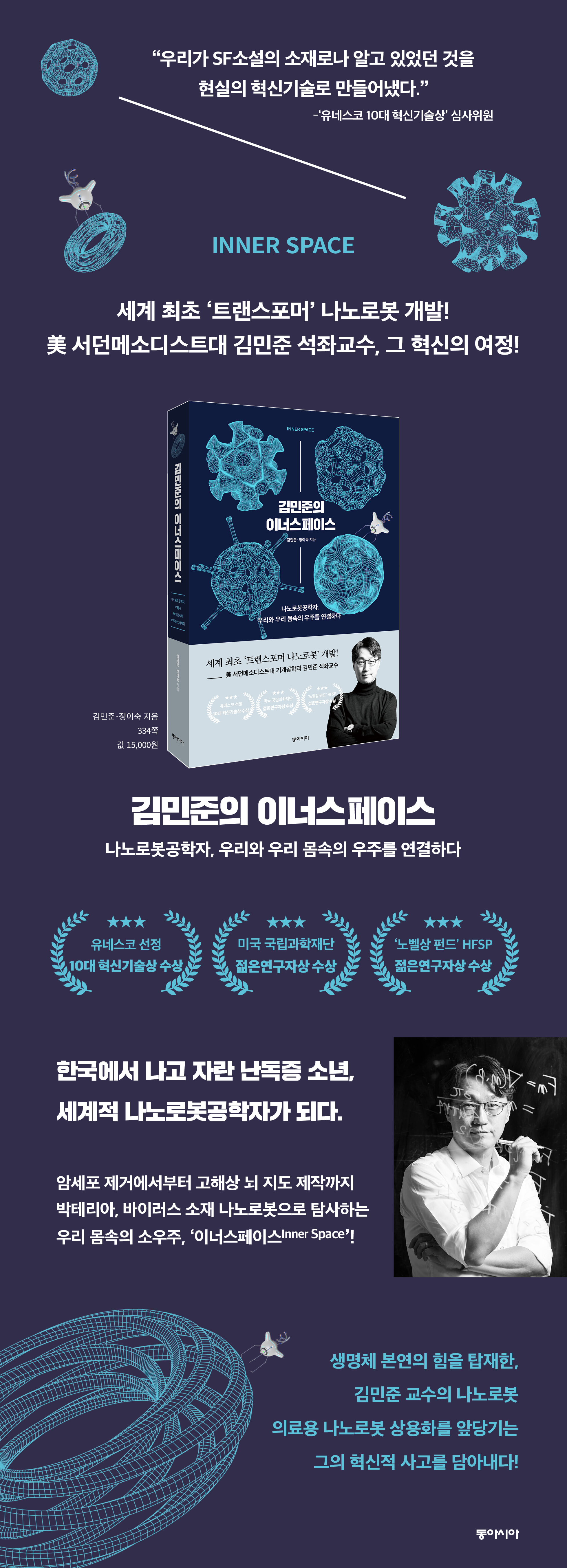
The world's first 'Transformer' nanorobot developed!
Professor Minjun Kim of Southern Methodist University, USA, on his journey of innovation!
From removing cancer cells to creating high-resolution brain maps
A microcosm inside our bodies, explored with nanorobots made of bacteria and viruses!
The UNESCO-Netexplo Award is an award given annually by UNESCO, in collaboration with the French Parliament and the Ministry of Digital Economy, to the most innovative and promising innovative technologies. Professor Kim Min-jun received the award in recognition of his development of a microrobot that swims along arterial blood vessels.
The reason the UNESCO-Netxplo Award jury described Professor Kim Min-jun's microrobot as "sci-fi" is not simply because his robot is so small that it is invisible.
Because it not only removes blockages in blood vessels by swimming inside them, but also allows drugs to be delivered precisely to specific parts of the body, in other words, it has opened up a way into the universe inside our bodies that is both very close and very distant to us.
"Kim Min-jun's Inner Space" is a spectacularly entertaining book that shows how science fiction imagination becomes reality, and how a dyslexic young man born and raised in Korea becomes a world-renowned scholar.
But just as there is light, there is also shadow, and the book also details the life of Professor Kim Min-jun, who is fiercely challenging himself underwater.
As you read about his 'journey of innovation', which was filled with countless failures, you will naturally find yourself rooting for his challenges.
Professor Minjun Kim of Southern Methodist University, USA, on his journey of innovation!
From removing cancer cells to creating high-resolution brain maps
A microcosm inside our bodies, explored with nanorobots made of bacteria and viruses!
The UNESCO-Netexplo Award is an award given annually by UNESCO, in collaboration with the French Parliament and the Ministry of Digital Economy, to the most innovative and promising innovative technologies. Professor Kim Min-jun received the award in recognition of his development of a microrobot that swims along arterial blood vessels.
The reason the UNESCO-Netxplo Award jury described Professor Kim Min-jun's microrobot as "sci-fi" is not simply because his robot is so small that it is invisible.
Because it not only removes blockages in blood vessels by swimming inside them, but also allows drugs to be delivered precisely to specific parts of the body, in other words, it has opened up a way into the universe inside our bodies that is both very close and very distant to us.
"Kim Min-jun's Inner Space" is a spectacularly entertaining book that shows how science fiction imagination becomes reality, and how a dyslexic young man born and raised in Korea becomes a world-renowned scholar.
But just as there is light, there is also shadow, and the book also details the life of Professor Kim Min-jun, who is fiercely challenging himself underwater.
As you read about his 'journey of innovation', which was filled with countless failures, you will naturally find yourself rooting for his challenges.
- You can preview some of the book's contents.
Preview
index
prolog
Chapter 1: Convergent Thinking of Nanorobotic Engineers
Connecting the individual microcosms of humanity
01 Dyslexic professor reading a book with a 30cm ruler
02 An experimentalist who constantly asks questions and seeks answers
03 A fusion human who connects different ideas
Chapter 2: The Wonders of Nanorobotics
Connecting our macrocosm with the microcosm within our bodies
The History of Micro and Nano Robots
01 Invisible, ultra-small machines: micro- and nano-robots
02 Bacterial nanomotors that capture the inherent strength of life
03 Bacteria-Powered Microrobots Dancing to the Beat of Electric Fields (1)
04 Bacteria-Powered Microrobots that Evade Defenders and Score Goal (2)
05 Microcyborg, a new cell-based robot that has never been seen before
06 The dream of inner space, expanding our world into the human body
07 Transformer nanorobots that self-assemble like magnetic beads depending on the environment
08 Bacterial nanorobots mimicking bacterial flagella
09 Artificial Cell Soft Microrobots with Freely Changing Shapes
10 Maestro Project: A Smart Nanorobot Manufacturing Factory Inside Our Bodies
Chapter 3: The Macrocosm That Created the Microcosm
Numerous mentors who created a nanorobotic engineer
ㆍAcademic Genealogy (Teacher Edition) - An Elegant Genealogy of Micro- and Nano-Robotics
01 Inner Space: Imagining the Universe Within Our Bodies
02 Family Legacy: Learning How to Communicate
03 Take on challenges in non-major fields and develop multidisciplinary research capabilities.
04 Experiences in Exile, a Fateful Encounter with Dasan, and the Path of a Researcher
05 Numerous mentors who created a nanorobotic engineer
06 Numerous colleagues with one nanorobotic engineer
Chapter 4: The Macrocosm Created by the Microcosm
A nanorobotic engineer raises countless disciples.
ㆍAcademic Genealogy (Disciple Edition) ─ The Elegant Genealogy of Micro-Nano Robotics
01 The Good, The Bad, and The Ugly, The 'First' Disciples
02 Korean disciples who give strength just by their presence
03 From a disciple to a fellow researcher advancing together, Dr. Jeong Yu-gi
04 Disciples who left to find a different path, leaving behind regrets
05 Disciples who spread out into the world, rooted in their teacher
Chapter 5: The Future Imagined by Nanoroboticists
Connecting Today's Imagination with Tomorrow's Reality
01 A landscape no one has yet seen, becoming the momentum to enjoy failure.
02 The Language of Mathematics: Reading Natural Phenomena and Making Imagination Real
03 Research with students, continuing the academic tradition while engaging in your passions.
04 A nation's research competitiveness depends on an environment that guarantees competition and collaboration.
05 10 Years of Animal Testing: Exploring the Future of Clinical Trials
06 Nanorobots of the Future: Connecting Today's Imagination with Tomorrow's Reality
Acknowledgements
Chapter 1: Convergent Thinking of Nanorobotic Engineers
Connecting the individual microcosms of humanity
01 Dyslexic professor reading a book with a 30cm ruler
02 An experimentalist who constantly asks questions and seeks answers
03 A fusion human who connects different ideas
Chapter 2: The Wonders of Nanorobotics
Connecting our macrocosm with the microcosm within our bodies
The History of Micro and Nano Robots
01 Invisible, ultra-small machines: micro- and nano-robots
02 Bacterial nanomotors that capture the inherent strength of life
03 Bacteria-Powered Microrobots Dancing to the Beat of Electric Fields (1)
04 Bacteria-Powered Microrobots that Evade Defenders and Score Goal (2)
05 Microcyborg, a new cell-based robot that has never been seen before
06 The dream of inner space, expanding our world into the human body
07 Transformer nanorobots that self-assemble like magnetic beads depending on the environment
08 Bacterial nanorobots mimicking bacterial flagella
09 Artificial Cell Soft Microrobots with Freely Changing Shapes
10 Maestro Project: A Smart Nanorobot Manufacturing Factory Inside Our Bodies
Chapter 3: The Macrocosm That Created the Microcosm
Numerous mentors who created a nanorobotic engineer
ㆍAcademic Genealogy (Teacher Edition) - An Elegant Genealogy of Micro- and Nano-Robotics
01 Inner Space: Imagining the Universe Within Our Bodies
02 Family Legacy: Learning How to Communicate
03 Take on challenges in non-major fields and develop multidisciplinary research capabilities.
04 Experiences in Exile, a Fateful Encounter with Dasan, and the Path of a Researcher
05 Numerous mentors who created a nanorobotic engineer
06 Numerous colleagues with one nanorobotic engineer
Chapter 4: The Macrocosm Created by the Microcosm
A nanorobotic engineer raises countless disciples.
ㆍAcademic Genealogy (Disciple Edition) ─ The Elegant Genealogy of Micro-Nano Robotics
01 The Good, The Bad, and The Ugly, The 'First' Disciples
02 Korean disciples who give strength just by their presence
03 From a disciple to a fellow researcher advancing together, Dr. Jeong Yu-gi
04 Disciples who left to find a different path, leaving behind regrets
05 Disciples who spread out into the world, rooted in their teacher
Chapter 5: The Future Imagined by Nanoroboticists
Connecting Today's Imagination with Tomorrow's Reality
01 A landscape no one has yet seen, becoming the momentum to enjoy failure.
02 The Language of Mathematics: Reading Natural Phenomena and Making Imagination Real
03 Research with students, continuing the academic tradition while engaging in your passions.
04 A nation's research competitiveness depends on an environment that guarantees competition and collaboration.
05 10 Years of Animal Testing: Exploring the Future of Clinical Trials
06 Nanorobots of the Future: Connecting Today's Imagination with Tomorrow's Reality
Acknowledgements
Detailed image
Into the book
Research is done by people.
Doing research means meeting people, and it is a process of walking a new path together through encounters with different people.
This is precisely why interdisciplinary research is considered a humanities process.
When unique people come together, we find commonality and originality in diversity.
Generality creates universal order, originality creates creative ideas.
And innovative research results begin with creative ideas.
--- p.6
I get lost in the text and find my way.
It's true that I have some discomfort because of dyslexia.
But I think most of us live with one or two handicaps.
We all get lost and find our way within our own handicaps.
So we are not different from each other.
--- p.23
Imagine a human about 1.8 meters tall and a 2 micrometer long bacterium swimming together in a pool.
Bacteria perceive pool water as a much more viscous liquid than humans perceive it.
Viscosity is a force that occurs or can occur due to the stickiness (viscosity) of a fluid.
In the movie Tarzan, you can see that the more a person in a swamp moves, the deeper they sink into the swamp.
Because it involves repetitive movements.
In a fluid with high viscosity, propulsion can be obtained only through non-repeated motion.
Bacteria swimming through repeated motions in water (viscosity: 1 centipoise) is similar to humans swimming through honey (viscosity: 2,000 centipoise).
What would happen if we filled a pool with honey and swam freestyle or breaststroke? No matter how vigorously and repeatedly we moved our arms and legs, we'd just float in place, unable to move forward.
--- p.60
The more you think about it, the more amazing bacteria are.
Nature has designed and evolved bacteria to be highly intelligent, utilizing their biochemical sensory organs to the fullest extent, and to survive in very harsh environments, using physically and chemically robust bodies and flexible flagella.
Even if they live independently, when their surrounding environment suddenly becomes unfavorable, bacteria strategically transform their form to survive.
Independent bacteria can self-differentiate and transform into mobile cell forms, and further form multicellular swarms to survive even in the worst environments.
In that sense, bacteria are like 'Transformer' robots in a small, invisible world.
--- p.95
Typically, chemical drug delivery methods are passive.
For example, when the capsule is swallowed, the capsule is peeled off in the stomach and the drug granules inside are dissolved in the fluid, allowing the drug to be delivered through diffusion.
It takes quite some time for the medicine to take effect once it has spread throughout the body.
Drug delivery methods using micro- and nanorobots are more active and targeted.
Nowadays, the presence of cancer cells or tumors can be roughly determined through blood or urine tests, and their location can be confirmed through MRI and a tissue biopsy.
That is, we can know in advance the target where the drug should be delivered within our body.
Therefore, after injecting a large number of micro/nano robots near the target, an external magnetic field can be used to bring them as close to the target as possible.
--- pp.102 ~ 103
Even a very simple experiment demonstrated how different the motion and control of nanorobots are in Newtonian and non-Newtonian fluids.
Unlike water, artificial mucus has a variety of micro- and nanometer-sized fiber tissues and a network-like structure.
Single magnetic particles rotating within it are constantly colliding with the surrounding structures and can swim through fluid dynamic interactions.
However, in non-Newtonian fluids, there are many limitations to the application of Newton's second law, so the control error due to the rotating magnetic field is considerably larger than in Newtonian fluids.
--- p.130
My maternal grandfather was disabled.
He said that he had an accident and had his right arm amputated long before I was born.
I was originally right-handed, but after losing my right arm, I had no choice but to become left-handed.
I vividly remember when I was little and we were eating at my maternal grandparents' house, they would tease me, saying, "You're so good at picking up food with one hand, even though I can't use chopsticks."
I'm still not as good at using chopsticks as my grandfather.
From a very young age, I had a different perspective on what people meant by disabled/non-disabled, normal/abnormal, because I saw my grandfather with a disability up close.
I grew up thinking that normal (non-disabled) and abnormal (disabled) are not absolute and that neither is right or wrong.
--- pp.165 ~ 166
After repeated failures, good luck often comes.
It was when I was conducting an experiment to create microrobots using cells.
Microorganisms with magnetism are usually highly toxic and difficult to inject into the human body.
Therefore, it is necessary to create hybrid cells that have artificial magnetism.
This was a very challenging task.
However, it was discovered that Tetrahymena, a protozoan belonging to the ciliate group, swallows magnetic nanoparticles, mistaking them for food, and then vomits them out three to four hours later.
One day, an undergraduate student went home after jokingly putting some nanoparticles into the Tetrahymena culture that a graduate student was experimenting with.
The next day, while the graduate student was conducting an experiment, he noticed strange spots inside the cell body.
He asked the undergraduate what he had done to make his cells polka-dotted.
The undergraduate pretended not to know and took the clock hand off.
But a few hours later, when the undergraduate looked through the microscope, the spotted cells were nowhere to be found.
The surprised undergraduate repeated the experiment he had been joking about.
Then, the cells swallowed the nanoparticles and spit them out! Using an external magnetic field, the nanoparticles inside the cells were combined into a long stick shape, preventing the cells from spitting them out.
As a result, Tetrahymena, which had swallowed magnetic nanoparticles, could be controlled by an external magnetic field, and could be used as a variety of cell-based robots.
--- pp.300 ~ 301
When imagination becomes reality, that is 'innovation'.
Today, too, I reflect on the first law of thermodynamics: "Something cannot be created from nothing," and challenge myself to create new innovations through the convergence of technology and human encounters.
If people do research, people will also do convergence and innovation.
Innovation occurs when convergence technologies, achieved one by one through the collaboration of diverse people, reach a tipping point.
With this belief, I continue to work hard today with my students and collaborators.
Doing research means meeting people, and it is a process of walking a new path together through encounters with different people.
This is precisely why interdisciplinary research is considered a humanities process.
When unique people come together, we find commonality and originality in diversity.
Generality creates universal order, originality creates creative ideas.
And innovative research results begin with creative ideas.
--- p.6
I get lost in the text and find my way.
It's true that I have some discomfort because of dyslexia.
But I think most of us live with one or two handicaps.
We all get lost and find our way within our own handicaps.
So we are not different from each other.
--- p.23
Imagine a human about 1.8 meters tall and a 2 micrometer long bacterium swimming together in a pool.
Bacteria perceive pool water as a much more viscous liquid than humans perceive it.
Viscosity is a force that occurs or can occur due to the stickiness (viscosity) of a fluid.
In the movie Tarzan, you can see that the more a person in a swamp moves, the deeper they sink into the swamp.
Because it involves repetitive movements.
In a fluid with high viscosity, propulsion can be obtained only through non-repeated motion.
Bacteria swimming through repeated motions in water (viscosity: 1 centipoise) is similar to humans swimming through honey (viscosity: 2,000 centipoise).
What would happen if we filled a pool with honey and swam freestyle or breaststroke? No matter how vigorously and repeatedly we moved our arms and legs, we'd just float in place, unable to move forward.
--- p.60
The more you think about it, the more amazing bacteria are.
Nature has designed and evolved bacteria to be highly intelligent, utilizing their biochemical sensory organs to the fullest extent, and to survive in very harsh environments, using physically and chemically robust bodies and flexible flagella.
Even if they live independently, when their surrounding environment suddenly becomes unfavorable, bacteria strategically transform their form to survive.
Independent bacteria can self-differentiate and transform into mobile cell forms, and further form multicellular swarms to survive even in the worst environments.
In that sense, bacteria are like 'Transformer' robots in a small, invisible world.
--- p.95
Typically, chemical drug delivery methods are passive.
For example, when the capsule is swallowed, the capsule is peeled off in the stomach and the drug granules inside are dissolved in the fluid, allowing the drug to be delivered through diffusion.
It takes quite some time for the medicine to take effect once it has spread throughout the body.
Drug delivery methods using micro- and nanorobots are more active and targeted.
Nowadays, the presence of cancer cells or tumors can be roughly determined through blood or urine tests, and their location can be confirmed through MRI and a tissue biopsy.
That is, we can know in advance the target where the drug should be delivered within our body.
Therefore, after injecting a large number of micro/nano robots near the target, an external magnetic field can be used to bring them as close to the target as possible.
--- pp.102 ~ 103
Even a very simple experiment demonstrated how different the motion and control of nanorobots are in Newtonian and non-Newtonian fluids.
Unlike water, artificial mucus has a variety of micro- and nanometer-sized fiber tissues and a network-like structure.
Single magnetic particles rotating within it are constantly colliding with the surrounding structures and can swim through fluid dynamic interactions.
However, in non-Newtonian fluids, there are many limitations to the application of Newton's second law, so the control error due to the rotating magnetic field is considerably larger than in Newtonian fluids.
--- p.130
My maternal grandfather was disabled.
He said that he had an accident and had his right arm amputated long before I was born.
I was originally right-handed, but after losing my right arm, I had no choice but to become left-handed.
I vividly remember when I was little and we were eating at my maternal grandparents' house, they would tease me, saying, "You're so good at picking up food with one hand, even though I can't use chopsticks."
I'm still not as good at using chopsticks as my grandfather.
From a very young age, I had a different perspective on what people meant by disabled/non-disabled, normal/abnormal, because I saw my grandfather with a disability up close.
I grew up thinking that normal (non-disabled) and abnormal (disabled) are not absolute and that neither is right or wrong.
--- pp.165 ~ 166
After repeated failures, good luck often comes.
It was when I was conducting an experiment to create microrobots using cells.
Microorganisms with magnetism are usually highly toxic and difficult to inject into the human body.
Therefore, it is necessary to create hybrid cells that have artificial magnetism.
This was a very challenging task.
However, it was discovered that Tetrahymena, a protozoan belonging to the ciliate group, swallows magnetic nanoparticles, mistaking them for food, and then vomits them out three to four hours later.
One day, an undergraduate student went home after jokingly putting some nanoparticles into the Tetrahymena culture that a graduate student was experimenting with.
The next day, while the graduate student was conducting an experiment, he noticed strange spots inside the cell body.
He asked the undergraduate what he had done to make his cells polka-dotted.
The undergraduate pretended not to know and took the clock hand off.
But a few hours later, when the undergraduate looked through the microscope, the spotted cells were nowhere to be found.
The surprised undergraduate repeated the experiment he had been joking about.
Then, the cells swallowed the nanoparticles and spit them out! Using an external magnetic field, the nanoparticles inside the cells were combined into a long stick shape, preventing the cells from spitting them out.
As a result, Tetrahymena, which had swallowed magnetic nanoparticles, could be controlled by an external magnetic field, and could be used as a variety of cell-based robots.
--- pp.300 ~ 301
When imagination becomes reality, that is 'innovation'.
Today, too, I reflect on the first law of thermodynamics: "Something cannot be created from nothing," and challenge myself to create new innovations through the convergence of technology and human encounters.
If people do research, people will also do convergence and innovation.
Innovation occurs when convergence technologies, achieved one by one through the collaboration of diverse people, reach a tipping point.
With this belief, I continue to work hard today with my students and collaborators.
--- p.333
Publisher's Review
“Professor Kim Min-jun has developed a truly fantastic and innovative technology.
What we only knew as the subject of science fiction has been made into a reality of science.
“We saw limitless potential in his skills.”
- Comments from the UNESCO-Netxplo Awards jury
The world's first 'Transformer' nanorobot that changes shape and explores the inside of the human body has been developed!
"Inner Space" made real by Professor Minjun Kim of Southern Methodist University
The above commentary is one of the many accolades Professor Kim Min-jun received at the 2016 UNESCO-Netexplo Award ceremony.
The UNESCO-Netexplo Award is an award given annually by UNESCO, in collaboration with the French Parliament and the Ministry of Digital Economy, to the most innovative and promising innovative technologies. Professor Kim Min-jun received the award in recognition of his development of a microrobot that swims along arterial blood vessels.
The reason the UNESCO-Netxplo Award jury described Professor Kim Min-jun's microrobot as "sci-fi" is not simply because his robot is so small that it is invisible.
Because it not only removes blockages in blood vessels by swimming inside them, but also allows drugs to be delivered precisely to specific parts of the body, in other words, it has opened up a way into the universe inside our bodies that is both very close and very distant to us.
The science fiction robot developed by Professor Kim Min-jun was already introduced in a science fiction movie 30 years ago.
The movie with the same name as this book is called “Inner Space,” which means “the universe inside the body.”
This movie features a scene where a miniature submarine explores the inside of the human body, and Professor Kim Min-jun actively utilized this science fiction imagination in his research on nanorobots.
The world's first 'Transformer' nanorobot he developed is also an example of the use of science fiction imagination.
Professor Kim Min-jun recalls that he came up with the idea, "What if we could change our own shape like the robots in 'Transformers'?" while observing that nanorobots had difficulty moving due to the diverse fluid environments in the human body, such as nasal mucus, spinal fluid, and blood.
The development of Transformer nanorobots has significantly improved the drug delivery and detection capabilities of nanorobots, thereby establishing Professor Kim Min-jun as a world-renowned scholar.
In this way, this book provides spectacular entertainment by showing how science fiction imagination becomes reality and how a dyslexic young man born and raised in Korea becomes a world-renowned scholar.
But just as there is light, there is also shadow, and the book also details the life of Professor Kim Min-jun, who is fiercely challenging himself underwater.
As you read about his 'journey of innovation', which was filled with countless failures, you will naturally find yourself rooting for his challenges.
From cancer cell removal and high-resolution brain mapping to tissue regeneration and memory access.
Transformer nanorobots become a catalyst for accelerating the commercialization of medical nanorobots.
Professor Minjun Kim's nanorobot, equipped with the inherent power of bacteria, viruses, and living organisms.
Micro-nano robots (hereinafter referred to as nanorobots) may seem to have the most important feature of being one-hundred-thousandth the thickness of a human hair, but in fact, they have an even more important feature.
That is, it was designed and manufactured to be able to swim and move in body fluids.
Our lives changed dramatically when nanorobots entered our bodies.
The direction and speed of nanorobots in the body can be controlled through magnetic fields, and if we can fully manipulate them, we will be able to solve problems that were previously too large to be possible.
For example, it will be possible to deliver drugs that destroy cancer cells and tumors by reaching the inside of the body that cannot be reached by human hands or general surgical robots, and if nanorobots are inserted into the brain, it will be possible to explore the human brain, which has been considered an unknown area until now.
Therefore, the key is how to make nanorobots move inside the human body.
As explained earlier, the human body is mostly made up of various mucus, including nasal mucus, spinal fluid, and blood.
This is a fluid to which Newton's laws do not apply (hereinafter referred to as a non-Newtonian fluid), and unless one can freely swim through this sticky swamp of non-Newtonian fluid, it is impossible to accurately deliver drugs to a specific area.
To solve this problem, Professor Kim Min-jun developed a bacterial robot (first-generation bacterial nanorobot) that mimics the ability of bacteria to swim vigorously even in non-Newtonian fluids.
And going further, we developed a robot that automatically recognizes changes in the fluid environment and transforms into the most optimized form. This is the Transformer Nanorobot (second-generation bacterial nanorobot).
By being equipped with this shape-changing function, nanorobots can move freely even in harsh fluid environments, which will soon become a momentum for advancing the commercialization of medical nanorobots.
Even after developing the Transformer nanorobot, Professor Kim Min-jun continued to evolve his nanorobot.
As the second-generation bacterial nanorobot struggled to penetrate the obstacle of the cell wall, the bacterial nanorobot was given the ability to rotate in a three-dimensional spiral structure (third-generation bacterial nanorobot).
As it evolves from the first generation to the third generation, it reaches the commercialization level only in terms of hardware.
However, there remains a software issue to fully control the complex internal structure of the human body. To address this, Professor Kim Min-jun is currently conducting research to equip nanorobots with artificial intelligence's deep learning capabilities.
Furthermore, research is ongoing to replace artificial bacteria with other materials for more efficient drug delivery systems. Professor Kim Min-jun's next-generation nanorobot material, surprisingly, is a virus, a "master of penetration."
In 2020, the virus, which emerged as a "catastrophe for humanity," is undergoing a process of innovation in Professor Kim Min-jun's laboratory, being reborn as "the salvation of humanity."
How did the world's first Transformer nanorobot come to be?
Interdisciplinary thinking that connects different disciplines such as mechanical engineering, biomedical engineering, and microbiology
“Nanorobotics is not a discipline that can be pursued alone.
“It is a humanistic process that produces results one by one through joint research through communication with researchers from various academic fields.”
- 〈Prologue〉
As Professor Kim Min-jun emphasizes in the Prologue, nanorobotics is a discipline that cannot be pursued alone.
As explained earlier, nanorobots, unlike the robots we commonly know, must be small enough to be invisible and must be able to move freely inside the human body.
That's why, to create nanorobots, we can't just focus on robotics.
It is necessary to cover a wide range of fields, including biomedical engineering, electrical and computer engineering, materials engineering, mathematics, chemistry, physics, microbiology, and medicine.
So, does that mean a nanorobotics engineer must be an all-round genius like Leonardo da Vinci? Professor Kim Min-jun says no.
He says the key is to form a convergent research team that can replace a single, all-round genius, and to connect ideas from different academic fields through convergent thinking.
A dyslexic boy born and raised in Korea, his journey to becoming a world-renowned scholar.
The Elegant Genealogy of Nanorobotics: The Mentors Who Cultivated Convergence Researchers
Professor Kim Min-jun is a typical Korean youth who was born in Korea, attended elementary, middle, and high school, and even experienced military life through ROTC.
No, rather, because of the dyslexia I had suffered from since childhood, I was far from typical in terms of learning ability.
How did he, who still cannot read a book without a 30cm ruler, rise to the ranks of world-renowned scholars at such a young age?
To answer these questions, Professor Kim Min-jun honestly describes his life from childhood to the present and introduces the various teachers he has had.
Interestingly, among the teachers who raised Professor Kim Min-jun, there were not only ‘professors’.
From my childhood experiences of breaking down the barriers between disability and non-disability while living with my maternal grandfather, who was disabled after having his right arm amputated, to my school days of overcoming dyslexia by receiving a 30cm ruler as a gift from my Korean teacher, to my military life as a rifle platoon leader working with platoon members from diverse backgrounds.
He cites his experience living with diverse people without prejudice as one of the key reasons he was able to grow into a convergence researcher.
In addition, through numerous episodes related to the professors, Nobel Prize winners, research partners, and students he met while studying abroad in the United States, the book fascinatingly unfolds the journey of a dyslexic boy to become a world-renowned scholar, as well as the research life of a world-renowned nanorobotics engineer.
What we only knew as the subject of science fiction has been made into a reality of science.
“We saw limitless potential in his skills.”
- Comments from the UNESCO-Netxplo Awards jury
The world's first 'Transformer' nanorobot that changes shape and explores the inside of the human body has been developed!
"Inner Space" made real by Professor Minjun Kim of Southern Methodist University
The above commentary is one of the many accolades Professor Kim Min-jun received at the 2016 UNESCO-Netexplo Award ceremony.
The UNESCO-Netexplo Award is an award given annually by UNESCO, in collaboration with the French Parliament and the Ministry of Digital Economy, to the most innovative and promising innovative technologies. Professor Kim Min-jun received the award in recognition of his development of a microrobot that swims along arterial blood vessels.
The reason the UNESCO-Netxplo Award jury described Professor Kim Min-jun's microrobot as "sci-fi" is not simply because his robot is so small that it is invisible.
Because it not only removes blockages in blood vessels by swimming inside them, but also allows drugs to be delivered precisely to specific parts of the body, in other words, it has opened up a way into the universe inside our bodies that is both very close and very distant to us.
The science fiction robot developed by Professor Kim Min-jun was already introduced in a science fiction movie 30 years ago.
The movie with the same name as this book is called “Inner Space,” which means “the universe inside the body.”
This movie features a scene where a miniature submarine explores the inside of the human body, and Professor Kim Min-jun actively utilized this science fiction imagination in his research on nanorobots.
The world's first 'Transformer' nanorobot he developed is also an example of the use of science fiction imagination.
Professor Kim Min-jun recalls that he came up with the idea, "What if we could change our own shape like the robots in 'Transformers'?" while observing that nanorobots had difficulty moving due to the diverse fluid environments in the human body, such as nasal mucus, spinal fluid, and blood.
The development of Transformer nanorobots has significantly improved the drug delivery and detection capabilities of nanorobots, thereby establishing Professor Kim Min-jun as a world-renowned scholar.
In this way, this book provides spectacular entertainment by showing how science fiction imagination becomes reality and how a dyslexic young man born and raised in Korea becomes a world-renowned scholar.
But just as there is light, there is also shadow, and the book also details the life of Professor Kim Min-jun, who is fiercely challenging himself underwater.
As you read about his 'journey of innovation', which was filled with countless failures, you will naturally find yourself rooting for his challenges.
From cancer cell removal and high-resolution brain mapping to tissue regeneration and memory access.
Transformer nanorobots become a catalyst for accelerating the commercialization of medical nanorobots.
Professor Minjun Kim's nanorobot, equipped with the inherent power of bacteria, viruses, and living organisms.
Micro-nano robots (hereinafter referred to as nanorobots) may seem to have the most important feature of being one-hundred-thousandth the thickness of a human hair, but in fact, they have an even more important feature.
That is, it was designed and manufactured to be able to swim and move in body fluids.
Our lives changed dramatically when nanorobots entered our bodies.
The direction and speed of nanorobots in the body can be controlled through magnetic fields, and if we can fully manipulate them, we will be able to solve problems that were previously too large to be possible.
For example, it will be possible to deliver drugs that destroy cancer cells and tumors by reaching the inside of the body that cannot be reached by human hands or general surgical robots, and if nanorobots are inserted into the brain, it will be possible to explore the human brain, which has been considered an unknown area until now.
Therefore, the key is how to make nanorobots move inside the human body.
As explained earlier, the human body is mostly made up of various mucus, including nasal mucus, spinal fluid, and blood.
This is a fluid to which Newton's laws do not apply (hereinafter referred to as a non-Newtonian fluid), and unless one can freely swim through this sticky swamp of non-Newtonian fluid, it is impossible to accurately deliver drugs to a specific area.
To solve this problem, Professor Kim Min-jun developed a bacterial robot (first-generation bacterial nanorobot) that mimics the ability of bacteria to swim vigorously even in non-Newtonian fluids.
And going further, we developed a robot that automatically recognizes changes in the fluid environment and transforms into the most optimized form. This is the Transformer Nanorobot (second-generation bacterial nanorobot).
By being equipped with this shape-changing function, nanorobots can move freely even in harsh fluid environments, which will soon become a momentum for advancing the commercialization of medical nanorobots.
Even after developing the Transformer nanorobot, Professor Kim Min-jun continued to evolve his nanorobot.
As the second-generation bacterial nanorobot struggled to penetrate the obstacle of the cell wall, the bacterial nanorobot was given the ability to rotate in a three-dimensional spiral structure (third-generation bacterial nanorobot).
As it evolves from the first generation to the third generation, it reaches the commercialization level only in terms of hardware.
However, there remains a software issue to fully control the complex internal structure of the human body. To address this, Professor Kim Min-jun is currently conducting research to equip nanorobots with artificial intelligence's deep learning capabilities.
Furthermore, research is ongoing to replace artificial bacteria with other materials for more efficient drug delivery systems. Professor Kim Min-jun's next-generation nanorobot material, surprisingly, is a virus, a "master of penetration."
In 2020, the virus, which emerged as a "catastrophe for humanity," is undergoing a process of innovation in Professor Kim Min-jun's laboratory, being reborn as "the salvation of humanity."
How did the world's first Transformer nanorobot come to be?
Interdisciplinary thinking that connects different disciplines such as mechanical engineering, biomedical engineering, and microbiology
“Nanorobotics is not a discipline that can be pursued alone.
“It is a humanistic process that produces results one by one through joint research through communication with researchers from various academic fields.”
- 〈Prologue〉
As Professor Kim Min-jun emphasizes in the Prologue, nanorobotics is a discipline that cannot be pursued alone.
As explained earlier, nanorobots, unlike the robots we commonly know, must be small enough to be invisible and must be able to move freely inside the human body.
That's why, to create nanorobots, we can't just focus on robotics.
It is necessary to cover a wide range of fields, including biomedical engineering, electrical and computer engineering, materials engineering, mathematics, chemistry, physics, microbiology, and medicine.
So, does that mean a nanorobotics engineer must be an all-round genius like Leonardo da Vinci? Professor Kim Min-jun says no.
He says the key is to form a convergent research team that can replace a single, all-round genius, and to connect ideas from different academic fields through convergent thinking.
A dyslexic boy born and raised in Korea, his journey to becoming a world-renowned scholar.
The Elegant Genealogy of Nanorobotics: The Mentors Who Cultivated Convergence Researchers
Professor Kim Min-jun is a typical Korean youth who was born in Korea, attended elementary, middle, and high school, and even experienced military life through ROTC.
No, rather, because of the dyslexia I had suffered from since childhood, I was far from typical in terms of learning ability.
How did he, who still cannot read a book without a 30cm ruler, rise to the ranks of world-renowned scholars at such a young age?
To answer these questions, Professor Kim Min-jun honestly describes his life from childhood to the present and introduces the various teachers he has had.
Interestingly, among the teachers who raised Professor Kim Min-jun, there were not only ‘professors’.
From my childhood experiences of breaking down the barriers between disability and non-disability while living with my maternal grandfather, who was disabled after having his right arm amputated, to my school days of overcoming dyslexia by receiving a 30cm ruler as a gift from my Korean teacher, to my military life as a rifle platoon leader working with platoon members from diverse backgrounds.
He cites his experience living with diverse people without prejudice as one of the key reasons he was able to grow into a convergence researcher.
In addition, through numerous episodes related to the professors, Nobel Prize winners, research partners, and students he met while studying abroad in the United States, the book fascinatingly unfolds the journey of a dyslexic boy to become a world-renowned scholar, as well as the research life of a world-renowned nanorobotics engineer.
GOODS SPECIFICS
- Date of issue: September 9, 2020
- Page count, weight, size: 336 pages | 462g | 141*210*20mm
- ISBN13: 9788962623482
- ISBN10: 896262348X
You may also like
카테고리
korean


korean

![GQ KOREA Mark (Monthly): December [2025]](http://librairie.coreenne.fr/cdn/shop/files/8ef265dbbfbf186523ed75ba7319009d.jpg?v=1765340328&width=3840)


