

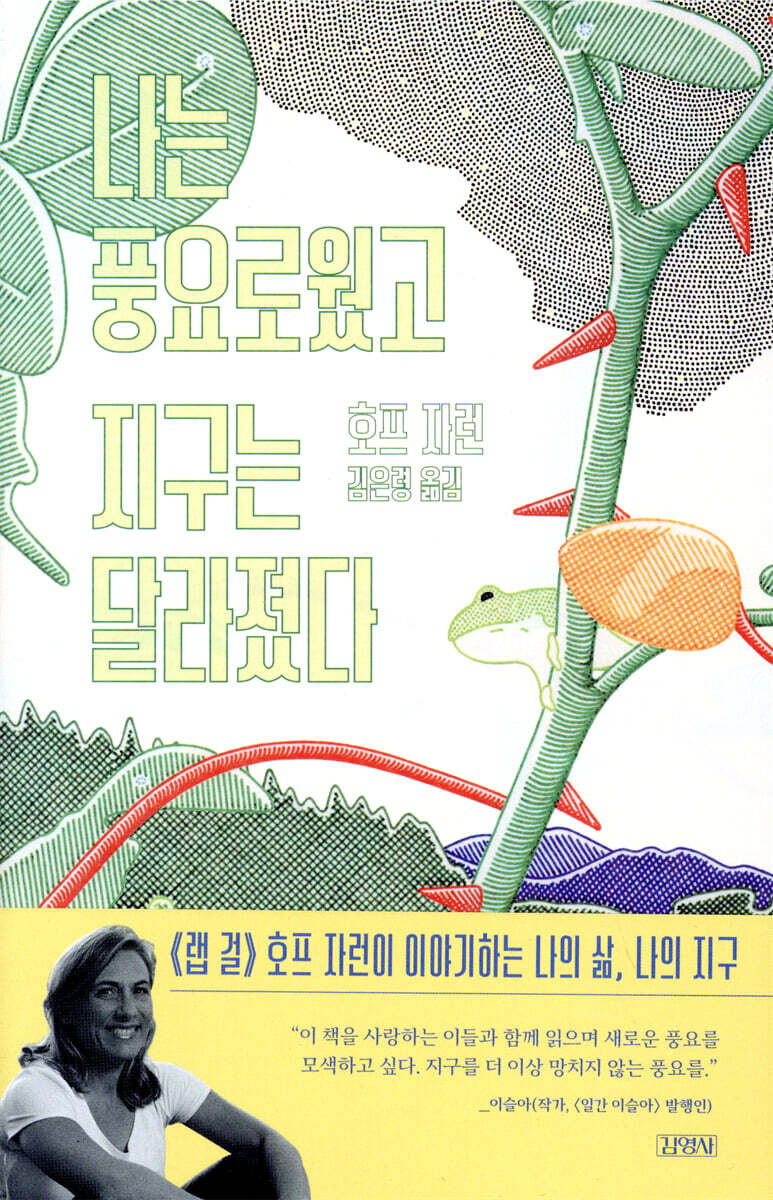
I was rich, and the world was different.
 |
Description
Book Introduction
- A word from MD
-
Now is the time to act for the EarthA new work from the author of "Rap Girl."
The author divides childhood and the changes on Earth into life, food, energy, and ecosystem, and presents them like a documentary.
As we have become more affluent, the Earth has been sacrificed, and we warn of the dangers this poses.
Please don't forget the request: "Consume less, share more."
September 11, 2020. Natural Science PD Kim Yu-ri
New book from Rap Girl Hope Jarren!
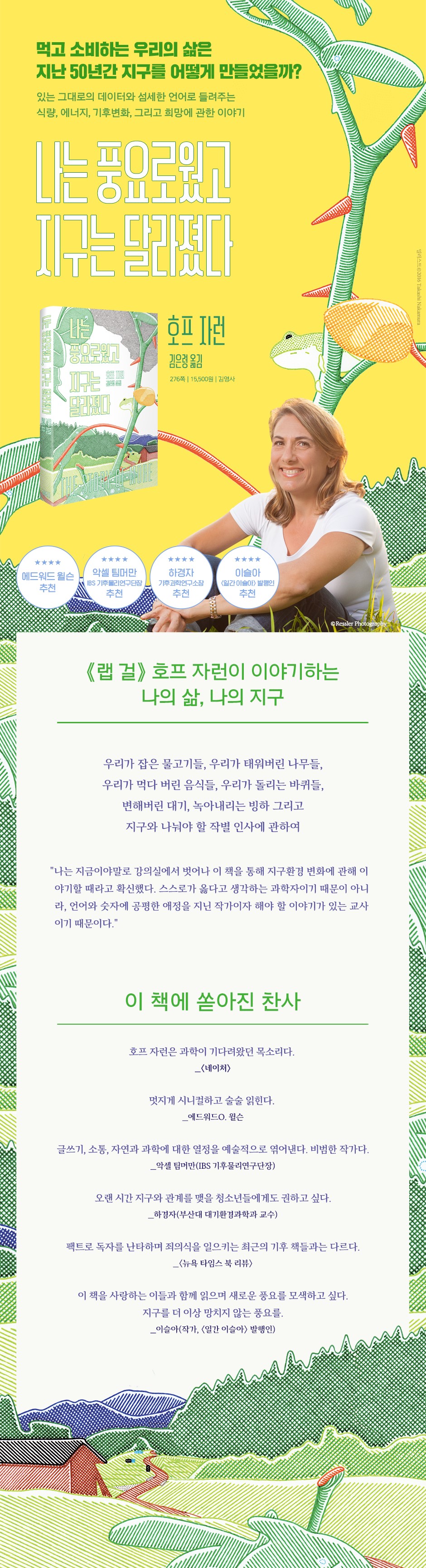
How has our lifestyle of eating and consuming shaped the Earth over the past 50 years?
A female botanist shares her story about life, the planet, and abundance.
"I Was Rich, and the Earth Was Different," which arrived at our timely conclusion, is a book about the threats and fears we must face, but it is also a story about the abundant life we have enjoyed and can enjoy before that.
As the original title, 'The Story of More', suggests, this book is a story about the serious problems created by our lifestyle of consuming more and faster, but it is also a story about a safer and more convenient life, and a more abundant life that more people can enjoy.
How can we avoid compromising the sustainability of the Earth's environment without giving up what we cannot? Hope Jahren seeks to answer this question.
Hope Jahren chose her own life as the main material to talk about the changes in the Earth.
The author, who brilliantly portrayed the present-day life of a female scientist in "Rap Girl," now elegantly weaves together scientific facts, history, and her own life to reveal the connection between the way we live and the planet we endanger because of it.
Grounded in solid facts and figures, yet infused with warm humor, the book invites readers to a new understanding—a new way of thinking about a future where everyone can thrive.
How has our lifestyle of eating and consuming shaped the Earth over the past 50 years?
A female botanist shares her story about life, the planet, and abundance.
"I Was Rich, and the Earth Was Different," which arrived at our timely conclusion, is a book about the threats and fears we must face, but it is also a story about the abundant life we have enjoyed and can enjoy before that.
As the original title, 'The Story of More', suggests, this book is a story about the serious problems created by our lifestyle of consuming more and faster, but it is also a story about a safer and more convenient life, and a more abundant life that more people can enjoy.
How can we avoid compromising the sustainability of the Earth's environment without giving up what we cannot? Hope Jahren seeks to answer this question.
Hope Jahren chose her own life as the main material to talk about the changes in the Earth.
The author, who brilliantly portrayed the present-day life of a female scientist in "Rap Girl," now elegantly weaves together scientific facts, history, and her own life to reveal the connection between the way we live and the planet we endanger because of it.
Grounded in solid facts and figures, yet infused with warm humor, the book invites readers to a new understanding—a new way of thinking about a future where everyone can thrive.
- You can preview some of the book's contents.
Preview
index
Preface to the Korean edition
Part 1.
life
1.
Our story begins
2.
Who are we
3.
How do we exist?
4.
Where do we stand?
Part 2.
food
5.
Growing crops
6.
Raising livestock
7.
catching fish
8.
Making sugar
9.
Throw it all away
Part 3.
energy
10.
Leave the lights on
11.
Move around
12.
The plants we burned
13.
The wheels we turn
Part 4.
earth
14.
The atmosphere has changed
15.
Warmer weather
16.
melting glaciers
17.
Rising water levels
18.
A harsh farewell
19.
Another page
supplement.
For the abundance of the earth
Ⅰ.
Actions you should take
Ⅱ.
The difference you make
Ⅲ.
Environmental Catechism
Ⅳ.
Sources and Further Reading
Acknowledgements
Translator's Note
Part 1.
life
1.
Our story begins
2.
Who are we
3.
How do we exist?
4.
Where do we stand?
Part 2.
food
5.
Growing crops
6.
Raising livestock
7.
catching fish
8.
Making sugar
9.
Throw it all away
Part 3.
energy
10.
Leave the lights on
11.
Move around
12.
The plants we burned
13.
The wheels we turn
Part 4.
earth
14.
The atmosphere has changed
15.
Warmer weather
16.
melting glaciers
17.
Rising water levels
18.
A harsh farewell
19.
Another page
supplement.
For the abundance of the earth
Ⅰ.
Actions you should take
Ⅱ.
The difference you make
Ⅲ.
Environmental Catechism
Ⅳ.
Sources and Further Reading
Acknowledgements
Translator's Note
Detailed image
Into the book
All of this convinced me that now was the time to get out of the classroom and talk about global environmental change through this book.
Not because I am a scientist who thinks I am right, but because I am a writer with a fair love of language and numbers, and a teacher with a story to tell.
So, if you'll listen, I'll tell you what happened in my world, in your world, in this world that we all belong to.
This world has changed.
--- pp.23~24
If we examine the positions that argue that strong antipathy to overpopulation alone is not enough to stop population growth, we can discover a pattern.
One thing that the great thinkers mentioned above never considered was the correlation between a woman's status in society and the average number of children she bears in her lifetime.
Seven of the ten countries with the smallest gaps between men and women in health, opportunity, and social participation are also among the highest-income countries in the world.
Conversely, the six countries with the largest gender gaps are among the lowest-income countries.
It is unclear whether wealth ensures women's health, opportunities, and social participation, or whether these factors make wealth possible.
It's probably a combination of both.
What is clear is that women in societies with a small gender gap have only about half the number of children as women in societies with a large gender gap.
The number of children per woman in 'high-gap' countries is close to four, while in 'low-gap' countries it is less than two.
It can be understood that the most effective and sustainable mechanism for curbing population growth is related to the abolition of gender inequality.
--- p.29
Nevertheless, being poor on this planet does not mean a death sentence as it once did.
Over the past 25 years, even in the world's poorest countries, access to clean water has increased by 30 percent, and access to better sanitation has doubled.
Over the past 30 years, vaccination rates in the same area have doubled, and access to preconception care has increased by more than 30 percent.
As a result, the approximate mortality rate in poor countries has now fallen by about half since I was born in 1969, bringing it closer to that of wealthier countries, as I mentioned earlier.
We still have a long way to go when it comes to deaths during childbirth, but we're on the right track.
--- p.38
Most people I've had dinner with over the past 20 years haven't said they were disgusted by slaughter and slaughterhouses, but they have said they feel sorry for them.
Embarrassed and a little defensive by that reaction, I tried to convince myself with all my knowledge that in my hometown, pig slaughter takes place in a pretty nice, clean place full of ordinary people, or at least a benevolent place.
He explained how Temple Grandin helped design a facility that would allow pigs to cross the Jordan River at a rate of one every five seconds while minimizing trauma to the workers.
People were told that the pigs, moving in long, winding lines (like we do at airports), were unaware of the glorious ascension that was coming to them.
You'll find yourself walking into pig heaven long before you even realize what's happening.
--- p.69
More importantly, the global workforce to maintain and operate railways has been drastically reduced.
Over the past 20 years, one in four railway jobs worldwide has been lost, most of it through privatization.
The U.S. rail system, which has never experienced a robust passenger rail system except for the lines between New York and Washington, is in marked decline, with one in seven rail jobs lost since 1991.
The situation in Britain is even worse, with one in three railway jobs lost over the same period.
Spain has virtually decimated its rail system over the past 30 years, losing four out of five rail jobs.
Although the quality of the national railway deteriorated, its use increased.
Since 1991, passenger numbers and distance travelled have increased by more than 20 percent in the United States, 70 percent in Spain, and double in the United Kingdom.
This change had nothing to do with user convenience.
--- pp.131~132
Simply put, carbon dioxide molecules have a unique structure that allows them to take away and absorb heat.
If you add a little carbon dioxide to the air in the grow room and let the sunlight shine in, the temperature will rise much more than if you did not add extra carbon dioxide.
This simple fact has been written in chemistry textbooks for over a hundred years, but it took me six months of seeing it with my own eyes to truly understand it.
How slowly does the whetstone that sharpens the human mind turn?
Scientists have been trying to inform politicians about this problem for over 100 years so they can prepare for it.
Swedish chemist Svante Arrhenius warned in 1896 that burning fossil fuels would cause global warming.
Since then, the amount of carbon dioxide filling the atmosphere has increased by about a third.
Then, wouldn't the Earth become hotter?
It was both yes and no.
But in most cases, it was like that.
--- p.181
Ice is supposed to melt when the temperature rises above 0 degrees Celsius.
This is probably one of the first science experiments we do as children.
As a baby, you too may have looked at your mother's water cup and wondered about the shiny square object inside.
If your mom took out a few ice cubes and put them in your little hands, you'd probably be fascinated by the glassy solid and the moisture it leaves behind as it melted.
As the spring of 1976 arrived, it was time to say goodbye to Covington.
I might think of a powerful scene in a children's book, when I, six years old, discovered Covington had been reduced to a puddle of water one April morning, and cried my eyes out, my tears adding to the remains of the transformation.
But the reality was not like that.
Winter has passed and, as always, the whole world has become warmer.
All the ice melted, and by May 1st, Labor Day, I had a real, living friend named Jennifer.
To be honest, I don't even remember being sad when Covington disappeared.
Long before studying the water cycle, perhaps Covington instinctively knew that when all the ice melted, he would head to the vast, welcoming embrace of the ocean.
--- p.200
Global records of carbon dioxide, temperature, ice cover, and sea level rise are a vast body of data derived from simple measurements, clearly showing trends over the past two decades.
In addition, a new script has also appeared.
Every time I turn on my computer, I'm bombarded with stories about climate change denial, many of them thoughtless and unpolished.
Meanwhile, clicking on the numerous links that appear on the computer also reveals the hypocrisy and exaggeration of those who are unnecessarily alarmist about climate change.
We're divided into two camps, provoking our opponents across the internet, as if the atmosphere cares what we think, as if shouting makes water return to the ice, as if winning an argument is an achievement in itself.
America has become an unhappy couple.
A couple who are so scared that they can't even see any change and end up fighting about the dishes and laundry.
--- p.209
Fish are not officially counted until their detailed anatomical characteristics have been established.
After determining whether this species has been observed before, and if it is new, determine which other species it is most closely related to.
The lab houses a large collection of fish, all of which are placed in ethanol solutions, waiting for their turn, creating a truly bizarre sight.
Rows of white plastic containers, each as tall as my shoulder, line every wall, from the lab to the hallway to the balcony.
Each can lid has a handle that, when lifted, reveals more than forty fishing lines, each with a dead fish hanging from its end.
Given these circumstances, I wouldn't have been particularly surprised if I had seen a fish floating in the coffee cup the woman guiding the tour held up.
--- p.213
The good news is that there's no reason to think that saving energy necessarily lowers our quality of life.
In 1965, life expectancy in Switzerland was roughly the same as in the United States today and higher than the global average.
There were fewer working days and the commute was shorter.
Life wasn't perfect back then, but we had the basics of a healthy life while using far fewer fossil fuels.
Not because I am a scientist who thinks I am right, but because I am a writer with a fair love of language and numbers, and a teacher with a story to tell.
So, if you'll listen, I'll tell you what happened in my world, in your world, in this world that we all belong to.
This world has changed.
--- pp.23~24
If we examine the positions that argue that strong antipathy to overpopulation alone is not enough to stop population growth, we can discover a pattern.
One thing that the great thinkers mentioned above never considered was the correlation between a woman's status in society and the average number of children she bears in her lifetime.
Seven of the ten countries with the smallest gaps between men and women in health, opportunity, and social participation are also among the highest-income countries in the world.
Conversely, the six countries with the largest gender gaps are among the lowest-income countries.
It is unclear whether wealth ensures women's health, opportunities, and social participation, or whether these factors make wealth possible.
It's probably a combination of both.
What is clear is that women in societies with a small gender gap have only about half the number of children as women in societies with a large gender gap.
The number of children per woman in 'high-gap' countries is close to four, while in 'low-gap' countries it is less than two.
It can be understood that the most effective and sustainable mechanism for curbing population growth is related to the abolition of gender inequality.
--- p.29
Nevertheless, being poor on this planet does not mean a death sentence as it once did.
Over the past 25 years, even in the world's poorest countries, access to clean water has increased by 30 percent, and access to better sanitation has doubled.
Over the past 30 years, vaccination rates in the same area have doubled, and access to preconception care has increased by more than 30 percent.
As a result, the approximate mortality rate in poor countries has now fallen by about half since I was born in 1969, bringing it closer to that of wealthier countries, as I mentioned earlier.
We still have a long way to go when it comes to deaths during childbirth, but we're on the right track.
--- p.38
Most people I've had dinner with over the past 20 years haven't said they were disgusted by slaughter and slaughterhouses, but they have said they feel sorry for them.
Embarrassed and a little defensive by that reaction, I tried to convince myself with all my knowledge that in my hometown, pig slaughter takes place in a pretty nice, clean place full of ordinary people, or at least a benevolent place.
He explained how Temple Grandin helped design a facility that would allow pigs to cross the Jordan River at a rate of one every five seconds while minimizing trauma to the workers.
People were told that the pigs, moving in long, winding lines (like we do at airports), were unaware of the glorious ascension that was coming to them.
You'll find yourself walking into pig heaven long before you even realize what's happening.
--- p.69
More importantly, the global workforce to maintain and operate railways has been drastically reduced.
Over the past 20 years, one in four railway jobs worldwide has been lost, most of it through privatization.
The U.S. rail system, which has never experienced a robust passenger rail system except for the lines between New York and Washington, is in marked decline, with one in seven rail jobs lost since 1991.
The situation in Britain is even worse, with one in three railway jobs lost over the same period.
Spain has virtually decimated its rail system over the past 30 years, losing four out of five rail jobs.
Although the quality of the national railway deteriorated, its use increased.
Since 1991, passenger numbers and distance travelled have increased by more than 20 percent in the United States, 70 percent in Spain, and double in the United Kingdom.
This change had nothing to do with user convenience.
--- pp.131~132
Simply put, carbon dioxide molecules have a unique structure that allows them to take away and absorb heat.
If you add a little carbon dioxide to the air in the grow room and let the sunlight shine in, the temperature will rise much more than if you did not add extra carbon dioxide.
This simple fact has been written in chemistry textbooks for over a hundred years, but it took me six months of seeing it with my own eyes to truly understand it.
How slowly does the whetstone that sharpens the human mind turn?
Scientists have been trying to inform politicians about this problem for over 100 years so they can prepare for it.
Swedish chemist Svante Arrhenius warned in 1896 that burning fossil fuels would cause global warming.
Since then, the amount of carbon dioxide filling the atmosphere has increased by about a third.
Then, wouldn't the Earth become hotter?
It was both yes and no.
But in most cases, it was like that.
--- p.181
Ice is supposed to melt when the temperature rises above 0 degrees Celsius.
This is probably one of the first science experiments we do as children.
As a baby, you too may have looked at your mother's water cup and wondered about the shiny square object inside.
If your mom took out a few ice cubes and put them in your little hands, you'd probably be fascinated by the glassy solid and the moisture it leaves behind as it melted.
As the spring of 1976 arrived, it was time to say goodbye to Covington.
I might think of a powerful scene in a children's book, when I, six years old, discovered Covington had been reduced to a puddle of water one April morning, and cried my eyes out, my tears adding to the remains of the transformation.
But the reality was not like that.
Winter has passed and, as always, the whole world has become warmer.
All the ice melted, and by May 1st, Labor Day, I had a real, living friend named Jennifer.
To be honest, I don't even remember being sad when Covington disappeared.
Long before studying the water cycle, perhaps Covington instinctively knew that when all the ice melted, he would head to the vast, welcoming embrace of the ocean.
--- p.200
Global records of carbon dioxide, temperature, ice cover, and sea level rise are a vast body of data derived from simple measurements, clearly showing trends over the past two decades.
In addition, a new script has also appeared.
Every time I turn on my computer, I'm bombarded with stories about climate change denial, many of them thoughtless and unpolished.
Meanwhile, clicking on the numerous links that appear on the computer also reveals the hypocrisy and exaggeration of those who are unnecessarily alarmist about climate change.
We're divided into two camps, provoking our opponents across the internet, as if the atmosphere cares what we think, as if shouting makes water return to the ice, as if winning an argument is an achievement in itself.
America has become an unhappy couple.
A couple who are so scared that they can't even see any change and end up fighting about the dishes and laundry.
--- p.209
Fish are not officially counted until their detailed anatomical characteristics have been established.
After determining whether this species has been observed before, and if it is new, determine which other species it is most closely related to.
The lab houses a large collection of fish, all of which are placed in ethanol solutions, waiting for their turn, creating a truly bizarre sight.
Rows of white plastic containers, each as tall as my shoulder, line every wall, from the lab to the hallway to the balcony.
Each can lid has a handle that, when lifted, reveals more than forty fishing lines, each with a dead fish hanging from its end.
Given these circumstances, I wouldn't have been particularly surprised if I had seen a fish floating in the coffee cup the woman guiding the tour held up.
--- p.213
The good news is that there's no reason to think that saving energy necessarily lowers our quality of life.
In 1965, life expectancy in Switzerland was roughly the same as in the United States today and higher than the global average.
There were fewer working days and the commute was shorter.
Life wasn't perfect back then, but we had the basics of a healthy life while using far fewer fossil fuels.
--- p.229
Publisher's Review
New book from Rap Girl Hope Jarren!
How has our lifestyle of eating and consuming shaped the Earth over the past 50 years?
A female geoscientist shares her story about life, the planet, and abundance.
“I want to read this book with those who love it and find new enrichment.
“Affluence that will not further destroy the Earth.”
_Isul-a (author, publisher of "Daily Isul-a")
★★★★★ Recommended by Edward Wilson, Elizabeth Kolbert, Axel Timmermann (Director of the IBS Center for Climate Physics), Ha Kyung-ja (Director of the Climate Science Institute), and Lee Seul-ah!
What on earth happened to this planet?
A book about the Earth's ecosystem that I never dared to learn about.
In 2020, a series of events occurred, making people all over the world feel the destruction of the ecosystem, which had long been heard only in words.
The coronavirus has put the brakes on what seemed like an indefinitely long-lasting daily life, and disasters continue to unfold, uncontained in specific regions, such as unusually high temperatures in Siberia and uncontrollable wildfires.
Also, as the rainy season continued for over 50 days and the snow at the King Sejong Station in Antarctica completely melted, we also began to feel the reality of climate change, which we had only thought was distant.
Many people feel that something unusual is happening, but they still seem at a loss as to how to feel or how to live beyond simply living through this period as if it were the end of the world.
This book, which has arrived at such a timely moment for us, is a book about the threats and fears we must face, but it is also a story about the abundant life we have enjoyed and can enjoy before that.
As the original title, 'The Story of More', suggests, this book is a story about the serious problems created by our lifestyle of consuming more and faster, but it is also a story about a safer and more convenient life, and how more people can benefit from it.
How can we avoid compromising the sustainability of the Earth's environment without giving up what we cannot? Hope Jahren seeks to answer this question.
While maintaining the following attitude.
“I held a chalkboard and taught a classroom full of students about the numbers that showed how our planet, Earth, had changed since I was a child in the 1970s.
I taught about what has already happened.
I didn't teach what I assumed would happen.
I didn't even teach what I thought should have happened.
“I taught my students what I had learned through my own studies.”
“To clearly understand how the world has changed,
“There is no better way to relive childhood memories.”
Hope Jahren chose her own life as the main material to talk about the changes in the Earth.
The author, who brilliantly depicted the present-day life of a female scientist through "Rap Girl," has now combined her life from childhood with the changing circumstances of the Earth.
He talks about melting glaciers, describes a baby holding a piece of ice in his hand, and introduces his friend, a chunk of ice whom he named "Covington" when he was six.
And now, he laments the difficulty of running a junior hockey season in Canada, the potential for the Winter Olympics to be moved from outdoors to indoors, and, speaking of the carved ice at Glacier National Park, which opened in 1910, says, “If you want to go see it, take my advice: don’t put the day off.”
Hope Jahren also grew up in the heartland plains of the American Central Plains.
It was a rural area that supplied food to the city through agriculture and livestock farming.
He talks about his childhood memories of playing in cornfields and the townspeople who worked in the slaughterhouse.
We open the door to Hope Jahren's memories and encounter the way humans have organized nature and life through grain and meat.
Through this, we can step away from the role of consumers shopping at a supermarket and think about how we are already shaping the lives and world of others through the way we eat, think, and act.
How has our lifestyle of eating and consuming shaped the Earth over the past 50 years?
My Life, My Earth, as told by Hope Jahren, born in 1969
The unique feature of this book is that the author, born in 1969, examines the Earth's ecosystem based on events that have occurred over the past 50 years of his life, including changes in the Earth's environment.
Fifty years, less than the average human lifespan, is a good interval to note the rapid changes that have occurred in recent times.
There are many statistics and numbers based on this 50-year time difference, but they are at a level that even elementary school students can easily understand.
These figures vividly illustrate the changes in population, life expectancy, food production methods, and energy consumption worldwide since he was born in 1969, and the impact these have ultimately had on the global environment.
For example, let's look at a story about salmon farming in Norway, where the author currently lives.
To produce 1 kilogram of salmon, you need 3 kilograms of salmon feed, and to produce 1 kilogram of salmon feed, you need to grind up to 5 kilograms of fish.
As a result, to produce 1 kilogram of salmon raised in a farm, 15 kilograms of small fish living in the ocean are needed.
According to this principle, about one-third of the fish caught in the sea today are crushed and used as feed for fish farms.
The contradictory resource allocation in agriculture and livestock is being repeated in the ocean as well.
In this book, readers will be introduced to the realities behind the abundance we enjoy today: inequality, resource depletion, overflowing waste, and climate change, which is considered the greatest challenge facing humanity.
A thoughtful and humorous piece by a scientist
A green book that inspires dreams of beauty rather than threats.
The personal, honest, and humorous narrative that shines through in "Rap Girl" will always leave readers genuinely curious about what happened to the planet we all lived on.
In this book, which began with a lecture on climate change that the author gave in 2009, Hope Jahren also fully demonstrates her capabilities as a geobiologist.
After taking the course, he began compiling data showing how much the population had grown, how intensive agriculture had become, and how energy use had soared over the past half-century. Over the next few years, he logged into public databases, downloaded numbers, and sifted through piles of spreadsheets, trying to quantify the changes in the world and look for patterns.
This book quantifies events on Earth, and is supported by scientific knowledge gained through Hope Jahren's own experiments and observations.
We can also see how science is preparing for ecological crises through experiments on carbon emissions from plant growth farms and archival research conducted at an ichthyology laboratory in Brazil to prepare for the extinction of fish.
"I Was Rich, and the Earth Was Different" is not a book that endlessly scares us. Rather, it is a book written by a realist who believes that we can improve the ecological crisis with our own resources by examining one by one the things we have enjoyed and the things we can enjoy.
The appendix, "For the Abundance of the Earth" (originally titled "The Story of Less"), offers advice to help us all live in a way that respects our ecosystems.
Therefore, rather than a practical guide, this is a guide to help us plan our lives anew with a broader perspective.
Additionally, we have included an 'Environmental Catechism' that briefly summarizes the changes that have occurred on Earth over the past 50 years.
Through this, we will be able to “become people who can do what needs to be done, when it is time to do so,” as the author said in the preface sent specifically to Korean readers.
Now is the time to hear the story of a scientist who, like his name, wants to give hope.
“Of course there is hope.
“I strongly believe that there is hope for us, and I hope you can keep that hope alive.”
Hope Jahren is the voice science has been waiting for.
- "Nature"
It's quite different from recent climate books that bombard readers with facts and make them feel guilty.
Hope Jahren writes with the same delicacy as a skate blade whispers on the ice, leaving a trail of ice fragments.
- The New York Times Book Review
A concise, personal, yet universally applicable examination of issues that affect everyone on Earth.
Don't use fear tactics or shout warnings.
…it clearly shows how much the things discarded by those who have the advantage can enrich those who do not.
- "Kurkus Review"
How has our lifestyle of eating and consuming shaped the Earth over the past 50 years?
A female geoscientist shares her story about life, the planet, and abundance.
“I want to read this book with those who love it and find new enrichment.
“Affluence that will not further destroy the Earth.”
_Isul-a (author, publisher of "Daily Isul-a")
★★★★★ Recommended by Edward Wilson, Elizabeth Kolbert, Axel Timmermann (Director of the IBS Center for Climate Physics), Ha Kyung-ja (Director of the Climate Science Institute), and Lee Seul-ah!
What on earth happened to this planet?
A book about the Earth's ecosystem that I never dared to learn about.
In 2020, a series of events occurred, making people all over the world feel the destruction of the ecosystem, which had long been heard only in words.
The coronavirus has put the brakes on what seemed like an indefinitely long-lasting daily life, and disasters continue to unfold, uncontained in specific regions, such as unusually high temperatures in Siberia and uncontrollable wildfires.
Also, as the rainy season continued for over 50 days and the snow at the King Sejong Station in Antarctica completely melted, we also began to feel the reality of climate change, which we had only thought was distant.
Many people feel that something unusual is happening, but they still seem at a loss as to how to feel or how to live beyond simply living through this period as if it were the end of the world.
This book, which has arrived at such a timely moment for us, is a book about the threats and fears we must face, but it is also a story about the abundant life we have enjoyed and can enjoy before that.
As the original title, 'The Story of More', suggests, this book is a story about the serious problems created by our lifestyle of consuming more and faster, but it is also a story about a safer and more convenient life, and how more people can benefit from it.
How can we avoid compromising the sustainability of the Earth's environment without giving up what we cannot? Hope Jahren seeks to answer this question.
While maintaining the following attitude.
“I held a chalkboard and taught a classroom full of students about the numbers that showed how our planet, Earth, had changed since I was a child in the 1970s.
I taught about what has already happened.
I didn't teach what I assumed would happen.
I didn't even teach what I thought should have happened.
“I taught my students what I had learned through my own studies.”
“To clearly understand how the world has changed,
“There is no better way to relive childhood memories.”
Hope Jahren chose her own life as the main material to talk about the changes in the Earth.
The author, who brilliantly depicted the present-day life of a female scientist through "Rap Girl," has now combined her life from childhood with the changing circumstances of the Earth.
He talks about melting glaciers, describes a baby holding a piece of ice in his hand, and introduces his friend, a chunk of ice whom he named "Covington" when he was six.
And now, he laments the difficulty of running a junior hockey season in Canada, the potential for the Winter Olympics to be moved from outdoors to indoors, and, speaking of the carved ice at Glacier National Park, which opened in 1910, says, “If you want to go see it, take my advice: don’t put the day off.”
Hope Jahren also grew up in the heartland plains of the American Central Plains.
It was a rural area that supplied food to the city through agriculture and livestock farming.
He talks about his childhood memories of playing in cornfields and the townspeople who worked in the slaughterhouse.
We open the door to Hope Jahren's memories and encounter the way humans have organized nature and life through grain and meat.
Through this, we can step away from the role of consumers shopping at a supermarket and think about how we are already shaping the lives and world of others through the way we eat, think, and act.
How has our lifestyle of eating and consuming shaped the Earth over the past 50 years?
My Life, My Earth, as told by Hope Jahren, born in 1969
The unique feature of this book is that the author, born in 1969, examines the Earth's ecosystem based on events that have occurred over the past 50 years of his life, including changes in the Earth's environment.
Fifty years, less than the average human lifespan, is a good interval to note the rapid changes that have occurred in recent times.
There are many statistics and numbers based on this 50-year time difference, but they are at a level that even elementary school students can easily understand.
These figures vividly illustrate the changes in population, life expectancy, food production methods, and energy consumption worldwide since he was born in 1969, and the impact these have ultimately had on the global environment.
For example, let's look at a story about salmon farming in Norway, where the author currently lives.
To produce 1 kilogram of salmon, you need 3 kilograms of salmon feed, and to produce 1 kilogram of salmon feed, you need to grind up to 5 kilograms of fish.
As a result, to produce 1 kilogram of salmon raised in a farm, 15 kilograms of small fish living in the ocean are needed.
According to this principle, about one-third of the fish caught in the sea today are crushed and used as feed for fish farms.
The contradictory resource allocation in agriculture and livestock is being repeated in the ocean as well.
In this book, readers will be introduced to the realities behind the abundance we enjoy today: inequality, resource depletion, overflowing waste, and climate change, which is considered the greatest challenge facing humanity.
A thoughtful and humorous piece by a scientist
A green book that inspires dreams of beauty rather than threats.
The personal, honest, and humorous narrative that shines through in "Rap Girl" will always leave readers genuinely curious about what happened to the planet we all lived on.
In this book, which began with a lecture on climate change that the author gave in 2009, Hope Jahren also fully demonstrates her capabilities as a geobiologist.
After taking the course, he began compiling data showing how much the population had grown, how intensive agriculture had become, and how energy use had soared over the past half-century. Over the next few years, he logged into public databases, downloaded numbers, and sifted through piles of spreadsheets, trying to quantify the changes in the world and look for patterns.
This book quantifies events on Earth, and is supported by scientific knowledge gained through Hope Jahren's own experiments and observations.
We can also see how science is preparing for ecological crises through experiments on carbon emissions from plant growth farms and archival research conducted at an ichthyology laboratory in Brazil to prepare for the extinction of fish.
"I Was Rich, and the Earth Was Different" is not a book that endlessly scares us. Rather, it is a book written by a realist who believes that we can improve the ecological crisis with our own resources by examining one by one the things we have enjoyed and the things we can enjoy.
The appendix, "For the Abundance of the Earth" (originally titled "The Story of Less"), offers advice to help us all live in a way that respects our ecosystems.
Therefore, rather than a practical guide, this is a guide to help us plan our lives anew with a broader perspective.
Additionally, we have included an 'Environmental Catechism' that briefly summarizes the changes that have occurred on Earth over the past 50 years.
Through this, we will be able to “become people who can do what needs to be done, when it is time to do so,” as the author said in the preface sent specifically to Korean readers.
Now is the time to hear the story of a scientist who, like his name, wants to give hope.
“Of course there is hope.
“I strongly believe that there is hope for us, and I hope you can keep that hope alive.”
Hope Jahren is the voice science has been waiting for.
- "Nature"
It's quite different from recent climate books that bombard readers with facts and make them feel guilty.
Hope Jahren writes with the same delicacy as a skate blade whispers on the ice, leaving a trail of ice fragments.
- The New York Times Book Review
A concise, personal, yet universally applicable examination of issues that affect everyone on Earth.
Don't use fear tactics or shout warnings.
…it clearly shows how much the things discarded by those who have the advantage can enrich those who do not.
- "Kurkus Review"
GOODS SPECIFICS
- Date of issue: September 4, 2020
- Page count, weight, size: 276 pages | 350g | 135*210*17mm
- ISBN13: 9788934990307
- ISBN10: 8934990309
You may also like
카테고리
korean


korean

![GQ KOREA Mark (Monthly): December [2025]](http://librairie.coreenne.fr/cdn/shop/files/8ef265dbbfbf186523ed75ba7319009d.jpg?v=1765340328&width=3840)


