

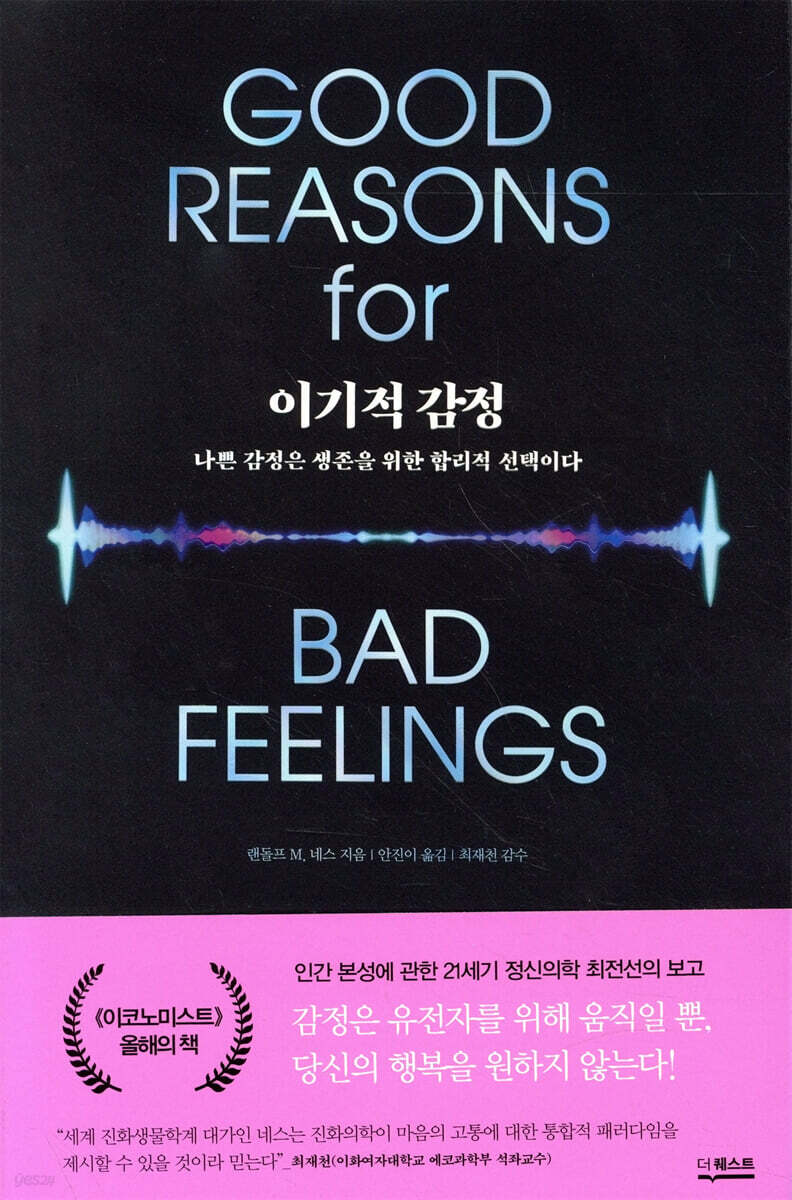
selfish feelings
 |
Description
Book Introduction
- A word from MD
-
Emotions don't care about your happiness.Why do humans experience negative emotions? A new emotional paradigm is presented by the author, a psychiatrist and evolutionary biologist who opened the world's first anxiety clinic and has treated patients for over 30 years.
Based on the premise that humans choose selfish emotions as a safety device in life, we discuss the true meaning of evolution and the way of life.
August 21, 2020. Natural Science PD Kim Yu-ri
A report from the front lines of 21st-century psychiatry on human nature.
“Emotions don’t care about your happiness.”
"Selfish Emotions" begins with one question.
"Why did nature instill bad emotions in humans?" Why haven't emotions like sadness, betrayal, and shame, which are supposed to be eliminated or avoided, disappeared over thousands of years of evolution? Isn't it ironic that almost everyone has to endure pain in their pursuit of happiness?
Randolph M., a renowned psychiatrist and founder of evolutionary medicine,
Ness replies that it is because bad feelings are useful.
To be precise, these painful emotions are for the genes.
The author, who opened the world's first anxiety clinic and has studied emotions, presents a new paradigm for human evolution beyond emotions in this book.
This book, which states that “worry about anxiety is the most common cause of unnecessary anxiety,” will fundamentally change the way not only medical professionals and scholars, but also ordinary readers, look at emotions, and conveys a lifestyle necessary in an era where crisis has become the norm.
“Emotions don’t care about your happiness.”
"Selfish Emotions" begins with one question.
"Why did nature instill bad emotions in humans?" Why haven't emotions like sadness, betrayal, and shame, which are supposed to be eliminated or avoided, disappeared over thousands of years of evolution? Isn't it ironic that almost everyone has to endure pain in their pursuit of happiness?
Randolph M., a renowned psychiatrist and founder of evolutionary medicine,
Ness replies that it is because bad feelings are useful.
To be precise, these painful emotions are for the genes.
The author, who opened the world's first anxiety clinic and has studied emotions, presents a new paradigm for human evolution beyond emotions in this book.
This book, which states that “worry about anxiety is the most common cause of unnecessary anxiety,” will fundamentally change the way not only medical professionals and scholars, but also ordinary readers, look at emotions, and conveys a lifestyle necessary in an era where crisis has become the norm.
- You can preview some of the book's contents.
Preview
index
Recommendation: Seeking the True Evolution of Psychiatry
Preface to the Korean Edition: How to Live with Anxiety in an Age of Crisis
Prologue: A New Perspective on the Question: "Why is human life filled with suffering?"
Part 1: Why is the human heart so easily broken?
1.
New question
Humans evolved through natural selection.
But why weren't negative emotions eliminated during evolution? Why do we still suffer from painful emotions?
2.
We still don't know what mental illness is
Psychiatric diagnosis is unclear.
This is because they confuse symptoms with diseases and assume that each mental disorder has a specific cause.
It is now necessary to look at psychiatry from an evolutionary perspective.
3.
Emotions don't care about your happiness.
There are six evolutionary reasons why the human mind is prone to disease.
It is a human delusion to think that emotions evolved for our happiness.
Part 2: The Selfish Origins of Emotions
4.
Good reasons to feel bad
Emotions should be viewed as specialized operating systems tailored to individual situations.
Depending on the situation, even negative emotions like anxiety, depression, and sadness can be useful.
Knowing this can help you deal with negative emotions.
5.
Your anxiety protects you
Even seemingly useless anxiety can be normal.
Just as a fire detector is valuable because it gives you the confidence that it will sound immediately when there is a real fire, even if it is oversensitive and gives false alarms.
6.
The sinking feeling tells you when to stop.
When things go well, you can make the most of the opportunity by getting excited.
If you find yourself feeling down in a challenging situation, you can change your strategy or goals without wasting energy.
The ability to change moods depending on the situation is evolutionarily advantageous.
7.
A terrible feeling for no good reason
The mood regulation system calms or excites the mood as the situation changes, and returns the mood to baseline when the situation ends.
When this system malfunctions, it can lead to severe mental disorders, including bipolar disorder.
Part 3: The Joys and Sorrows of Social Life
8.
To understand a person, you must read the context of their life and emotions.
An individual's emotions and behaviors must be understood in the context of that person's life goals and plans.
This is why we need to understand emotions by integrating the individual technical approach and the law-making approach.
9.
Guilt and sadness, difficult emotions that create deep relationships
Natural selection does not provide relationship benefits without a cost.
The price is social anxiety and constant worry about what others think, and the benefit is an optimal partner and cooperative friends.
10.
Oppression and distortion, sometimes not knowing myself is bliss.
We don't get everything we want in life.
At this time, unconscious repression and defense mechanisms help us avoid mental pain and focus on possible tasks.
It also makes us moral people and gives us an advantage in survival.
Part 4: Dysfunctional Behavior and Serious Mental Illnesses
11.
Can Bad Sex Be Good for Your Genes?
Why do sexual problems like frigidity, premature ejaculation, and ectropia so frequently occur? Again, it's because natural selection was designed to maximize reproduction, not human happiness or pleasure.
12.
Your primal appetite rules your diet.
The vicious cycle of obsessing over weight loss leads to binge eating, fear of gaining weight, more aggressive dieting, and higher weight standards.
You may also develop bulimia nervosa and anorexia nervosa.
13.
Endless craving turns you into a zombie
Why do humans become so easily addicted to something? Now, with the dissonance between the human mind and the environment more severe than ever, drugs can instantly take over our behavioral control systems, turning us into zombies.
14.
Schizophrenia, autism, bipolar disorder: mental illnesses that are found at the edge of fitness.
Why do genes that cause unfortunate mental disorders like schizophrenia, autism, and bipolar disorder persist? From an evolutionary perspective, let's take a fresh look at innate vulnerability, fitness landscapes, and control systems.
Epilogue: Evolutionary Psychiatry is a Bridge, Not an Island
Recommended books
annotation
Search
Preface to the Korean Edition: How to Live with Anxiety in an Age of Crisis
Prologue: A New Perspective on the Question: "Why is human life filled with suffering?"
Part 1: Why is the human heart so easily broken?
1.
New question
Humans evolved through natural selection.
But why weren't negative emotions eliminated during evolution? Why do we still suffer from painful emotions?
2.
We still don't know what mental illness is
Psychiatric diagnosis is unclear.
This is because they confuse symptoms with diseases and assume that each mental disorder has a specific cause.
It is now necessary to look at psychiatry from an evolutionary perspective.
3.
Emotions don't care about your happiness.
There are six evolutionary reasons why the human mind is prone to disease.
It is a human delusion to think that emotions evolved for our happiness.
Part 2: The Selfish Origins of Emotions
4.
Good reasons to feel bad
Emotions should be viewed as specialized operating systems tailored to individual situations.
Depending on the situation, even negative emotions like anxiety, depression, and sadness can be useful.
Knowing this can help you deal with negative emotions.
5.
Your anxiety protects you
Even seemingly useless anxiety can be normal.
Just as a fire detector is valuable because it gives you the confidence that it will sound immediately when there is a real fire, even if it is oversensitive and gives false alarms.
6.
The sinking feeling tells you when to stop.
When things go well, you can make the most of the opportunity by getting excited.
If you find yourself feeling down in a challenging situation, you can change your strategy or goals without wasting energy.
The ability to change moods depending on the situation is evolutionarily advantageous.
7.
A terrible feeling for no good reason
The mood regulation system calms or excites the mood as the situation changes, and returns the mood to baseline when the situation ends.
When this system malfunctions, it can lead to severe mental disorders, including bipolar disorder.
Part 3: The Joys and Sorrows of Social Life
8.
To understand a person, you must read the context of their life and emotions.
An individual's emotions and behaviors must be understood in the context of that person's life goals and plans.
This is why we need to understand emotions by integrating the individual technical approach and the law-making approach.
9.
Guilt and sadness, difficult emotions that create deep relationships
Natural selection does not provide relationship benefits without a cost.
The price is social anxiety and constant worry about what others think, and the benefit is an optimal partner and cooperative friends.
10.
Oppression and distortion, sometimes not knowing myself is bliss.
We don't get everything we want in life.
At this time, unconscious repression and defense mechanisms help us avoid mental pain and focus on possible tasks.
It also makes us moral people and gives us an advantage in survival.
Part 4: Dysfunctional Behavior and Serious Mental Illnesses
11.
Can Bad Sex Be Good for Your Genes?
Why do sexual problems like frigidity, premature ejaculation, and ectropia so frequently occur? Again, it's because natural selection was designed to maximize reproduction, not human happiness or pleasure.
12.
Your primal appetite rules your diet.
The vicious cycle of obsessing over weight loss leads to binge eating, fear of gaining weight, more aggressive dieting, and higher weight standards.
You may also develop bulimia nervosa and anorexia nervosa.
13.
Endless craving turns you into a zombie
Why do humans become so easily addicted to something? Now, with the dissonance between the human mind and the environment more severe than ever, drugs can instantly take over our behavioral control systems, turning us into zombies.
14.
Schizophrenia, autism, bipolar disorder: mental illnesses that are found at the edge of fitness.
Why do genes that cause unfortunate mental disorders like schizophrenia, autism, and bipolar disorder persist? From an evolutionary perspective, let's take a fresh look at innate vulnerability, fitness landscapes, and control systems.
Epilogue: Evolutionary Psychiatry is a Bridge, Not an Island
Recommended books
annotation
Search
Detailed image
Into the book
Why are mood and anxiety disorders so common? Why haven't genes for schizophrenia disappeared? Any trait that predisposes an organism to disease remains a mystery to evolution.
The old answer to these questions is that natural selection has limits.
--- From Chapter 3, “Emotions Don’t Care About Your Happiness”
People who are currently experiencing negative emotions might find it absurd to hear that those emotions are useful.
To overcome that doubt, I will now present four reasons why negative emotions may have evolutionary origins and utility.
First, symptoms like anxiety and sadness are not rare changes that occur in some people at unpredictable times.
These symptoms are consistent reactions that occur in almost everyone in certain situations, such as sweating or coughing.
Second, the mechanism that regulates emotional expression switches on the emotions associated with a particular situation in that situation.
Third, lack of response is actually harmful to us.
Fourth, these symptoms impose significant costs on individuals, but they benefit individual genes.
--- From Chapter 4, “Good Reasons to Feel Bad”
Let's say you're kneeling by a pond trying to get water for your family when you see a lion in the distance.
Our ancestors' reactions varied.
Some were amazed by the lion's strength, while others showed no reaction.
They became food for the lions.
Others threw down their luggage and ran up the nearest tree.
They survived the next day.
Their genes still live in us today.
--- From Chapter 5, “Your Anxiety Protects You”
People who feel excited in a favorable situation can make the most of the opportunity.
People who feel down in challenging situations can change their strategies or goals without risking harm or wasting energy.
The ability to vary one's mood depending on the presence or absence of opportunity provides a selective advantage.
--- From Chapter 6, "The 'Sunken Feeling' Tells You When to Stop"
Why are humans social beings? Why do we care so much about what others think of us? How does our ability to feel guilt help us? Why do we feel sadness? To answer these questions, we need to turn a common question on its head.
What selective advantage does our tendency to help others offer us? Our puzzle isn't why some people struggle with interpersonal relationships.
How love and good deeds can maximize an organism's Darwinian fitness.
--- From Chapter 9, “Guilt and Sadness: Difficult Emotions That Create Deep Relationships”
I think the main function of repression is to keep certain desires out of consciousness.
We can only get a part of what we want.
The gap between what we have and what we want creates envy, anxiety, anger, and dissatisfaction.
Mental suffering can be avoided by not allowing one to enter a consciousness that can never be filled.
And instead of thinking and rethinking impossible tasks, you can focus on possible tasks.
A more important function of repression is that it makes us appear more moral and actually become more moral people.
Our fitness increases thanks to suppression.
--- From Chapter 10, “Oppression and Distortion, Sometimes Not Knowing Myself is Blessing”
It's strange that natural selection has resulted in so many sexual dysfunctions and sexual dissatisfaction.
Because sex is key to reproduction, it should be subject to natural selection more strongly than any other function, and indeed it is.
That's exactly the problem.
Natural selection has evolved our brains and bodies to maximize reproduction, at the expense of much of human happiness.
--- From Chapter 11, "Can Bad Sex Be Good for Your Genes?"
The systems that protect us from becoming overweight are rather poor.
In the Paleolithic era, the genetic mutations that made some people overweight would not have been selected for.
If the body is too heavy, it cannot escape from predators.
However, the risk of being eaten because the body was too heavy was less than the risk of being eaten because the body was too thin.
So the brain mechanisms that protect us from becoming obese are weaker than the mechanisms that protect us from starvation.
--- From Chapter 12, “Your Primal Appetite Rules Your Diet”
People with schizophrenia, autism, and bipolar disorder each affect about 1 percent of the world's population.
And 2 to 5 percent of people show mild symptoms of each disease.
Although vulnerability is largely determined by a person's genes, people with schizophrenia or autism spectrum disorders tend to have fewer children than others.
The evolutionary question is obvious.
Why haven't the genetic mutations that cause these diseases been eliminated by natural selection?
The old answer to these questions is that natural selection has limits.
--- From Chapter 3, “Emotions Don’t Care About Your Happiness”
People who are currently experiencing negative emotions might find it absurd to hear that those emotions are useful.
To overcome that doubt, I will now present four reasons why negative emotions may have evolutionary origins and utility.
First, symptoms like anxiety and sadness are not rare changes that occur in some people at unpredictable times.
These symptoms are consistent reactions that occur in almost everyone in certain situations, such as sweating or coughing.
Second, the mechanism that regulates emotional expression switches on the emotions associated with a particular situation in that situation.
Third, lack of response is actually harmful to us.
Fourth, these symptoms impose significant costs on individuals, but they benefit individual genes.
--- From Chapter 4, “Good Reasons to Feel Bad”
Let's say you're kneeling by a pond trying to get water for your family when you see a lion in the distance.
Our ancestors' reactions varied.
Some were amazed by the lion's strength, while others showed no reaction.
They became food for the lions.
Others threw down their luggage and ran up the nearest tree.
They survived the next day.
Their genes still live in us today.
--- From Chapter 5, “Your Anxiety Protects You”
People who feel excited in a favorable situation can make the most of the opportunity.
People who feel down in challenging situations can change their strategies or goals without risking harm or wasting energy.
The ability to vary one's mood depending on the presence or absence of opportunity provides a selective advantage.
--- From Chapter 6, "The 'Sunken Feeling' Tells You When to Stop"
Why are humans social beings? Why do we care so much about what others think of us? How does our ability to feel guilt help us? Why do we feel sadness? To answer these questions, we need to turn a common question on its head.
What selective advantage does our tendency to help others offer us? Our puzzle isn't why some people struggle with interpersonal relationships.
How love and good deeds can maximize an organism's Darwinian fitness.
--- From Chapter 9, “Guilt and Sadness: Difficult Emotions That Create Deep Relationships”
I think the main function of repression is to keep certain desires out of consciousness.
We can only get a part of what we want.
The gap between what we have and what we want creates envy, anxiety, anger, and dissatisfaction.
Mental suffering can be avoided by not allowing one to enter a consciousness that can never be filled.
And instead of thinking and rethinking impossible tasks, you can focus on possible tasks.
A more important function of repression is that it makes us appear more moral and actually become more moral people.
Our fitness increases thanks to suppression.
--- From Chapter 10, “Oppression and Distortion, Sometimes Not Knowing Myself is Blessing”
It's strange that natural selection has resulted in so many sexual dysfunctions and sexual dissatisfaction.
Because sex is key to reproduction, it should be subject to natural selection more strongly than any other function, and indeed it is.
That's exactly the problem.
Natural selection has evolved our brains and bodies to maximize reproduction, at the expense of much of human happiness.
--- From Chapter 11, "Can Bad Sex Be Good for Your Genes?"
The systems that protect us from becoming overweight are rather poor.
In the Paleolithic era, the genetic mutations that made some people overweight would not have been selected for.
If the body is too heavy, it cannot escape from predators.
However, the risk of being eaten because the body was too heavy was less than the risk of being eaten because the body was too thin.
So the brain mechanisms that protect us from becoming obese are weaker than the mechanisms that protect us from starvation.
--- From Chapter 12, “Your Primal Appetite Rules Your Diet”
People with schizophrenia, autism, and bipolar disorder each affect about 1 percent of the world's population.
And 2 to 5 percent of people show mild symptoms of each disease.
Although vulnerability is largely determined by a person's genes, people with schizophrenia or autism spectrum disorders tend to have fewer children than others.
The evolutionary question is obvious.
Why haven't the genetic mutations that cause these diseases been eliminated by natural selection?
--- From Chapter 14, “Schizophrenia, Autism, Bipolar Disorder, Mental Illnesses We Met at the Edge of Fitness”
Publisher's Review
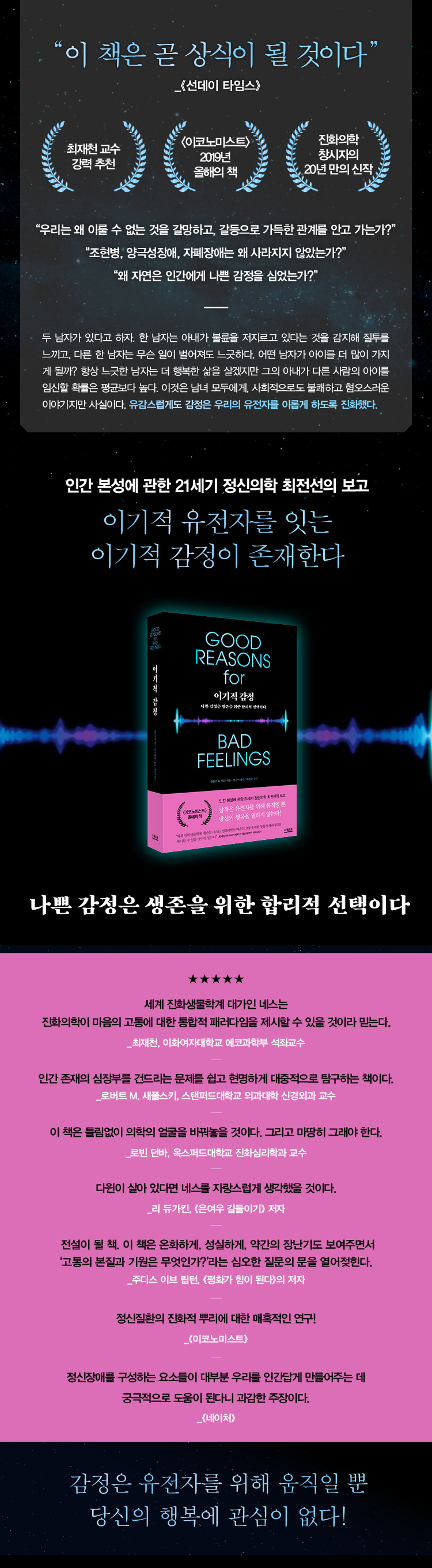
The Economist's 2019 Books of the Year
◆ Highly recommended by Professor Choi Jae-cheon ◆
“Ness, a world-renowned evolutionary biologist,
Evolutionary medicine offers an integrative paradigm for mental suffering.
I believe I can present it.”
Choi Jae-cheon (Professor Emeritus, Department of Eco-Science, Ewha Womans University)
"This book will soon become common knowledge" - The Sunday Times
Selfish emotions exist, inheriting selfish genes.
Too much stomach acid can cause heartburn, but too little can also be a problem.
Because stomach acid kills bacteria and digests food.
Diarrhea is not just about eliminating, it also helps to remove toxins and infections from the gastrointestinal tract.
Coughing removes foreign substances from the respiratory tract.
Fever is a finely regulated response to fight infection.
Most people born without the ability to feel pain also die prematurely.
So, isn't there a reason for anxiety and depression?
Let's say there are two men.
One man feels jealous because he senses his wife is having an affair, while the other man is relaxed no matter what happens.
Which man is more likely to have more children? A man who is always easygoing will likely lead a happier life, but his wife is more likely than average to conceive another man's child.
This is a story that is socially offensive and disgusting to both men and women, but it is true.
Unfortunately, emotions evolved to benefit our genes.
_ From Chapter 4, “Good Reasons to Feel Bad”
Jealousy is an emotion that causes pain, such as blame, violence, and relationship breakdown.
Yet natural selection has not eliminated this terrible emotion from humans.
Randolph M., who has a unique background as a 'world-renowned evolutionary biologist with a medical school background'
Ness cites 'survival and genetic reproduction' as the reason.
Nature has created a system in which humans 'must feel' negative emotions such as anxiety, depression, sadness, and shame in order to survive and pass on their genes to future generations.
Emotions make humans unhappy for these selfish reasons.
In other words, if someone is feeling anxious or feeling down for a long period of time, it's possible that those emotions are sacrificing the individual for the benefit of their genes.
It is a human delusion to think that emotions evolved for our happiness.
Emotions are selfish.
“Ness is a man who offers new insights into humanity”_Edward O.
Wilson
Changing the paradigm of medicine and emotions
Randolph M., founder of evolutionary medicine
The Return of Ness
Every day, 350 million people worldwide are unable to lead normal lives due to mood disorders, and many of them, unfortunately, end up in a life-ending state.
In the United States alone, the economic loss due to depression is estimated at $210 billion.
However, over the past 50 years, there has been no clear progress in the treatment of various mental disorders, including schizophrenia and depression.
Psychoanalysis did not provide a complete solution, and the genetic mutations that were expected to cause various diseases were not discovered.
Above all, almost everyone has found no basis for feeling bad! People thought.
'Isn't it time to change the approach itself?'
"The Selfish Emotion" criticizes existing psychiatry for seeking the cause of illness without understanding the normal functioning mechanisms of emotions, and argues for the need for a new approach.
Author Randolph M.
Ness is credited with pioneering evolutionary medicine by publishing the book "Why Do We Get Sick?" with George Williams, who is known to have had a major influence on Richard Dawkins's writing of "The Selfish Gene."
Edward Wilson, the founder of sociobiology and author of Consilience, said it offered “new insights into humanity as well as advances in medicine.”
Twenty years later, Ness once again asks new questions by focusing on emotions and mental illness in "The Selfish Emotion."
Why do mental disorders exist? Why do the genes that cause anxiety, depression, addiction, anorexia, and autism still persist?
Eating disorders are not the product of natural selection, but the mechanisms that regulate eating during famine are. ADHD is not the product of natural selection, but the mechanisms that regulate attention are.
Severe depression is not a product of natural selection, but the ability to produce normal mood swings and mood elevations is a product of natural selection.
The evolutionary framework provides a foundation for psychiatry.
_ From the epilogue, “Evolutionary Psychiatry is a Bridge, Not an Island”
His insight into emotions and mental disorders from an evolutionary perspective could revitalize stagnant psychiatry.
For example, he views emotions as “a specialized operating system tailored to individual situations,” and notes that patients with depression who are not easily treated may be facing obstacles that prevent them from achieving their goals.
People with anorexia nervosa are asked to consider whether they have an extreme fear of being fat, those with severe paranoia are asked to consider whether they fear that others are plotting against them, and those with pathological jealousy are asked to consider whether they have fantasized about being abandoned by their partner.
It also brings about changes in treatment methods.
Just hearing that “anxiety is a useful response, but it’s often excessive” gave patients confidence.
Above all, it frees clinicians and patients from the illusion of a specific cause and allows them to consider a variety of treatment options.
Psychiatry has remained in the same position for 50 years without the biological knowledge that it should have naturally utilized as a medical field.
This book utilizes the most practical aspects of evolutionary theory to break down the problems facing current psychiatry and suggest a new path forward.
This is the birth of evolutionary psychiatry.
This book, which is the first to introduce the emergence and necessity of evolutionary psychiatry to the public, will change the paradigm not only in the medical field but also in the way people view emotions.
In an age where crisis has become a daily occurrence,
How do we live with anxiety?
Everyone tries to escape from painful emotions.
However, it is not always possible to change or avoid negative situations.
It is nearly impossible to help a dying spouse or simply endure the pain of a broken heart.
Caring for a child addicted to drugs or being fired from a job are problems that cannot be solved by one person.
Moreover, how should we view the so-called "corona blues" that came with the coronavirus pandemic, which has no end in sight?
The author makes a bold claim: “Tricks to relieve anxiety in the COVID-19 era may be helpful, but they may be worse than nothing.”
Rather, it is said that worrying about anxiety is the main cause of unnecessary anxiety.
And focusing on relieving anxiety makes us look back at the meaning of life that we had been missing.
It is true that the current coronavirus pandemic is causing serious mental distress.
But rather than vaguely talking about the prevalence of mental illness, we need to pay attention to individual experiences, including illness, loneliness, fatigue, unemployment, and poverty.
And we should also look to the positive experiences of people who are finally free from long commutes and poor jobs.
_From the preface of the Korean edition
We truly know how to do good deeds and care for others.
Kindness and care, instead of making life worthwhile, come at the cost of guilt and sorrow.
Thanks to our unique mechanisms for regulating our desires, most people live with a sense of humor and maintain good interpersonal relationships.
Thanks to the results of natural selection, life becomes happy and meaningful for mankind.
Rather than being horrified by the suffering of life, we should be amazed and amazed by the miracle that so many people are mentally healthy.
We live in an age where crisis has become a daily occurrence.
People are afraid and anxious about danger that may come at any time.
There is an urgent need to overturn the existing way of looking at emotions.
"Selfish Emotions" is a book we need in this day and age, when emotions and survival are so closely linked.
It challenges and revolutionizes the existing emotional paradigm, offering a new way of life: why social anxiety is so common, why anxiety and low mood are necessary for you, and ultimately, why we feel bad emotions.
Randolph Ness's books will soon become common knowledge.
_The Sunday Times
A fascinating study of the evolutionary roots of mental illness!
_The Economist
The day will come when evolutionary psychiatry becomes mainstream.
At that time, Randolph Ness's book will be recognized as the foundational text for the field of evolutionary psychiatry.
_The Wall Street Journal
It's a bold claim that most of the things that make up mental illness ultimately help make us human.
_「Nature」
◆ Highly recommended by Professor Choi Jae-cheon ◆
“Ness, a world-renowned evolutionary biologist,
Evolutionary medicine offers an integrative paradigm for mental suffering.
I believe I can present it.”
Choi Jae-cheon (Professor Emeritus, Department of Eco-Science, Ewha Womans University)
"This book will soon become common knowledge" - The Sunday Times
Selfish emotions exist, inheriting selfish genes.
Too much stomach acid can cause heartburn, but too little can also be a problem.
Because stomach acid kills bacteria and digests food.
Diarrhea is not just about eliminating, it also helps to remove toxins and infections from the gastrointestinal tract.
Coughing removes foreign substances from the respiratory tract.
Fever is a finely regulated response to fight infection.
Most people born without the ability to feel pain also die prematurely.
So, isn't there a reason for anxiety and depression?
Let's say there are two men.
One man feels jealous because he senses his wife is having an affair, while the other man is relaxed no matter what happens.
Which man is more likely to have more children? A man who is always easygoing will likely lead a happier life, but his wife is more likely than average to conceive another man's child.
This is a story that is socially offensive and disgusting to both men and women, but it is true.
Unfortunately, emotions evolved to benefit our genes.
_ From Chapter 4, “Good Reasons to Feel Bad”
Jealousy is an emotion that causes pain, such as blame, violence, and relationship breakdown.
Yet natural selection has not eliminated this terrible emotion from humans.
Randolph M., who has a unique background as a 'world-renowned evolutionary biologist with a medical school background'
Ness cites 'survival and genetic reproduction' as the reason.
Nature has created a system in which humans 'must feel' negative emotions such as anxiety, depression, sadness, and shame in order to survive and pass on their genes to future generations.
Emotions make humans unhappy for these selfish reasons.
In other words, if someone is feeling anxious or feeling down for a long period of time, it's possible that those emotions are sacrificing the individual for the benefit of their genes.
It is a human delusion to think that emotions evolved for our happiness.
Emotions are selfish.
“Ness is a man who offers new insights into humanity”_Edward O.
Wilson
Changing the paradigm of medicine and emotions
Randolph M., founder of evolutionary medicine
The Return of Ness
Every day, 350 million people worldwide are unable to lead normal lives due to mood disorders, and many of them, unfortunately, end up in a life-ending state.
In the United States alone, the economic loss due to depression is estimated at $210 billion.
However, over the past 50 years, there has been no clear progress in the treatment of various mental disorders, including schizophrenia and depression.
Psychoanalysis did not provide a complete solution, and the genetic mutations that were expected to cause various diseases were not discovered.
Above all, almost everyone has found no basis for feeling bad! People thought.
'Isn't it time to change the approach itself?'
"The Selfish Emotion" criticizes existing psychiatry for seeking the cause of illness without understanding the normal functioning mechanisms of emotions, and argues for the need for a new approach.
Author Randolph M.
Ness is credited with pioneering evolutionary medicine by publishing the book "Why Do We Get Sick?" with George Williams, who is known to have had a major influence on Richard Dawkins's writing of "The Selfish Gene."
Edward Wilson, the founder of sociobiology and author of Consilience, said it offered “new insights into humanity as well as advances in medicine.”
Twenty years later, Ness once again asks new questions by focusing on emotions and mental illness in "The Selfish Emotion."
Why do mental disorders exist? Why do the genes that cause anxiety, depression, addiction, anorexia, and autism still persist?
Eating disorders are not the product of natural selection, but the mechanisms that regulate eating during famine are. ADHD is not the product of natural selection, but the mechanisms that regulate attention are.
Severe depression is not a product of natural selection, but the ability to produce normal mood swings and mood elevations is a product of natural selection.
The evolutionary framework provides a foundation for psychiatry.
_ From the epilogue, “Evolutionary Psychiatry is a Bridge, Not an Island”
His insight into emotions and mental disorders from an evolutionary perspective could revitalize stagnant psychiatry.
For example, he views emotions as “a specialized operating system tailored to individual situations,” and notes that patients with depression who are not easily treated may be facing obstacles that prevent them from achieving their goals.
People with anorexia nervosa are asked to consider whether they have an extreme fear of being fat, those with severe paranoia are asked to consider whether they fear that others are plotting against them, and those with pathological jealousy are asked to consider whether they have fantasized about being abandoned by their partner.
It also brings about changes in treatment methods.
Just hearing that “anxiety is a useful response, but it’s often excessive” gave patients confidence.
Above all, it frees clinicians and patients from the illusion of a specific cause and allows them to consider a variety of treatment options.
Psychiatry has remained in the same position for 50 years without the biological knowledge that it should have naturally utilized as a medical field.
This book utilizes the most practical aspects of evolutionary theory to break down the problems facing current psychiatry and suggest a new path forward.
This is the birth of evolutionary psychiatry.
This book, which is the first to introduce the emergence and necessity of evolutionary psychiatry to the public, will change the paradigm not only in the medical field but also in the way people view emotions.
In an age where crisis has become a daily occurrence,
How do we live with anxiety?
Everyone tries to escape from painful emotions.
However, it is not always possible to change or avoid negative situations.
It is nearly impossible to help a dying spouse or simply endure the pain of a broken heart.
Caring for a child addicted to drugs or being fired from a job are problems that cannot be solved by one person.
Moreover, how should we view the so-called "corona blues" that came with the coronavirus pandemic, which has no end in sight?
The author makes a bold claim: “Tricks to relieve anxiety in the COVID-19 era may be helpful, but they may be worse than nothing.”
Rather, it is said that worrying about anxiety is the main cause of unnecessary anxiety.
And focusing on relieving anxiety makes us look back at the meaning of life that we had been missing.
It is true that the current coronavirus pandemic is causing serious mental distress.
But rather than vaguely talking about the prevalence of mental illness, we need to pay attention to individual experiences, including illness, loneliness, fatigue, unemployment, and poverty.
And we should also look to the positive experiences of people who are finally free from long commutes and poor jobs.
_From the preface of the Korean edition
We truly know how to do good deeds and care for others.
Kindness and care, instead of making life worthwhile, come at the cost of guilt and sorrow.
Thanks to our unique mechanisms for regulating our desires, most people live with a sense of humor and maintain good interpersonal relationships.
Thanks to the results of natural selection, life becomes happy and meaningful for mankind.
Rather than being horrified by the suffering of life, we should be amazed and amazed by the miracle that so many people are mentally healthy.
We live in an age where crisis has become a daily occurrence.
People are afraid and anxious about danger that may come at any time.
There is an urgent need to overturn the existing way of looking at emotions.
"Selfish Emotions" is a book we need in this day and age, when emotions and survival are so closely linked.
It challenges and revolutionizes the existing emotional paradigm, offering a new way of life: why social anxiety is so common, why anxiety and low mood are necessary for you, and ultimately, why we feel bad emotions.
Randolph Ness's books will soon become common knowledge.
_The Sunday Times
A fascinating study of the evolutionary roots of mental illness!
_The Economist
The day will come when evolutionary psychiatry becomes mainstream.
At that time, Randolph Ness's book will be recognized as the foundational text for the field of evolutionary psychiatry.
_The Wall Street Journal
It's a bold claim that most of the things that make up mental illness ultimately help make us human.
_「Nature」
GOODS SPECIFICS
- Date of publication: August 24, 2020
- Page count, weight, size: 576 pages | 830g | 150*225*28mm
- ISBN13: 9791165212506
- ISBN10: 1165212501
You may also like
카테고리
korean


korean

![ELLE 엘르 스페셜 에디션 A형 : 12월 [2025]](http://librairie.coreenne.fr/cdn/shop/files/b8e27a3de6c9538896439686c6b0e8fb.jpg?v=1766436872&width=3840)


