

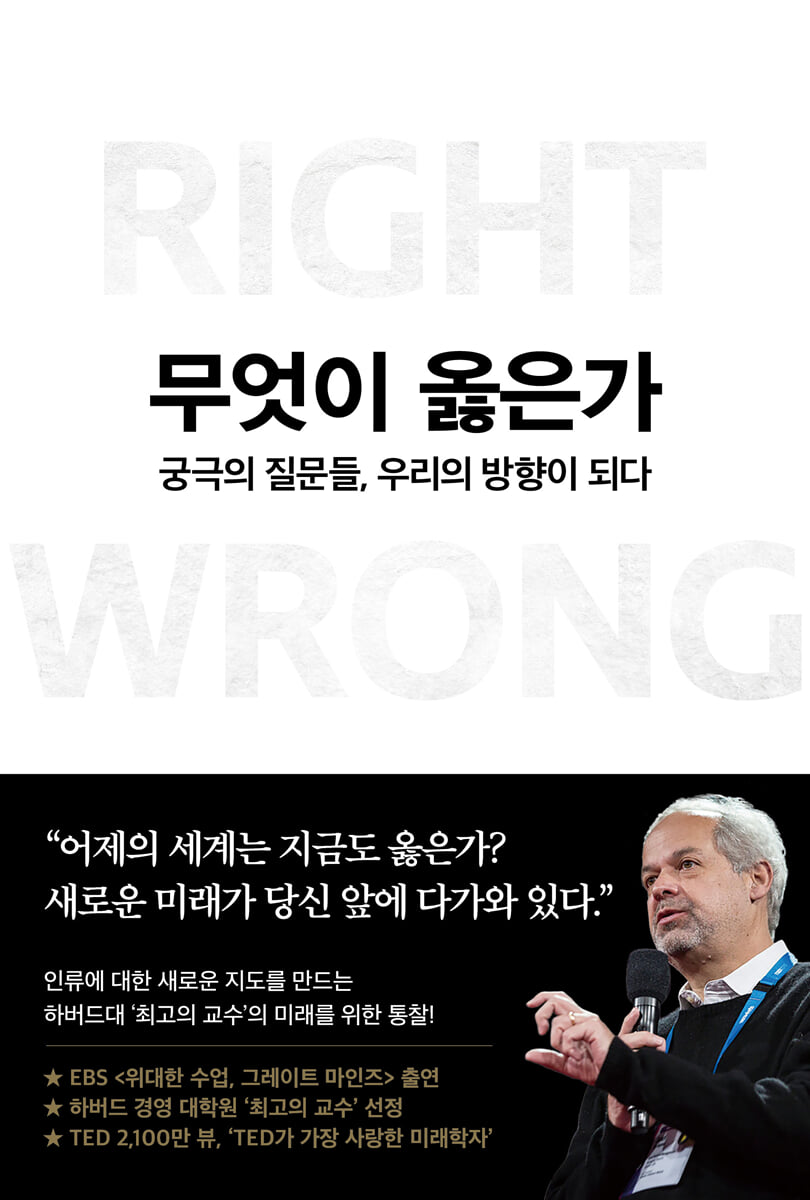
What is right
 |
Description
Book Introduction
* A comprehensive liberal arts course taught by the author, who served as a top professor at Harvard Business School. * TED's 'Masterpiece Lecture' with 21 million views * Amazon Humanities Bestseller * Recommended books by Professor Lee Eo-ryeong, Neuroscientist Jeong Jae-seung, Professor Lee Ki-jin, and other leading Korean intellectuals. Why are intellectuals around the world once again focusing on the obvious issues of "right and wrong"? Why are issues like feminism, sexual minorities, poverty, class, and inequality becoming increasingly heated and complex? All the problems that occur in our society today boil down to a battle between 'right and wrong.' As conflicts become increasingly diverse and intensified due to differing ideologies, values, and beliefs, it is no longer easy to judge "right and wrong" using conventional, flat thinking. So, in an era where political correctness and a keen sense of it are now considered a personal competitive advantage, how should we think and judge? Do you have your own intellectual basis for thinking differently from others? Juan Enriquez, known as 'TED's most beloved futurist' and currently asking the most provocative questions in the United States, has raised the issue of 'right and wrong', a global hot topic. Having received rave reviews from major international media outlets such as the Wall Street Journal, Time, and Harvard Business Review for his various theories on the future of humanity, in What's Right, he exposes the true nature of the "right and wrong" we take for granted through bold and controversial dialogue. If Michael Sandel's "Justice: What's the Right Thing to Do?" evokes the concepts of justice left by political philosophers, and Yuval Harari's "Sapiens" examines humanity's past through civilization, "What's Right?" unfolds a map of the future that will inevitably come to humanity through technological advancements and changes in thinking. We invite you to this intellectual dialogue, which explores all sorts of ethical dilemmas and offers a wealth of debate. From the crimes of the mentally ill to the use of disposable products in the age of climate disaster, this intellectual journey will leave you pleasantly dizzy. |
- You can preview some of the book's contents.
Preview
index
Introduction | Why has the question of right and wrong become such a hot issue?
Chapter 1: Is it right to redesign humans?
Immaculate Conception
Human defaults change
Brains growing in the lab
Mental malfunction is a crime?
Chapter 2: Is it right for technology to change ethics?
If the price of sunlight goes down
Technology favors the rich?
fake meat on the table
Press the extinction button
Social Media, Lies, and Fake News
Chapter 3: Is Yesterday's World Still Right?
Was slavery a perfect labor system?
Sexual Minorities: Sexual Deviance vs. Sexual Orientation
God's face keeps changing
Chapter 4: Is Unlimited Freedom on Social Media Right?
digital tattoos
Your desires recorded on dating apps
Chapter 5: Is the current social structure system right?
Warnings of Baumol's theory
Truths You Didn't Know About Medical Bills
The collapsing fairness of education
The lucrative prison business
The Counterattack of Disposables
Chapter 6: All Your 'Rights' Are Wrong
There is no law for refugees
How War Makes Money
Excessive procedures lead to death
Chapter 7 So… what’s the conclusion?
Ethics 2.0, 3.0, 4.0
The Remaining Story | Who Will Change the Game Now?
China... alone in ethics?
When artificial intelligence surpasses humans
Coexistence of viruses and humans
Alien life and future civilizations
main
Chapter 1: Is it right to redesign humans?
Immaculate Conception
Human defaults change
Brains growing in the lab
Mental malfunction is a crime?
Chapter 2: Is it right for technology to change ethics?
If the price of sunlight goes down
Technology favors the rich?
fake meat on the table
Press the extinction button
Social Media, Lies, and Fake News
Chapter 3: Is Yesterday's World Still Right?
Was slavery a perfect labor system?
Sexual Minorities: Sexual Deviance vs. Sexual Orientation
God's face keeps changing
Chapter 4: Is Unlimited Freedom on Social Media Right?
digital tattoos
Your desires recorded on dating apps
Chapter 5: Is the current social structure system right?
Warnings of Baumol's theory
Truths You Didn't Know About Medical Bills
The collapsing fairness of education
The lucrative prison business
The Counterattack of Disposables
Chapter 6: All Your 'Rights' Are Wrong
There is no law for refugees
How War Makes Money
Excessive procedures lead to death
Chapter 7 So… what’s the conclusion?
Ethics 2.0, 3.0, 4.0
The Remaining Story | Who Will Change the Game Now?
China... alone in ethics?
When artificial intelligence surpasses humans
Coexistence of viruses and humans
Alien life and future civilizations
main
Detailed image

Into the book
What we consider right, ethical, and standard is changing at an unprecedented rate.
Many of the pillars that supported certainty, faith, and what we have always held to be self-evident and eternal truths have already crumbled.
--- p.11
We are accustomed to thinking of ethics as something like a pure white marble statue.
This means that it is considered an immortal, legal totem (sacred symbol) that can never be changed.
But let's consider that even 'everything ethical' changes fundamentally over time.
--- p.12
As contraception became more widespread and women's power grew, even the most fundamental family norms changed at a frightening pace.
So what should we tolerate and what should we not tolerate in terms of sex, gender, and reproductive ethics for future generations?
--- p.33
As technologies to map the brain and intervene in its functions continue to develop, they will also face a number of ethical questions.
Questions related to 'at what stage of life, for what purpose, and to what extent can brain function regulation be allowed?'
--- p.72
If we can maintain a high standard of living while reducing our carbon footprint, we can live more ethically without sacrificing comfort.
The faster the cost curve descends and the clearer and easier new alternatives become, the faster the generational shift in beliefs and ethics will occur.
--- p.94
In any case, something is no longer accepted simply because it is right, and what is wrong is often considered justified.
But the key question to ask here is how much of what you now know to be absolutely right or wrong was actually realized 'back then'?
--- p.148
The history of slavery is an extreme example of how even ethics accepted as legitimate in society can change over time.
--- p.163
There have also been changes in the nature of marriage.
In 1967, only 3 percent of marriages were interracial; by 2018, that number had risen to one in five.
However, it is technology that has contributed significantly to this change.
--- p.169
As recently as 1968, the American Psychiatric Association's Diagnostic and Statistical Manual of Mental Disorders described homosexuality as "psychopathic personality disorder."
In 1968, a group of enlightened psychiatrists reclassified homosexuality as "sexual deviance" in the second edition of the Diagnostic and Statistical Manual of Mental Disorders.
--- p.173
Globally, there is a close link between press freedom, internet accessibility, and acceptance of homosexuality.
In other words, it is technology, particularly social networks and technologies related to TV and film, that is rapidly driving the ethical shift.
Hollywood has changed.
Some people watched the ABC sitcom "Ellen" starring Ellen DeGeneres.
--- p.177
People often think of religion and technology as being at odds with each other.
But sometimes these two coexist and coevolve.
Technology often disseminates religion and religious norms.
During the Age of Conquest, various gods spread across the world, and during the period of expansion of various empires, the gods worshipped by each empire also expanded their scope.
--- p.189
By 2021, the number of surveillance cameras worldwide will reach 1 billion.
It's no longer a secret that you're covered in electronic tattoos.
Now you are immortal.
Now, what kind of person do you want to be judged as?
--- p.217
If we had the financial means to right injustice, it would be much easier to help those who suffer and to change something that many people know is wrong.
This phenomenon of rapidly shifting ethical standards occurs when wealth continues to grow and costs continue to fall, but not when costs are rising relentlessly and problems are piling up.
--- p.232
In our discussions and in our dealings with one another, let us not be bound by the laws or religious standards of any particular era.
Instead, let's judge based on core principles such as modesty, generosity, empathy, politeness, humility, compassion, courtesy, and truthfulness.
--- p.316
When humans possess machines that constantly learn and evolve, the machine-based 'ethical' logic will ultimately be completely different from the one initially established by humans.
On the other hand, the ethics of machine artificial intelligence may develop independently from humans during the evolution process.
--- p.336
The various beliefs and customs of these 'other beings' can ultimately completely shake up the landscape of this world.
Many of the pillars that supported certainty, faith, and what we have always held to be self-evident and eternal truths have already crumbled.
--- p.11
We are accustomed to thinking of ethics as something like a pure white marble statue.
This means that it is considered an immortal, legal totem (sacred symbol) that can never be changed.
But let's consider that even 'everything ethical' changes fundamentally over time.
--- p.12
As contraception became more widespread and women's power grew, even the most fundamental family norms changed at a frightening pace.
So what should we tolerate and what should we not tolerate in terms of sex, gender, and reproductive ethics for future generations?
--- p.33
As technologies to map the brain and intervene in its functions continue to develop, they will also face a number of ethical questions.
Questions related to 'at what stage of life, for what purpose, and to what extent can brain function regulation be allowed?'
--- p.72
If we can maintain a high standard of living while reducing our carbon footprint, we can live more ethically without sacrificing comfort.
The faster the cost curve descends and the clearer and easier new alternatives become, the faster the generational shift in beliefs and ethics will occur.
--- p.94
In any case, something is no longer accepted simply because it is right, and what is wrong is often considered justified.
But the key question to ask here is how much of what you now know to be absolutely right or wrong was actually realized 'back then'?
--- p.148
The history of slavery is an extreme example of how even ethics accepted as legitimate in society can change over time.
--- p.163
There have also been changes in the nature of marriage.
In 1967, only 3 percent of marriages were interracial; by 2018, that number had risen to one in five.
However, it is technology that has contributed significantly to this change.
--- p.169
As recently as 1968, the American Psychiatric Association's Diagnostic and Statistical Manual of Mental Disorders described homosexuality as "psychopathic personality disorder."
In 1968, a group of enlightened psychiatrists reclassified homosexuality as "sexual deviance" in the second edition of the Diagnostic and Statistical Manual of Mental Disorders.
--- p.173
Globally, there is a close link between press freedom, internet accessibility, and acceptance of homosexuality.
In other words, it is technology, particularly social networks and technologies related to TV and film, that is rapidly driving the ethical shift.
Hollywood has changed.
Some people watched the ABC sitcom "Ellen" starring Ellen DeGeneres.
--- p.177
People often think of religion and technology as being at odds with each other.
But sometimes these two coexist and coevolve.
Technology often disseminates religion and religious norms.
During the Age of Conquest, various gods spread across the world, and during the period of expansion of various empires, the gods worshipped by each empire also expanded their scope.
--- p.189
By 2021, the number of surveillance cameras worldwide will reach 1 billion.
It's no longer a secret that you're covered in electronic tattoos.
Now you are immortal.
Now, what kind of person do you want to be judged as?
--- p.217
If we had the financial means to right injustice, it would be much easier to help those who suffer and to change something that many people know is wrong.
This phenomenon of rapidly shifting ethical standards occurs when wealth continues to grow and costs continue to fall, but not when costs are rising relentlessly and problems are piling up.
--- p.232
In our discussions and in our dealings with one another, let us not be bound by the laws or religious standards of any particular era.
Instead, let's judge based on core principles such as modesty, generosity, empathy, politeness, humility, compassion, courtesy, and truthfulness.
--- p.316
When humans possess machines that constantly learn and evolve, the machine-based 'ethical' logic will ultimately be completely different from the one initially established by humans.
On the other hand, the ethics of machine artificial intelligence may develop independently from humans during the evolution process.
--- p.336
The various beliefs and customs of these 'other beings' can ultimately completely shake up the landscape of this world.
--- p.352
Publisher's Review
Why is the issue of 'right and wrong' becoming increasingly heated?
As ethical shifts occur around the world,
The most controversial topics, and therefore the more intelligent conversations.
You are a good citizen.
By diligently completing the regular education curriculum, they have grown into mature members of society, faithfully following established rules, and participating in various community activities.
You respect human rights, think rationally according to norms, and act within social categories.
Because that's how I learned it.
So you think about the various social controversies you saw on the news this morning and you feel angry.
And you're probably thinking:
“How can they be so ignorant and uncivilized? How can they act so selfishly and unreasonably?
We consider ourselves to be good at discerning between right and wrong.
And based on that belief, we interpret, evaluate, and categorize others.
But Juan Enriquez shatters this certainty in What is Right.
And it speaks to the most important premise we have been missing in our judgment of right and wrong.
Right and wrong change over time.
We regard ethics as absolute and fundamental, but rules change, and there are no eternal truths.
So how will the things we so generously acknowledge today be different tomorrow? Will today's "righteousness" still be right tomorrow?
Yesterday was right, today is wrong
The moment my righteousness becomes barbarism
When the night passes and the morning comes, all standards change, and you may no longer be a good citizen.
The history of humanity has been one of merging, breaking, and improving upon the practices of other tribes.
The standard of 'rightness' has also developed in a way that continuously changes itself through this process.
And the driving force behind this movement was ‘technology.’
Ethics evolve in symbiosis with technology.
For example, as recently as 1968, the American Psychiatric Association described homosexuality as a “psychopathic personality disorder.”
However, as media-related technologies have advanced, social perceptions of LGBTQIA have changed.
As same-sex couples, previously excluded from mainstream media, began to appear in diverse media channels, minorities outside the normal family frame and their diversity began to be seen by the public.
Even the sacred realm of pregnancy and childbirth began to be shaken by the advent of science and technology.
With the development of various contraceptive and medical technologies that can control the timing of pregnancy and whether or not to give birth, the perception of pregnancy, which was once considered a natural process, has changed, and laws related to women's right to terminate pregnancy as well as the right of unmarried mothers to choose pregnancy through sperm banks are being adjusted.
Slavery, which was taken for granted for mass agricultural production, also disappeared with technological advancement.
The author says it is no coincidence that Britain was the first country to abolish slavery.
The history of industrialization earlier than other countries and the rapid replacement of human labor with machines is related to the abolition of slavery in Britain.
The North of the United States, which achieved rapid industrialization, banned the practice of slavery before the South, which relied on agriculture.
The author argues that, based on Baumol's "Cost Disease" theory, unethical behavior continues to be tolerated in places where technological advancement stagnates and productivity declines, but as technology advances, wealth increases, and costs decrease, ethical standards also shift rapidly.
In other words, the possibility of ethical change increases with the introduction and change of new technologies, and the 'rightness' of the times that was taken for granted is evaluated as 'barbarism' in history.
So what comes next? In this age of rapidly advancing science and technology, what changes can we anticipate? The history of right and wrong, which moves with time, predicts that exponentially advancing science and technology will also transform our current ethical standards in other ways.
A letter or complaint from the future
We are potential perpetrators
Juan Enriquez presents us with some interesting scenarios about right and wrong in the age of science and technology.
For example, you may be identified as the perpetrator of an incident in the future.
One morning, you will receive a complaint, filed in court by your grandson.
You knew you had a genetic defect, but you didn't use gene editing technology, and your grandson, who was born with that defect, was charged with "injury" due to your negligent judgment.
While complex ethical issues may have made it difficult for you to choose gene editing, your children's generation will likely think about gene editing in a completely different way than we do today.
You are also mentioned here as an accomplice in another incident.
Humans have confined animals in groups in sanitary-poor, confined-to-the-ground conditions.
When animals became sick, they were easily buried alive.
And he has been repeating such actions.
You didn't change your meat-based diet even after seeing the brutal killing of animals.
For future generations who will take for granted the consumption of lab-grown meat substitutes, today's meat-eating habits and 'mukbang' content in the media, which consider gluttony a blessing, will become symbols of the barbarism and ignorance of the present age.
In the new age of science and technology, we are all potential perpetrators.
In the future, with the birth of genetically tailored children and new brain production technologies, humans will emerge as a new species, and artificial intelligence will increasingly speak and think like humans.
Additionally, as the era of Martian colonization approaches, a new space will open up for humanity.
In such a change, the absolute truths you hold onto now will become dead theories, and what you take for granted now will become the standard by which future generations will evaluate you.
And you will not be free from their criticism.
“You are right! Right?”
Question the ultimate truth again
Humanity is now intoxicated by the new technologies that "Brave New World" is showing us, and futurists are competing to be the first to enter that civilization, presenting various predictions.
But the author stands at the entrance and asks:
How to get in.
The issues raised by futurist Juan Enriquez, one of the most provocative issues in the United States today, offer a variety of ways to think about the ethical challenges we will face in the future.
How will one-on-one partnerships for reproductive purposes change if pregnancy and childbirth are completely replaced by machines? Can gay couples avoid the surrogacy debate by using in vitro fertilization? How should we utilize the social media prison where we monitor each other in real time? What if the content of my dating app, filled with my sexual desires, becomes permanent data? What if AI is a fabrication of developers' social biases? What if AI opens my chatroom?
The author discusses future ethics that are difficult to explain with the existing winner-take-all criteria of left or right, or with the dichotomous judgments that have existed in the cultural war between generations, races, and religions, while going through unfamiliar questions that have not been discussed before.
And those questions will make you uncomfortable and make you think again.
We live in an age where political correctness and a keen sensitivity to it are a source of competitiveness for individuals.
As social, political, and economic issues like feminism, sexual minorities, poverty, and class become more complex and intense, the ability to think about and understand these debates becomes essential. Juan Enriquez, a TED-favored futurist and Harvard Business School's "Best Professor," constantly reflects on "open possibilities" rather than "absolute answers" to these questions.
And now, between the wavering lines of right and wrong, you will gain your own intellectual weapon.
As ethical shifts occur around the world,
The most controversial topics, and therefore the more intelligent conversations.
You are a good citizen.
By diligently completing the regular education curriculum, they have grown into mature members of society, faithfully following established rules, and participating in various community activities.
You respect human rights, think rationally according to norms, and act within social categories.
Because that's how I learned it.
So you think about the various social controversies you saw on the news this morning and you feel angry.
And you're probably thinking:
“How can they be so ignorant and uncivilized? How can they act so selfishly and unreasonably?
We consider ourselves to be good at discerning between right and wrong.
And based on that belief, we interpret, evaluate, and categorize others.
But Juan Enriquez shatters this certainty in What is Right.
And it speaks to the most important premise we have been missing in our judgment of right and wrong.
Right and wrong change over time.
We regard ethics as absolute and fundamental, but rules change, and there are no eternal truths.
So how will the things we so generously acknowledge today be different tomorrow? Will today's "righteousness" still be right tomorrow?
Yesterday was right, today is wrong
The moment my righteousness becomes barbarism
When the night passes and the morning comes, all standards change, and you may no longer be a good citizen.
The history of humanity has been one of merging, breaking, and improving upon the practices of other tribes.
The standard of 'rightness' has also developed in a way that continuously changes itself through this process.
And the driving force behind this movement was ‘technology.’
Ethics evolve in symbiosis with technology.
For example, as recently as 1968, the American Psychiatric Association described homosexuality as a “psychopathic personality disorder.”
However, as media-related technologies have advanced, social perceptions of LGBTQIA have changed.
As same-sex couples, previously excluded from mainstream media, began to appear in diverse media channels, minorities outside the normal family frame and their diversity began to be seen by the public.
Even the sacred realm of pregnancy and childbirth began to be shaken by the advent of science and technology.
With the development of various contraceptive and medical technologies that can control the timing of pregnancy and whether or not to give birth, the perception of pregnancy, which was once considered a natural process, has changed, and laws related to women's right to terminate pregnancy as well as the right of unmarried mothers to choose pregnancy through sperm banks are being adjusted.
Slavery, which was taken for granted for mass agricultural production, also disappeared with technological advancement.
The author says it is no coincidence that Britain was the first country to abolish slavery.
The history of industrialization earlier than other countries and the rapid replacement of human labor with machines is related to the abolition of slavery in Britain.
The North of the United States, which achieved rapid industrialization, banned the practice of slavery before the South, which relied on agriculture.
The author argues that, based on Baumol's "Cost Disease" theory, unethical behavior continues to be tolerated in places where technological advancement stagnates and productivity declines, but as technology advances, wealth increases, and costs decrease, ethical standards also shift rapidly.
In other words, the possibility of ethical change increases with the introduction and change of new technologies, and the 'rightness' of the times that was taken for granted is evaluated as 'barbarism' in history.
So what comes next? In this age of rapidly advancing science and technology, what changes can we anticipate? The history of right and wrong, which moves with time, predicts that exponentially advancing science and technology will also transform our current ethical standards in other ways.
A letter or complaint from the future
We are potential perpetrators
Juan Enriquez presents us with some interesting scenarios about right and wrong in the age of science and technology.
For example, you may be identified as the perpetrator of an incident in the future.
One morning, you will receive a complaint, filed in court by your grandson.
You knew you had a genetic defect, but you didn't use gene editing technology, and your grandson, who was born with that defect, was charged with "injury" due to your negligent judgment.
While complex ethical issues may have made it difficult for you to choose gene editing, your children's generation will likely think about gene editing in a completely different way than we do today.
You are also mentioned here as an accomplice in another incident.
Humans have confined animals in groups in sanitary-poor, confined-to-the-ground conditions.
When animals became sick, they were easily buried alive.
And he has been repeating such actions.
You didn't change your meat-based diet even after seeing the brutal killing of animals.
For future generations who will take for granted the consumption of lab-grown meat substitutes, today's meat-eating habits and 'mukbang' content in the media, which consider gluttony a blessing, will become symbols of the barbarism and ignorance of the present age.
In the new age of science and technology, we are all potential perpetrators.
In the future, with the birth of genetically tailored children and new brain production technologies, humans will emerge as a new species, and artificial intelligence will increasingly speak and think like humans.
Additionally, as the era of Martian colonization approaches, a new space will open up for humanity.
In such a change, the absolute truths you hold onto now will become dead theories, and what you take for granted now will become the standard by which future generations will evaluate you.
And you will not be free from their criticism.
“You are right! Right?”
Question the ultimate truth again
Humanity is now intoxicated by the new technologies that "Brave New World" is showing us, and futurists are competing to be the first to enter that civilization, presenting various predictions.
But the author stands at the entrance and asks:
How to get in.
The issues raised by futurist Juan Enriquez, one of the most provocative issues in the United States today, offer a variety of ways to think about the ethical challenges we will face in the future.
How will one-on-one partnerships for reproductive purposes change if pregnancy and childbirth are completely replaced by machines? Can gay couples avoid the surrogacy debate by using in vitro fertilization? How should we utilize the social media prison where we monitor each other in real time? What if the content of my dating app, filled with my sexual desires, becomes permanent data? What if AI is a fabrication of developers' social biases? What if AI opens my chatroom?
The author discusses future ethics that are difficult to explain with the existing winner-take-all criteria of left or right, or with the dichotomous judgments that have existed in the cultural war between generations, races, and religions, while going through unfamiliar questions that have not been discussed before.
And those questions will make you uncomfortable and make you think again.
We live in an age where political correctness and a keen sensitivity to it are a source of competitiveness for individuals.
As social, political, and economic issues like feminism, sexual minorities, poverty, and class become more complex and intense, the ability to think about and understand these debates becomes essential. Juan Enriquez, a TED-favored futurist and Harvard Business School's "Best Professor," constantly reflects on "open possibilities" rather than "absolute answers" to these questions.
And now, between the wavering lines of right and wrong, you will gain your own intellectual weapon.
GOODS SPECIFICS
- Publication date: April 19, 2022
- Page count, weight, size: 372 pages | 674g | 152*225*30mm
- ISBN13: 9788933871805
- ISBN10: 8933871802
You may also like
카테고리
korean


korean

![ELLE 엘르 스페셜 에디션 A형 : 12월 [2025]](http://librairie.coreenne.fr/cdn/shop/files/b8e27a3de6c9538896439686c6b0e8fb.jpg?v=1766436872&width=3840)


