

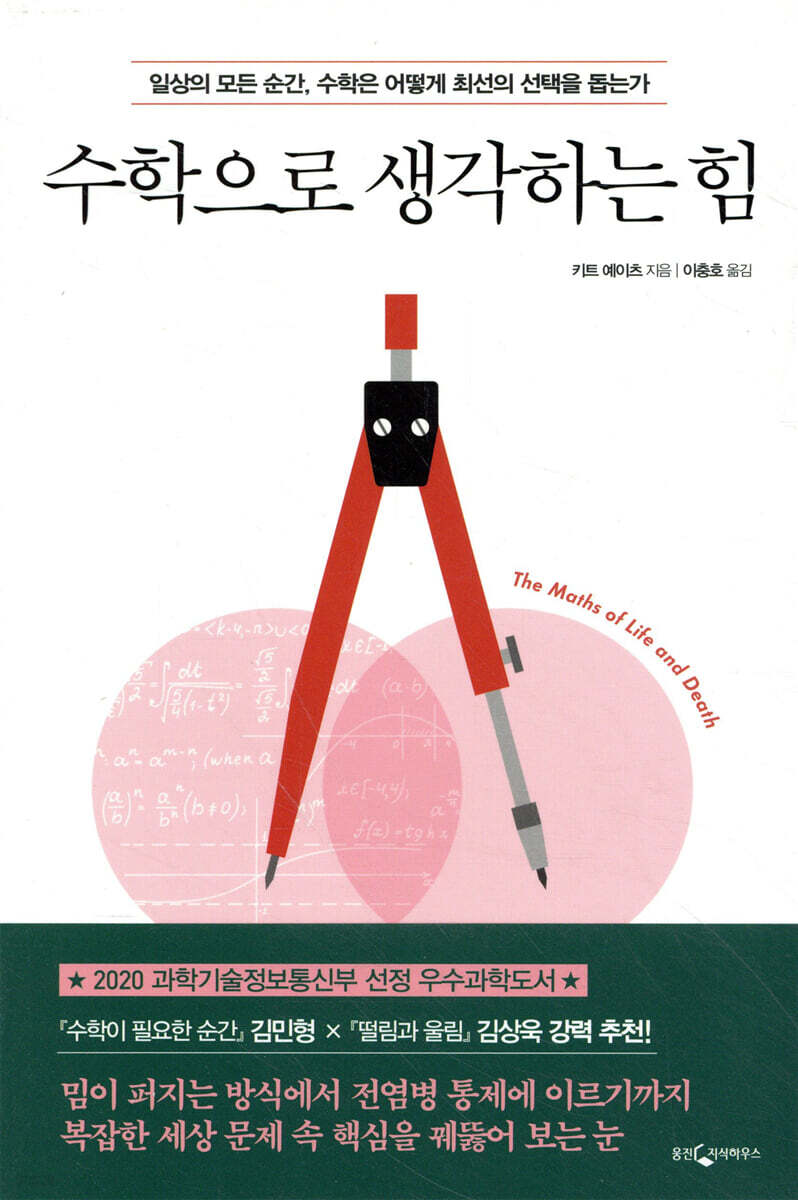
The power of thinking with mathematics
 |
Description
Book Introduction
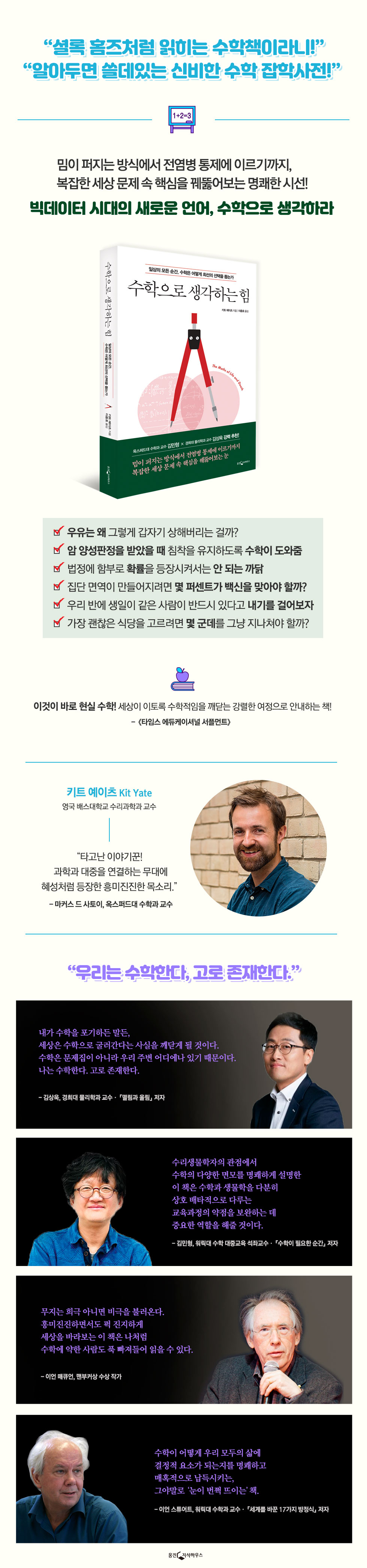
“A math book that reads like Sherlock Holmes!”
If you follow the math story that goes on and on, you will be captivated.
The seemingly complex mysteries of the world are now clearly solved.
This book claims that everything in the world can be explained with mathematics, and it even does so in a very entertaining way.
From counting snails in your backyard to algorithms that pick good restaurants, the possibility of a cancer diagnosis being wrong, the miscarriage of justice that misused probability to frame a murderer, to ways to reduce false alarms in hospital rooms or control infectious diseases… .
We travel across every place and moment of the world, discovering mathematics we had previously overlooked, and solving problems in a three-dimensional way, the answers of which change completely depending on the mathematical approach.
"The Power of Mathematical Thinking" is the captivating first book by Kit Yates, a mathematical biologist who is being watched by science star writers, including Man Booker Prize-winning author Ian McEwan, as a "next-generation math storyteller."
Kim Sang-wook, a professor of physics at Kyung Hee University, also highly recommended it, saying, “It’s a true math geek book. It’s so much fun.”
The author guides readers on a fascinating intellectual journey to discover the hidden patterns of how the world works through mathematics (without ever mentioning an equation).
If you follow the math story that goes on and on, you will be captivated.
The seemingly complex mysteries of the world are now clearly solved.
This book claims that everything in the world can be explained with mathematics, and it even does so in a very entertaining way.
From counting snails in your backyard to algorithms that pick good restaurants, the possibility of a cancer diagnosis being wrong, the miscarriage of justice that misused probability to frame a murderer, to ways to reduce false alarms in hospital rooms or control infectious diseases… .
We travel across every place and moment of the world, discovering mathematics we had previously overlooked, and solving problems in a three-dimensional way, the answers of which change completely depending on the mathematical approach.
"The Power of Mathematical Thinking" is the captivating first book by Kit Yates, a mathematical biologist who is being watched by science star writers, including Man Booker Prize-winning author Ian McEwan, as a "next-generation math storyteller."
Kim Sang-wook, a professor of physics at Kyung Hee University, also highly recommended it, saying, “It’s a true math geek book. It’s so much fun.”
The author guides readers on a fascinating intellectual journey to discover the hidden patterns of how the world works through mathematics (without ever mentioning an equation).
- You can preview some of the book's contents.
Preview
index
(Introduction) If you look closely, the world is made up of mathematics.
Chapter 1: The World Changed in the Blink of an Eye
; The incredible power and limitations of exponential change
Why does milk spoil so quickly?
The Mathematics of Multi-Level Marketing Scams
A fetus grows 16 times in a week
The power to destroy the world
What happened in Chernobyl
Exponential Decay and the Science of Dating
Why is everyone pouring ice water over themselves?
Is the future exponential?
The population explosion and the Earth's carrying capacity
As you get older, time seems to fly by.
Chapter 2: How to Stay Calm After Being Diagnosed with Cancer
; Understanding Sensitivity, Specificity, and Second Opinions
Try personal genetic testing
Formula for measuring obesity
God's Equation: The Divine Meaning of Life and Death
How to reduce false alarms in hospital rooms
There is a possibility that my positive test result is wrong.
Beware of the illusion of certainty
Two tests are better than one
Chapter 3: Guilt Made with Mathematics
; Why probability should not be arbitrarily brought into court
The absurd argument of the Dreyfus affair
Guilty until proven innocent?
1 in 73 million chance
Dependent and independent events
ecological fallacy
Inspection error
Let's roll the dice
How Math Blinds Us
Chapter 4: How to Avoid Being Fooled by Statistics
; A gap in context is a red light on reliability
What are the odds that two people have the same birthday?
How to Infuse Authority into Numbers
The presidential election polls were a complete disaster.
Do the math, properly
Pork is life-threatening?
Relative figures that cause ratio bias
A common statistical trap: regression to the mean.
3 Questions to Ask to Avoid Being Fooled
Chapter 5: Wrong Place and Wrong Time
; How the number system gets us into trouble
Rome's weakness in mathematics was due to its number system.
It departs at 9 PM, not 9 AM.
Advantages of the duodecimal system
British weights and measures become a headache
People bitten by the millennium bug
Binary, the language of computers
Chapter 6: The Never-ending Optimization
From evolution to social media, the limitless potential of algorithms
Million Dollar Problems
The shortest route to visit all the bars in the country
Where the greedy algorithm takes you
Does evolution pursue perfection?
How to Reduce Your Failure Rate When Choosing a Restaurant
“Keep your composure and check the algorithm.”
The algorithm that fooled the stock market
Why Facebook Killed Its Trending Platform
Chapter 7: How Math Becomes a Weapon in the Pandemic Era
From the SIR model to herd immunity, the struggles of mathematical epidemiology
Interventions that reduced smallpox mortality
Infected group, infected group, eliminated group
A mathematical model that interprets epidemic spread patterns
The fragile foundation of a great model
The next pandemic
Ebola patient zero
All the information about disease transmission in one number
How long should I quarantine for?
Herd immunity threshold
Vaccination is the mathematical best option
(In conclusion) The freedom that mathematics gives
Chapter 1: The World Changed in the Blink of an Eye
; The incredible power and limitations of exponential change
Why does milk spoil so quickly?
The Mathematics of Multi-Level Marketing Scams
A fetus grows 16 times in a week
The power to destroy the world
What happened in Chernobyl
Exponential Decay and the Science of Dating
Why is everyone pouring ice water over themselves?
Is the future exponential?
The population explosion and the Earth's carrying capacity
As you get older, time seems to fly by.
Chapter 2: How to Stay Calm After Being Diagnosed with Cancer
; Understanding Sensitivity, Specificity, and Second Opinions
Try personal genetic testing
Formula for measuring obesity
God's Equation: The Divine Meaning of Life and Death
How to reduce false alarms in hospital rooms
There is a possibility that my positive test result is wrong.
Beware of the illusion of certainty
Two tests are better than one
Chapter 3: Guilt Made with Mathematics
; Why probability should not be arbitrarily brought into court
The absurd argument of the Dreyfus affair
Guilty until proven innocent?
1 in 73 million chance
Dependent and independent events
ecological fallacy
Inspection error
Let's roll the dice
How Math Blinds Us
Chapter 4: How to Avoid Being Fooled by Statistics
; A gap in context is a red light on reliability
What are the odds that two people have the same birthday?
How to Infuse Authority into Numbers
The presidential election polls were a complete disaster.
Do the math, properly
Pork is life-threatening?
Relative figures that cause ratio bias
A common statistical trap: regression to the mean.
3 Questions to Ask to Avoid Being Fooled
Chapter 5: Wrong Place and Wrong Time
; How the number system gets us into trouble
Rome's weakness in mathematics was due to its number system.
It departs at 9 PM, not 9 AM.
Advantages of the duodecimal system
British weights and measures become a headache
People bitten by the millennium bug
Binary, the language of computers
Chapter 6: The Never-ending Optimization
From evolution to social media, the limitless potential of algorithms
Million Dollar Problems
The shortest route to visit all the bars in the country
Where the greedy algorithm takes you
Does evolution pursue perfection?
How to Reduce Your Failure Rate When Choosing a Restaurant
“Keep your composure and check the algorithm.”
The algorithm that fooled the stock market
Why Facebook Killed Its Trending Platform
Chapter 7: How Math Becomes a Weapon in the Pandemic Era
From the SIR model to herd immunity, the struggles of mathematical epidemiology
Interventions that reduced smallpox mortality
Infected group, infected group, eliminated group
A mathematical model that interprets epidemic spread patterns
The fragile foundation of a great model
The next pandemic
Ebola patient zero
All the information about disease transmission in one number
How long should I quarantine for?
Herd immunity threshold
Vaccination is the mathematical best option
(In conclusion) The freedom that mathematics gives
Detailed image
Into the book
As an applied mathematician, I believe that mathematics is, above all, a practical tool for understanding a complex world.
Mathematical models can be a great help in understanding everyday situations, and they don't necessarily require hundreds of equations or countless lines of computer code.
At its most basic level, we can say that mathematics is about patterns.
Every time we look at the world around us, we create a model of the patterns we observe.
If you've ever noticed a motif in the fractal branches of a tree or the multiple symmetries of a snowflake, you've seen mathematics.
When we tap our feet on the floor to keep time with music or when we hum in the shower and our voices resonate, the sound we hear is also mathematics.
We do math when we kick a ball to shake the net or catch a cricket ball flying in a parabolic trajectory.
With every new experience, with every new sensory input, the model of our surroundings improves, changes, becomes more detailed, and becomes more complex.
Creating mathematical models designed to help us understand complex realities is the best way to understand the rules that govern the world around us.
--- p.15, from “Introduction”
Multi-level marketing businesses that need to attract more investors to realize profits are ultimately doomed to failure.
The number of new investors required at each stage increases proportionally to the number of people already signed up.
In this type of multi-level marketing business, after 15 levels, the number of subscribers exceeds 10,000.
This may seem like a lot, but Give and Take easily surpasses this stage.
But if you go past step 15, you'll now need to have one in seven people on Earth sign up to continue your multi-level marketing business.
This rapid growth phenomenon, which eventually leads to a halt in the influx of new subscribers, is called exponential (or exponential) growth.
--- p.25, from “Chapter 1: The World That Changed in the Blink of an Eye”
The phenomenon of the exponential decay of the number of radioactive atoms forms the basis of radiometric dating, a method of determining the age of a substance by its radioactivity level.
By comparing the proportion of a particular radioactive atom present in nature with the proportion of that radioactive atom contained in its decay products, the age of the radiation-emitting material can be theoretically calculated.
Radiometric dating has many uses, including estimating the age of the Earth and dating ancient artifacts such as the Dead Sea Scrolls.
In November 2017, radiocarbon dating was used to prove that the world's most expensive whiskey was fake.
A Swiss hotel that was selling whisky labelled as 130-year-old Macallan single malt for $10,000 a glass was left in utter shame after it was discovered that it was actually a cheap blended whisky made in the 1970s.
In December 2018, a follow-up investigation found that more than a third of all 'vintage' Scotch whiskies tested were fake.
--- p.46, from “Chapter 1: The World Changed in the Blink of an Eye”
If we judge a period of time as a proportion of the time we have lived so far, then the exponential growth model of perceived time makes sense.
For me, at 34, one year is less than 3% of my life so far.
These days, it feels like my birthday comes around too quickly.
But a ten-year-old must wait 10 percent of his or her life before receiving his or her next birthday present, requiring patience that borders on the adult level.
My four-year-old son has to wait another quarter of his life before celebrating another birthday, and that seems unbearable.
In this exponential model, the time it takes a four-year-old to reach their next birthday is equivalent to the time it takes a 40-year-old to reach 50.
From this relative perspective, it makes perfect sense that time seems to accelerate as we get older.
--- p.63, from “Chapter 1: The World Changed in the Blink of an Eye”
God's equation compares the extra 'health benefits' a drug provides to patients on one side of the scale with the extra costs the NHS has to pay on the other.
It is difficult to assess the additional health benefits.
For example, how can you compare the benefits of a drug that reduces the risk of heart disease with the benefits of a drug that prolongs the lives of cancer patients?
(Omitted) 'God's Equation' can be seen as an attempt to take difficult decisions that affect life and death out of our subjective hands and place them under the control of objective mathematical formulas.
While this perspective seems to emphasize the impartiality and objectivity of mathematics, it ignores the subjective decisions that operate behind judgments about quality of life and cost-effectiveness thresholds in the early stages of the decision-making process.
--- p.89-90, from “Chapter 2: How to Stay Calm After Being Diagnosed with Cancer”
An interesting phenomenon was observed in children born to mothers who smoked during pregnancy in the 1960s and 1970s.
Low-birth-weight babies born to mothers who smoked were significantly less likely to die within one year than low-birth-weight babies born to mothers who did not smoke.
Low birth weight has long been associated with higher infant mortality, but smoking during pregnancy appears to offer some protection against low birth weight infants.
But in fact, that wasn't the case at all.
The answer to this paradox lay in the confounding variable.
Low birth weight is 'correlated' with high infant mortality, but is not 'a cause' of high infant mortality.
In general, these two can be caused by other negative conditions, i.e. confounding variables.
Smoking and other negative health conditions can lower birth weight and increase infant mortality, but to varying degrees.
Smoking causes many babies who would otherwise be healthy to be born with low birth weight.
Other causes of low birth weight are usually more detrimental to the child's health and thus contribute to higher infant mortality rates.
Because children born to mothers who smoke have a much higher rate of low birth weight and only a slightly higher rate of infant mortality, the death rate within a year of birth for these children is bound to be lower than for children born with low birth weight due to more risky conditions.
--- p.142, from “Chapter 3 Guilt Created by Mathematics”
Shortly after John McCain announced his candidacy for the 2008 U.S. presidential election, Google invited him to speak about his proposed policies.
At the time, Google CEO Eric Schmidt told McCain that running for president was a lot like interviewing at Google, and asked him questions that would be asked in a real Google interview.
“How do you know whether it’s a good idea to align a million 32-bit integers in 2 megabytes of RAM?” McCain looked puzzled, and Schmidt, thoroughly amused, quickly moved on to his next serious question.
Six months later, when he invited Barack Obama to Google, Schmidt asked him the same question.
Obama looked toward the audience, rubbed his eyes, and began, “Well, so...”
Schmidt noticed that Obama was flustered and tried to intervene, but Obama looked straight into Schmidt's eyes and said, "...No, no.
“I don’t think bubble sort is the right way to do it,” he continued.
Applause and cheers erupted from the computer scientists in the audience.
The unexpectedly erudite answers from Obama—including sharing an inside joke about the inefficiencies of sorting algorithms—were hallmarks of the seemingly spontaneous charisma (backed up by meticulous preparation) that characterized Obama throughout his campaign and ultimately propelled him to the White House.
--- p.271, from “Chapter 6: Optimization That Never Ends”
In a broader sense, epidemiology suggests strategies for dealing with outbreaks of disease and preventive measures to avoid them.
The science of repair, coupled with reliable scientific evidence, makes vaccination an easy decision.
Getting vaccinated not only protects ourselves, but also our family, friends, neighbors, and colleagues.
Figures from the World Health Organization show that vaccines save millions of lives every year, and that millions more could be saved if the number of people vaccinated worldwide were increased.
Vaccines are the best way to prevent the outbreak of deadly diseases and the only chance to end their devastating effects forever.
Mechanical engineering is a spark of hope for the future and a key to unlocking the secrets to solving this enormous challenge.
Mathematical models can be a great help in understanding everyday situations, and they don't necessarily require hundreds of equations or countless lines of computer code.
At its most basic level, we can say that mathematics is about patterns.
Every time we look at the world around us, we create a model of the patterns we observe.
If you've ever noticed a motif in the fractal branches of a tree or the multiple symmetries of a snowflake, you've seen mathematics.
When we tap our feet on the floor to keep time with music or when we hum in the shower and our voices resonate, the sound we hear is also mathematics.
We do math when we kick a ball to shake the net or catch a cricket ball flying in a parabolic trajectory.
With every new experience, with every new sensory input, the model of our surroundings improves, changes, becomes more detailed, and becomes more complex.
Creating mathematical models designed to help us understand complex realities is the best way to understand the rules that govern the world around us.
--- p.15, from “Introduction”
Multi-level marketing businesses that need to attract more investors to realize profits are ultimately doomed to failure.
The number of new investors required at each stage increases proportionally to the number of people already signed up.
In this type of multi-level marketing business, after 15 levels, the number of subscribers exceeds 10,000.
This may seem like a lot, but Give and Take easily surpasses this stage.
But if you go past step 15, you'll now need to have one in seven people on Earth sign up to continue your multi-level marketing business.
This rapid growth phenomenon, which eventually leads to a halt in the influx of new subscribers, is called exponential (or exponential) growth.
--- p.25, from “Chapter 1: The World That Changed in the Blink of an Eye”
The phenomenon of the exponential decay of the number of radioactive atoms forms the basis of radiometric dating, a method of determining the age of a substance by its radioactivity level.
By comparing the proportion of a particular radioactive atom present in nature with the proportion of that radioactive atom contained in its decay products, the age of the radiation-emitting material can be theoretically calculated.
Radiometric dating has many uses, including estimating the age of the Earth and dating ancient artifacts such as the Dead Sea Scrolls.
In November 2017, radiocarbon dating was used to prove that the world's most expensive whiskey was fake.
A Swiss hotel that was selling whisky labelled as 130-year-old Macallan single malt for $10,000 a glass was left in utter shame after it was discovered that it was actually a cheap blended whisky made in the 1970s.
In December 2018, a follow-up investigation found that more than a third of all 'vintage' Scotch whiskies tested were fake.
--- p.46, from “Chapter 1: The World Changed in the Blink of an Eye”
If we judge a period of time as a proportion of the time we have lived so far, then the exponential growth model of perceived time makes sense.
For me, at 34, one year is less than 3% of my life so far.
These days, it feels like my birthday comes around too quickly.
But a ten-year-old must wait 10 percent of his or her life before receiving his or her next birthday present, requiring patience that borders on the adult level.
My four-year-old son has to wait another quarter of his life before celebrating another birthday, and that seems unbearable.
In this exponential model, the time it takes a four-year-old to reach their next birthday is equivalent to the time it takes a 40-year-old to reach 50.
From this relative perspective, it makes perfect sense that time seems to accelerate as we get older.
--- p.63, from “Chapter 1: The World Changed in the Blink of an Eye”
God's equation compares the extra 'health benefits' a drug provides to patients on one side of the scale with the extra costs the NHS has to pay on the other.
It is difficult to assess the additional health benefits.
For example, how can you compare the benefits of a drug that reduces the risk of heart disease with the benefits of a drug that prolongs the lives of cancer patients?
(Omitted) 'God's Equation' can be seen as an attempt to take difficult decisions that affect life and death out of our subjective hands and place them under the control of objective mathematical formulas.
While this perspective seems to emphasize the impartiality and objectivity of mathematics, it ignores the subjective decisions that operate behind judgments about quality of life and cost-effectiveness thresholds in the early stages of the decision-making process.
--- p.89-90, from “Chapter 2: How to Stay Calm After Being Diagnosed with Cancer”
An interesting phenomenon was observed in children born to mothers who smoked during pregnancy in the 1960s and 1970s.
Low-birth-weight babies born to mothers who smoked were significantly less likely to die within one year than low-birth-weight babies born to mothers who did not smoke.
Low birth weight has long been associated with higher infant mortality, but smoking during pregnancy appears to offer some protection against low birth weight infants.
But in fact, that wasn't the case at all.
The answer to this paradox lay in the confounding variable.
Low birth weight is 'correlated' with high infant mortality, but is not 'a cause' of high infant mortality.
In general, these two can be caused by other negative conditions, i.e. confounding variables.
Smoking and other negative health conditions can lower birth weight and increase infant mortality, but to varying degrees.
Smoking causes many babies who would otherwise be healthy to be born with low birth weight.
Other causes of low birth weight are usually more detrimental to the child's health and thus contribute to higher infant mortality rates.
Because children born to mothers who smoke have a much higher rate of low birth weight and only a slightly higher rate of infant mortality, the death rate within a year of birth for these children is bound to be lower than for children born with low birth weight due to more risky conditions.
--- p.142, from “Chapter 3 Guilt Created by Mathematics”
Shortly after John McCain announced his candidacy for the 2008 U.S. presidential election, Google invited him to speak about his proposed policies.
At the time, Google CEO Eric Schmidt told McCain that running for president was a lot like interviewing at Google, and asked him questions that would be asked in a real Google interview.
“How do you know whether it’s a good idea to align a million 32-bit integers in 2 megabytes of RAM?” McCain looked puzzled, and Schmidt, thoroughly amused, quickly moved on to his next serious question.
Six months later, when he invited Barack Obama to Google, Schmidt asked him the same question.
Obama looked toward the audience, rubbed his eyes, and began, “Well, so...”
Schmidt noticed that Obama was flustered and tried to intervene, but Obama looked straight into Schmidt's eyes and said, "...No, no.
“I don’t think bubble sort is the right way to do it,” he continued.
Applause and cheers erupted from the computer scientists in the audience.
The unexpectedly erudite answers from Obama—including sharing an inside joke about the inefficiencies of sorting algorithms—were hallmarks of the seemingly spontaneous charisma (backed up by meticulous preparation) that characterized Obama throughout his campaign and ultimately propelled him to the White House.
--- p.271, from “Chapter 6: Optimization That Never Ends”
In a broader sense, epidemiology suggests strategies for dealing with outbreaks of disease and preventive measures to avoid them.
The science of repair, coupled with reliable scientific evidence, makes vaccination an easy decision.
Getting vaccinated not only protects ourselves, but also our family, friends, neighbors, and colleagues.
Figures from the World Health Organization show that vaccines save millions of lives every year, and that millions more could be saved if the number of people vaccinated worldwide were increased.
Vaccines are the best way to prevent the outbreak of deadly diseases and the only chance to end their devastating effects forever.
Mechanical engineering is a spark of hope for the future and a key to unlocking the secrets to solving this enormous challenge.
--- p.351, from “Chapter 7: How Mathematics Becomes a Weapon in the Pandemic Era”
Publisher's Review
“We do mathematics, therefore we exist.”
Mathematics is a factor that affects the joys and sorrows of everyday life.
Perhaps the decisive question between life and death
★★★ Mathematician Kim Min-hyung X Physicist Kim Sang-wook X Novelist Ian McEwan… Highly recommended!
"This is real math! A book that takes you on an intense journey to discover how mathematical the world truly is."
≫ Math that helps you stay calm even when you have a positive cancer diagnosis?
; Let's take a deep breath and calculate the accuracy of this test.
The breast cancer screening test results came back positive.
This screening test is said to 'accurately distinguish between those with cancer and those without cancer nine times out of ten.'
A 90% chance of cancer?! Before you panic and panic, it might be helpful to consider the math.
In fact, a simple mathematical argument would show that a positive result from this screening test is overwhelmingly not breast cancer.
Let's say that 10,000 women in their 50s underwent this screening test under the condition of an average incidence rate of 0.4%.
Out of 10,000, 40 have breast cancer, and 9,960 do not.
Among 40 breast cancer patients, 36 (90%) were true benign.
The problem is that 996 out of 9,960 people who do not have breast cancer, or 10%, are diagnosed with a false positive.
Of the 1,032 people who tested positive, only 36 actually had cancer.
The accuracy of this test, which 'correctly distinguishes nine out of ten', is only 3.48%.
There is a very simple way to increase the accuracy of your test: take a second test.
For many diseases, the first test is usually a screening test with low specificity (high false positives).
Because it is designed to discover as many potential patients as possible at low cost.
The second test is usually a diagnostic test, which has a much higher specificity and filters out the majority of false positives.
In the same vein, annual breast cancer screening significantly increases the likelihood that even healthy people will have a (false) positive test result at least once in their lifetime.
Okay, are you feeling a little more settled now? After you've entered the math room, you'll be much more composed as you make your second appointment.
Like it or not, false positives and false negatives are unavoidable.
While modern technology can help us deal with some issues through tools like filtering, we must learn to make our own judgments and choices.
That is, we must examine the test results with a suspicious (mathematical) eye.
You can't completely ignore the test results, but you can avoid unnecessary sleepless nights.
Additionally, even when there is no more accurate test available, repeating the same test can greatly improve the accuracy of the results.
(Read Chapter 2 of this book about sensitivity, specificity, and filtering.)
≫ A math talk show that connects the dots to find the optimal path!
"A math book that reads like Sherlock Holmes!" (Mathematician Stephen Strogatz)
"A dictionary of useful and mysterious mathematical trivia" (Physicist Kim Sang-wook)
“Even someone as weak in math as I am can get lost in this book” (Novelist Ian McEwan)
"The Power of Thinking in Mathematics" vividly shows us that we are, in fact, living in mathematics, and teaches us how to live with fewer mistakes by giving us the glasses of mathematics.
Not only does this book not contain any equations, but it also does not contain difficult mathematical concepts such as differentiation or integration.
Instead, it's full of stories.
The interwoven stories traverse a wide range of topics and fields, guiding readers on an intellectual journey that begins with mathematics and leads to insights into world problems (or vice versa).
The author weaves together real-life incidents where the application (or misuse) of mathematics was a decisive factor in dramatically changing people's fates.
As an applied mathematician who is recognized as a 'natural storyteller' and 'next-generation mathematical storyteller,' he brings in topics that serve as clues to moving from problem to solution, and connects and mixes them in an interesting way.
It features a man who falsely tested positive for AIDS and went to hell, an entrepreneur who went bankrupt because of a faulty algorithm, a mother falsely accused of murdering her two children due to a malicious interpretation of probability, an investor who lost a fortune because he didn't understand exponential growth, and the shabby Roman numeral system and the duodecimal time system adopted by the world.
We also address the ethical dilemmas surrounding statistical fraud and explore how mathematics relates to social issues such as elections, pandemics, hate, and artificial intelligence.
This book naturally convinces us that mathematics has a lot to tell us about every topic in the world.
Furthermore, this book arms us with easy and simple mathematical rules and tools.
You'll learn life lessons both big and small, from how to maximize your chances of choosing a good restaurant, to how to stay calm when you hear an unexpected diagnosis from your doctor, to how to decipher the truth behind the numbers in newspaper headlines.
We'll also delve into the underlying principles of the corporate algorithms that control our daily lives, hidden behind the curtain, and examine the role mathematics plays in the measures taken to prevent the spread of deadly diseases.
Although it may not be a weapon for life, it can easily serve as a shield.
Be sure to read Chapter 6, which discusses the "Optimization and Greed Algorithms," which demonstrates that choosing not to be wrong rather than always winning can be a better way to live.
Because we can't wait until the next life to figure out the best way.
≫ Seven intellectual explorations that reveal the patterns of all things in the world.
From how memes spread to controlling epidemics
Think in Mathematics: The New Language of the Big Data Era
This book is divided into seven chapters.
Chapter 1, “The World That Changed in the Blink of an Eye,” deals with the power and limitations of exponential change.
It explores the need for exponential sense in everyday phenomena, such as the way memes spread on the internet, the way embryos grow rapidly, the way money in the bank grows very slowly, and the perception that time passes more quickly as we get older.
Chapter 2, "Staying Calm After a Cancer Diagnosis," examines how personal genetic testing, disease screening tests, and obesity tests can be both accurate and inaccurate, and examines the dilemma of using mathematical criteria for medical judgment.
Chapter 3, “Guilt Created by Mathematics,” is a fascinating yet chilling story of mathematics presented in a courtroom, like a mystery novel.
The wrongful imprisonment of a woman convicted of murdering two children was caused by bringing the fallible nature of probability into the courtroom and blinding people to the fear of math.
The woman was acquitted after an appeal, and the trial remains one of the worst miscarriages of justice in British judicial history.
Here we will examine ecological fallacies, test fallacies, and independence assumption fallacies.
Chapter 4, "How to Not Be Fooled by Statistics," examines how the media cleverly uses mathematics to distort facts.
You should be able to detect bias that occurs when using relative numbers, regression to the mean that confuses statistical figures, etc.
Chapter 5, “Wrong Place and Wrong Time,” contains many interesting episodes about the number system.
It provides an interesting account of the development of the number system from ancient civilizations to the major and minor incidents that occurred due to the British system of weights and measures, and the influence it has had on our way of thinking.
As a bonus, the best way to avoid war is to buy snacks in packs of 12, no matter how many children you have.
Chapter 6, "Never-ending Optimization," explores the mathematics behind everyday algorithmic optimization examples, such as Google Navigation and Amazon delivery routes.
The fact that evolution, nature's most famous algorithm, explores more blindly than perfectly suggests much to us.
Chapter 7, "How Mathematics Becomes a Weapon in the Pandemic Era," deals with mathematical mechanics, and is full of insights that seem to anticipate the COVID-19 era.
By mathematically verifying that staying home when you have an infectious disease prevents the actual spread of the disease and allows you to escape the infected group more quickly, this study presents a criterion that companies should incorporate into their sick leave policies.
A welcome addition even to the 'Math Haters' Club'.
Seriously, anyone, even someone who's been a lifelong math nerd, will happily join in on this fun math chatter.
─ "Kirkus Review"
This is real-world mathematics! This book will take you on an intense journey to discover just how mathematical the world truly is!
─ "Times Educational Supplement"
From Ponzi schemes to nuclear fission, the ice bucket fad, book recommendation algorithms, and epidemic control… This fascinating book explores the uses and abuses of mathematics in everyday life, making it a wonderful resource for any curious and open-minded reader.
─ Publisher's Weekly
It's easy to think that the use of mathematics in everyday life is limited to calculating tips at restaurants or calculating discounts at the grocery store, but Yates shows that our lives interact with mathematics more frequently and more deeply than we realize.
─ Scientific American
Mathematics is a factor that affects the joys and sorrows of everyday life.
Perhaps the decisive question between life and death
★★★ Mathematician Kim Min-hyung X Physicist Kim Sang-wook X Novelist Ian McEwan… Highly recommended!
"This is real math! A book that takes you on an intense journey to discover how mathematical the world truly is."
≫ Math that helps you stay calm even when you have a positive cancer diagnosis?
; Let's take a deep breath and calculate the accuracy of this test.
The breast cancer screening test results came back positive.
This screening test is said to 'accurately distinguish between those with cancer and those without cancer nine times out of ten.'
A 90% chance of cancer?! Before you panic and panic, it might be helpful to consider the math.
In fact, a simple mathematical argument would show that a positive result from this screening test is overwhelmingly not breast cancer.
Let's say that 10,000 women in their 50s underwent this screening test under the condition of an average incidence rate of 0.4%.
Out of 10,000, 40 have breast cancer, and 9,960 do not.
Among 40 breast cancer patients, 36 (90%) were true benign.
The problem is that 996 out of 9,960 people who do not have breast cancer, or 10%, are diagnosed with a false positive.
Of the 1,032 people who tested positive, only 36 actually had cancer.
The accuracy of this test, which 'correctly distinguishes nine out of ten', is only 3.48%.
There is a very simple way to increase the accuracy of your test: take a second test.
For many diseases, the first test is usually a screening test with low specificity (high false positives).
Because it is designed to discover as many potential patients as possible at low cost.
The second test is usually a diagnostic test, which has a much higher specificity and filters out the majority of false positives.
In the same vein, annual breast cancer screening significantly increases the likelihood that even healthy people will have a (false) positive test result at least once in their lifetime.
Okay, are you feeling a little more settled now? After you've entered the math room, you'll be much more composed as you make your second appointment.
Like it or not, false positives and false negatives are unavoidable.
While modern technology can help us deal with some issues through tools like filtering, we must learn to make our own judgments and choices.
That is, we must examine the test results with a suspicious (mathematical) eye.
You can't completely ignore the test results, but you can avoid unnecessary sleepless nights.
Additionally, even when there is no more accurate test available, repeating the same test can greatly improve the accuracy of the results.
(Read Chapter 2 of this book about sensitivity, specificity, and filtering.)
≫ A math talk show that connects the dots to find the optimal path!
"A math book that reads like Sherlock Holmes!" (Mathematician Stephen Strogatz)
"A dictionary of useful and mysterious mathematical trivia" (Physicist Kim Sang-wook)
“Even someone as weak in math as I am can get lost in this book” (Novelist Ian McEwan)
"The Power of Thinking in Mathematics" vividly shows us that we are, in fact, living in mathematics, and teaches us how to live with fewer mistakes by giving us the glasses of mathematics.
Not only does this book not contain any equations, but it also does not contain difficult mathematical concepts such as differentiation or integration.
Instead, it's full of stories.
The interwoven stories traverse a wide range of topics and fields, guiding readers on an intellectual journey that begins with mathematics and leads to insights into world problems (or vice versa).
The author weaves together real-life incidents where the application (or misuse) of mathematics was a decisive factor in dramatically changing people's fates.
As an applied mathematician who is recognized as a 'natural storyteller' and 'next-generation mathematical storyteller,' he brings in topics that serve as clues to moving from problem to solution, and connects and mixes them in an interesting way.
It features a man who falsely tested positive for AIDS and went to hell, an entrepreneur who went bankrupt because of a faulty algorithm, a mother falsely accused of murdering her two children due to a malicious interpretation of probability, an investor who lost a fortune because he didn't understand exponential growth, and the shabby Roman numeral system and the duodecimal time system adopted by the world.
We also address the ethical dilemmas surrounding statistical fraud and explore how mathematics relates to social issues such as elections, pandemics, hate, and artificial intelligence.
This book naturally convinces us that mathematics has a lot to tell us about every topic in the world.
Furthermore, this book arms us with easy and simple mathematical rules and tools.
You'll learn life lessons both big and small, from how to maximize your chances of choosing a good restaurant, to how to stay calm when you hear an unexpected diagnosis from your doctor, to how to decipher the truth behind the numbers in newspaper headlines.
We'll also delve into the underlying principles of the corporate algorithms that control our daily lives, hidden behind the curtain, and examine the role mathematics plays in the measures taken to prevent the spread of deadly diseases.
Although it may not be a weapon for life, it can easily serve as a shield.
Be sure to read Chapter 6, which discusses the "Optimization and Greed Algorithms," which demonstrates that choosing not to be wrong rather than always winning can be a better way to live.
Because we can't wait until the next life to figure out the best way.
≫ Seven intellectual explorations that reveal the patterns of all things in the world.
From how memes spread to controlling epidemics
Think in Mathematics: The New Language of the Big Data Era
This book is divided into seven chapters.
Chapter 1, “The World That Changed in the Blink of an Eye,” deals with the power and limitations of exponential change.
It explores the need for exponential sense in everyday phenomena, such as the way memes spread on the internet, the way embryos grow rapidly, the way money in the bank grows very slowly, and the perception that time passes more quickly as we get older.
Chapter 2, "Staying Calm After a Cancer Diagnosis," examines how personal genetic testing, disease screening tests, and obesity tests can be both accurate and inaccurate, and examines the dilemma of using mathematical criteria for medical judgment.
Chapter 3, “Guilt Created by Mathematics,” is a fascinating yet chilling story of mathematics presented in a courtroom, like a mystery novel.
The wrongful imprisonment of a woman convicted of murdering two children was caused by bringing the fallible nature of probability into the courtroom and blinding people to the fear of math.
The woman was acquitted after an appeal, and the trial remains one of the worst miscarriages of justice in British judicial history.
Here we will examine ecological fallacies, test fallacies, and independence assumption fallacies.
Chapter 4, "How to Not Be Fooled by Statistics," examines how the media cleverly uses mathematics to distort facts.
You should be able to detect bias that occurs when using relative numbers, regression to the mean that confuses statistical figures, etc.
Chapter 5, “Wrong Place and Wrong Time,” contains many interesting episodes about the number system.
It provides an interesting account of the development of the number system from ancient civilizations to the major and minor incidents that occurred due to the British system of weights and measures, and the influence it has had on our way of thinking.
As a bonus, the best way to avoid war is to buy snacks in packs of 12, no matter how many children you have.
Chapter 6, "Never-ending Optimization," explores the mathematics behind everyday algorithmic optimization examples, such as Google Navigation and Amazon delivery routes.
The fact that evolution, nature's most famous algorithm, explores more blindly than perfectly suggests much to us.
Chapter 7, "How Mathematics Becomes a Weapon in the Pandemic Era," deals with mathematical mechanics, and is full of insights that seem to anticipate the COVID-19 era.
By mathematically verifying that staying home when you have an infectious disease prevents the actual spread of the disease and allows you to escape the infected group more quickly, this study presents a criterion that companies should incorporate into their sick leave policies.
A welcome addition even to the 'Math Haters' Club'.
Seriously, anyone, even someone who's been a lifelong math nerd, will happily join in on this fun math chatter.
─ "Kirkus Review"
This is real-world mathematics! This book will take you on an intense journey to discover just how mathematical the world truly is!
─ "Times Educational Supplement"
From Ponzi schemes to nuclear fission, the ice bucket fad, book recommendation algorithms, and epidemic control… This fascinating book explores the uses and abuses of mathematics in everyday life, making it a wonderful resource for any curious and open-minded reader.
─ Publisher's Weekly
It's easy to think that the use of mathematics in everyday life is limited to calculating tips at restaurants or calculating discounts at the grocery store, but Yates shows that our lives interact with mathematics more frequently and more deeply than we realize.
─ Scientific American
GOODS SPECIFICS
- Publication date: July 28, 2020
- Page count, weight, size: 388 pages | 526g | 145*215*20mm
- ISBN13: 9788901243931
- ISBN10: 8901243938
You may also like
카테고리
korean


korean

![ELLE 엘르 스페셜 에디션 A형 : 12월 [2025]](http://librairie.coreenne.fr/cdn/shop/files/b8e27a3de6c9538896439686c6b0e8fb.jpg?v=1766436872&width=3840)


