

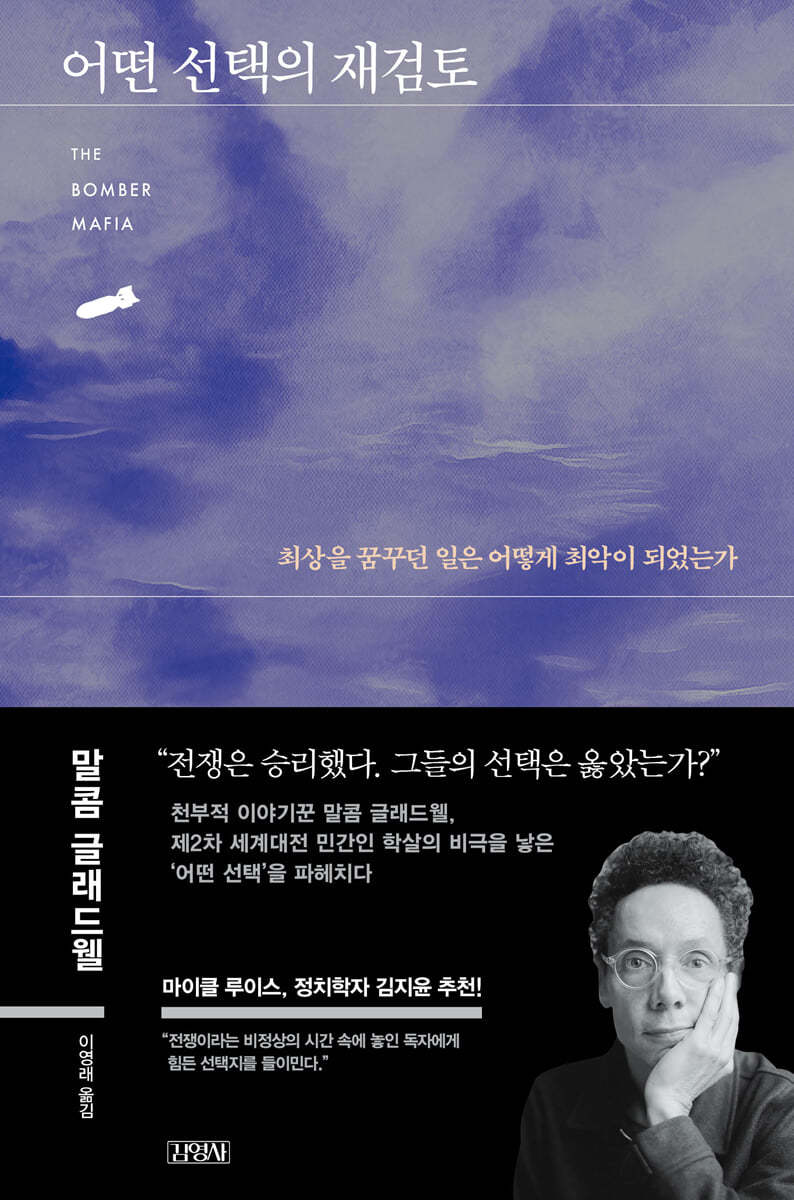
Reconsideration of some choices
 |
Description
Book Introduction
Malcolm Gladwell, global bestselling author of "Interpreting Others," "Outliers," and "The Tipping Point" Reexamining the Civilian Massacres of the Tokyo Air Raid in World War II Bestselling author and gifted storyteller Malcolm Gladwell returns with a historical nonfiction book about a defining moment in World War II. It delves into the tragedy of the civilian massacre of the US military's 'Tokyo Air Raid' in 1945 and reexamines 'opposite choices that started with the same intention.' What if the Tokyo air raid, which killed 100,000 people in one night, was actually intended to save more lives? In "A Certain Choice: A Reconsideration of the Future," Malcolm Gladwell traces the process by which the US military command decided to conduct the Tokyo air raid, revealing the gap between ideals and reality, intentions and choices. Does the "ethical war" dreamed of by the bomber mafia exist? Why do intentions and choices diverge? At a time when we need to consider the right choice more than ever, this fascinating book will raise burning questions. |
- You can preview some of the book's contents.
Preview
index
Introduction: A Story of Obsession
Chapter 0 Hansel vs.
Lemay: Same goal, opposite people
Part 1.
dream
Chapter 1: Norden's Perfectionism: How Did the Bombsight Come to Be?
Chapter 2: Bomber Mafia: When Technological Progress Meets Faith
Chapter 3: Psychopaths: People Who Lack Bonding
Chapter 4: Don Quixote: A Man Unshaken by Temptation
Chapter 5 Burning Everything: Should You Do the Unacceptable?
Part 2.
temptation
Chapter 6 Review: Abandoning Beliefs and Winning
Chapter 7 Napalm: What is most essential for the purpose?
Chapter 8 D-Day: The Darkest Night of World War II
Chapter 9 Revisited: Was It the Right Choice?
Chapter 10 Again Hansel vs.
Lemay: Conscience and Will
Acknowledgements
main
Search
Chapter 0 Hansel vs.
Lemay: Same goal, opposite people
Part 1.
dream
Chapter 1: Norden's Perfectionism: How Did the Bombsight Come to Be?
Chapter 2: Bomber Mafia: When Technological Progress Meets Faith
Chapter 3: Psychopaths: People Who Lack Bonding
Chapter 4: Don Quixote: A Man Unshaken by Temptation
Chapter 5 Burning Everything: Should You Do the Unacceptable?
Part 2.
temptation
Chapter 6 Review: Abandoning Beliefs and Winning
Chapter 7 Napalm: What is most essential for the purpose?
Chapter 8 D-Day: The Darkest Night of World War II
Chapter 9 Revisited: Was It the Right Choice?
Chapter 10 Again Hansel vs.
Lemay: Conscience and Will
Acknowledgements
main
Search
Detailed image
.jpg)
Into the book
This book is a product of my obsession.
But it's also a story about other people's obsessions, the grandest obsessions of the 20th century.
--- p.10
"Reconsidering a Choice" examines cases of how dreams can go astray.
Why do brilliant new ideas fall from the sky and land softly on our laps, but instead crash hard into the ground and shatter into pieces? Actually, the story I'm about to tell isn't a war story.
Although it mostly happens in war.
The story I'm going to tell is about a genius from the Netherlands and the computer he built at home.
It's the story of brothers living in central Alabama, the story of a British psychopath, and the story of a chemist with a penchant for ignorance who worked in the basement of Harvard University.
This is a story about the confusion of our intentions.
Because when we look back on the past, we always forget and move on from this confusion.
--- p.19
Several historians I've met were former Air Force pilots.
They personally piloted advanced fighter jets, stealth bombers, and transport aircraft worth millions of dollars.
So their talk about air power was not superficial.
They were talking about something they had actually experienced.
But the bomber mafia of the 1930s was talking about something theoretical, something they hoped would exist.
It was a dream come true.
--- p.51
“If he thought he was doing something to benefit humanity, one might wonder why he went to the trouble of developing a bombsight to help those who drop bombs.
Because he had a genuine belief that he could save lives by making bombing more accurate.”
--- p.87
The United States and Japan have had less contact with each other and know less about each other than any other adversary in history.
More importantly, they were geographically farther apart than any other wartime opponent.
The Pacific War was by definition a naval war, but as the conflict intensified, it became an air war.
The scale of the Pacific theater made it a kind of air war unlike anything anyone had ever fought before.
--- p.148
Napalm would solve every problem that Haywood Hansell and precision bombers had encountered in warfare so far.
Precision bombing was ineffective.
Hansell was struggling under conditions more difficult than any combat commander in the history of warfare.
His planes were unable to hit their targets because of the wind and clouds over Tokyo.
The thought goes like this.
What if we didn't need to aim at anything? What if we just burned everything?
--- p.188
When impacted, thousands of small explosions occur.
A strong smell of gasoline wafts through the air.
Burning napalm droplets spread in all directions.
Soon another wave of bombers approaches.
And again.
The entire attack lasted nearly three hours.
1,665 tons of napalm were dropped.
Curtis LeMay's war planners had calculated that so many incendiary bombs falling so close together would create a firestorm, a conflagration powerful enough to generate and sustain its own winds.
Their calculations were correct.
Everything within 40 square kilometers burned.
But it's also a story about other people's obsessions, the grandest obsessions of the 20th century.
--- p.10
"Reconsidering a Choice" examines cases of how dreams can go astray.
Why do brilliant new ideas fall from the sky and land softly on our laps, but instead crash hard into the ground and shatter into pieces? Actually, the story I'm about to tell isn't a war story.
Although it mostly happens in war.
The story I'm going to tell is about a genius from the Netherlands and the computer he built at home.
It's the story of brothers living in central Alabama, the story of a British psychopath, and the story of a chemist with a penchant for ignorance who worked in the basement of Harvard University.
This is a story about the confusion of our intentions.
Because when we look back on the past, we always forget and move on from this confusion.
--- p.19
Several historians I've met were former Air Force pilots.
They personally piloted advanced fighter jets, stealth bombers, and transport aircraft worth millions of dollars.
So their talk about air power was not superficial.
They were talking about something they had actually experienced.
But the bomber mafia of the 1930s was talking about something theoretical, something they hoped would exist.
It was a dream come true.
--- p.51
“If he thought he was doing something to benefit humanity, one might wonder why he went to the trouble of developing a bombsight to help those who drop bombs.
Because he had a genuine belief that he could save lives by making bombing more accurate.”
--- p.87
The United States and Japan have had less contact with each other and know less about each other than any other adversary in history.
More importantly, they were geographically farther apart than any other wartime opponent.
The Pacific War was by definition a naval war, but as the conflict intensified, it became an air war.
The scale of the Pacific theater made it a kind of air war unlike anything anyone had ever fought before.
--- p.148
Napalm would solve every problem that Haywood Hansell and precision bombers had encountered in warfare so far.
Precision bombing was ineffective.
Hansell was struggling under conditions more difficult than any combat commander in the history of warfare.
His planes were unable to hit their targets because of the wind and clouds over Tokyo.
The thought goes like this.
What if we didn't need to aim at anything? What if we just burned everything?
--- p.188
When impacted, thousands of small explosions occur.
A strong smell of gasoline wafts through the air.
Burning napalm droplets spread in all directions.
Soon another wave of bombers approaches.
And again.
The entire attack lasted nearly three hours.
1,665 tons of napalm were dropped.
Curtis LeMay's war planners had calculated that so many incendiary bombs falling so close together would create a firestorm, a conflagration powerful enough to generate and sustain its own winds.
Their calculations were correct.
Everything within 40 square kilometers burned.
--- p.210
Publisher's Review
A new book by gifted storyteller Malcolm Gladwell
A historical nonfiction work following the global bestsellers 『Interpretations of Others』, 『Outliers』, and 『Tipping Point』.
Michael Lewis and political scientist Jiyun Kim highly recommend!
I read it as if I was being sucked into it.
A gifted storyteller, Gladwell presents readers with difficult choices amidst the extraordinary times of war.
Just as I was sighing in relief that I didn't have to make a harsh decision, the image of a crying Ukrainian child appeared before my eyes.
As he said, all wars are absurd.
Kim Ji-yoon, political scientist and author of "I Don't Want to Sacrifice My Rights"
Malcolm Gladwell, the world's best-selling author of 『Interpretations of Others』, 『Outliers』, and 『The Tipping Point』, returns with a historical non-fiction book that covers a crucial moment in World War II.
It delves into the tragedy of the civilian massacre of the US military's 'Tokyo Air Raid' in 1945 and reexamines 'opposite choices that started with the same intention.'
The Tokyo Air Raid, which marked the beginning of the attack on mainland Japan, resulted in 100,000 deaths in one night.
Few people realize that this tragic event was actually born out of a hope to save more lives.
What on earth happened in the US Army Air Force that led the operation?
"Reconsidering Certain Choices" (original title: The Bomber Mafia) is a story about a choice that was made with the best in mind but ended up in the worst possible way.
Malcolm Gladwell reexamines the process by which the US military command decided to launch the Tokyo air raid, revealing the gap between ideals and reality, intentions and choices.
The commanders of the U.S. Army Air Forces, nicknamed the "Bomber Mafia," attempted to preserve a shred of humanity in a war that revealed the ugliest insanity of humanity, but their efforts ultimately resulted in the mass murder of civilians.
Does the "ethical war" dreamed of by the bomber mafia exist? Why do intentions and choices diverge?
This book is based on episodes of Malcolm Gladwell's popular podcast, Revisionist History.
Set against the backdrop of war, it presents a suspenseful plot twist that keeps you on the edge of your seat until the very end, between human desires and dreams, and the yearning for victory and humanism.
A masterpiece of historical nonfiction, crafted with Malcolm Gladwell's masterful storytelling and insight.
Avoid loss of life! Destroy only industrial facilities!
The Bomber Mafia's Choice: A Combination of Technological Innovation and Humanistic Aspirations
From low-altitude nighttime indiscriminate bombing to high-altitude daytime precision bombing
The bomber mafia, the main characters of "Reconsidering a Certain Choice," refers to the commanders of the US Army Air Forces who played a leading role in the air raids on the Japanese mainland and held the direction of the war in their hands.
A nickname created in comparison to the Mafia that terrorized American society around the 1930s, the Bomber Mafia, who advocated for an innovative and progressive view of war that was different from the past, were considered 'eccentrics' by the Army and Navy.
Their motto was “Proficimus more irretenti” (We progress without being bound by convention).
The leaders of the Air Wing Tactical School were called the "Bomber Mafia."
It wasn't a name given as a compliment.
It was a time when Al Capone and Lucky Luciano existed, and gunfights were raging in the streets.
But they thought that label suited them very well.
And so the name stuck.
(Page 46)
The Bomber Mafia attempted to change the course of war through 'high-altitude daytime precision bombing' using the latest bombers of the time (B-29 Superfortress).
It was a new method that avoided the senseless loss of life experienced in World War I and eliminated the enemy's ability to wage war by precisely bombing only their industries and military supplies.
Until then, it was common practice to drop as many bombs as possible from low altitude in the middle of the night when enemy visibility was obscured.
The success rate of the bombing was disappointing compared to the adverse effects of civilian casualties.
The advancement of science and technology enabled the bomber mafia to dream of a new war.
The Norden bombsight, developed by Dutch engineer Carl Norden, is said to be able to hit targets the size of pickle barrels from 9 kilometers above the ground.
Also, the B-29 Superfortress bomber, which had a development cost more expensive than the nuclear bomb (Manhattan Project), was a new weapon that could operate at high altitudes where enemy anti-aircraft fire could not reach.
The darkest night of World War II
The Challenges and Frustration of the Bomber Mafia
Did the Bomber Mafia's operations go smoothly? While technological advancements were said to be behind them, their ideals were far more ambitious than reality.
The worsening weather and the jet stream were a hazard.
The US military launched an air strike on Japan from Guam in the Mariana Islands, now a familiar tourist destination.
However, there were not many clear days to begin with, and the jet stream over Japan, which maintained wind speeds comparable to those of a hurricane, greatly reduced the accuracy of the bombing.
At the time, the US military reportedly achieved only 1 percent of the targeted bombing damage.
To say that “we have not achieved satisfactory results” is an understatement, to say the least.
The first air raid caused only 1 percent of the damage to the Nakajima plant.
Hansel tried again three days later.
Not a single bomb hit the factory.
On December 27, 72 B-29s were sent.
They also failed to hit the factory and set fire to a hospital.
In the end, Hansel attacked the factory five times, but barely touched it.
(Page 161)
It was the US military leadership that decisively defeated the bomber mafia's challenge.
There was pressure to end the war quickly.
Although the intention of 'no more casualties of war' remained the same, the US military command dramatically changed course.
The Bomber Mafia's high-altitude daytime precision bombing campaign was abandoned, and indiscriminate bombing, as before, was adopted.
The goal was to inflict as much damage as possible within a short period of time to eradicate Japan's will to fight.
However, Malcolm Gladwell points out that there was 'not enough deliberation and review' in this process.
Mass murder to stop the sacrifice? The author subtly suggests that racist thinking was also embedded in this.
On March 9, 1945, Tokyo became a sea of fire.
In just one night, 100,000 people died and 1 million were displaced.
It was the darkest night of World War II.
Less than half a year later, all of Japan's major cities were reduced to ashes.
It was 'another choice' different from the bomber mafia.
Malcolm Gladwell asks:
What was the right decision? Why did two choices, both driven by the same goal of reducing the casualties of war, lead to such different outcomes? The war ended as the US military hoped, but was their choice the right one?
What does it take to make the 'right choice'?
Conscience and will for humanism
General Haywood Hansell, a leading figure in the bomber mafia, was fired for refusing to launch a napalm attack on Tokyo.
The story goes that he knew very well what the outcome of the Tokyo air raid would be.
If the conscience and beliefs of the bomber mafia had remained intact, would the course of history have changed?
The question Malcolm Gladwell poses in "A Certain Choice Reconsidered" is simple.
What if the course of history, taken for granted, was actually the result of abandoning choices that could have yielded better results? Then, what constitutes the "right choice"? Malcolm Gladwell suggests it stems from the conscience and will the bomber mafia has maintained from the beginning.
The issue of civilian casualties has become a serious issue in the Ukraine-Russia war that has been going on since February 2022.
Was breaking the initial promise to minimize civilian casualties a "necessary choice for victory"? This is a fascinating book that will prompt Korean readers to ponder the right choice more than ever.
There are a series of moral problems that can only be solved by applying conscience and will.
They are a very difficult type of problem.
On the other hand, there are problems that can be solved by applying human ingenuity.
The genius of the Bomber Mafia is understanding the difference.
“Innocent people should not be massacred or burned beyond recognition for military purposes.
“We can do better than that.” (p. 233)
A historical nonfiction work following the global bestsellers 『Interpretations of Others』, 『Outliers』, and 『Tipping Point』.
Michael Lewis and political scientist Jiyun Kim highly recommend!
I read it as if I was being sucked into it.
A gifted storyteller, Gladwell presents readers with difficult choices amidst the extraordinary times of war.
Just as I was sighing in relief that I didn't have to make a harsh decision, the image of a crying Ukrainian child appeared before my eyes.
As he said, all wars are absurd.
Kim Ji-yoon, political scientist and author of "I Don't Want to Sacrifice My Rights"
Malcolm Gladwell, the world's best-selling author of 『Interpretations of Others』, 『Outliers』, and 『The Tipping Point』, returns with a historical non-fiction book that covers a crucial moment in World War II.
It delves into the tragedy of the civilian massacre of the US military's 'Tokyo Air Raid' in 1945 and reexamines 'opposite choices that started with the same intention.'
The Tokyo Air Raid, which marked the beginning of the attack on mainland Japan, resulted in 100,000 deaths in one night.
Few people realize that this tragic event was actually born out of a hope to save more lives.
What on earth happened in the US Army Air Force that led the operation?
"Reconsidering Certain Choices" (original title: The Bomber Mafia) is a story about a choice that was made with the best in mind but ended up in the worst possible way.
Malcolm Gladwell reexamines the process by which the US military command decided to launch the Tokyo air raid, revealing the gap between ideals and reality, intentions and choices.
The commanders of the U.S. Army Air Forces, nicknamed the "Bomber Mafia," attempted to preserve a shred of humanity in a war that revealed the ugliest insanity of humanity, but their efforts ultimately resulted in the mass murder of civilians.
Does the "ethical war" dreamed of by the bomber mafia exist? Why do intentions and choices diverge?
This book is based on episodes of Malcolm Gladwell's popular podcast, Revisionist History.
Set against the backdrop of war, it presents a suspenseful plot twist that keeps you on the edge of your seat until the very end, between human desires and dreams, and the yearning for victory and humanism.
A masterpiece of historical nonfiction, crafted with Malcolm Gladwell's masterful storytelling and insight.
Avoid loss of life! Destroy only industrial facilities!
The Bomber Mafia's Choice: A Combination of Technological Innovation and Humanistic Aspirations
From low-altitude nighttime indiscriminate bombing to high-altitude daytime precision bombing
The bomber mafia, the main characters of "Reconsidering a Certain Choice," refers to the commanders of the US Army Air Forces who played a leading role in the air raids on the Japanese mainland and held the direction of the war in their hands.
A nickname created in comparison to the Mafia that terrorized American society around the 1930s, the Bomber Mafia, who advocated for an innovative and progressive view of war that was different from the past, were considered 'eccentrics' by the Army and Navy.
Their motto was “Proficimus more irretenti” (We progress without being bound by convention).
The leaders of the Air Wing Tactical School were called the "Bomber Mafia."
It wasn't a name given as a compliment.
It was a time when Al Capone and Lucky Luciano existed, and gunfights were raging in the streets.
But they thought that label suited them very well.
And so the name stuck.
(Page 46)
The Bomber Mafia attempted to change the course of war through 'high-altitude daytime precision bombing' using the latest bombers of the time (B-29 Superfortress).
It was a new method that avoided the senseless loss of life experienced in World War I and eliminated the enemy's ability to wage war by precisely bombing only their industries and military supplies.
Until then, it was common practice to drop as many bombs as possible from low altitude in the middle of the night when enemy visibility was obscured.
The success rate of the bombing was disappointing compared to the adverse effects of civilian casualties.
The advancement of science and technology enabled the bomber mafia to dream of a new war.
The Norden bombsight, developed by Dutch engineer Carl Norden, is said to be able to hit targets the size of pickle barrels from 9 kilometers above the ground.
Also, the B-29 Superfortress bomber, which had a development cost more expensive than the nuclear bomb (Manhattan Project), was a new weapon that could operate at high altitudes where enemy anti-aircraft fire could not reach.
The darkest night of World War II
The Challenges and Frustration of the Bomber Mafia
Did the Bomber Mafia's operations go smoothly? While technological advancements were said to be behind them, their ideals were far more ambitious than reality.
The worsening weather and the jet stream were a hazard.
The US military launched an air strike on Japan from Guam in the Mariana Islands, now a familiar tourist destination.
However, there were not many clear days to begin with, and the jet stream over Japan, which maintained wind speeds comparable to those of a hurricane, greatly reduced the accuracy of the bombing.
At the time, the US military reportedly achieved only 1 percent of the targeted bombing damage.
To say that “we have not achieved satisfactory results” is an understatement, to say the least.
The first air raid caused only 1 percent of the damage to the Nakajima plant.
Hansel tried again three days later.
Not a single bomb hit the factory.
On December 27, 72 B-29s were sent.
They also failed to hit the factory and set fire to a hospital.
In the end, Hansel attacked the factory five times, but barely touched it.
(Page 161)
It was the US military leadership that decisively defeated the bomber mafia's challenge.
There was pressure to end the war quickly.
Although the intention of 'no more casualties of war' remained the same, the US military command dramatically changed course.
The Bomber Mafia's high-altitude daytime precision bombing campaign was abandoned, and indiscriminate bombing, as before, was adopted.
The goal was to inflict as much damage as possible within a short period of time to eradicate Japan's will to fight.
However, Malcolm Gladwell points out that there was 'not enough deliberation and review' in this process.
Mass murder to stop the sacrifice? The author subtly suggests that racist thinking was also embedded in this.
On March 9, 1945, Tokyo became a sea of fire.
In just one night, 100,000 people died and 1 million were displaced.
It was the darkest night of World War II.
Less than half a year later, all of Japan's major cities were reduced to ashes.
It was 'another choice' different from the bomber mafia.
Malcolm Gladwell asks:
What was the right decision? Why did two choices, both driven by the same goal of reducing the casualties of war, lead to such different outcomes? The war ended as the US military hoped, but was their choice the right one?
What does it take to make the 'right choice'?
Conscience and will for humanism
General Haywood Hansell, a leading figure in the bomber mafia, was fired for refusing to launch a napalm attack on Tokyo.
The story goes that he knew very well what the outcome of the Tokyo air raid would be.
If the conscience and beliefs of the bomber mafia had remained intact, would the course of history have changed?
The question Malcolm Gladwell poses in "A Certain Choice Reconsidered" is simple.
What if the course of history, taken for granted, was actually the result of abandoning choices that could have yielded better results? Then, what constitutes the "right choice"? Malcolm Gladwell suggests it stems from the conscience and will the bomber mafia has maintained from the beginning.
The issue of civilian casualties has become a serious issue in the Ukraine-Russia war that has been going on since February 2022.
Was breaking the initial promise to minimize civilian casualties a "necessary choice for victory"? This is a fascinating book that will prompt Korean readers to ponder the right choice more than ever.
There are a series of moral problems that can only be solved by applying conscience and will.
They are a very difficult type of problem.
On the other hand, there are problems that can be solved by applying human ingenuity.
The genius of the Bomber Mafia is understanding the difference.
“Innocent people should not be massacred or burned beyond recognition for military purposes.
“We can do better than that.” (p. 233)
GOODS SPECIFICS
- Publication date: April 22, 2022
- Format: Hardcover book binding method guide
- Page count, weight, size: 260 pages | 542g | 144*220*20mm
- ISBN13: 9788934961642
- ISBN10: 8934961643
You may also like
카테고리
korean


korean

![GQ KOREA Mark (Monthly): December [2025]](http://librairie.coreenne.fr/cdn/shop/files/8ef265dbbfbf186523ed75ba7319009d.jpg?v=1765340328&width=3840)


