

Errors of the mind
 |
Description
Book Introduction
The 12 Shadows of Our Nature, According to a World-Renowned Neuroscientist
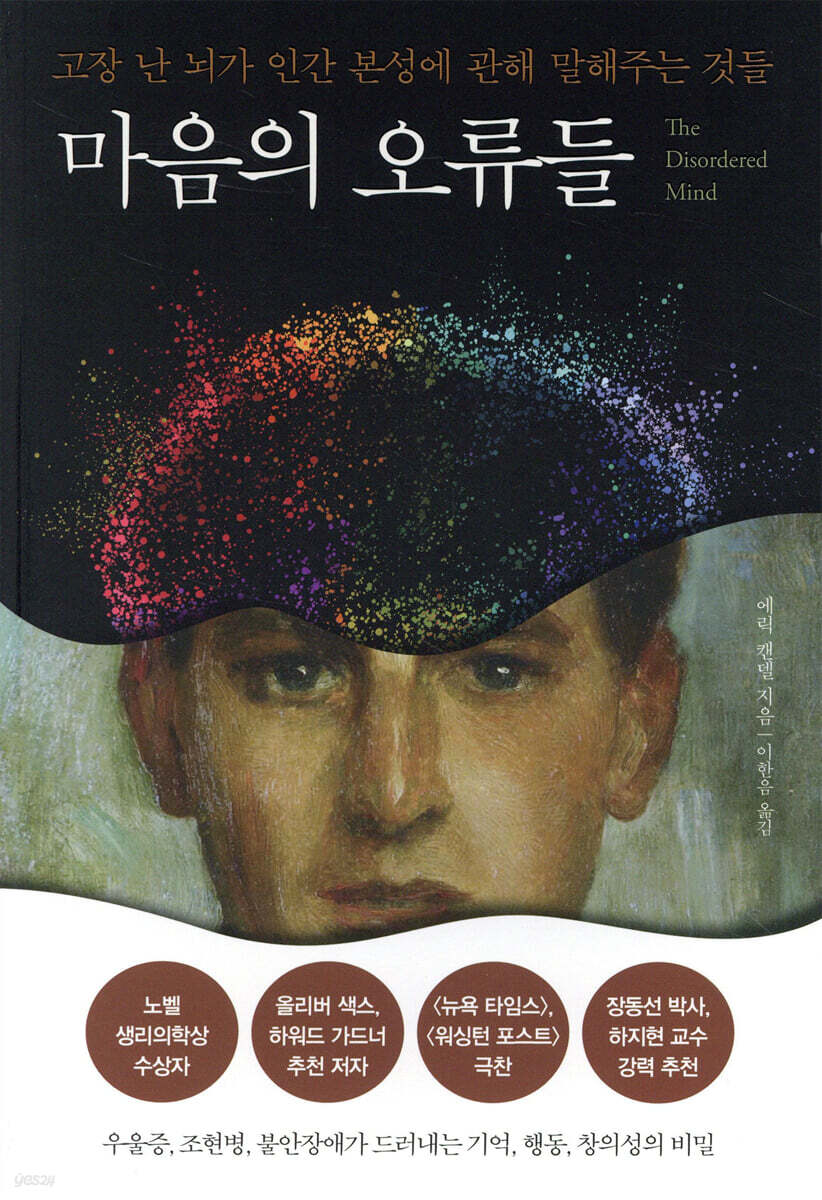
★ Nobel Prize in Physiology or Medicine winners ★ Recommended authors: Oliver Sacks and Howard Gardner ★ , rave reviews ★ Strongly recommended by Dr. Jang Dong-seon and Professor Ha Ji-hyun Ernest Hemingway and Winston Churchill, who won the Nobel Prize in Literature and received widespread public love, suffered from severe depression throughout their lives. Van Gogh painted his best work in his later years, when he suffered from bipolar disorder. John Nash, the mathematician known for the movie A Beautiful Mind, was a man with schizophrenia who displayed tremendous mathematical talent. What on earth is going on? Eric Kandel, a neuroscientist who won the 2000 Nobel Prize in Physiology or Medicine for his work on the neural mechanisms of learning and memory, answers all these questions. As a world-renowned scholar and great biologist who has studied the human brain for nearly 70 years, he reveals that autism, depression, bipolar disorder, schizophrenia, and post-traumatic stress disorder, which were previously considered to be mental problems, are actually related to a malfunctioning brain. Above all, by examining these errors that occur in the process of the brain creating the mind, we unravel the mysteries of human nature, such as sociality, creativity, memory, behavior, and consciousness. Philosophy and psychology, which are concerned with the mind and consciousness, are ultimately biology. This book, brimming with biological insights that merge science and the humanities, will fundamentally change the way we see ourselves and each other. |
- You can preview some of the book's contents.
Preview
index
Introduction
Chapter 1: What Brain Disorders Tell Us About Ourselves
Chapter 2 Our Intensely Social Nature: The Autism Spectrum
Chapter 3: Integrating Emotions and Self: Depression and Bipolar Disorder
Chapter 4: The Ability to Think, Make Decisions, and Carry Out Actions: Schizophrenia
Chapter 5 Memory, the Repository of the Self: Dementia
Chapter 6 Our Innate Creativity: Brain Disease and Art
Chapter 7 Exercise: Parkinson's and Huntington's Diseases
Chapter 8: The Interplay of Conscious and Unconscious Emotions: Anxiety, Post-Traumatic Stress, and Poor Decision Making
Chapter 9: The Pleasure Principle and Freedom of Choice: Addiction
Chapter 10: Sexual Differentiation of the Brain and Gender Identity
Chapter 11: Consciousness: The Brain's Greatest Mystery Remains
The outgoing text returns to the starting point
main
Search
pictorial
Detailed image

Into the book
This book explores how the brain processes that generate our minds can become disrupted, leading to devastating conditions like autism, depression, bipolar disorder, schizophrenia, Alzheimer's, Parkinson's, and post-traumatic stress disorder.
…just as our sex and gender identity are determined by how the brain develops and differentiates, it also shows that examining normal variations in brain function can provide a deeper understanding of how the brain works.
Finally, the book also shows how a biological approach to the mind can begin to unravel the mysteries of creativity and consciousness.
In particular, through people with schizophrenia or bipolar disorder who display remarkable creativity, it explains that their creativity emerges from the interconnected patterns of brain, mind, and behavior that are common to everyone.
--From pp.12-13
How do the coded signals sent by the trillions of neurons in our brains give rise to consciousness, love, language, and art? How does this astonishingly complex network give rise to our identity, a self that develops, grows, and yet remains remarkably constant throughout our lives?
---From p.17
People with major mental illness often exhibit exaggerated behaviors in everyday life.
Everyone feels blue from time to time, but when you have depression, this feeling is greatly intensified.
Everyone feels excited when things are going well, but during the manic phase of bipolar disorder, this feeling becomes excessively heightened.
Normal fears and pleasure seeking can escalate into severe anxiety and addiction.
p.51
Bruno Bettelheim popularized the misleading term "refrigerator mother" to explain the origins of autism.
Bettelheim argued that autism is not caused by biological factors, but rather by mothers failing to give affection to unwanted children.
Bettelheim's theory of autism, which caused great distress to many parents, has now been completely discarded.
--From pp.68-69
Both implicit and explicit memories can be stored for short-term periods of a few minutes, long-term periods of days, weeks, or even longer.
Each type of memory storage requires specific changes in the brain.
Short-term memory is the result of strengthening existing synaptic connections to make them function better, whereas long-term memory comes from the growth of new synapses.
In other words, long-term memory causes anatomical changes in the brain, whereas short-term memory does not.
As synaptic connections weaken or disappear over time, short-term memories become blurred or lost.
---From p.174
What we've learned from biology so far is that creativity arises when inhibitions are somewhat relaxed, allowing the brain to unconsciously create new associations.
As Andreessen noticed, this allows us to see the world from a new perspective, sometimes accompanied by intense joy and excitement.
---From p.232
Recently, Edna Foa and other researchers have shown that prolonged exposure therapy works particularly well for people with fear-related disorders.
This type of psychotherapy essentially works by undoing learned fear associations in the amygdala, teaching the brain to stop being afraid.
For example, if we wanted to alleviate the fear felt by a LeDoux mouse, we would play the same tone repeatedly to the mouse without the electric shock.
Eventually, the synaptic connections underlying the fear association will weaken and disappear, and the mouse will no longer flinch in response to that sound.
--From pp.274-275
Francis Crick, the most important biologist of our time, devoted the last 30 years of his life to studying how consciousness arises from brain activity.
“Your joys and sorrows, your memories and ambitions, your sense of personal identity and your free will are really nothing more than the actions of vast combinations of neurons and their associated molecules,” Crick wrote in his 1994 book, The Astonishing Hypothesis.
---From p.335
I have found through research that learning (experience) changes the connections between neurons in the brain.
This means that one person's brain is slightly different from everyone else's brain.
Identical twins have the same genome, but their brains are slightly different because they have been exposed to different environments.
In the process of elucidating brain function, brain imaging will also reveal the biological underpinnings of our individual mental lives.
…just as our sex and gender identity are determined by how the brain develops and differentiates, it also shows that examining normal variations in brain function can provide a deeper understanding of how the brain works.
Finally, the book also shows how a biological approach to the mind can begin to unravel the mysteries of creativity and consciousness.
In particular, through people with schizophrenia or bipolar disorder who display remarkable creativity, it explains that their creativity emerges from the interconnected patterns of brain, mind, and behavior that are common to everyone.
--From pp.12-13
How do the coded signals sent by the trillions of neurons in our brains give rise to consciousness, love, language, and art? How does this astonishingly complex network give rise to our identity, a self that develops, grows, and yet remains remarkably constant throughout our lives?
---From p.17
People with major mental illness often exhibit exaggerated behaviors in everyday life.
Everyone feels blue from time to time, but when you have depression, this feeling is greatly intensified.
Everyone feels excited when things are going well, but during the manic phase of bipolar disorder, this feeling becomes excessively heightened.
Normal fears and pleasure seeking can escalate into severe anxiety and addiction.
p.51
Bruno Bettelheim popularized the misleading term "refrigerator mother" to explain the origins of autism.
Bettelheim argued that autism is not caused by biological factors, but rather by mothers failing to give affection to unwanted children.
Bettelheim's theory of autism, which caused great distress to many parents, has now been completely discarded.
--From pp.68-69
Both implicit and explicit memories can be stored for short-term periods of a few minutes, long-term periods of days, weeks, or even longer.
Each type of memory storage requires specific changes in the brain.
Short-term memory is the result of strengthening existing synaptic connections to make them function better, whereas long-term memory comes from the growth of new synapses.
In other words, long-term memory causes anatomical changes in the brain, whereas short-term memory does not.
As synaptic connections weaken or disappear over time, short-term memories become blurred or lost.
---From p.174
What we've learned from biology so far is that creativity arises when inhibitions are somewhat relaxed, allowing the brain to unconsciously create new associations.
As Andreessen noticed, this allows us to see the world from a new perspective, sometimes accompanied by intense joy and excitement.
---From p.232
Recently, Edna Foa and other researchers have shown that prolonged exposure therapy works particularly well for people with fear-related disorders.
This type of psychotherapy essentially works by undoing learned fear associations in the amygdala, teaching the brain to stop being afraid.
For example, if we wanted to alleviate the fear felt by a LeDoux mouse, we would play the same tone repeatedly to the mouse without the electric shock.
Eventually, the synaptic connections underlying the fear association will weaken and disappear, and the mouse will no longer flinch in response to that sound.
--From pp.274-275
Francis Crick, the most important biologist of our time, devoted the last 30 years of his life to studying how consciousness arises from brain activity.
“Your joys and sorrows, your memories and ambitions, your sense of personal identity and your free will are really nothing more than the actions of vast combinations of neurons and their associated molecules,” Crick wrote in his 1994 book, The Astonishing Hypothesis.
---From p.335
I have found through research that learning (experience) changes the connections between neurons in the brain.
This means that one person's brain is slightly different from everyone else's brain.
Identical twins have the same genome, but their brains are slightly different because they have been exposed to different environments.
In the process of elucidating brain function, brain imaging will also reveal the biological underpinnings of our individual mental lives.
---From the text
Publisher's Review
“Are we just a bunch of nerve cells?”
The Secrets of Memory, Behavior, and Creativity Revealed by Depression, Schizophrenia, and Anxiety Disorders
The brain is like a computer.
Just as a computer converts input values into digital language for processing, our brain processes stimuli by sending and receiving neurotransmitters digitally.
Just as computer outputs, such as light or sound, vary depending on which electrical circuit a digital code is transmitted along, the electrical signals sent by the hundreds of billions of neurons in our brains vary depending on the neural pathways they follow, resulting in memories, emotions, and consciousness.
But how could we know this? One way is to look into a broken brain.
Just as a computer component's function becomes apparent when it breaks down, the brain's neural circuits also become apparent when they break down or are not properly formed.
For example, damage to a brain region called Wernicke's area can lead to language comprehension deficits, malfunctioning of the prefrontal cortex can lead to loss of moral judgment, and decreased activity in the brain's reward system can lead to susceptibility to addiction.
In other words, every mental illness has a corresponding brain disorder, and every mental process—cognition, memory, social interaction, creativity—has a corresponding brain function.
“Every activity we engage in, every emotion and thought that makes us perceive ourselves as individual beings, comes from our brain.
When you taste a peach, make a difficult decision, feel depressed, or feel a surge of emotion while looking at a painting, you are relying entirely on the biological machinery of your brain.
“It is your brain that makes you who you are.” - Excerpt from the text
As our brains change, our mental processes change too.
We can also leverage this.
For example, activating inhibitory neurons in the perirhinal cortex using oxytocin can increase intimacy between couples.
Weakening synaptic connections to disrupt memory can alleviate post-traumatic stress, and deactivating parts of the prefrontal cortex can release repressed creativity.
We can rewire our brains, and therefore ourselves.
Where science and humanities intersect
The cutting edge of brain science!
“We have learned far more about the brain and its disorders in the past century than we have in the entire history of mankind.”—Excerpt from the text
Neuroscience is a rapidly developing field.
Thanks to technological advancements over the past two decades, our knowledge of neuroscience has exploded.
Neuroscience is also an incredibly important field.
Because it is not only the science of ourselves, but also the science that determines how we view others.
However, brain science has been plagued by persistent misunderstandings.
Readers have been confused by false information that genes determine all human behavior or that the brain's plasticity nullifies innate nature.
Fortunately, there is a world-renowned neuroscientist who can correct this misunderstanding and provide a comprehensive overview of brain science.
That's Eric Kandel.
As in his classics, In Search of Memory and The Age of Insight, in this book he offers scientific answers to age-old humanistic questions, integrating the latest research in modern brain science.
Are the human body and mind separate? What exactly is consciousness? How is gender identity formed? How can we make decisions without regrets? What will scientific advancements bring us? Hearing answers to these questions, filled with biological insights, will transform the world before you.
The Secrets of Memory, Behavior, and Creativity Revealed by Depression, Schizophrenia, and Anxiety Disorders
The brain is like a computer.
Just as a computer converts input values into digital language for processing, our brain processes stimuli by sending and receiving neurotransmitters digitally.
Just as computer outputs, such as light or sound, vary depending on which electrical circuit a digital code is transmitted along, the electrical signals sent by the hundreds of billions of neurons in our brains vary depending on the neural pathways they follow, resulting in memories, emotions, and consciousness.
But how could we know this? One way is to look into a broken brain.
Just as a computer component's function becomes apparent when it breaks down, the brain's neural circuits also become apparent when they break down or are not properly formed.
For example, damage to a brain region called Wernicke's area can lead to language comprehension deficits, malfunctioning of the prefrontal cortex can lead to loss of moral judgment, and decreased activity in the brain's reward system can lead to susceptibility to addiction.
In other words, every mental illness has a corresponding brain disorder, and every mental process—cognition, memory, social interaction, creativity—has a corresponding brain function.
“Every activity we engage in, every emotion and thought that makes us perceive ourselves as individual beings, comes from our brain.
When you taste a peach, make a difficult decision, feel depressed, or feel a surge of emotion while looking at a painting, you are relying entirely on the biological machinery of your brain.
“It is your brain that makes you who you are.” - Excerpt from the text
As our brains change, our mental processes change too.
We can also leverage this.
For example, activating inhibitory neurons in the perirhinal cortex using oxytocin can increase intimacy between couples.
Weakening synaptic connections to disrupt memory can alleviate post-traumatic stress, and deactivating parts of the prefrontal cortex can release repressed creativity.
We can rewire our brains, and therefore ourselves.
Where science and humanities intersect
The cutting edge of brain science!
“We have learned far more about the brain and its disorders in the past century than we have in the entire history of mankind.”—Excerpt from the text
Neuroscience is a rapidly developing field.
Thanks to technological advancements over the past two decades, our knowledge of neuroscience has exploded.
Neuroscience is also an incredibly important field.
Because it is not only the science of ourselves, but also the science that determines how we view others.
However, brain science has been plagued by persistent misunderstandings.
Readers have been confused by false information that genes determine all human behavior or that the brain's plasticity nullifies innate nature.
Fortunately, there is a world-renowned neuroscientist who can correct this misunderstanding and provide a comprehensive overview of brain science.
That's Eric Kandel.
As in his classics, In Search of Memory and The Age of Insight, in this book he offers scientific answers to age-old humanistic questions, integrating the latest research in modern brain science.
Are the human body and mind separate? What exactly is consciousness? How is gender identity formed? How can we make decisions without regrets? What will scientific advancements bring us? Hearing answers to these questions, filled with biological insights, will transform the world before you.
GOODS SPECIFICS
- Date of issue: July 1, 2020
- Page count, weight, size: 400 pages | 646g | 148*215*30mm
- ISBN13: 9788925536934
- ISBN10: 8925536935
You may also like
카테고리
korean


korean

![ELLE 엘르 스페셜 에디션 A형 : 12월 [2025]](http://librairie.coreenne.fr/cdn/shop/files/b8e27a3de6c9538896439686c6b0e8fb.jpg?v=1766436872&width=3840)


