

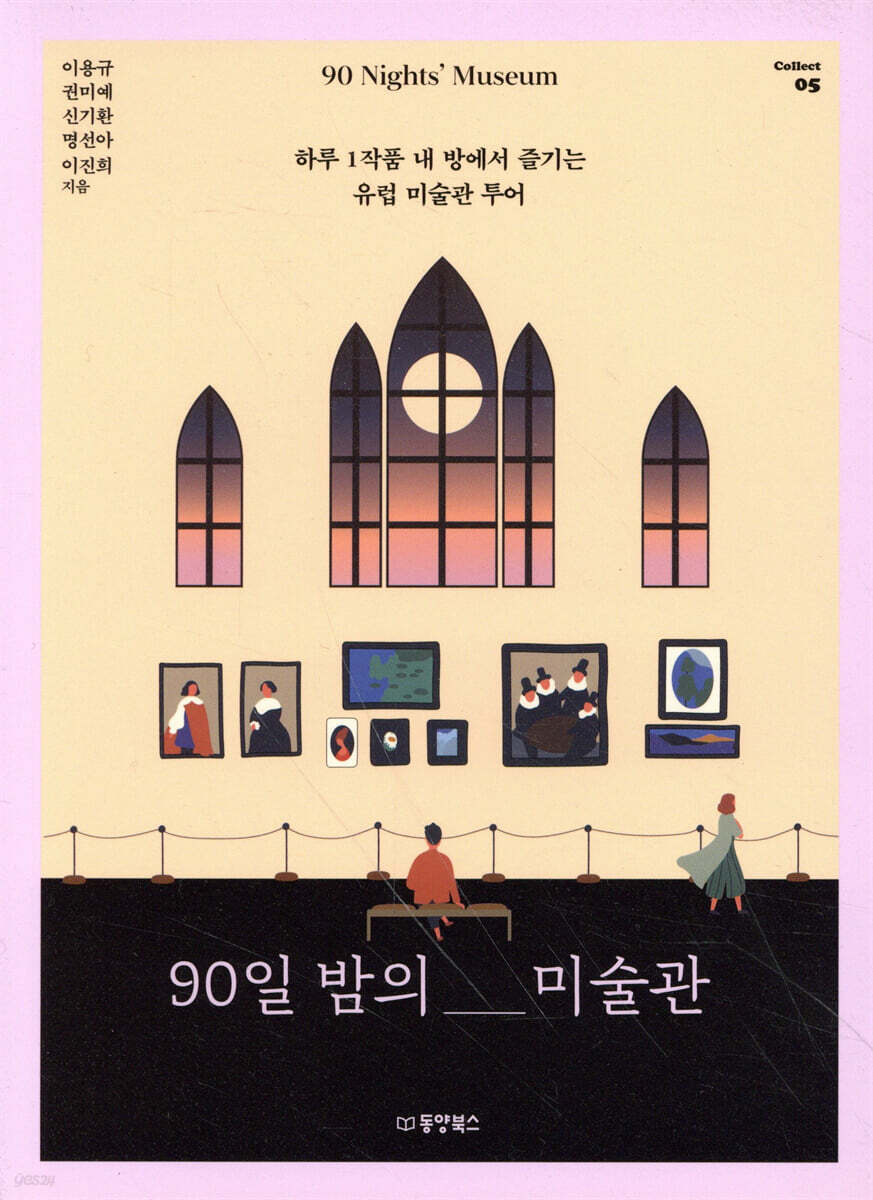
90 Nights of Art Museum
 |
Description
Book Introduction
It has impressed thousands of people in art galleries across Europe.
Five docents vividly tell the story of art.
England, France, Spain, Germany, the Netherlands, etc.
With docents who have been working at local art museums for a long time
Let's take a look at the works that have illuminated Western art history.
For 90 days, you can enjoy the feeling of traveling to European art museums from home.
Five docents from Eurobike Country, a company famous for its knowledge-based tours in Europe, have compiled the touching stories of art they have shared with countless travelers into a book.
Each is organized by country and art museum where they worked, so you can enjoy it vividly as if you were listening to an actual docent's explanation.
Let's broaden our appreciation of art through the lives and stories behind the paintings of various painters from the Renaissance to the present day.
Five docents vividly tell the story of art.
England, France, Spain, Germany, the Netherlands, etc.
With docents who have been working at local art museums for a long time
Let's take a look at the works that have illuminated Western art history.
For 90 days, you can enjoy the feeling of traveling to European art museums from home.
Five docents from Eurobike Country, a company famous for its knowledge-based tours in Europe, have compiled the touching stories of art they have shared with countless travelers into a book.
Each is organized by country and art museum where they worked, so you can enjoy it vividly as if you were listening to an actual docent's explanation.
Let's broaden our appreciation of art through the lives and stories behind the paintings of various painters from the Renaissance to the present day.
- You can preview some of the book's contents.
Preview
index
Entrance
uk
Day 1: The more you look, the more astonishing the sophistication [Jan van Eyck | Portrait of the Arnolfini Couple]
Day 2: The Painter Who Was Obsessed with Perspective [Paolo Uccello | The Battle of San Romano]
Day 3: Hot Topic: Wedding Items [Sandro Botticelli | Venus and Mars]
Day 4: The National Gallery's First Collection [Sebastiano del Piombo | The Resurrection of Lazarus]
Day 5: A Masterpiece Filled with Symbolism [(Small) Hans Holbein | The Ambassadors]
Day 6: Not Everything Is What It Seems [Agnolo Bronzino | Allegory of Venus and Cupid]
Day 7: Religion Comes Down to Earth [Michelangelo Merisi da Caravaggio | The Supper at Emmaus]
Day 8: The Value of the Distorted Pearl [Peter Paul Rubens | Samson and Delilah]
Day 9: The Refined Hypocrisy of a Failed King [Anthony Van Dyck | Equestrian Portrait of Charles I]
Day 10: Self-Portraits of Life [Rembrandt van Rijn | Self-Portrait at Age 34, Self-Portrait at Age 63]
Day 11: Religious, Yet Not [Jan Jans Trek | Vanitas Still Life]
Day 12 Portrait of a Noble Horse [George Stubbs | Whistlejacket]
Day 13: The Dazzling Natural Scenery [John Constable | Hay Wagon]
Day 14: The Queen of the Nine Days [Paul Delaroche | The Execution of Lady Jane Grey]
Day 15: Britain's Beloved Painter [William Turner | The Last Voyage of the Temeraire]
Day 16: Eerie but Beautiful [John Everett Millais | Ophelia]
Day 17: The Father of Modern Art [Paul Cézanne | Self-Portrait]
Day 18: More Real Than Reality [Edouard Manet | A Bar at the Folies-Bergère]
Day 19: A Look of Desperate Loneliness [Vincent van Gogh | Self-Portrait with Bandaged Ear]
Day 20: Blue Air, Love, and Flowers [Marc Chagall | Bouquets and Flying Lovers]
Day 21: The Reincarnation of Narcissus [Salvador Dali | The Metamorphosis of Narcissus]
france
Day 22: The World's Most Famous Painting [Leonardo da Vinci | Mona Lisa]
Day 23: The Genius Who Longed for His Mother's Love [Leonardo da Vinci | Saint Anne and the Holy Child]
Day 24: The Virgin Mary in Reality [Michelangelo Merisi da Caravaggio | The Death of the Virgin]
Day 25: A Painting Fit for a Hero [Jacques-Louis David | The Coronation of Napoleon I]
Day 26: The Great Courage of Ordinary Citizens [Eugène Delacroix | Liberty Leading the People]
Day 27 Even if it's not a beautiful reality [Gustave Courbet | The Burial at Ornans]
Day 28: A Realistic Allegory Surrounding the Painter [Gustave Courbet | The Painter's Studio]
Day 29: A Warm Look at Noble Labor [Jean-François Millet | The Gleaners, The Angelus]
Day 30: A Slightly Strange Venus [Alexandre Cabanel | The Birth of Venus]
Day 31 What did you see in the painting [Edouard Manet | Luncheon on the Grass]?
Day 32: An Uncomfortable Painting [Édouard Manet | Olympia]
Day 33: The Beginning of Impressionism [Claude Monet | Impression: Sunrise]
Day 34: Master of Capturing the Moment [Edgar Degas | Absinthe]
Day 35: The Painter's Sad Farewell Ceremony [Claude Monet | Camille on Her Deathbed]
Day 36: Leaving Beauty Behind [Auguste Renoir | Dance in the City, Dance in the Country]
Day 37: Similar but Completely Different Works [Vincent van Gogh | The Siesta], [Millet | Midday]
Day 38: A Vulgar Joke Thrown into an Art Museum [Marcel Duchamp | LHOOQ]
Day 39 Matisse Blue [Henri Matisse | Blue Nude IV]
Netherlands
Day 40: 17th-Century Female Painters [Judith Leyster | A Man Offering Money to a Young Woman]
Day 41 Night Scene [Rembrandt van Rijn | Night Scene]
Day 42: The Dutch Mona Lisa [Johannes Vermeer | Girl with a Pearl Earring]
Day 43: Love and Hate for My Father [Vincent van Gogh | Still Life with a Bible]
Day 44: Van Gogh's Profile [Henri de Toulouse-Lautrec | Portrait of Vincent van Gogh]
Day 45: Despair or Hope [Vincent van Gogh | Wheatfield with Crows]
Spain
Day 46: A Prayerful Painting [Fra Angelico | Annunciation]
Day 47: A Picture Becomes a Drama [Rogier van der Weyden | The Descent from the Cross]
Day 48: Fairy Tales for Adults [Hieronymus Bosch | The Seven Deadly Sins]
Day 49: A World of Fantasy and the Bizarre [Hieronymus Bosch | The Garden of Earthly Delights]
Day 50: The Terror of the Black Death That Shook Europe [Pieter Bruegel the Elder | The Triumph of Death]
Day 51 I Will Walk My Own Way [El Greco | The Stripping of Christ]
Day 52: Drawing Lessons from the East and the West [El Greco | The Burial of the Count of Orgaz]
Day 53: The Most Human Appearance of a God in History [Diego Velázquez | The Triumph of Bacchus]
Day 54: Capturing a 0.1-Second Moment [Diego Velázquez | Vulcan's Forge]
Day 55: The Power to Draw Everyone Into the Painting [Diego Velázquez | The Maids of Honor]
Day 56: The Painter's Brush Against an Incompetent Royal Family [Francisco Goya | Portrait of the Family of Charles IV]
Day 57: A Nude Painting That Shook an Era [Francisco Goya | The Naked Maja, The Clothed Maja]
Day 58: Intoxicated by the Madness of War [Francisco Goya | May 2, 1808]
Day 59: A Hero Revived by the Painter's Fingertips [Francisco Goya | May 3, 1808]
Day 60: The Grim State of Death [Francisco Goya | Saturn Devouring His Son]
Day 61: Picasso's Creativity at Sixteen [Pablo Picasso | Science and Compassion]
Day 62: Ambiguous but Intense [Pablo Picasso | Waiting (Margot)]
Day 63: Denouncing the Tragedy of the Fatherland with a Brush [Pablo Picasso | Guernica]
Day 64 I am the navel of the world [Salvador Dali | Soft Self-Portrait with Grilled Bacon]
Day 65: To Fascination or to Be Fascinated [Salvador Dali | Leda Atomica]
Day 66: Great Artists Steal [Pablo Picasso | The Maids of Honor]
Day 67: The Protagonist Who Chose Tragedy [Pablo Picasso | Jacqueline]
Day 68: Warm Melody [Joan Miro | Sky Blue Gold]
germany
Day 69: The Father of the Renaissance [Giotto Dibondone | The Last Supper]
Day 70: The Flemish Style [Hans Memling | The Seven Joys of the Virgin]
Day 71: Raphael's Teacher [Pietro Perugino | The Vision of St. Bernard]
Day 72: Endless Anguish About Oneself [Albrecht Dürer | Self-Portrait in a Fur Coat]
Day 73: The Three Great Masters of the Renaissance [Raphael Sanzio | Cannizzani's Holy Family]
Day 74: Venice's Finest Hand [Vecellio Titian | The Transience of the Present World (Vanitas)]
Day 75: 16th-Century Edition of "Taegukgi" [Albrecht Altdorfer | Battle of Issus]
Day 76: The Honor of the Emperor Giving a Brush [Vecellio Titian | Portrait of Charles V]
Day 77: Is Longevity Happiness? [Titian Vecellio | Christ Crowned with Thorns]
Day 78 Romantic Wedding Snaps [Peter Paul Rubens | Rubens and Isabella Brandt Under the Honeysuckle]
Day 79: The Classic Baroque [Peter Paul Rubens | The Last Judgment]
Day 80: The Magician of Light [Peter Paul Rubens | The Rape of the Daughters of Leucippus]
Day 81: Young Rembrandt [Rembrandt van Rijn | Self-Portrait as a Young Man]
Day 82: Tears of Heaven [Rembrandt van Rijn | The Sacrifice of Isaac]
Other areas
Day 83: The Witch Hunts: A Fictional Portrait of Elisabetta Sirani | Beatrice Cenzi
Day 84 Like David Surrounded by Wild Beasts [Henri Matisse | Harmony of Red]
Day 85: The Goat Playing the Violin [Marc Chagall | The Violinist with the Green Face]
Day 86: I Paint My Reality [Frida Kahlo | Self-Portrait in Velvet]
Day 87: The Pigeon Who Loved the Elephant [Frida Kahlo | Just a Few Stabs]
Day 88: Rejecting the Familiar [René Magritte | The Treachery of Images: This is Not a Pipe]
Day 89 Men Falling from the Sky Like Rain [René Magritte | Golconda]
Day 90: The Mysterious Power of Poetry [René Magritte | Empire of Light]
Browse by artist
uk
Day 1: The more you look, the more astonishing the sophistication [Jan van Eyck | Portrait of the Arnolfini Couple]
Day 2: The Painter Who Was Obsessed with Perspective [Paolo Uccello | The Battle of San Romano]
Day 3: Hot Topic: Wedding Items [Sandro Botticelli | Venus and Mars]
Day 4: The National Gallery's First Collection [Sebastiano del Piombo | The Resurrection of Lazarus]
Day 5: A Masterpiece Filled with Symbolism [(Small) Hans Holbein | The Ambassadors]
Day 6: Not Everything Is What It Seems [Agnolo Bronzino | Allegory of Venus and Cupid]
Day 7: Religion Comes Down to Earth [Michelangelo Merisi da Caravaggio | The Supper at Emmaus]
Day 8: The Value of the Distorted Pearl [Peter Paul Rubens | Samson and Delilah]
Day 9: The Refined Hypocrisy of a Failed King [Anthony Van Dyck | Equestrian Portrait of Charles I]
Day 10: Self-Portraits of Life [Rembrandt van Rijn | Self-Portrait at Age 34, Self-Portrait at Age 63]
Day 11: Religious, Yet Not [Jan Jans Trek | Vanitas Still Life]
Day 12 Portrait of a Noble Horse [George Stubbs | Whistlejacket]
Day 13: The Dazzling Natural Scenery [John Constable | Hay Wagon]
Day 14: The Queen of the Nine Days [Paul Delaroche | The Execution of Lady Jane Grey]
Day 15: Britain's Beloved Painter [William Turner | The Last Voyage of the Temeraire]
Day 16: Eerie but Beautiful [John Everett Millais | Ophelia]
Day 17: The Father of Modern Art [Paul Cézanne | Self-Portrait]
Day 18: More Real Than Reality [Edouard Manet | A Bar at the Folies-Bergère]
Day 19: A Look of Desperate Loneliness [Vincent van Gogh | Self-Portrait with Bandaged Ear]
Day 20: Blue Air, Love, and Flowers [Marc Chagall | Bouquets and Flying Lovers]
Day 21: The Reincarnation of Narcissus [Salvador Dali | The Metamorphosis of Narcissus]
france
Day 22: The World's Most Famous Painting [Leonardo da Vinci | Mona Lisa]
Day 23: The Genius Who Longed for His Mother's Love [Leonardo da Vinci | Saint Anne and the Holy Child]
Day 24: The Virgin Mary in Reality [Michelangelo Merisi da Caravaggio | The Death of the Virgin]
Day 25: A Painting Fit for a Hero [Jacques-Louis David | The Coronation of Napoleon I]
Day 26: The Great Courage of Ordinary Citizens [Eugène Delacroix | Liberty Leading the People]
Day 27 Even if it's not a beautiful reality [Gustave Courbet | The Burial at Ornans]
Day 28: A Realistic Allegory Surrounding the Painter [Gustave Courbet | The Painter's Studio]
Day 29: A Warm Look at Noble Labor [Jean-François Millet | The Gleaners, The Angelus]
Day 30: A Slightly Strange Venus [Alexandre Cabanel | The Birth of Venus]
Day 31 What did you see in the painting [Edouard Manet | Luncheon on the Grass]?
Day 32: An Uncomfortable Painting [Édouard Manet | Olympia]
Day 33: The Beginning of Impressionism [Claude Monet | Impression: Sunrise]
Day 34: Master of Capturing the Moment [Edgar Degas | Absinthe]
Day 35: The Painter's Sad Farewell Ceremony [Claude Monet | Camille on Her Deathbed]
Day 36: Leaving Beauty Behind [Auguste Renoir | Dance in the City, Dance in the Country]
Day 37: Similar but Completely Different Works [Vincent van Gogh | The Siesta], [Millet | Midday]
Day 38: A Vulgar Joke Thrown into an Art Museum [Marcel Duchamp | LHOOQ]
Day 39 Matisse Blue [Henri Matisse | Blue Nude IV]
Netherlands
Day 40: 17th-Century Female Painters [Judith Leyster | A Man Offering Money to a Young Woman]
Day 41 Night Scene [Rembrandt van Rijn | Night Scene]
Day 42: The Dutch Mona Lisa [Johannes Vermeer | Girl with a Pearl Earring]
Day 43: Love and Hate for My Father [Vincent van Gogh | Still Life with a Bible]
Day 44: Van Gogh's Profile [Henri de Toulouse-Lautrec | Portrait of Vincent van Gogh]
Day 45: Despair or Hope [Vincent van Gogh | Wheatfield with Crows]
Spain
Day 46: A Prayerful Painting [Fra Angelico | Annunciation]
Day 47: A Picture Becomes a Drama [Rogier van der Weyden | The Descent from the Cross]
Day 48: Fairy Tales for Adults [Hieronymus Bosch | The Seven Deadly Sins]
Day 49: A World of Fantasy and the Bizarre [Hieronymus Bosch | The Garden of Earthly Delights]
Day 50: The Terror of the Black Death That Shook Europe [Pieter Bruegel the Elder | The Triumph of Death]
Day 51 I Will Walk My Own Way [El Greco | The Stripping of Christ]
Day 52: Drawing Lessons from the East and the West [El Greco | The Burial of the Count of Orgaz]
Day 53: The Most Human Appearance of a God in History [Diego Velázquez | The Triumph of Bacchus]
Day 54: Capturing a 0.1-Second Moment [Diego Velázquez | Vulcan's Forge]
Day 55: The Power to Draw Everyone Into the Painting [Diego Velázquez | The Maids of Honor]
Day 56: The Painter's Brush Against an Incompetent Royal Family [Francisco Goya | Portrait of the Family of Charles IV]
Day 57: A Nude Painting That Shook an Era [Francisco Goya | The Naked Maja, The Clothed Maja]
Day 58: Intoxicated by the Madness of War [Francisco Goya | May 2, 1808]
Day 59: A Hero Revived by the Painter's Fingertips [Francisco Goya | May 3, 1808]
Day 60: The Grim State of Death [Francisco Goya | Saturn Devouring His Son]
Day 61: Picasso's Creativity at Sixteen [Pablo Picasso | Science and Compassion]
Day 62: Ambiguous but Intense [Pablo Picasso | Waiting (Margot)]
Day 63: Denouncing the Tragedy of the Fatherland with a Brush [Pablo Picasso | Guernica]
Day 64 I am the navel of the world [Salvador Dali | Soft Self-Portrait with Grilled Bacon]
Day 65: To Fascination or to Be Fascinated [Salvador Dali | Leda Atomica]
Day 66: Great Artists Steal [Pablo Picasso | The Maids of Honor]
Day 67: The Protagonist Who Chose Tragedy [Pablo Picasso | Jacqueline]
Day 68: Warm Melody [Joan Miro | Sky Blue Gold]
germany
Day 69: The Father of the Renaissance [Giotto Dibondone | The Last Supper]
Day 70: The Flemish Style [Hans Memling | The Seven Joys of the Virgin]
Day 71: Raphael's Teacher [Pietro Perugino | The Vision of St. Bernard]
Day 72: Endless Anguish About Oneself [Albrecht Dürer | Self-Portrait in a Fur Coat]
Day 73: The Three Great Masters of the Renaissance [Raphael Sanzio | Cannizzani's Holy Family]
Day 74: Venice's Finest Hand [Vecellio Titian | The Transience of the Present World (Vanitas)]
Day 75: 16th-Century Edition of "Taegukgi" [Albrecht Altdorfer | Battle of Issus]
Day 76: The Honor of the Emperor Giving a Brush [Vecellio Titian | Portrait of Charles V]
Day 77: Is Longevity Happiness? [Titian Vecellio | Christ Crowned with Thorns]
Day 78 Romantic Wedding Snaps [Peter Paul Rubens | Rubens and Isabella Brandt Under the Honeysuckle]
Day 79: The Classic Baroque [Peter Paul Rubens | The Last Judgment]
Day 80: The Magician of Light [Peter Paul Rubens | The Rape of the Daughters of Leucippus]
Day 81: Young Rembrandt [Rembrandt van Rijn | Self-Portrait as a Young Man]
Day 82: Tears of Heaven [Rembrandt van Rijn | The Sacrifice of Isaac]
Other areas
Day 83: The Witch Hunts: A Fictional Portrait of Elisabetta Sirani | Beatrice Cenzi
Day 84 Like David Surrounded by Wild Beasts [Henri Matisse | Harmony of Red]
Day 85: The Goat Playing the Violin [Marc Chagall | The Violinist with the Green Face]
Day 86: I Paint My Reality [Frida Kahlo | Self-Portrait in Velvet]
Day 87: The Pigeon Who Loved the Elephant [Frida Kahlo | Just a Few Stabs]
Day 88: Rejecting the Familiar [René Magritte | The Treachery of Images: This is Not a Pipe]
Day 89 Men Falling from the Sky Like Rain [René Magritte | Golconda]
Day 90: The Mysterious Power of Poetry [René Magritte | Empire of Light]
Browse by artist
Detailed image

Into the book
Ultimately, Bronzino, through numerous allegories, conveyed the message that love that pursues pleasure is accompanied by pain such as foolishness, fickleness, deception, jealousy, and vanity, and therefore, love should always be true and thoughtful.
At first glance, it looks like an erotic picture of a young man and woman making love, followed by a commotion and a lot of people making a fuss.
But the moment you realize the symbols hidden in the picture like a riddle, you realize that it is an intelligent metaphor and satire on the various attributes of love.
--- p.47, from 「Agnolo Bronzino, [Allegory of Venus and Cupid]」
Rembrandt seems to be an exception.
In contrast to many who hide or exaggerate their true selves through self-portraits, he expressed the joys and sorrows of life, and even his own mistakes, very rigorously and openly.
Perhaps Rembrandt considered self-portraits not just a genre of art, but a "mirror of the soul" or an "inner face." Therefore, through Rembrandt's self-portraits, we can sense not just his appearance, but his life and the aspirations he possessed.
--- p.61, from “Rembrandt van Rijn, [Self-portrait at Age 34] and [Self-portrait at Age 63]”
Take another look at the [Mona Lisa].
What emotional state and facial expression do you see? They might look happy, content, or sad.
In fact, this painting is characterized by a smile that changes every time you look at it.
Mona Lisa's mysterious smile projects the viewer's emotional state.
When I was curious about my emotions, I would go to see the Mona Lisa. It was a wonderful piece of art that made me smile brightly when I was happy and felt sad with me when I was sad.
How are you feeling right now?
--- p.115, from “Leonardo da Vinci, [Mona Lisa]”
Renoir reached the point where he could no longer hold a brush because his joints were damaged, but he tied a brush to his paralyzed hand and painted with almost his whole body.
When someone asked Renoir why he paints with such pain, he answered like this:
“Because the pain disappears and beauty remains.”
It means that your painful times will eventually pass, but your beautiful work will remain.
Someone thought that beauty should be left behind.
Renoir painted with the hope that everyone would be happy, so those who look at his paintings also feel happy.
--- p.160, from “Auguste Renoir, [Dances in the City] and [Dances in the Country]”
The color blue seduces artists in a strange, inexplicable way.
Although modern art developed based in Paris, France, it may also be the reason why renowned artists are flocking to the Mediterranean seaside towns in southern France.
Even Henri Matisse, who led a new style in art history with his bold colors, spent his later years in Nice, a resort city in southern France, a place filled with the warmth of blue.
You can see 'Matisse Blue' at the Matisse Museum located here.
--- p.179, from "Henri Matisse, [Blue Nude IV]"
At that time, this culture was not recognized as a social problem at all.
If this is the case with the once-heroic "genius painter," how many masterpieces by female painters have we missed? (Omitted) Leister's works began to be rediscovered only after more than 200 years of her death.
It is a pity that we are now able to interpret her works, which were mistaken for those of male artists until the late 19th century, from her perspective.
--- p.188, from 「Judith Leister, [A Man Offering Money to a Young Woman]」
The power that has placed Rohier in the ranks of Flemish masters, and more subtly, the power that has imprinted the Prado Museum on my life, lies in his ability to express emotions.
(Omitted) Sometimes, through Rohier's [Descent from the Cross], I feel once again that a single picture can have a more magnificent story and emotion than a movie or a novel.
--- p.221, from “Rogier van der Weyden, [The Descent from the Cross]”
In addition to the outstretched arms and the scars on the palms, there is one more hidden element in the painting that leads us to interpret the young man in the white shirt as Jesus.
That is the shadow of a mother hugging her child tightly behind the young man.
This is a passage that reminds us of the Virgin Mary embracing the dead Jesus.
In this way, Goya hid hints throughout his paintings that lead us to think.
The painters' hints greatly increase the fun of reading the paintings.
--- p.273, from “Francisco Goya, [May 3, 1808]”
In fact, you have to look closely at the painting to understand how Rubens achieved this expression.
If you look closely at the painting, you can see that it is simply a thick layer of white paint.
It might look awkward if you look at it up close, but since Rubens calculated the reflection of light, when you look at it from a distance, it feels as vivid as a real person's foot or real silk.
This painting is one that shows why he is called a 'genius'.
--- p.358, from "Peter Paul Rubens, [The Abduction of the Daughters of Leucippus]"
The most basic way to appreciate a work of art begins with something extremely personal and subjective, rather than a clear explanation or logical commentary.
As Magritte said, “What’s important in my paintings is not what you see, but what makes you think.” Focus on the thoughts that come to mind after looking at a painting.
At first glance, it looks like an erotic picture of a young man and woman making love, followed by a commotion and a lot of people making a fuss.
But the moment you realize the symbols hidden in the picture like a riddle, you realize that it is an intelligent metaphor and satire on the various attributes of love.
--- p.47, from 「Agnolo Bronzino, [Allegory of Venus and Cupid]」
Rembrandt seems to be an exception.
In contrast to many who hide or exaggerate their true selves through self-portraits, he expressed the joys and sorrows of life, and even his own mistakes, very rigorously and openly.
Perhaps Rembrandt considered self-portraits not just a genre of art, but a "mirror of the soul" or an "inner face." Therefore, through Rembrandt's self-portraits, we can sense not just his appearance, but his life and the aspirations he possessed.
--- p.61, from “Rembrandt van Rijn, [Self-portrait at Age 34] and [Self-portrait at Age 63]”
Take another look at the [Mona Lisa].
What emotional state and facial expression do you see? They might look happy, content, or sad.
In fact, this painting is characterized by a smile that changes every time you look at it.
Mona Lisa's mysterious smile projects the viewer's emotional state.
When I was curious about my emotions, I would go to see the Mona Lisa. It was a wonderful piece of art that made me smile brightly when I was happy and felt sad with me when I was sad.
How are you feeling right now?
--- p.115, from “Leonardo da Vinci, [Mona Lisa]”
Renoir reached the point where he could no longer hold a brush because his joints were damaged, but he tied a brush to his paralyzed hand and painted with almost his whole body.
When someone asked Renoir why he paints with such pain, he answered like this:
“Because the pain disappears and beauty remains.”
It means that your painful times will eventually pass, but your beautiful work will remain.
Someone thought that beauty should be left behind.
Renoir painted with the hope that everyone would be happy, so those who look at his paintings also feel happy.
--- p.160, from “Auguste Renoir, [Dances in the City] and [Dances in the Country]”
The color blue seduces artists in a strange, inexplicable way.
Although modern art developed based in Paris, France, it may also be the reason why renowned artists are flocking to the Mediterranean seaside towns in southern France.
Even Henri Matisse, who led a new style in art history with his bold colors, spent his later years in Nice, a resort city in southern France, a place filled with the warmth of blue.
You can see 'Matisse Blue' at the Matisse Museum located here.
--- p.179, from "Henri Matisse, [Blue Nude IV]"
At that time, this culture was not recognized as a social problem at all.
If this is the case with the once-heroic "genius painter," how many masterpieces by female painters have we missed? (Omitted) Leister's works began to be rediscovered only after more than 200 years of her death.
It is a pity that we are now able to interpret her works, which were mistaken for those of male artists until the late 19th century, from her perspective.
--- p.188, from 「Judith Leister, [A Man Offering Money to a Young Woman]」
The power that has placed Rohier in the ranks of Flemish masters, and more subtly, the power that has imprinted the Prado Museum on my life, lies in his ability to express emotions.
(Omitted) Sometimes, through Rohier's [Descent from the Cross], I feel once again that a single picture can have a more magnificent story and emotion than a movie or a novel.
--- p.221, from “Rogier van der Weyden, [The Descent from the Cross]”
In addition to the outstretched arms and the scars on the palms, there is one more hidden element in the painting that leads us to interpret the young man in the white shirt as Jesus.
That is the shadow of a mother hugging her child tightly behind the young man.
This is a passage that reminds us of the Virgin Mary embracing the dead Jesus.
In this way, Goya hid hints throughout his paintings that lead us to think.
The painters' hints greatly increase the fun of reading the paintings.
--- p.273, from “Francisco Goya, [May 3, 1808]”
In fact, you have to look closely at the painting to understand how Rubens achieved this expression.
If you look closely at the painting, you can see that it is simply a thick layer of white paint.
It might look awkward if you look at it up close, but since Rubens calculated the reflection of light, when you look at it from a distance, it feels as vivid as a real person's foot or real silk.
This painting is one that shows why he is called a 'genius'.
--- p.358, from "Peter Paul Rubens, [The Abduction of the Daughters of Leucippus]"
The most basic way to appreciate a work of art begins with something extremely personal and subjective, rather than a clear explanation or logical commentary.
As Magritte said, “What’s important in my paintings is not what you see, but what makes you think.” Focus on the thoughts that come to mind after looking at a painting.
--- p.406, from "René Magritte, [Empire of Light]"
Publisher's Review
- UK: National Gallery, Tate Gallery, Courtauld Gallery
- France: Louvre Museum, Orsay Museum, Marmottan Museum
- Netherlands: Rijksmuseum, Mauritshuis, Van Gogh Museum
- Spain: Prado Museum, Toledo Cathedral, Picasso Museum in Barcelona, etc.
- Germany: Alte Pinakothek
- Includes 102 artworks and commentary from various art museums
A 90-Day European Art Museum Tour from the Comfort of Your Room
The famous docent tours that I heard about at European art galleries
It's all in the book!
There are people who travel tens of thousands of kilometers to Europe simply because they love painting.
And by going to the art museum every day and looking at the works I love so much, I have been able to move countless people.
The authors of "90 Nights at the Museum" are people who never get tired of reading the same explanations thousands of times, and who want to run to the paintings right now, make eye contact with the characters in them, and have a conversation with them.
Guides include Yong-gyu Lee, who worked for 12 years at the Louvre Museum and the Musee d'Orsay in Paris, France; Ki-hwan Shin, who worked for 10 years at the National Gallery in the UK; Jin-hee Lee, a guide from Spain; Seon-ah Myeong, a guide from Germany; and Mi-ye Kwon, who has worked in France, the UK, and Spain and is skilled in explaining modern art.
Five guides who have received top ratings at art museums across Europe and have impressed countless travelers have come together for this book.
And each of us carefully selected the works and commentary we wanted to show to our readers from the art museums where we worked.
These days, it's difficult to travel in person, so I've put into a book the exact same commentary I heard while slowly walking through each piece at a local art gallery.
“For those who want to visit art galleries in London, I have carefully selected works that have impressed me personally from my favorite London art galleries.” - Shin Ki-hwan
“I chose works that I like and that I want to show my readers if they have the opportunity to visit France.” - Lee Yong-gyu
“I wanted to introduce a variety of paintings by contemporary artists rather than classical art.
“I also chose the painting with the thought that it would be good to find organicity in other works by the same artist.” - Kwon Mi-ye
“I selected these paintings as must-sees when traveling to Spain.
“So that when you return to Korea after your trip, you won’t be left with the regret of thinking, ‘Oh, you mean I didn’t see this painting in Spain?’” - Lee Jin-hee
“I wanted to introduce you to the Flemish style of painting, which may still be unfamiliar to us.
“In particular, I wanted to capture how the Flemish style of painting developed through exchanges with countries such as Italy, and what unique charms the Flemish style possesses.” - Myeong Seon-ah
Read one piece a day, on your way to and from work, or before bed, and put your smartphone down for a moment to read without any pressure.
You can have a time of deep appreciation of the painting, neither too short nor too long.
This is a 90-day art museum tour that begins in the UK and continues through France, the Netherlands, Spain, Germany, and even the United States and Mexico.
While concentrating and appreciating each piece,
Of course, the historical background and story contained in the famous painting
The flow of art history unfolds naturally in your mind.
The authors of this book have been providing commentary for Korean tourists traveling in Europe, and they excel at explaining topics that many people are curious about in a way that is easy for people of all ages to understand.
These characteristics are also clearly evident in the book.
As you focus on the story of each piece, you will naturally become familiar with the major events in world history that serve as the background for the piece, the artist's characteristics, and the painting style.
The works of each country are introduced in chronological order of production year, allowing for appreciation according to the flow of art history.
This allows us to see what influences artists have had on each other and what changes and developments have occurred over time.
Additionally, at the end of each article, the author has included 'appreciation tips'.
This is a point of appreciation unique to authors who have looked at paintings up close for a long time.
It's about the main part of the painting, it introduces other works or movies that would be good to see together, and it's also a short story behind the painting.
It adds another layer of enjoyment to your appreciation of paintings.
"90 Nights at the Museum" is the fifth book in the "Collect" series, which Dongyang Books started with the goal of creating books that readers would want to keep and read for a long time.
Fill a season's worth of time with romance and culture with the previously published 『90 Nights of Classics』.
- France: Louvre Museum, Orsay Museum, Marmottan Museum
- Netherlands: Rijksmuseum, Mauritshuis, Van Gogh Museum
- Spain: Prado Museum, Toledo Cathedral, Picasso Museum in Barcelona, etc.
- Germany: Alte Pinakothek
- Includes 102 artworks and commentary from various art museums
A 90-Day European Art Museum Tour from the Comfort of Your Room
The famous docent tours that I heard about at European art galleries
It's all in the book!
There are people who travel tens of thousands of kilometers to Europe simply because they love painting.
And by going to the art museum every day and looking at the works I love so much, I have been able to move countless people.
The authors of "90 Nights at the Museum" are people who never get tired of reading the same explanations thousands of times, and who want to run to the paintings right now, make eye contact with the characters in them, and have a conversation with them.
Guides include Yong-gyu Lee, who worked for 12 years at the Louvre Museum and the Musee d'Orsay in Paris, France; Ki-hwan Shin, who worked for 10 years at the National Gallery in the UK; Jin-hee Lee, a guide from Spain; Seon-ah Myeong, a guide from Germany; and Mi-ye Kwon, who has worked in France, the UK, and Spain and is skilled in explaining modern art.
Five guides who have received top ratings at art museums across Europe and have impressed countless travelers have come together for this book.
And each of us carefully selected the works and commentary we wanted to show to our readers from the art museums where we worked.
These days, it's difficult to travel in person, so I've put into a book the exact same commentary I heard while slowly walking through each piece at a local art gallery.
“For those who want to visit art galleries in London, I have carefully selected works that have impressed me personally from my favorite London art galleries.” - Shin Ki-hwan
“I chose works that I like and that I want to show my readers if they have the opportunity to visit France.” - Lee Yong-gyu
“I wanted to introduce a variety of paintings by contemporary artists rather than classical art.
“I also chose the painting with the thought that it would be good to find organicity in other works by the same artist.” - Kwon Mi-ye
“I selected these paintings as must-sees when traveling to Spain.
“So that when you return to Korea after your trip, you won’t be left with the regret of thinking, ‘Oh, you mean I didn’t see this painting in Spain?’” - Lee Jin-hee
“I wanted to introduce you to the Flemish style of painting, which may still be unfamiliar to us.
“In particular, I wanted to capture how the Flemish style of painting developed through exchanges with countries such as Italy, and what unique charms the Flemish style possesses.” - Myeong Seon-ah
Read one piece a day, on your way to and from work, or before bed, and put your smartphone down for a moment to read without any pressure.
You can have a time of deep appreciation of the painting, neither too short nor too long.
This is a 90-day art museum tour that begins in the UK and continues through France, the Netherlands, Spain, Germany, and even the United States and Mexico.
While concentrating and appreciating each piece,
Of course, the historical background and story contained in the famous painting
The flow of art history unfolds naturally in your mind.
The authors of this book have been providing commentary for Korean tourists traveling in Europe, and they excel at explaining topics that many people are curious about in a way that is easy for people of all ages to understand.
These characteristics are also clearly evident in the book.
As you focus on the story of each piece, you will naturally become familiar with the major events in world history that serve as the background for the piece, the artist's characteristics, and the painting style.
The works of each country are introduced in chronological order of production year, allowing for appreciation according to the flow of art history.
This allows us to see what influences artists have had on each other and what changes and developments have occurred over time.
Additionally, at the end of each article, the author has included 'appreciation tips'.
This is a point of appreciation unique to authors who have looked at paintings up close for a long time.
It's about the main part of the painting, it introduces other works or movies that would be good to see together, and it's also a short story behind the painting.
It adds another layer of enjoyment to your appreciation of paintings.
"90 Nights at the Museum" is the fifth book in the "Collect" series, which Dongyang Books started with the goal of creating books that readers would want to keep and read for a long time.
Fill a season's worth of time with romance and culture with the previously published 『90 Nights of Classics』.
GOODS SPECIFICS
- Publication date: November 2, 2020
- Page count, weight, size: 416 pages | 552g | 143*195*20mm
- ISBN13: 9791157686629
- ISBN10: 1157686621
You may also like
카테고리
korean


korean

![ELLE 엘르 A형 (여성월간) : 1월 [2026]](http://librairie.coreenne.fr/cdn/shop/files/3b70e1cf77cf67d6da56e0eb041901e8.jpg?v=1767265322&width=3840)


