

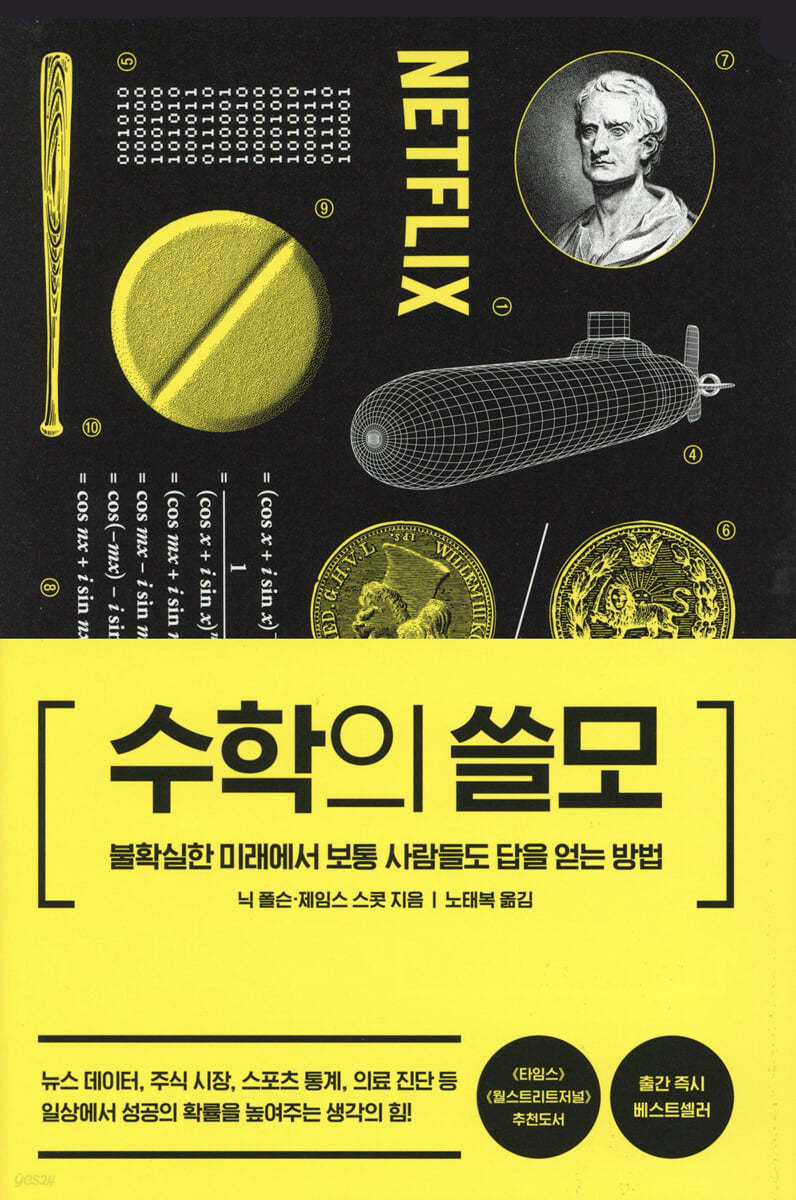
The Usefulness of Mathematics
 |
Description
Book Introduction
- A word from MD
-
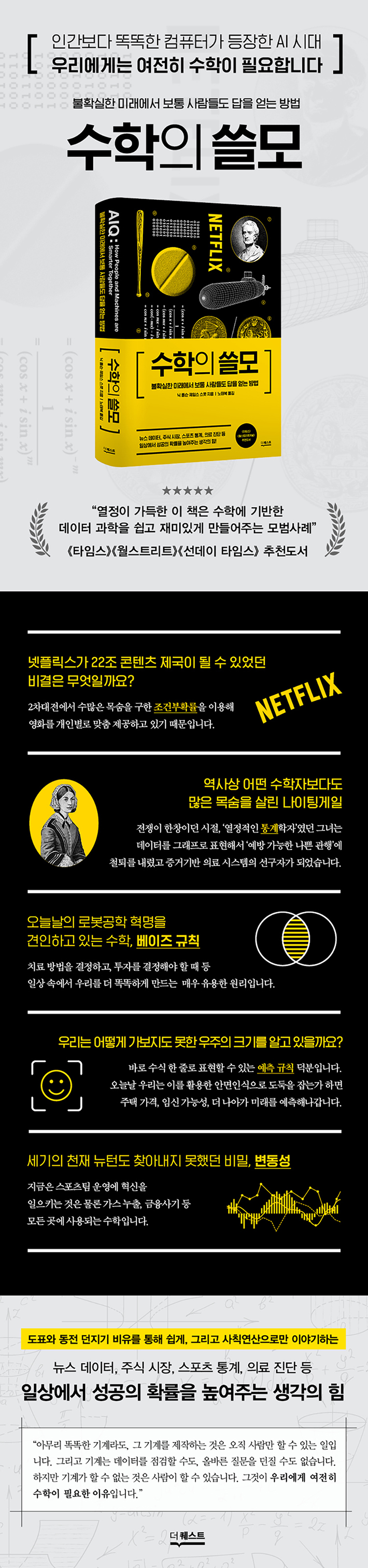
The Power of Math to Increase Your Chances of Success in Everyday LifeNetflix, a 22 trillion won content empire, has mathematics at the heart of robotics principles and economic forecasting.
This book tells us why we need mathematics by discussing mathematical problems we encounter in everyday life and telling stories of historical figures who solved problems with mathematics.
March 31, 2020. Natural Science PD Kim Tae-hee
Because the answer is always math
We still need math
When was the last time you did "calculation"? Does the mere mention of calculation make you cringe? Here are two professors who cured students of the dreaded blister virus.
Nick Paulson and James Scott, respectively, made students at the University of Chicago and the University of Texas understand the utility of mathematics, making their eyes shine and their confidence in math shine.
"The Usefulness of Mathematics" is a book that serves as a model for explaining mathematical thinking and its usefulness, in which the two professors joined forces.
First, we explain that today's amazing technologies, from Alexa, which is at the forefront of change, to image recognition algorithms, are the result of precisely leveraging probability.
It also tells the story of how fascinating historical figures like Newton, Nightingale, and Grace Hopper used mathematics to solve problems and change history.
These are fascinating stories that make us realize why we need mathematics.
Are you worried that following in the footsteps of great giants will make math seem more difficult? Don't worry.
This book has helped people who know its value but find math difficult, and even those who have given up on math, to bridge the gap between themselves and math.
Anyone can overcome their preconception that mathematics is difficult by seeing how mathematics can be used to arrive at answers not only in everyday problems but also in seemingly unrelated ones.
Above all, this book is easy enough to understand even for those who are not familiar with mathematics, as it embodies the teaching methods of the two professors who captivated students.
Formulas are expressed only as simple arithmetic operations, and how mathematics can be used is explained using coin tossing and various diagrams.
Anyone who reads this book, which can be understood even without a background in mathematical concepts, will be able to obtain more accurate answers in the future world of increasing uncertainty.
We still need math
When was the last time you did "calculation"? Does the mere mention of calculation make you cringe? Here are two professors who cured students of the dreaded blister virus.
Nick Paulson and James Scott, respectively, made students at the University of Chicago and the University of Texas understand the utility of mathematics, making their eyes shine and their confidence in math shine.
"The Usefulness of Mathematics" is a book that serves as a model for explaining mathematical thinking and its usefulness, in which the two professors joined forces.
First, we explain that today's amazing technologies, from Alexa, which is at the forefront of change, to image recognition algorithms, are the result of precisely leveraging probability.
It also tells the story of how fascinating historical figures like Newton, Nightingale, and Grace Hopper used mathematics to solve problems and change history.
These are fascinating stories that make us realize why we need mathematics.
Are you worried that following in the footsteps of great giants will make math seem more difficult? Don't worry.
This book has helped people who know its value but find math difficult, and even those who have given up on math, to bridge the gap between themselves and math.
Anyone can overcome their preconception that mathematics is difficult by seeing how mathematics can be used to arrive at answers not only in everyday problems but also in seemingly unrelated ones.
Above all, this book is easy enough to understand even for those who are not familiar with mathematics, as it embodies the teaching methods of the two professors who captivated students.
Formulas are expressed only as simple arithmetic operations, and how mathematics can be used is explained using coin tossing and various diagrams.
Anyone who reads this book, which can be understood even without a background in mathematical concepts, will be able to obtain more accurate answers in the future world of increasing uncertainty.
- You can preview some of the book's contents.
Preview
index
Entering
In the AI Era, We Still Need Math·007
I.
How Netflix Reads Your Tastes: The Language of Probability · 017
The Story of the Mathematician Who Saved the World · 024 │ The Return of the Fighter vs. the Crashed Fighter · 032 │ How to Properly Read the Language of Probability · 036 │ The Secret to Netflix's Content Empire: Conditional Probability · 042 │ The Future Depends on Probability · 050
[The Future Created by Mathematics] The Light and Shadow of Recommendation Systems · 055
II.
Calculating the Future in One Line: Patterns and Prediction Rules · 063
How Computers Classify Cucumbers: Input and Output · 67│It All Started with a Rule Discovered by a Woman · 72│Prediction Rules: Fit Equations to Data · 87│The Age of Calculating and Predicting the Future · 92
[The Future Created by Mathematics] What Deep Learning Can Give Us · Part 107
III.
Surviving the Data Deluge: Bayes' Rule 111
How do robots work? Math helps. · 116 │ Finding submarines in the vast ocean with math · 120 │ How a pastor's unpublished mathematical theory drove the robotics revolution · 132 │ How to get smarter with Bayes' rule: Medical diagnosis and selecting a fund manager · 138
[Useful Math Concepts] Bayes' Rule Solved with Equations · 154
IV.
How to Talk to Your Digital Assistant: Statistics and Algorithms·157
Computers Now Communicate with Humans Through 'Statistics' · 163 │ Grace Hopper, the Queen of Computer Coding · 167 │ From Grace Hopper to Alexa: The Natural Language Revolution · 180 │ Computer Developers Who Recognize the Value of Statistics · 187 │ Massive Data Fuels the Revolution · 191 │ How Words Become Numbers · 195
[The Future Created by Mathematics] A Future Where Machines and Humans Converse · 210
V.
Between Luck and Scandal, Detecting the "Anomaly": Volatility·213
Are there truly lucky people? · 216│What the 17th-Century British Economic Crisis Missed: Volatility · 220│The Trap Even Newton, the Century's Mathematical Genius, Couldn't Overcome · 227│Volatility Is Everywhere: Anomaly Detection in the AI Age · 238│Moneyball for the Digital Age · 251
[Useful Math Concepts] The Square Root Rule, aka the De Moivre Equation·258
Ⅵ.
How to Stay on Track in Everyday Life: The Power of a Well-Established Family · 261
Why Humans Must Be Smart Even in the Age of AI · 267│Act 1: Hasty Conclusions Are Dangerous · 269│Interlude: Why Building a Good Family Is Important · 271│Act 2: How Effective Is Your Contraception? · 275│Epilogue: The Most Dangerous and Unproductive Enthusiasm · 286
[The Future Created by Mathematics] Models Are Destined to Rust·293
Ⅶ.
Where will the next innovations take place?: Public Health and Data Science ·307
Nightingale, the Angel of Crimea · 313 │ Nightingale's First Legacy · 321 │ Nightingale's Second Legacy: The Arrow of Statistics · 322 │ The Third Legacy: The Beginning of an Evidence-Based Healthcare System · 325 │ Wisdom in the AI Age: Breaking Bad Practices · 327 │ AI Assisting Medical Professionals · 339
[The Future Created by Mathematics] To Fully Introduce Data Science into the Healthcare Sector·348
In the AI Era, We Still Need Math·007
I.
How Netflix Reads Your Tastes: The Language of Probability · 017
The Story of the Mathematician Who Saved the World · 024 │ The Return of the Fighter vs. the Crashed Fighter · 032 │ How to Properly Read the Language of Probability · 036 │ The Secret to Netflix's Content Empire: Conditional Probability · 042 │ The Future Depends on Probability · 050
[The Future Created by Mathematics] The Light and Shadow of Recommendation Systems · 055
II.
Calculating the Future in One Line: Patterns and Prediction Rules · 063
How Computers Classify Cucumbers: Input and Output · 67│It All Started with a Rule Discovered by a Woman · 72│Prediction Rules: Fit Equations to Data · 87│The Age of Calculating and Predicting the Future · 92
[The Future Created by Mathematics] What Deep Learning Can Give Us · Part 107
III.
Surviving the Data Deluge: Bayes' Rule 111
How do robots work? Math helps. · 116 │ Finding submarines in the vast ocean with math · 120 │ How a pastor's unpublished mathematical theory drove the robotics revolution · 132 │ How to get smarter with Bayes' rule: Medical diagnosis and selecting a fund manager · 138
[Useful Math Concepts] Bayes' Rule Solved with Equations · 154
IV.
How to Talk to Your Digital Assistant: Statistics and Algorithms·157
Computers Now Communicate with Humans Through 'Statistics' · 163 │ Grace Hopper, the Queen of Computer Coding · 167 │ From Grace Hopper to Alexa: The Natural Language Revolution · 180 │ Computer Developers Who Recognize the Value of Statistics · 187 │ Massive Data Fuels the Revolution · 191 │ How Words Become Numbers · 195
[The Future Created by Mathematics] A Future Where Machines and Humans Converse · 210
V.
Between Luck and Scandal, Detecting the "Anomaly": Volatility·213
Are there truly lucky people? · 216│What the 17th-Century British Economic Crisis Missed: Volatility · 220│The Trap Even Newton, the Century's Mathematical Genius, Couldn't Overcome · 227│Volatility Is Everywhere: Anomaly Detection in the AI Age · 238│Moneyball for the Digital Age · 251
[Useful Math Concepts] The Square Root Rule, aka the De Moivre Equation·258
Ⅵ.
How to Stay on Track in Everyday Life: The Power of a Well-Established Family · 261
Why Humans Must Be Smart Even in the Age of AI · 267│Act 1: Hasty Conclusions Are Dangerous · 269│Interlude: Why Building a Good Family Is Important · 271│Act 2: How Effective Is Your Contraception? · 275│Epilogue: The Most Dangerous and Unproductive Enthusiasm · 286
[The Future Created by Mathematics] Models Are Destined to Rust·293
Ⅶ.
Where will the next innovations take place?: Public Health and Data Science ·307
Nightingale, the Angel of Crimea · 313 │ Nightingale's First Legacy · 321 │ Nightingale's Second Legacy: The Arrow of Statistics · 322 │ The Third Legacy: The Beginning of an Evidence-Based Healthcare System · 325 │ Wisdom in the AI Age: Breaking Bad Practices · 327 │ AI Assisting Medical Professionals · 339
[The Future Created by Mathematics] To Fully Introduce Data Science into the Healthcare Sector·348
Detailed image
Into the book
The world's largest companies, from Amazon, Facebook, and Google in the US to Baidu, Tencent, and Alibaba in China, are all excited about AI.
Rumor has it that these tech giants are locked in a costly, global arms race to dominate AI technology.
They have also been courting recent PhD graduates for a long time with high salaries and fancy espresso machines.
They are particularly keen to attract math and coding talent.
It's because of the AI algorithm.
--- From "Entering_In the AI Era, We Still Need Mathematics"
For the past 40 years, we two authors have been teaching students who have contracted a terrible virus that makes them hate math.
But we have seen many students with sparkling eyes even in those types of situations.
This was especially true when I learned that amazing technologies, from Alexa to image recognition algorithms, are actually the result of precisely leveraging the probabilities of big data.
And I realized that if you use even a little bit of math in your decision-making, in the right situations, you can become a smarter person.
--- From "Entering_In the AI Era, We Still Need Mathematics"
The core algorithm of the future is recommendation, not search.
Recommendations are plentiful and limitless.
Also, recommendation engines are like doppelgangers: one day they might know what you want better than you do.
(Omitted) Needless to say, there is a lot of sophisticated mathematics involved in these recommendation engines.
However, readers with math phobia need not be afraid.
Because there is only one core concept you need to know.
The point is that in recommendation engines, ‘personalization’ means ‘conditional probability.’
(Omitted) If we believe that the future of digital life lies in recommendations rather than search, then that future also depends on conditional probability.
--- 「Ⅰ.
From "How Netflix Reads Your Tastes"
When viewed through the lens of Bayes' rule, finding a lost submarine and locating a car on a road are very similar problems.
But Bayes' rule is a concept that can be applied much more broadly than that.
It is a useful equation that can be applied anywhere in daily life.
Let's think about ourselves, who are faced with all kinds of new information every day.
Bayes' rule poses an important question to us:
When and how much should we change our minds based on information? Bayes' rule is a precise mathematical compass that tells us where to be skeptical and where to be open-minded.
--- 「Ⅲ..
From “Surviving the Data Flood”
After 30 years of trial and error, natural language processing experts have finally realized that a new approach is needed.
The new approach had to be flexible.
It had to be probabilistic, not deterministic.
It had to be bottom-up and based on real-world data rather than top-down and based on extensive rules.
Above all, it had to be able to address the way people actually speak, rather than the demands of grammarians.
So, in the 1980s, scientists tried something new.
After challenging the established ways and throwing out the rules, he said:
“Let’s just use the data.” That’s how we invented a new algorithm that was completely different from the previous one from the beginning.
The premise is that human linguistic knowledge is too difficult to reproduce in machines through rules.
But what if we could use the statistical data we have about how we actually speak and write?
--- 「Ⅳ.
From “How to Talk to a Digital Assistant”
This system, called specimen currency testing, was designed by the Royal Mint, which produces British currency, to prevent counterfeiting.
What makes this system interesting is that it failed.
For centuries, the anomaly went undetected, playing a subtle but significant role in triggering an economic crisis that caused widespread suffering and anger.
(syncopation)
Those who conducted the currency test believed that the tolerance given to a single coin should be ±1 gram.
But according to modern statistics, that is a huge mistake.
The acceptable range depends on how many coins are in the sample.
The larger the sample, the narrower the acceptable range.
According to the square root rule, also known as 'de Moivre's theorem', yes.
That is, the variability of a sample mean decreases as the square root of the sample size increases.
--- 「Ⅴ.
Between Luck and Scandal, Detect the 'Irregular'
The tendency of people to blindly try to find patterns has been criticized a lot.
But the phenomenon of jumping to conclusions still persists.
For example, there are times when a data set cannot answer a certain question.
At that point, you might think you need to find some data that can provide an answer.
But let's go back to the birth control pill we talked about earlier.
Data on one-year failure rates for birth control pills cannot tell us about 10-year failure rates.
If you want to know what happens in 10 years, you have to wait 10 years.
Trying to find out the answer right now is an attempt to force a confession by using questionable assumptions based on the data obtained.
Such a confession might end up causing real harm.
Because it can produce false fake news and as a result, many people may be harmed.
--- 「Ⅵ..
From “How to Not Make Mistakes in Daily Life”
In this new era, we must be more cautious about jumping to conclusions.
To do this, we must remember that all unverified assumptions are provisional, that is, approximations that we can use, for better or worse, only until more data becomes available.
--- 「Ⅵ..
From “How to Not Make Mistakes in Daily Life”
E.T. Cook, Nightingale's first biographer, nicknamed his protagonist "the passionate statistician."
This nickname may not quite align with the popular imagination, like "The Lady with the Lamp," but it does a much better job of explaining how Nightingale made the world a better place.
Nightingale was good at representing data in graphs, or in modern terms, 'data visualization'.
Thanks to this, the nation has taken notice of the unpleasant situation that is rampant in military hospitals.
According to one colleague, the graphs Nightingale created using data were effective in making visual content that was difficult for the deaf public to understand mentally.
--- 「Ⅶ.
Where will the next innovation happen?
Nightingale was keenly aware of how the new field of statistics was transforming other fields such as astronomy and earth science.
He also discovered that European statisticians, including one of his idols, the renowned Belgian statistician Adolphe Quetelet, were using the new tool to address complex social science questions about crime and population change.
Nightingale recognized that applying these statistical techniques to medicine would have enormous potential.
Rumor has it that these tech giants are locked in a costly, global arms race to dominate AI technology.
They have also been courting recent PhD graduates for a long time with high salaries and fancy espresso machines.
They are particularly keen to attract math and coding talent.
It's because of the AI algorithm.
--- From "Entering_In the AI Era, We Still Need Mathematics"
For the past 40 years, we two authors have been teaching students who have contracted a terrible virus that makes them hate math.
But we have seen many students with sparkling eyes even in those types of situations.
This was especially true when I learned that amazing technologies, from Alexa to image recognition algorithms, are actually the result of precisely leveraging the probabilities of big data.
And I realized that if you use even a little bit of math in your decision-making, in the right situations, you can become a smarter person.
--- From "Entering_In the AI Era, We Still Need Mathematics"
The core algorithm of the future is recommendation, not search.
Recommendations are plentiful and limitless.
Also, recommendation engines are like doppelgangers: one day they might know what you want better than you do.
(Omitted) Needless to say, there is a lot of sophisticated mathematics involved in these recommendation engines.
However, readers with math phobia need not be afraid.
Because there is only one core concept you need to know.
The point is that in recommendation engines, ‘personalization’ means ‘conditional probability.’
(Omitted) If we believe that the future of digital life lies in recommendations rather than search, then that future also depends on conditional probability.
--- 「Ⅰ.
From "How Netflix Reads Your Tastes"
When viewed through the lens of Bayes' rule, finding a lost submarine and locating a car on a road are very similar problems.
But Bayes' rule is a concept that can be applied much more broadly than that.
It is a useful equation that can be applied anywhere in daily life.
Let's think about ourselves, who are faced with all kinds of new information every day.
Bayes' rule poses an important question to us:
When and how much should we change our minds based on information? Bayes' rule is a precise mathematical compass that tells us where to be skeptical and where to be open-minded.
--- 「Ⅲ..
From “Surviving the Data Flood”
After 30 years of trial and error, natural language processing experts have finally realized that a new approach is needed.
The new approach had to be flexible.
It had to be probabilistic, not deterministic.
It had to be bottom-up and based on real-world data rather than top-down and based on extensive rules.
Above all, it had to be able to address the way people actually speak, rather than the demands of grammarians.
So, in the 1980s, scientists tried something new.
After challenging the established ways and throwing out the rules, he said:
“Let’s just use the data.” That’s how we invented a new algorithm that was completely different from the previous one from the beginning.
The premise is that human linguistic knowledge is too difficult to reproduce in machines through rules.
But what if we could use the statistical data we have about how we actually speak and write?
--- 「Ⅳ.
From “How to Talk to a Digital Assistant”
This system, called specimen currency testing, was designed by the Royal Mint, which produces British currency, to prevent counterfeiting.
What makes this system interesting is that it failed.
For centuries, the anomaly went undetected, playing a subtle but significant role in triggering an economic crisis that caused widespread suffering and anger.
(syncopation)
Those who conducted the currency test believed that the tolerance given to a single coin should be ±1 gram.
But according to modern statistics, that is a huge mistake.
The acceptable range depends on how many coins are in the sample.
The larger the sample, the narrower the acceptable range.
According to the square root rule, also known as 'de Moivre's theorem', yes.
That is, the variability of a sample mean decreases as the square root of the sample size increases.
--- 「Ⅴ.
Between Luck and Scandal, Detect the 'Irregular'
The tendency of people to blindly try to find patterns has been criticized a lot.
But the phenomenon of jumping to conclusions still persists.
For example, there are times when a data set cannot answer a certain question.
At that point, you might think you need to find some data that can provide an answer.
But let's go back to the birth control pill we talked about earlier.
Data on one-year failure rates for birth control pills cannot tell us about 10-year failure rates.
If you want to know what happens in 10 years, you have to wait 10 years.
Trying to find out the answer right now is an attempt to force a confession by using questionable assumptions based on the data obtained.
Such a confession might end up causing real harm.
Because it can produce false fake news and as a result, many people may be harmed.
--- 「Ⅵ..
From “How to Not Make Mistakes in Daily Life”
In this new era, we must be more cautious about jumping to conclusions.
To do this, we must remember that all unverified assumptions are provisional, that is, approximations that we can use, for better or worse, only until more data becomes available.
--- 「Ⅵ..
From “How to Not Make Mistakes in Daily Life”
E.T. Cook, Nightingale's first biographer, nicknamed his protagonist "the passionate statistician."
This nickname may not quite align with the popular imagination, like "The Lady with the Lamp," but it does a much better job of explaining how Nightingale made the world a better place.
Nightingale was good at representing data in graphs, or in modern terms, 'data visualization'.
Thanks to this, the nation has taken notice of the unpleasant situation that is rampant in military hospitals.
According to one colleague, the graphs Nightingale created using data were effective in making visual content that was difficult for the deaf public to understand mentally.
--- 「Ⅶ.
Where will the next innovation happen?
Nightingale was keenly aware of how the new field of statistics was transforming other fields such as astronomy and earth science.
He also discovered that European statisticians, including one of his idols, the renowned Belgian statistician Adolphe Quetelet, were using the new tool to address complex social science questions about crime and population change.
Nightingale recognized that applying these statistical techniques to medicine would have enormous potential.
--- 「Ⅶ.
Where will the next innovation take place?
Where will the next innovation take place?
Publisher's Review
"This passionate book is a model for making math-based data science accessible and fun."
_ The Sunday Times (UK)
Recommended by Britain's most influential newspapers, The Times and The Wall Street Journal
In the AI era, machines smarter than humans have emerged.
To you who asks what use is mathematics?
In 2016 and 2019, we experienced frustration as we watched the match between Lee Sedol, the so-called genius Go player, and AI.
And countless people say:
Soon, machines will take the place of humans.
It's no longer surprising that research shows that humans, who are inherently biased and have limited computational abilities, make poor decisions overall.
Meanwhile, intelligent systems, including calculators and smartphones, are rapidly becoming smarter.
So, does that mean humans are becoming useless?
《The Usefulness of Mathematics》refutes such opinions as follows:
Machines can make predictions based on the assumptions they are programmed with, but they cannot check those assumptions.
You can also work with a model, but you can't use that model to ask the right questions.
And while it can process millions of data points per second, it can't determine which data points are even worth using in the first place.
But what machines can't do, people can do. _Ⅵ..
How to avoid mistakes in everyday life
Steven Levitt, a senior advisor at the MIT Media Lab and co-author of Freakonomics, called the book “the first book to finally do this properly and captivatingly.”
If anyone is afraid that AI will take their job, I highly recommend reading this book.
You'll find answers to your questions as you read about how the designers at Netflix, the driving force behind the digital economy, the engineers driving the robotics revolution, and those who have successfully communicated with computers have solved these problems.
The answer is mathematics, the most powerful weapon that only humans can use!
Raise your economic acumen, survive the flood of data, and predict the future.
Math stories that are useful to everyone!
This book deals with everyday problems that everyone encounters at least once in their lives.
Because mathematics is not only useful for smart people to solve great problems, but also for ordinary people to solve ordinary problems.
Among them, one man's story is impressive.
The man, who had undergone more than 124 thorough examinations over 20 years and was slowly dying, did not have an incurable disease.
He was even a man who had overcome a stroke.
The reason was as follows.
Because no one around him looked at the graph of his height over time.
If you just looked at the graph and connected the dots, you could have easily identified the symptoms and prescribed a treatment.
Your kidney function is rapidly declining, and if you continue like this, you will eventually suffer great pain and pay a high price.
_Ⅶ.
Where will the next innovation happen?
In addition, the New York Times article on contraception that shocked obstetricians and gynecologists in 2014 explains the power of a "well-built family" and the usefulness of the "Bayes Rule" for those concerned about retirement funds.
If you want to understand the world and lead the way in creating the future, mathematics is a necessary way of thinking.
The answer is beckoning us everywhere, even if we don't notice it.
The only way to cut through all the noise and follow those gestures accurately is through mathematics.
If you follow this book exactly as it suggests, you'll be able to manage your money more reliably than anyone else, avoid being fooled by fake news, make accurate medical diagnoses, and become smarter.
Above all, it can read and predict the rapidly changing future.
Because mathematics is the core principle that creates the future.
It would be impossible to imagine what would happen today without mathematics.
Mathematics, the core principle that moves the present and creates the future!
Still, some people may ask whether the mathematical part can be left to the computer.
Of course, computers will be better at the computational part.
But as Chapter 4 of this book, “How to Talk to Digital Assistants,” shows, even computers that are good at calculating wouldn’t have become as smart as they are today, understanding human speech and recognizing faces, if humans hadn’t properly recognized the value of statistics.
What about Netflix, a content empire worth $22 trillion?
Chapter 1, “How Netflix Reads Your Tastes,” states that the core of its recommendation engine is also conditional probability.
This conditional probability saved countless lives during World War II, and today's big companies use the same mathematics to personalize movies, music, news, and cancer drugs.
The core principle driving the robotics revolution is also a mathematical principle called 'Bayes' rule', and banks use the 'square root rule' to detect credit card fraud, and the most invested in modern sports regardless of the field is anomaly detection.
Given these points, it is impossible to imagine a world without mathematics, neither in the past nor in the future.
All the benefits we enjoy today are thanks to mathematics.
Specifically, it is because humans have been good at using mathematics.
So, those who try to understand society always face an insurmountable wall called mathematics.
Don't be frustrated every time, but try to understand math.
You too can understand the rapidly changing world and become a leading force in driving change at the forefront.
So that even people who are not familiar with mathematics can understand,
The power of mathematical thinking, expressed only through arithmetic operations and analogies.
I recommend this book to those who have known the usefulness of mathematics but have not been able to use it properly, and to those who want to use mathematics properly at least once.
This book contains easy-to-read and understand mathematical usage methods for people who feel a headache just hearing the word “calculation” or who are afraid of making mistakes just by looking at equations.
It's not because the arithmetic operations in the book are easy.
In Chapter 5, “Detecting the Anomaly Between Luck and Scandal,” he explains whether the New Patriots football team really has a goddess of victory, and in Chapter 6, “How to Not Be Wrong in Everyday Life,” he uses the analogy of flipping a coin, which even an elementary school student can easily understand, to calculate the probability of legendary baseball hitter Joe DiMaggio’s legendary hitting streak happening again.
Chapter 3, "Surviving the Data Flood," provides a visual diagram showing how to determine whether a woman's mammogram results are true or false.
You've probably never actually picked up a piece of paper and pencil and solved a Bayes' rule problem.
Still, there is no problem.
If you learn to view the world from the perspective of self-driving cars, combining prior probabilities, data, and the two according to Bayes' rule, you can become much wiser.
_Ⅲ..
Surviving the Data Deluge
Not everyone needs to know the exact mathematical concepts.
Mathematics is now a matter of liberal arts.
As the authors say, the ability to view and think about problems from a mathematical perspective will be increasingly in demand in the future.
In that sense, I hope that those who have ever given up on math will trust this book with the thought that it is their last chance.
_ The Sunday Times (UK)
Recommended by Britain's most influential newspapers, The Times and The Wall Street Journal
In the AI era, machines smarter than humans have emerged.
To you who asks what use is mathematics?
In 2016 and 2019, we experienced frustration as we watched the match between Lee Sedol, the so-called genius Go player, and AI.
And countless people say:
Soon, machines will take the place of humans.
It's no longer surprising that research shows that humans, who are inherently biased and have limited computational abilities, make poor decisions overall.
Meanwhile, intelligent systems, including calculators and smartphones, are rapidly becoming smarter.
So, does that mean humans are becoming useless?
《The Usefulness of Mathematics》refutes such opinions as follows:
Machines can make predictions based on the assumptions they are programmed with, but they cannot check those assumptions.
You can also work with a model, but you can't use that model to ask the right questions.
And while it can process millions of data points per second, it can't determine which data points are even worth using in the first place.
But what machines can't do, people can do. _Ⅵ..
How to avoid mistakes in everyday life
Steven Levitt, a senior advisor at the MIT Media Lab and co-author of Freakonomics, called the book “the first book to finally do this properly and captivatingly.”
If anyone is afraid that AI will take their job, I highly recommend reading this book.
You'll find answers to your questions as you read about how the designers at Netflix, the driving force behind the digital economy, the engineers driving the robotics revolution, and those who have successfully communicated with computers have solved these problems.
The answer is mathematics, the most powerful weapon that only humans can use!
Raise your economic acumen, survive the flood of data, and predict the future.
Math stories that are useful to everyone!
This book deals with everyday problems that everyone encounters at least once in their lives.
Because mathematics is not only useful for smart people to solve great problems, but also for ordinary people to solve ordinary problems.
Among them, one man's story is impressive.
The man, who had undergone more than 124 thorough examinations over 20 years and was slowly dying, did not have an incurable disease.
He was even a man who had overcome a stroke.
The reason was as follows.
Because no one around him looked at the graph of his height over time.
If you just looked at the graph and connected the dots, you could have easily identified the symptoms and prescribed a treatment.
Your kidney function is rapidly declining, and if you continue like this, you will eventually suffer great pain and pay a high price.
_Ⅶ.
Where will the next innovation happen?
In addition, the New York Times article on contraception that shocked obstetricians and gynecologists in 2014 explains the power of a "well-built family" and the usefulness of the "Bayes Rule" for those concerned about retirement funds.
If you want to understand the world and lead the way in creating the future, mathematics is a necessary way of thinking.
The answer is beckoning us everywhere, even if we don't notice it.
The only way to cut through all the noise and follow those gestures accurately is through mathematics.
If you follow this book exactly as it suggests, you'll be able to manage your money more reliably than anyone else, avoid being fooled by fake news, make accurate medical diagnoses, and become smarter.
Above all, it can read and predict the rapidly changing future.
Because mathematics is the core principle that creates the future.
It would be impossible to imagine what would happen today without mathematics.
Mathematics, the core principle that moves the present and creates the future!
Still, some people may ask whether the mathematical part can be left to the computer.
Of course, computers will be better at the computational part.
But as Chapter 4 of this book, “How to Talk to Digital Assistants,” shows, even computers that are good at calculating wouldn’t have become as smart as they are today, understanding human speech and recognizing faces, if humans hadn’t properly recognized the value of statistics.
What about Netflix, a content empire worth $22 trillion?
Chapter 1, “How Netflix Reads Your Tastes,” states that the core of its recommendation engine is also conditional probability.
This conditional probability saved countless lives during World War II, and today's big companies use the same mathematics to personalize movies, music, news, and cancer drugs.
The core principle driving the robotics revolution is also a mathematical principle called 'Bayes' rule', and banks use the 'square root rule' to detect credit card fraud, and the most invested in modern sports regardless of the field is anomaly detection.
Given these points, it is impossible to imagine a world without mathematics, neither in the past nor in the future.
All the benefits we enjoy today are thanks to mathematics.
Specifically, it is because humans have been good at using mathematics.
So, those who try to understand society always face an insurmountable wall called mathematics.
Don't be frustrated every time, but try to understand math.
You too can understand the rapidly changing world and become a leading force in driving change at the forefront.
So that even people who are not familiar with mathematics can understand,
The power of mathematical thinking, expressed only through arithmetic operations and analogies.
I recommend this book to those who have known the usefulness of mathematics but have not been able to use it properly, and to those who want to use mathematics properly at least once.
This book contains easy-to-read and understand mathematical usage methods for people who feel a headache just hearing the word “calculation” or who are afraid of making mistakes just by looking at equations.
It's not because the arithmetic operations in the book are easy.
In Chapter 5, “Detecting the Anomaly Between Luck and Scandal,” he explains whether the New Patriots football team really has a goddess of victory, and in Chapter 6, “How to Not Be Wrong in Everyday Life,” he uses the analogy of flipping a coin, which even an elementary school student can easily understand, to calculate the probability of legendary baseball hitter Joe DiMaggio’s legendary hitting streak happening again.
Chapter 3, "Surviving the Data Flood," provides a visual diagram showing how to determine whether a woman's mammogram results are true or false.
You've probably never actually picked up a piece of paper and pencil and solved a Bayes' rule problem.
Still, there is no problem.
If you learn to view the world from the perspective of self-driving cars, combining prior probabilities, data, and the two according to Bayes' rule, you can become much wiser.
_Ⅲ..
Surviving the Data Deluge
Not everyone needs to know the exact mathematical concepts.
Mathematics is now a matter of liberal arts.
As the authors say, the ability to view and think about problems from a mathematical perspective will be increasingly in demand in the future.
In that sense, I hope that those who have ever given up on math will trust this book with the thought that it is their last chance.
GOODS SPECIFICS
- Date of issue: April 2, 2020
- Format: Hardcover book binding method guide
- Page count, weight, size: 384 pages | 718g | 164*230*30mm
- ISBN13: 9791165210991
- ISBN10: 1165210991
You may also like
카테고리
korean


korean

![ELLE 엘르 스페셜 에디션 A형 : 12월 [2025]](http://librairie.coreenne.fr/cdn/shop/files/b8e27a3de6c9538896439686c6b0e8fb.jpg?v=1766436872&width=3840)


