

Blue Sky Red Earth
 |
Description
Book Introduction
In the scientist's seat Thinking about the future of humanity The author of this book, Cho Cheon-ho, is the first director of the National Institute of Meteorological Sciences. In this book's "Excerpt: What Should National Science and Technology Research and Development Be Like?", he reveals the various struggles and regrets he experienced as a scientist and public official, and proposes the path that our country's national research organizations should take. The article became a hot topic on social media and garnered sympathy from scientific researchers. This book will be helpful to many people as it explains various issues related to climate change in an easy-to-understand way by an atmospheric scientist. Another aspect that is noteworthy is the message this book conveys. Climate change has already changed many things, and the resulting damage is being felt primarily by the poor and powerless. South Korea, which lives in temperate zones, may not feel much change yet, but people living in low-latitude regions are already suffering greatly from climate change. It is an appeal to scientifically explain what is happening now and to think about the meaning and ramifications of what is happening. We clearly contributed to what happened and will be held accountable at some point. The message this book conveys is clear. We need to understand how the way we live and the social systems we have developed will affect the future, and we need to think about what we can do to create a better world. We must clearly understand what conditions made humankind and civilization possible and how we can maintain them. Because our future climate will be shaped by our actions. As this book says, the future is not something that is 'given' but something that is 'achieved'. |
- You can preview some of the book's contents.
Preview
index
Recommendation
Preface_ Dreaming of a Blue Sky on a Red Earth
Chapter 1: Climate, From the Birth of Life to the Anthropocene
A climate suitable for humans appeared by chance.
The past may not be a guide to the future.
Human civilization depends on a stable climate.
Values that were successful in the past will lead to future ruin.
Opening a new world in adversity
The Earth crisis is a human crisis.
Chapter 2: Change: The Only Constant in the Future: Climate Change
The climate must persist and the weather must change.
Very small greenhouse gases affect the entire planet.
If a record is broken once, it's a coincidence, but if it's broken every time, it's a change.
Extreme weather is now normal
Oceans heated by greenhouse gases cause powerful typhoons.
The sky in my country is so beautiful
What happens in the Arctic doesn't stay in the Arctic.
The future is not something that is "given," but something that is "achieved."
Chapter 3: Crisis and catastrophe come in an instant.
You can run off a cliff if you have a guardrail.
The Earth can heat itself
Time is not on our side
If you don't have enough water, you'll get hungry.
Democracy prevents global crises
As glaciers shrink, so do habitats.
Chapter 4 Dust, the Dust That Should Be, the Dust That's a Problem
A long, long history of dust
Tiny specks of dust save the ecosystem.
Dust also causes climate change
Climate change caused by volcanic eruptions
The dangers and conflicts hidden in the seemingly insignificant dust
Eliminating fine dust with artificial rain is a modern-day rainmaking ritual.
Chapter 5: Responding to Climate Change: Surviving in the Era
Who Denies Science
Climate change is the biggest market failure
It's just that free riders pay more than forced riders.
Climate change response is national security
Climate change arises from excess, not scarcity.
The heat wave will reveal our true colors.
Can geoengineering stop climate change?
Chapter 6: Prediction, because we must prepare even for the unknown future.
Knowing past climates is essential for adapting to future climates.
The science of building rationality through countless failures
Ensemble forecasting, reminiscent of collective intelligence, overcomes uncertainty.
Just because you don't know everything doesn't mean you don't know anything. 262
We have weather forecasts, so why not earthquake forecasts?
What should be the research and development of national science and technology?
References
Preface_ Dreaming of a Blue Sky on a Red Earth
Chapter 1: Climate, From the Birth of Life to the Anthropocene
A climate suitable for humans appeared by chance.
The past may not be a guide to the future.
Human civilization depends on a stable climate.
Values that were successful in the past will lead to future ruin.
Opening a new world in adversity
The Earth crisis is a human crisis.
Chapter 2: Change: The Only Constant in the Future: Climate Change
The climate must persist and the weather must change.
Very small greenhouse gases affect the entire planet.
If a record is broken once, it's a coincidence, but if it's broken every time, it's a change.
Extreme weather is now normal
Oceans heated by greenhouse gases cause powerful typhoons.
The sky in my country is so beautiful
What happens in the Arctic doesn't stay in the Arctic.
The future is not something that is "given," but something that is "achieved."
Chapter 3: Crisis and catastrophe come in an instant.
You can run off a cliff if you have a guardrail.
The Earth can heat itself
Time is not on our side
If you don't have enough water, you'll get hungry.
Democracy prevents global crises
As glaciers shrink, so do habitats.
Chapter 4 Dust, the Dust That Should Be, the Dust That's a Problem
A long, long history of dust
Tiny specks of dust save the ecosystem.
Dust also causes climate change
Climate change caused by volcanic eruptions
The dangers and conflicts hidden in the seemingly insignificant dust
Eliminating fine dust with artificial rain is a modern-day rainmaking ritual.
Chapter 5: Responding to Climate Change: Surviving in the Era
Who Denies Science
Climate change is the biggest market failure
It's just that free riders pay more than forced riders.
Climate change response is national security
Climate change arises from excess, not scarcity.
The heat wave will reveal our true colors.
Can geoengineering stop climate change?
Chapter 6: Prediction, because we must prepare even for the unknown future.
Knowing past climates is essential for adapting to future climates.
The science of building rationality through countless failures
Ensemble forecasting, reminiscent of collective intelligence, overcomes uncertainty.
Just because you don't know everything doesn't mean you don't know anything. 262
We have weather forecasts, so why not earthquake forecasts?
What should be the research and development of national science and technology?
References
Detailed image
Into the book
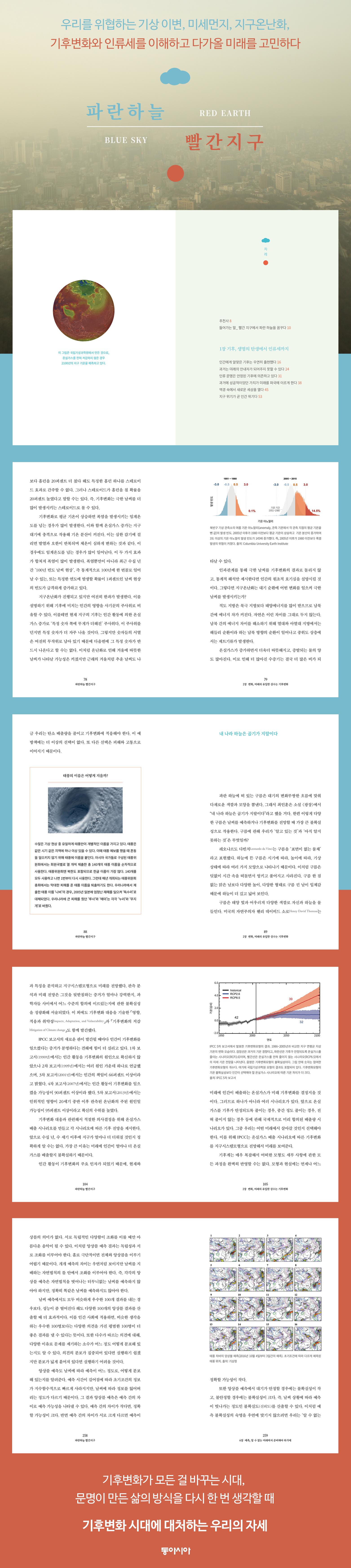
We are guilty of the arrogance of thinking that human civilization is an inevitable result of human intelligence, but if we look at Earth's history, this too was merely a fortuitous event that occurred thanks to favorable climatic conditions.
Since the Industrial Revolution, mankind has achieved today's prosperity by burning fossil fuels that had been buried underground for hundreds of millions of years.
But this prosperity threatens to disrupt the stable climate that has supported civilization for the past 7,000 years.
Now, humanity has gone beyond adapting to natural climate changes and has become the agent causing climate change.
--- p.37
Climate is the world we know, weather is the world we experience.
That is, the climate we know becomes reality as weather that changes every day.
Climate tells us what clothes we will buy in the future, and the weather tells us what clothes we will wear now.
Climate and weather are distinguished by time scales.
Climate is a long-term state of equilibrium, while weather is a short-term deviation from that equilibrium.
The weather is a state where temperature, humidity, precipitation, cloudiness, wind, etc. change constantly under high and low pressure conditions.
Climate, on the other hand, is the average state of the weather over a long period of time (typically 30 years).
Climate also includes not only average conditions but also the highest and lowest temperatures over a given period, the accumulated rainfall over a month or year, and the frequency of extreme weather events.
--- p.60
Since the Industrial Revolution, atmospheric carbon dioxide concentrations have increased by 46 percent, methane by 157 percent, and nitrous oxide by about 22 percent.
Carbon dioxide concentrations prior to 1958 can be measured by analyzing air bubbles trapped in polar ice cores.
The concentration in 1850 was 285 parts per million air molecules, or 285 parts per million, which is the highest concentration within the natural range that can vary during Earth's cycles of ice and interglacial periods.
Then, in 1958, when the first measurement was made at Mauna Loa, the carbon dioxide concentration was 315 ppm.
Today it has reached 405 ppm and is rising by 2 ppm each year.
Carbon dioxide concentrations are currently higher than at any time in the past 800,000 years, and are rising at a much faster rate.
To find current carbon dioxide concentrations in the past, we have to go back 3 to 5 million years.
At that time, the temperature was 1 to 2 degrees warmer than now, and the sea level was 10 to 20 meters higher than now.
Humanity has no experience surviving under these conditions.
--- p.162
With each new edition of the IPCC report, the view that the evidence is clear that humans are causing climate change grows stronger.
The first report (1990) did not confirm human activity as the cause of climate change, but the second report (1995) mentioned it as one of several causes, and the third report (2001) stated that humans are responsible for more than 66 percent.
The Fourth Assessment Report (2007) stated that there was a greater than 90 percent chance that human activities had caused climate change.
The Fifth Assessment Report (2013) raised the level of confidence to more than 95 percent that anthropogenic influences are the primary cause of observed warming since the mid-20th century.
--- p.104
Meanwhile, nitrogen in the air is very stable and does not react easily with oxygen.
However, when gasoline is mixed with air and explodes inside a car engine, nitrogen and oxygen react with each other to produce nitrogen oxides.
In cities, nitrogen dioxide, a type of nitrogen oxide emitted by cars overnight, reaches its highest concentration in the early morning and begins to decline rapidly as the sun rises.
This is because when exposed to sunlight, another chemical reaction occurs, destroying nitrogen dioxide and creating ozone in its place.
Ozone concentrations are highest between 2 and 3 p.m. when the sunlight is strongest.
This kind of thing used to happen all the time in Los Angeles, which was overflowing with cars in the past, so it was called 'Los Angeles smog'.
Additionally, nitrogen oxides react with ozone and other substances to produce nitric acid, an acidic substance, which reacts with ammonia, an alkaline substance in the atmosphere, to produce ammonium nitrate, a secondary pollutant.
--- p.175
From this perspective, Yale University Professor Nordhausen, winner of the 2018 Nobel Prize in Economics, attempted to find the optimal path by comparing the costs and benefits of reducing greenhouse gas emissions.
Nordhouse offers a 3 percent discount, meaning it will cover the costs associated with a 3 to 3.5 degree Celsius rise in temperature.
How could a discount rate of 3 percent be calculated? Even if climate disruption were to cause hunger and displacement for hundreds of millions of people in poor countries, GDP would only fall by a small amount.
Because poor people are not given much value in the global economy.
Since people are like this, it is impossible for the ecosystem to be evaluated as having high value.
The extinction of a species is so devastating to the web of life that it cannot be measured in monetary terms, but its associated economic value is also underestimated.
Moreover, Nordhaus calculated that the damage to the most vulnerable sectors to climate change, such as agriculture, forestry, and fisheries, only accounts for about 4 percent of the world's total GDP.
If this argument is true, we must believe that the world economy can continue to grow even if the world's food supply collapses.
It also did not consider tipping points in climate change that arise from positive feedbacks, such as glaciers breaking up and releasing methane.
Once the Earth passes the tipping point, there will be no planet fit for humans, no matter the cost.
Since the Industrial Revolution, mankind has achieved today's prosperity by burning fossil fuels that had been buried underground for hundreds of millions of years.
But this prosperity threatens to disrupt the stable climate that has supported civilization for the past 7,000 years.
Now, humanity has gone beyond adapting to natural climate changes and has become the agent causing climate change.
--- p.37
Climate is the world we know, weather is the world we experience.
That is, the climate we know becomes reality as weather that changes every day.
Climate tells us what clothes we will buy in the future, and the weather tells us what clothes we will wear now.
Climate and weather are distinguished by time scales.
Climate is a long-term state of equilibrium, while weather is a short-term deviation from that equilibrium.
The weather is a state where temperature, humidity, precipitation, cloudiness, wind, etc. change constantly under high and low pressure conditions.
Climate, on the other hand, is the average state of the weather over a long period of time (typically 30 years).
Climate also includes not only average conditions but also the highest and lowest temperatures over a given period, the accumulated rainfall over a month or year, and the frequency of extreme weather events.
--- p.60
Since the Industrial Revolution, atmospheric carbon dioxide concentrations have increased by 46 percent, methane by 157 percent, and nitrous oxide by about 22 percent.
Carbon dioxide concentrations prior to 1958 can be measured by analyzing air bubbles trapped in polar ice cores.
The concentration in 1850 was 285 parts per million air molecules, or 285 parts per million, which is the highest concentration within the natural range that can vary during Earth's cycles of ice and interglacial periods.
Then, in 1958, when the first measurement was made at Mauna Loa, the carbon dioxide concentration was 315 ppm.
Today it has reached 405 ppm and is rising by 2 ppm each year.
Carbon dioxide concentrations are currently higher than at any time in the past 800,000 years, and are rising at a much faster rate.
To find current carbon dioxide concentrations in the past, we have to go back 3 to 5 million years.
At that time, the temperature was 1 to 2 degrees warmer than now, and the sea level was 10 to 20 meters higher than now.
Humanity has no experience surviving under these conditions.
--- p.162
With each new edition of the IPCC report, the view that the evidence is clear that humans are causing climate change grows stronger.
The first report (1990) did not confirm human activity as the cause of climate change, but the second report (1995) mentioned it as one of several causes, and the third report (2001) stated that humans are responsible for more than 66 percent.
The Fourth Assessment Report (2007) stated that there was a greater than 90 percent chance that human activities had caused climate change.
The Fifth Assessment Report (2013) raised the level of confidence to more than 95 percent that anthropogenic influences are the primary cause of observed warming since the mid-20th century.
--- p.104
Meanwhile, nitrogen in the air is very stable and does not react easily with oxygen.
However, when gasoline is mixed with air and explodes inside a car engine, nitrogen and oxygen react with each other to produce nitrogen oxides.
In cities, nitrogen dioxide, a type of nitrogen oxide emitted by cars overnight, reaches its highest concentration in the early morning and begins to decline rapidly as the sun rises.
This is because when exposed to sunlight, another chemical reaction occurs, destroying nitrogen dioxide and creating ozone in its place.
Ozone concentrations are highest between 2 and 3 p.m. when the sunlight is strongest.
This kind of thing used to happen all the time in Los Angeles, which was overflowing with cars in the past, so it was called 'Los Angeles smog'.
Additionally, nitrogen oxides react with ozone and other substances to produce nitric acid, an acidic substance, which reacts with ammonia, an alkaline substance in the atmosphere, to produce ammonium nitrate, a secondary pollutant.
--- p.175
From this perspective, Yale University Professor Nordhausen, winner of the 2018 Nobel Prize in Economics, attempted to find the optimal path by comparing the costs and benefits of reducing greenhouse gas emissions.
Nordhouse offers a 3 percent discount, meaning it will cover the costs associated with a 3 to 3.5 degree Celsius rise in temperature.
How could a discount rate of 3 percent be calculated? Even if climate disruption were to cause hunger and displacement for hundreds of millions of people in poor countries, GDP would only fall by a small amount.
Because poor people are not given much value in the global economy.
Since people are like this, it is impossible for the ecosystem to be evaluated as having high value.
The extinction of a species is so devastating to the web of life that it cannot be measured in monetary terms, but its associated economic value is also underestimated.
Moreover, Nordhaus calculated that the damage to the most vulnerable sectors to climate change, such as agriculture, forestry, and fisheries, only accounts for about 4 percent of the world's total GDP.
If this argument is true, we must believe that the world economy can continue to grow even if the world's food supply collapses.
It also did not consider tipping points in climate change that arise from positive feedbacks, such as glaciers breaking up and releasing methane.
Once the Earth passes the tipping point, there will be no planet fit for humans, no matter the cost.
--- p.198
Publisher's Review
Former National Institute of Meteorological Sciences Director Cho Cheon-ho says
The dangers facing humanity
A survey of 745 experts was conducted at the 2018 Davos Forum.
Here, extreme (catastrophic) weather was ranked as the second most impactful risk facing humanity after weapons of mass destruction.
Extreme weather was the most likely to occur, while the use of weapons of mass destruction was the least likely.
We are already experiencing this situation.
Last year, an unprecedented heat wave swept across the Korean Peninsula, causing significant damage.
Fine dust is the most common climate phenomenon that threatens our health.
We all now realize that climate change threatens our health, lives, and property.
Climate change is not an event scheduled for the distant future, but a problem that is right before our eyes at this very moment.
The author of this book, Cho Cheon-ho, former director of the National Institute of Meteorological Sciences, explains the essence of the era of climate change from the perspective of the general public.
Among scientists, it is an undeniable fact that climate change is occurring, and the cause of climate change is global warming.
Human activity has caused the planet to warm, shifting it away from the climate conditions that made civilization possible and entering a state it has never experienced before.
We have entered the Anthropocene, a geological epoch triggered by human actions.
This book presents scientific data and explains how climate change occurs.
And then he asks:
What will the future hold? Will we be able to survive on a planet where climate change is the norm? What must we do to adapt to this new era?
Climate change that gave birth to civilization,
Could climate change destroy civilization?
In fact, climate change has always been happening.
We know that glacial and interglacial periods alternated.
Beginning 900,000 years ago, interglacial and glacial periods alternated every 100,000 years, with a temperature difference of about 4 to 5 degrees.
However, in the approximately 100 years since the Industrial Revolution, temperatures have risen by about 1 degree.
It took 100,000 years for the temperature to rise and fall by 4 to 5 degrees, but now it has risen by 1 degree in just 100 years.
The Intergovernmental Panel on Climate Change (IPCC) has set the goal of limiting global warming to 1.5 degrees Celsius compared to pre-industrial levels within this century.
The calculation is that if the temperature rises by more than 1.5 degrees compared to before the Industrial Revolution, what will happen after that will be uncontrollable.
The civilization we enjoy seems to have been achieved through human ability, but it is actually a product of chance that was possible under specific climatic conditions.
During the Ice Age, it was too cold for farming, so people could not settle in one place, and thus no civilization could develop.
It was only after the interglacial period, when temperatures stabilized about 12,000 years ago, and sea level fluctuations ended about 7,000 years ago, that agricultural life became possible and civilization could emerge.
The same goes for modern civilization.
As technology advances, it may seem as though humans are in control of everything, but when large-scale environmental disasters such as rising sea levels or ecosystem destruction occur, there may not be much humans can do.
Civilization is helpless in the face of extreme weather events such as hurricanes, heat waves, and torrential rains that have already swept across the North American continent.
Misconceptions and truths surrounding fine dust
There are no tricks to solving fine dust problems.
The current fine dust problem tends to be overly focused on the source of its emissions.
However, this book emphasizes that the damage caused by pollutant dust is an unavoidable side effect of industrial development, and that we cannot be free from this responsibility.
In the 19th century, Sweden had to live with the sky being covered by a 'black curtain' due to smoke blowing in from England.
In the past, Los Angeles had a phenomenon called 'Los Angeles smog' due to the exhaust fumes emitted by automobiles.
But those countries now have much cleaner air quality than we do.
How could this be possible? Because the state and society stepped in and systematically managed and worked hard.
We blame China for the fine dust problem, but it is clear as day that if China, our important trading partner, shuts down its factories, we too will suffer significant losses.
As is frequently reported in the news, the current state of thermal power generation and pollutant emissions in our country cannot be taken lightly.
It is impossible to enjoy the benefits of emitting fine dust while simultaneously avoiding the accompanying inconveniences.
This book says that it is time to think at a more fundamental level.
These days, various measures to reduce fine dust concentrations, such as artificial rain and large air purifiers, are being proposed, but in reality, these are merely stopgap measures that have not been properly scientifically verified.
But I ask whether the reason politicians keep mentioning such measures is because they are trying to ignore more fundamental solutions.
By strengthening standards for reducing fine dust, strengthening regulations and enforcement, and improving public transportation infrastructure, we can reduce the generation of fine dust itself.
However, pursuing these types of initiatives is costly, creates conflicts of interest, and creates controversy.
That is why I suspect that they are trying to divert public attention by mentioning emergency measures and such.
This book predicts that attempts to solve the fine dust problem will serve as a measure of our society's level and capabilities.
Politics, economy, diplomacy, and even security
The power of climate change, a variable in all fields
We recognize the issue of climate change as an ecological problem.
If climate change occurs and the glaciers melt, polar bears will not be able to survive.
Of course, biodiversity and the ecological environment are areas we cannot give up.
But climate change poses catastrophic challenges everywhere.
First of all, there is the economic dimension.
Carbon emissions have caused climate change, which is affecting many people around the world.
In that respect, climate change can be viewed as an 'external effect' as discussed in economics.
According to the Stern Report, published by Professor Nicholas Stern of the London School of Economics, if no action is taken to address climate change now, the cost of these externalities will amount to 5 to 20 percent of global GDP by the middle of this century.
On the other hand, it is predicted that if we take immediate action, we can prevent climate costs from reaching around 1 percent of GDP.
Economically speaking, we are currently burdening future generations with a huge amount of debt.
From a security perspective, we can also find examples of climate change having fatal consequences.
The Center for Strategic and International Studies (CSIS), which is led by former CIA officials, predicted in its 2007 report, “The Age of Consequences,” that climate change would lead to a massive increase in migration and immigration, creating new conflicts between races, religions, and food sources.
As an example, he cited the Darfur crisis, the worst ethnic cleansing in the 21st century.
In Darfur, when rainfall decreased by more than 40% due to the influence of the Indian Ocean monsoon, nomadic Arabs encroached on the farmlands of Africans.
The conflict between the two groups, which have different skin colors and religions, may appear to be a racial or religious war on the surface, but in reality it is closer to a climate war triggered by climate change.
President Obama also mentioned climate change as a cause of the Syrian war in a speech, saying that climate change could pose a serious threat to national security.
Environmental destruction and disasters that have occurred so far have had a regional character.
However, the climate change problem occurring today has a global character.
In 2010, Russia was hit by a drought, and the Russian government, fearing a shortage of wheat production, restricted exports.
Then, wheat prices soared, causing large-scale riots in North Africa and the Middle East.
Climate change is not just destroying nature; it is also creating cracks in human-made social systems.
Although the impact is still relatively small, we cannot be safe from the massive flow.
The dangers facing humanity
A survey of 745 experts was conducted at the 2018 Davos Forum.
Here, extreme (catastrophic) weather was ranked as the second most impactful risk facing humanity after weapons of mass destruction.
Extreme weather was the most likely to occur, while the use of weapons of mass destruction was the least likely.
We are already experiencing this situation.
Last year, an unprecedented heat wave swept across the Korean Peninsula, causing significant damage.
Fine dust is the most common climate phenomenon that threatens our health.
We all now realize that climate change threatens our health, lives, and property.
Climate change is not an event scheduled for the distant future, but a problem that is right before our eyes at this very moment.
The author of this book, Cho Cheon-ho, former director of the National Institute of Meteorological Sciences, explains the essence of the era of climate change from the perspective of the general public.
Among scientists, it is an undeniable fact that climate change is occurring, and the cause of climate change is global warming.
Human activity has caused the planet to warm, shifting it away from the climate conditions that made civilization possible and entering a state it has never experienced before.
We have entered the Anthropocene, a geological epoch triggered by human actions.
This book presents scientific data and explains how climate change occurs.
And then he asks:
What will the future hold? Will we be able to survive on a planet where climate change is the norm? What must we do to adapt to this new era?
Climate change that gave birth to civilization,
Could climate change destroy civilization?
In fact, climate change has always been happening.
We know that glacial and interglacial periods alternated.
Beginning 900,000 years ago, interglacial and glacial periods alternated every 100,000 years, with a temperature difference of about 4 to 5 degrees.
However, in the approximately 100 years since the Industrial Revolution, temperatures have risen by about 1 degree.
It took 100,000 years for the temperature to rise and fall by 4 to 5 degrees, but now it has risen by 1 degree in just 100 years.
The Intergovernmental Panel on Climate Change (IPCC) has set the goal of limiting global warming to 1.5 degrees Celsius compared to pre-industrial levels within this century.
The calculation is that if the temperature rises by more than 1.5 degrees compared to before the Industrial Revolution, what will happen after that will be uncontrollable.
The civilization we enjoy seems to have been achieved through human ability, but it is actually a product of chance that was possible under specific climatic conditions.
During the Ice Age, it was too cold for farming, so people could not settle in one place, and thus no civilization could develop.
It was only after the interglacial period, when temperatures stabilized about 12,000 years ago, and sea level fluctuations ended about 7,000 years ago, that agricultural life became possible and civilization could emerge.
The same goes for modern civilization.
As technology advances, it may seem as though humans are in control of everything, but when large-scale environmental disasters such as rising sea levels or ecosystem destruction occur, there may not be much humans can do.
Civilization is helpless in the face of extreme weather events such as hurricanes, heat waves, and torrential rains that have already swept across the North American continent.
Misconceptions and truths surrounding fine dust
There are no tricks to solving fine dust problems.
The current fine dust problem tends to be overly focused on the source of its emissions.
However, this book emphasizes that the damage caused by pollutant dust is an unavoidable side effect of industrial development, and that we cannot be free from this responsibility.
In the 19th century, Sweden had to live with the sky being covered by a 'black curtain' due to smoke blowing in from England.
In the past, Los Angeles had a phenomenon called 'Los Angeles smog' due to the exhaust fumes emitted by automobiles.
But those countries now have much cleaner air quality than we do.
How could this be possible? Because the state and society stepped in and systematically managed and worked hard.
We blame China for the fine dust problem, but it is clear as day that if China, our important trading partner, shuts down its factories, we too will suffer significant losses.
As is frequently reported in the news, the current state of thermal power generation and pollutant emissions in our country cannot be taken lightly.
It is impossible to enjoy the benefits of emitting fine dust while simultaneously avoiding the accompanying inconveniences.
This book says that it is time to think at a more fundamental level.
These days, various measures to reduce fine dust concentrations, such as artificial rain and large air purifiers, are being proposed, but in reality, these are merely stopgap measures that have not been properly scientifically verified.
But I ask whether the reason politicians keep mentioning such measures is because they are trying to ignore more fundamental solutions.
By strengthening standards for reducing fine dust, strengthening regulations and enforcement, and improving public transportation infrastructure, we can reduce the generation of fine dust itself.
However, pursuing these types of initiatives is costly, creates conflicts of interest, and creates controversy.
That is why I suspect that they are trying to divert public attention by mentioning emergency measures and such.
This book predicts that attempts to solve the fine dust problem will serve as a measure of our society's level and capabilities.
Politics, economy, diplomacy, and even security
The power of climate change, a variable in all fields
We recognize the issue of climate change as an ecological problem.
If climate change occurs and the glaciers melt, polar bears will not be able to survive.
Of course, biodiversity and the ecological environment are areas we cannot give up.
But climate change poses catastrophic challenges everywhere.
First of all, there is the economic dimension.
Carbon emissions have caused climate change, which is affecting many people around the world.
In that respect, climate change can be viewed as an 'external effect' as discussed in economics.
According to the Stern Report, published by Professor Nicholas Stern of the London School of Economics, if no action is taken to address climate change now, the cost of these externalities will amount to 5 to 20 percent of global GDP by the middle of this century.
On the other hand, it is predicted that if we take immediate action, we can prevent climate costs from reaching around 1 percent of GDP.
Economically speaking, we are currently burdening future generations with a huge amount of debt.
From a security perspective, we can also find examples of climate change having fatal consequences.
The Center for Strategic and International Studies (CSIS), which is led by former CIA officials, predicted in its 2007 report, “The Age of Consequences,” that climate change would lead to a massive increase in migration and immigration, creating new conflicts between races, religions, and food sources.
As an example, he cited the Darfur crisis, the worst ethnic cleansing in the 21st century.
In Darfur, when rainfall decreased by more than 40% due to the influence of the Indian Ocean monsoon, nomadic Arabs encroached on the farmlands of Africans.
The conflict between the two groups, which have different skin colors and religions, may appear to be a racial or religious war on the surface, but in reality it is closer to a climate war triggered by climate change.
President Obama also mentioned climate change as a cause of the Syrian war in a speech, saying that climate change could pose a serious threat to national security.
Environmental destruction and disasters that have occurred so far have had a regional character.
However, the climate change problem occurring today has a global character.
In 2010, Russia was hit by a drought, and the Russian government, fearing a shortage of wheat production, restricted exports.
Then, wheat prices soared, causing large-scale riots in North Africa and the Middle East.
Climate change is not just destroying nature; it is also creating cracks in human-made social systems.
Although the impact is still relatively small, we cannot be safe from the massive flow.
GOODS SPECIFICS
- Date of issue: March 29, 2019
- Page count, weight, size: 292 pages | 413g | 145*205*21mm
- ISBN13: 9788962622713
- ISBN10: 8962622718
You may also like
카테고리
korean


korean

![ELLE 엘르 스페셜 에디션 A형 : 12월 [2025]](http://librairie.coreenne.fr/cdn/shop/files/b8e27a3de6c9538896439686c6b0e8fb.jpg?v=1766436872&width=3840)


