

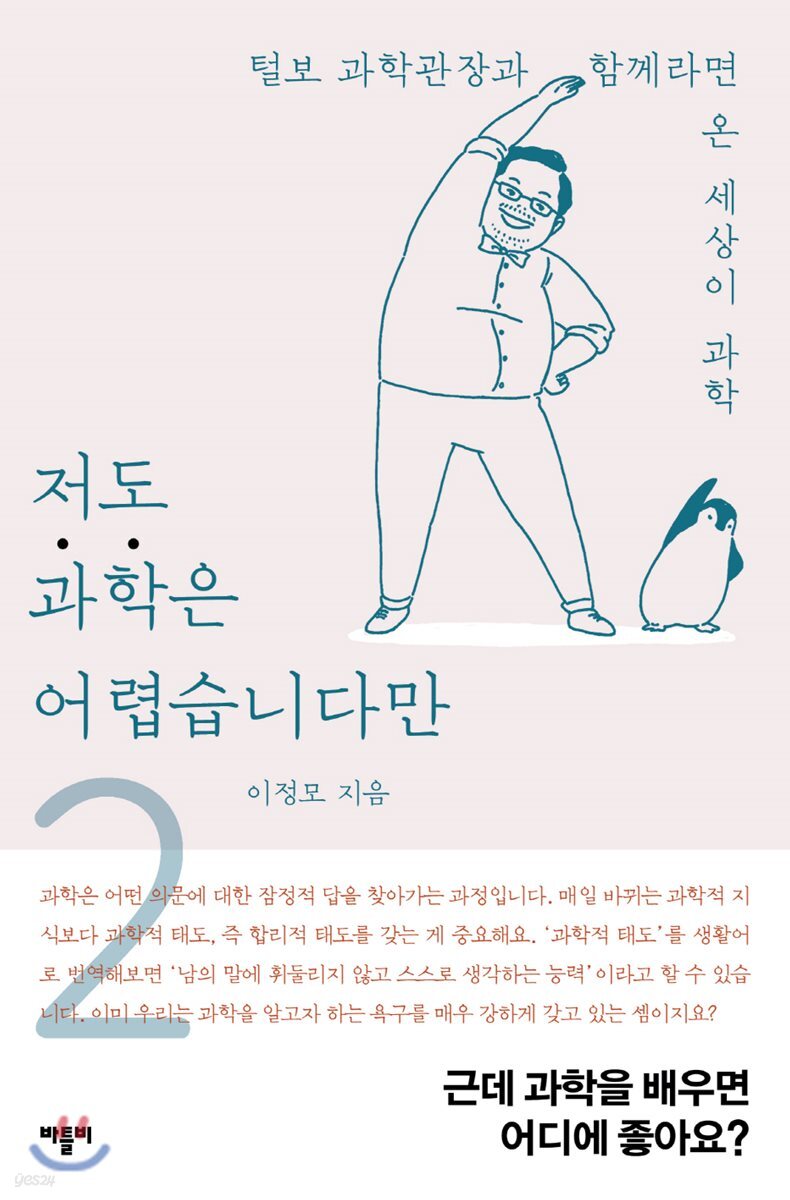
I also find science difficult 2
 |
Description
Book Introduction
‘Science’ discovered in everyday life by Lee Jeong-mo, director of the Seoul Metropolitan Science Museum.
Director Lee Jeong-mo, who created a huge buzz with his previous work, “Science is Difficult for Me Too,” has returned with a new work, “Science is Difficult for Me Too 2,” which surpasses his previous work.
By introducing scientific concepts and scientific thinking, we show that becoming familiar with science can make life a little less anxious and more free.
Part 1, "The Usefulness of Science," vividly demonstrates the usefulness of science through examples of people regaining their dreams through science and technology, and Part 2, "Love Wins," proves that science can be a weapon in life.
In 'Part 3: The Ability to Doubt', we correct misconceptions and myths, and in 'Part 4: Animal Help', we introduce animals that have become extinct or are endangered due to industrialization and urbanization, and we explore ways for humans and animals to coexist.
Part 5: A Place Worth Living Together introduces efforts to make this Earth a place worth living together.
At the end of the book, there is an 'Author Interview', which contains the author's honest and pleasant thoughts on topics that readers are curious about, such as reactions to his previous work, the daily life of a scientist, writing methods, his reading history, and the role of science museums.
Director Lee Jeong-mo, who created a huge buzz with his previous work, “Science is Difficult for Me Too,” has returned with a new work, “Science is Difficult for Me Too 2,” which surpasses his previous work.
By introducing scientific concepts and scientific thinking, we show that becoming familiar with science can make life a little less anxious and more free.
Part 1, "The Usefulness of Science," vividly demonstrates the usefulness of science through examples of people regaining their dreams through science and technology, and Part 2, "Love Wins," proves that science can be a weapon in life.
In 'Part 3: The Ability to Doubt', we correct misconceptions and myths, and in 'Part 4: Animal Help', we introduce animals that have become extinct or are endangered due to industrialization and urbanization, and we explore ways for humans and animals to coexist.
Part 5: A Place Worth Living Together introduces efforts to make this Earth a place worth living together.
At the end of the book, there is an 'Author Interview', which contains the author's honest and pleasant thoughts on topics that readers are curious about, such as reactions to his previous work, the daily life of a scientist, writing methods, his reading history, and the role of science museums.
- You can preview some of the book's contents.
Preview
index
In publishing the book
Part 1: The Usefulness of Science
Who said such nonsense?
Humility and intuition
Diego doesn't know either
When I thought I had lost everything
Math rather than apples
General and Special
I want to be a soldier
Accumulation of failures
Falling has wings
Rest well
I think I'd be happy now if I gave up math.
Best invention
Part 2: Love Wins
Neutron and Human Rights Award
He fought with humor
Love wins
There is no dominance or recessiveness.
44 years of observation
Leave your worries on land
How to survive intact
I can walk now
Being discriminated against
Lee Jang-yoon and Dongbaek
The President and the Criminal
It's not something that can be achieved through effort
Not only the name
Part 3: The ability to doubt
science phobia
Things you are grateful for cannot be obtained for free.
We just have to do well
The path is something you find by wandering with your whole body
Letter from the Future
Nuisance and Special Relativity
Master of Terror
Radon and negative ions
Spicy Tomato
Don't test our patience
Peanut rage, water glass rage
I hope another life awaits you
There is no Tokyo time in this world.
Don't kneel
Part 4: Animal Help
Penguins of the Arctic, Penguins of the Antarctic
What's with that pillow?
The bird that best adapted to the city
Plastic that saved elephants
Worse than a pirate, worse than a whaling man
The Industrial Revolution and the Sperm Whale
A tiger that doesn't even exist
Young people tracking dolphins
What is a spouse?
Panama Canal and Mosquito Net
A4 paper and chicken
migratory birds, resident birds, and passerine birds
Part 5: A Place to Live Together
Fast and flexible like bamboo
Let's go play, to another planet
Another great adventure
Overspending family
Audacious goals
Peacemaker and fine dust
Sister, just throw it away
If there's an aurora, there are aliens.
Peace World Cup and Space Probe
dishwasher
money-eating hippopotamus
Who ate all that pollack?
His back that changed my life
Interview_This is my first time with Director Lee Jeong-mo.
Part 1: The Usefulness of Science
Who said such nonsense?
Humility and intuition
Diego doesn't know either
When I thought I had lost everything
Math rather than apples
General and Special
I want to be a soldier
Accumulation of failures
Falling has wings
Rest well
I think I'd be happy now if I gave up math.
Best invention
Part 2: Love Wins
Neutron and Human Rights Award
He fought with humor
Love wins
There is no dominance or recessiveness.
44 years of observation
Leave your worries on land
How to survive intact
I can walk now
Being discriminated against
Lee Jang-yoon and Dongbaek
The President and the Criminal
It's not something that can be achieved through effort
Not only the name
Part 3: The ability to doubt
science phobia
Things you are grateful for cannot be obtained for free.
We just have to do well
The path is something you find by wandering with your whole body
Letter from the Future
Nuisance and Special Relativity
Master of Terror
Radon and negative ions
Spicy Tomato
Don't test our patience
Peanut rage, water glass rage
I hope another life awaits you
There is no Tokyo time in this world.
Don't kneel
Part 4: Animal Help
Penguins of the Arctic, Penguins of the Antarctic
What's with that pillow?
The bird that best adapted to the city
Plastic that saved elephants
Worse than a pirate, worse than a whaling man
The Industrial Revolution and the Sperm Whale
A tiger that doesn't even exist
Young people tracking dolphins
What is a spouse?
Panama Canal and Mosquito Net
A4 paper and chicken
migratory birds, resident birds, and passerine birds
Part 5: A Place to Live Together
Fast and flexible like bamboo
Let's go play, to another planet
Another great adventure
Overspending family
Audacious goals
Peacemaker and fine dust
Sister, just throw it away
If there's an aurora, there are aliens.
Peace World Cup and Space Probe
dishwasher
money-eating hippopotamus
Who ate all that pollack?
His back that changed my life
Interview_This is my first time with Director Lee Jeong-mo.
Into the book
The periodic table is the beginning and the end of chemistry.
Chemistry is a study of all the bonds and reactions that occur between the elements that form the basis of all things, but the elements do not react or combine with just anyone.
There is a certain logic to how they combine and react, and the periodic table is a graphic representation of that logic.
--- p.16
So how do you know if you have an altruistic streak? A kind and understanding personality is a barometer.
Kindness demonstrates generosity of resources, a willingness to provide resources, a good personality, and a willingness to actively participate in parenting.
--- p.66
Scientists sometimes make reckless choices.
It is deciding and executing something that others would not even think of.
The Grants, Darwinists, arrived on a small island in the Galapagos Islands in 1973.
Their wish is only one.
It is witnessing the progress of evolution.
The couple lived there for 44 years.
--- p.86
Mayfly males live for only about 15 hours.
There is not enough time for mating.
So there is no mouth.
I gave up eating.
Even these mayfly males sleep.
This means that sleep is not an option, but rather an essential element for survival.
--- p.110
There is no perfect map.
Therefore, it is impossible to find a perfect route on a map.
The path is something you find by wandering with your whole body.
--- p.133
Children who couldn't resist eating snacks had difficulty feeling confident about future rewards.
Long-term follow-up of children also found that patience had no correlation with math or reading skills.
--- p.156
When you have children role-play, you can easily see the children in the high-status roles looking angry.
This is because people with angry expressions tend to be perceived as more powerful and of higher social status.
Even adults try to control others by deliberately expressing anger.
--- p.160
In 1875, the last remaining magpie duck on Earth died on Long Island, USA.
Just a few decades after the down pillow trend began, the magpie duck, which had existed for millions of years, became extinct.
Because of that pillow.
--- p.182
As the nature of electricity was discovered, the electrical industry developed rapidly and there was a need for insulators to wrap power lines.
Shellac was used at this time.
Shellac is a viscous substance secreted by female scale insects.
The shellac that could be obtained from the resin secreted by 30,000 scale insects over six months was only 1 kilogram.
No matter how many bugs there were, it seemed they couldn't keep up with the development of the electrical industry.
--- p.189
It's strange.
When a revolution occurs, working hours become longer.
The agricultural revolution occurred 12,000 years ago.
Compared to the comfortable life of a Paleolithic hunter, who could feed his entire family for several days with a single good hunt, the life of a Neolithic farmer was difficult.
The toes that remained as remains were twisted, the knees were bent with arthritis, and the back was bent.
The same was true of the 19th century industrial revolution.
--- p.197
Mating was not a secret, but it was not something that could be done with anyone's help.
It was a lonely struggle.
There is only one species on Earth that finds a mate for others: Homo sapiens sapiens, modern humans.
All other life on Earth finds its own mates.
--- p.208
Koreans eat about 1 billion chickens a year.
They have to survive their entire lives on just one sheet of A4 paper.
All while suffering from all kinds of stress and even being attacked by ticks.
I can't get out of this book I'm reading right now for the rest of my life.
Let's eat chicken and eggs a little more expensively.
What should be locked in A4 is not chicken, but writing.
--- pp.218~219
Let's get an idea of how big the universe is.
The closest star to Earth is the Sun.
It takes about 8 minutes and 20 seconds for sunlight to reach Earth.
Considering that it only takes 1.2 seconds for moonlight to reach Earth, the sun is incredibly far away.
However, the second closest star to Earth is located 4 years and 4 months away at the speed of light.
The distance between stars is unspeakably vast.
But there are about 100 billion stars like this in our galaxy, and there are about 100 billion galaxies in the universe, each with 100 billion stars.
--- p.254
Could a tiny particle of dust be launched from Seoul City Hall Plaza and hit a 3-centimeter-diameter marble placed in New York City Hall Plaza, 10,000 kilometers away? It seems absurd.
But then something like that happened.
--- p.258
Hippopotamus poop provides nutrients to fish and insects living in rivers and lakes.
Fish again become a source of protein for birds and people.
During the dry season, the lake becomes depleted of oxygen due to hippopotamus droppings.
Fish are dying in droves.
It's okay.
Eagles and crocodiles clean it thoroughly.
And then the rainy season comes again.
This is how the ecosystem goes round and round.
--- p.268
The answer to Park Wan-seo's novel, "Who Ate All the Singa?" can only be found by reading the book, but the answer to the question, "Who Ate All the Pollock?" is obvious.
We ate.
I ate it all as a side dish, not as a stew, soup, or side dish.
--- p.272
It is not buildings that change the world, but people.
Chemistry is a study of all the bonds and reactions that occur between the elements that form the basis of all things, but the elements do not react or combine with just anyone.
There is a certain logic to how they combine and react, and the periodic table is a graphic representation of that logic.
--- p.16
So how do you know if you have an altruistic streak? A kind and understanding personality is a barometer.
Kindness demonstrates generosity of resources, a willingness to provide resources, a good personality, and a willingness to actively participate in parenting.
--- p.66
Scientists sometimes make reckless choices.
It is deciding and executing something that others would not even think of.
The Grants, Darwinists, arrived on a small island in the Galapagos Islands in 1973.
Their wish is only one.
It is witnessing the progress of evolution.
The couple lived there for 44 years.
--- p.86
Mayfly males live for only about 15 hours.
There is not enough time for mating.
So there is no mouth.
I gave up eating.
Even these mayfly males sleep.
This means that sleep is not an option, but rather an essential element for survival.
--- p.110
There is no perfect map.
Therefore, it is impossible to find a perfect route on a map.
The path is something you find by wandering with your whole body.
--- p.133
Children who couldn't resist eating snacks had difficulty feeling confident about future rewards.
Long-term follow-up of children also found that patience had no correlation with math or reading skills.
--- p.156
When you have children role-play, you can easily see the children in the high-status roles looking angry.
This is because people with angry expressions tend to be perceived as more powerful and of higher social status.
Even adults try to control others by deliberately expressing anger.
--- p.160
In 1875, the last remaining magpie duck on Earth died on Long Island, USA.
Just a few decades after the down pillow trend began, the magpie duck, which had existed for millions of years, became extinct.
Because of that pillow.
--- p.182
As the nature of electricity was discovered, the electrical industry developed rapidly and there was a need for insulators to wrap power lines.
Shellac was used at this time.
Shellac is a viscous substance secreted by female scale insects.
The shellac that could be obtained from the resin secreted by 30,000 scale insects over six months was only 1 kilogram.
No matter how many bugs there were, it seemed they couldn't keep up with the development of the electrical industry.
--- p.189
It's strange.
When a revolution occurs, working hours become longer.
The agricultural revolution occurred 12,000 years ago.
Compared to the comfortable life of a Paleolithic hunter, who could feed his entire family for several days with a single good hunt, the life of a Neolithic farmer was difficult.
The toes that remained as remains were twisted, the knees were bent with arthritis, and the back was bent.
The same was true of the 19th century industrial revolution.
--- p.197
Mating was not a secret, but it was not something that could be done with anyone's help.
It was a lonely struggle.
There is only one species on Earth that finds a mate for others: Homo sapiens sapiens, modern humans.
All other life on Earth finds its own mates.
--- p.208
Koreans eat about 1 billion chickens a year.
They have to survive their entire lives on just one sheet of A4 paper.
All while suffering from all kinds of stress and even being attacked by ticks.
I can't get out of this book I'm reading right now for the rest of my life.
Let's eat chicken and eggs a little more expensively.
What should be locked in A4 is not chicken, but writing.
--- pp.218~219
Let's get an idea of how big the universe is.
The closest star to Earth is the Sun.
It takes about 8 minutes and 20 seconds for sunlight to reach Earth.
Considering that it only takes 1.2 seconds for moonlight to reach Earth, the sun is incredibly far away.
However, the second closest star to Earth is located 4 years and 4 months away at the speed of light.
The distance between stars is unspeakably vast.
But there are about 100 billion stars like this in our galaxy, and there are about 100 billion galaxies in the universe, each with 100 billion stars.
--- p.254
Could a tiny particle of dust be launched from Seoul City Hall Plaza and hit a 3-centimeter-diameter marble placed in New York City Hall Plaza, 10,000 kilometers away? It seems absurd.
But then something like that happened.
--- p.258
Hippopotamus poop provides nutrients to fish and insects living in rivers and lakes.
Fish again become a source of protein for birds and people.
During the dry season, the lake becomes depleted of oxygen due to hippopotamus droppings.
Fish are dying in droves.
It's okay.
Eagles and crocodiles clean it thoroughly.
And then the rainy season comes again.
This is how the ecosystem goes round and round.
--- p.268
The answer to Park Wan-seo's novel, "Who Ate All the Singa?" can only be found by reading the book, but the answer to the question, "Who Ate All the Pollock?" is obvious.
We ate.
I ate it all as a side dish, not as a stew, soup, or side dish.
--- p.272
It is not buildings that change the world, but people.
--- p.277
Publisher's Review
The very science book that countless 'Moonsongs' have praised,
『Science is difficult for me too』 Director Lee Jeong-mo's new work!
The sequel to 『Science is Difficult for Me Too』, which was greatly welcomed by many 'Moonsong' including 'Gwapoja' in 2018, has been published.
If the previous work, "Science is Difficult for Me Too," used the tool of science to shatter the false myths of our society, the new work, "Science is Difficult for Me Too 2," shows that through science, our society can move towards a just and happy society, a cheerful and safe society.
For example, the author reflects on the efficiency of our society through sleep research.
All animals sleep.
The same goes for male mayflies, which live for only about 15 hours.
Even those who have lost their mouths because they are too busy courting each other to eat, still sleep.
It is said that while sleeping, waste products accumulated in the brain are washed away.
At this time, waste is not a metaphor for all the messy memories and information stored in the brain.
In reality, physical waste builds up.
It is a type of protein called 'amyloid beta'.
Amyloid beta, the substance that causes Alzheimer's disease (although this is controversial these days), accumulates in our brains every day.
-Page 110
When fatigue builds up, the brain switches itself off.
This is why disasters caused by lack of sleep continue to occur.
Devices that can prevent this have already been developed.
In Europe, this has been introduced as a mandatory measure to fundamentally prevent workers from overworking.
What is important is a system that accepts 'safety costs' as a given, not as inefficiency.
??Science is difficult for me too, but 2』 helps readers connect life and science through everyday examples.
Anyone who has ever felt lost about where and how to begin studying science can now find a clue through "Science is Difficult for Me Too 2."
As you read each page, you will find yourself looking at the world through the eyes of a scientist, and you will realize that science is a weapon in your life.
To improve our lives
Science, a weapon you must master
The author, who has been a scientist and science communicator for over 30 years, draws scientific events from familiar and ordinary daily life and gently explains their meaning.
Stories often start from small and trivial things like pillows, comic books, and A4 paper.
It arouses the reader's curiosity by asking strange and unfamiliar questions.
Materials that seem unlikely to be connected are naturally connected like a snake jumping over a wall, and the humorous landmines placed here and there tickle the reader's heart before ending with a weighty and unexpected ending.
For example, the story that started with the pure love comic 『Rose of Versailles』 progresses to ‘world peace’ (not ‘world conquest’ as dreamed of by the evil scientist).
The ILO, established by the peace treaty ending World War I, stated that world peace was only possible when social justice was realized.
The author states that the ILO Charter has been proven by animal behavior.
The researchers rewarded capuchin monkeys with cucumbers when they completed a given task.
The monkeys gratefully accepted it.
Then, the researchers gave different rewards to the two monkeys who performed the same task.
They gave one monkey a cucumber and the other a grape.
Then the monkey who received the cucumber protested strongly by throwing the cucumber away.
-Page 98
The 'marshmallow experiment', which showed that children with high patience had better grades and were more likely to succeed in school, is considered by natural scientists to be a meaningless experiment due to too many uncontrolled variables.
In fact, recent research suggests that patience has no correlation with success.
Whether or not you eat a snack right away had more to do with your family's circumstances than your patience.
Children who couldn't resist eating snacks had difficulty feeling confident about future rewards.
This is the same in our society today.
To have a cheerful society, we need confidence in future rewards.
We must not deceive citizens, especially young people.
-Page 157
If it's our fault
We just have to do well
The author highlights the dazzling achievements of science and technology, noting how scientists' curiosity, passion, and pursuit of truth are contributing to resolving everyday problems and inconveniences and creating a better world.
The author argues that if something happens because of our fault, we just need to do our best.
Although we humans have made countless mistakes, we also have the ability to reflect and the technology to restore.
We drove magpies to extinction to make down pillows, and elephants to the brink of extinction to make ivory billiard balls, but fortunately, we developed plastic just as they were on the verge of extinction.
As the plastic that saved elephants threatens marine life, efforts are underway to eliminate plastic altogether, and in thousands of transition cities and urban farms preparing for a world without oil, millions of people are generating energy from sunlight, wind, and geothermal heat and capturing carbon.
Scientists around the world are continuing their efforts to restore extinct species, including tortoises, tigers, and pollock.
Unlike the previous five mass extinctions, the cause of the sixth mass extinction that is currently underway is us humans.
How fortunate.
The problems we create we can solve.
We can't tell our children that the world will change overnight, but we can promise them that there are solutions.
We still have about 20 years left.
-Page 245
Hear from the author's interview
A scientist's daily life, writing, and reading
At the end of the book, there is an 'Author Interview', which contains the author's honest and humorous thoughts on topics that readers are curious about.
It contains a variety of stories, including an interesting anecdote about the title of his previous work, 『Science is Difficult for Me Too』, the real reason why he said science was difficult even though he was a scientist, the moment when studying science became fun, the reason why he speaks out on social issues as a scientist, why he thinks the secret to his popularity is his ‘looks’, the source of his sense of humor, tips for not being overwhelmed by deadlines, the secret to writing a column in 1 hour and 30 minutes, how to find writing material, books and comics that left an impression on him, his reading history, the reason why he volunteers to be a docent even though he is the director, the role of the science museum, future plans, and words of advice for those who want to become scientists.
?I heard that you often volunteer to guide visitors yourself or serve as a docent.
If you say, “I’m the manager here. Can I show you around?” without making an appointment in advance, many people will feel embarrassed or awkward at first.
But as they listen to the explanation, they become interested and ask a lot of questions.
I often go out of my way to find out the audience's reactions and what they are curious about.
Actually, it's not fun to just sit around and do administrative work.
I like to interact directly with the audience.
-Page 296
In this way, the author draws all aspects of daily life into science and reinterprets them from a scientific perspective, from everyday objects and phenomena like picky eating, cars, pizza, fine dust, and carbohydrates, to social issues and concerns such as the inter-Korean summit, Korean rockets, space probes, ecological resources, and euthanasia.
It helps us develop a scientific attitude by introducing solutions to the problems we face.
『Science is difficult for me too』 Director Lee Jeong-mo's new work!
The sequel to 『Science is Difficult for Me Too』, which was greatly welcomed by many 'Moonsong' including 'Gwapoja' in 2018, has been published.
If the previous work, "Science is Difficult for Me Too," used the tool of science to shatter the false myths of our society, the new work, "Science is Difficult for Me Too 2," shows that through science, our society can move towards a just and happy society, a cheerful and safe society.
For example, the author reflects on the efficiency of our society through sleep research.
All animals sleep.
The same goes for male mayflies, which live for only about 15 hours.
Even those who have lost their mouths because they are too busy courting each other to eat, still sleep.
It is said that while sleeping, waste products accumulated in the brain are washed away.
At this time, waste is not a metaphor for all the messy memories and information stored in the brain.
In reality, physical waste builds up.
It is a type of protein called 'amyloid beta'.
Amyloid beta, the substance that causes Alzheimer's disease (although this is controversial these days), accumulates in our brains every day.
-Page 110
When fatigue builds up, the brain switches itself off.
This is why disasters caused by lack of sleep continue to occur.
Devices that can prevent this have already been developed.
In Europe, this has been introduced as a mandatory measure to fundamentally prevent workers from overworking.
What is important is a system that accepts 'safety costs' as a given, not as inefficiency.
??Science is difficult for me too, but 2』 helps readers connect life and science through everyday examples.
Anyone who has ever felt lost about where and how to begin studying science can now find a clue through "Science is Difficult for Me Too 2."
As you read each page, you will find yourself looking at the world through the eyes of a scientist, and you will realize that science is a weapon in your life.
To improve our lives
Science, a weapon you must master
The author, who has been a scientist and science communicator for over 30 years, draws scientific events from familiar and ordinary daily life and gently explains their meaning.
Stories often start from small and trivial things like pillows, comic books, and A4 paper.
It arouses the reader's curiosity by asking strange and unfamiliar questions.
Materials that seem unlikely to be connected are naturally connected like a snake jumping over a wall, and the humorous landmines placed here and there tickle the reader's heart before ending with a weighty and unexpected ending.
For example, the story that started with the pure love comic 『Rose of Versailles』 progresses to ‘world peace’ (not ‘world conquest’ as dreamed of by the evil scientist).
The ILO, established by the peace treaty ending World War I, stated that world peace was only possible when social justice was realized.
The author states that the ILO Charter has been proven by animal behavior.
The researchers rewarded capuchin monkeys with cucumbers when they completed a given task.
The monkeys gratefully accepted it.
Then, the researchers gave different rewards to the two monkeys who performed the same task.
They gave one monkey a cucumber and the other a grape.
Then the monkey who received the cucumber protested strongly by throwing the cucumber away.
-Page 98
The 'marshmallow experiment', which showed that children with high patience had better grades and were more likely to succeed in school, is considered by natural scientists to be a meaningless experiment due to too many uncontrolled variables.
In fact, recent research suggests that patience has no correlation with success.
Whether or not you eat a snack right away had more to do with your family's circumstances than your patience.
Children who couldn't resist eating snacks had difficulty feeling confident about future rewards.
This is the same in our society today.
To have a cheerful society, we need confidence in future rewards.
We must not deceive citizens, especially young people.
-Page 157
If it's our fault
We just have to do well
The author highlights the dazzling achievements of science and technology, noting how scientists' curiosity, passion, and pursuit of truth are contributing to resolving everyday problems and inconveniences and creating a better world.
The author argues that if something happens because of our fault, we just need to do our best.
Although we humans have made countless mistakes, we also have the ability to reflect and the technology to restore.
We drove magpies to extinction to make down pillows, and elephants to the brink of extinction to make ivory billiard balls, but fortunately, we developed plastic just as they were on the verge of extinction.
As the plastic that saved elephants threatens marine life, efforts are underway to eliminate plastic altogether, and in thousands of transition cities and urban farms preparing for a world without oil, millions of people are generating energy from sunlight, wind, and geothermal heat and capturing carbon.
Scientists around the world are continuing their efforts to restore extinct species, including tortoises, tigers, and pollock.
Unlike the previous five mass extinctions, the cause of the sixth mass extinction that is currently underway is us humans.
How fortunate.
The problems we create we can solve.
We can't tell our children that the world will change overnight, but we can promise them that there are solutions.
We still have about 20 years left.
-Page 245
Hear from the author's interview
A scientist's daily life, writing, and reading
At the end of the book, there is an 'Author Interview', which contains the author's honest and humorous thoughts on topics that readers are curious about.
It contains a variety of stories, including an interesting anecdote about the title of his previous work, 『Science is Difficult for Me Too』, the real reason why he said science was difficult even though he was a scientist, the moment when studying science became fun, the reason why he speaks out on social issues as a scientist, why he thinks the secret to his popularity is his ‘looks’, the source of his sense of humor, tips for not being overwhelmed by deadlines, the secret to writing a column in 1 hour and 30 minutes, how to find writing material, books and comics that left an impression on him, his reading history, the reason why he volunteers to be a docent even though he is the director, the role of the science museum, future plans, and words of advice for those who want to become scientists.
?I heard that you often volunteer to guide visitors yourself or serve as a docent.
If you say, “I’m the manager here. Can I show you around?” without making an appointment in advance, many people will feel embarrassed or awkward at first.
But as they listen to the explanation, they become interested and ask a lot of questions.
I often go out of my way to find out the audience's reactions and what they are curious about.
Actually, it's not fun to just sit around and do administrative work.
I like to interact directly with the audience.
-Page 296
In this way, the author draws all aspects of daily life into science and reinterprets them from a scientific perspective, from everyday objects and phenomena like picky eating, cars, pizza, fine dust, and carbohydrates, to social issues and concerns such as the inter-Korean summit, Korean rockets, space probes, ecological resources, and euthanasia.
It helps us develop a scientific attitude by introducing solutions to the problems we face.
GOODS SPECIFICS
- Date of issue: March 15, 2019
- Page count, weight, size: 304 pages | 376g | 135*205*20mm
- ISBN13: 9791196486945
- ISBN10: 1196486948
You may also like
카테고리
korean


korean

![ELLE 엘르 스페셜 에디션 A형 : 12월 [2025]](http://librairie.coreenne.fr/cdn/shop/files/b8e27a3de6c9538896439686c6b0e8fb.jpg?v=1766436872&width=3840)


