

Evolving to live in the city
 |
Description
Book Introduction
A huge incident that takes place in the middle of the city
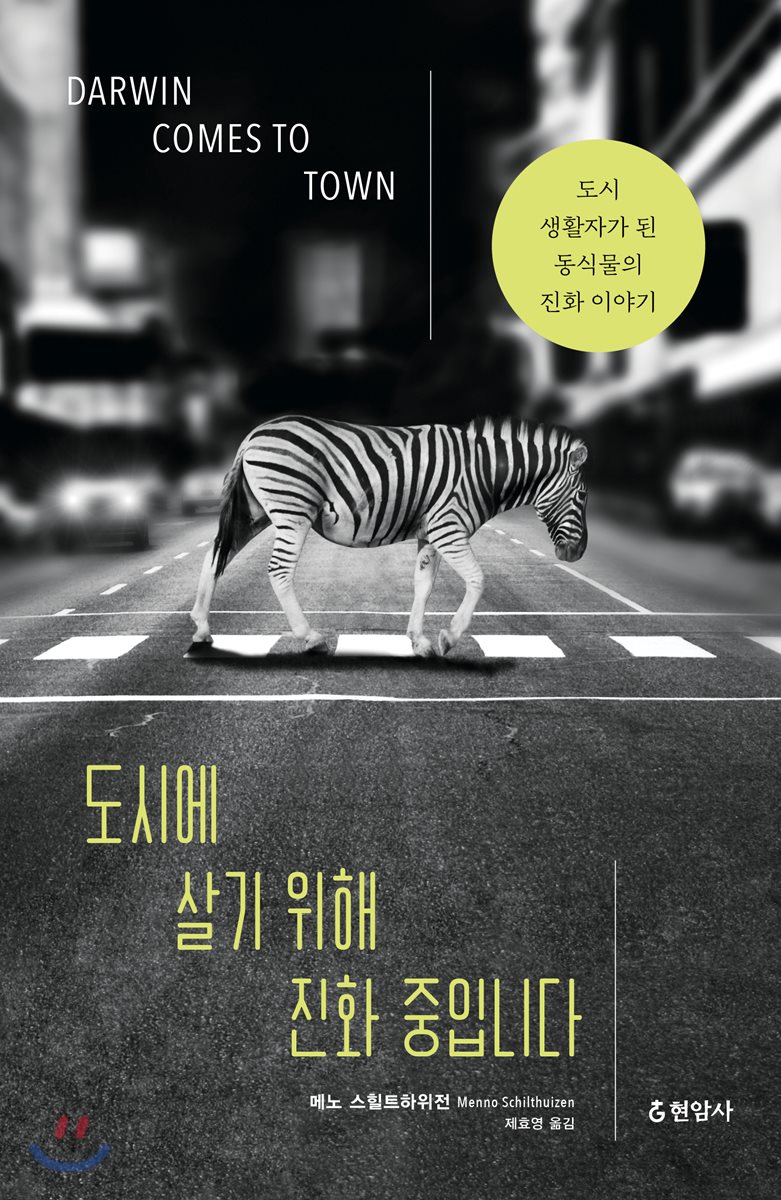
“Evolution is happening right before our eyes!”
The prevailing pessimism has been that when the era of overpopulation arrives, the remaining handful of natural environments will be completely destroyed.
But in some ways, that prediction was off the mark.
In this city, not a pristine area but teeming with humans, nature is clearly forming a new ecosystem.
This book presents a new picture of a city where humans and nature coexist in unique harmony.
It's hard to believe how plants and animals can find homes and adapt in modern megacities, where noise pollution and traffic congestion are rampant, lights are on 24/7, and skyscrapers form a forest.
But without us knowing, countless plants and animals are already being reborn as city dwellers, just like typical modern city dwellers.
You can prepare yourself mentally, as you will be surprised by a story you never imagined.
“Evolution is happening right before our eyes!”
The prevailing pessimism has been that when the era of overpopulation arrives, the remaining handful of natural environments will be completely destroyed.
But in some ways, that prediction was off the mark.
In this city, not a pristine area but teeming with humans, nature is clearly forming a new ecosystem.
This book presents a new picture of a city where humans and nature coexist in unique harmony.
It's hard to believe how plants and animals can find homes and adapt in modern megacities, where noise pollution and traffic congestion are rampant, lights are on 24/7, and skyscrapers form a forest.
But without us knowing, countless plants and animals are already being reborn as city dwellers, just like typical modern city dwellers.
You can prepare yourself mentally, as you will be surprised by a story you never imagined.
- You can preview some of the book's contents.
Preview
index
- Enter the city
Part 1.
Living in the city
1.
Top-tier engineers in the ecosystem
2.
Are ants and humans that different?
3.
Islands in the city
4.
What a naturalist does in the city
5.
A very typical modern city dweller
6.
Those chosen to adapt
Part 2.
The Secrets of Urban Nature You Never Knew
7.
Something I really wanted to tell you
8.
That's true
9.
Fast enough to be seen
10.
The Country Mouse and the City Mouse
11.
How Pigeons Cope with Heavy Metals
12.
Be captivated by the dazzling lights
13.
But is this really evolution?
Part 3.
Encounters in the City
14.
Special contact, close encounter
15.
Can never stop
16.
Sounds of the City
17.
Sex and the City
18.
Evolving to live in the city
Part 4.
Darwin comes to the city
19.
The link between you and me
20.
Urban Design Guidelines with Darwin's Advice
- Mission of the Super Keystone Species
- Additional information
- Words of gratitude
- References
Part 1.
Living in the city
1.
Top-tier engineers in the ecosystem
2.
Are ants and humans that different?
3.
Islands in the city
4.
What a naturalist does in the city
5.
A very typical modern city dweller
6.
Those chosen to adapt
Part 2.
The Secrets of Urban Nature You Never Knew
7.
Something I really wanted to tell you
8.
That's true
9.
Fast enough to be seen
10.
The Country Mouse and the City Mouse
11.
How Pigeons Cope with Heavy Metals
12.
Be captivated by the dazzling lights
13.
But is this really evolution?
Part 3.
Encounters in the City
14.
Special contact, close encounter
15.
Can never stop
16.
Sounds of the City
17.
Sex and the City
18.
Evolving to live in the city
Part 4.
Darwin comes to the city
19.
The link between you and me
20.
Urban Design Guidelines with Darwin's Advice
- Mission of the Super Keystone Species
- Additional information
- Words of gratitude
- References
Detailed image
.jpg)
Into the book
When discussing ecology and evolution, ecosystems and nature, we stubbornly exclude the human element and exhibit a short-sighted attitude, focusing on those habitats where human influence is still minimal, even among those disappearing.
Likewise, trying to protect nature by isolating it from harmful human influences as much as possible will only lead to an unnatural world.
(Pages 14-15)
How does nature respond when presented with challenges and opportunities to survive? It evolves.
Change and adapt if possible.
(Page 15)
We must recognize that, outside of pristine nature, traditional conservation methods (which treat all invasive species as "weeds" and "pests" and try to eradicate them) may actually end up destroying the ecosystems that will protect humanity in the future.
(Page 18)
Just as ants build their nests, Homo sapiens roam Manhattan today, creating their own ecosystems.
And like any good ecosystem engineer, this practice creates an environment where other plants and animals can coexist.
Like ants, ‘animals that coexist with humans’ are created.
(Page 33)
Countless philosophers, ecologists, and environmentalists have already tried to define what nature and naturalness are, so I don't want to add my opinion.
However, I want to make it clear that I view human cities as entirely natural phenomena, identical in their entirety to the structures established by other ecosystem engineers to create their own societies.
(Page 36)
Nowadays, the habitat of the house crow is no longer found outside of cities, and can only be seen in tropical cities and urban areas.
As biological philosopher Thom Van Dooren has also stated:
“For these birds, the ‘natural environment’ is us humans.” (Page 54)
As cities expand, arable land gradually decreases, and agricultural production is being squeezed to the max, leaving no space for farming. As a result, there is little or no space left for biodiversity to be preserved.
Thus, rather than the fertile, geometrically structured countryside, the sprawling city, with its tangled mess of backyards, green rooftops, old stone walls, overgrown sewer systems and urban parks, has become a haven for countless wild animals.
(Page 72)
Another interesting fact is that a person's sexual characteristics also change.
For millions of years, the number of people humans could have had as sexual partners throughout their lives could be counted on one hand.
But today's urban dwellers have far more potential sexual partners around them.
This means that competition to find a partner will become more intense, and sexual selection will become more intense.
Just as the criteria for what a city-dwelling magpie perceives as a perfect mate have shifted, no one knows how human sexual signals and preferences will evolve in the future.
(Page 291)
My goal is to make the urban creatures you encounter every day as you walk through the city feel more special, more interesting, and more valuable than the creatures you encounter often.
(Page 313)
Likewise, trying to protect nature by isolating it from harmful human influences as much as possible will only lead to an unnatural world.
(Pages 14-15)
How does nature respond when presented with challenges and opportunities to survive? It evolves.
Change and adapt if possible.
(Page 15)
We must recognize that, outside of pristine nature, traditional conservation methods (which treat all invasive species as "weeds" and "pests" and try to eradicate them) may actually end up destroying the ecosystems that will protect humanity in the future.
(Page 18)
Just as ants build their nests, Homo sapiens roam Manhattan today, creating their own ecosystems.
And like any good ecosystem engineer, this practice creates an environment where other plants and animals can coexist.
Like ants, ‘animals that coexist with humans’ are created.
(Page 33)
Countless philosophers, ecologists, and environmentalists have already tried to define what nature and naturalness are, so I don't want to add my opinion.
However, I want to make it clear that I view human cities as entirely natural phenomena, identical in their entirety to the structures established by other ecosystem engineers to create their own societies.
(Page 36)
Nowadays, the habitat of the house crow is no longer found outside of cities, and can only be seen in tropical cities and urban areas.
As biological philosopher Thom Van Dooren has also stated:
“For these birds, the ‘natural environment’ is us humans.” (Page 54)
As cities expand, arable land gradually decreases, and agricultural production is being squeezed to the max, leaving no space for farming. As a result, there is little or no space left for biodiversity to be preserved.
Thus, rather than the fertile, geometrically structured countryside, the sprawling city, with its tangled mess of backyards, green rooftops, old stone walls, overgrown sewer systems and urban parks, has become a haven for countless wild animals.
(Page 72)
Another interesting fact is that a person's sexual characteristics also change.
For millions of years, the number of people humans could have had as sexual partners throughout their lives could be counted on one hand.
But today's urban dwellers have far more potential sexual partners around them.
This means that competition to find a partner will become more intense, and sexual selection will become more intense.
Just as the criteria for what a city-dwelling magpie perceives as a perfect mate have shifted, no one knows how human sexual signals and preferences will evolve in the future.
(Page 291)
My goal is to make the urban creatures you encounter every day as you walk through the city feel more special, more interesting, and more valuable than the creatures you encounter often.
(Page 313)
--- From the text
Publisher's Review
What is nature
“To be honest, I secretly like the city.”
The author is a biologist who loves nature.
For biologists, city centers are not ideal places to conduct research.
There's even a sort of unwritten rule that says, 'Cities are a necessary evil, and a true biologist should avoid staying in them for as long as possible.'
Most of them would say, 'The real world exists outside the city, in the forests, valleys and fields, and that is true nature.'
However, although the author was a biologist, he was not only interested in pure nature itself.
At the beginning of the book, he confesses his secret love right from the start.
In fact, he is also an 'urban philanderer'.
Rather than the orderly, slick appearance, the smooth, running parts, I like the city's dirty, natural parts, the places erased from memory, the places that are worn like a carpet whose threads have frayed, the vulnerable parts of the city where artificial and natural objects meet and form an ecological relationship.
To a biologist, the hustle and bustle of a city, and its utterly unnatural appearance, are like a microcosm of countless ecosystems.
(Page 9)
In his eyes, he captured 'plants and animals that have become city dwellers.'
What if, contrary to our fears, the various birds, small mammals, insects, and plants that have made their home in cities are leading stable lives and reproducing smoothly? It wouldn't be an exaggeration to call the evolutionary power that enabled them to survive a source of hope.
The author closely tracks the changes in various natural entities and their environments to understand what factors contributed to adapting to the city, a world that must have been unfamiliar at first.
So, in this book, we will learn about animals that coexist with humans and the habitats they find in human-created ecosystems.
The global trend of urbanization cannot be stopped.
Rather, the pace of change is accelerating and the changes are becoming more rapid.
But maybe we can live here together.
The most notable feature of 『Evolving to Live in the City』 is its perspective that sees humans as a part of nature.
When we talk about nature, we usually think of a pristine, unique environment where 'human' or 'artificial' elements have been eliminated or minimized.
The author first raises a question here and brings up the story of the ants.
Ants build their homes from materials they find in their environment, and the same goes for people.
Worker ants, who are only concerned with maintaining the stability of the ant society, bring in anything edible from their surroundings.
Of course, people do that too.
As long as the problems of food and shelter can be solved, the ant colony will continue to expand and prosper.
The same goes for human cities.
As an ant colony grows, changes occur in the area, and other insects living nearby adapt to the changing environment and learn new survival skills, which are then absorbed into the ant colony.
(These insects are called 'ant animals.') Yet, we naturally accept the role of ants in the ant society or the entire food chain, and only think that human activities destroy nature and undermine the food chain.
If we are to understand and coexist with ‘nature as urban dwellers,’ we must reset this perspective.
Why do we implicitly or explicitly exclude humans when we talk about nature? Why do we consider an anthill hanging from a distant tree to be natural, but not a man-made city? Why do we applaud the ecological function ants perform in the rainforest, yet express disgust at the way humans dominate the landscape? There's no fundamental difference, yet.
(Pages 35-36)
The Human Role as Ecosystem Engineers
“Let’s apply Darwin’s laws to create an eco-friendly city.”
The stories of urban evolution, from mosquitoes living in London Underground tunnels and beetles living on anthills to crows, sparrows, black-headed gulls, moths, lizards, parrots, rats, crows, and pigeons, are all fascinating.
Sometimes they rather take advantage of things that humans have unintentionally provided and turn them into opportunities.
To survive, nature changes and adapts as much as possible.
But each survivor has a different narrative.
This is because the factors that led them to evolve, the influence of variables, and the way they are expressed are all different.
The important thing is that in the process, it inevitably influences and is influenced by humans.
Beyond simply analyzing and interpreting what has already happened, the author emphasizes the human mission to cultivate a richer urban ecosystem in the future.
First, we present guidelines for urban design that take into account the evolution of living organisms.
These are suggestions that seem somewhat at odds with the tenets that underlie current ecological urban design, such as, ‘Don’t act like a gardener, don’t select species like landscaping, just let them fill in naturally’, ‘Don’t unconditionally reject alien species or insist on native species by dividing species into native and alien species’, and ‘Rather than necessarily creating corridors to connect nature within the city, properly separate them so that unique environments are maintained in various places’.
Since it is an institutional issue, it will be difficult to improve it in an instant, but it is something that must be taken to heart.
It is also impressive that the importance of city residents' interest and participation in observing various evolutionary patterns so that we can coexist with nature is emphasized.
In fact, urban agriculture, which is part of Japan's nature restoration project, is actively participated by the elderly population over 60 years old.
A Dutch application called Snailsnap allows users to upload photos of snails, which are common throughout the country, and researchers are analyzing thousands of these photos to investigate the evolution of urban snails.
In this way, anyone can become a citizen scientist and contribute to research for eco-cities.
If a global "urban evolution observation group" were formed, we would be able to continuously confirm traces of Darwinism in the ecosystems of all cities.
By reassuring us that there are clear things each individual can do to foster harmony between the city and nature, this book encourages us to take a step forward rather than to be discouraged.
We may be able to help.
By observing, monitoring, and understanding urban evolution, we can design urban environments to facilitate and adjust the evolutionary process.
In other words, humans can engineer the functions that humans have as ecosystem engineers.
Instead of resorting to destructive methods that eliminate creatures with infinite potential for evolution, we should apply Darwin's laws to create eco-friendly cities and use them in more constructive ways.
(Page 314)
After reading "Evolving to Live in the City," the pigeons that have shamelessly taken over India will suddenly look different.
When you spot a particularly dull pigeon, you might think, 'Those birds, they could probably survive the zinc dripping from that streetlight over there.'
“To be honest, I secretly like the city.”
The author is a biologist who loves nature.
For biologists, city centers are not ideal places to conduct research.
There's even a sort of unwritten rule that says, 'Cities are a necessary evil, and a true biologist should avoid staying in them for as long as possible.'
Most of them would say, 'The real world exists outside the city, in the forests, valleys and fields, and that is true nature.'
However, although the author was a biologist, he was not only interested in pure nature itself.
At the beginning of the book, he confesses his secret love right from the start.
In fact, he is also an 'urban philanderer'.
Rather than the orderly, slick appearance, the smooth, running parts, I like the city's dirty, natural parts, the places erased from memory, the places that are worn like a carpet whose threads have frayed, the vulnerable parts of the city where artificial and natural objects meet and form an ecological relationship.
To a biologist, the hustle and bustle of a city, and its utterly unnatural appearance, are like a microcosm of countless ecosystems.
(Page 9)
In his eyes, he captured 'plants and animals that have become city dwellers.'
What if, contrary to our fears, the various birds, small mammals, insects, and plants that have made their home in cities are leading stable lives and reproducing smoothly? It wouldn't be an exaggeration to call the evolutionary power that enabled them to survive a source of hope.
The author closely tracks the changes in various natural entities and their environments to understand what factors contributed to adapting to the city, a world that must have been unfamiliar at first.
So, in this book, we will learn about animals that coexist with humans and the habitats they find in human-created ecosystems.
The global trend of urbanization cannot be stopped.
Rather, the pace of change is accelerating and the changes are becoming more rapid.
But maybe we can live here together.
The most notable feature of 『Evolving to Live in the City』 is its perspective that sees humans as a part of nature.
When we talk about nature, we usually think of a pristine, unique environment where 'human' or 'artificial' elements have been eliminated or minimized.
The author first raises a question here and brings up the story of the ants.
Ants build their homes from materials they find in their environment, and the same goes for people.
Worker ants, who are only concerned with maintaining the stability of the ant society, bring in anything edible from their surroundings.
Of course, people do that too.
As long as the problems of food and shelter can be solved, the ant colony will continue to expand and prosper.
The same goes for human cities.
As an ant colony grows, changes occur in the area, and other insects living nearby adapt to the changing environment and learn new survival skills, which are then absorbed into the ant colony.
(These insects are called 'ant animals.') Yet, we naturally accept the role of ants in the ant society or the entire food chain, and only think that human activities destroy nature and undermine the food chain.
If we are to understand and coexist with ‘nature as urban dwellers,’ we must reset this perspective.
Why do we implicitly or explicitly exclude humans when we talk about nature? Why do we consider an anthill hanging from a distant tree to be natural, but not a man-made city? Why do we applaud the ecological function ants perform in the rainforest, yet express disgust at the way humans dominate the landscape? There's no fundamental difference, yet.
(Pages 35-36)
The Human Role as Ecosystem Engineers
“Let’s apply Darwin’s laws to create an eco-friendly city.”
The stories of urban evolution, from mosquitoes living in London Underground tunnels and beetles living on anthills to crows, sparrows, black-headed gulls, moths, lizards, parrots, rats, crows, and pigeons, are all fascinating.
Sometimes they rather take advantage of things that humans have unintentionally provided and turn them into opportunities.
To survive, nature changes and adapts as much as possible.
But each survivor has a different narrative.
This is because the factors that led them to evolve, the influence of variables, and the way they are expressed are all different.
The important thing is that in the process, it inevitably influences and is influenced by humans.
Beyond simply analyzing and interpreting what has already happened, the author emphasizes the human mission to cultivate a richer urban ecosystem in the future.
First, we present guidelines for urban design that take into account the evolution of living organisms.
These are suggestions that seem somewhat at odds with the tenets that underlie current ecological urban design, such as, ‘Don’t act like a gardener, don’t select species like landscaping, just let them fill in naturally’, ‘Don’t unconditionally reject alien species or insist on native species by dividing species into native and alien species’, and ‘Rather than necessarily creating corridors to connect nature within the city, properly separate them so that unique environments are maintained in various places’.
Since it is an institutional issue, it will be difficult to improve it in an instant, but it is something that must be taken to heart.
It is also impressive that the importance of city residents' interest and participation in observing various evolutionary patterns so that we can coexist with nature is emphasized.
In fact, urban agriculture, which is part of Japan's nature restoration project, is actively participated by the elderly population over 60 years old.
A Dutch application called Snailsnap allows users to upload photos of snails, which are common throughout the country, and researchers are analyzing thousands of these photos to investigate the evolution of urban snails.
In this way, anyone can become a citizen scientist and contribute to research for eco-cities.
If a global "urban evolution observation group" were formed, we would be able to continuously confirm traces of Darwinism in the ecosystems of all cities.
By reassuring us that there are clear things each individual can do to foster harmony between the city and nature, this book encourages us to take a step forward rather than to be discouraged.
We may be able to help.
By observing, monitoring, and understanding urban evolution, we can design urban environments to facilitate and adjust the evolutionary process.
In other words, humans can engineer the functions that humans have as ecosystem engineers.
Instead of resorting to destructive methods that eliminate creatures with infinite potential for evolution, we should apply Darwin's laws to create eco-friendly cities and use them in more constructive ways.
(Page 314)
After reading "Evolving to Live in the City," the pigeons that have shamelessly taken over India will suddenly look different.
When you spot a particularly dull pigeon, you might think, 'Those birds, they could probably survive the zinc dripping from that streetlight over there.'
GOODS SPECIFICS
- Date of issue: January 30, 2019
- Page count, weight, size: 368 pages | 478g | 140*215*30mm
- ISBN13: 9788932319711
- ISBN10: 8932319715
You may also like
카테고리
korean


korean

![ELLE 엘르 스페셜 에디션 A형 : 12월 [2025]](http://librairie.coreenne.fr/cdn/shop/files/b8e27a3de6c9538896439686c6b0e8fb.jpg?v=1766436872&width=3840)


