

Evolved mind
 |
Description
Book Introduction
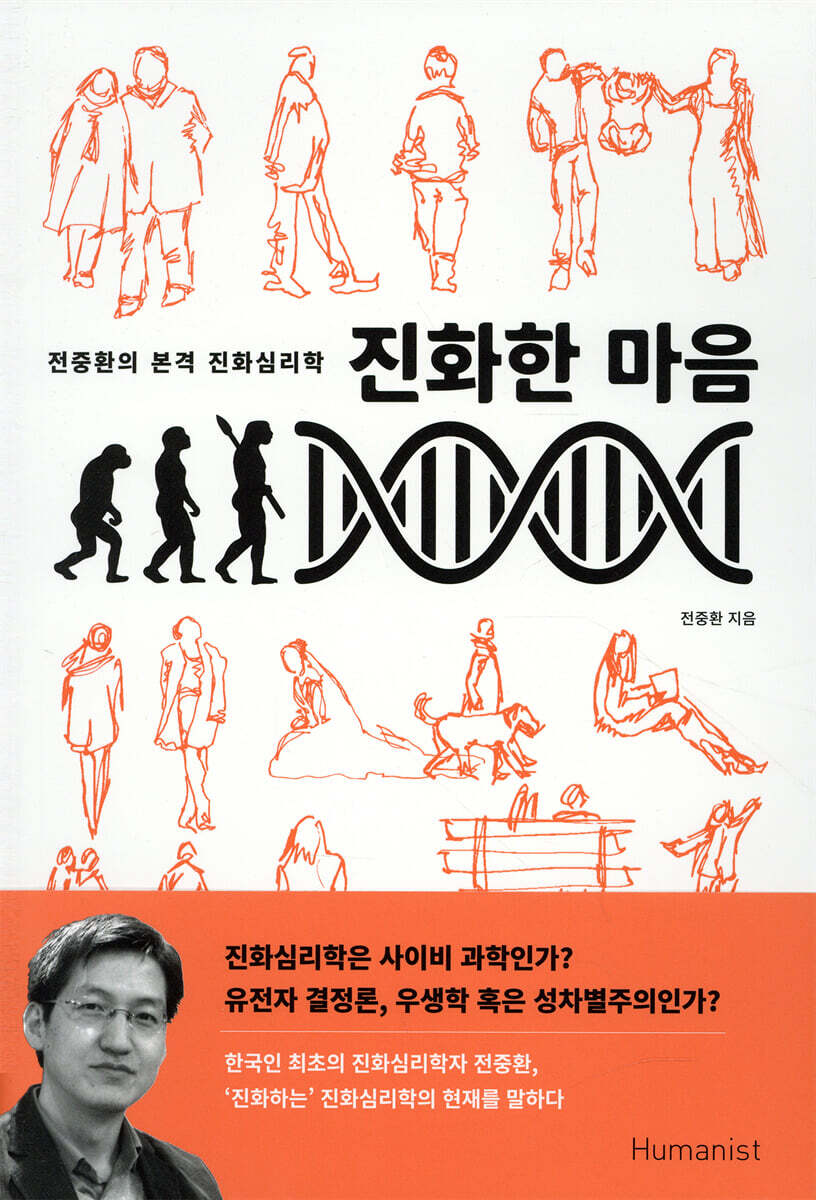
Is it so great that the mind has evolved? All about human psychology according to evolutionary psychology What does it mean that the human mind is a product of evolution by natural selection? In other words, what does it mean that humans are survival machines for "selfish" genes? The JTBC drama "SKY Castle" features a reading discussion of Dawkins' "The Selfish Gene." Kang Ye-seo (played by Kim Hye-yoon), the top student in the school, grumbles in English, “Individuals have no choice but to be selfish in order to pass on their genes to the next generation.” In response, Cha Ki-jun (played by Jo Byeong-gyu) said, “Only humans can overcome and fight against the selfishness of genes. “I think this is the core of this book,” he counters. Both are wrong. To say that genes are 'selfish' means that the unit of natural selection is not the group or the individual, but the gene. There is no reason why the genes that scientists use as metaphors for "selfishness" should necessarily produce selfish individuals. …If the interpretation that "humans are inherently selfish" is incorrect, what does it really mean to say that humans are survival machines for "selfish" genes? Is the fact that the mind evolved really that remarkable? From "Ending the Book: So What?" (pp. 378-379) Evolutionary psychology has made several attempts to scientifically explain the human mind. However, there were many negative views on evolutionary psychology, such as that it is a discipline that only studies mating or that it is the logic that womanizers use to justify their actions. Although a considerable amount of time has passed since evolutionary psychology was introduced in Korea, we still misinterpret it. Just as the metaphor of ‘selfish’ in ‘The Selfish Gene’ is misunderstood as referring to selfish humans. What can evolutionary psychology tell us? Jeon Jung-hwan, Korea's first evolutionary psychologist, gave many readers a fresh shock with his introductory book on evolutionary psychology, "Old Extension Cord," which explains human psychological phenomena found in everyday life from an evolutionary perspective. Over the past decade, he has grown as a scholar alongside the emerging field of evolutionary psychology, introducing the latest research findings in evolutionary psychology to the public and confronting head-on the skepticism, misunderstandings, and prejudices that surround evolutionary psychology. It fully explores how evolutionary psychology can be useful to us and the relationship between the human mind, behavior, and nature. |
- You can preview some of the book's contents.
Preview
index
Before reading the book, why is the 'evolved mind' important?
Part I: Foundations of Evolutionary Psychology
01 The Origins of Evolutionary Psychology
02 What is evolutionary psychology?
03 Common Misconceptions
Part II Survival
04 How do we get and select food?
05 Eat or be eaten
06 Avoid pathogens!
Part III: Performance Matching
07 Mating Strategies of Men and Women
08 Preference for a long-term spouse
09 Preference for short-term sexual partners
10 Beautiful Faces
11 Human estrus
Part IV Family and Blood Relatives
12 Blood is thicker than water
13 Conflict within the family is natural.
14 It takes a village to raise a child
15 Cuteness that melts your whole body
Part V Group Life
16 Spotting the Scammers
17 If you accumulate virtue, you will be blessed someday.
18 Why is friendship important?
19 The Evolutionary Roots of Violence
20 Leadership Instincts
Part VI Learning and Culture
21 Stones cannot learn
22 Why do we go to school?
23 Culture is biology
24 Culture comes from human nature.
Part VII Applied Evolutionary Psychology
25 Why do conservatives and progressives exist?
26 The Mystery of Morality
27 Why are personalities different?
28 Why does the mind become sick?
So what do you want me to do as I finish the book?
Note
Image source
Search
Part I: Foundations of Evolutionary Psychology
01 The Origins of Evolutionary Psychology
02 What is evolutionary psychology?
03 Common Misconceptions
Part II Survival
04 How do we get and select food?
05 Eat or be eaten
06 Avoid pathogens!
Part III: Performance Matching
07 Mating Strategies of Men and Women
08 Preference for a long-term spouse
09 Preference for short-term sexual partners
10 Beautiful Faces
11 Human estrus
Part IV Family and Blood Relatives
12 Blood is thicker than water
13 Conflict within the family is natural.
14 It takes a village to raise a child
15 Cuteness that melts your whole body
Part V Group Life
16 Spotting the Scammers
17 If you accumulate virtue, you will be blessed someday.
18 Why is friendship important?
19 The Evolutionary Roots of Violence
20 Leadership Instincts
Part VI Learning and Culture
21 Stones cannot learn
22 Why do we go to school?
23 Culture is biology
24 Culture comes from human nature.
Part VII Applied Evolutionary Psychology
25 Why do conservatives and progressives exist?
26 The Mystery of Morality
27 Why are personalities different?
28 Why does the mind become sick?
So what do you want me to do as I finish the book?
Note
Image source
Search
Detailed image

Publisher's Review
Is evolutionary psychology really a pseudoscience disguised as science?
Genetic determinism or sexism?
“Evolutionary psychology is a pseudoscience that fabricates plausible stories?”
“Evolutionary psychology is genetic determinism, which says that genes determine human behavior?”
“Does evolutionary psychology justify wrong behaviors like sexual harassment, violence, and discrimination as natural?”
“Evolutionary psychology claims that all behavior is based on the human nature to have many children?”
Evolutionary psychology has attracted attention as a fascinating tool for understanding humans, but it has also been at the center of misunderstanding and controversy as it is used to explain the dark side of human nature.
The debate surrounding evolutionary psychology continues.
Especially in our society, there is a tendency to rush to attract attention with provocative keywords, to write articles in a desired direction, and to quote only certain passages as desired, or to use them to justify sexism.
Misunderstandings surrounding evolutionary psychology begin with misinterpreting phenomena as value judgments.
Evolutionary psychology, as a science, only explains phenomena, not justifies them.
Like any other science, evolutionary psychology only explains its object of study—human behavior—but does not justify it.
Epidemics, cancer, tsunamis, earthquakes, volcanic eruptions, droughts, storms, etc. are all natural phenomena.
The reason scientists study them so diligently is not to justify them, but to eliminate them or reduce their damage.
Geologists say, “Earthquakes are an act of nature.
Have you ever seen someone advise, "So please, don't try to avoid earthquakes?" Geologists are trying to uncover the scientific causes of earthquakes.
The causal explanations discovered in this way can be effectively utilized in earthquake prevention.
- 03 Common Misunderstandings (pages 56-57)
Some of the human behaviors that evolutionary psychologists study are clearly legally or morally wrong.
There are many aspects of human nature that we consider undesirable, such as violence, prejudice against outsiders, and the sexual drive that leads to pornography.
They remain with us today only because they helped our ancestors reproduce in the distant past.
However, because the ability to make thoughtful, rational judgments has evolved as part of human nature, controlling instincts also becomes possible when we properly understand the blueprint of the 'evolved mind.'
By asking 'why' rather than 'how'
Exploring the hidden inner self of humans
When we say 'heart', different people think of different things.
Some people recall their emotions, which fluctuate from day to day, while others recall their true inner feelings, hidden from the public eye. Others recall morally correct values.
However, most people will agree to some extent with the protests that 'I can't do anything about it' and 'it's just my nature'.
The mind, is it something we are born with, so should we just leave it alone?
We express ourselves through our actions, but we must know the true heart that creates those actions.
Evolutionary psychologists emphasize that 'evolved psychological mechanisms' rather than behavior should be the primary object of inquiry.
For example, the act of feeling disgusted by something cannot be said to be good or bad.
What matters is why we feel disgusted and how we process information given from outside in our minds.
In this sense, natural selection cannot select 'action' itself, but can only select 'the mind that underlies the action'.
In other words, the human mind is a ‘product of evolution’ that evolved through natural selection.
Is this fact so important? If we understand the purpose for which the mind is designed, we can unify and explain various human psychological phenomena under a single principle.
Psychology can also become a solid science.
Evolutionary psychology reveals the fundamental reasons why our brains, hormones, reason and emotions work the way they do.
Let's say I'm walking along a forest path and I see a snake approaching me.
Needless to say, the thirty-six stratagems were an adaptive behavior that increased the chances of reproduction in this situation.
Note that the number of actions our human ancestors could have taken upon seeing a snake was virtually infinite.
Our ancestors could fall in love with snakes, feel pity for their delicate nature, drool at the sight of snakes, or run away in fear of snakes.
Because running away from a snake at first sight was most beneficial for reproduction, fear of snakes became a universal psychological adaptation in humans.
- 02 What is evolutionary psychology? (page 44)
If you think you know enough about evolutionary psychology,
Now is the time to read 『The Evolved Mind』!
Jeon Jung-hwan says this in the introduction to the book:
“I don’t mean to scare you, but this book is not an introduction to evolutionary psychology for beginners.” If you are a reader who has been tired of the countless evolutionary psychology books that have been published so far because they are all similar, only deal with light topics that are relevant to daily life, or are focused on the phenomenon of sex and mating, it is time to read this book.
Author Jeon Jung-hwan introduced evolutionary psychology in a friendly and fun way by looking at the daily lives of modern city dwellers through an evolutionary perspective in his first book, “Old Extension Cord,” and in his second book, “Nature is the Answer,” he analyzed social phenomena through the eyes of an evolutionary psychologist.
Now, after two books, "The Evolved Mind" covers a wide range of research topics, focusing on the fundamental theories of evolutionary psychology, including survival, sex and mating, family and kinship, group living, leadership, reputation, friendship, violence, learning, culture, politics, and morality, as well as the latest research trends.
Using the drama Mr. Sunshine as an example, he talks about the conditions that men and women want in a partner, explains the psychology of the public who are crazy about Kakao Friends' 'Ryan', who is just a single character, and tells stories about human psychology that are closer and more vivid, using examples from Korea, such as the 'Hamkke Burger' man who spent about 1 million won of his own money to provide meals for the families of the missing during the Sewol Ferry disaster.
In addition, it covers the process of how evolutionary psychology was born, the differences between Edward Wilson's "Sociobiology" and Richard Dawkins' "The Selfish Gene," why sociobiology was criticized as racist and a far-right ideology, and the history of the theories and controversies representing evolutionary psychology.
I highly recommend this book to anyone who is interested in the discipline itself as well as the topics covered in evolutionary psychology.
As Steven Pinker said, “All psychology is evolutionary psychology,” evolutionary psychology is not a sub-discipline of psychology, but rather an approach that explains “all psychological” phenomena of humans from an evolutionary perspective.
It is also a science that discovers and verifies the characteristics of human psychology that have adapted to the environment.
Evolutionary psychology, which explains how our "evolved mind" is designed to function, will provide a new guide for controlling the dark side of human nature.
Genetic determinism or sexism?
“Evolutionary psychology is a pseudoscience that fabricates plausible stories?”
“Evolutionary psychology is genetic determinism, which says that genes determine human behavior?”
“Does evolutionary psychology justify wrong behaviors like sexual harassment, violence, and discrimination as natural?”
“Evolutionary psychology claims that all behavior is based on the human nature to have many children?”
Evolutionary psychology has attracted attention as a fascinating tool for understanding humans, but it has also been at the center of misunderstanding and controversy as it is used to explain the dark side of human nature.
The debate surrounding evolutionary psychology continues.
Especially in our society, there is a tendency to rush to attract attention with provocative keywords, to write articles in a desired direction, and to quote only certain passages as desired, or to use them to justify sexism.
Misunderstandings surrounding evolutionary psychology begin with misinterpreting phenomena as value judgments.
Evolutionary psychology, as a science, only explains phenomena, not justifies them.
Like any other science, evolutionary psychology only explains its object of study—human behavior—but does not justify it.
Epidemics, cancer, tsunamis, earthquakes, volcanic eruptions, droughts, storms, etc. are all natural phenomena.
The reason scientists study them so diligently is not to justify them, but to eliminate them or reduce their damage.
Geologists say, “Earthquakes are an act of nature.
Have you ever seen someone advise, "So please, don't try to avoid earthquakes?" Geologists are trying to uncover the scientific causes of earthquakes.
The causal explanations discovered in this way can be effectively utilized in earthquake prevention.
- 03 Common Misunderstandings (pages 56-57)
Some of the human behaviors that evolutionary psychologists study are clearly legally or morally wrong.
There are many aspects of human nature that we consider undesirable, such as violence, prejudice against outsiders, and the sexual drive that leads to pornography.
They remain with us today only because they helped our ancestors reproduce in the distant past.
However, because the ability to make thoughtful, rational judgments has evolved as part of human nature, controlling instincts also becomes possible when we properly understand the blueprint of the 'evolved mind.'
By asking 'why' rather than 'how'
Exploring the hidden inner self of humans
When we say 'heart', different people think of different things.
Some people recall their emotions, which fluctuate from day to day, while others recall their true inner feelings, hidden from the public eye. Others recall morally correct values.
However, most people will agree to some extent with the protests that 'I can't do anything about it' and 'it's just my nature'.
The mind, is it something we are born with, so should we just leave it alone?
We express ourselves through our actions, but we must know the true heart that creates those actions.
Evolutionary psychologists emphasize that 'evolved psychological mechanisms' rather than behavior should be the primary object of inquiry.
For example, the act of feeling disgusted by something cannot be said to be good or bad.
What matters is why we feel disgusted and how we process information given from outside in our minds.
In this sense, natural selection cannot select 'action' itself, but can only select 'the mind that underlies the action'.
In other words, the human mind is a ‘product of evolution’ that evolved through natural selection.
Is this fact so important? If we understand the purpose for which the mind is designed, we can unify and explain various human psychological phenomena under a single principle.
Psychology can also become a solid science.
Evolutionary psychology reveals the fundamental reasons why our brains, hormones, reason and emotions work the way they do.
Let's say I'm walking along a forest path and I see a snake approaching me.
Needless to say, the thirty-six stratagems were an adaptive behavior that increased the chances of reproduction in this situation.
Note that the number of actions our human ancestors could have taken upon seeing a snake was virtually infinite.
Our ancestors could fall in love with snakes, feel pity for their delicate nature, drool at the sight of snakes, or run away in fear of snakes.
Because running away from a snake at first sight was most beneficial for reproduction, fear of snakes became a universal psychological adaptation in humans.
- 02 What is evolutionary psychology? (page 44)
If you think you know enough about evolutionary psychology,
Now is the time to read 『The Evolved Mind』!
Jeon Jung-hwan says this in the introduction to the book:
“I don’t mean to scare you, but this book is not an introduction to evolutionary psychology for beginners.” If you are a reader who has been tired of the countless evolutionary psychology books that have been published so far because they are all similar, only deal with light topics that are relevant to daily life, or are focused on the phenomenon of sex and mating, it is time to read this book.
Author Jeon Jung-hwan introduced evolutionary psychology in a friendly and fun way by looking at the daily lives of modern city dwellers through an evolutionary perspective in his first book, “Old Extension Cord,” and in his second book, “Nature is the Answer,” he analyzed social phenomena through the eyes of an evolutionary psychologist.
Now, after two books, "The Evolved Mind" covers a wide range of research topics, focusing on the fundamental theories of evolutionary psychology, including survival, sex and mating, family and kinship, group living, leadership, reputation, friendship, violence, learning, culture, politics, and morality, as well as the latest research trends.
Using the drama Mr. Sunshine as an example, he talks about the conditions that men and women want in a partner, explains the psychology of the public who are crazy about Kakao Friends' 'Ryan', who is just a single character, and tells stories about human psychology that are closer and more vivid, using examples from Korea, such as the 'Hamkke Burger' man who spent about 1 million won of his own money to provide meals for the families of the missing during the Sewol Ferry disaster.
In addition, it covers the process of how evolutionary psychology was born, the differences between Edward Wilson's "Sociobiology" and Richard Dawkins' "The Selfish Gene," why sociobiology was criticized as racist and a far-right ideology, and the history of the theories and controversies representing evolutionary psychology.
I highly recommend this book to anyone who is interested in the discipline itself as well as the topics covered in evolutionary psychology.
As Steven Pinker said, “All psychology is evolutionary psychology,” evolutionary psychology is not a sub-discipline of psychology, but rather an approach that explains “all psychological” phenomena of humans from an evolutionary perspective.
It is also a science that discovers and verifies the characteristics of human psychology that have adapted to the environment.
Evolutionary psychology, which explains how our "evolved mind" is designed to function, will provide a new guide for controlling the dark side of human nature.
GOODS SPECIFICS
- Date of issue: January 18, 2019
- Page count, weight, size: 432 pages | 562g | 150*220*30mm
- ISBN13: 9791160801880
- ISBN10: 1160801886
You may also like
카테고리
korean


korean

![ELLE 엘르 스페셜 에디션 A형 : 12월 [2025]](http://librairie.coreenne.fr/cdn/shop/files/b8e27a3de6c9538896439686c6b0e8fb.jpg?v=1766436872&width=3840)


