

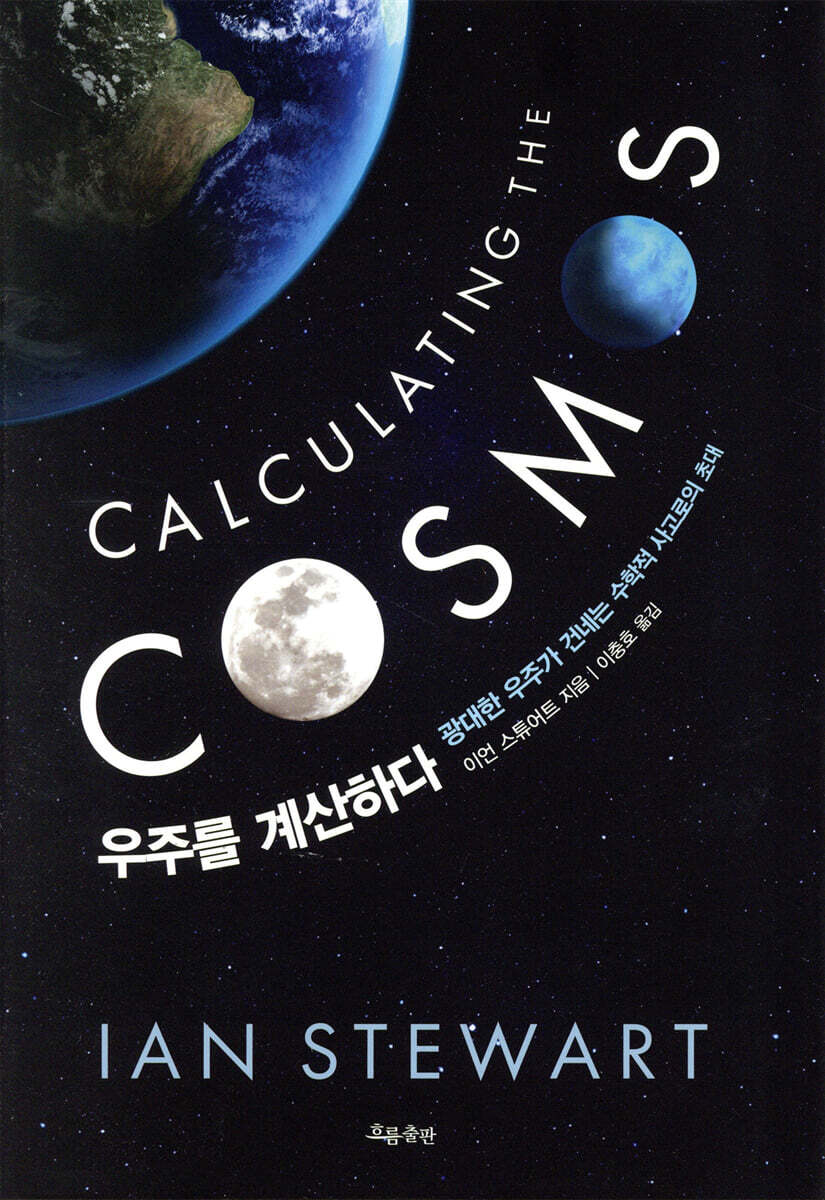
Calculating the Universe
 |
Description
Book Introduction
- A word from MD
-
Uncovering the secrets the world holdsA book that covers numerous scientific discoveries and advancements that have contributed to humanity's understanding of the world, including the origins of the Earth and the Moon, black holes, and the Big Bang, and says that mathematics is at the heart of them.
The fascinating journey of mathematics, which faithfully answers scientific questions, reveals how unknown celestial bodies have been discovered and the secrets of the universe have been unraveled.
January 25, 2019. Natural Science PD Park Hyung-wook
From the creation of the Earth and the Moon to the origin of planets and asteroids,
An enchanting journey of 'mathematics' into distant galaxies and the universe!
Ian Stewart, a British mathematician and popular science writer, recipient of the Royal Society's Michael Faraday Award for contributions to popular science and the American Association for the Advancement of Science's Award for Popularization of Science, and Professor Emeritus at the University of Warwick, has come to Korean readers with a surprising book that uses mathematics to reveal the secrets hidden in the universe.
Professor Ian Stewart, familiar to Korean readers through his books 『Great Mathematical Problems』 and 『A History of Mathematics for the Liberal Arts』, colorfully unfolds his extensive knowledge ranging from astronomy, physics, and cosmology in this book 『Computing the Universe: An Invitation to Mathematical Thinking from the Vast Universe』.
Advances in science have made space exploration possible, giving us more extensive and accurate information about the planets and celestial bodies in our solar system than ever before.
At the heart of all these scientific advances is mathematics.
Mathematics is a core discipline that explains the formation process of numerous celestial bodies, such as the sun, moon, planets, and stars, and proves their fundamental principles.
In this book, "Calculating the Universe," Ian Stewart covers the story of mathematics that has revealed the secrets of the universe throughout history, from Kepler, who discovered natural phenomena such as solar and lunar eclipses and the orbits of planets, to Newton, who devised the law of universal gravitation that applies to gravity and celestial bodies, and Einstein.
From the Earth and the Moon, to asteroids and black holes, the Big Bang theory, and the multiverse, this remarkable journey to discover how mathematics predicted the existence of previously unobserved celestial bodies and unlocked the secrets of the unknown universe is fascinating, mysterious, and moving.
Like countless stars twinkling in the distant universe.
An enchanting journey of 'mathematics' into distant galaxies and the universe!
Ian Stewart, a British mathematician and popular science writer, recipient of the Royal Society's Michael Faraday Award for contributions to popular science and the American Association for the Advancement of Science's Award for Popularization of Science, and Professor Emeritus at the University of Warwick, has come to Korean readers with a surprising book that uses mathematics to reveal the secrets hidden in the universe.
Professor Ian Stewart, familiar to Korean readers through his books 『Great Mathematical Problems』 and 『A History of Mathematics for the Liberal Arts』, colorfully unfolds his extensive knowledge ranging from astronomy, physics, and cosmology in this book 『Computing the Universe: An Invitation to Mathematical Thinking from the Vast Universe』.
Advances in science have made space exploration possible, giving us more extensive and accurate information about the planets and celestial bodies in our solar system than ever before.
At the heart of all these scientific advances is mathematics.
Mathematics is a core discipline that explains the formation process of numerous celestial bodies, such as the sun, moon, planets, and stars, and proves their fundamental principles.
In this book, "Calculating the Universe," Ian Stewart covers the story of mathematics that has revealed the secrets of the universe throughout history, from Kepler, who discovered natural phenomena such as solar and lunar eclipses and the orbits of planets, to Newton, who devised the law of universal gravitation that applies to gravity and celestial bodies, and Einstein.
From the Earth and the Moon, to asteroids and black holes, the Big Bang theory, and the multiverse, this remarkable journey to discover how mathematics predicted the existence of previously unobserved celestial bodies and unlocked the secrets of the unknown universe is fascinating, mysterious, and moving.
Like countless stars twinkling in the distant universe.
- You can preview some of the book's contents.
Preview
index
prolog
01 The Force of Attraction at a Distance: The Law of Gravity That Governs the Universe
02 The Collapse of the Solar Nebula: The Birth of the Solar System
03 Unusual Moon: The Birth of the Moon
04 The Clockwork Universe: Titius-Bode's Law
05 Sky Police: The Story of an Asteroid Discovery
06 The Planet That Devoured Its Own Children: The Secret of Saturn's Rings
07 Cosimo's Stars: Satellite Orbits and Laplace Resonances
08 Where do comets come from: The origin of comets
09 Chaos in the Universe: Chaos Dynamics
10 Interplanetary Superhighways: Hohmann Ellipses and Lagrange Points
11 Giant Fireballs: Spectroscopy and Stellar Evolution
12 The Great River of Heaven: The Structure and Spiral Arms of Galaxies
13 Alien Worlds: Exploring Exoplanets
14 Dark Stars: Black Holes and General Relativity
15 Threads and Giant Cavities: The Geometry of the Universe
16 Cosmic Eggs: The Big Bang and the Expansion of the Universe
17 Big Bang: Inflation and Dark Energy
18 The Dark Side: Dark Matter
19 Universes Beyond Ours: Fundamental Constants and the Multiverse
Epilogue
Postscript and References
Units and Terms
Photo and illustration source
Search
01 The Force of Attraction at a Distance: The Law of Gravity That Governs the Universe
02 The Collapse of the Solar Nebula: The Birth of the Solar System
03 Unusual Moon: The Birth of the Moon
04 The Clockwork Universe: Titius-Bode's Law
05 Sky Police: The Story of an Asteroid Discovery
06 The Planet That Devoured Its Own Children: The Secret of Saturn's Rings
07 Cosimo's Stars: Satellite Orbits and Laplace Resonances
08 Where do comets come from: The origin of comets
09 Chaos in the Universe: Chaos Dynamics
10 Interplanetary Superhighways: Hohmann Ellipses and Lagrange Points
11 Giant Fireballs: Spectroscopy and Stellar Evolution
12 The Great River of Heaven: The Structure and Spiral Arms of Galaxies
13 Alien Worlds: Exploring Exoplanets
14 Dark Stars: Black Holes and General Relativity
15 Threads and Giant Cavities: The Geometry of the Universe
16 Cosmic Eggs: The Big Bang and the Expansion of the Universe
17 Big Bang: Inflation and Dark Energy
18 The Dark Side: Dark Matter
19 Universes Beyond Ours: Fundamental Constants and the Multiverse
Epilogue
Postscript and References
Units and Terms
Photo and illustration source
Search
Detailed image
Into the book
Space exploration is fundamental science.
While most people are intrigued by new discoveries on planets, some would rather see their tax dollars used for more practical purposes.
But space exploration also benefits our daily lives, and the ability to create precise mathematical models of celestial bodies interacting through gravity, combined with satellite technology, has led to many amazing inventions.
Examples include satellite broadcasting, a highly efficient international telephone network, weather satellites, satellites that monitor solar magnetic storms, and satellites that monitor the environment and map the Earth.
Previous generations will be amazed by this achievement.
Until the 1930s, few people thought that humans would ever walk on the moon.
But we succeeded in going to the moon despite the claims of those who said we couldn't.
So far, we have only explored the region of space near Earth, which is nothing compared to the vastness of the entire universe.
We haven't even set foot on another planet yet, and we can't even think about going to the nearest star.
Even if we could build a reliable spacecraft, it would take hundreds of years to get there using existing technology.
But we don't give up and keep moving forward.
- pp.
From 19~20 "Prologue"
The night sky is dotted with bright stars, but wide, irregular bands of light cross the entire sky, appearing more like a river than a collection of bright points.
In fact, the ancient Egyptians viewed the Milky Way as a celestial river, corresponding to the Nile.
Even today, the Milky Way is called the Milky Way in English, a name that reflects its mysterious shape.
Astronomers call the cosmic structure that created the Milky Way the Galaxy, a word derived from the Ancient Greek galaxias ('milk') and kyklos galaktikos ('milk circle').
It took astronomers thousands of years to realize that this milky blob across the sky was a gigantic band of stars, so distant that our eyes could not distinguish them as individual points.
This belt is actually a lens-shaped disk when viewed sideways, and contains the Earth and our solar system.
These are now called galaxies.
Galaxies are the most numerous groups of large structures made up of stars.
Many galaxies display striking patterns called spiral arms, the origin of which is still unknown.
Despite the fact that galaxies are so ubiquitous, we don't fully understand them.
- pp.
From 283-285 “The Great River of the Sky: The Structure and Spiral Arms of Galaxies”
From a distance within our solar system, our planet is reduced to a single blue pixel in a digital photograph—that pale blue dot made famous by Voyager 1's last image in 1990.
Voyager 1 was roughly as far away as Pluto, which means it's still in Earth's backyard on a cosmic scale.
Yet our beautiful world has been reduced to an insignificant speck.
From a distant star, we might as well not exist at all, and neither would the Earth or the Sun, despite all the difference our very existence makes.
And when viewed from other galaxies, even our own would appear insignificant on the cosmic scale.
It's a humbling thought that makes us reflect on ourselves, and it really shows us how fragile our planet is.
At the same time, it makes you feel a sense of wonder at the grandeur of the universe.
More constructively, it makes me curious about what else is out there and where it all came from.
- pp.
From 391-392 "The Cosmic Egg: The Big Bang and the Expansion of the Universe"
While most people are intrigued by new discoveries on planets, some would rather see their tax dollars used for more practical purposes.
But space exploration also benefits our daily lives, and the ability to create precise mathematical models of celestial bodies interacting through gravity, combined with satellite technology, has led to many amazing inventions.
Examples include satellite broadcasting, a highly efficient international telephone network, weather satellites, satellites that monitor solar magnetic storms, and satellites that monitor the environment and map the Earth.
Previous generations will be amazed by this achievement.
Until the 1930s, few people thought that humans would ever walk on the moon.
But we succeeded in going to the moon despite the claims of those who said we couldn't.
So far, we have only explored the region of space near Earth, which is nothing compared to the vastness of the entire universe.
We haven't even set foot on another planet yet, and we can't even think about going to the nearest star.
Even if we could build a reliable spacecraft, it would take hundreds of years to get there using existing technology.
But we don't give up and keep moving forward.
- pp.
From 19~20 "Prologue"
The night sky is dotted with bright stars, but wide, irregular bands of light cross the entire sky, appearing more like a river than a collection of bright points.
In fact, the ancient Egyptians viewed the Milky Way as a celestial river, corresponding to the Nile.
Even today, the Milky Way is called the Milky Way in English, a name that reflects its mysterious shape.
Astronomers call the cosmic structure that created the Milky Way the Galaxy, a word derived from the Ancient Greek galaxias ('milk') and kyklos galaktikos ('milk circle').
It took astronomers thousands of years to realize that this milky blob across the sky was a gigantic band of stars, so distant that our eyes could not distinguish them as individual points.
This belt is actually a lens-shaped disk when viewed sideways, and contains the Earth and our solar system.
These are now called galaxies.
Galaxies are the most numerous groups of large structures made up of stars.
Many galaxies display striking patterns called spiral arms, the origin of which is still unknown.
Despite the fact that galaxies are so ubiquitous, we don't fully understand them.
- pp.
From 283-285 “The Great River of the Sky: The Structure and Spiral Arms of Galaxies”
From a distance within our solar system, our planet is reduced to a single blue pixel in a digital photograph—that pale blue dot made famous by Voyager 1's last image in 1990.
Voyager 1 was roughly as far away as Pluto, which means it's still in Earth's backyard on a cosmic scale.
Yet our beautiful world has been reduced to an insignificant speck.
From a distant star, we might as well not exist at all, and neither would the Earth or the Sun, despite all the difference our very existence makes.
And when viewed from other galaxies, even our own would appear insignificant on the cosmic scale.
It's a humbling thought that makes us reflect on ourselves, and it really shows us how fragile our planet is.
At the same time, it makes you feel a sense of wonder at the grandeur of the universe.
More constructively, it makes me curious about what else is out there and where it all came from.
- pp.
From 391-392 "The Cosmic Egg: The Big Bang and the Expansion of the Universe"
--- From the text
Publisher's Review
How was this Earth and the universe we live in created?
The amazing history of mankind and mathematics exploring the unknown world!
'Pale Blue Dot' was named by astronomer Carl Sagan after a photo of Earth taken by Voyager 1 in 1990, just before it left the solar system as it flew by Pluto.
This realization that the Earth is just a tiny dot in the vast expanse of space is a surprising thought that made humanity look back with humility and feel the grandeur of space called space.
At the same time, it was a historical event that sparked humanity's imagination and curiosity about the unknown existence called 'space'.
Ian Stewart, a British mathematician and popular science writer, recipient of the Royal Society's Michael Faraday Award for contributions to popular science and the American Association for the Advancement of Science's Award for Popularization of Science, and Professor Emeritus at the University of Warwick, has come to Korean readers with a surprising book that uses mathematics to reveal the secrets hidden in the universe.
Professor Ian Stewart, familiar to Korean readers through his books 『Great Mathematical Problems』 and 『A History of Mathematics for the Liberal Arts』, colorfully unfolds his extensive knowledge ranging from astronomy, physics, and cosmology in this book 『Computing the Universe: An Invitation to Mathematical Thinking from the Vast Universe』.
He covers the fascinating stories of astronomers, mathematicians, and physicists who have studied the secrets of the universe throughout history, from Kepler, who discovered natural phenomena such as solar and lunar eclipses and the orbits of the planets, to Newton and Einstein, who devised the laws of gravity and universal gravitation that apply to celestial bodies.
This book is a journey of 'mathematics' and a journey of humanity, about how it predicted the existence of previously unobserved celestial bodies, from the Earth and the Moon, to asteroids and black holes, the Big Bang theory, and the multiverse, and how it unravels the secrets of the unknown existence called the universe.
From gravity to the sun, moon, comets, black holes, the Big Bang, and the multiverse.
Providing deep and rich wisdom about the universe
When did humanity's curiosity about space begin?
The history of space exploration and the human science based on its achievements dates back to ancient Babylonia 3,000 years ago.
From the ancient Babylonians' prediction of eclipses to calculus, chaos, and the curvature of space-time, humanity has constantly strived to understand astronomical phenomena, including the sun, moon, planets, and stars.
These efforts have inspired all aspects of human learning, and have had a particularly profound impact on the development of mathematics.
Through the discipline of mathematics, mankind was able to calculate the principles of solar and lunar eclipses, and even estimate the rotation and orbital speed of planets, the size of stars, and the distances between stars.
Furthermore, mathematics has helped us understand the planet we live on, Earth, through the law of gravity, and has become the foundation of the scientific civilization that allows us to navigate the universe today.
This book, "Calculating the Universe," reveals that nature (including the universe) is formed and operates through all mathematical laws.
This book consists of a total of 19 chapters.
It covers almost every celestial phenomenon that humanity has ever discovered, from the law of gravitation discovered by Newton, the secrets of the formation of the solar system and the moon, the Titius-Bode law that revealed the secrets of the arrangement of planets in the universe, the discovery of asteroids, the orbits of satellites, the composition and principles of comets, the structure of galaxies, dark matter, the principles of black holes, the Big Bang and the expansion of the universe, and the multiverse.
As world-renowned mathematician Professor Kim Min-hyung of Oxford's Merton College put it, this book provides us with "deep and rich wisdom about the universe."
Let's think about gravity.
It took a genius of the highest order to realize that the force that causes terrestrial objects to fall is the same force that holds celestial objects up.
Newton compared a falling apple to the moon and realized that the moon, unlike the apple, floats in the sky because it moves 'sideways'.
In fact, the moon is constantly falling down, but the Earth's surface is moving away from the moon at the same rate.
So the moon goes around the Earth forever, falling down, without colliding with the Earth.
So the real difference wasn't that apples fell and the moon didn't.
The real difference was that the apple didn't move sideways fast enough to eventually collide with the Earth.
The discovery of the law of universal gravitation is considered a truly heroic moment in the history and development of science.
This law, which states that 'every object' in the universe attracts every other object, allows us to know the magnitude and direction of 'all forces arising there' in any space (whether on Earth or off Earth).
By plugging all these forces into the laws of motion, we can determine the acceleration, or velocity, and position of each object at any moment.
Newton's laws of motion and gravity led to a permanent alliance between astronomy and mathematics, resulting in much of what we know about the universe today.
Ian Stewart explores the history of comets, as well as gravity.
As revealed in Shakespeare's works, comets have long been considered omens of disaster.
This enigmatic object suddenly appears in the night sky with a long, bright, curved tail, slowly moving against the backdrop of stars before disappearing again.
In the past, when understanding of astronomy was limited, comets were either messengers sent by the gods or used by priests and shamans to strengthen their influence.
This ignorance was eventually resolved by scientific evidence, when astronomer Tycho Brahe calculated the distance to the Great Comet in 1577, showing that it was farther away than the Moon.
A comet was a celestial body that existed in the sky.
Halley's Comet, the most familiar to us, is one of the great astronomical discoveries that Edmond Halley derived from mathematical patterns around 1705.
Edmond Halley predicted that the motion of comets was periodic, and that the same comet would return to Earth's sky repeatedly at regular intervals.
Edmond Halley investigated and synthesized the evidence for comet sightings to prove this prediction, and proved his hypothesis correct (although he died before it could be proven).
In fact, records of observations of Halley's Comet date back to China in 240 BC.
Halley's Comet, named after Edmond, was the first celestial body other than a planet discovered to orbit the Sun, and Edmond's prediction was one of the true astronomical predictions based on the mathematical theory of celestial mechanics.
Most cosmologists today believe that the entire universe was born about 13.8 billion years ago.
A speck of space-time appeared out of nowhere and expanded at an incredibly fast rate, and as the fiery fireball cooled, particles such as quarks and gluons were born.
These particles combined to form protons and neutrons, which combined to form atomic nuclei, and after 380,000 years, hydrogen, helium, and deuterium atoms appeared.
From this time on, matter began to form clumps under the influence of gravity, resulting in the appearance of stars and planets.
This scenario is the famous Big Bang.
The Big Bang theory was born when Hubble discovered a simple mathematical pattern through astronomical observations.
Einstein later published his general theory of relativity, which refuted the idea that the universe is an infinitely large empty space, and in 1927, Lemaître made the surprising discovery that 'the universe is expanding' using Einstein's field equations.
Until this discovery, the prevailing opinion in the scientific community was that the universe remained in its current state (infinitely vast space).
This was a very innovative idea, and the astronomical technology of the time could not prove the hypothesis, nor could it receive support from the scientific community.
Even Einstein thought it made no sense.
But a few years later, a female astronomer named Levitt, using experiments measuring the brightness of thousands of stars, discovered a mathematical pattern in a specific type of star called Cepheid variables.
That is, the intrinsic brightness of a star is related to its period of variation in a specific mathematical way, and by using Cepheid variables as a standard, it becomes possible to determine how far away other stars are.
Based on these results, an examination of the spectra of many galaxies revealed that many galaxies are rapidly moving away from Earth.
The universe is continuing to expand tremendously at this very moment.
The never-ending journey into space!
The journey into space began in prehistoric times, when early humans looked up at the night sky and wondered what was happening up there.
And we are still on that journey.
The reason we don't know when this journey will end is because the more we learn about the universe, the more we don't understand.
Mathematics has developed alongside related fields such as astronomy, physics, relativity, and string theory.
When science asks questions, mathematics tries to find answers.
Newton's efforts to discover the laws of gravity and motion led to the development of differential equations and n-body problems.
These in turn inspired calculations predicting the existence of Neptune and the chaotic tumble of Hyperion.
In this way, mathematics and science (especially astronomy) have become increasingly sophisticated, inspiring each other's new concepts.
Today, scientists are constantly refining and improving their understanding of the universe.
This is how real science progresses.
It's like taking three steps forward and then two steps back.
In this book, Ian Stewart explains the traditional views on astronomy and mathematics and why they were so widely accepted.
And if such views need to be revised and replaced with new theories, they should be criticized with justification.
Ian Stewart argues that perhaps it is not the right answer now to answer scientific mysteries based on historical evidence.
Even a few decades ago, few people supported the Big Bang or dark matter.
There were countless mistakes and errors, and through that process the current scientific foundation was established.
Is this scientific basis really correct?
Maybe not.
The Big Bang may not have happened, and black holes may not exist.
Redshift may not be evidence of an expanding universe.
Maybe so.
Maybe not.
Our journey into space is still ongoing.
So the joy is here, right now, trying to figure it all out.
The amazing history of mankind and mathematics exploring the unknown world!
'Pale Blue Dot' was named by astronomer Carl Sagan after a photo of Earth taken by Voyager 1 in 1990, just before it left the solar system as it flew by Pluto.
This realization that the Earth is just a tiny dot in the vast expanse of space is a surprising thought that made humanity look back with humility and feel the grandeur of space called space.
At the same time, it was a historical event that sparked humanity's imagination and curiosity about the unknown existence called 'space'.
Ian Stewart, a British mathematician and popular science writer, recipient of the Royal Society's Michael Faraday Award for contributions to popular science and the American Association for the Advancement of Science's Award for Popularization of Science, and Professor Emeritus at the University of Warwick, has come to Korean readers with a surprising book that uses mathematics to reveal the secrets hidden in the universe.
Professor Ian Stewart, familiar to Korean readers through his books 『Great Mathematical Problems』 and 『A History of Mathematics for the Liberal Arts』, colorfully unfolds his extensive knowledge ranging from astronomy, physics, and cosmology in this book 『Computing the Universe: An Invitation to Mathematical Thinking from the Vast Universe』.
He covers the fascinating stories of astronomers, mathematicians, and physicists who have studied the secrets of the universe throughout history, from Kepler, who discovered natural phenomena such as solar and lunar eclipses and the orbits of the planets, to Newton and Einstein, who devised the laws of gravity and universal gravitation that apply to celestial bodies.
This book is a journey of 'mathematics' and a journey of humanity, about how it predicted the existence of previously unobserved celestial bodies, from the Earth and the Moon, to asteroids and black holes, the Big Bang theory, and the multiverse, and how it unravels the secrets of the unknown existence called the universe.
From gravity to the sun, moon, comets, black holes, the Big Bang, and the multiverse.
Providing deep and rich wisdom about the universe
When did humanity's curiosity about space begin?
The history of space exploration and the human science based on its achievements dates back to ancient Babylonia 3,000 years ago.
From the ancient Babylonians' prediction of eclipses to calculus, chaos, and the curvature of space-time, humanity has constantly strived to understand astronomical phenomena, including the sun, moon, planets, and stars.
These efforts have inspired all aspects of human learning, and have had a particularly profound impact on the development of mathematics.
Through the discipline of mathematics, mankind was able to calculate the principles of solar and lunar eclipses, and even estimate the rotation and orbital speed of planets, the size of stars, and the distances between stars.
Furthermore, mathematics has helped us understand the planet we live on, Earth, through the law of gravity, and has become the foundation of the scientific civilization that allows us to navigate the universe today.
This book, "Calculating the Universe," reveals that nature (including the universe) is formed and operates through all mathematical laws.
This book consists of a total of 19 chapters.
It covers almost every celestial phenomenon that humanity has ever discovered, from the law of gravitation discovered by Newton, the secrets of the formation of the solar system and the moon, the Titius-Bode law that revealed the secrets of the arrangement of planets in the universe, the discovery of asteroids, the orbits of satellites, the composition and principles of comets, the structure of galaxies, dark matter, the principles of black holes, the Big Bang and the expansion of the universe, and the multiverse.
As world-renowned mathematician Professor Kim Min-hyung of Oxford's Merton College put it, this book provides us with "deep and rich wisdom about the universe."
Let's think about gravity.
It took a genius of the highest order to realize that the force that causes terrestrial objects to fall is the same force that holds celestial objects up.
Newton compared a falling apple to the moon and realized that the moon, unlike the apple, floats in the sky because it moves 'sideways'.
In fact, the moon is constantly falling down, but the Earth's surface is moving away from the moon at the same rate.
So the moon goes around the Earth forever, falling down, without colliding with the Earth.
So the real difference wasn't that apples fell and the moon didn't.
The real difference was that the apple didn't move sideways fast enough to eventually collide with the Earth.
The discovery of the law of universal gravitation is considered a truly heroic moment in the history and development of science.
This law, which states that 'every object' in the universe attracts every other object, allows us to know the magnitude and direction of 'all forces arising there' in any space (whether on Earth or off Earth).
By plugging all these forces into the laws of motion, we can determine the acceleration, or velocity, and position of each object at any moment.
Newton's laws of motion and gravity led to a permanent alliance between astronomy and mathematics, resulting in much of what we know about the universe today.
Ian Stewart explores the history of comets, as well as gravity.
As revealed in Shakespeare's works, comets have long been considered omens of disaster.
This enigmatic object suddenly appears in the night sky with a long, bright, curved tail, slowly moving against the backdrop of stars before disappearing again.
In the past, when understanding of astronomy was limited, comets were either messengers sent by the gods or used by priests and shamans to strengthen their influence.
This ignorance was eventually resolved by scientific evidence, when astronomer Tycho Brahe calculated the distance to the Great Comet in 1577, showing that it was farther away than the Moon.
A comet was a celestial body that existed in the sky.
Halley's Comet, the most familiar to us, is one of the great astronomical discoveries that Edmond Halley derived from mathematical patterns around 1705.
Edmond Halley predicted that the motion of comets was periodic, and that the same comet would return to Earth's sky repeatedly at regular intervals.
Edmond Halley investigated and synthesized the evidence for comet sightings to prove this prediction, and proved his hypothesis correct (although he died before it could be proven).
In fact, records of observations of Halley's Comet date back to China in 240 BC.
Halley's Comet, named after Edmond, was the first celestial body other than a planet discovered to orbit the Sun, and Edmond's prediction was one of the true astronomical predictions based on the mathematical theory of celestial mechanics.
Most cosmologists today believe that the entire universe was born about 13.8 billion years ago.
A speck of space-time appeared out of nowhere and expanded at an incredibly fast rate, and as the fiery fireball cooled, particles such as quarks and gluons were born.
These particles combined to form protons and neutrons, which combined to form atomic nuclei, and after 380,000 years, hydrogen, helium, and deuterium atoms appeared.
From this time on, matter began to form clumps under the influence of gravity, resulting in the appearance of stars and planets.
This scenario is the famous Big Bang.
The Big Bang theory was born when Hubble discovered a simple mathematical pattern through astronomical observations.
Einstein later published his general theory of relativity, which refuted the idea that the universe is an infinitely large empty space, and in 1927, Lemaître made the surprising discovery that 'the universe is expanding' using Einstein's field equations.
Until this discovery, the prevailing opinion in the scientific community was that the universe remained in its current state (infinitely vast space).
This was a very innovative idea, and the astronomical technology of the time could not prove the hypothesis, nor could it receive support from the scientific community.
Even Einstein thought it made no sense.
But a few years later, a female astronomer named Levitt, using experiments measuring the brightness of thousands of stars, discovered a mathematical pattern in a specific type of star called Cepheid variables.
That is, the intrinsic brightness of a star is related to its period of variation in a specific mathematical way, and by using Cepheid variables as a standard, it becomes possible to determine how far away other stars are.
Based on these results, an examination of the spectra of many galaxies revealed that many galaxies are rapidly moving away from Earth.
The universe is continuing to expand tremendously at this very moment.
The never-ending journey into space!
The journey into space began in prehistoric times, when early humans looked up at the night sky and wondered what was happening up there.
And we are still on that journey.
The reason we don't know when this journey will end is because the more we learn about the universe, the more we don't understand.
Mathematics has developed alongside related fields such as astronomy, physics, relativity, and string theory.
When science asks questions, mathematics tries to find answers.
Newton's efforts to discover the laws of gravity and motion led to the development of differential equations and n-body problems.
These in turn inspired calculations predicting the existence of Neptune and the chaotic tumble of Hyperion.
In this way, mathematics and science (especially astronomy) have become increasingly sophisticated, inspiring each other's new concepts.
Today, scientists are constantly refining and improving their understanding of the universe.
This is how real science progresses.
It's like taking three steps forward and then two steps back.
In this book, Ian Stewart explains the traditional views on astronomy and mathematics and why they were so widely accepted.
And if such views need to be revised and replaced with new theories, they should be criticized with justification.
Ian Stewart argues that perhaps it is not the right answer now to answer scientific mysteries based on historical evidence.
Even a few decades ago, few people supported the Big Bang or dark matter.
There were countless mistakes and errors, and through that process the current scientific foundation was established.
Is this scientific basis really correct?
Maybe not.
The Big Bang may not have happened, and black holes may not exist.
Redshift may not be evidence of an expanding universe.
Maybe so.
Maybe not.
Our journey into space is still ongoing.
So the joy is here, right now, trying to figure it all out.
GOODS SPECIFICS
- Date of issue: January 10, 2019
- Page count, weight, size: 532 pages | 900g | 152*220*35mm
- ISBN13: 9788965962953
- ISBN10: 8965962951
You may also like
카테고리
korean


korean

![ELLE 엘르 스페셜 에디션 A형 : 12월 [2025]](http://librairie.coreenne.fr/cdn/shop/files/b8e27a3de6c9538896439686c6b0e8fb.jpg?v=1766436872&width=3840)


