

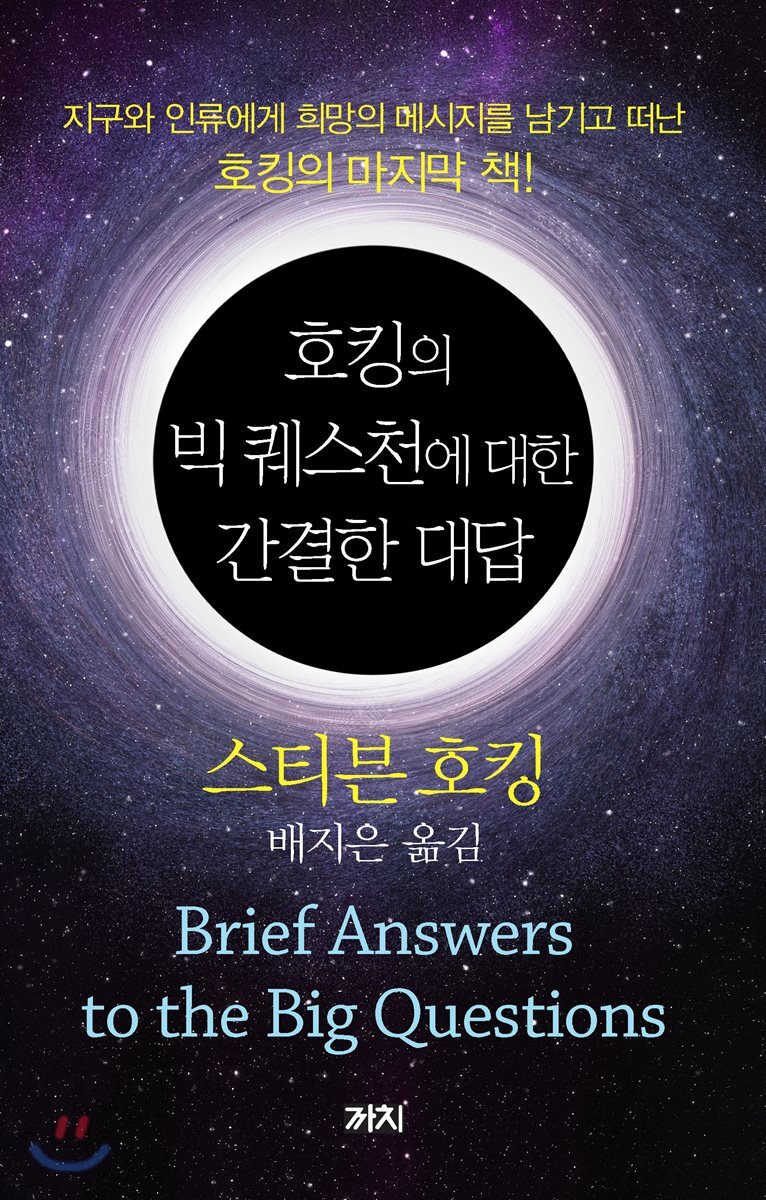
A Concise Answer to Hawking's Big Question
 |
Description
Book Introduction
Solve the Big Questions with imagination, wonder, and creativity. Stephen Hawking's final message, suggesting a breakthrough. Stephen Hawking, who was nicknamed Einstein in his childhood and who achieved the greatest world-wide fame as a scientist since Einstein, left us his final answer to the great question, the Big Question, in this book, and passed away in March 2018 at the age of 76. He supported his family and his studies while battling the devastating effects of Lou Gehrig's disease, which gave him five years to live at the age of just twenty-one. Afterwards, he continued to devote himself to research, even though he was forced to communicate using only a few facial muscles, while also offering wisdom and opinions on social and humanitarian issues. Hawking not only proposed groundbreaking physics theories such as Hawking radiation, Hawking temperature, no-boundary theory, and information contradiction, but also believed that science played a crucial role in solving the problems facing the Earth. He was a bold pioneer of quantum gravity theory, attempting to unify quantum theory and relativity theory. Furthermore, he impressed upon the public the image of a “challenging philosopher” who went beyond the “narrow” world of scientists by approaching the fundamental problems of humanity and mankind and seeking answers to big questions. Now we face enormous challenges on Earth—including climate change, the threat of nuclear war, and the advancement of artificial intelligence—and Hawking encourages us that we can overcome these challenges with our imagination, curiosity, wonder, and creativity. On the one hand, he raised the issue of nuclear war and expressed genuine concern about the recent situation in North Korea. |
- You can preview some of the book's contents.
Preview
index
Foreword / Eddie Redmayne
Introduction / Kip S.
hand
Why We Should Ask the Big Questions
1.
Does God exist?
2.
How did it all begin?
3.
Is there other intelligent life in the universe?
4.
Can we predict the future?
5.
What exists inside a black hole?
6.
Is time travel possible?
7.
Will we survive on Earth?
8.
Should we colonize space?
9.
Will artificial intelligence surpass us?
10.
How should we shape the future?
Review / Lucy Hawking
Acknowledgements
Translator's Note
Search
Introduction / Kip S.
hand
Why We Should Ask the Big Questions
1.
Does God exist?
2.
How did it all begin?
3.
Is there other intelligent life in the universe?
4.
Can we predict the future?
5.
What exists inside a black hole?
6.
Is time travel possible?
7.
Will we survive on Earth?
8.
Should we colonize space?
9.
Will artificial intelligence surpass us?
10.
How should we shape the future?
Review / Lucy Hawking
Acknowledgements
Translator's Note
Search
Detailed image

Publisher's Review
In this book, we can take a concise look at physics theories such as Hawking radiation and the theory of relativity as Hawking answers the Big Questions, and also see his wisdom that goes beyond the limits of knowledge.
He was a giant who left a legacy of hope for humanity both academically and spiritually.
This book has been translated and published in over 30 countries.
10 Big Questions and Their Answers
In this book, Stephen Hawking answers ten big questions, or "Big Questions," starting with the question, "Why should we ask the big questions?"
1.
Does God exist?
2.
How did it all begin?
3.
Can we predict the future?
4.
What exists inside a black hole?
5.
Is time travel possible?
6.
How should we shape the future?
7.
Will we survive on Earth?
8.
Is there other intelligent life in the universe?
9.
Should we colonize space?
10.
Will artificial intelligence surpass us?
He is 1.
Talking about 'Does God Exist?', he explains that the universe was created naturally from nothing according to the laws of science, and that in order for the universe to be created, there must be three basic ingredients: matter, energy, and space, which are lumps of matter with mass.
2. To answer the question, 'How did everything begin?', he mentions the expansion of the universe, and says that by calculating backwards from the current expansion rate, we can conclude that galaxies were very close together about 10-15 billion years ago.
He predicted that at that time, everything was gathered at one point in space, and that the universe began from that point.
3. On the topic of 'Can we predict the future?', Hawking believed that, at least in principle, we can predict the future, but in reality, our ability to predict the future is severely limited due to the incredibly complex equations.
4. In the question, 'What exists inside a black hole?', he talks about what a black hole is and what theories we need to know to understand black holes.
5. In a story about 'Is time travel possible?', it is explained that all that is needed to travel through time is a spaceship that can travel faster than light.
As a spacecraft approaches the speed of light, the thrust required to accelerate it becomes increasingly greater.
So, to accelerate faster than the speed of light, it would take infinite power.
6. Regarding 'How should we shape the future?', Hawking believed that we must look to the wider universe through scientific efforts and technological innovation, while at the same time working to solve problems on Earth.
He was also optimistic that ultimately it would be possible to establish human settlements on other planets.
The answers to these six questions are deeply rooted in the science he studied.
7.
He continues the story with the question, "Will we survive on Earth?" and says that he believes that inevitably, within the next 1,000 years, the Earth will be severely damaged in some way, and that before then, ingenious humans will find a way to escape the Earth's merciless bonds and survive the catastrophe.
8. 'Is There Other Intelligent Life in the Universe?' discusses the probability of life existing elsewhere in the universe and how life might develop in the future.
9. Regarding the question, "Should we colonize space?", give specific examples of why we should go into space and how we should do so.
Stephen Hawking is 10.
In response to the question, "Will AI surpass us?", he explains that using AI as a tool will amplify existing intelligence, leading to improvements across all fields of science and society.
However, there are concerns about the consequences of creating something that would be equal to or even superior to humans.
The answers to these four questions cannot be firmly rooted in the science he studies.
Through these questions and answers, readers can glimpse his profound wisdom and creative side.
In this book, Stephen Hawking presents 10 big questions and his concise and logical answers to them.
He discusses a wide range of topics in great depth, and even offers wise answers to questions that don't have definitive answers.
Hawking's final answer will provide readers with fascinating intellectual stimulation and deep insight, giving them the opportunity to think deeply about where we came from, how the universe began, and who exists outside the universe.
The questions he never let go of until the moment of his death lead us to reconsider where we should go from here.
He was a giant who left a legacy of hope for humanity both academically and spiritually.
This book has been translated and published in over 30 countries.
10 Big Questions and Their Answers
In this book, Stephen Hawking answers ten big questions, or "Big Questions," starting with the question, "Why should we ask the big questions?"
1.
Does God exist?
2.
How did it all begin?
3.
Can we predict the future?
4.
What exists inside a black hole?
5.
Is time travel possible?
6.
How should we shape the future?
7.
Will we survive on Earth?
8.
Is there other intelligent life in the universe?
9.
Should we colonize space?
10.
Will artificial intelligence surpass us?
He is 1.
Talking about 'Does God Exist?', he explains that the universe was created naturally from nothing according to the laws of science, and that in order for the universe to be created, there must be three basic ingredients: matter, energy, and space, which are lumps of matter with mass.
2. To answer the question, 'How did everything begin?', he mentions the expansion of the universe, and says that by calculating backwards from the current expansion rate, we can conclude that galaxies were very close together about 10-15 billion years ago.
He predicted that at that time, everything was gathered at one point in space, and that the universe began from that point.
3. On the topic of 'Can we predict the future?', Hawking believed that, at least in principle, we can predict the future, but in reality, our ability to predict the future is severely limited due to the incredibly complex equations.
4. In the question, 'What exists inside a black hole?', he talks about what a black hole is and what theories we need to know to understand black holes.
5. In a story about 'Is time travel possible?', it is explained that all that is needed to travel through time is a spaceship that can travel faster than light.
As a spacecraft approaches the speed of light, the thrust required to accelerate it becomes increasingly greater.
So, to accelerate faster than the speed of light, it would take infinite power.
6. Regarding 'How should we shape the future?', Hawking believed that we must look to the wider universe through scientific efforts and technological innovation, while at the same time working to solve problems on Earth.
He was also optimistic that ultimately it would be possible to establish human settlements on other planets.
The answers to these six questions are deeply rooted in the science he studied.
7.
He continues the story with the question, "Will we survive on Earth?" and says that he believes that inevitably, within the next 1,000 years, the Earth will be severely damaged in some way, and that before then, ingenious humans will find a way to escape the Earth's merciless bonds and survive the catastrophe.
8. 'Is There Other Intelligent Life in the Universe?' discusses the probability of life existing elsewhere in the universe and how life might develop in the future.
9. Regarding the question, "Should we colonize space?", give specific examples of why we should go into space and how we should do so.
Stephen Hawking is 10.
In response to the question, "Will AI surpass us?", he explains that using AI as a tool will amplify existing intelligence, leading to improvements across all fields of science and society.
However, there are concerns about the consequences of creating something that would be equal to or even superior to humans.
The answers to these four questions cannot be firmly rooted in the science he studies.
Through these questions and answers, readers can glimpse his profound wisdom and creative side.
In this book, Stephen Hawking presents 10 big questions and his concise and logical answers to them.
He discusses a wide range of topics in great depth, and even offers wise answers to questions that don't have definitive answers.
Hawking's final answer will provide readers with fascinating intellectual stimulation and deep insight, giving them the opportunity to think deeply about where we came from, how the universe began, and who exists outside the universe.
The questions he never let go of until the moment of his death lead us to reconsider where we should go from here.
GOODS SPECIFICS
- Date of issue: January 7, 2019
- Page count, weight, size: 298 pages | 566g | 145*225*20mm
- ISBN13: 9788972916802
- ISBN10: 8972916803
You may also like
카테고리
korean


korean

![ELLE 엘르 스페셜 에디션 A형 : 12월 [2025]](http://librairie.coreenne.fr/cdn/shop/files/b8e27a3de6c9538896439686c6b0e8fb.jpg?v=1766436872&width=3840)


