

Scientists 1
 |
Description
Book Introduction
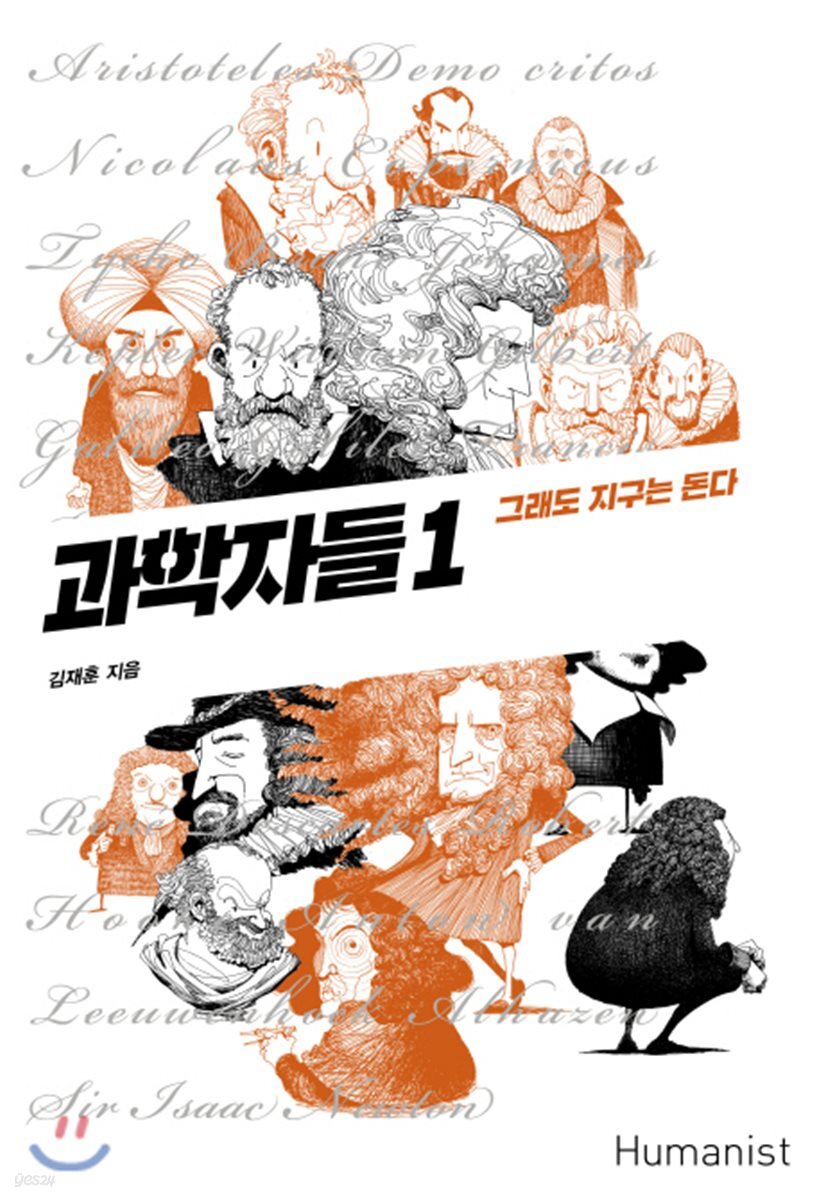
Scientist 1: But the Earth still spins.
- Revolutionaries who gave birth to the discipline of science in an era when religion took precedence over science.
In Volume 1, scientists who started from natural philosophy and established the system of study called science appear.
It shows the process of proving the heliocentric theory from the ancient Greek philosopher Aristotle and Nicolaus Copernicus, who claimed that the Earth revolved in an era when the Earth was the center of the world, to Kepler and Galileo, who continued his research and observations even while under house arrest.
Despite the historical context in which religion was superior to all other academic disciplines, they maintained their beliefs in order to discover the fundamental principles that could explain the world.
Francis Bacon then advocated induction as a new research method in natural science, and René Descartes repeatedly doubted to obtain true knowledge, saying, “I think, therefore I am.”
Therefore, I am,” he cried.
The illustrations provide a clear understanding of Newton's three laws of motion, and also reveal the story of the somewhat unfamiliar Arab scientist Ibn al-Haytham, who had to feign madness to save his life.
- Revolutionaries who gave birth to the discipline of science in an era when religion took precedence over science.
In Volume 1, scientists who started from natural philosophy and established the system of study called science appear.
It shows the process of proving the heliocentric theory from the ancient Greek philosopher Aristotle and Nicolaus Copernicus, who claimed that the Earth revolved in an era when the Earth was the center of the world, to Kepler and Galileo, who continued his research and observations even while under house arrest.
Despite the historical context in which religion was superior to all other academic disciplines, they maintained their beliefs in order to discover the fundamental principles that could explain the world.
Francis Bacon then advocated induction as a new research method in natural science, and René Descartes repeatedly doubted to obtain true knowledge, saying, “I think, therefore I am.”
Therefore, I am,” he cried.
The illustrations provide a clear understanding of Newton's three laws of motion, and also reveal the story of the somewhat unfamiliar Arab scientist Ibn al-Haytham, who had to feign madness to save his life.
- You can preview some of the book's contents.
Preview
index
Scientists 1
: And yet the Earth turns
Before starting the book 4
01 2,000 years of common sense
Aristotle 13
02 Memories of the Atom
Democritus 29
03 Prelude to a Scientific Revolution
Nicolaus Copernicus 45
04 Human Telescope
Tycho Brahe 65
05 The path of the planet
Johannes Kepler 83
06 The power that turns the Earth
William Gilbert 101
07 Evidence for the heliocentric theory found through a telescope
Galileo Galilei 1 117
08 The Laws of Motion in the World
Galileo Galilei 2 131
09 The experiment was successful
Francis Bacon 147
10 Confidence Recovery Projects
René Descartes 161
11 Talented Salaried Scientists
Robert Hooke 177
12 What you see is not everything
Anton van Leeuwenhoek 191
13 Father of Optics
Ibn al-Haytham 205
14 Three Laws of Motion
Isaac Newton 1 221
15 Powers of the Universe
Isaac Newton 2 239
Author's Note 257
Characters and major events in this book 258
260 references mentioned in this book
Reference 262
Search 264
: And yet the Earth turns
Before starting the book 4
01 2,000 years of common sense
Aristotle 13
02 Memories of the Atom
Democritus 29
03 Prelude to a Scientific Revolution
Nicolaus Copernicus 45
04 Human Telescope
Tycho Brahe 65
05 The path of the planet
Johannes Kepler 83
06 The power that turns the Earth
William Gilbert 101
07 Evidence for the heliocentric theory found through a telescope
Galileo Galilei 1 117
08 The Laws of Motion in the World
Galileo Galilei 2 131
09 The experiment was successful
Francis Bacon 147
10 Confidence Recovery Projects
René Descartes 161
11 Talented Salaried Scientists
Robert Hooke 177
12 What you see is not everything
Anton van Leeuwenhoek 191
13 Father of Optics
Ibn al-Haytham 205
14 Three Laws of Motion
Isaac Newton 1 221
15 Powers of the Universe
Isaac Newton 2 239
Author's Note 257
Characters and major events in this book 258
260 references mentioned in this book
Reference 262
Search 264
Detailed image
.jpg)
Publisher's Review
Scientists who have influenced each other in different times and spaces, both alone and together.
Whose shoulders did Newton stand on?
While everyone who studies science is familiar with the names of certain scientists, it is not immediately clear when they were active, what their exact achievements were, or what influence they had on other scientists before developing a single law.
Even the most intelligent and greatest geniuses of the century did not stand alone.
As Newton said, “If I have seen further, it is because I stood on the shoulders of giants.” He was indebted to the research of scientists who came before him and left behind information for future scientists.
They were colleagues and rivals who encouraged each other, and sometimes through arguments and confrontations they proved hypotheses closer to the truth.
In "Scientists," not only are the stories of each scientist revealed, but the thoughts they exchanged and the influence they had on each other are also clearly revealed.
Tycho Brahe handed over the observations he had devoted his life to to Johannes Kepler, a bright young man with only one talent.
Brahe believed that Kepler would further solidify the geocentric theory, but Kepler sought to complete Copernicus' heliocentric theory.
Michael Faraday, known as the father of electromagnetism, developed his dream of pursuing science after attending David Humphrey's lectures in a general science course for the general public, and James Clerk Maxwell, who inherited all of Faraday's research, created the basic equations of electromagnetism that bear his name.
It is said that on the wall of Einstein's laboratory hung portraits of three people: Newton, Faraday, and Maxwell.
However, not all of them had a positive influence on each other.
Jealousy and envy can become the driving force behind research, and arrogance can lead to self-destruction.
52 Scientists Who Left Their Names Over 2,500 Years
Revived as a character and moving vividly
Scientists, who had been described in a flat and monotonous manner in countless books on the history of science, are now revived as characters, finding their own appearance and personality and beginning to breathe life into them.
From the natural philosopher Aristotle in 400 BC to Arno Penzias and Robert Wilson, who won the Nobel Prize for their discovery of cosmic microwave background radiation in 1978, this book captures the important moments of discovery and the human side of 52 scientists selected from the grand history of science.
The 52 key figures are indispensable figures in the history of science, whose achievements in each field are itself academic.
Following the story of each scientist naturally reveals what kind of curiosity led them to focus on a problem and what motivated them to continue their research with perseverance and persistence.
If you read all of 『Scientists』, you can understand the entire history of science, and if you read each volume, you can observe the trends in each field.
In Volume 1, you can meet 13 thinkers, astronomers, and physicists who established a scientific worldview and gave birth to a new discipline called science in opposition to religion. In Volume 2, you can hear the stories of 17 engineers, astronomers, and physicists who developed modern physics through ingenious ideas and continuous research. In Volume 3, we cover 22 chemists, geologists, and biologists who explored the microscopic world and discovered universal truths.
The characters of the main characters, which are based on the actual appearance of each person, as well as the environment in which they grew up and their personality traits, were captured through the unique perspective of writer Kim Jae-hoon.
Through the characters' dialogue, we can glimpse the circumstances of the times and the struggles of scientists, and if we carefully examine the paintings, we can discover elements that the author has carefully hidden.
The more you read it, the more attractive it becomes.
Essential knowledge, intelligent humor, and perfect illustrations.
The science graphic novel we've been waiting for
Why can't science comics satisfy both the content and the illustrations? Until now, most science comics in Korea have been educational comics aimed at young people.
The focus was on organizing knowledge, and pictures were treated as tools or secondary to explaining the content.
But a painting can capture points that are difficult to describe in words, and it becomes an object of appreciation in itself.
Now is the time to discover a work that combines the pleasure of reading with the pleasure of seeing, offering the ultimate satisfaction that can be found through books.
Kim Jae-hoon, a cartoonist known for his overwhelming illustrations, has been continuously working to reprocess text-based knowledge into pictures. He is an exceptional cartoonist who fully utilizes the flexibility of the cartoon genre to visualize the essence of knowledge.
Starting with design, he brought history and philosophy into the realm of drawing through his previous works, 『Design Caricature』, 『Rival』, and the cartoons serialized in 『JoongAng Ilbo』, and this time he has incorporated 'science' into the form of knowledge cartoons.
"Scientists" (3 volumes) is a work that unfolds the major figures in the history of science into comics, and the characters and storylines of each scientist are brought to life to make it even more engaging.
It also helps you visualize concepts to understand scientific knowledge more intuitively.
Artist Kim Jae-hoon's refined illustrations, featuring delicate sketches, intelligent humor that exudes a cynical charm, and solid knowledge that covers essential concepts and events, herald the birth of a Korean-style science graphic novel unlike anything seen before.
Whose shoulders did Newton stand on?
While everyone who studies science is familiar with the names of certain scientists, it is not immediately clear when they were active, what their exact achievements were, or what influence they had on other scientists before developing a single law.
Even the most intelligent and greatest geniuses of the century did not stand alone.
As Newton said, “If I have seen further, it is because I stood on the shoulders of giants.” He was indebted to the research of scientists who came before him and left behind information for future scientists.
They were colleagues and rivals who encouraged each other, and sometimes through arguments and confrontations they proved hypotheses closer to the truth.
In "Scientists," not only are the stories of each scientist revealed, but the thoughts they exchanged and the influence they had on each other are also clearly revealed.
Tycho Brahe handed over the observations he had devoted his life to to Johannes Kepler, a bright young man with only one talent.
Brahe believed that Kepler would further solidify the geocentric theory, but Kepler sought to complete Copernicus' heliocentric theory.
Michael Faraday, known as the father of electromagnetism, developed his dream of pursuing science after attending David Humphrey's lectures in a general science course for the general public, and James Clerk Maxwell, who inherited all of Faraday's research, created the basic equations of electromagnetism that bear his name.
It is said that on the wall of Einstein's laboratory hung portraits of three people: Newton, Faraday, and Maxwell.
However, not all of them had a positive influence on each other.
Jealousy and envy can become the driving force behind research, and arrogance can lead to self-destruction.
52 Scientists Who Left Their Names Over 2,500 Years
Revived as a character and moving vividly
Scientists, who had been described in a flat and monotonous manner in countless books on the history of science, are now revived as characters, finding their own appearance and personality and beginning to breathe life into them.
From the natural philosopher Aristotle in 400 BC to Arno Penzias and Robert Wilson, who won the Nobel Prize for their discovery of cosmic microwave background radiation in 1978, this book captures the important moments of discovery and the human side of 52 scientists selected from the grand history of science.
The 52 key figures are indispensable figures in the history of science, whose achievements in each field are itself academic.
Following the story of each scientist naturally reveals what kind of curiosity led them to focus on a problem and what motivated them to continue their research with perseverance and persistence.
If you read all of 『Scientists』, you can understand the entire history of science, and if you read each volume, you can observe the trends in each field.
In Volume 1, you can meet 13 thinkers, astronomers, and physicists who established a scientific worldview and gave birth to a new discipline called science in opposition to religion. In Volume 2, you can hear the stories of 17 engineers, astronomers, and physicists who developed modern physics through ingenious ideas and continuous research. In Volume 3, we cover 22 chemists, geologists, and biologists who explored the microscopic world and discovered universal truths.
The characters of the main characters, which are based on the actual appearance of each person, as well as the environment in which they grew up and their personality traits, were captured through the unique perspective of writer Kim Jae-hoon.
Through the characters' dialogue, we can glimpse the circumstances of the times and the struggles of scientists, and if we carefully examine the paintings, we can discover elements that the author has carefully hidden.
The more you read it, the more attractive it becomes.
Essential knowledge, intelligent humor, and perfect illustrations.
The science graphic novel we've been waiting for
Why can't science comics satisfy both the content and the illustrations? Until now, most science comics in Korea have been educational comics aimed at young people.
The focus was on organizing knowledge, and pictures were treated as tools or secondary to explaining the content.
But a painting can capture points that are difficult to describe in words, and it becomes an object of appreciation in itself.
Now is the time to discover a work that combines the pleasure of reading with the pleasure of seeing, offering the ultimate satisfaction that can be found through books.
Kim Jae-hoon, a cartoonist known for his overwhelming illustrations, has been continuously working to reprocess text-based knowledge into pictures. He is an exceptional cartoonist who fully utilizes the flexibility of the cartoon genre to visualize the essence of knowledge.
Starting with design, he brought history and philosophy into the realm of drawing through his previous works, 『Design Caricature』, 『Rival』, and the cartoons serialized in 『JoongAng Ilbo』, and this time he has incorporated 'science' into the form of knowledge cartoons.
"Scientists" (3 volumes) is a work that unfolds the major figures in the history of science into comics, and the characters and storylines of each scientist are brought to life to make it even more engaging.
It also helps you visualize concepts to understand scientific knowledge more intuitively.
Artist Kim Jae-hoon's refined illustrations, featuring delicate sketches, intelligent humor that exudes a cynical charm, and solid knowledge that covers essential concepts and events, herald the birth of a Korean-style science graphic novel unlike anything seen before.
GOODS SPECIFICS
- Date of publication: September 27, 2018
- Page count, weight, size: 272 pages | 616g | 158*235*20mm
- ISBN13: 9791160801590
- ISBN10: 1160801592
You may also like
카테고리
korean


korean

![ELLE 엘르 스페셜 에디션 A형 : 12월 [2025]](http://librairie.coreenne.fr/cdn/shop/files/b8e27a3de6c9538896439686c6b0e8fb.jpg?v=1766436872&width=3840)


