

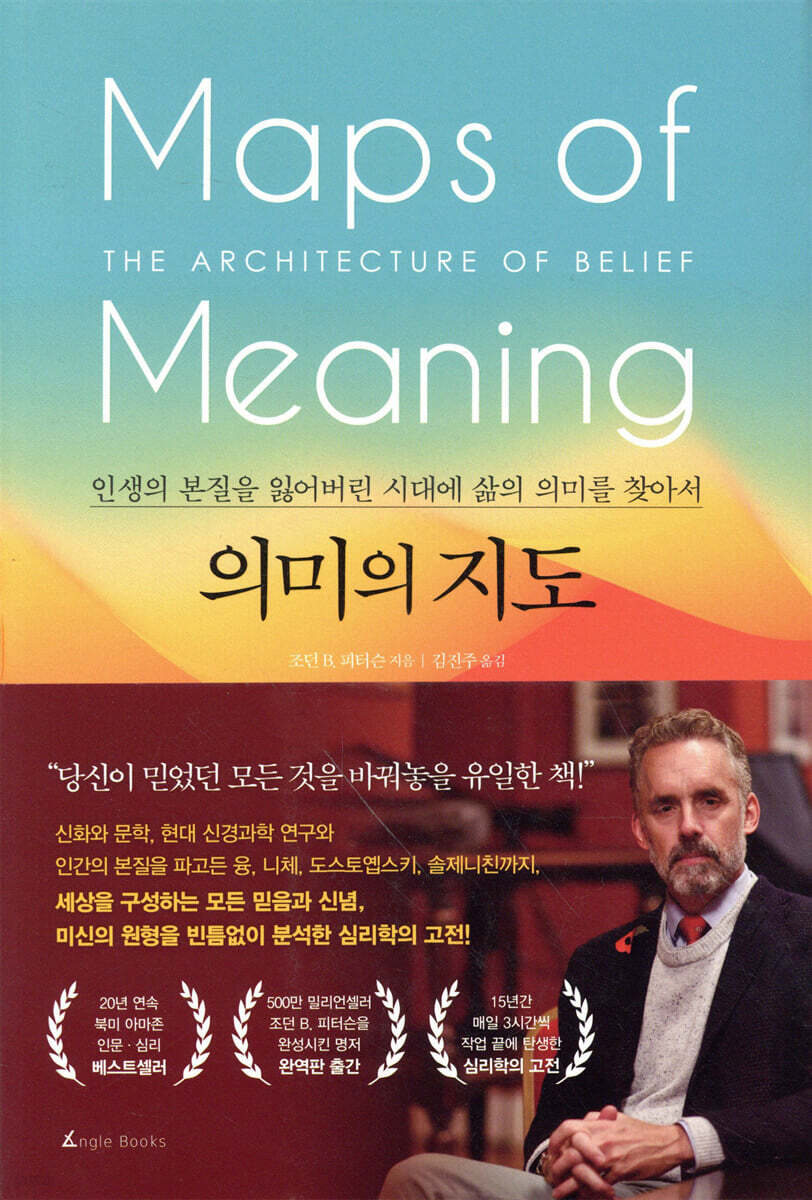
Map of meaning
 |
Description
Book Introduction
- A word from MD
-
A classic of modern psychologyJordan Peterson's masterpiece, which served as the basis for "12 Rules for Life" and "Beyond Order."
What is there in the world? How should we live? Jordan Peterson examines mythology, literature, philosophy, and modern neuroscience to reconstruct the rules of life.
In an age where values have disappeared, can we regain the meaning of life?November 9, 2021. Humanities PD Son Min-gyu
Through a new reading of true choice, meaning, and direction in life.
Destroying the 'perfect order' that leaves us empty!
We need to know four things:
“What is there in this world?
What to do with it.
“There is a difference between knowing what you have and knowing what to do with it.”
So what is the difference?
Every culture has a core premise that forms the center of the culture and serves as the foundation for all secondary beliefs.
We cannot easily give up this premise, because if we give up, 'everything we believed in' will collapse, and the unknown that brings chaos will once again dominate the world.
Drawing on research in mythology, literature, and modern neuroscience, this book shows how humans learn to navigate perilous "unexplored territories" and how they transform those unknown threats into opportunities, leading us to rediscover the "structure and meaning of beliefs" that govern and shape our lives.
Moreover, in this era where all standards of law, justice, and right and wrong are being shaken, this will serve as an opportunity to once again realize what we must protect and live by, and why it is important.
Destroying the 'perfect order' that leaves us empty!
We need to know four things:
“What is there in this world?
What to do with it.
“There is a difference between knowing what you have and knowing what to do with it.”
So what is the difference?
Every culture has a core premise that forms the center of the culture and serves as the foundation for all secondary beliefs.
We cannot easily give up this premise, because if we give up, 'everything we believed in' will collapse, and the unknown that brings chaos will once again dominate the world.
Drawing on research in mythology, literature, and modern neuroscience, this book shows how humans learn to navigate perilous "unexplored territories" and how they transform those unknown threats into opportunities, leading us to rediscover the "structure and meaning of beliefs" that govern and shape our lives.
Moreover, in this era where all standards of law, justice, and right and wrong are being shaken, this will serve as an opportunity to once again realize what we must protect and live by, and why it is important.
- You can preview some of the book's contents.
Preview
index
prolog
“Go down to hell”
Chapter 1: The Map of Experience: On Things and Meaning
I thought that if I understood a thought conceptually, I could claim rights to that thought.
I thought I could accept it as if it were my own thoughts, as if it were myself.
At the time, my head was filled with other people's thoughts, claims that I couldn't logically refute.
I didn't realize that just because an idea is irrefutable doesn't mean it's true, and that you have to earn the right to make an idea your own.
The Age of Myth | The Lightness and Uncertainty of Being | How Should We Act?
Chapter 2: The Map of Meaning: Three Dimensions of Analysis
I learned that the horrific things we experience in life can actually be a necessary prerequisite for life, and that this condition can be understood and accepted.
In order to survive, we must model 'meaning'.
This map of meaning, in the form of a story that we so desperately need, shows us the value of reality compared to our ideals, and also provides practical methods, or action plans, to achieve our desired goals.
The Essence of the Mind | The Components of Experience in Myth | The Great Father, Images of Bases and Explored Territories
Chapter 3: Training Period and Socialization: Embracing "Shared Guidance"
When the terrain changes, you can't reach your destination just by walking along a well-trodden path.
If we fail to adapt our habits and beliefs to keep pace with change, we will deceive ourselves, deny the world, and replace reality with hopes that will soon crumble.
As a result of their inability to face reality as it is, they destroy the foundation of their lives, face an uncertain future, and become trapped in the past that had been their refuge.
Chapter 4: The Emergence of Anomalies: Challenges to the "Shared Map"
The fact that an anomaly has occurred in the world of experience simply means that there is a flaw in the goal-oriented schema that dictates our current actions and evaluation criteria.
In the first stage of analyzing an anomaly, the exact location and cause of the error and its meaning are merely 'hypotheses'.
To properly understand and experience anomalies, we must elicit their specific meaning.
We must work hard to transform purely emotional information into behavior, beliefs, and even mental and personality changes.
The Paradigmatic Structure of the Base | The Four Faces of the Anomaly | The Emergence of Self-Consciousness and the Anomaly Eternally Imbued with Death
Chapter 5: Conflicting Brothers: Archetypal Responses to the Unknown
Meaning is the most profound expression of instinct.
Humans are drawn to the unknown and are accustomed to conquering the unknown.
Our instinct to perceive meaning in our minds regulates the extent to which we engage with the unknown.
When you are exposed to too much of the unknown, change turns into chaos.
If you have too little contact, you will stagnate and regress.
People who find a good balance between the two will develop a strong personality.
You will gain the confidence to endure life and the adaptability to deal with nature and society, and you will be able to get closer to the heroic ideal.
The Emergence, Development, and Representation of the Enemy | The Antagonist's Deliberate Distortion of the Map of Meaning | The Hero's Adaptive Patterns of Reconstructing the Map of Meaning | The Alchemical Process and the Philosopher's Stone | Small Decisions That Change the World
Epilogue
The confidence that you can endure life
main
“Go down to hell”
Chapter 1: The Map of Experience: On Things and Meaning
I thought that if I understood a thought conceptually, I could claim rights to that thought.
I thought I could accept it as if it were my own thoughts, as if it were myself.
At the time, my head was filled with other people's thoughts, claims that I couldn't logically refute.
I didn't realize that just because an idea is irrefutable doesn't mean it's true, and that you have to earn the right to make an idea your own.
The Age of Myth | The Lightness and Uncertainty of Being | How Should We Act?
Chapter 2: The Map of Meaning: Three Dimensions of Analysis
I learned that the horrific things we experience in life can actually be a necessary prerequisite for life, and that this condition can be understood and accepted.
In order to survive, we must model 'meaning'.
This map of meaning, in the form of a story that we so desperately need, shows us the value of reality compared to our ideals, and also provides practical methods, or action plans, to achieve our desired goals.
The Essence of the Mind | The Components of Experience in Myth | The Great Father, Images of Bases and Explored Territories
Chapter 3: Training Period and Socialization: Embracing "Shared Guidance"
When the terrain changes, you can't reach your destination just by walking along a well-trodden path.
If we fail to adapt our habits and beliefs to keep pace with change, we will deceive ourselves, deny the world, and replace reality with hopes that will soon crumble.
As a result of their inability to face reality as it is, they destroy the foundation of their lives, face an uncertain future, and become trapped in the past that had been their refuge.
Chapter 4: The Emergence of Anomalies: Challenges to the "Shared Map"
The fact that an anomaly has occurred in the world of experience simply means that there is a flaw in the goal-oriented schema that dictates our current actions and evaluation criteria.
In the first stage of analyzing an anomaly, the exact location and cause of the error and its meaning are merely 'hypotheses'.
To properly understand and experience anomalies, we must elicit their specific meaning.
We must work hard to transform purely emotional information into behavior, beliefs, and even mental and personality changes.
The Paradigmatic Structure of the Base | The Four Faces of the Anomaly | The Emergence of Self-Consciousness and the Anomaly Eternally Imbued with Death
Chapter 5: Conflicting Brothers: Archetypal Responses to the Unknown
Meaning is the most profound expression of instinct.
Humans are drawn to the unknown and are accustomed to conquering the unknown.
Our instinct to perceive meaning in our minds regulates the extent to which we engage with the unknown.
When you are exposed to too much of the unknown, change turns into chaos.
If you have too little contact, you will stagnate and regress.
People who find a good balance between the two will develop a strong personality.
You will gain the confidence to endure life and the adaptability to deal with nature and society, and you will be able to get closer to the heroic ideal.
The Emergence, Development, and Representation of the Enemy | The Antagonist's Deliberate Distortion of the Map of Meaning | The Hero's Adaptive Patterns of Reconstructing the Map of Meaning | The Alchemical Process and the Philosopher's Stone | Small Decisions That Change the World
Epilogue
The confidence that you can endure life
main
Detailed image

Into the book
Today, humanity possesses technological capabilities that are both immensely destructive and creative, but at the same time, it is equally engulfed in the lightness of existence, uncertainty, and chaos.
Constant cultural exchange and critical thinking have made it difficult for us to trust in age-old traditions.
Maybe there was a good reason for that.
But man cannot live without faith, and science cannot create faith.
We have to believe in something.
So, since the rise of science, have the myths we have come to rely on been more refined and complete than those we have rejected?
--- p.54
Humans, like animals, are true to their instincts.
Will this eat me? Can I eat this? Will this chase me? Should I chase this? Could this be a mate? We can model "objective reality," and there's no doubt that such modeling is useful.
But in order to survive, we must model 'meaning'.
This map of meaning (in the form of a story) that we desperately need shows us the value of reality compared to our ideals, and also provides practical methods, or action plans, to achieve our desired goals.
Describing the three elements—the current state, the ideal future, and a plan to change the current state into the ideal future—is a necessary and sufficient condition for weaving together the simplest form of a story.
Stories like these explain the value of our given environment in relation to spatiotemporally limited behavioral patterns.
Assuming we are now at point A, we can go to point B.
Because if you don't know where you are now, you can't plan where to go.
The fact that point B is the final goal means that the value of point B is higher than the value of point A.
Point B is a more ideal point compared to the current location.
The map is given emotional value, meaning, because of the perception that point B is better than the present.
The ability to create hypothetical goals, such as point B, and compare them to the present allows humans to utilize their cognitive systems to regulate their emotional responses.
--- p.74
To exaggerate a bit, we could say that we spend our entire lives trying to avoid encountering the unknown, or at least 'unintentionally'.
As civilized people, we enjoy a sense of security.
(Assuming that others share their stories with us) we can predict others' behavior and, furthermore, control our environment to minimize the possibility of threat or punishment.
Such prediction and control became possible as a result of accumulated efforts to adapt to the environment, which formed a culture.
But it is this very culture that blinds us to the depths of our emotional reality, to the breadth of its scope and the dramatic consequences of its consequences.
--- p.129
This mysterious and seemingly absurd 'sacrifice ritual' actually enacts two key, interrelated ideas in dramatic form.
First, the human essence (the divine aspect) must constantly be 'offered up' to the unknown and must voluntarily come before the destructive and creative power of the Great Mother, the embodiment of the unknown.
Second, only when we destroy and sacrifice what we 'love most' do the unknown positive aspects of ourselves emerge.
The first idea is based on the idea that new information must be generated and new behavior patterns developed through voluntary encounters with the unknown.
The second idea is that clinging to something that is inappropriate, outdated, or ineffective (such as inappropriate behaviors or beliefs) hinders adaptation and turns the world into a wasteland.
The act of clinging to 'things of inappropriate value' is an act of being ruled by a 'sick value system' (a dead god) and denying the hero.
--- p.318~319
It is very foolish to act as if only some of the elements that make up the world exist.
Ignored elements will inevitably raise their heads even when oppressed.
And in an undesirable way, too.
Knowledge of myths makes it easier to avoid being fooled by ideologies.
A true myth portrays the many contradictory aspects that exist in any situation.
Behind every positive aspect, there is always an 'enemy' lurking.
Therefore, the benevolent aspect of 'nature' must be understood alongside its horrific aspect of randomly inflicting suffering and death on living beings.
Moreover, the power of society to protect and safeguard individuals can only be properly understood in light of the conservatism of a society that has become corrupt and suppresses diversity.
Even the heroic aspect of an individual must be viewed in light of the arrogant, cowardly, and cruel nature of his adversary.
Stories that fully explain the 'components of the real world' in this way are stable and balanced, unlike ideologies, and cause far fewer social ills.
But the elements that make up the world as a field of action are constantly in conflict and at war.
Where should we go amidst these conflicting elements? How can we consider "all elements" and still survive without being destroyed? Examining the relationship between "individual, society, and chaos" from a developmental perspective can help us understand the appropriate interplay between these forces.
--- p.400~401
The core of human limitation is not suffering, but existence itself.
Humans have the ability to carry the weight of their own limitations.
The reason we turn away from that ability and become corrupt is because we are afraid to take responsibility for our own lives.
Then the tragic condition of existence necessary for life becomes unbearable.
Contrary to popular belief, it is not earthquakes, floods, or cancer that make life truly unbearable.
Humans can withstand natural disasters and, moreover, deal with them with nobility and dignity.
It is the senseless suffering we inflict on one another, our own evil, that degrades life to the point of unacceptability and shakes our faith in human nature.
So why does the ability to commit evil exist?
--- p.495
Usually, a false person is guilty of not doing something he ought to do (of course, he may also commit active sins) rather than doing something he ought not to do.
They deliberately fail to explore and update existing knowledge.
The fact that an anomaly has occurred in the world of experience simply means that there is a flaw in the goal-oriented schema that dictates our current actions and evaluation criteria.
In the first stage of analyzing an anomaly, the exact location and cause of the error and its meaning are merely 'hypotheses'.
To properly understand and experience anomalies, we must elicit their specific meaning.
We must work hard to transform purely emotional information into behavior, beliefs, and even mental and personality changes.
Experiencing anomalies and taking no action is the simplest and most common way to commit a lie.
By not looking at anything and not acting, you can temporarily hide the dangers inherent in your mistakes.
People who reject creative exploration in this way do not bother to refresh their procedural and descriptive memories, but rather adapt to the present as if nothing has changed, refusing to think in new ways.
Correcting errors requires effort.
It takes courage to mediate between order and chaos.
--- p.601~602
Meaning is the most profound expression of instinct.
Humans are drawn to the unknown and are accustomed to conquering the unknown.
Our instinct to perceive meaning in our minds regulates the extent to which we engage with the unknown.
When you are exposed to too much of the unknown, change turns into chaos.
Conversely, if you have too little contact, you will stagnate and regress.
People who find a good balance between the two will develop a strong personality.
You will gain the confidence to endure life and the adaptability to deal with nature and society, and you will be able to get closer to the heroic ideal.
Because each person is unique, if they have the courage to maintain their individuality, they can each find meaning in their own way.
When the diverse individualities of individuals are expressed and transformed into knowledge that can be passed on to society, the course of history will change, and all of humanity will enter deeper into unknown territory.
We each have social and biological conditions that set the limits of our lives.
But those who know how to consistently pursue their heart's interest will transcend limitations by acquiring their own appropriate means.
Meaning is the instinct that makes life possible.
If we abandon meaning, each individual's individuality loses its power to save.
The worst lie is to say that meaning does not exist or that meaning is not important.
Those who deny meaning are bound to be visited by hatred for life and a desire for destruction.
--- p.871~872
Father, I think I've discovered something no one has ever thought of before.
But I'm not sure if I can convey that idea properly.
The idea is so vast that we can only think clearly about a part of it at a time.
It's really difficult to write it all down.
So, most of the knowledge I'm trying to convey in logical language has always been passed down from one person to another through art, music, religion, and tradition, rather than through rational explanations. It's like translating one language into another.
But this is not just a different language, it is a completely different way of experiencing things.
Constant cultural exchange and critical thinking have made it difficult for us to trust in age-old traditions.
Maybe there was a good reason for that.
But man cannot live without faith, and science cannot create faith.
We have to believe in something.
So, since the rise of science, have the myths we have come to rely on been more refined and complete than those we have rejected?
--- p.54
Humans, like animals, are true to their instincts.
Will this eat me? Can I eat this? Will this chase me? Should I chase this? Could this be a mate? We can model "objective reality," and there's no doubt that such modeling is useful.
But in order to survive, we must model 'meaning'.
This map of meaning (in the form of a story) that we desperately need shows us the value of reality compared to our ideals, and also provides practical methods, or action plans, to achieve our desired goals.
Describing the three elements—the current state, the ideal future, and a plan to change the current state into the ideal future—is a necessary and sufficient condition for weaving together the simplest form of a story.
Stories like these explain the value of our given environment in relation to spatiotemporally limited behavioral patterns.
Assuming we are now at point A, we can go to point B.
Because if you don't know where you are now, you can't plan where to go.
The fact that point B is the final goal means that the value of point B is higher than the value of point A.
Point B is a more ideal point compared to the current location.
The map is given emotional value, meaning, because of the perception that point B is better than the present.
The ability to create hypothetical goals, such as point B, and compare them to the present allows humans to utilize their cognitive systems to regulate their emotional responses.
--- p.74
To exaggerate a bit, we could say that we spend our entire lives trying to avoid encountering the unknown, or at least 'unintentionally'.
As civilized people, we enjoy a sense of security.
(Assuming that others share their stories with us) we can predict others' behavior and, furthermore, control our environment to minimize the possibility of threat or punishment.
Such prediction and control became possible as a result of accumulated efforts to adapt to the environment, which formed a culture.
But it is this very culture that blinds us to the depths of our emotional reality, to the breadth of its scope and the dramatic consequences of its consequences.
--- p.129
This mysterious and seemingly absurd 'sacrifice ritual' actually enacts two key, interrelated ideas in dramatic form.
First, the human essence (the divine aspect) must constantly be 'offered up' to the unknown and must voluntarily come before the destructive and creative power of the Great Mother, the embodiment of the unknown.
Second, only when we destroy and sacrifice what we 'love most' do the unknown positive aspects of ourselves emerge.
The first idea is based on the idea that new information must be generated and new behavior patterns developed through voluntary encounters with the unknown.
The second idea is that clinging to something that is inappropriate, outdated, or ineffective (such as inappropriate behaviors or beliefs) hinders adaptation and turns the world into a wasteland.
The act of clinging to 'things of inappropriate value' is an act of being ruled by a 'sick value system' (a dead god) and denying the hero.
--- p.318~319
It is very foolish to act as if only some of the elements that make up the world exist.
Ignored elements will inevitably raise their heads even when oppressed.
And in an undesirable way, too.
Knowledge of myths makes it easier to avoid being fooled by ideologies.
A true myth portrays the many contradictory aspects that exist in any situation.
Behind every positive aspect, there is always an 'enemy' lurking.
Therefore, the benevolent aspect of 'nature' must be understood alongside its horrific aspect of randomly inflicting suffering and death on living beings.
Moreover, the power of society to protect and safeguard individuals can only be properly understood in light of the conservatism of a society that has become corrupt and suppresses diversity.
Even the heroic aspect of an individual must be viewed in light of the arrogant, cowardly, and cruel nature of his adversary.
Stories that fully explain the 'components of the real world' in this way are stable and balanced, unlike ideologies, and cause far fewer social ills.
But the elements that make up the world as a field of action are constantly in conflict and at war.
Where should we go amidst these conflicting elements? How can we consider "all elements" and still survive without being destroyed? Examining the relationship between "individual, society, and chaos" from a developmental perspective can help us understand the appropriate interplay between these forces.
--- p.400~401
The core of human limitation is not suffering, but existence itself.
Humans have the ability to carry the weight of their own limitations.
The reason we turn away from that ability and become corrupt is because we are afraid to take responsibility for our own lives.
Then the tragic condition of existence necessary for life becomes unbearable.
Contrary to popular belief, it is not earthquakes, floods, or cancer that make life truly unbearable.
Humans can withstand natural disasters and, moreover, deal with them with nobility and dignity.
It is the senseless suffering we inflict on one another, our own evil, that degrades life to the point of unacceptability and shakes our faith in human nature.
So why does the ability to commit evil exist?
--- p.495
Usually, a false person is guilty of not doing something he ought to do (of course, he may also commit active sins) rather than doing something he ought not to do.
They deliberately fail to explore and update existing knowledge.
The fact that an anomaly has occurred in the world of experience simply means that there is a flaw in the goal-oriented schema that dictates our current actions and evaluation criteria.
In the first stage of analyzing an anomaly, the exact location and cause of the error and its meaning are merely 'hypotheses'.
To properly understand and experience anomalies, we must elicit their specific meaning.
We must work hard to transform purely emotional information into behavior, beliefs, and even mental and personality changes.
Experiencing anomalies and taking no action is the simplest and most common way to commit a lie.
By not looking at anything and not acting, you can temporarily hide the dangers inherent in your mistakes.
People who reject creative exploration in this way do not bother to refresh their procedural and descriptive memories, but rather adapt to the present as if nothing has changed, refusing to think in new ways.
Correcting errors requires effort.
It takes courage to mediate between order and chaos.
--- p.601~602
Meaning is the most profound expression of instinct.
Humans are drawn to the unknown and are accustomed to conquering the unknown.
Our instinct to perceive meaning in our minds regulates the extent to which we engage with the unknown.
When you are exposed to too much of the unknown, change turns into chaos.
Conversely, if you have too little contact, you will stagnate and regress.
People who find a good balance between the two will develop a strong personality.
You will gain the confidence to endure life and the adaptability to deal with nature and society, and you will be able to get closer to the heroic ideal.
Because each person is unique, if they have the courage to maintain their individuality, they can each find meaning in their own way.
When the diverse individualities of individuals are expressed and transformed into knowledge that can be passed on to society, the course of history will change, and all of humanity will enter deeper into unknown territory.
We each have social and biological conditions that set the limits of our lives.
But those who know how to consistently pursue their heart's interest will transcend limitations by acquiring their own appropriate means.
Meaning is the instinct that makes life possible.
If we abandon meaning, each individual's individuality loses its power to save.
The worst lie is to say that meaning does not exist or that meaning is not important.
Those who deny meaning are bound to be visited by hatred for life and a desire for destruction.
--- p.871~872
Father, I think I've discovered something no one has ever thought of before.
But I'm not sure if I can convey that idea properly.
The idea is so vast that we can only think clearly about a part of it at a time.
It's really difficult to write it all down.
So, most of the knowledge I'm trying to convey in logical language has always been passed down from one person to another through art, music, religion, and tradition, rather than through rational explanations. It's like translating one language into another.
But this is not just a different language, it is a completely different way of experiencing things.
--- p.855
Publisher's Review
A classic in psychology born from 15 years of 3-hour work every day!
So far Jordan B.
Peterson has suggested
Meet the humanities book that forms the foundation of all life's laws.
This book, which is close to 1000 pages, is not easy to own or read.
Why It's Amazon's Longest-Running Bestseller in the Humanities and Psychology Category
Jordan B., named “The Professor Who Changed My Life” by University of Toronto students and now an international bestselling author.
Peterson's first book, Maps of Meaning, published in 1999, offers a deep and broad analysis of human nature across numerous fields, including historical sources, the Bible, myths and narratives, philosophy, psychology, and brain science.
This book, which has been a bestseller in humanities psychology on Amazon for over 20 years, is also considered a classic of psychology that needs no further explanation.
"Map of Meaning," which has been repeatedly cited in many of Peterson's books, including his representative work, "12 Rules for Life," is the result of Peterson's regular work of three hours a day for nearly 15 years from 1985 to 1999, and thus contains more fundamental and in-depth content than his previous works.
Of course, it is a thick humanities book that requires some courage to read as it is close to 1000 pages, but Jordan B.
It is worth the challenge, as it is said to be the work that completed Peterson's thought.
"Map of Meaning," which took over two years to translate into Korean, explains the fundamental foundations of "belief" and "conviction" that govern human beings, along with their systems and structures, and through this, connects human nature, ideology, and the mechanisms of social structure with surprising insight.
Things that are essentially the same but bring about completely different life outcomes
To understand the meaning of categories of things
We need to learn to think differently than we do now.
“I was afraid of life, and I struggled to escape from it,
And yet I hoped for something from him.” _Tolstoy
The author says that at the root of the world, 'order' and 'chaos' coexist, and that these two, that is, culture and nature, the unknown and the known, are intertwined and irregular reactions form and change the world.
And through powerful insights and arguments to find a balance between these gaps, it also rejects conservative or progressive worldviews, or extreme ideologies such as fascism and totalitarianism.
He argues that we must acknowledge and confront the 'chaos' that continues to permeate our constructed world order, and explore the dangerous unknown.
That is, in order to have the power of belief that sustains our lives, the adaptability to properly deal with nature and society, and to get closer to our ideal goals, we must neither be dominated by a universal order nor avoid chaos.
The subtitles “Antidotes to Chaos” and “Beyond Order” are an extension of this perspective.
Advancing our understanding of humanity and communities through the wisdom and meaning of myth.
The author says, “Knowledge of myths makes it easier to avoid being fooled by ideology.”
That is because a true myth comprehensively portrays the various contradictory aspects that exist in any situation.
It's as if there's always something 'negative' lurking behind every positive aspect.
In this book, Jordan Peterson shows how mythic archetypes shape our behavior and provide us with meaning, influencing our psyche and shaping our cultural, moral, religious, and spiritual beliefs.
Through this 'mythical thinking', we can gain another frame for looking at life with more insight.
About the structure of beliefs that are most precious in our lives
By the end of my childhood, I had abandoned the value system that had been the foundation of my life.
This meant that I had no socially constructed universal 'philosophy' within me to help me understand the ontological questions that had arisen in my mind as I grew up.
It took me years to fully realize the consequences of the absence of philosophy.
"The Map of Meaning" is a book that the author began to write in order to solve the homework he had in life.
He delves into the archetypes of human motivation and emotion hidden in the great ideas of ancient and modern times to understand the structure of 'beliefs' that govern life and society.
Moreover, through the author's own psychological counseling case, he shows how life can become 'meaningful' and valuable regardless of circumstances through just belief.
Meaning is the instinct that makes life possible.
If we abandon meaning, each individual's individuality loses its power to save.
The worst lie is to say that meaning does not exist or that meaning is not important.
Those who deny meaning are bound to be visited by hatred for life and a desire for destruction.
Ultimately, this book deals with the vast mythological foundations that make up the world and human nature, but it also contains questions about the social absurdities we encounter as we live, the limitations of life, and the value and meaning of life that exist only on the borderline between order and chaos, and how to find them.
The 'heroic life' that the author found in the link between ancient and modern thought is nothing else.
To draw the meaning of life, we must not be afraid to stand on the borderline between order and chaos, face and accept the changes that come with it, and thus gain the 'confidence to endure life.'
So far Jordan B.
Peterson has suggested
Meet the humanities book that forms the foundation of all life's laws.
This book, which is close to 1000 pages, is not easy to own or read.
Why It's Amazon's Longest-Running Bestseller in the Humanities and Psychology Category
Jordan B., named “The Professor Who Changed My Life” by University of Toronto students and now an international bestselling author.
Peterson's first book, Maps of Meaning, published in 1999, offers a deep and broad analysis of human nature across numerous fields, including historical sources, the Bible, myths and narratives, philosophy, psychology, and brain science.
This book, which has been a bestseller in humanities psychology on Amazon for over 20 years, is also considered a classic of psychology that needs no further explanation.
"Map of Meaning," which has been repeatedly cited in many of Peterson's books, including his representative work, "12 Rules for Life," is the result of Peterson's regular work of three hours a day for nearly 15 years from 1985 to 1999, and thus contains more fundamental and in-depth content than his previous works.
Of course, it is a thick humanities book that requires some courage to read as it is close to 1000 pages, but Jordan B.
It is worth the challenge, as it is said to be the work that completed Peterson's thought.
"Map of Meaning," which took over two years to translate into Korean, explains the fundamental foundations of "belief" and "conviction" that govern human beings, along with their systems and structures, and through this, connects human nature, ideology, and the mechanisms of social structure with surprising insight.
Things that are essentially the same but bring about completely different life outcomes
To understand the meaning of categories of things
We need to learn to think differently than we do now.
“I was afraid of life, and I struggled to escape from it,
And yet I hoped for something from him.” _Tolstoy
The author says that at the root of the world, 'order' and 'chaos' coexist, and that these two, that is, culture and nature, the unknown and the known, are intertwined and irregular reactions form and change the world.
And through powerful insights and arguments to find a balance between these gaps, it also rejects conservative or progressive worldviews, or extreme ideologies such as fascism and totalitarianism.
He argues that we must acknowledge and confront the 'chaos' that continues to permeate our constructed world order, and explore the dangerous unknown.
That is, in order to have the power of belief that sustains our lives, the adaptability to properly deal with nature and society, and to get closer to our ideal goals, we must neither be dominated by a universal order nor avoid chaos.
The subtitles “Antidotes to Chaos” and “Beyond Order” are an extension of this perspective.
Advancing our understanding of humanity and communities through the wisdom and meaning of myth.
The author says, “Knowledge of myths makes it easier to avoid being fooled by ideology.”
That is because a true myth comprehensively portrays the various contradictory aspects that exist in any situation.
It's as if there's always something 'negative' lurking behind every positive aspect.
In this book, Jordan Peterson shows how mythic archetypes shape our behavior and provide us with meaning, influencing our psyche and shaping our cultural, moral, religious, and spiritual beliefs.
Through this 'mythical thinking', we can gain another frame for looking at life with more insight.
About the structure of beliefs that are most precious in our lives
By the end of my childhood, I had abandoned the value system that had been the foundation of my life.
This meant that I had no socially constructed universal 'philosophy' within me to help me understand the ontological questions that had arisen in my mind as I grew up.
It took me years to fully realize the consequences of the absence of philosophy.
"The Map of Meaning" is a book that the author began to write in order to solve the homework he had in life.
He delves into the archetypes of human motivation and emotion hidden in the great ideas of ancient and modern times to understand the structure of 'beliefs' that govern life and society.
Moreover, through the author's own psychological counseling case, he shows how life can become 'meaningful' and valuable regardless of circumstances through just belief.
Meaning is the instinct that makes life possible.
If we abandon meaning, each individual's individuality loses its power to save.
The worst lie is to say that meaning does not exist or that meaning is not important.
Those who deny meaning are bound to be visited by hatred for life and a desire for destruction.
Ultimately, this book deals with the vast mythological foundations that make up the world and human nature, but it also contains questions about the social absurdities we encounter as we live, the limitations of life, and the value and meaning of life that exist only on the borderline between order and chaos, and how to find them.
The 'heroic life' that the author found in the link between ancient and modern thought is nothing else.
To draw the meaning of life, we must not be afraid to stand on the borderline between order and chaos, face and accept the changes that come with it, and thus gain the 'confidence to endure life.'
GOODS SPECIFICS
- Publication date: November 25, 2021
- Page count, weight, size: 928 pages | 1,306g | 152*220*40mm
- ISBN13: 9791187512608
- ISBN10: 1187512605
You may also like
카테고리
korean


korean

![GQ KOREA Mark (Monthly): December [2025]](http://librairie.coreenne.fr/cdn/shop/files/8ef265dbbfbf186523ed75ba7319009d.jpg?v=1765340328&width=3840)


