

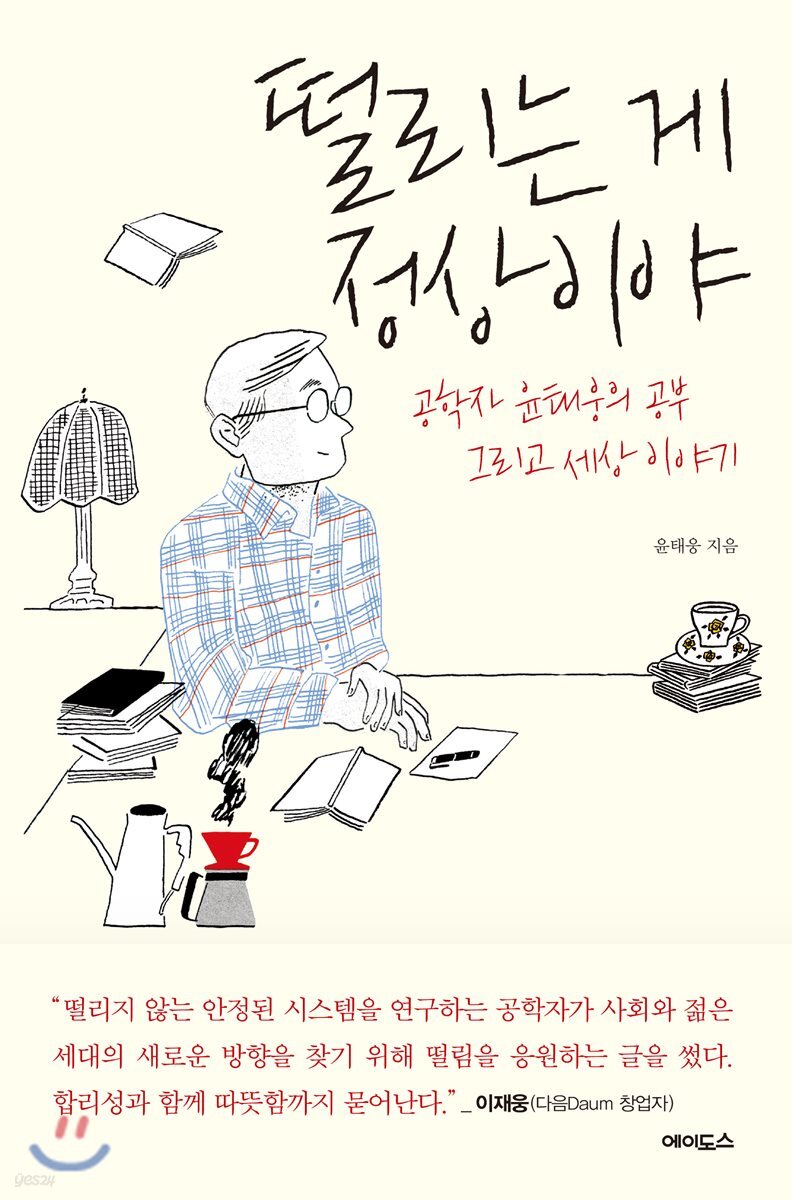
It's normal to be nervous
 |
Description
Book Introduction
This is a scientific essay and a record of self-reflection that contains the thoughts and reflections of an engineer who teaches engineering at a university for many years.
We discuss what we should study in the age of artificial intelligence, where the power of scientific knowledge and mathematical thinking lies, and what the world looks like from the perspective of engineers.
The essence of engineering writing can be seen in the simple, unadorned sentences and the simple perspective on the world.
He addressed various issues in Korean society, from why mathematics should be a required liberal arts subject for citizens to the relationship between scientists and the scientific community, the nationalization of history textbooks, and issues related to sexual minorities, through the language and perspective of an engineer.
We discuss what we should study in the age of artificial intelligence, where the power of scientific knowledge and mathematical thinking lies, and what the world looks like from the perspective of engineers.
The essence of engineering writing can be seen in the simple, unadorned sentences and the simple perspective on the world.
He addressed various issues in Korean society, from why mathematics should be a required liberal arts subject for citizens to the relationship between scientists and the scientific community, the nationalization of history textbooks, and issues related to sexual minorities, through the language and perspective of an engineer.
- You can preview some of the book's contents.
Preview
index
Introduction 6
Part 1 Study 11
Science is not about being stubborn | Poisoning the well | There is no Superman | Learning and emptiness | The virtue of science | It is normal to be nervous | English lectures and the frog professor | Foreign languages, foreign words, and Korean | How to write Korean sentences | | Story of final exams | Wisdom gained from climbing | Professor, please teach the class on time… | Meeting of different perspectives | Mathematics, essential liberal arts for free citizens | How should mathematics be taught | Mathematical rigor | Formulas | Elevators | Mathematics and writing | Mathematics for all | Proof and falsification
Part 2 School 97
Science and engineering education and chicken | Unfamiliar world and universities | Conversation | 21st century education and 20th century schools | Why is shame the student's responsibility? | The dream of a white airplane scattered in the sky field | Universities that do not know how to apologize | Papers are also writing! | Papers and popular writing | Engineers' social responsibility | Citizens, experts, and identity | Scientists' claims and peer review | Conflicts of interest and bias | Horizontal communication | Soft language and sharp logic | S University's harsh claim to the right of subrogation | The problem of the gap in universities | Understanding the principles is important | About plagiarism | Research ethics, the researcher community, and social responsibility
Part 3 World 169
Let's become citizens first! | The meaning of the word 'conformity' | Math exams, conformity and non-conformity | Data, politics, and science | Scientists and the National Assembly election | The abnormalization of normality | National unification and totalitarianism | Why artificial intelligence supported Hitler | Soccer and satellites | Information security and public certification at universities | Female professors in science and engineering universities | Personal pronouns and correct names | Poetry and poets | The foolish pastor of Gwanghwamun | The 'daily life' we must return to | A society that does not record | Woodpeckers and the Constitution | Scientists and engineers' stories about the Constitution | Transgender health research and crowdfunding | Let's create a diversity report | Diversity is power | Love, sex, marriage, and correct names | Climbing Jeju Oreum and commemorating the April 3rd Incident | Issues of nuclear phase-out and the perspective of engineers | ESC, a community of scientists and engineers | Science is a public good that leads to a better society
Epilogue | Reflection and Communication 271
Source 280
Part 1 Study 11
Science is not about being stubborn | Poisoning the well | There is no Superman | Learning and emptiness | The virtue of science | It is normal to be nervous | English lectures and the frog professor | Foreign languages, foreign words, and Korean | How to write Korean sentences | | Story of final exams | Wisdom gained from climbing | Professor, please teach the class on time… | Meeting of different perspectives | Mathematics, essential liberal arts for free citizens | How should mathematics be taught | Mathematical rigor | Formulas | Elevators | Mathematics and writing | Mathematics for all | Proof and falsification
Part 2 School 97
Science and engineering education and chicken | Unfamiliar world and universities | Conversation | 21st century education and 20th century schools | Why is shame the student's responsibility? | The dream of a white airplane scattered in the sky field | Universities that do not know how to apologize | Papers are also writing! | Papers and popular writing | Engineers' social responsibility | Citizens, experts, and identity | Scientists' claims and peer review | Conflicts of interest and bias | Horizontal communication | Soft language and sharp logic | S University's harsh claim to the right of subrogation | The problem of the gap in universities | Understanding the principles is important | About plagiarism | Research ethics, the researcher community, and social responsibility
Part 3 World 169
Let's become citizens first! | The meaning of the word 'conformity' | Math exams, conformity and non-conformity | Data, politics, and science | Scientists and the National Assembly election | The abnormalization of normality | National unification and totalitarianism | Why artificial intelligence supported Hitler | Soccer and satellites | Information security and public certification at universities | Female professors in science and engineering universities | Personal pronouns and correct names | Poetry and poets | The foolish pastor of Gwanghwamun | The 'daily life' we must return to | A society that does not record | Woodpeckers and the Constitution | Scientists and engineers' stories about the Constitution | Transgender health research and crowdfunding | Let's create a diversity report | Diversity is power | Love, sex, marriage, and correct names | Climbing Jeju Oreum and commemorating the April 3rd Incident | Issues of nuclear phase-out and the perspective of engineers | ESC, a community of scientists and engineers | Science is a public good that leads to a better society
Epilogue | Reflection and Communication 271
Source 280
Detailed image
Into the book
A properly functioning chronograph will always have a shaky needle tip.
Because I'm shaking.
On the other hand, the tip of the broken needle does not move at all.
As if he knew for sure which way was south.
When I was a student, I envied my seniors who were full of unwavering confidence.
I was also dissatisfied with the way I was fumbling and stumbling, not knowing what was what.
It was only after some time had passed and I had seen Mr. Shin Young-bok's collection of calligraphy and paintings that I was able to say this to myself.
'Yes, it's normal to tremble!' Of course, the metaphor of the snail is not a simple consolation for ignorance.
A complete chronometer does not shake haphazardly.
There is a specific direction called the South.
To maintain that kind of trembling is to demand that we not stagnate.
--- p.27
Mathematics is a way of thinking, a sophisticated language with unambiguous structure.
For example, differential equations describe everything in the changing world.
Mathematics is a powerful system of thought that enables rigorous conceptual definitions, quantitative and abstract thinking, and logical reasoning.
It is also an open system that cannot be confined within a formal framework.
Mathematics also abstracts by capturing the shared properties of seemingly unrelated objects.
That's why some people call mathematics the science of patterns.
Mathematics is also a virtue necessary for living as a free and competent citizen.
The idea is not to memorize the results of mathematical knowledge, but to learn mathematical thinking methods and attitudes.
The ability to develop a coherent logic using precise sentences is probably not unrelated to mathematics.
The process is important.
The result itself that the sum of the interior angles of a triangle is 180° is not very meaningful.
Haven't we already seen that even if we follow the same process, if the premise is different, the sum of the internal angles of a triangle can be greater or less than 180°?
Mathematical reasoning skills can only be honed through mathematics.
The three proofs presented here were examples of mathematical activity.
It's better to not do any mechanical, repetitive calculation-intensive work than to do nothing at all.
I think we should focus on logic and reasoning.
--- p.93~94
Imagine a network of many circles.
If the meeting of different circles is called fusion, then the fusion will occur at the boundary of the circle, not at the center.
If you stay in the center, it will be more difficult to see beyond the borders.
In that respect, as feminist scholar Jeong Hee-jin said, minority status is an epistemological resource.
In the picture, where multiple circles are not isolated from each other but dynamically meet, we can glimpse the power of the so-called periphery.
This is not to say that the center is unimportant.
It is about moving away from the uniformity that emphasizes only the center and recognizing that diversity is the vitality of society.
Because I'm shaking.
On the other hand, the tip of the broken needle does not move at all.
As if he knew for sure which way was south.
When I was a student, I envied my seniors who were full of unwavering confidence.
I was also dissatisfied with the way I was fumbling and stumbling, not knowing what was what.
It was only after some time had passed and I had seen Mr. Shin Young-bok's collection of calligraphy and paintings that I was able to say this to myself.
'Yes, it's normal to tremble!' Of course, the metaphor of the snail is not a simple consolation for ignorance.
A complete chronometer does not shake haphazardly.
There is a specific direction called the South.
To maintain that kind of trembling is to demand that we not stagnate.
--- p.27
Mathematics is a way of thinking, a sophisticated language with unambiguous structure.
For example, differential equations describe everything in the changing world.
Mathematics is a powerful system of thought that enables rigorous conceptual definitions, quantitative and abstract thinking, and logical reasoning.
It is also an open system that cannot be confined within a formal framework.
Mathematics also abstracts by capturing the shared properties of seemingly unrelated objects.
That's why some people call mathematics the science of patterns.
Mathematics is also a virtue necessary for living as a free and competent citizen.
The idea is not to memorize the results of mathematical knowledge, but to learn mathematical thinking methods and attitudes.
The ability to develop a coherent logic using precise sentences is probably not unrelated to mathematics.
The process is important.
The result itself that the sum of the interior angles of a triangle is 180° is not very meaningful.
Haven't we already seen that even if we follow the same process, if the premise is different, the sum of the internal angles of a triangle can be greater or less than 180°?
Mathematical reasoning skills can only be honed through mathematics.
The three proofs presented here were examples of mathematical activity.
It's better to not do any mechanical, repetitive calculation-intensive work than to do nothing at all.
I think we should focus on logic and reasoning.
--- p.93~94
Imagine a network of many circles.
If the meeting of different circles is called fusion, then the fusion will occur at the boundary of the circle, not at the center.
If you stay in the center, it will be more difficult to see beyond the borders.
In that respect, as feminist scholar Jeong Hee-jin said, minority status is an epistemological resource.
In the picture, where multiple circles are not isolated from each other but dynamically meet, we can glimpse the power of the so-called periphery.
This is not to say that the center is unimportant.
It is about moving away from the uniformity that emphasizes only the center and recognizing that diversity is the vitality of society.
--- p.278
Publisher's Review
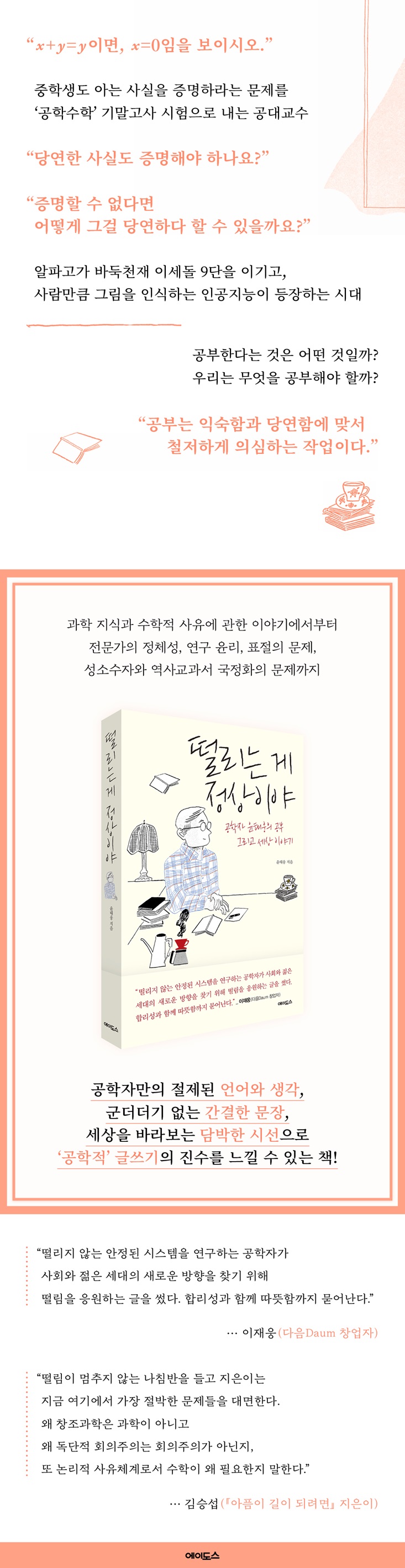
“Do I have to prove obvious facts?”
“How can you take it for granted if you can’t prove it?”
“If x+y=y, then show that x=0.” This is one of the questions that the author, an engineering professor, gave to engineering students for the final exam of ‘Engineering Mathematics.’
Students are confused by the problem.
Do we really need to prove such an obvious fact? Why did we ask a question that asked us to prove something even a middle school student would know?
"Learning is emptiness." Studying is a fierce act of questioning familiarity.
In an era where AlphaGo has defeated Go prodigy Lee Sedol, and artificial intelligence continues to evolve day by day, what kind of study should we pursue? Studying by repeating mechanical calculations based on formulas is no longer meaningful.
It requires the ability to reason and think logically, and the ability to select and combine a large amount of information to create knowledge.
The author, who has been teaching students for a long time and has thought about education and study, says this.
Studying is 'the work of fiercely questioning familiarity.'
This is why we ask engineering students to prove facts that even middle school students know.
Don't just accept what seems obvious.
Learning begins with intentionally emptying one's past experiences, preconceptions, and prejudices.
True learning begins when we question and rationally question what we are accustomed to and take for granted.
Engineers who study stable systems that do not tremble, talk about 'trembling'.
Perhaps one of the most recurring words in the book is 'mathematical thinking'.
The author emphasizes that mathematics is 'the most certain knowledge system created by mankind' and 'a sophisticated and beautiful language free from ambiguity and ambiguity.'
A significant portion of the book is devoted to the principles of mathematics, the characteristics of mathematical thinking, and stories of mathematicians.
But what always accompanies mathematics and science, powerful ways of thinking free from ambiguity and uncertainty, are falsifiability, rational doubt and questioning, an open attitude, and horizontal communication.
And here lies the beauty of mathematics and science.
This is the message that the history of science and the logic of mathematics show us about the process by which scientific knowledge is created.
'Creating problems is more important than finding answers, rational doubt and questioning is more important than blind obedience to authority, sincere failure is more important than dishonest success, and the process is more important than the result.' In that sense, we must be more scientific.
This is why engineers who study stable, non-trembling systems must talk about 'tremor'.
Before we raise our voices with conviction, before we push forward with vertical authority, we must always question, learn, communicate, and reflect.
The broken compass no longer trembles.
“It’s normal to be nervous.”
Deep and solid thinking, warm and simple gaze
An engineer's thoughts expressed in clean, concise sentences!
Those that have matured over a long period of time have a depth and solidity that cannot be easily imitated.
The book is a collection of articles written over a long period of time, reflecting thoughts that have been honed and refined.
Although there are some parts that have been rewritten, revised, and polished, the basic argument has not changed much.
Books are connected and expanded as if the study that started with oneself forms a concentric circle with school and the world.
This is why the diverse topics covered, from the principles of scientific knowledge and mathematical reasoning to the identity of experts, research ethics, plagiarism, sexual violence incidents, and the nationalization of history textbooks, are consistently connected by a few themes.
The engineer's thoughts emphasizing that engineering students write Korean sentences accurately are connected to issues such as the 'Benz female prosecutor incident' and the 'ban on homosexuality in the military', and the open attitude of scientific knowledge that emphasizes the possibility of falsification is connected to the topics of nationalizing history textbooks and unifying public opinion, and the ethics and identity of experts are smoothly connected to the story of the reporter who reported Jeong Yu-ra's whereabouts to the police and continued reporting, or the perspective on the Hwang Woo-suk incident.
This book presents the fresh ideas of an engineer who talks about study and the world in concise yet precise language.
“How can you take it for granted if you can’t prove it?”
“If x+y=y, then show that x=0.” This is one of the questions that the author, an engineering professor, gave to engineering students for the final exam of ‘Engineering Mathematics.’
Students are confused by the problem.
Do we really need to prove such an obvious fact? Why did we ask a question that asked us to prove something even a middle school student would know?
"Learning is emptiness." Studying is a fierce act of questioning familiarity.
In an era where AlphaGo has defeated Go prodigy Lee Sedol, and artificial intelligence continues to evolve day by day, what kind of study should we pursue? Studying by repeating mechanical calculations based on formulas is no longer meaningful.
It requires the ability to reason and think logically, and the ability to select and combine a large amount of information to create knowledge.
The author, who has been teaching students for a long time and has thought about education and study, says this.
Studying is 'the work of fiercely questioning familiarity.'
This is why we ask engineering students to prove facts that even middle school students know.
Don't just accept what seems obvious.
Learning begins with intentionally emptying one's past experiences, preconceptions, and prejudices.
True learning begins when we question and rationally question what we are accustomed to and take for granted.
Engineers who study stable systems that do not tremble, talk about 'trembling'.
Perhaps one of the most recurring words in the book is 'mathematical thinking'.
The author emphasizes that mathematics is 'the most certain knowledge system created by mankind' and 'a sophisticated and beautiful language free from ambiguity and ambiguity.'
A significant portion of the book is devoted to the principles of mathematics, the characteristics of mathematical thinking, and stories of mathematicians.
But what always accompanies mathematics and science, powerful ways of thinking free from ambiguity and uncertainty, are falsifiability, rational doubt and questioning, an open attitude, and horizontal communication.
And here lies the beauty of mathematics and science.
This is the message that the history of science and the logic of mathematics show us about the process by which scientific knowledge is created.
'Creating problems is more important than finding answers, rational doubt and questioning is more important than blind obedience to authority, sincere failure is more important than dishonest success, and the process is more important than the result.' In that sense, we must be more scientific.
This is why engineers who study stable, non-trembling systems must talk about 'tremor'.
Before we raise our voices with conviction, before we push forward with vertical authority, we must always question, learn, communicate, and reflect.
The broken compass no longer trembles.
“It’s normal to be nervous.”
Deep and solid thinking, warm and simple gaze
An engineer's thoughts expressed in clean, concise sentences!
Those that have matured over a long period of time have a depth and solidity that cannot be easily imitated.
The book is a collection of articles written over a long period of time, reflecting thoughts that have been honed and refined.
Although there are some parts that have been rewritten, revised, and polished, the basic argument has not changed much.
Books are connected and expanded as if the study that started with oneself forms a concentric circle with school and the world.
This is why the diverse topics covered, from the principles of scientific knowledge and mathematical reasoning to the identity of experts, research ethics, plagiarism, sexual violence incidents, and the nationalization of history textbooks, are consistently connected by a few themes.
The engineer's thoughts emphasizing that engineering students write Korean sentences accurately are connected to issues such as the 'Benz female prosecutor incident' and the 'ban on homosexuality in the military', and the open attitude of scientific knowledge that emphasizes the possibility of falsification is connected to the topics of nationalizing history textbooks and unifying public opinion, and the ethics and identity of experts are smoothly connected to the story of the reporter who reported Jeong Yu-ra's whereabouts to the police and continued reporting, or the perspective on the Hwang Woo-suk incident.
This book presents the fresh ideas of an engineer who talks about study and the world in concise yet precise language.
GOODS SPECIFICS
- Date of publication: September 29, 2018
- Page count, weight, size: 284 pages | 374g | 137*210*20mm
- ISBN13: 9791185415215
- ISBN10: 1185415211
You may also like
카테고리
korean


korean

![ELLE 엘르 스페셜 에디션 A형 : 12월 [2025]](http://librairie.coreenne.fr/cdn/shop/files/b8e27a3de6c9538896439686c6b0e8fb.jpg?v=1766436872&width=3840)


