

Philosophy Lab
 |
Description
Book Introduction
- A word from MD
-
Living Wisely with PhilosophersThis book is concise, clear, and profound.
We explained how the thoughts of thinkers can be helpful in addressing over 130 issues that we may encounter in our daily lives, including relationships, psychology, politics, and economics.
You can read it in small chunks or all at once.
Philosophy can be a powerful weapon in life.
October 15, 2021. Humanities PD Son Min-gyu
A philosophy research institute that connects you with philosophers who are directly related to your life.
A personalized philosophy solution from an Oxford University philosophy professor.
130+ Answers from Philosophers That Will Save You Now
“Philosophy is certainly a field of self-development, and it is the most powerful force that can change our lives.” A young philosopher who teaches philosophy at Oxford University answers today’s question, which he has been pondering with his students, through his own philosophy.
The author's unique, humorous style, which poses contemporary questions as if he were talking to students and provides answers through the stories of philosophers, removes barriers to philosophy.
If you've ever vaguely felt that philosophy was difficult, stop by today's philosophy research institute, Philosophy Lab.
You will be surprised to find that the questions you have are directly connected to the questions philosophers have asked, and you will be surprised again to find that the answers philosophers have thought about and studied will solve your concerns.
New and interesting philosophies come to life vividly, as if I were a debater in a laboratory of young intellectuals.
《Philosophy Lab》 is a philosophy guidebook that introduces over 130 philosophical concepts that answer diverse questions about existence, daily life, art, human relationships, mental health, politics, and economics in concise and clear language.
The author begins every story with a current question we have now.
"Why do we feel guilty about leaving work on time?" "Can our jobs become our identity?" "Does losing our smartphones rob us of cognitive functions?" And it connects us with leading philosophers who can answer these questions.
The thoughts and ideas of that philosopher, who pondered in the most logical and intense manner, still shine, illuminating our narrow perspectives and closed minds.
We are amazed by the fact that the Greek philosophers Socrates and Aristotle, Descartes in the 17th century, Kant in the 19th century, and Beauvoir in the 20th century devoted their lives to thinking about the questions of 'today'.
If we could understand the real reasons for the troubles we face where we are now, and if the wisest and most intelligent minds in history could give us hints on how to solve them, our tomorrow might be a little better.
right.
We are each philosophers who struggle with our own lives, our own fates that sometimes appear, and seek answers as we go through each day.
Find your own kind and rational philosopher friend in this book.
A personalized philosophy solution from an Oxford University philosophy professor.
130+ Answers from Philosophers That Will Save You Now
“Philosophy is certainly a field of self-development, and it is the most powerful force that can change our lives.” A young philosopher who teaches philosophy at Oxford University answers today’s question, which he has been pondering with his students, through his own philosophy.
The author's unique, humorous style, which poses contemporary questions as if he were talking to students and provides answers through the stories of philosophers, removes barriers to philosophy.
If you've ever vaguely felt that philosophy was difficult, stop by today's philosophy research institute, Philosophy Lab.
You will be surprised to find that the questions you have are directly connected to the questions philosophers have asked, and you will be surprised again to find that the answers philosophers have thought about and studied will solve your concerns.
New and interesting philosophies come to life vividly, as if I were a debater in a laboratory of young intellectuals.
《Philosophy Lab》 is a philosophy guidebook that introduces over 130 philosophical concepts that answer diverse questions about existence, daily life, art, human relationships, mental health, politics, and economics in concise and clear language.
The author begins every story with a current question we have now.
"Why do we feel guilty about leaving work on time?" "Can our jobs become our identity?" "Does losing our smartphones rob us of cognitive functions?" And it connects us with leading philosophers who can answer these questions.
The thoughts and ideas of that philosopher, who pondered in the most logical and intense manner, still shine, illuminating our narrow perspectives and closed minds.
We are amazed by the fact that the Greek philosophers Socrates and Aristotle, Descartes in the 17th century, Kant in the 19th century, and Beauvoir in the 20th century devoted their lives to thinking about the questions of 'today'.
If we could understand the real reasons for the troubles we face where we are now, and if the wisest and most intelligent minds in history could give us hints on how to solve them, our tomorrow might be a little better.
right.
We are each philosophers who struggle with our own lives, our own fates that sometimes appear, and seek answers as we go through each day.
Find your own kind and rational philosopher friend in this book.
- You can preview some of the book's contents.
Preview
index
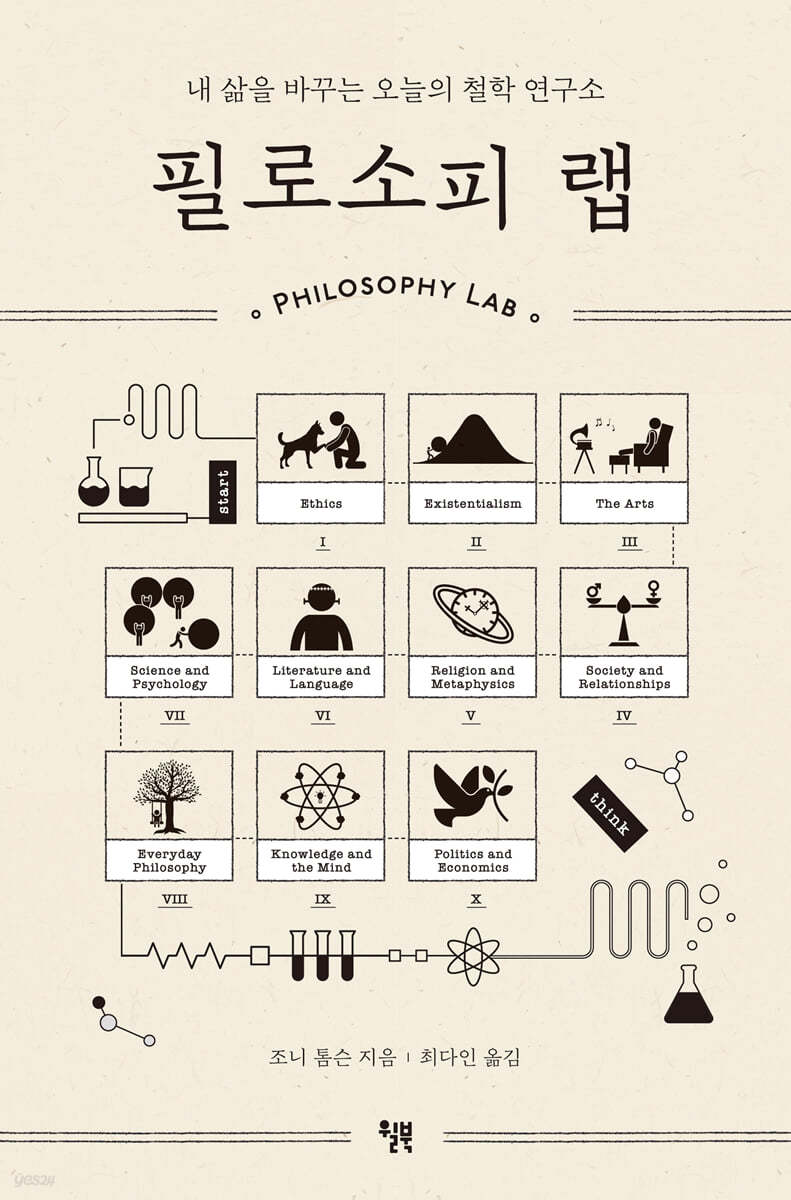
Entering - Connecting the Philosopher and Me
Institute of Philosophy
Ⅰ.
ethic
Plato - The Invisible Man
Bentham - Calculating Morality
Aristotle - The Doctrine of the Mean
Kant - “What if others do the same?!”
Land - Selfishness
Conte - Altruism
Abelard - Good Intentions
Singer - Discrimination
Kant - The Wrong Way to Treat Others
Aquinas - The Justification of War
Singer - Speciesism
Zimbardo - The Evil That Is Made
Clifford - The Ethics of Faith
Love Rock - Mother Nature
Ⅱ.
existentialism
Sartre - Self-Deception
Existentialism - Emptiness
Montaigne - Memento Mori
Nietzsche - The Will to Power
Heidegger - Mortality
Camus - Absurdity
Schopenhauer - Boredom
Sartre - Others
Nietzsche - Eternal Return
Kierkegaard - Stages of Existence
Hegel - Master-Servant Relationship
Camus - Rebellion
Beauvoir - Feminism
Fanon - Black Existentialism
Ⅲ.
art
Aristotle - Stress Relief
Kant - Beauty and the Sublime
Schopenhauer - Music
Goethe - Theory of Colors
Harari - Collective Myths
Yung - Character selection window
Joker - Nihilism
Nietzsche - Apollo and Dionysus
Adorno - Cultural Industry
Thanos - Eco-terrorism
Wabi-sabi - Broken Beauty
Ⅳ.
Society and human relationships
Plato - True Love
Montaigne - Passions gone astray
Grouchy - Parental Affection
Murdoch - Seeing the Good in Others
Beaver - The Shackles of Overtime
Du Bois - Double Perception
Wollstonecraft - First-Wave Feminism
Marx - Class Struggle
Confucius - A sense of belonging
Hegel - World Spirit
Apia - Cosmopolitanism
MacKinnon - Unfair Rules
Burke - Courtesy Makes the World
Arendt - The Banality of Evil
V.
Religion and Metaphysics
Al Kindi - The First Cause
Freud - The Father
Paley - Watchmaker
Hume - The Problem of Evil
Descartes - Proving God with Logic
Feuerbach - God in Human Form
Pascal - A Wager with God
Marx - Opium of the People
Berkeley - What No One Has Seen
Hume - Miracle
Spinoza - We are all gods
Zen Buddhism - Koan
Ⅵ.
Literature and Language
Campbell - All the Stories of the World
Huxley - Brave New World
Beckett - Waiting
Orwell - Doublethink
Kafka - Alienation
Proust - Involuntary Memory
Romantic poets - nature poetry
Radford - fiction
Aristotle - Rhetoric
Shelley - Evil Scientist
Chomsky - Language Acquisition
Derrida - The Meaning of Words
Wittgenstein - Language Games
Structuralism - Binary Opposition
Ⅶ.
Science and Psychology
Bacon - Scientific Methodology
Kuhn - Paradigm Shift
Heidegger - The Impact of Technological Development
Heraclitus - The Changing Self
Rivet - The Brain and Free Will
Popper - pseudoscience
Turing - Robots vs. Humans
Asimov's Three Laws of Robotics
Fermi - Alien
Godfrey Smith - Other Intelligences
Freud - Personality
Piaget - Developmental Psychology
Gestalt Therapy - Doing Nothing
Ⅷ.
Philosophy in everyday life
Aristotle - Friendship
Beauvoir - Motherhood
Rousseau - Childhood
Foucault - Discipline
Stoicism - Looking from afar
Freud - The Death Drive
Frankl - Giving Meaning to Suffering
Epicurus - Pleasure
Postscript - Looking at the Tree
Stoicism - Choosing Your Response
Soro - A walk
Sun Tzu - How to Win at Board Games
Harvey - Insomnia
Ⅸ.
Perception and Mind
Descartes - Winged Orange Goblin
Locke - The Mind's Eye
Plato - Allegory of the Cave
Pyrrhon - Judgment reserved
Hume - The Black Swan
Buridan - The Indecisive Donkey
Socrates - Questioning Everything
Aristotle - Laws of Logic
Eubulides - Pile of Stones
Descartes - Cogito
Hume - The Bundle of the Self
Kant - Creating the World
Chalmers - Pencil Thoughts
Clark & Chalmers - Expanding the Mind
Ⅹ.
Politics and Economics
Hobbes - The Formation of Government
Machiavelli - How to Be a King
Ibn Khaldun - The Rise and Fall of Empires
Herder - Nationalism
Thucydides - The Inevitable War
Marx - World History
Burke - The Wisdom of the Ancestral
Pain - Revolution
Smith - The Invisible Hand
Tocqueville - Defending Democracy
Kant - World Peace
Gandhi - Nonviolence
Engels - The Marketplace of Ideas
Fukuyama - The End of History
Acknowledgements
Search
Institute of Philosophy
Ⅰ.
ethic
Plato - The Invisible Man
Bentham - Calculating Morality
Aristotle - The Doctrine of the Mean
Kant - “What if others do the same?!”
Land - Selfishness
Conte - Altruism
Abelard - Good Intentions
Singer - Discrimination
Kant - The Wrong Way to Treat Others
Aquinas - The Justification of War
Singer - Speciesism
Zimbardo - The Evil That Is Made
Clifford - The Ethics of Faith
Love Rock - Mother Nature
Ⅱ.
existentialism
Sartre - Self-Deception
Existentialism - Emptiness
Montaigne - Memento Mori
Nietzsche - The Will to Power
Heidegger - Mortality
Camus - Absurdity
Schopenhauer - Boredom
Sartre - Others
Nietzsche - Eternal Return
Kierkegaard - Stages of Existence
Hegel - Master-Servant Relationship
Camus - Rebellion
Beauvoir - Feminism
Fanon - Black Existentialism
Ⅲ.
art
Aristotle - Stress Relief
Kant - Beauty and the Sublime
Schopenhauer - Music
Goethe - Theory of Colors
Harari - Collective Myths
Yung - Character selection window
Joker - Nihilism
Nietzsche - Apollo and Dionysus
Adorno - Cultural Industry
Thanos - Eco-terrorism
Wabi-sabi - Broken Beauty
Ⅳ.
Society and human relationships
Plato - True Love
Montaigne - Passions gone astray
Grouchy - Parental Affection
Murdoch - Seeing the Good in Others
Beaver - The Shackles of Overtime
Du Bois - Double Perception
Wollstonecraft - First-Wave Feminism
Marx - Class Struggle
Confucius - A sense of belonging
Hegel - World Spirit
Apia - Cosmopolitanism
MacKinnon - Unfair Rules
Burke - Courtesy Makes the World
Arendt - The Banality of Evil
V.
Religion and Metaphysics
Al Kindi - The First Cause
Freud - The Father
Paley - Watchmaker
Hume - The Problem of Evil
Descartes - Proving God with Logic
Feuerbach - God in Human Form
Pascal - A Wager with God
Marx - Opium of the People
Berkeley - What No One Has Seen
Hume - Miracle
Spinoza - We are all gods
Zen Buddhism - Koan
Ⅵ.
Literature and Language
Campbell - All the Stories of the World
Huxley - Brave New World
Beckett - Waiting
Orwell - Doublethink
Kafka - Alienation
Proust - Involuntary Memory
Romantic poets - nature poetry
Radford - fiction
Aristotle - Rhetoric
Shelley - Evil Scientist
Chomsky - Language Acquisition
Derrida - The Meaning of Words
Wittgenstein - Language Games
Structuralism - Binary Opposition
Ⅶ.
Science and Psychology
Bacon - Scientific Methodology
Kuhn - Paradigm Shift
Heidegger - The Impact of Technological Development
Heraclitus - The Changing Self
Rivet - The Brain and Free Will
Popper - pseudoscience
Turing - Robots vs. Humans
Asimov's Three Laws of Robotics
Fermi - Alien
Godfrey Smith - Other Intelligences
Freud - Personality
Piaget - Developmental Psychology
Gestalt Therapy - Doing Nothing
Ⅷ.
Philosophy in everyday life
Aristotle - Friendship
Beauvoir - Motherhood
Rousseau - Childhood
Foucault - Discipline
Stoicism - Looking from afar
Freud - The Death Drive
Frankl - Giving Meaning to Suffering
Epicurus - Pleasure
Postscript - Looking at the Tree
Stoicism - Choosing Your Response
Soro - A walk
Sun Tzu - How to Win at Board Games
Harvey - Insomnia
Ⅸ.
Perception and Mind
Descartes - Winged Orange Goblin
Locke - The Mind's Eye
Plato - Allegory of the Cave
Pyrrhon - Judgment reserved
Hume - The Black Swan
Buridan - The Indecisive Donkey
Socrates - Questioning Everything
Aristotle - Laws of Logic
Eubulides - Pile of Stones
Descartes - Cogito
Hume - The Bundle of the Self
Kant - Creating the World
Chalmers - Pencil Thoughts
Clark & Chalmers - Expanding the Mind
Ⅹ.
Politics and Economics
Hobbes - The Formation of Government
Machiavelli - How to Be a King
Ibn Khaldun - The Rise and Fall of Empires
Herder - Nationalism
Thucydides - The Inevitable War
Marx - World History
Burke - The Wisdom of the Ancestral
Pain - Revolution
Smith - The Invisible Hand
Tocqueville - Defending Democracy
Kant - World Peace
Gandhi - Nonviolence
Engels - The Marketplace of Ideas
Fukuyama - The End of History
Acknowledgements
Search
Detailed image

Into the book
There is something about philosophy that makes people feel tired.
I'm not sure if it's because philosophers use words like "false" when "false" would suffice, or because they keep invoking ancient Greek words every other sentence.
But philosophy doesn't have to be that way, and that's why I wrote this book.
--- p.12
Memento mori (literally, "remember that you must die") urges us to remember our mortality.
It's a tool that helps you let go of all those annoying worries by asking yourself, "Is this really important?" to trivialize the small issues.
--- p.50
When we think about the time, money, and effort we pour into meaningless things, we cannot help but be truly absurd beings.
People in the world take absurd situations very seriously.
Fans wait for hours in the rain just to catch a glimpse of their beloved stars.
Gamers stay up for two full nights trying to beat the final boss.
But what good does that do? Why on earth do they do this? Why is it so serious?
--- p.88
Why are you still working? More importantly, why do you feel guilty about leaving work on time? (...) You feel guilty if you don't reply to emails, you feel uncomfortable being the first to leave the office, and you brightly declare, "I enjoy my job!" during job interviews.
Many people say that it takes a long time for them to get used to a life without work even after retirement.
We define ourselves by our profession.
Weber was one of the first to point out that this way of thinking is both trained and terribly unnatural.
Whether the 'Protestant work ethic' is real or fake, right or wrong, you are the one who decides.
--- p.108
John Lennon sang this song:
"Life is what happens to you when you're busy making other plans." How much time do we waste in our lives, waiting for our own "godliness"? "Godliness" can be interpreted as symbolizing the meaning humans strive to find in life.
We wait for true love, liberation, professional success, religious enlightenment, or even death.
But life is a routine, a farce, unfolding while we pass the time waiting for some abstract and mysterious future.
--- p.160
What restores you? What lifts all your worries, obsessions, anxieties, and fears? Everyone has a method or two, but none possesses as much philosophical depth as a steady, steady, and faithfully beating metronome—in other words, a pleasant walk.
--- p.234
Becoming a mother is an amazing and life-changing experience.
For many, this experience provides identity, fulfillment, and meaning.
It also dismantles and fundamentally reconstructs her previous life, turning her entire being towards the life of another.
To none other than his own child.
Beauvoir believed that all of this made motherhood dangerous.
So, I argued that if we don't approach this issue carefully, it could be detrimental to both mother and child.
--- p.216
Sun Tzu wrote one of the most frequently quoted books in the world, and his The Art of War is still taught in military academies today.
He is popular with guerrillas and revolutionaries around the world because he often writes from the perspective of smaller or weaker forces.
In the 1960s, Mao Zedong often quoted Sun Tzu.
His book contains many interesting contents that can be easily applied to our lives.
I'm not sure if it's because philosophers use words like "false" when "false" would suffice, or because they keep invoking ancient Greek words every other sentence.
But philosophy doesn't have to be that way, and that's why I wrote this book.
--- p.12
Memento mori (literally, "remember that you must die") urges us to remember our mortality.
It's a tool that helps you let go of all those annoying worries by asking yourself, "Is this really important?" to trivialize the small issues.
--- p.50
When we think about the time, money, and effort we pour into meaningless things, we cannot help but be truly absurd beings.
People in the world take absurd situations very seriously.
Fans wait for hours in the rain just to catch a glimpse of their beloved stars.
Gamers stay up for two full nights trying to beat the final boss.
But what good does that do? Why on earth do they do this? Why is it so serious?
--- p.88
Why are you still working? More importantly, why do you feel guilty about leaving work on time? (...) You feel guilty if you don't reply to emails, you feel uncomfortable being the first to leave the office, and you brightly declare, "I enjoy my job!" during job interviews.
Many people say that it takes a long time for them to get used to a life without work even after retirement.
We define ourselves by our profession.
Weber was one of the first to point out that this way of thinking is both trained and terribly unnatural.
Whether the 'Protestant work ethic' is real or fake, right or wrong, you are the one who decides.
--- p.108
John Lennon sang this song:
"Life is what happens to you when you're busy making other plans." How much time do we waste in our lives, waiting for our own "godliness"? "Godliness" can be interpreted as symbolizing the meaning humans strive to find in life.
We wait for true love, liberation, professional success, religious enlightenment, or even death.
But life is a routine, a farce, unfolding while we pass the time waiting for some abstract and mysterious future.
--- p.160
What restores you? What lifts all your worries, obsessions, anxieties, and fears? Everyone has a method or two, but none possesses as much philosophical depth as a steady, steady, and faithfully beating metronome—in other words, a pleasant walk.
--- p.234
Becoming a mother is an amazing and life-changing experience.
For many, this experience provides identity, fulfillment, and meaning.
It also dismantles and fundamentally reconstructs her previous life, turning her entire being towards the life of another.
To none other than his own child.
Beauvoir believed that all of this made motherhood dangerous.
So, I argued that if we don't approach this issue carefully, it could be detrimental to both mother and child.
--- p.216
Sun Tzu wrote one of the most frequently quoted books in the world, and his The Art of War is still taught in military academies today.
He is popular with guerrillas and revolutionaries around the world because he often writes from the perspective of smaller or weaker forces.
In the 1960s, Mao Zedong often quoted Sun Tzu.
His book contains many interesting contents that can be easily applied to our lives.
--- p.237
Publisher's Review
The most interesting philosophy stories introduced by a philosophy nerd.
Author Johnny Thompson, who has been masochistically obsessed with reading thick philosophy books since childhood, questions why philosophy is such a tiresome subject to even hearing about.
He wondered if scholars were hesitant to talk about the subjects they had studied and explored with difficulty in an easy and fun way. He started posting short philosophical thoughts of philosophers who had thought deeply about various fields such as psychology, science, art, politics, and economics on his Instagram account, which received a great response, and this book, "Philosophy Lab," is the result of that series.
Over 130 philosophical stories from ten fields are presented in easy-to-understand and enjoyable language, along with intuitive and fun illustrations on every page.
In just two pages of philosophy, we can understand famous philosophical theories such as Descartes' "Cogito," Sartre's "Hell is other people," Montaigne's "Memento Mori," and Nietzsche's "Amor Fati."
If you have ever felt more confused after reading thick philosophy books on Nietzsche's existentialism, Kant's ethics, Marx's theory, structuralism, or phenomenology, this book's concise explanations will allow you to draw a picture of the outline of these short-lived philosophies in your head.
Author Johnny Thompson writes in the introduction that he hopes philosophy will escape the lofty ivory tower and come into our commuter buses, cafes, and living rooms.
How to see the world through the eyes of a philosopher
《Philosophy Lab》 doesn't just cover famous philosophers we're all familiar with.
The author finds existentialism in movie characters like the Joker and Thanos, and questions the ethics of scientists in literary works like Mary Shelley's Frankenstein.
In fact, science, psychology, and art also began long ago as a branch of philosophy.
Goethe was fascinated by color, and Schopenhauer considered music to be the highest ideal among the arts.
The importance of 'parental love' and 'empathy' during the growth process, as argued by 18th century French female philosopher Sophie de Grouchy, did not receive much attention at the time, but is now heard as a very common story.
In the play Waiting for Godot, the author explains what Godot is and how it reflects our lives, and, referring to Huxley's Brave New World, overlaps it with our lives today, where we are accustomed to carrying around mobile devices that provide entertainment to our brains and release dopamine.
It also addresses cutting-edge scientific dilemmas, such as, “If a teacher confiscates a student’s smartphone, will they be depriving them of some cognitive function?” and “What should self-driving cars do when accidents involving human injury or death are unavoidable?”
Because the philosophy the author explores touches all of our lives, anyone who reads this book will find themselves asking questions and thinking like a philosopher.
The magic of philosophy comes when you see the place you started from with new eyes.
Philosophical questions change the way we see the world and force us to reexamine everything we thought we knew.
Philosophy gives us new eyes to see the world.
_ From the text
Aristotle was the original philosopher who spoke of the power of habit.
Philosophers were not people who only talked about things separate from life.
What's the favorite pastime of philosophers? Walking.
Nietzsche said, “The only thoughts that are worth anything are those that come from walking,” and Aristotle’s disciples were called the “School of Leisure” because they enjoyed walking whenever they discussed philosophy.
Above all, the 'walk' that Thoreau speaks of is an act in which we put aside our purpose in life and leave reality behind, and the act of walking itself becomes the purpose.
Johnny Thompson connects the philosopher's way of life to modern people in this way, saying that what is needed for complex modern people is to 'let go of their thoughts' and be willing to let go of 'things they cannot control'.
This is where Gestalt therapy can help.
Gestalt therapy, which involves doing nothing, means focusing on the 'present' without asking about my past, asking questions, and talking about changes in my behavior going forward.
Some of the philosophy of the 'Stoic school' is also helpful.
In particular, modern cognitive behavioral therapy has many similarities with ancient Stoicism.
This is because ancient philosophers have already practiced the method of letting go of what is beyond our control and focusing on behavioral and cognitive changes that we can control.
There were also philosophers of the 'habit' and 'challenge' types that many people have been practicing recently.
Aristotle said that our actions create our virtue.
“We are made of what we repeat.
Therefore, excellence is not an act, but a habit.” This means that by acting correctly and practicing virtue, you can gradually hone this skill, just like you would train your muscles at the gym.
Philosophers, who might be engrossed in a corner of their room or engrossed in incomprehensible metaphysical discourse, are in fact not people confined to their own thoughts, but rather people who have improved their lives and put this into practice by changing their lives and behaviors.
The range of concepts and diversity covered in this book is meaningful because they are stories that can be applied and practiced in our lives.
Transforming old philosophy into the most up-to-date philosophy
Two paths lie before you as you drive the train.
If the train continues to drive, five people will be saved and one will die. If the train changes direction, one person will be killed and five will survive. This is the dilemma that arises in the ethical issues surrounding AI road-driving cars.
In this dilemma, first presented by Philippa Foot in the 1960s, Aquinas' 'principle of double effect', which places emphasis on 'intention', and utilitarianism, which originated in Greek philosophy, became the philosophies that offered solutions to this issue.
Ultimately, even in the face of the most cutting-edge technology, humans are forced to confront fundamental questions.
This is also the essence of philosophy.
This is because, regardless of time and place, humans have always resolved real-world problems into philosophical questions.
As we observe changes in technology and society, philosophers are the first to ponder fundamental questions.
In the 19th century, when science and technology were developing rapidly, Mary Shelley asked about the ethics of responsibility for creatures created by scientists in her novel Frankenstein.
When we started storing information on our phones, Clark and Chalmers asked the question: if phones could replace our cognition, why should we confine it to our skulls?
“If a teacher confiscates a student’s cell phone, isn’t that taking away some of their cognitive function?”
This book delves into readers using a highly intuitive and brilliant matching method that connects the questions faced by contemporary philosophers with the questions of today.
Let's take a moment to clear our heads at the author's philosophical research center, which he has organized in his delicious language.
Perhaps there is a clue to the solution to this question here.
The moment we encounter the philosopher's thoughts, we experience a moment of insight into the world.
Author Johnny Thompson, who has been masochistically obsessed with reading thick philosophy books since childhood, questions why philosophy is such a tiresome subject to even hearing about.
He wondered if scholars were hesitant to talk about the subjects they had studied and explored with difficulty in an easy and fun way. He started posting short philosophical thoughts of philosophers who had thought deeply about various fields such as psychology, science, art, politics, and economics on his Instagram account, which received a great response, and this book, "Philosophy Lab," is the result of that series.
Over 130 philosophical stories from ten fields are presented in easy-to-understand and enjoyable language, along with intuitive and fun illustrations on every page.
In just two pages of philosophy, we can understand famous philosophical theories such as Descartes' "Cogito," Sartre's "Hell is other people," Montaigne's "Memento Mori," and Nietzsche's "Amor Fati."
If you have ever felt more confused after reading thick philosophy books on Nietzsche's existentialism, Kant's ethics, Marx's theory, structuralism, or phenomenology, this book's concise explanations will allow you to draw a picture of the outline of these short-lived philosophies in your head.
Author Johnny Thompson writes in the introduction that he hopes philosophy will escape the lofty ivory tower and come into our commuter buses, cafes, and living rooms.
How to see the world through the eyes of a philosopher
《Philosophy Lab》 doesn't just cover famous philosophers we're all familiar with.
The author finds existentialism in movie characters like the Joker and Thanos, and questions the ethics of scientists in literary works like Mary Shelley's Frankenstein.
In fact, science, psychology, and art also began long ago as a branch of philosophy.
Goethe was fascinated by color, and Schopenhauer considered music to be the highest ideal among the arts.
The importance of 'parental love' and 'empathy' during the growth process, as argued by 18th century French female philosopher Sophie de Grouchy, did not receive much attention at the time, but is now heard as a very common story.
In the play Waiting for Godot, the author explains what Godot is and how it reflects our lives, and, referring to Huxley's Brave New World, overlaps it with our lives today, where we are accustomed to carrying around mobile devices that provide entertainment to our brains and release dopamine.
It also addresses cutting-edge scientific dilemmas, such as, “If a teacher confiscates a student’s smartphone, will they be depriving them of some cognitive function?” and “What should self-driving cars do when accidents involving human injury or death are unavoidable?”
Because the philosophy the author explores touches all of our lives, anyone who reads this book will find themselves asking questions and thinking like a philosopher.
The magic of philosophy comes when you see the place you started from with new eyes.
Philosophical questions change the way we see the world and force us to reexamine everything we thought we knew.
Philosophy gives us new eyes to see the world.
_ From the text
Aristotle was the original philosopher who spoke of the power of habit.
Philosophers were not people who only talked about things separate from life.
What's the favorite pastime of philosophers? Walking.
Nietzsche said, “The only thoughts that are worth anything are those that come from walking,” and Aristotle’s disciples were called the “School of Leisure” because they enjoyed walking whenever they discussed philosophy.
Above all, the 'walk' that Thoreau speaks of is an act in which we put aside our purpose in life and leave reality behind, and the act of walking itself becomes the purpose.
Johnny Thompson connects the philosopher's way of life to modern people in this way, saying that what is needed for complex modern people is to 'let go of their thoughts' and be willing to let go of 'things they cannot control'.
This is where Gestalt therapy can help.
Gestalt therapy, which involves doing nothing, means focusing on the 'present' without asking about my past, asking questions, and talking about changes in my behavior going forward.
Some of the philosophy of the 'Stoic school' is also helpful.
In particular, modern cognitive behavioral therapy has many similarities with ancient Stoicism.
This is because ancient philosophers have already practiced the method of letting go of what is beyond our control and focusing on behavioral and cognitive changes that we can control.
There were also philosophers of the 'habit' and 'challenge' types that many people have been practicing recently.
Aristotle said that our actions create our virtue.
“We are made of what we repeat.
Therefore, excellence is not an act, but a habit.” This means that by acting correctly and practicing virtue, you can gradually hone this skill, just like you would train your muscles at the gym.
Philosophers, who might be engrossed in a corner of their room or engrossed in incomprehensible metaphysical discourse, are in fact not people confined to their own thoughts, but rather people who have improved their lives and put this into practice by changing their lives and behaviors.
The range of concepts and diversity covered in this book is meaningful because they are stories that can be applied and practiced in our lives.
Transforming old philosophy into the most up-to-date philosophy
Two paths lie before you as you drive the train.
If the train continues to drive, five people will be saved and one will die. If the train changes direction, one person will be killed and five will survive. This is the dilemma that arises in the ethical issues surrounding AI road-driving cars.
In this dilemma, first presented by Philippa Foot in the 1960s, Aquinas' 'principle of double effect', which places emphasis on 'intention', and utilitarianism, which originated in Greek philosophy, became the philosophies that offered solutions to this issue.
Ultimately, even in the face of the most cutting-edge technology, humans are forced to confront fundamental questions.
This is also the essence of philosophy.
This is because, regardless of time and place, humans have always resolved real-world problems into philosophical questions.
As we observe changes in technology and society, philosophers are the first to ponder fundamental questions.
In the 19th century, when science and technology were developing rapidly, Mary Shelley asked about the ethics of responsibility for creatures created by scientists in her novel Frankenstein.
When we started storing information on our phones, Clark and Chalmers asked the question: if phones could replace our cognition, why should we confine it to our skulls?
“If a teacher confiscates a student’s cell phone, isn’t that taking away some of their cognitive function?”
This book delves into readers using a highly intuitive and brilliant matching method that connects the questions faced by contemporary philosophers with the questions of today.
Let's take a moment to clear our heads at the author's philosophical research center, which he has organized in his delicious language.
Perhaps there is a clue to the solution to this question here.
The moment we encounter the philosopher's thoughts, we experience a moment of insight into the world.
GOODS SPECIFICS
- Publication date: October 20, 2021
- Page count, weight, size: 308 pages | 444g | 145*220*30mm
- ISBN13: 9791155814116
- ISBN10: 1155814118
You may also like
카테고리
korean


korean

![GQ KOREA Mark (Monthly): December [2025]](http://librairie.coreenne.fr/cdn/shop/files/8ef265dbbfbf186523ed75ba7319009d.jpg?v=1765340328&width=3840)


