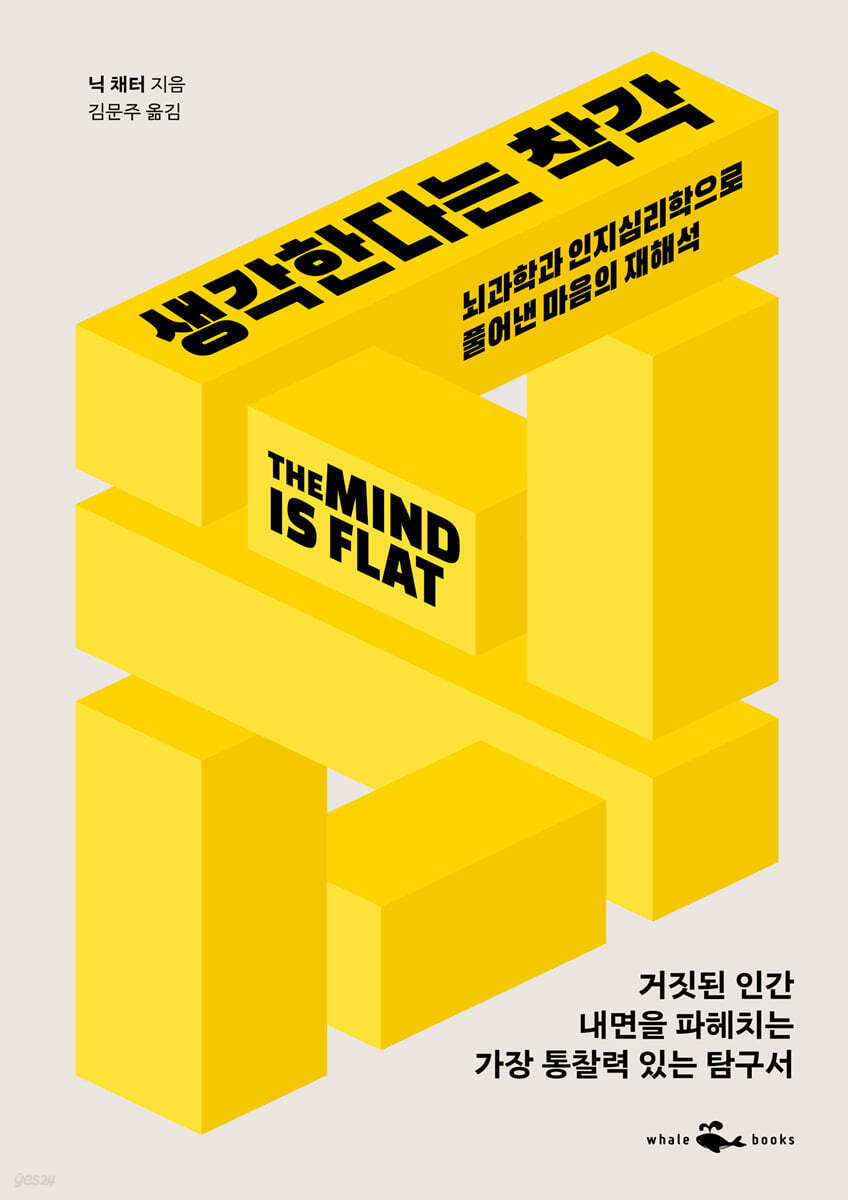
![[Yesuricover] The illusion of thinking](http://librairie.coreenne.fr/cdn/shop/files/74f15f68893f9404fa1dbae1fede975b.jpg?v=1765331590&width=3840)

[Yesuricover] The illusion of thinking
 |
Description
Book Introduction
*** Awarded by the Association of American Publishers, Clinical Psychology Category ***
*** A book lauded by Tim Harford, New Scientist, and The Spectator ***
Digging into the false inner self of humans
The most insightful exploration
Everything we think, desire and explain is
It's just an illusion
Do people truly choose their political stance based on their beliefs? Do they always give the same answers to the same questions? We firmly believe that our thoughts, desires, and actions stem from a deep, inexplicable inner world, and we like to think of ourselves as possessing a hidden inner self.
That's why I think you can't fully understand yourself without knowing your inner self.
Author Nick Chatter argues that there is no such thing as a veiled, profound mind.
The author, a leading behavioral scientist, uncovers a completely new concept that is completely different from the direction of research he has been pursuing so far, through brain science, neuroscience, cognitive psychology, and behavioral psychology.
Inner beliefs, values, and desires are not fixed things, but are created by past experiences.
In other words, today's memories are just yesterday's interpretations.
So, rather than being influenced by something underlying in their inner selves, humans continually create their own identities and constantly act spontaneously.
Ultimately, the experiences created in this way influence our own behavioral direction and even our inner psychology.
This book boldly challenges the preconceptions we've harbored for centuries and offers entirely new horizons for understanding ourselves and others.
Instead of trying to untangle your own tangled mind, you should focus more on the creative project of learning about life.
How can we be happier? How can we think more consistently? How can we solve problems? We must break free from the idea that we must find the answers within ourselves.
Searching for one's inner self is simply inefficient.
By letting go of the unconscious, we can reconstruct our lives.
*** A book lauded by Tim Harford, New Scientist, and The Spectator ***
Digging into the false inner self of humans
The most insightful exploration
Everything we think, desire and explain is
It's just an illusion
Do people truly choose their political stance based on their beliefs? Do they always give the same answers to the same questions? We firmly believe that our thoughts, desires, and actions stem from a deep, inexplicable inner world, and we like to think of ourselves as possessing a hidden inner self.
That's why I think you can't fully understand yourself without knowing your inner self.
Author Nick Chatter argues that there is no such thing as a veiled, profound mind.
The author, a leading behavioral scientist, uncovers a completely new concept that is completely different from the direction of research he has been pursuing so far, through brain science, neuroscience, cognitive psychology, and behavioral psychology.
Inner beliefs, values, and desires are not fixed things, but are created by past experiences.
In other words, today's memories are just yesterday's interpretations.
So, rather than being influenced by something underlying in their inner selves, humans continually create their own identities and constantly act spontaneously.
Ultimately, the experiences created in this way influence our own behavioral direction and even our inner psychology.
This book boldly challenges the preconceptions we've harbored for centuries and offers entirely new horizons for understanding ourselves and others.
Instead of trying to untangle your own tangled mind, you should focus more on the creative project of learning about life.
How can we be happier? How can we think more consistently? How can we solve problems? We must break free from the idea that we must find the answers within ourselves.
Searching for one's inner self is simply inefficient.
By letting go of the unconscious, we can reconstruct our lives.
- You can preview some of the book's contents.
Preview
index
There is no such thing as profound spiritual depth for us.
Prologue: Profound Literature, Shallow Mind
PART 1 The Illusion of Depth of the Heart
CHAPTER 1 The Power of Made-Up Stories
CHAPTER 2 Reality of Emotions
CHAPTER 3: The Anatomy of a Fabrication
CHAPTER 4 Unfaithful Imagination
CHAPTER 5: Creating Emotions
CHAPTER 6 MAKING CHOICES
PART 2 The Spontaneous Mind
CHAPTER 7 The Cycle of Thought
CHAPTER 8 The Narrow Neck of Consciousness
CHAPTER 9 The Myth of Unconscious Thought
CHAPTER 10 The Boundaries of Consciousness
CHAPTER 11 Precedents, Not Principles
CHAPTER 12 The Secret of Intelligence
Epilogue: Reinventing Ourselves
annotation
Prologue: Profound Literature, Shallow Mind
PART 1 The Illusion of Depth of the Heart
CHAPTER 1 The Power of Made-Up Stories
CHAPTER 2 Reality of Emotions
CHAPTER 3: The Anatomy of a Fabrication
CHAPTER 4 Unfaithful Imagination
CHAPTER 5: Creating Emotions
CHAPTER 6 MAKING CHOICES
PART 2 The Spontaneous Mind
CHAPTER 7 The Cycle of Thought
CHAPTER 8 The Narrow Neck of Consciousness
CHAPTER 9 The Myth of Unconscious Thought
CHAPTER 10 The Boundaries of Consciousness
CHAPTER 11 Precedents, Not Principles
CHAPTER 12 The Secret of Intelligence
Epilogue: Reinventing Ourselves
annotation
Detailed image

Into the book
The brain is an engine that spontaneously searches for meaning and chooses the most reasonable action at that moment.
Therefore, thoughts and actions are based on past thoughts and actions, and the brain controls and reworks these past thoughts and actions to cope with the situation of the moment.
Moreover, just as today's thoughts follow yesterday's precedents, today's thoughts provide a precedent for tomorrow, giving consistency to our actions, words, and lives.
So what makes each of us special is largely the uniqueness of our individual histories of pre-existing thoughts and experiences.
In other words, each of us is a unique tradition that is constantly in the process of creation.
---From "Profound Literature, Shallow Mind"
The notion that people have complete and coherent views about the world and their preferences about what they want is also widely assumed in management and policy circles.
Market researchers strive to study what goods and services we want.
Decision makers struggle to distill the beliefs and preferences of multiple stakeholders in complex projects such as airports and power plants.
Health economists strive to assign a stable monetary value to disease, disability, and life itself.
These projects all suffer from the same problem: the inconsistent and biased nature of our intuition.
People give completely different answers to the exact same question (even if given only a few minutes of time).
And people's answers to various questions are sometimes inconsistent, and their actual choices also show the same variance (people can express that their lives are very precious and yet engage in risky behavior).
And sometimes we express opinions on issues (like nuclear weapons, climate change, or whether the government should fund a new cancer treatment), but in reality, we only have a superficial understanding of them.
Most people only understand these issues to the same degree as they understand how a refrigerator works.
---From "The Power of Made-Up Stories"
The obvious conclusion to draw from this is that we do not justify our actions by consulting our inner archives.
Rather, the process of explaining thoughts, actions, and behaviors is a creative process.
And, like imagery, the creative process is so quick and smooth that we can easily imagine it emerging from the depths of our minds.
But just as we reframe and recreate images 'in the moment' to answer any question that arises in our minds (how is the tiger's tail curled? Are all four paws on the ground? Are its claws exposed or hidden?), we can create justifications for thoughts that require justification as long as they arise.
“Why would raising taxes help the poor?” Well, after all, they pay little in taxes and receive a lot of help from public services.
Or, conversely, “Why would raising taxes hurt the poor?” Clearly, they are the least able to afford it and are more likely to be affected by the tax’s impact on the economy.
The interpreter can argue both sides in any case.
Like a competent lawyer, he will gladly defend your words and actions no matter what happens.
Therefore, our values and beliefs are never as stable as we imagine.
---From "Making Choices"
I believe that the way we attribute meaning to works of literature and art has much in common with the way we understand events, stories, and relationships in our everyday lives.
As we go through life, we constantly try to understand the things that happen to us.
We compare our lives to other lives, to those depicted in art, literature, and film, and sometimes we take a step back and try to understand how the various pieces of life fit together (or don't).
And we do the same for other people's lives, our relationships, the groups we belong to, the projects we're involved in, and so on.
As with art and literature, we can constantly discuss and rethink not only our own lives but also our analyses and evaluations of them.
Therefore, thoughts and actions are based on past thoughts and actions, and the brain controls and reworks these past thoughts and actions to cope with the situation of the moment.
Moreover, just as today's thoughts follow yesterday's precedents, today's thoughts provide a precedent for tomorrow, giving consistency to our actions, words, and lives.
So what makes each of us special is largely the uniqueness of our individual histories of pre-existing thoughts and experiences.
In other words, each of us is a unique tradition that is constantly in the process of creation.
---From "Profound Literature, Shallow Mind"
The notion that people have complete and coherent views about the world and their preferences about what they want is also widely assumed in management and policy circles.
Market researchers strive to study what goods and services we want.
Decision makers struggle to distill the beliefs and preferences of multiple stakeholders in complex projects such as airports and power plants.
Health economists strive to assign a stable monetary value to disease, disability, and life itself.
These projects all suffer from the same problem: the inconsistent and biased nature of our intuition.
People give completely different answers to the exact same question (even if given only a few minutes of time).
And people's answers to various questions are sometimes inconsistent, and their actual choices also show the same variance (people can express that their lives are very precious and yet engage in risky behavior).
And sometimes we express opinions on issues (like nuclear weapons, climate change, or whether the government should fund a new cancer treatment), but in reality, we only have a superficial understanding of them.
Most people only understand these issues to the same degree as they understand how a refrigerator works.
---From "The Power of Made-Up Stories"
The obvious conclusion to draw from this is that we do not justify our actions by consulting our inner archives.
Rather, the process of explaining thoughts, actions, and behaviors is a creative process.
And, like imagery, the creative process is so quick and smooth that we can easily imagine it emerging from the depths of our minds.
But just as we reframe and recreate images 'in the moment' to answer any question that arises in our minds (how is the tiger's tail curled? Are all four paws on the ground? Are its claws exposed or hidden?), we can create justifications for thoughts that require justification as long as they arise.
“Why would raising taxes help the poor?” Well, after all, they pay little in taxes and receive a lot of help from public services.
Or, conversely, “Why would raising taxes hurt the poor?” Clearly, they are the least able to afford it and are more likely to be affected by the tax’s impact on the economy.
The interpreter can argue both sides in any case.
Like a competent lawyer, he will gladly defend your words and actions no matter what happens.
Therefore, our values and beliefs are never as stable as we imagine.
---From "Making Choices"
I believe that the way we attribute meaning to works of literature and art has much in common with the way we understand events, stories, and relationships in our everyday lives.
As we go through life, we constantly try to understand the things that happen to us.
We compare our lives to other lives, to those depicted in art, literature, and film, and sometimes we take a step back and try to understand how the various pieces of life fit together (or don't).
And we do the same for other people's lives, our relationships, the groups we belong to, the projects we're involved in, and so on.
As with art and literature, we can constantly discuss and rethink not only our own lives but also our analyses and evaluations of them.
---From "The Boundaries of Consciousness"
Publisher's Review
The shallow human psychology
Where does it come from?
We must escape from the prison of thought.
You can reinvent yourself and your life!
Amidst the daily barrage of books on human psychology and the brain, The Illusion of Thinking exposes the shallowness of human beings who have lived under the illusion that there is hidden depth within their inner world.
The idea that there is a "deep inner self" permeates society and continues to influence much of what we do today, even as we explore the brain.
The author, who preaches that we are merely victims of our brain's deception and that there are no hidden beliefs or motivations within us, meticulously explains why humans are constantly deceived by their brains, citing various experiments and examples.
What is this author's argument that attacks traditional thinking?
The brain, a biological computer, seems to plan and execute our thoughts and actions, but, paradoxically, this is not true.
Depending on the situation, it is just improvised to fit the situation.
We mistakenly believe that we can eloquently explain and justify our behaviors and mental habits with words.
But a chess master cannot explain how he plays chess, and a doctor cannot explain how he diagnoses a patient.
In other words, it just sounds like an explanation.
“People can eloquently explain and justify their thoughts and actions through words.
Each time you ask a question about such an explanation, more verbal explanations and justifications will pour out.
But no matter how long it continues, if you analyze this linguistic flow, it is nothing more than a series of loosely connected fragments.” _From [The Power of Made-Up Stories]
We are like judges who judge new cases each time by constantly referring to and reinterpreting past precedents.
So, our brain doesn't create the present from 'hidden depths', but rather creatively and spontaneously creates the present based on the past.
Does that mean we are destined to be passive humans? The author argues the opposite.
This book says that we are not driven by the hidden power of our inner world, but rather by the thoughts and actions of the past, and that we can recreate ourselves moment by moment as if our thoughts and actions today are the precedent for tomorrow.
Life is a game where we make the rules and keep score.
The 'prison' of thought is ultimately something I created, and because I created it, I can dismantle it.
Just as we can only create a new story (future) by starting from the story we already have (present).
The 'intention' hidden from us
The great illusion that there will be
Stop interpreting and giving meaning
Focus on every moment!
When you hear the word 'psychoanalysis', there is someone who automatically comes to mind: Sigmund Freud.
People have always believed that the opinions of these psychologists, or experts, are correct.
The person sacrificed here is world-renowned opera director Herbert Graf.
When Herbert was four years old, he was walking down the street with his mother when he happened to see a carriage and horse collapsing on the street.
The incident was so terrifying that Herbert ended up staying at home for a while.
Freud: Herbert is like Oedipus.
The desire to get rid of the father and possess the mother, to be with her, is what keeps him from leaving the house.
Herbert: No, I just got scared at that time.
When a passing horse falls down.
That's why I'm scared to go out.
Nick Chatter: What do you think Herbert's fears were?
Freud: With a letter from the child's father and a single brief interview with the child… .
This is the well-known story of 'Little Hans', which is still considered a representative example of sexual development and unconscious impulses in infancy.
This leads us to question whether it is right to give meaning to actions and thoughts based on superficial interpretations and fragmentary judgments.
We assume that other people's words and actions have hidden intentions.
But trying to 'figure out the intention' is nothing more than self-interpretation, and the truth disappears far away.
Even if the intention is wrong, there is a strong temptation to assume that it is right.
Ultimately, we end up doubting ourselves and others and distorting the world.
“Interpreting the motivations of real people is no different from interpreting the motivations of fictional characters.”
It is dangerous to place too much importance on temporary emotional interpretations.
As we will discuss in more detail in the book, unconscious thoughts (impulses) cannot occur because we can only have one thought at a time.
After reading this book, you may need to revise some of your 'assumptions' about yourself.
Especially if that's what makes me a creative person.
And finally, by breaking free from traditional thinking, you will be able to view life flexibly and liberate yourself.
Where does it come from?
We must escape from the prison of thought.
You can reinvent yourself and your life!
Amidst the daily barrage of books on human psychology and the brain, The Illusion of Thinking exposes the shallowness of human beings who have lived under the illusion that there is hidden depth within their inner world.
The idea that there is a "deep inner self" permeates society and continues to influence much of what we do today, even as we explore the brain.
The author, who preaches that we are merely victims of our brain's deception and that there are no hidden beliefs or motivations within us, meticulously explains why humans are constantly deceived by their brains, citing various experiments and examples.
What is this author's argument that attacks traditional thinking?
The brain, a biological computer, seems to plan and execute our thoughts and actions, but, paradoxically, this is not true.
Depending on the situation, it is just improvised to fit the situation.
We mistakenly believe that we can eloquently explain and justify our behaviors and mental habits with words.
But a chess master cannot explain how he plays chess, and a doctor cannot explain how he diagnoses a patient.
In other words, it just sounds like an explanation.
“People can eloquently explain and justify their thoughts and actions through words.
Each time you ask a question about such an explanation, more verbal explanations and justifications will pour out.
But no matter how long it continues, if you analyze this linguistic flow, it is nothing more than a series of loosely connected fragments.” _From [The Power of Made-Up Stories]
We are like judges who judge new cases each time by constantly referring to and reinterpreting past precedents.
So, our brain doesn't create the present from 'hidden depths', but rather creatively and spontaneously creates the present based on the past.
Does that mean we are destined to be passive humans? The author argues the opposite.
This book says that we are not driven by the hidden power of our inner world, but rather by the thoughts and actions of the past, and that we can recreate ourselves moment by moment as if our thoughts and actions today are the precedent for tomorrow.
Life is a game where we make the rules and keep score.
The 'prison' of thought is ultimately something I created, and because I created it, I can dismantle it.
Just as we can only create a new story (future) by starting from the story we already have (present).
The 'intention' hidden from us
The great illusion that there will be
Stop interpreting and giving meaning
Focus on every moment!
When you hear the word 'psychoanalysis', there is someone who automatically comes to mind: Sigmund Freud.
People have always believed that the opinions of these psychologists, or experts, are correct.
The person sacrificed here is world-renowned opera director Herbert Graf.
When Herbert was four years old, he was walking down the street with his mother when he happened to see a carriage and horse collapsing on the street.
The incident was so terrifying that Herbert ended up staying at home for a while.
Freud: Herbert is like Oedipus.
The desire to get rid of the father and possess the mother, to be with her, is what keeps him from leaving the house.
Herbert: No, I just got scared at that time.
When a passing horse falls down.
That's why I'm scared to go out.
Nick Chatter: What do you think Herbert's fears were?
Freud: With a letter from the child's father and a single brief interview with the child… .
This is the well-known story of 'Little Hans', which is still considered a representative example of sexual development and unconscious impulses in infancy.
This leads us to question whether it is right to give meaning to actions and thoughts based on superficial interpretations and fragmentary judgments.
We assume that other people's words and actions have hidden intentions.
But trying to 'figure out the intention' is nothing more than self-interpretation, and the truth disappears far away.
Even if the intention is wrong, there is a strong temptation to assume that it is right.
Ultimately, we end up doubting ourselves and others and distorting the world.
“Interpreting the motivations of real people is no different from interpreting the motivations of fictional characters.”
It is dangerous to place too much importance on temporary emotional interpretations.
As we will discuss in more detail in the book, unconscious thoughts (impulses) cannot occur because we can only have one thought at a time.
After reading this book, you may need to revise some of your 'assumptions' about yourself.
Especially if that's what makes me a creative person.
And finally, by breaking free from traditional thinking, you will be able to view life flexibly and liberate yourself.
GOODS SPECIFICS
- Date of issue: September 30, 2021
- Page count, weight, size: 332 pages | 580g | 152*215*30mm
- ISBN13: 9791190313995
- ISBN10: 1190313995
You may also like
카테고리
korean


korean

![ELLE 엘르 스페셜 에디션 A형 : 12월 [2025]](http://librairie.coreenne.fr/cdn/shop/files/b8e27a3de6c9538896439686c6b0e8fb.jpg?v=1766436872&width=3840)


