

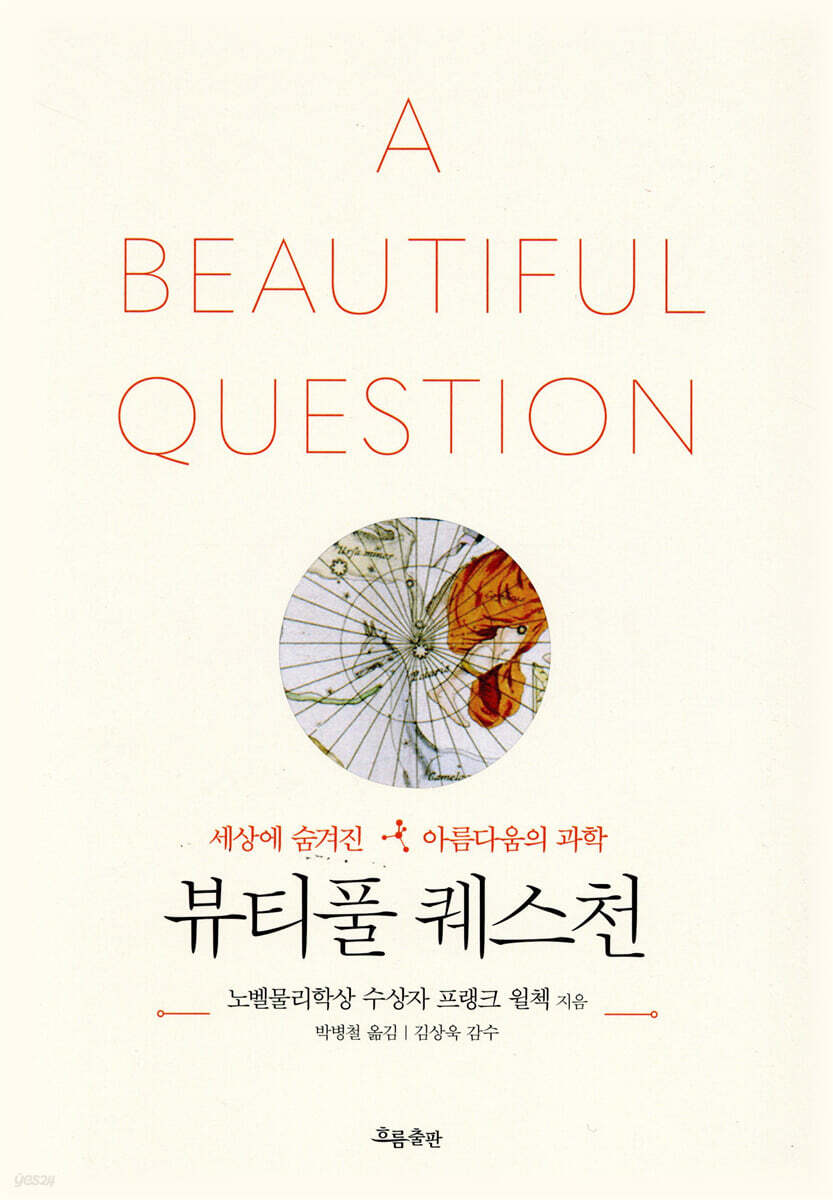
Beautiful Question
 |
Description
Book Introduction
“This book says that this world is a work of art.
“It is breathtakingly beautiful in itself.”
_ Professor Kim Sang-wook, Department of Physics, Kyung Hee University
Frank Wilczek, the world's greatest living intellect and winner of the 2004 Nobel Prize in Physics!
Discover the profound beauty hidden in this world through mathematics, science, and quantum mechanics!
Endless admiration and longing for the universe, wonder and delight in nature.
Since the beginning of human history, curiosity and affection for this beautiful world surrounding humans have continued like an undying flame.
What profound secrets lie hidden in this world that continue to fascinate humanity? In this book, Frank Wilczek, a professor at MIT and one of the world's greatest living scientists, unites "beauty" and "truth," the pursuits of humanity over the ages.
Wilczek invites us into the history of science to uncover the source of the innate beauty of the world that surrounds us and the profound principles hidden within it.
From Pythagoras, who discovered the order of the universe in numbers 2,500 years ago, to Galileo, who witnessed the mysteries of the celestial bodies with his own eyes, to Newton, who unified the motions of all things into a single law of mechanics, to Maxwell, who perfected classical electromagnetism, to Einstein, who opened a new horizon in modern physics with the theory of relativity, and to 20th-century physicists like Emmy Noether, who established quantum theory.
These brilliant minds, all of whom shared the assumption that the world is inherently beautiful, discovered great scientific theories that will remain in history forever.
Wilczek reveals the essence of their thoughts and theories, namely, that this world was created by the fundamental principles of 'symmetry' and 'economy', and seeks an answer to one question.
“Is this world really a work of art?”
Wilczek's long journey in search of the profound natural truths that shape the visible world of reality elegantly crosses the fields of mathematics, science, aesthetics, and quantum mechanics.
Wilczek's exceptional logic and intuition, worthy of a Nobel Prize winner in physics, spans the universe from its birth to the present, vividly reproducing microscopic entities, from atoms and photons to quarks, so close that they seem within reach, demonstrating that beauty resides in every aspect of this world.
As readers embark on this surprising and exciting journey, they will experience an expansion of their thinking and insight into the world.
“It is breathtakingly beautiful in itself.”
_ Professor Kim Sang-wook, Department of Physics, Kyung Hee University
Frank Wilczek, the world's greatest living intellect and winner of the 2004 Nobel Prize in Physics!
Discover the profound beauty hidden in this world through mathematics, science, and quantum mechanics!
Endless admiration and longing for the universe, wonder and delight in nature.
Since the beginning of human history, curiosity and affection for this beautiful world surrounding humans have continued like an undying flame.
What profound secrets lie hidden in this world that continue to fascinate humanity? In this book, Frank Wilczek, a professor at MIT and one of the world's greatest living scientists, unites "beauty" and "truth," the pursuits of humanity over the ages.
Wilczek invites us into the history of science to uncover the source of the innate beauty of the world that surrounds us and the profound principles hidden within it.
From Pythagoras, who discovered the order of the universe in numbers 2,500 years ago, to Galileo, who witnessed the mysteries of the celestial bodies with his own eyes, to Newton, who unified the motions of all things into a single law of mechanics, to Maxwell, who perfected classical electromagnetism, to Einstein, who opened a new horizon in modern physics with the theory of relativity, and to 20th-century physicists like Emmy Noether, who established quantum theory.
These brilliant minds, all of whom shared the assumption that the world is inherently beautiful, discovered great scientific theories that will remain in history forever.
Wilczek reveals the essence of their thoughts and theories, namely, that this world was created by the fundamental principles of 'symmetry' and 'economy', and seeks an answer to one question.
“Is this world really a work of art?”
Wilczek's long journey in search of the profound natural truths that shape the visible world of reality elegantly crosses the fields of mathematics, science, aesthetics, and quantum mechanics.
Wilczek's exceptional logic and intuition, worthy of a Nobel Prize winner in physics, spans the universe from its birth to the present, vividly reproducing microscopic entities, from atoms and photons to quarks, so close that they seem within reach, demonstrating that beauty resides in every aspect of this world.
As readers embark on this surprising and exciting journey, they will experience an expansion of their thinking and insight into the world.
- You can preview some of the book's contents.
Preview
index
Praise poured in for this book
Reviewer's Note: Sangwook Kim, Professor of Physics, Kyunghee University
User's Manual for this Book
Chapter 1 Questions
Chapter 2 Pythagoras: Thought and Object
Chapter 3 Pythagoras: Numbers and Harmonies
Chapter 4 Plato: Symmetrical Structures - Plato's Solids
Chapter 5 Plato: Man Out of the Cave
Chapter 6 Newton: Methodology and Madness
Chapter 7 Newton: Color
Chapter 8 Newton: Mechanical Beauty
Chapter 9 Maxwell: God's Aesthetic Sense
Chapter 10 Maxwell: The Doors of Perception
Chapter 11: Introduction to Symmetry
Chapter 12 Quantum Beauty I: The Music of the Sphere
Chapter 13 Symmetry I: Einstein's Two Steps
Chapter 14: Quantum Beauty II: The Energetic Electron
Chapter 15 Symmetry II: Local Color
Chapter 16: Quantum Beauty III: Beauty at the Core of Nature
Chapter 17 Symmetry III: Emmy Noether - Time, Energy, and Sanity
Chapter 18 Quantum Beauty IV: We Believe in Beauty
Chapter 19 A Beautiful Answer?
Chronicles of Physics
Glossary
Americas
Recommended books
Copyright of the painting
index
Acknowledgements
Translator's Note
Reviewer's Note: Sangwook Kim, Professor of Physics, Kyunghee University
User's Manual for this Book
Chapter 1 Questions
Chapter 2 Pythagoras: Thought and Object
Chapter 3 Pythagoras: Numbers and Harmonies
Chapter 4 Plato: Symmetrical Structures - Plato's Solids
Chapter 5 Plato: Man Out of the Cave
Chapter 6 Newton: Methodology and Madness
Chapter 7 Newton: Color
Chapter 8 Newton: Mechanical Beauty
Chapter 9 Maxwell: God's Aesthetic Sense
Chapter 10 Maxwell: The Doors of Perception
Chapter 11: Introduction to Symmetry
Chapter 12 Quantum Beauty I: The Music of the Sphere
Chapter 13 Symmetry I: Einstein's Two Steps
Chapter 14: Quantum Beauty II: The Energetic Electron
Chapter 15 Symmetry II: Local Color
Chapter 16: Quantum Beauty III: Beauty at the Core of Nature
Chapter 17 Symmetry III: Emmy Noether - Time, Energy, and Sanity
Chapter 18 Quantum Beauty IV: We Believe in Beauty
Chapter 19 A Beautiful Answer?
Chronicles of Physics
Glossary
Americas
Recommended books
Copyright of the painting
index
Acknowledgements
Translator's Note
Detailed image

Into the book
Artists have their own style.
Renoir's characteristically muted colors, Rembrandt's mysterious shadows, and Raphael's elegant style have little in common.
The same goes for the music of Mozart, the Beatles, and Louis Armstrong.
No one will be confused about who is singing their music.
Likewise, beauty projected onto physical entities also has a particular style.
Nature, like an artist, has its own style.
To appreciate the art of nature, one must be able to empathize with the style that only nature possesses.
Nature's artistic style can be broadly summarized into two categories:
● Symmetry: Nature embodies love through harmony, balance, and exquisite proportions.
● Economy: Nature produces various effects with minimal means.
- In Chapter 1 [Question]
Plato's view of nature has had a profound influence on modern scientific thinking in several ways.
Plato's claim that "all things are made up of a few basic units" still underpins the foundation of science.
Moreover, Plato's idea of "tracing the structure of nature from symmetry" has driven science (especially physics) for the past 2,000 years.
Modern physicists have arrived at some special structures through pure mathematical logic (especially symmetry logic), and it is here that they are searching for the fundamental elements of nature.
Plato's idea that there is symmetry in the deepest recesses of nature plays a central role in understanding physical reality.
It is a very bold idea to think that symmetry is reflected in the structure of nature.
By demanding mathematical perfection from nature, physicists have succeeded in reducing the complexity of phenomena to a few, and have created models to describe nature based on this list.
This list has also served as a guidepost guiding us through uncharted territory.
What catches our attention in Plato's thought is the part that says, "Beauty is inherent in the deepest part of this world."
He said that the smallest fundamental unit of this world (the atom) is “a pure concept that can be discovered and described by the human mind, realized in the real world.”
- In Chapter 4 [Plato: Symmetrical Structures - Plato's Solids]
Imagine you are standing on top of a mountain and throwing a rock horizontally (i.e. parallel to the ground).
If the stone is slow, it will fall before it can go very far.
However, if you throw the stone hard, it may fly farther and fall on the mountainside.
Okay, let's try a little harder.
The harder you throw a rock, the closer it will reach the ground at its starting point. At a certain speed, the rock will circle the Earth and hit the back of your head! If you knew this in advance and lowered your head after throwing the rock hard, the rock would orbit the Earth like a satellite from its initial height.
(How do you overcome air resistance? This is a thought experiment in your imagination, so please forget about the minor issues.) Now, imagine a super-massive mountain much larger than the diameter of the Earth.
From the top of that mountain, he threw an enormous boulder at just the right speed to make it orbit the Earth.
Let's call this rock 'Moon'.
Let's apply this to the sun as well.
In other words, the planets orbiting the sun are like rocks thrown at an appropriate speed from the top of a mountain.
Gravity is a force that applies to all objects with mass without exception.
If we introduce gravity into the thought experiment above, we can explain almost everything that happens around us, from rocks falling to the Earth's surface to the moon orbiting it, using a single logic.
Of course, thought experiments alone cannot prove anything, but when accompanied by careful research and experimentation, useful results can be obtained.
It's good if the result of the thought experiment is logical, and even better if it's beautiful.
- From Chapter 8 [Newton: Mechanical Beauty]
In general, symmetry means 'change without change'.
The first person to discover the close relationship between mathematical symmetry and physical laws was the German mathematician Emmy Noether (1882-1935).
Noether's theorem can be written as follows:
“If a physical law is symmetrical with respect to a transformation, there exists a corresponding conservation quantity.” By proving that the law of conservation of energy is “a result derived from the invariance of physical laws with respect to time,” she revealed the origin and beauty of laws to the world.
With the magic wand of mathematics wielded by Noether, an ugly frog was transformed into a handsome prince! This is one of the most profound and magnificent achievements in physics.
- From Chapter 17 [Symmetry III: Emmy Noether - Time, Energy, and Sanity]
Renoir's characteristically muted colors, Rembrandt's mysterious shadows, and Raphael's elegant style have little in common.
The same goes for the music of Mozart, the Beatles, and Louis Armstrong.
No one will be confused about who is singing their music.
Likewise, beauty projected onto physical entities also has a particular style.
Nature, like an artist, has its own style.
To appreciate the art of nature, one must be able to empathize with the style that only nature possesses.
Nature's artistic style can be broadly summarized into two categories:
● Symmetry: Nature embodies love through harmony, balance, and exquisite proportions.
● Economy: Nature produces various effects with minimal means.
- In Chapter 1 [Question]
Plato's view of nature has had a profound influence on modern scientific thinking in several ways.
Plato's claim that "all things are made up of a few basic units" still underpins the foundation of science.
Moreover, Plato's idea of "tracing the structure of nature from symmetry" has driven science (especially physics) for the past 2,000 years.
Modern physicists have arrived at some special structures through pure mathematical logic (especially symmetry logic), and it is here that they are searching for the fundamental elements of nature.
Plato's idea that there is symmetry in the deepest recesses of nature plays a central role in understanding physical reality.
It is a very bold idea to think that symmetry is reflected in the structure of nature.
By demanding mathematical perfection from nature, physicists have succeeded in reducing the complexity of phenomena to a few, and have created models to describe nature based on this list.
This list has also served as a guidepost guiding us through uncharted territory.
What catches our attention in Plato's thought is the part that says, "Beauty is inherent in the deepest part of this world."
He said that the smallest fundamental unit of this world (the atom) is “a pure concept that can be discovered and described by the human mind, realized in the real world.”
- In Chapter 4 [Plato: Symmetrical Structures - Plato's Solids]
Imagine you are standing on top of a mountain and throwing a rock horizontally (i.e. parallel to the ground).
If the stone is slow, it will fall before it can go very far.
However, if you throw the stone hard, it may fly farther and fall on the mountainside.
Okay, let's try a little harder.
The harder you throw a rock, the closer it will reach the ground at its starting point. At a certain speed, the rock will circle the Earth and hit the back of your head! If you knew this in advance and lowered your head after throwing the rock hard, the rock would orbit the Earth like a satellite from its initial height.
(How do you overcome air resistance? This is a thought experiment in your imagination, so please forget about the minor issues.) Now, imagine a super-massive mountain much larger than the diameter of the Earth.
From the top of that mountain, he threw an enormous boulder at just the right speed to make it orbit the Earth.
Let's call this rock 'Moon'.
Let's apply this to the sun as well.
In other words, the planets orbiting the sun are like rocks thrown at an appropriate speed from the top of a mountain.
Gravity is a force that applies to all objects with mass without exception.
If we introduce gravity into the thought experiment above, we can explain almost everything that happens around us, from rocks falling to the Earth's surface to the moon orbiting it, using a single logic.
Of course, thought experiments alone cannot prove anything, but when accompanied by careful research and experimentation, useful results can be obtained.
It's good if the result of the thought experiment is logical, and even better if it's beautiful.
- From Chapter 8 [Newton: Mechanical Beauty]
In general, symmetry means 'change without change'.
The first person to discover the close relationship between mathematical symmetry and physical laws was the German mathematician Emmy Noether (1882-1935).
Noether's theorem can be written as follows:
“If a physical law is symmetrical with respect to a transformation, there exists a corresponding conservation quantity.” By proving that the law of conservation of energy is “a result derived from the invariance of physical laws with respect to time,” she revealed the origin and beauty of laws to the world.
With the magic wand of mathematics wielded by Noether, an ugly frog was transformed into a handsome prince! This is one of the most profound and magnificent achievements in physics.
- From Chapter 17 [Symmetry III: Emmy Noether - Time, Energy, and Sanity]
--- From the text
Publisher's Review
Studying science means learning about the world we live in.
It's about understanding that this world is beautiful!
What was God's intention in creating this world (if he exists)? Historically, answers to this question have varied depending on one's perspective on the world, but the one truth universally acknowledged is this: "The world surrounding us is beautiful."
Because of this, people with rich creative power believed that the being that created this world was essentially an artist, and that they could share and feel his aesthetic sense.
Their ideas have had a profound influence on philosophy, science, literature, and art, raising numerous questions over the centuries.
In conclusion, nature exists in exquisite proportions, in harmony and balance, and produces maximum effects with minimal means (without the slightest waste).
Symmetry and economy! These two elements, as Frank Wilczek, one of the 21st century's greatest intellectuals and scientists, believes, are the profound principles inherent in nature that make the world beautiful.
However, it is impossible to discover these natural operating principles using only human senses.
This is because human senses can only discern a very limited number of elements that nature inherently possesses, such as light, color, and constituent particles like atoms.
This is something that can only be done by looking through a microscope or telescope, by disassembling atoms or nuclei, or by going through lengthy mathematical logic.
Frank Wilczek summons scientists, artists, and philosophers from throughout history to bring this invisible world to life.
These historical figures are great masters who dedicated themselves to exploring the various phenomena of nature and unlocking the secrets of beauty.
Frank Wilczek follows in their glorious footsteps, showing us that understanding the world scientifically is the quickest way to understanding beauty.
Through the history of science
Finding the answer to 'Beautiful World'!
The history of the perspective on viewing this world as a work of art is similar to the history of art.
In art, an original style is not discarded simply because it is old; it often lives a long life, exerting a significant influence on new styles.
Likewise, if we reconstruct science from a historical perspective, we can retrace the paths taken by great scientists, moving from simple concepts of scientific theory to increasingly complex ones.
Through this, we can sequentially see the process in which concepts that initially feel very unfamiliar go through familiar stages and become self-evident.
Frank Wilczek explains to readers the proposition that this world is a work of art that preserves beauty through the ideas and theories of scientists throughout history.
The first to appear is Pythagoras.
The Pythagorean theorem states that the geometric shapes of objects are connected through numbers.
In other words, the belief that 'this world is made of integers' (of course, this logic was broken) that Pythagoras and his followers believed in was a belief that 'beautiful concepts' were realized in this world through numbers.
Pythagoras also discovered two surprising laws that govern the pitch of sounds.
The fact is that the pitch of a sound changes depending on the length of the vibrating part, and that a pleasant chord is created when the tension applied to the string forms a simple integer ratio.
What we can learn from Pythagoras' experiment is that the shape, size, weight, and harmony of objects are closely related to numbers.
The source of sound is ultimately a vibrating string, and vibration means periodic motion.
Periodic motion refers to motion that occurs at regular time intervals, and is the same as the periodic motion of the planets, including the sun.
Ultimately, the sounds or chords produced by any instrument on Earth are the 'music of the celestial bodies' that fill the universe.
In other words, the mathematical ratio that Pythagoras discovered to form harmonious Mars is a law of nature that can also be applied to the mathematical ratios that form celestial bodies.
And humans instinctively perceive Mars, which is created with such harmonious mathematical proportions, as beautiful.
Plato believed that identical atoms come together to create the physical entities of nature, and that beauty is inherent in the smallest units that make up this world.
Plato explained the world as a five-dimensional regular polygon, reflecting the symmetry of these atoms.
Of course, Plato's theories about atoms and solids have been proven false by modern science, but Plato's idea of 'tracing nature through symmetry' has driven the development of science (especially physics) for the next 2,000 years.
Plato's ideas have also played a central role in modern scientists' understanding of physical reality.
Plato, through the metaphor of the 'Man in the Cave', said that humans have limited senses, like the man in the cave who sees only shadows of the real world, not the real world.
That is why Plato said that in order to encounter the 'reality that transcends the appearance of this world', we must try to peel away the complex appearance of things and reach the essence hidden within them.
In other words, anyone who feels beauty in nature can discover the true source of beauty through training to see reality.
Science and physics are the key!
The spark of modern science, ignited by Copernicus' heliocentric theory, began to explode in all directions through Newton.
At this point, the world begins to deconstruct itself based on observation and measurement, precise description through geometry and equations, and a mathematical system that synthesizes all of these.
Newton is considered a figure who raised the level of all science through 'analysis and synthesis'.
Newton achieved remarkable results in the fields of mathematics (infinite series and calculus), mechanics (the law of universal gravitation), and optics (color theory), and from then on, the essence of nature and the universe began to be solved mathematically.
Maxwell, who opened a new chapter in modern physics, changed 'space', which was merely a container for matter, into a medium that filled the universe.
Before Maxwell, space was just empty space.
Frank Wilczek considers Maxwell one of the greatest physicists of all time.
According to Wilczek, Maxwell predicted that if mathematical beauty exists in nature, then it would be possible to deduce the laws of nature from beauty.
Based on these assumptions, Maxwell predicted a new form of light.
And by discovering that the speed of the wave created by the combination of electric and magnetic fields is the same as the speed of light, he ultimately proved that light is an electromagnetic wave.
Since Maxwell, scientists have begun to define nature through beauty.
Numerous physicists and other scientists have argued that symmetry is the most beautiful principle hidden in nature, and according to them, the concept of symmetry exists without exception in all profound physical laws.
Symmetry, hidden in nature, governed all things, and it was simpler, more precise, and more beautiful than any other principle.
The concept of symmetry fascinated Galileo, Einstein, Emmy Noether, and even 20th-century physicists.
Symmetry means 'change without change'.
Imagine a circle.
Rotating a circle does not change its shape.
From Galileo to Einstein, symmetry was established as the supreme principle governing the entire universe.
Einstein proved that there is a local symmetry in spacetime (the laws of physics do not change even if different speeds are added to spacetime), and Emmy Noether extended this and showed that for the laws of physics to be symmetrical, there must be a corresponding conserved quantity, which is energy.
Ultimately, all conservation laws applicable in physics originate from the symmetries of nature, and these laws contain beauty.
And this world, made up of those laws, is bound to be beautiful.
Beautiful world, beautiful people!
We remain in this world as one light!
Throughout history, countless scientists have sought order and harmony by inventing their own theories, but a more perfect and pure beauty already existed in this world.
The solar system was formed by sophisticated mechanical laws, and light existed perfectly beyond the imperfect scope of human vision and imagination.
Nature, too, was realized according to the powerful principle of symmetry.
There are no exceptions.
Frank Wilczek says:
“This world follows the laws of physics, and those laws contain beauty.”
After all, this world is essentially a wonderful work of art, one that possesses beauty.
The world is beautiful.
Frank Wilczek concludes the book by saying something we often forget:
“You and I are made of matter and follow the laws of physics.
“You and I have a choice, and we have to take responsibility for the consequences.”
Frank Wilczek concludes:
Ultimately, we, as a component of this world and a part of nature, are also a beautiful and amazing work of art.
In this book, Frank Wilczek speaks of the beauty of the world, but at the same time, he makes us realize that we humans are also a part of nature and a component of the world, making us reflect on our ultimate attitude toward life that we should pursue.
This book broadens our perspective on nature, while ultimately reducing the realm of thought from the dimension of the world to the dimension of individual human beings.
We are all ultimately born beautiful.
Of course, creating a beautiful life is each person's responsibility.
But if we don't forget that fact, we will remain as beautiful beings in this world as a brilliant light and then disappear (because according to the laws of physics, light continues to move forward), says Frank Wilczek.
A happy person is one who realizes that what he does today is connected to his life and embodies the work of eternity.
Therefore, humans must strive to combine the finite and the infinite by imitating the divine processes of nature as closely as possible.
We must not take ourselves lightly, thinking that we are short-lived, nor should we turn a blind eye to the reality before us, thinking that we will never be able to unravel the mysteries of time.
_ James Clerk Maxwell
It's about understanding that this world is beautiful!
What was God's intention in creating this world (if he exists)? Historically, answers to this question have varied depending on one's perspective on the world, but the one truth universally acknowledged is this: "The world surrounding us is beautiful."
Because of this, people with rich creative power believed that the being that created this world was essentially an artist, and that they could share and feel his aesthetic sense.
Their ideas have had a profound influence on philosophy, science, literature, and art, raising numerous questions over the centuries.
In conclusion, nature exists in exquisite proportions, in harmony and balance, and produces maximum effects with minimal means (without the slightest waste).
Symmetry and economy! These two elements, as Frank Wilczek, one of the 21st century's greatest intellectuals and scientists, believes, are the profound principles inherent in nature that make the world beautiful.
However, it is impossible to discover these natural operating principles using only human senses.
This is because human senses can only discern a very limited number of elements that nature inherently possesses, such as light, color, and constituent particles like atoms.
This is something that can only be done by looking through a microscope or telescope, by disassembling atoms or nuclei, or by going through lengthy mathematical logic.
Frank Wilczek summons scientists, artists, and philosophers from throughout history to bring this invisible world to life.
These historical figures are great masters who dedicated themselves to exploring the various phenomena of nature and unlocking the secrets of beauty.
Frank Wilczek follows in their glorious footsteps, showing us that understanding the world scientifically is the quickest way to understanding beauty.
Through the history of science
Finding the answer to 'Beautiful World'!
The history of the perspective on viewing this world as a work of art is similar to the history of art.
In art, an original style is not discarded simply because it is old; it often lives a long life, exerting a significant influence on new styles.
Likewise, if we reconstruct science from a historical perspective, we can retrace the paths taken by great scientists, moving from simple concepts of scientific theory to increasingly complex ones.
Through this, we can sequentially see the process in which concepts that initially feel very unfamiliar go through familiar stages and become self-evident.
Frank Wilczek explains to readers the proposition that this world is a work of art that preserves beauty through the ideas and theories of scientists throughout history.
The first to appear is Pythagoras.
The Pythagorean theorem states that the geometric shapes of objects are connected through numbers.
In other words, the belief that 'this world is made of integers' (of course, this logic was broken) that Pythagoras and his followers believed in was a belief that 'beautiful concepts' were realized in this world through numbers.
Pythagoras also discovered two surprising laws that govern the pitch of sounds.
The fact is that the pitch of a sound changes depending on the length of the vibrating part, and that a pleasant chord is created when the tension applied to the string forms a simple integer ratio.
What we can learn from Pythagoras' experiment is that the shape, size, weight, and harmony of objects are closely related to numbers.
The source of sound is ultimately a vibrating string, and vibration means periodic motion.
Periodic motion refers to motion that occurs at regular time intervals, and is the same as the periodic motion of the planets, including the sun.
Ultimately, the sounds or chords produced by any instrument on Earth are the 'music of the celestial bodies' that fill the universe.
In other words, the mathematical ratio that Pythagoras discovered to form harmonious Mars is a law of nature that can also be applied to the mathematical ratios that form celestial bodies.
And humans instinctively perceive Mars, which is created with such harmonious mathematical proportions, as beautiful.
Plato believed that identical atoms come together to create the physical entities of nature, and that beauty is inherent in the smallest units that make up this world.
Plato explained the world as a five-dimensional regular polygon, reflecting the symmetry of these atoms.
Of course, Plato's theories about atoms and solids have been proven false by modern science, but Plato's idea of 'tracing nature through symmetry' has driven the development of science (especially physics) for the next 2,000 years.
Plato's ideas have also played a central role in modern scientists' understanding of physical reality.
Plato, through the metaphor of the 'Man in the Cave', said that humans have limited senses, like the man in the cave who sees only shadows of the real world, not the real world.
That is why Plato said that in order to encounter the 'reality that transcends the appearance of this world', we must try to peel away the complex appearance of things and reach the essence hidden within them.
In other words, anyone who feels beauty in nature can discover the true source of beauty through training to see reality.
Science and physics are the key!
The spark of modern science, ignited by Copernicus' heliocentric theory, began to explode in all directions through Newton.
At this point, the world begins to deconstruct itself based on observation and measurement, precise description through geometry and equations, and a mathematical system that synthesizes all of these.
Newton is considered a figure who raised the level of all science through 'analysis and synthesis'.
Newton achieved remarkable results in the fields of mathematics (infinite series and calculus), mechanics (the law of universal gravitation), and optics (color theory), and from then on, the essence of nature and the universe began to be solved mathematically.
Maxwell, who opened a new chapter in modern physics, changed 'space', which was merely a container for matter, into a medium that filled the universe.
Before Maxwell, space was just empty space.
Frank Wilczek considers Maxwell one of the greatest physicists of all time.
According to Wilczek, Maxwell predicted that if mathematical beauty exists in nature, then it would be possible to deduce the laws of nature from beauty.
Based on these assumptions, Maxwell predicted a new form of light.
And by discovering that the speed of the wave created by the combination of electric and magnetic fields is the same as the speed of light, he ultimately proved that light is an electromagnetic wave.
Since Maxwell, scientists have begun to define nature through beauty.
Numerous physicists and other scientists have argued that symmetry is the most beautiful principle hidden in nature, and according to them, the concept of symmetry exists without exception in all profound physical laws.
Symmetry, hidden in nature, governed all things, and it was simpler, more precise, and more beautiful than any other principle.
The concept of symmetry fascinated Galileo, Einstein, Emmy Noether, and even 20th-century physicists.
Symmetry means 'change without change'.
Imagine a circle.
Rotating a circle does not change its shape.
From Galileo to Einstein, symmetry was established as the supreme principle governing the entire universe.
Einstein proved that there is a local symmetry in spacetime (the laws of physics do not change even if different speeds are added to spacetime), and Emmy Noether extended this and showed that for the laws of physics to be symmetrical, there must be a corresponding conserved quantity, which is energy.
Ultimately, all conservation laws applicable in physics originate from the symmetries of nature, and these laws contain beauty.
And this world, made up of those laws, is bound to be beautiful.
Beautiful world, beautiful people!
We remain in this world as one light!
Throughout history, countless scientists have sought order and harmony by inventing their own theories, but a more perfect and pure beauty already existed in this world.
The solar system was formed by sophisticated mechanical laws, and light existed perfectly beyond the imperfect scope of human vision and imagination.
Nature, too, was realized according to the powerful principle of symmetry.
There are no exceptions.
Frank Wilczek says:
“This world follows the laws of physics, and those laws contain beauty.”
After all, this world is essentially a wonderful work of art, one that possesses beauty.
The world is beautiful.
Frank Wilczek concludes the book by saying something we often forget:
“You and I are made of matter and follow the laws of physics.
“You and I have a choice, and we have to take responsibility for the consequences.”
Frank Wilczek concludes:
Ultimately, we, as a component of this world and a part of nature, are also a beautiful and amazing work of art.
In this book, Frank Wilczek speaks of the beauty of the world, but at the same time, he makes us realize that we humans are also a part of nature and a component of the world, making us reflect on our ultimate attitude toward life that we should pursue.
This book broadens our perspective on nature, while ultimately reducing the realm of thought from the dimension of the world to the dimension of individual human beings.
We are all ultimately born beautiful.
Of course, creating a beautiful life is each person's responsibility.
But if we don't forget that fact, we will remain as beautiful beings in this world as a brilliant light and then disappear (because according to the laws of physics, light continues to move forward), says Frank Wilczek.
A happy person is one who realizes that what he does today is connected to his life and embodies the work of eternity.
Therefore, humans must strive to combine the finite and the infinite by imitating the divine processes of nature as closely as possible.
We must not take ourselves lightly, thinking that we are short-lived, nor should we turn a blind eye to the reality before us, thinking that we will never be able to unravel the mysteries of time.
_ James Clerk Maxwell
GOODS SPECIFICS
- Date of publication: June 15, 2018
- Format: Hardcover book binding method guide
- Page count, weight, size: 552 pages | 892g | 152*220*36mm
- ISBN13: 9788965962656
- ISBN10: 896596265X
You may also like
카테고리
korean


korean

![ELLE 엘르 스페셜 에디션 A형 : 12월 [2025]](http://librairie.coreenne.fr/cdn/shop/files/b8e27a3de6c9538896439686c6b0e8fb.jpg?v=1766436872&width=3840)


