

Map of Happiness
 |
Description
Book Introduction
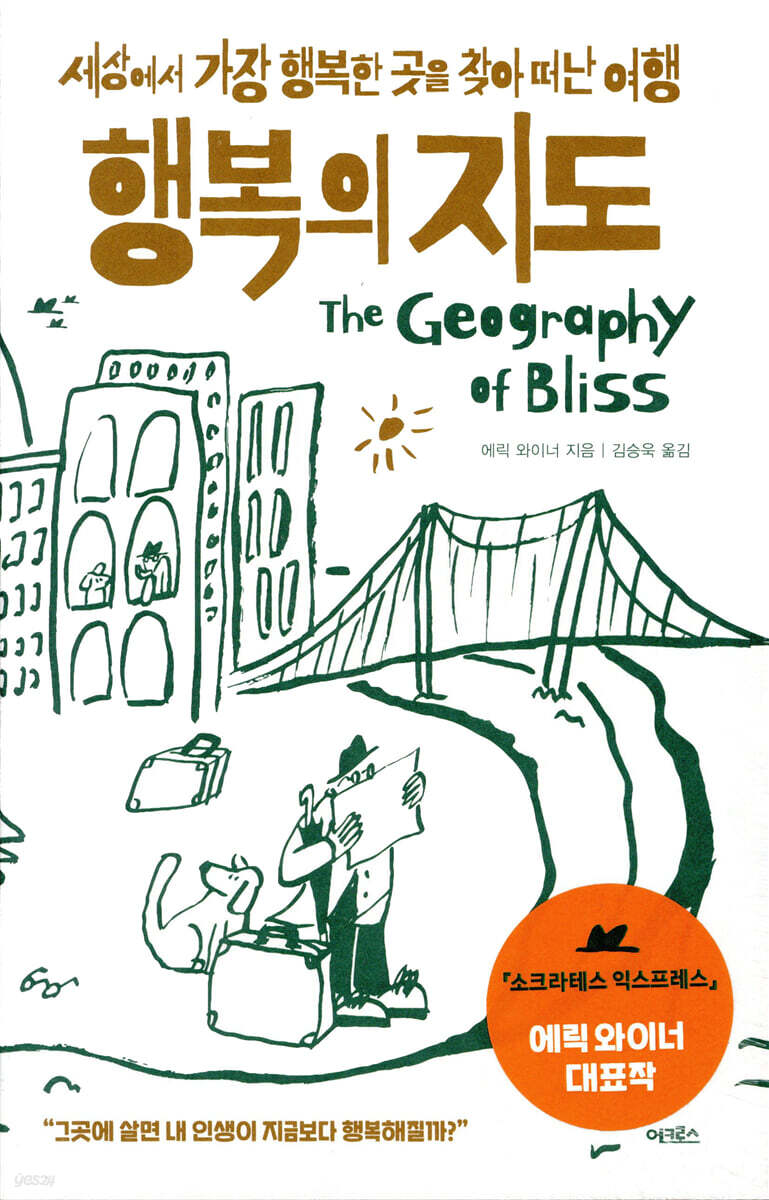
“Would my life be happier if I lived there?” Eric Weiner's masterpiece, "Socrates Express"! A journey to find the happiest place in the world A New York Times bestseller, a Washington Post Book of the Year, and Amazon's #1 nonfiction book. “Almost every definition of happiness is portrayed as cheerful.” Bestselling author Eric Weiner's journey to find happiness “Create a map of happiness. Rich or poor country, tropical or frigid, democracy or dictatorship, these things don't matter. “I will follow the scent of happiness wherever it goes.” Eric Weiner, a writer who worked as a reporter for the [New York Times] and as an NPR foreign correspondent, reported news from various cities in 30 countries, including New Delhi, Jerusalem, and Tokyo. One day he realizes that he is only reporting news of wars and diseases from unfortunate countries. So, contrary to what I've done before, I decided to uncover the truth about the happiest country in the world, a country that no one has ever heard of before. What kind of country would be happy? What if we lived in a country with no taxes? What if we lived in a country where failure was actually encouraged? What if we lived in a country where overthinking was discouraged? Would we be happy then? Do the people there truly feel happy? How is their happiness similar to, and different from, ours? |
- You can preview some of the book's contents.
Preview
index
To Korean Readers - Happiness is Stronger Than You Think
Prologue - Are you unhappy because you are not happy?
1.
Netherlands - Happiness comes from endless tolerance.
2.
Switzerland - Happiness is a quiet contentment.
3.
Bhutan - Happiness is the nation's highest goal.
4.
Qatar - Happiness is like winning the lottery
5.
Iceland - Happiness is the opportunity to fail
6.
Moldova - Happiness is somewhere else, not here.
7.
Thailand - Happiness is not thinking
8.
UK - Happiness is a byproduct of a good life.
9.
India - Happiness is a contradiction
10.
America - Happiness is a haven for the mind.
Epilogue - Is it still far?
Prologue - Are you unhappy because you are not happy?
1.
Netherlands - Happiness comes from endless tolerance.
2.
Switzerland - Happiness is a quiet contentment.
3.
Bhutan - Happiness is the nation's highest goal.
4.
Qatar - Happiness is like winning the lottery
5.
Iceland - Happiness is the opportunity to fail
6.
Moldova - Happiness is somewhere else, not here.
7.
Thailand - Happiness is not thinking
8.
UK - Happiness is a byproduct of a good life.
9.
India - Happiness is a contradiction
10.
America - Happiness is a haven for the mind.
Epilogue - Is it still far?
Into the book
I organized “Socrates Express” around 14 “how to do” methods.
Some topics are small, like how to get out of bed or how to walk, while others are big, like how to cope with adversity or how to grow old.
Yes, there is also a story about how to die.
But 'how to be happy' was not included there.
Why? Because happiness is never something we obtain directly.
Happiness is a pleasant side effect, a byproduct of a good life.
--- p.6
European explorers learned Aramaic, the language spoken by Jesus, in preparation for their voyages of discovery in search of paradise.
I too have set out to find happiness, but I cannot speak Aramaic.
(...) All I took on my trip was not the Bible, but a few Lonely Planet travel guides and the conviction, as Henry Miller said, that “a man’s destination is never a place, but a new way of looking at things.”
--- p.12
“We are obsessed with measuring school enrollment rates.
And yet, we don't look at the content of the education.
Let's take a country like Japan as an example. While its citizens live long lives, what is the quality of life for those over 60? It makes sense.
We measure what is easiest to measure, but we don't measure what really matters to people's lives.
The National Happiness Index was created to correct this problem.
--- p.109
Icelanders just sing, draw, and write whatever they want.
Because of this free-spirited attitude, Icelandic artists produce a lot of sloppy work.
And then he is the first to admit that fact.
But those crappy works play an important role in the world of art.
In fact, these nonsense works are like fertilizer for farming.
It is thanks to the nonsense that good works can grow.
Good work cannot be produced without nonsense.
--- p.267
There are basically only three ways to make ourselves happy.
Increasing positive emotions (good mood), decreasing negative emotions (bad mood), or changing the subject.
We rarely consider this third method.
Even if we consider it, we ignore it as an escape from reality.
Changing the subject? That's avoiding the issue.
This is a cowardly act! To Thai people, this is a strange and very foolish idea.
Thai people don't believe words.
They see words as instruments of deception rather than instruments of truth.
--- p.366
“I’ve seen many people who have a lot of money but are unhappy.
It is people, not money, that make people happy.
Dogs also make people happy.”
--- p.431
It's a relief to think that I'm finally leaving this crazy place.
But I also feel like I want to stay here.
Contradiction? Yes, that's right.
But this is a contradiction I can live with.
I can even learn to enjoy this contradiction.
Some topics are small, like how to get out of bed or how to walk, while others are big, like how to cope with adversity or how to grow old.
Yes, there is also a story about how to die.
But 'how to be happy' was not included there.
Why? Because happiness is never something we obtain directly.
Happiness is a pleasant side effect, a byproduct of a good life.
--- p.6
European explorers learned Aramaic, the language spoken by Jesus, in preparation for their voyages of discovery in search of paradise.
I too have set out to find happiness, but I cannot speak Aramaic.
(...) All I took on my trip was not the Bible, but a few Lonely Planet travel guides and the conviction, as Henry Miller said, that “a man’s destination is never a place, but a new way of looking at things.”
--- p.12
“We are obsessed with measuring school enrollment rates.
And yet, we don't look at the content of the education.
Let's take a country like Japan as an example. While its citizens live long lives, what is the quality of life for those over 60? It makes sense.
We measure what is easiest to measure, but we don't measure what really matters to people's lives.
The National Happiness Index was created to correct this problem.
--- p.109
Icelanders just sing, draw, and write whatever they want.
Because of this free-spirited attitude, Icelandic artists produce a lot of sloppy work.
And then he is the first to admit that fact.
But those crappy works play an important role in the world of art.
In fact, these nonsense works are like fertilizer for farming.
It is thanks to the nonsense that good works can grow.
Good work cannot be produced without nonsense.
--- p.267
There are basically only three ways to make ourselves happy.
Increasing positive emotions (good mood), decreasing negative emotions (bad mood), or changing the subject.
We rarely consider this third method.
Even if we consider it, we ignore it as an escape from reality.
Changing the subject? That's avoiding the issue.
This is a cowardly act! To Thai people, this is a strange and very foolish idea.
Thai people don't believe words.
They see words as instruments of deception rather than instruments of truth.
--- p.366
“I’ve seen many people who have a lot of money but are unhappy.
It is people, not money, that make people happy.
Dogs also make people happy.”
--- p.431
It's a relief to think that I'm finally leaving this crazy place.
But I also feel like I want to stay here.
Contradiction? Yes, that's right.
But this is a contradiction I can live with.
I can even learn to enjoy this contradiction.
---From "Chapter 9: India: Happiness is a Contradiction"
Publisher's Review
“Would my life be happier if I lived there?”
Eric Weiner's masterpiece, "Socrates Express"!
A journey to find the happiest place in the world
A New York Times bestseller, a Washington Post Book of the Year, and Amazon's #1 nonfiction book.
“Almost every definition of happiness is portrayed as cheerful.”
Bestselling author Eric Weiner's journey to find happiness
“Create a map of happiness.
Rich or poor country, tropical or frigid, democracy or dictatorship, these things don't matter.
“I will follow the scent of happiness wherever it goes.”
Eric Weiner, a writer who worked as a reporter for the New York Times and as an NPR foreign correspondent, reported news from various cities in 30 countries, including New Delhi, Jerusalem, and Tokyo.
One day he realizes that he is only reporting news of wars and diseases from unfortunate countries.
So, contrary to what I've done before, I decided to uncover the truth about the happiest country in the world, a country that no one has ever heard of before.
What kind of country would be happy? What if we lived in a country with no taxes? What if we lived in a country where failure was actually encouraged? What if we lived in a country where overthinking was discouraged? Would we be happy then? Do the people there truly feel happy? How is their happiness similar to, and different from, ours?
With these questions in mind, Eric Weiner decided to travel to countries that possessed the very qualities we consider essential to happiness: money, pleasure, spiritual depth, and family.
He travels to ten countries across four continents, including Switzerland, Iceland, Bhutan, and India, embarking on an adventure to uncover the true nature of happiness, from happiness researcher to politician, and from worldly wisdom to hypnosis.
In the author's adventure, in which he throws himself wholeheartedly, almost every definition of happiness that humanity has ever had is cheerfully depicted.
“I packed my bags and left the house.
To embark on a journey that I knew would be as foolish and ultimately a waste of effort as the one I had attempted when I was five years old.
Eric Hoffer said this:
'The search for happiness is one of the major causes of unhappiness.' That's okay.
Because I'm already unhappy.
“You have to lose to win.”
“Did he catch the bluebird of happiness? Or did he just waste his time?”
Small but Big Truths About Happiness Encountered by a Wrong and Complaining Traveler
Eric Weiner's first destination is the Netherlands.
He meets Professor Ruth Vanhoven, a leading figure in happiness research and the author of the World Happiness Database.
Professor Benhoven speaks through a database of everything humanity knows about what makes us happy, what doesn't, and the happiest places in the world.
“Extroverts are happier than introverts.
Optimistic people are happier than pessimistic people.
Married people are happier than single people, but people with children are not happier than couples without children.
(...) Religious people are happier than non-religious people.
(...) People are most unhappy when they go to work.
Busy people are happier than people who have too little to do.
“The rich are happier than the poor, but the difference is very small.”
But Eric Weiner realizes that it's pointless to base happiness on data or research findings, such as getting married but not having children, going to church regularly, or quitting your PhD.
And he sets off.
Switzerland is one of the countries with the highest happiness index along with its economic level.
Bhutan, where the government directly created an index called the "National Happiness Index" and implemented policies to increase the total happiness of its citizens.
Qatar has so much money that it runs well without taxes from its citizens.
Iceland, a country where failure is encouraged.
Moldova makes us realize that the beginning of unhappiness is jealousy and comparison.
India is a bundle of contradictions.
The UK implemented a happiness promotion program targeting unhappy villages.
And to Eric Weiner's own home, the United States.
What makes this book special and interesting is the little truths Eric Winer discovers.
What he discovered while traveling, wondering, 'Will happiness come to me naturally if I live there?' was not the world's 'happiest country' or the external 'conditions for happiness,' but the 'various faces of happiness' shown by each country, culture, and people.
Eric Weiner's masterpiece, the 2021 bestseller "Socrates Express"
"A true story of happiness that resonates even more deeply in the midst of a pandemic."
"The Map to Happiness" is the masterpiece of Eric Weiner, author of "Socrates Express" published in 2021. It was immediately selected as a [New York Times] bestseller and [Washington Post] Book of the Year upon its publication in 2008.
Afterwards, it was translated and published in over 20 countries around the world, enjoying explosive popularity, and was also published in Korea in 2008, bringing great fame to the author.
With the publication of this book, he has risen to the ranks of the world's most notable non-fiction writers, receiving praise for "Bill Bryson's humor combined with Alain de Botton's insight."
The book, originally published in 2008, was republished in 2021 in Korean with a preface by the author after translation, revision, and proofreading.
Below is an excerpt from the author's preface to Korean readers.
“For the past two years, the world has endured unbearable things.
Humanity is more connected than ever, and that vile coronavirus has exploited this interconnectedness with brutal efficiency, sneaking around on airplanes, cruise ships, and even on the lips of loved ones.
The world has become a death trap.
Still, we persevered.
What, for what purpose? To find happiness.
To find true happiness, not the happiness of a smile symbol with an empty smile, but a deeper happiness.
A lot has changed since I set out on a Don Quixote-like journey to find the happiest place in the world.
But it also hasn't changed at all.
To explain it, it's like this.
Despite suffering a devastating economic collapse, Iceland remains one of the happiest places in the world.
Even though Thailand has experienced several political upheavals, including a coup, the people always find time to have fun and smile (they are the maestros of smiles).
The Himalayan nation of Bhutan continues to refine its national happiness index policy.
As I said, happiness is durable.” (From “To Korean Readers”)
Eric Weiner's masterpiece, "Socrates Express"!
A journey to find the happiest place in the world
A New York Times bestseller, a Washington Post Book of the Year, and Amazon's #1 nonfiction book.
“Almost every definition of happiness is portrayed as cheerful.”
Bestselling author Eric Weiner's journey to find happiness
“Create a map of happiness.
Rich or poor country, tropical or frigid, democracy or dictatorship, these things don't matter.
“I will follow the scent of happiness wherever it goes.”
Eric Weiner, a writer who worked as a reporter for the New York Times and as an NPR foreign correspondent, reported news from various cities in 30 countries, including New Delhi, Jerusalem, and Tokyo.
One day he realizes that he is only reporting news of wars and diseases from unfortunate countries.
So, contrary to what I've done before, I decided to uncover the truth about the happiest country in the world, a country that no one has ever heard of before.
What kind of country would be happy? What if we lived in a country with no taxes? What if we lived in a country where failure was actually encouraged? What if we lived in a country where overthinking was discouraged? Would we be happy then? Do the people there truly feel happy? How is their happiness similar to, and different from, ours?
With these questions in mind, Eric Weiner decided to travel to countries that possessed the very qualities we consider essential to happiness: money, pleasure, spiritual depth, and family.
He travels to ten countries across four continents, including Switzerland, Iceland, Bhutan, and India, embarking on an adventure to uncover the true nature of happiness, from happiness researcher to politician, and from worldly wisdom to hypnosis.
In the author's adventure, in which he throws himself wholeheartedly, almost every definition of happiness that humanity has ever had is cheerfully depicted.
“I packed my bags and left the house.
To embark on a journey that I knew would be as foolish and ultimately a waste of effort as the one I had attempted when I was five years old.
Eric Hoffer said this:
'The search for happiness is one of the major causes of unhappiness.' That's okay.
Because I'm already unhappy.
“You have to lose to win.”
“Did he catch the bluebird of happiness? Or did he just waste his time?”
Small but Big Truths About Happiness Encountered by a Wrong and Complaining Traveler
Eric Weiner's first destination is the Netherlands.
He meets Professor Ruth Vanhoven, a leading figure in happiness research and the author of the World Happiness Database.
Professor Benhoven speaks through a database of everything humanity knows about what makes us happy, what doesn't, and the happiest places in the world.
“Extroverts are happier than introverts.
Optimistic people are happier than pessimistic people.
Married people are happier than single people, but people with children are not happier than couples without children.
(...) Religious people are happier than non-religious people.
(...) People are most unhappy when they go to work.
Busy people are happier than people who have too little to do.
“The rich are happier than the poor, but the difference is very small.”
But Eric Weiner realizes that it's pointless to base happiness on data or research findings, such as getting married but not having children, going to church regularly, or quitting your PhD.
And he sets off.
Switzerland is one of the countries with the highest happiness index along with its economic level.
Bhutan, where the government directly created an index called the "National Happiness Index" and implemented policies to increase the total happiness of its citizens.
Qatar has so much money that it runs well without taxes from its citizens.
Iceland, a country where failure is encouraged.
Moldova makes us realize that the beginning of unhappiness is jealousy and comparison.
India is a bundle of contradictions.
The UK implemented a happiness promotion program targeting unhappy villages.
And to Eric Weiner's own home, the United States.
What makes this book special and interesting is the little truths Eric Winer discovers.
What he discovered while traveling, wondering, 'Will happiness come to me naturally if I live there?' was not the world's 'happiest country' or the external 'conditions for happiness,' but the 'various faces of happiness' shown by each country, culture, and people.
Eric Weiner's masterpiece, the 2021 bestseller "Socrates Express"
"A true story of happiness that resonates even more deeply in the midst of a pandemic."
"The Map to Happiness" is the masterpiece of Eric Weiner, author of "Socrates Express" published in 2021. It was immediately selected as a [New York Times] bestseller and [Washington Post] Book of the Year upon its publication in 2008.
Afterwards, it was translated and published in over 20 countries around the world, enjoying explosive popularity, and was also published in Korea in 2008, bringing great fame to the author.
With the publication of this book, he has risen to the ranks of the world's most notable non-fiction writers, receiving praise for "Bill Bryson's humor combined with Alain de Botton's insight."
The book, originally published in 2008, was republished in 2021 in Korean with a preface by the author after translation, revision, and proofreading.
Below is an excerpt from the author's preface to Korean readers.
“For the past two years, the world has endured unbearable things.
Humanity is more connected than ever, and that vile coronavirus has exploited this interconnectedness with brutal efficiency, sneaking around on airplanes, cruise ships, and even on the lips of loved ones.
The world has become a death trap.
Still, we persevered.
What, for what purpose? To find happiness.
To find true happiness, not the happiness of a smile symbol with an empty smile, but a deeper happiness.
A lot has changed since I set out on a Don Quixote-like journey to find the happiest place in the world.
But it also hasn't changed at all.
To explain it, it's like this.
Despite suffering a devastating economic collapse, Iceland remains one of the happiest places in the world.
Even though Thailand has experienced several political upheavals, including a coup, the people always find time to have fun and smile (they are the maestros of smiles).
The Himalayan nation of Bhutan continues to refine its national happiness index policy.
As I said, happiness is durable.” (From “To Korean Readers”)
GOODS SPECIFICS
- Date of issue: September 3, 2021
- Page count, weight, size: 528 pages | 694g | 140*220*35mm
- ISBN13: 9791167740021
- ISBN10: 1167740025
You may also like
카테고리
korean


korean

![GQ KOREA Mark (Monthly): December [2025]](http://librairie.coreenne.fr/cdn/shop/files/8ef265dbbfbf186523ed75ba7319009d.jpg?v=1765340328&width=3840)


