

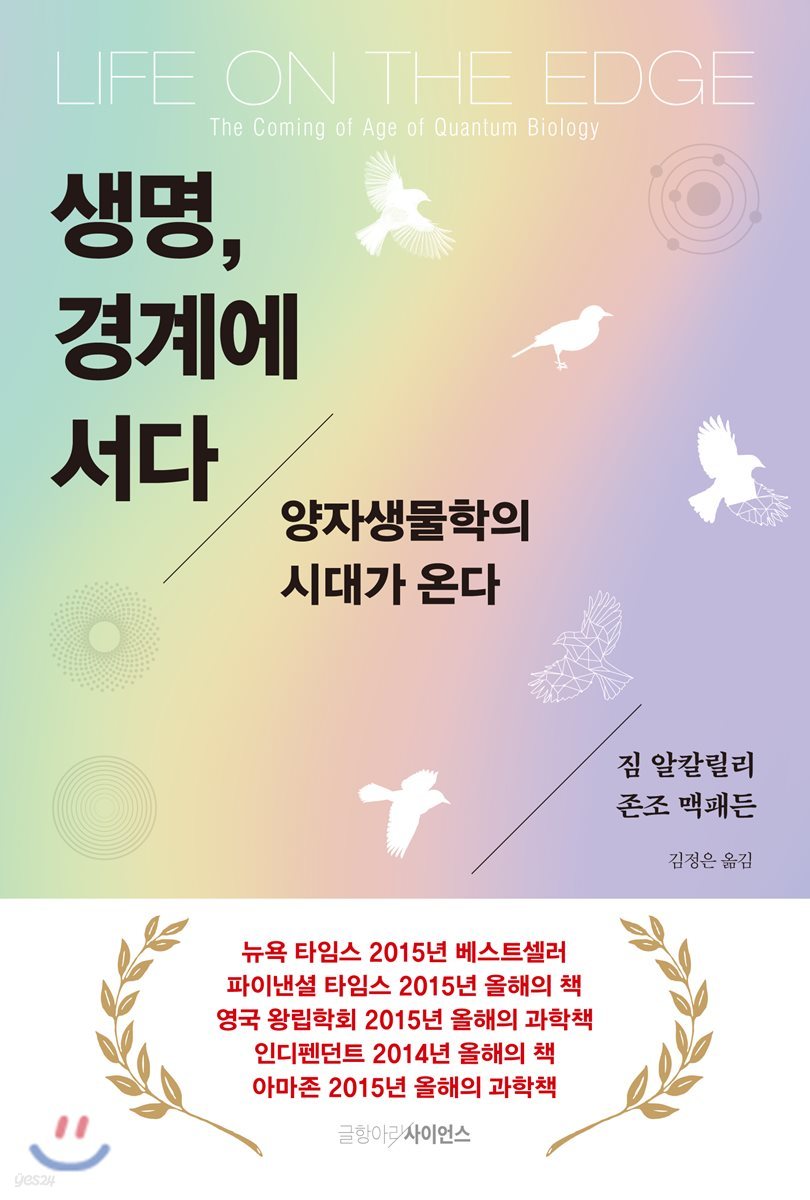
Life, standing on the edge
 |
Description
Book Introduction
The person next to me is so ordinary and insignificant that it reminds me that humans are imperfect beings. But if you look closely at him, you will see a mysterious flame of life burning within him. He holds the secret of life and death, yet we still do not clearly understand the mechanism of life and death. Not a single person so far. If you look around, electrons are always spinning and catalysts are reacting, but there is no special element that explains life anywhere. The thrilling book, "Life, Standing on the Boundary," provides a comprehensive overview of a nascent field. He argues that extremely small events occurring at the subatomic level have powerful effects on the behavior of humans and animals, and that true life exists there. Master storytellers Jim Al-Khalili and Jonjo McFadden delve into quantum mechanics to uncover its secrets. If you ask scientists what theory has had the most impact in science, biologists will likely point to Darwin's theory of evolution by natural selection, while physicists will likely give the top spot to quantum mechanics. Physics and chemistry, which provide a surprisingly complete picture of the components of the entire universe, are largely built on the foundations of quantum mechanics. Without the explanatory power of quantum mechanics, the workings of the world would not be as well understood as they are today. |
- You can preview some of the book's contents.
Preview
index
Chapter 1 Introduction
The Hidden Ghostly Truth│Quantum Biology│If quantum mechanics is a normal phenomenon, why should we be excited about quantum biology?
Chapter 2 What is Life?
"Vital Force" │ The Triumph of Dynamics │ Molecular Billiards │ Is Life Chaos? │ A Closer Look at Life │ Genes │ The Strange Laughter of Life │ The Quantum Revolution │ Schrödinger's Wave Function │ Early Quantum Biologists │ Order │ Discord
Chapter 3: The Engine of Life
Enzymes: Between the Living and the Dead│Why We Need Enzymes and Why Tadpole Tails Disappear│A Changing Landscape│Trash and Twists│Does Transition State Theory Explain Everything?│Electron Transfer│Quantum Tunneling│Quantum Tunneling of Electrons in Living Things│Proton Movement│Dynamic Isotope Effect│So, Does This Create Quantums in Quantum Biology?
Chapter 4: Quantum Pulse
The Core Mystery of Quantum Mechanics | Quantum Measurement | A Journey to the Heart of Photosynthesis | Quantum Beats
Chapter 5 Finding Nemo's House
The Physical Reality of Fragrance│The Secrets of Olfaction Revealed│Smelling with the Quantum Nose│The Nose Wars│A Physicist Smells
Chapter 6: Butterflies, Fruit Flies, and Quantum Birds
The Bird Compass│Quantum Spin and Ghostly Action│The Meaning of Direction in Radicals
Chapter 7 Quantum Genes
Fidelity│Betrayal│Giraffes, Peas, and Fruit Flies│Proton-Based Codes│Quantum Leap Genes?
Chapter 8: The Mind
How Strange Is Consciousness? The Dynamics of Thought How Does the Mind Move Matter? Qubit Computation Microtubule Computation? Quantum Ion Channels?
Chapter 9: How Life Began
Sticky Problems│From Mud to Cells│The World of RNA│So, Can Quantum Mechanics Help?│What Did the First Self-Replicator Look Like?
Chapter 10: Quantum Biology: Life on the Brink of a Storm
Good Vibrations (Bob-Bob) │ Reflections on the Driving Force of Life │ Life on the Quantum Boundary of the Classical Storm │ Creating Life with a Bottom-Up Approach │ The First Steps of a Primitive Quantum Protocell
Epilogue: Quantum Life
Acknowledgements
annotation
Search
The Hidden Ghostly Truth│Quantum Biology│If quantum mechanics is a normal phenomenon, why should we be excited about quantum biology?
Chapter 2 What is Life?
"Vital Force" │ The Triumph of Dynamics │ Molecular Billiards │ Is Life Chaos? │ A Closer Look at Life │ Genes │ The Strange Laughter of Life │ The Quantum Revolution │ Schrödinger's Wave Function │ Early Quantum Biologists │ Order │ Discord
Chapter 3: The Engine of Life
Enzymes: Between the Living and the Dead│Why We Need Enzymes and Why Tadpole Tails Disappear│A Changing Landscape│Trash and Twists│Does Transition State Theory Explain Everything?│Electron Transfer│Quantum Tunneling│Quantum Tunneling of Electrons in Living Things│Proton Movement│Dynamic Isotope Effect│So, Does This Create Quantums in Quantum Biology?
Chapter 4: Quantum Pulse
The Core Mystery of Quantum Mechanics | Quantum Measurement | A Journey to the Heart of Photosynthesis | Quantum Beats
Chapter 5 Finding Nemo's House
The Physical Reality of Fragrance│The Secrets of Olfaction Revealed│Smelling with the Quantum Nose│The Nose Wars│A Physicist Smells
Chapter 6: Butterflies, Fruit Flies, and Quantum Birds
The Bird Compass│Quantum Spin and Ghostly Action│The Meaning of Direction in Radicals
Chapter 7 Quantum Genes
Fidelity│Betrayal│Giraffes, Peas, and Fruit Flies│Proton-Based Codes│Quantum Leap Genes?
Chapter 8: The Mind
How Strange Is Consciousness? The Dynamics of Thought How Does the Mind Move Matter? Qubit Computation Microtubule Computation? Quantum Ion Channels?
Chapter 9: How Life Began
Sticky Problems│From Mud to Cells│The World of RNA│So, Can Quantum Mechanics Help?│What Did the First Self-Replicator Look Like?
Chapter 10: Quantum Biology: Life on the Brink of a Storm
Good Vibrations (Bob-Bob) │ Reflections on the Driving Force of Life │ Life on the Quantum Boundary of the Classical Storm │ Creating Life with a Bottom-Up Approach │ The First Steps of a Primitive Quantum Protocell
Epilogue: Quantum Life
Acknowledgements
annotation
Search
Into the book
Life seems to have one foot in the classical world of everyday objects, while the other is hidden deep within a strange and unique place called the quantum world.
We would say that life exists at the quantum boundary._Page 44
Why is it that what happens effortlessly to countless lowly microorganisms every moment remains impossible for us? Are we missing a single ingredient? This question was pondered by the renowned physicist Erwin Schrödinger 70 years ago, and his astonishing answer is the central theme of this book. (Page 63)
Therefore, to understand the real action taking place inside the active site of an enzyme, we must abandon our preconceptions and enter the strange world of quantum mechanics.
In the world of quantum mechanics, we can do two things—or more than a hundred—simultaneously, make ghostly connections, and penetrate seemingly impassable barriers. _Page 117
There is really only one law that governs how the world works.
This is the law of quantum mechanics.
Even the statistical laws and Newton's laws of motion, familiar to us, are ultimately laws of quantum mechanics, filtered through the lens of decoherence, which obscures the strange. _Page 179
We would say that life exists at the quantum boundary._Page 44
Why is it that what happens effortlessly to countless lowly microorganisms every moment remains impossible for us? Are we missing a single ingredient? This question was pondered by the renowned physicist Erwin Schrödinger 70 years ago, and his astonishing answer is the central theme of this book. (Page 63)
Therefore, to understand the real action taking place inside the active site of an enzyme, we must abandon our preconceptions and enter the strange world of quantum mechanics.
In the world of quantum mechanics, we can do two things—or more than a hundred—simultaneously, make ghostly connections, and penetrate seemingly impassable barriers. _Page 117
There is really only one law that governs how the world works.
This is the law of quantum mechanics.
Even the statistical laws and Newton's laws of motion, familiar to us, are ultimately laws of quantum mechanics, filtered through the lens of decoherence, which obscures the strange. _Page 179
--- From the text
Publisher's Review
A theory that was buried in a drawer in the scientific community
A Piece of Quantum Mechanics Revealed by the European Robin
This book is a revolutionary work that begins with a solid scientific foundation in the somewhat unfamiliar field of "quantum biology," then goes through a process of rational reasoning and then covers the latest experiments and theories to elucidate its principles.
Physicist Alkali and geneticist McFadden have combined quantum physics, biochemistry, and biology to create a book that draws on over 20 years of research.
Quantum mechanics is often referred to as the 'strange' phenomenon whereby an object can exist in two places at once, pass through apparently impassable barriers, and maintain connections with other distant objects.
As you know, even Einstein once said of quantum phenomena that they were “spooky.”
The authors of this book decided to make this bizarre concept more widely known by writing a popular science book and putting it in front of TV cameras.
Using excellent metaphors and terms from chemistry and physics, the principle of quantum mechanics is explained. Quantum particles, which are incredibly smaller than a speck of dust, ultimately become clues to unlocking the secrets of the vast universe.
The story opens with the flapping of the wings of a European robin.
(This will be revealed towards the end of the book, but it is a huge wingbeat that will reveal the origin of life.) In other words, this migratory bird that moves to escape the cold is utilizing the principles of quantum mechanics.
While some birds, such as homing pigeons, may have a traditional compass built into their heads based on magnetic particles, robins "see" the Earth's magnetic field in a slightly different way.
Certain chemicals in a bird's eye can instantly change the arrangement of electrons when they absorb light of the right energy.
This reversal uses some kind of quantum trickery to create a system that exists in two forms simultaneously (quantum entanglement).
Entanglement, one of the most mysterious properties of quantum mechanics, allows two particles to be instantly connected no matter how far apart they are.
Experiments have shown that entangled electron pairs can be particularly sensitive to the direction of a magnetic field, allowing the bird to detect whether it is facing toward the equator or away from it.
Life on the Edge clearly explains how the tiny events of the quantum world impact the world of mid-sized creatures like robins and humans, revealing how our world is overlaid and colored by quantum strangeness.
This completely changes our understanding of the dynamics of life.
Discrete energy levels, wave-particle duality, coherence, entanglement, and tunneling are not just of interest to scientists in cutting-edge physics laboratories.
The phenomena of quantum mechanics are as commonplace as your grandmother's apple pie, and they even occur in your grandmother's apple pie.
It's so ordinary, yet the world describes it as strange.
Schrödinger was right
The Revived Spark of Quantum Biology
This book goes back to Erwin Schrödinger and Pascual Jordan in revisiting quantum biology.
The person who kept the spark of quantum biology, which had been buried in a drawer of the scientific world, alive was none other than Schrödinger, who created quantum wave mechanics, and the person who laid the entire foundation of quantum biology was Jordan.
Quantum theory is recognized by all scientists as the most revolutionary paradigm of the 20th century, but it only brings to mind laboratories conducting nanoscale research in ultra-low temperature vacuums.
So most scientists wonder how quantum weirdness can survive in the warm, wet, and messy conditions of a living body.
Many biologists believe that quantum mechanics is relevant to biology, but they argue that its role is minimal.
The rules of quantum mechanics govern the behavior of atoms, so it stands to reason that the rules of the quantum world should also apply at the smallest scales in biology.
However, it is believed that it only operates on that scale and consequently has little or no effect on the larger-scale operations that are important to life.
But the authors of this book, along with their own firsthand experience of cutting-edge science, uncover what they have discovered so far in quantum mechanics and the "strange" phenomena at its heart.
In other words, groundbreaking experiments being conducted around the world recently have shown how the photosynthetic process depends on subatomic particles that can exist in many places simultaneously, and have revealed how, inside enzymes, the workhorses of life that build all the molecules in our cells, particles disappear from one spot and suddenly reappear somewhere else.
The papers they discuss here are very recent, published only a few years ago.
The authors say:
“Remember that living cells are extraordinarily complex places.
Cells are full of complex molecules that are constantly shuffling and fluctuating.
These molecules disrupt the delicate quantum coherence by randomly scattering in all directions, giving us a glimpse of the 'normal' everyday world.
Quantum coherence would have difficulty surviving in the midst of noisy molecular motion.
Therefore, it is a very surprising discovery that quantum effects such as tunneling persist within living cells, which are a sea of molecular turbulence.
After all, until just over a decade ago, most scientists dismissed the idea that tunneling and other sophisticated quantum phenomena could occur in biology.
The fact that quantum phenomena are found in these places suggests that life has devised special means to exploit the advantages offered by the quantum world to operate its cells.
What are the means? How does life prevent decoherence, the culprit of quantum phenomena? This enigma, one of the greatest mysteries of quantum biology, is now slowly being solved.”
The Future of Quantum Cryptography
Life on the edge of a storm
The roots of life run from the surface of Newtonian mechanics through the fluctuating water veins of thermodynamics to the foundations of quantum mechanics.
So life can exploit coherence, superposition, tunneling, and entanglement.
Photosystems, enzymes, the respiratory chain, and genes are structured down to the position of each particle, and their quantum motion makes a huge difference in the respiration that keeps us alive, the enzymes that make up our bodies, and the photosynthesis that creates almost all the biomass on Earth.
Life is like a ship sailing on a stormy sea.
This ship is manned by a seasoned captain, a genetic program honed by nearly four billion years of evolution, capable of navigating the vast depths of the quantum and classical realms.
Life is about embracing storms rather than avoiding them.
It is to gather the gusts and strong winds of molecules and inflate the sail.
So we straighten the ship of life, so that its narrow keel passes through the sea of thermodynamics and reaches the quantum world.
The deep roots of life allow us to deal with the bizarre phenomena that roam the boundaries of the quantum world.
There is really only one law that governs how the world works.
This is the law of quantum mechanics.
Even the statistical laws and Newton's laws of motion that we are familiar with are ultimately laws of quantum mechanics filtered through the lens of decoherence that obscures the strange.
The deeper we delve, the more we discover that quantum mechanics is always at the heart of our familiar reality.
We cannot yet be certain about all the futures described so far as quantum mechanics.
But there's no doubt that owls, clownfish, bacteria living under the Antarctic ice, dinosaurs roaming the Jurassic forests, monarch butterflies, fruit flies, plants, and microbes, like us, are rooted in the quantum world.
There is much left to discover, but the beauty of this new field of research is that, as Newton said, it is a world completely unknown.
A Piece of Quantum Mechanics Revealed by the European Robin
This book is a revolutionary work that begins with a solid scientific foundation in the somewhat unfamiliar field of "quantum biology," then goes through a process of rational reasoning and then covers the latest experiments and theories to elucidate its principles.
Physicist Alkali and geneticist McFadden have combined quantum physics, biochemistry, and biology to create a book that draws on over 20 years of research.
Quantum mechanics is often referred to as the 'strange' phenomenon whereby an object can exist in two places at once, pass through apparently impassable barriers, and maintain connections with other distant objects.
As you know, even Einstein once said of quantum phenomena that they were “spooky.”
The authors of this book decided to make this bizarre concept more widely known by writing a popular science book and putting it in front of TV cameras.
Using excellent metaphors and terms from chemistry and physics, the principle of quantum mechanics is explained. Quantum particles, which are incredibly smaller than a speck of dust, ultimately become clues to unlocking the secrets of the vast universe.
The story opens with the flapping of the wings of a European robin.
(This will be revealed towards the end of the book, but it is a huge wingbeat that will reveal the origin of life.) In other words, this migratory bird that moves to escape the cold is utilizing the principles of quantum mechanics.
While some birds, such as homing pigeons, may have a traditional compass built into their heads based on magnetic particles, robins "see" the Earth's magnetic field in a slightly different way.
Certain chemicals in a bird's eye can instantly change the arrangement of electrons when they absorb light of the right energy.
This reversal uses some kind of quantum trickery to create a system that exists in two forms simultaneously (quantum entanglement).
Entanglement, one of the most mysterious properties of quantum mechanics, allows two particles to be instantly connected no matter how far apart they are.
Experiments have shown that entangled electron pairs can be particularly sensitive to the direction of a magnetic field, allowing the bird to detect whether it is facing toward the equator or away from it.
Life on the Edge clearly explains how the tiny events of the quantum world impact the world of mid-sized creatures like robins and humans, revealing how our world is overlaid and colored by quantum strangeness.
This completely changes our understanding of the dynamics of life.
Discrete energy levels, wave-particle duality, coherence, entanglement, and tunneling are not just of interest to scientists in cutting-edge physics laboratories.
The phenomena of quantum mechanics are as commonplace as your grandmother's apple pie, and they even occur in your grandmother's apple pie.
It's so ordinary, yet the world describes it as strange.
Schrödinger was right
The Revived Spark of Quantum Biology
This book goes back to Erwin Schrödinger and Pascual Jordan in revisiting quantum biology.
The person who kept the spark of quantum biology, which had been buried in a drawer of the scientific world, alive was none other than Schrödinger, who created quantum wave mechanics, and the person who laid the entire foundation of quantum biology was Jordan.
Quantum theory is recognized by all scientists as the most revolutionary paradigm of the 20th century, but it only brings to mind laboratories conducting nanoscale research in ultra-low temperature vacuums.
So most scientists wonder how quantum weirdness can survive in the warm, wet, and messy conditions of a living body.
Many biologists believe that quantum mechanics is relevant to biology, but they argue that its role is minimal.
The rules of quantum mechanics govern the behavior of atoms, so it stands to reason that the rules of the quantum world should also apply at the smallest scales in biology.
However, it is believed that it only operates on that scale and consequently has little or no effect on the larger-scale operations that are important to life.
But the authors of this book, along with their own firsthand experience of cutting-edge science, uncover what they have discovered so far in quantum mechanics and the "strange" phenomena at its heart.
In other words, groundbreaking experiments being conducted around the world recently have shown how the photosynthetic process depends on subatomic particles that can exist in many places simultaneously, and have revealed how, inside enzymes, the workhorses of life that build all the molecules in our cells, particles disappear from one spot and suddenly reappear somewhere else.
The papers they discuss here are very recent, published only a few years ago.
The authors say:
“Remember that living cells are extraordinarily complex places.
Cells are full of complex molecules that are constantly shuffling and fluctuating.
These molecules disrupt the delicate quantum coherence by randomly scattering in all directions, giving us a glimpse of the 'normal' everyday world.
Quantum coherence would have difficulty surviving in the midst of noisy molecular motion.
Therefore, it is a very surprising discovery that quantum effects such as tunneling persist within living cells, which are a sea of molecular turbulence.
After all, until just over a decade ago, most scientists dismissed the idea that tunneling and other sophisticated quantum phenomena could occur in biology.
The fact that quantum phenomena are found in these places suggests that life has devised special means to exploit the advantages offered by the quantum world to operate its cells.
What are the means? How does life prevent decoherence, the culprit of quantum phenomena? This enigma, one of the greatest mysteries of quantum biology, is now slowly being solved.”
The Future of Quantum Cryptography
Life on the edge of a storm
The roots of life run from the surface of Newtonian mechanics through the fluctuating water veins of thermodynamics to the foundations of quantum mechanics.
So life can exploit coherence, superposition, tunneling, and entanglement.
Photosystems, enzymes, the respiratory chain, and genes are structured down to the position of each particle, and their quantum motion makes a huge difference in the respiration that keeps us alive, the enzymes that make up our bodies, and the photosynthesis that creates almost all the biomass on Earth.
Life is like a ship sailing on a stormy sea.
This ship is manned by a seasoned captain, a genetic program honed by nearly four billion years of evolution, capable of navigating the vast depths of the quantum and classical realms.
Life is about embracing storms rather than avoiding them.
It is to gather the gusts and strong winds of molecules and inflate the sail.
So we straighten the ship of life, so that its narrow keel passes through the sea of thermodynamics and reaches the quantum world.
The deep roots of life allow us to deal with the bizarre phenomena that roam the boundaries of the quantum world.
There is really only one law that governs how the world works.
This is the law of quantum mechanics.
Even the statistical laws and Newton's laws of motion that we are familiar with are ultimately laws of quantum mechanics filtered through the lens of decoherence that obscures the strange.
The deeper we delve, the more we discover that quantum mechanics is always at the heart of our familiar reality.
We cannot yet be certain about all the futures described so far as quantum mechanics.
But there's no doubt that owls, clownfish, bacteria living under the Antarctic ice, dinosaurs roaming the Jurassic forests, monarch butterflies, fruit flies, plants, and microbes, like us, are rooted in the quantum world.
There is much left to discover, but the beauty of this new field of research is that, as Newton said, it is a world completely unknown.
GOODS SPECIFICS
- Publication date: November 24, 2017
- Page count, weight, size: 448 pages | 734g | 148*220*30mm
- ISBN13: 9788967354589
- ISBN10: 8967354584
You may also like
카테고리
korean


korean

![GQ KOREA Mark (Monthly): December [2025]](http://librairie.coreenne.fr/cdn/shop/files/8ef265dbbfbf186523ed75ba7319009d.jpg?v=1765340328&width=3840)


