

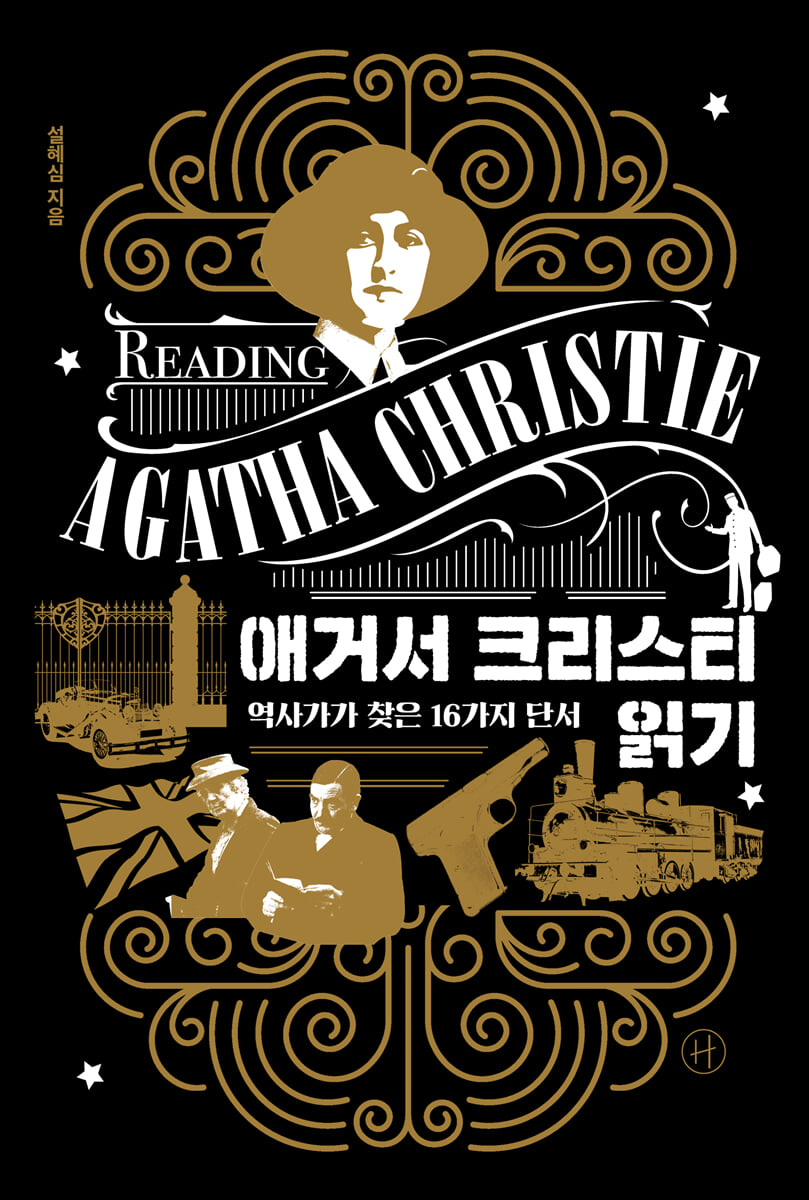
Reading Agatha Christie
 |
Description
Book Introduction
Historian Seol Hye-sim × 'Queen of Mystery Novels' Agatha Christie Traced through the eyes of a historical detective 16 Clues to Reading the Age of Poirot and Marple What would a historian's perspective reveal when reading the works of Agatha Christie, the "Queen of Mystery" and "Queen of Poisoning," who ushered in the golden age of detective fiction? Historian Seol Hye-sim takes us back to the era when Poirot and Marple roamed the streets, using 16 clues hidden throughout Christie's works. Discover the culprit and understand the work with social and cultural clues that only a historian can reveal! This adds to the excitement and thrill of reading Agatha Christie's work with a deeper, broader, and more penetrating perspective. |
- You can preview some of the book's contents.
Preview
index
Detective 1: "I don't do divorce investigations."
2nd House “Home, God bless the home!”
3 Poison “How many people did you give poison to?”
4 Military Service Exemption: "I missed the chance to fight for my country."
5 Sexuality "Love, love, scary words"
6 Hotel “What on earth do those old ladies have that allows them to stay at this hotel?”
7 Education “If you’re from Eton, you can’t do it!”
8. Identity Theft: "I'm just pretending to be a writer."
9. Rationing System "Just use a can of butter sent from America."
10 Vehicles “Oh, what joy that car gave me!”
11 Britishness “It must be because of that damn Britishness.”
12 Money “Money, money, money! I think about money morning, noon, and night!”
13th Class “Helen is not a suitable name for a maid”
14 Superstitions “There are still witches in every rural village.”
15. Microscopic History: “A Drop of Water in a Puddle”
16 Empire “Isn’t it time to go on a trip abroad?”
2nd House “Home, God bless the home!”
3 Poison “How many people did you give poison to?”
4 Military Service Exemption: "I missed the chance to fight for my country."
5 Sexuality "Love, love, scary words"
6 Hotel “What on earth do those old ladies have that allows them to stay at this hotel?”
7 Education “If you’re from Eton, you can’t do it!”
8. Identity Theft: "I'm just pretending to be a writer."
9. Rationing System "Just use a can of butter sent from America."
10 Vehicles “Oh, what joy that car gave me!”
11 Britishness “It must be because of that damn Britishness.”
12 Money “Money, money, money! I think about money morning, noon, and night!”
13th Class “Helen is not a suitable name for a maid”
14 Superstitions “There are still witches in every rural village.”
15. Microscopic History: “A Drop of Water in a Puddle”
16 Empire “Isn’t it time to go on a trip abroad?”
Detailed image

Into the book
In fact, Agatha emphasized the element of realism.
When asked where she gets her ideas for her work, she once said that while the characters are fictional, the essential elements, the setting, “must be something that already exists, something that must be real.”
You have to cruise the Nile, ride the Orient Express, and eat at a Chelsea cafe to be able to put that kind of background into a novel.
… … In this way, detective novels can be said to be a very useful and rich source of information in social history.
In that context, this work is significant as an adventurous attempt to utilize ‘B-grade literature’ as material for historical research.
So, as a historian, I would be very happy if this book could be of any help in understanding 20th-century British history, especially the society and culture of the interwar period.
---From "Publishing a Book"
Houses appear frequently in Agatha's works.
There are many works that mention a house in the title, such as Styles, Halo, Chimney, and Endhouse, and the desire to inherit a house is an important factor when looking for a motive for murder.
Agatha's autobiography begins and ends with Ashfield, the house where she spent her childhood, and is very home-related.
In fact, Agatha was a person who bought and sold so many houses that he could be called a 'real estate speculator' by today's standards.
He said it all when he wrote in his autobiography, “Looking at houses has always been my favorite hobby.”
---From "Chapter 2 Home: Home, God Bless Home!"
World Wars I and II required large-scale enlistment of adult males, making it difficult to find young, healthy men in rural areas.
However, in "Riding the Waves," Lolly Claude, a healthy young man, did not join the army but remained in the village.
Instead, his fiancée, Lynn Marchmont, was on a battlefield far abroad.
Why did this happen?
… … Unlike Rolly, who never left his home during the entire war, Lynn fought in the war across the wide world, including Egypt, North Africa, and Sicily.
To such a Rin, Rolly said, “I have never been to a war zone.
“I missed the chance I should have had to fight for my country,” he says.
But what seemed more bitter than the fact that Rolly was denied military service was the reversal of gender roles.
---From "Chapter 4 Military Service Exemption: I Missed Even the Opportunity to Fight for My Country"
Everything is too pink.
Doesn't it feel like British nationalism?
Whenever most British scholars wrote about the history of Britain during the war, they would always conclude that 'Britain was superior.'
It is a myth that the British people, burning with patriotism during the horrific World War, overcame class antagonism and united strongly, and that the entire nation persevered and ultimately overcame the difficulties.
… … But would the entire nation have united and endured their daily lives with patience? … … Even if we only look at Agatha’s works, we can easily find things like conflict, deviation, and defeatism caused by war.
It was a phenomenon that had already appeared immediately after World War I.
---From "Chapter 9 Rationing System: Just Use a Barrel of Butter Sent from America"
“The first way to inherit money is to write,” says Tuppence.
“I don’t have a single rich or old relative!” he says.
So I decided that the second method, marriage, was the best way to make a lot of money.
In fact, marriage for money was very popular in British upper class society during this period.
Interestingly, the main characters who were planning marriages involving a lot of money were mostly men, not women like Tuppence.
And I'm not talking about men like the swallow tribe, but rather well-mannered male nobles.
The noble gentlemen targeted an American heiress who possessed immense wealth.
… … Thus, American brides came to England with enormous dowries and married into noble families.
The British called such brides 'dollar princesses', a nickname that was full of mockery and sarcasm.
---From "Chapter 12 Money: Money, Money, Money! I Think About Money Morning, Noon, and Night"
The language and pronunciation used were also important indicators of class.
There is a perception in Britain that the lower classes have trouble pronouncing consonants.
In particular, they think they swallow the 't' sound or cannot pronounce the 'h' sound in glottal stop (a sound made by rubbing the tongue root against the wall of the throat).
For example, the lower class pronounces a handkerchief as 'anchor chief', but the upper class pronounces it as 'han-keo-chi-p'.
That's why in "Death on the Blue Train," when Helen says it's not a good name for a maid, Miss Byner insists, "I can pronounce 'h' just like anyone else."
---From "Chapter 13 Class: Helen is not a suitable name for a maid"
ITV has decided that when producing the Agatha Christie series, they will stick to period dramas that are faithful to the original work rather than adapting them into a modern setting.
While Sherlock Holmes was reborn as a modern character through the BBC's [Sherlock] series, Poirot and Marple insisted on 'old-fashionedness'.
David Suchet, who played Poirot, also said, “I am the Poirot that Agatha Christie created.
“I will not tolerate her taking Poirot out of the ‘box’ she has put him in,” he said.
Here, the 'box' refers to the historical context in which Poirot was active.
Agatha's Poirot frame so clearly evokes Britain as an empire.
And it sold all over the world, including Asia, and was very successful on a different level than the Sherlock series.
When asked where she gets her ideas for her work, she once said that while the characters are fictional, the essential elements, the setting, “must be something that already exists, something that must be real.”
You have to cruise the Nile, ride the Orient Express, and eat at a Chelsea cafe to be able to put that kind of background into a novel.
… … In this way, detective novels can be said to be a very useful and rich source of information in social history.
In that context, this work is significant as an adventurous attempt to utilize ‘B-grade literature’ as material for historical research.
So, as a historian, I would be very happy if this book could be of any help in understanding 20th-century British history, especially the society and culture of the interwar period.
---From "Publishing a Book"
Houses appear frequently in Agatha's works.
There are many works that mention a house in the title, such as Styles, Halo, Chimney, and Endhouse, and the desire to inherit a house is an important factor when looking for a motive for murder.
Agatha's autobiography begins and ends with Ashfield, the house where she spent her childhood, and is very home-related.
In fact, Agatha was a person who bought and sold so many houses that he could be called a 'real estate speculator' by today's standards.
He said it all when he wrote in his autobiography, “Looking at houses has always been my favorite hobby.”
---From "Chapter 2 Home: Home, God Bless Home!"
World Wars I and II required large-scale enlistment of adult males, making it difficult to find young, healthy men in rural areas.
However, in "Riding the Waves," Lolly Claude, a healthy young man, did not join the army but remained in the village.
Instead, his fiancée, Lynn Marchmont, was on a battlefield far abroad.
Why did this happen?
… … Unlike Rolly, who never left his home during the entire war, Lynn fought in the war across the wide world, including Egypt, North Africa, and Sicily.
To such a Rin, Rolly said, “I have never been to a war zone.
“I missed the chance I should have had to fight for my country,” he says.
But what seemed more bitter than the fact that Rolly was denied military service was the reversal of gender roles.
---From "Chapter 4 Military Service Exemption: I Missed Even the Opportunity to Fight for My Country"
Everything is too pink.
Doesn't it feel like British nationalism?
Whenever most British scholars wrote about the history of Britain during the war, they would always conclude that 'Britain was superior.'
It is a myth that the British people, burning with patriotism during the horrific World War, overcame class antagonism and united strongly, and that the entire nation persevered and ultimately overcame the difficulties.
… … But would the entire nation have united and endured their daily lives with patience? … … Even if we only look at Agatha’s works, we can easily find things like conflict, deviation, and defeatism caused by war.
It was a phenomenon that had already appeared immediately after World War I.
---From "Chapter 9 Rationing System: Just Use a Barrel of Butter Sent from America"
“The first way to inherit money is to write,” says Tuppence.
“I don’t have a single rich or old relative!” he says.
So I decided that the second method, marriage, was the best way to make a lot of money.
In fact, marriage for money was very popular in British upper class society during this period.
Interestingly, the main characters who were planning marriages involving a lot of money were mostly men, not women like Tuppence.
And I'm not talking about men like the swallow tribe, but rather well-mannered male nobles.
The noble gentlemen targeted an American heiress who possessed immense wealth.
… … Thus, American brides came to England with enormous dowries and married into noble families.
The British called such brides 'dollar princesses', a nickname that was full of mockery and sarcasm.
---From "Chapter 12 Money: Money, Money, Money! I Think About Money Morning, Noon, and Night"
The language and pronunciation used were also important indicators of class.
There is a perception in Britain that the lower classes have trouble pronouncing consonants.
In particular, they think they swallow the 't' sound or cannot pronounce the 'h' sound in glottal stop (a sound made by rubbing the tongue root against the wall of the throat).
For example, the lower class pronounces a handkerchief as 'anchor chief', but the upper class pronounces it as 'han-keo-chi-p'.
That's why in "Death on the Blue Train," when Helen says it's not a good name for a maid, Miss Byner insists, "I can pronounce 'h' just like anyone else."
---From "Chapter 13 Class: Helen is not a suitable name for a maid"
ITV has decided that when producing the Agatha Christie series, they will stick to period dramas that are faithful to the original work rather than adapting them into a modern setting.
While Sherlock Holmes was reborn as a modern character through the BBC's [Sherlock] series, Poirot and Marple insisted on 'old-fashionedness'.
David Suchet, who played Poirot, also said, “I am the Poirot that Agatha Christie created.
“I will not tolerate her taking Poirot out of the ‘box’ she has put him in,” he said.
Here, the 'box' refers to the historical context in which Poirot was active.
Agatha's Poirot frame so clearly evokes Britain as an empire.
And it sold all over the world, including Asia, and was very successful on a different level than the Sherlock series.
---From "Chapter 16 Empire: Isn't it time for you to go on a trip abroad?"
Publisher's Review
Traced through the eyes of a historical detective
16 Clues to Reading the Age of Poirot and Marple
What would a historian's perspective reveal when reading the works of Agatha Christie, the "Queen of Mystery" and "Queen of Poisoning," who ushered in the golden age of detective fiction? Historian Seol Hye-sim takes us back to the era when Poirot and Marple roamed the streets, using 16 clues hidden throughout Christie's works.
Discover the culprit and understand the work with social and cultural clues that only a historian can reveal! This adds to the excitement and thrill of reading Agatha Christie's work with a deeper, broader, and more penetrating perspective.
For me, Agatha Christie is a writer who will stay with me for the rest of my life.
The appeal of Christie's works is so rich that the top 10 changes every time they are selected.
Historian Seol Hye-sim delves into the author's personal history and the times he lived in to reveal what makes his works so compelling and special.
Thanks to historians who even treat their fandom as historical studies, we fall deeper into the charm of Agatha Christie.
Reading Agatha Christie will make you want to read Christie's novels, and reading Christie's novels will make you want to open this book.
What a funny little thing.
―Dahye Lee, writer
1.
What would a historian see when he reads Agatha Christie?
―How to Read a Historian's Mystery Novel
Agatha Christie, reborn from "B-grade literature" to historical fiction.
“Detective novels are very useful in social history.
“It can be said to be a rich source of information.”
What would a historian see when reading the works of Agatha Christie, the "Queen of Mystery" and "Queen of Poisoning," who ushered in the golden age of detective fiction? Historian Seol Hye-sim, who has often engaged readers with topics rarely explored in historical scholarship, such as hot springs, physiognomy, travel, and consumption, now evokes the nostalgia of readers who devoured "The Little Red Book" (the complete Agatha Christie collection published by Haemun Publishing) as children, bringing back the Agatha of that era for us.
This book is an attempt to examine the history and culture of 20th-century Britain, when Poirot and Marple roamed the streets, through 16 clues hidden throughout Agatha Christie's works, including houses, poison, sexuality, exemption from military service, money, class, Britishness, and empire.
It is significant in that it is the first attempt by a domestic historian to use a literary work, and moreover, a mystery novel, which is considered to be 'B-grade literature,' as material for historical research.
Agatha Christie's works have enjoyed immense popularity over the past 100 years, making them the world's third-best-selling books after the Bible and Shakespeare, but they have been treated coldly by academics as "B-grade novels."
Contemporary writers, including Raymond Chandler, also sharply criticized Agatha's novels, saying they were unrealistic.
However, in this book, Seol Hye-sim examines Agatha's life and works in a historical context, demonstrating how vividly and accurately Agatha's works reflect the values and social conditions of the time, and proving how useful and rich a resource detective novels can be for social history.
By providing 16 clues that only a historian can provide to read Agatha Christie's works more deeply and broadly, it will add excitement and thrill to reading Agatha Christie not only for mystery novel enthusiasts but also for readers of humanities and history.
2.
Social and cultural clues that only historians can grasp
―The 'buddy culture' of [True Detective], the 'dollar princess' of [Downton Abbey], and the women of [Land Girls] found in Agatha's novels!
―Peel off the mask of 'glory of empire' and see the true face of 20-year-old Britain.
“The time when people were crazy about her (Agatha’s) novels in the latter half of the 20th century was the hegemony of the British Empire.
It was like a training that was naturally internalized.
And even in the 21st century, Agatha's content continues to be reproduced and exerts influence.”
Only a historian who examines human life, the times, and the historical context can grasp the 16 social and cultural clues that allow us to understand Agatha's life and the times in which she lived.
By thoroughly examining the background and scenes, characters' personalities, actions, and dialogues in the novel, it reveals the hidden landscape of 20th-century British society, as well as the true face of the British people of the time.
Through the various forms of love depicted by Agatha, we can see the beginnings of 'buddy culture', the influence of 'Dollar Princess' through the appearance of a declining aristocratic family, the culture of British private schools and the perception of them through the characters who graduated from 'Eton', and the changes in British industrial history captured through the backgrounds of the nouveau riche, allowing us to look into British history and culture that cannot be seen through novels alone.
In particular, it clearly reveals the 'strangely uncomfortable' true face of Britain.
Set during World War I and II, the film reveals the subversion of gender roles and the resulting conflicts, as well as the wartime rationing system and various deviant acts, thereby stripping away the myth of the Blitz, a symbol of British nationalism.
It also critically examines the arrogance of the British, a long-standing reputation for their xenophobia and prejudice against foreigners, the perpetual distancing of the British upper class from the lower classes, and the blatant imperialist perspectives and attitudes evident in works set in West Asia and its colonies.
Although Agatha's novel was written in the 20th century, its content captures the glory of the British Empire in the late 19th century and the sentiments of the Victorian era.
This book provides readers with a historical context that allows them to understand Agatha's work more deeply and broadly, and suggests that they encounter Agatha from a new perspective, free from the nostalgia for the "glory of empire" that permeates her work.
3.
Agatha Christie was a surfer and a staunch British chauvinist?!
―The aspects of Agatha in the novel that can only be seen when you know the author's life.
―What is the true face of the ‘Queen of Mystery Novels’?
“House-hunting has always been my favorite pastime.”
This book explores how the author's personal experiences are reflected in his work, finding the intersection between reality and fiction.
As is well known, Agatha worked as a nurse and pharmacist during both world wars, and based on her experience and knowledge, she created a more realistic 'poisoning case' than anyone else.
The famous Murder on the Orient Express was also a reflection of Agatha's experiences traveling on the Orient Express, and Death in Mesopotamia was born from her experiences on archaeological excavations with her husband Max.
But beyond this well-known image, Agatha's novels contain fascinating glimpses into her life.
He loved houses so much that he featured numerous mansions in his novels. He could be called a 'real estate speculator', as he repeatedly bought houses, decorated them, and sold them again.
The many car model names that appear in various works show Agatha's fanatical love of cars.
Although Agatha did not receive formal education, she shows off her wealth of self-taught knowledge throughout her work.
Agatha's passion can be seen in the unexpected mention of classic titles, and in Poirot's long-time analysis and research of mystery novels, which led to the publication of a book.
Agatha also holds the surprising title of 'Britain's first female surfer'.
Agatha's joy and delight can be felt purely in the description of the moment when the protagonist in the novel stands up from the surfboard.
Agatha's unexpected appearance does not end here.
Agatha's work also shows elements of discrimination and prejudice, such as appearing to be a feminist but being misogynistic, criticizing the evils of capitalism but loving money, and claiming to be a cosmopolitan but being a staunch British chauvinist.
Only when we read the work with the author's life in mind can we truly appreciate the charm of Agatha's work more deeply.
16 Clues to Reading the Age of Poirot and Marple
What would a historian's perspective reveal when reading the works of Agatha Christie, the "Queen of Mystery" and "Queen of Poisoning," who ushered in the golden age of detective fiction? Historian Seol Hye-sim takes us back to the era when Poirot and Marple roamed the streets, using 16 clues hidden throughout Christie's works.
Discover the culprit and understand the work with social and cultural clues that only a historian can reveal! This adds to the excitement and thrill of reading Agatha Christie's work with a deeper, broader, and more penetrating perspective.
For me, Agatha Christie is a writer who will stay with me for the rest of my life.
The appeal of Christie's works is so rich that the top 10 changes every time they are selected.
Historian Seol Hye-sim delves into the author's personal history and the times he lived in to reveal what makes his works so compelling and special.
Thanks to historians who even treat their fandom as historical studies, we fall deeper into the charm of Agatha Christie.
Reading Agatha Christie will make you want to read Christie's novels, and reading Christie's novels will make you want to open this book.
What a funny little thing.
―Dahye Lee, writer
1.
What would a historian see when he reads Agatha Christie?
―How to Read a Historian's Mystery Novel
Agatha Christie, reborn from "B-grade literature" to historical fiction.
“Detective novels are very useful in social history.
“It can be said to be a rich source of information.”
What would a historian see when reading the works of Agatha Christie, the "Queen of Mystery" and "Queen of Poisoning," who ushered in the golden age of detective fiction? Historian Seol Hye-sim, who has often engaged readers with topics rarely explored in historical scholarship, such as hot springs, physiognomy, travel, and consumption, now evokes the nostalgia of readers who devoured "The Little Red Book" (the complete Agatha Christie collection published by Haemun Publishing) as children, bringing back the Agatha of that era for us.
This book is an attempt to examine the history and culture of 20th-century Britain, when Poirot and Marple roamed the streets, through 16 clues hidden throughout Agatha Christie's works, including houses, poison, sexuality, exemption from military service, money, class, Britishness, and empire.
It is significant in that it is the first attempt by a domestic historian to use a literary work, and moreover, a mystery novel, which is considered to be 'B-grade literature,' as material for historical research.
Agatha Christie's works have enjoyed immense popularity over the past 100 years, making them the world's third-best-selling books after the Bible and Shakespeare, but they have been treated coldly by academics as "B-grade novels."
Contemporary writers, including Raymond Chandler, also sharply criticized Agatha's novels, saying they were unrealistic.
However, in this book, Seol Hye-sim examines Agatha's life and works in a historical context, demonstrating how vividly and accurately Agatha's works reflect the values and social conditions of the time, and proving how useful and rich a resource detective novels can be for social history.
By providing 16 clues that only a historian can provide to read Agatha Christie's works more deeply and broadly, it will add excitement and thrill to reading Agatha Christie not only for mystery novel enthusiasts but also for readers of humanities and history.
2.
Social and cultural clues that only historians can grasp
―The 'buddy culture' of [True Detective], the 'dollar princess' of [Downton Abbey], and the women of [Land Girls] found in Agatha's novels!
―Peel off the mask of 'glory of empire' and see the true face of 20-year-old Britain.
“The time when people were crazy about her (Agatha’s) novels in the latter half of the 20th century was the hegemony of the British Empire.
It was like a training that was naturally internalized.
And even in the 21st century, Agatha's content continues to be reproduced and exerts influence.”
Only a historian who examines human life, the times, and the historical context can grasp the 16 social and cultural clues that allow us to understand Agatha's life and the times in which she lived.
By thoroughly examining the background and scenes, characters' personalities, actions, and dialogues in the novel, it reveals the hidden landscape of 20th-century British society, as well as the true face of the British people of the time.
Through the various forms of love depicted by Agatha, we can see the beginnings of 'buddy culture', the influence of 'Dollar Princess' through the appearance of a declining aristocratic family, the culture of British private schools and the perception of them through the characters who graduated from 'Eton', and the changes in British industrial history captured through the backgrounds of the nouveau riche, allowing us to look into British history and culture that cannot be seen through novels alone.
In particular, it clearly reveals the 'strangely uncomfortable' true face of Britain.
Set during World War I and II, the film reveals the subversion of gender roles and the resulting conflicts, as well as the wartime rationing system and various deviant acts, thereby stripping away the myth of the Blitz, a symbol of British nationalism.
It also critically examines the arrogance of the British, a long-standing reputation for their xenophobia and prejudice against foreigners, the perpetual distancing of the British upper class from the lower classes, and the blatant imperialist perspectives and attitudes evident in works set in West Asia and its colonies.
Although Agatha's novel was written in the 20th century, its content captures the glory of the British Empire in the late 19th century and the sentiments of the Victorian era.
This book provides readers with a historical context that allows them to understand Agatha's work more deeply and broadly, and suggests that they encounter Agatha from a new perspective, free from the nostalgia for the "glory of empire" that permeates her work.
3.
Agatha Christie was a surfer and a staunch British chauvinist?!
―The aspects of Agatha in the novel that can only be seen when you know the author's life.
―What is the true face of the ‘Queen of Mystery Novels’?
“House-hunting has always been my favorite pastime.”
This book explores how the author's personal experiences are reflected in his work, finding the intersection between reality and fiction.
As is well known, Agatha worked as a nurse and pharmacist during both world wars, and based on her experience and knowledge, she created a more realistic 'poisoning case' than anyone else.
The famous Murder on the Orient Express was also a reflection of Agatha's experiences traveling on the Orient Express, and Death in Mesopotamia was born from her experiences on archaeological excavations with her husband Max.
But beyond this well-known image, Agatha's novels contain fascinating glimpses into her life.
He loved houses so much that he featured numerous mansions in his novels. He could be called a 'real estate speculator', as he repeatedly bought houses, decorated them, and sold them again.
The many car model names that appear in various works show Agatha's fanatical love of cars.
Although Agatha did not receive formal education, she shows off her wealth of self-taught knowledge throughout her work.
Agatha's passion can be seen in the unexpected mention of classic titles, and in Poirot's long-time analysis and research of mystery novels, which led to the publication of a book.
Agatha also holds the surprising title of 'Britain's first female surfer'.
Agatha's joy and delight can be felt purely in the description of the moment when the protagonist in the novel stands up from the surfboard.
Agatha's unexpected appearance does not end here.
Agatha's work also shows elements of discrimination and prejudice, such as appearing to be a feminist but being misogynistic, criticizing the evils of capitalism but loving money, and claiming to be a cosmopolitan but being a staunch British chauvinist.
Only when we read the work with the author's life in mind can we truly appreciate the charm of Agatha's work more deeply.
GOODS SPECIFICS
- Date of issue: August 16, 2021
- Page count, weight, size: 280 pages | 404g | 135*200*20mm
- ISBN13: 9791160806755
- ISBN10: 1160806756
You may also like
카테고리
korean


korean

![GQ KOREA Mark (Monthly): December [2025]](http://librairie.coreenne.fr/cdn/shop/files/8ef265dbbfbf186523ed75ba7319009d.jpg?v=1765340328&width=3840)


