

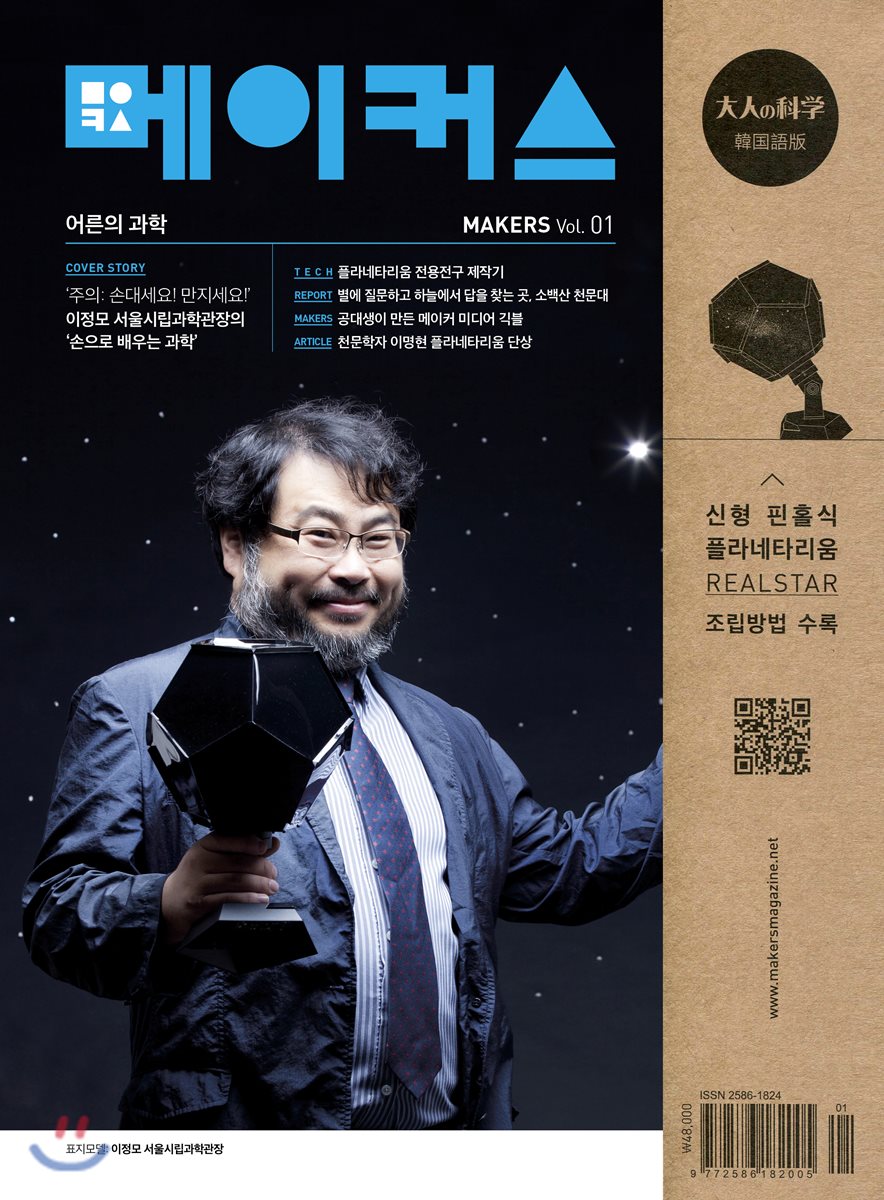
MAKERS Adult Science Vol. 01
 |
Description
Book Introduction
We are all 'makers'
We are all 'makers'.
Among the human fingers, the thumb touches all four of the other fingers.
Thanks to this, human hands are capable of performing more delicate and precise functions than any other primate.
We have made countless objects with hands that are superior to those of any other animal.
Sometimes out of necessity, sometimes out of curiosity, sometimes out of boredom.
Using your hands is a very valuable thing.
Humanity has accomplished all sorts of creative work with its own two hands.
But these days, we have handed over a lot of the work of our hands to machines.
We have handed over all the work of creating and recording to machines.
Because using your hands was annoying, difficult, and cumbersome.
My hands were getting more and more bored.
At the same time, all the creative activities I had enjoyed using my hands began to dull down a little.
Now, South Korea is allowing Son to return to his original role.
The DIY corners that occupy a corner of bookstores or shopping centers are representative of this.
I am realizing again that the very act of moving my hands brings richness to my life.
I enjoy the healing that comes from the very act of making something with my hands.
Because we are all ‘makers’.
But what should I make?
The desire to create is strong, but you're a little lost as to what you can create.
I need someone to guide me to what my curiosity is and to what sensations my five senses respond most dramatically.
"Makers: Science for Adults" was launched to breathe fresh air into the quietly growing Korean maker movement and provide a new impetus for its further vitality.
We are all 'makers'.
Among the human fingers, the thumb touches all four of the other fingers.
Thanks to this, human hands are capable of performing more delicate and precise functions than any other primate.
We have made countless objects with hands that are superior to those of any other animal.
Sometimes out of necessity, sometimes out of curiosity, sometimes out of boredom.
Using your hands is a very valuable thing.
Humanity has accomplished all sorts of creative work with its own two hands.
But these days, we have handed over a lot of the work of our hands to machines.
We have handed over all the work of creating and recording to machines.
Because using your hands was annoying, difficult, and cumbersome.
My hands were getting more and more bored.
At the same time, all the creative activities I had enjoyed using my hands began to dull down a little.
Now, South Korea is allowing Son to return to his original role.
The DIY corners that occupy a corner of bookstores or shopping centers are representative of this.
I am realizing again that the very act of moving my hands brings richness to my life.
I enjoy the healing that comes from the very act of making something with my hands.
Because we are all ‘makers’.
But what should I make?
The desire to create is strong, but you're a little lost as to what you can create.
I need someone to guide me to what my curiosity is and to what sensations my five senses respond most dramatically.
"Makers: Science for Adults" was launched to breathe fresh air into the quietly growing Korean maker movement and provide a new impetus for its further vitality.
- You can preview some of the book's contents.
Preview
Detailed image
.jpg)
Publisher's Review
Over 600,000 units sold!
Home planetarium projector from Japan's Gaken Educational Publishing's "Adult Science?"
Japan's maker culture started much earlier than ours.
It may also be thanks to the culture of craftsmen, a culture that highly values handmade goods.
There is a group that leads Japanese maker culture.
This is the 『Adult Science』 series by Gaken Education Publishing.
Make it into a kit so anyone can easily make it!
The "Adult Science" series has many surprising aspects.
First, we have made it into a kit so that anyone can easily make the items they wanted to make.
Designing and building things like home planetariums, electric guitars, drones, and robot vacuum cleaners from scratch is no easy task.
All of this can be done without difficulty through 『Adult Science』.
It's thanks to 『Adult Science』 that I was able to do all the hard work for them.
The planetarium, which is being introduced for the first time in the Korean version of 『Makers: Adult Science』, is the most popular product in the 『Adult Science』 series.
It's a wonderful thing that fills my room with the beautiful starlight of the sky.
Including the older planetariums that came out in 2005, over 1 million units have been sold.
This planetarium is special enough to receive so much love.
This is a planetarium I built myself, but it is by no means sloppy.
This is all thanks to the passion of Gaken Education Publishing, which even goes to the trouble of manufacturing its own bulbs to find the most suitable bulb.
After about two hours of immersion and completing the planetarium, you will experience a fantastic moment beyond your imagination.
The moderately difficult assembly process gives you a sense of accomplishment upon completion.
Complete, but not difficult.
Thanks to 'Kithwa', we can make maker activities more enjoyable and easier.
To satisfy your desire to own.
Satisfy your artistic sensibilities
Second, it's pretty.
Have you ever heard of kinetic artist Theo Jansen? You might not even know what kinetic art is.
Kinetic art refers to art in which the work itself moves or contains moving parts.
The representative artist in this field is Theo Jansen.
There are beautiful plastic sculptures on Dutch beaches.
His masterpiece is Stranbeest.
It moves with the wind like a living creature.
Theo Jansen creates works that combine physics and artistry so exquisitely that he has been nicknamed the Leonardo da Vinci of the 21st century.
You can also see his work in person in 『Adult Science』.
Theo Jansen's trilogy of "Adult Science", Mini Beast (small version of "Stranbeest"), Mini Rhinoceros (small version of "Rhinoceros"), and a bipedal walking robot in collaboration with Gundam.
『Makers: Adult Science』 will present the Theo Jansen series in sequence.
If you want something, you can make it yourself!
Third, it is original.
Have you ever thought about building your own camera? Or that trendy drone? Or an electric guitar, electronic keyboard, robot vacuum cleaner, phonograph, or steam engine? These are all things you've always wanted, but either because of the price or because they were too difficult to build yourself.
But what if you could make these things yourself? What if you could master the principles behind them while making them yourself?
Nowadays, everyone carries around a small digital camera.
Thanks to smartphones.
We are now living in an era where all information is processed and used digitally.
But as a reflex to this, I often miss the analog sensibility.
In particular, many people remember the longing for the warm light provided by film cameras.
But it is true that buying an analog camera is a bit burdensome.
The next issue of 『Makers: Science for Adults』 is preparing a camera.
The pleasure of taking pictures by manually turning the lens aperture to focus with the camera I made, then turning the film one by one.
The things presented in 『Makers: Adult Science』 are not mere ornamental objects, aka “pretty trash.”
These are actually usable items.
With the maker activities you've started with "Makers: Science for Adults," you'll be able to bravely say, "Let's make something we've always wanted."
It will be a stepping stone for those who are just starting out as a maker and feel overwhelmed and lost.
Pour the warmest water on Korean maker culture
"Makers: Science for Adults" aims to create a space where our science and our country's maker culture come together.
We diligently travel around and tell stories about science and makers in our country.
We met with Director Lee Jeong-mo of the Seoul Metropolitan Science Museum, a leader in popularizing science in Korea, and discussed how we can incorporate science into our daily lives.
We also gathered together people whose hobby is science and listened to the travel stories of those who went to the United States to see the best space show of 2017, the solar eclipse.
We visited Sobaeksan Observatory, the first observatory in Korea, to document the history of astronomical observations in Korea, and asked an astronomer who loves stars to tell us what a planetarium means to him.
We closely followed how young scientists engage in maker activities and what it means to have fun doing science.
Director Lee Jeong-mo, the protagonist of the cover story, says, “Makers are people who change the world.”
Director Lee Jeong-mo, who always emphasizes the importance of learning science through hands-on experience, created a "maker studio" in the science museum to encourage the wider spread of Korea's maker culture.
Director Lee Jeong-mo said this in an interview:
“I don’t know where to start.
It feels somehow difficult.
You can start by following along on your own.
We're adding new ideas to it.
“We need a stepping stone, and I hope that ‘Makers’ will fill this role.”
"Makers: Science for Adults" has just begun.
We took our first step toward creating a community where Korean maker activities can gather and hope that more makers will emerge.
Through maker activities, we will further expand the realm of science and technology, paving the way for these fields to become part of everyday life, not just the domain of experts, and accessible to everyone.
We will open our ears and eyes wider so that more people can take interest in maker activities and have fun together.
We will be "Makers: Science for Adults" that will welcome Korea's maker culture.
Home planetarium projector from Japan's Gaken Educational Publishing's "Adult Science?"
Japan's maker culture started much earlier than ours.
It may also be thanks to the culture of craftsmen, a culture that highly values handmade goods.
There is a group that leads Japanese maker culture.
This is the 『Adult Science』 series by Gaken Education Publishing.
Make it into a kit so anyone can easily make it!
The "Adult Science" series has many surprising aspects.
First, we have made it into a kit so that anyone can easily make the items they wanted to make.
Designing and building things like home planetariums, electric guitars, drones, and robot vacuum cleaners from scratch is no easy task.
All of this can be done without difficulty through 『Adult Science』.
It's thanks to 『Adult Science』 that I was able to do all the hard work for them.
The planetarium, which is being introduced for the first time in the Korean version of 『Makers: Adult Science』, is the most popular product in the 『Adult Science』 series.
It's a wonderful thing that fills my room with the beautiful starlight of the sky.
Including the older planetariums that came out in 2005, over 1 million units have been sold.
This planetarium is special enough to receive so much love.
This is a planetarium I built myself, but it is by no means sloppy.
This is all thanks to the passion of Gaken Education Publishing, which even goes to the trouble of manufacturing its own bulbs to find the most suitable bulb.
After about two hours of immersion and completing the planetarium, you will experience a fantastic moment beyond your imagination.
The moderately difficult assembly process gives you a sense of accomplishment upon completion.
Complete, but not difficult.
Thanks to 'Kithwa', we can make maker activities more enjoyable and easier.
To satisfy your desire to own.
Satisfy your artistic sensibilities
Second, it's pretty.
Have you ever heard of kinetic artist Theo Jansen? You might not even know what kinetic art is.
Kinetic art refers to art in which the work itself moves or contains moving parts.
The representative artist in this field is Theo Jansen.
There are beautiful plastic sculptures on Dutch beaches.
His masterpiece is Stranbeest.
It moves with the wind like a living creature.
Theo Jansen creates works that combine physics and artistry so exquisitely that he has been nicknamed the Leonardo da Vinci of the 21st century.
You can also see his work in person in 『Adult Science』.
Theo Jansen's trilogy of "Adult Science", Mini Beast (small version of "Stranbeest"), Mini Rhinoceros (small version of "Rhinoceros"), and a bipedal walking robot in collaboration with Gundam.
『Makers: Adult Science』 will present the Theo Jansen series in sequence.
If you want something, you can make it yourself!
Third, it is original.
Have you ever thought about building your own camera? Or that trendy drone? Or an electric guitar, electronic keyboard, robot vacuum cleaner, phonograph, or steam engine? These are all things you've always wanted, but either because of the price or because they were too difficult to build yourself.
But what if you could make these things yourself? What if you could master the principles behind them while making them yourself?
Nowadays, everyone carries around a small digital camera.
Thanks to smartphones.
We are now living in an era where all information is processed and used digitally.
But as a reflex to this, I often miss the analog sensibility.
In particular, many people remember the longing for the warm light provided by film cameras.
But it is true that buying an analog camera is a bit burdensome.
The next issue of 『Makers: Science for Adults』 is preparing a camera.
The pleasure of taking pictures by manually turning the lens aperture to focus with the camera I made, then turning the film one by one.
The things presented in 『Makers: Adult Science』 are not mere ornamental objects, aka “pretty trash.”
These are actually usable items.
With the maker activities you've started with "Makers: Science for Adults," you'll be able to bravely say, "Let's make something we've always wanted."
It will be a stepping stone for those who are just starting out as a maker and feel overwhelmed and lost.
Pour the warmest water on Korean maker culture
"Makers: Science for Adults" aims to create a space where our science and our country's maker culture come together.
We diligently travel around and tell stories about science and makers in our country.
We met with Director Lee Jeong-mo of the Seoul Metropolitan Science Museum, a leader in popularizing science in Korea, and discussed how we can incorporate science into our daily lives.
We also gathered together people whose hobby is science and listened to the travel stories of those who went to the United States to see the best space show of 2017, the solar eclipse.
We visited Sobaeksan Observatory, the first observatory in Korea, to document the history of astronomical observations in Korea, and asked an astronomer who loves stars to tell us what a planetarium means to him.
We closely followed how young scientists engage in maker activities and what it means to have fun doing science.
Director Lee Jeong-mo, the protagonist of the cover story, says, “Makers are people who change the world.”
Director Lee Jeong-mo, who always emphasizes the importance of learning science through hands-on experience, created a "maker studio" in the science museum to encourage the wider spread of Korea's maker culture.
Director Lee Jeong-mo said this in an interview:
“I don’t know where to start.
It feels somehow difficult.
You can start by following along on your own.
We're adding new ideas to it.
“We need a stepping stone, and I hope that ‘Makers’ will fill this role.”
"Makers: Science for Adults" has just begun.
We took our first step toward creating a community where Korean maker activities can gather and hope that more makers will emerge.
Through maker activities, we will further expand the realm of science and technology, paving the way for these fields to become part of everyday life, not just the domain of experts, and accessible to everyone.
We will open our ears and eyes wider so that more people can take interest in maker activities and have fun together.
We will be "Makers: Science for Adults" that will welcome Korea's maker culture.
GOODS SPECIFICS
- Date of issue: September 9, 2017
- Page count, weight, size: Page count being confirmed | 692g | 210*290*60mm
- ISBN13: 9772586182005
- ISBN10: 25861824
You may also like
카테고리
korean


korean

![GQ KOREA Mark (Monthly): December [2025]](http://librairie.coreenne.fr/cdn/shop/files/8ef265dbbfbf186523ed75ba7319009d.jpg?v=1765340328&width=3840)


