

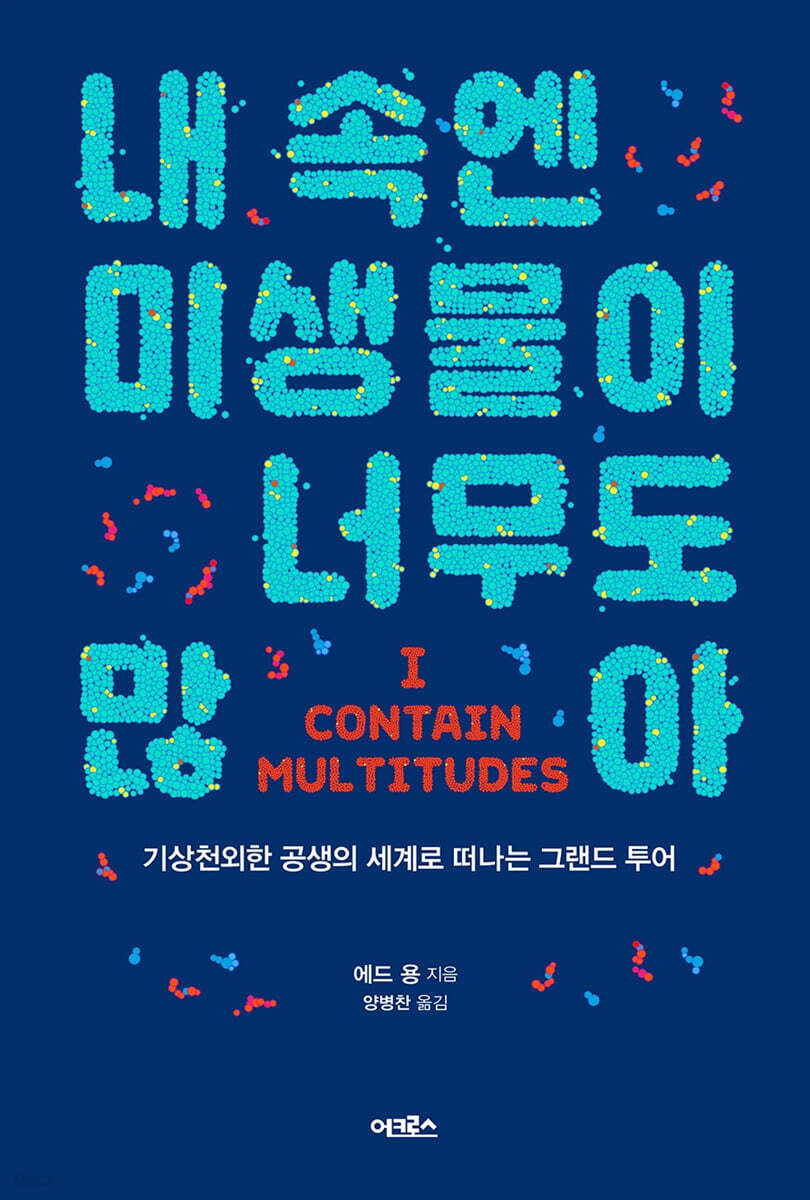
There are so many microbes inside me
 |
Description
Book Introduction
“When we discover our hidden companions, the world opens up to us in a whole new way.”
The young science journalist who captivated Bill Gates and Bill Bryson.
Ed Yong's revolutionary perspective on humanity and nature
The birth of a masterpiece that skillfully depicts the natural history of wondrous symbiosis.
★ Books recommended by Bill Gates and Bill Bryson
★ New York Times Bestseller
★ Best Books of 2016, selected by The Guardian, The Economist, and Kirkus Reviews
★ British Association of Science Writers Award-winning author
Where did the short-tailed squid's luminous cloak come from, hiding it from predators? What is the secret behind the paracatenula's ability to regenerate after being cut up? Why can the Mojave Desert wood rat freely consume lethally toxic prey? What is the secret behind the squid's survival in the deep, sunless depths of the ocean, devoid of any mouth or anus? At the heart of the mysteries of nature's wondrous life are microorganisms.
This book, "There Are So Many Microbes Inside Me," is a guide to the world of these "hidden heroes" who are active throughout the lifespans of animals, including humans, and who provide their hosts with amazing abilities.
The author, Ed Yong, is a world-renowned young science journalist who has compiled hundreds of papers and research results to map the microbial world.
From the surprising examples of symbiosis between microbes and animals to the ways in which microbes and humans can establish harmonious partnerships, to the processes by which the symbiotic order is disrupted, endangering human health and the ecosystem, and even the prescriptions scientists offer for reversing this, this book provides readers with a fascinating guide.
Infantis (B.) who educates the baby's immune system by feeding it the sugar in breast milk instead of the baby.
infantis), Wolbachia, which alternates between being a 'symbiotic partner' and a 'parasite' that disrupts reproduction, and Tremblaya, which maintains a precarious love triangle and shares roles with its host, you will gain a new perspective on humans and nature as you enjoy each episode of the strange drama of symbiosis created by microorganisms.
The young science journalist who captivated Bill Gates and Bill Bryson.
Ed Yong's revolutionary perspective on humanity and nature
The birth of a masterpiece that skillfully depicts the natural history of wondrous symbiosis.
★ Books recommended by Bill Gates and Bill Bryson
★ New York Times Bestseller
★ Best Books of 2016, selected by The Guardian, The Economist, and Kirkus Reviews
★ British Association of Science Writers Award-winning author
Where did the short-tailed squid's luminous cloak come from, hiding it from predators? What is the secret behind the paracatenula's ability to regenerate after being cut up? Why can the Mojave Desert wood rat freely consume lethally toxic prey? What is the secret behind the squid's survival in the deep, sunless depths of the ocean, devoid of any mouth or anus? At the heart of the mysteries of nature's wondrous life are microorganisms.
This book, "There Are So Many Microbes Inside Me," is a guide to the world of these "hidden heroes" who are active throughout the lifespans of animals, including humans, and who provide their hosts with amazing abilities.
The author, Ed Yong, is a world-renowned young science journalist who has compiled hundreds of papers and research results to map the microbial world.
From the surprising examples of symbiosis between microbes and animals to the ways in which microbes and humans can establish harmonious partnerships, to the processes by which the symbiotic order is disrupted, endangering human health and the ecosystem, and even the prescriptions scientists offer for reversing this, this book provides readers with a fascinating guide.
Infantis (B.) who educates the baby's immune system by feeding it the sugar in breast milk instead of the baby.
infantis), Wolbachia, which alternates between being a 'symbiotic partner' and a 'parasite' that disrupts reproduction, and Tremblaya, which maintains a precarious love triangle and shares roles with its host, you will gain a new perspective on humans and nature as you enjoy each episode of the strange drama of symbiosis created by microorganisms.
- You can preview some of the book's contents.
Preview
index
Prologue | At the Zoo
Chapter 1_ Living Island
We evolved from microbes | The 'amazing universe' inside us | If all the microbes on Earth disappeared at once | We are all islands | The most significant revolution since Darwin | The wondrous lens of microbes
Chapter 2: A New World Opens
A First Encounter with Dancing Microbes | The War Against Microbes | The Unfamiliar Idea of 'Symbiosis' | The Revolutionary Changes Brought About by Genetic Analysis | A Museum for Microbes
Chapter 3: Bodybuilders
The Squid's Survival Partner | The Outsourcing Company that Helps Animals Develop and Grow | The Black Box of Evolution | How Tube Worms Become Adults | The Neverending Dialogue for Maintaining Homeostasis | The Hyena's Personal Data | How Microbes Affect the Brain and Behavior | Psychobiotics
Chapter 4: Conditional Contracts
Wolbachia disrupts its host's reproduction | No villains, no heroes | A world rife with corruption and betrayal | Microbial farms need fences | Breast milk, a revolutionary mammalian invention | Symbiosis comes at a price
Chapter 5: The Key to Health and Disease
The Death of Coral | An Unexpected Assassin | Experiments on Slim and Fat Mice | The Cause of Malnutrition | Inflammatory Bowel Disease | Why 'Old Friends' Are Disappearing | The Indiscriminate Killing of Antibiotics | Warning from Vanishing Microbes | The 'Microbiome Imbalance' Model | Toward Establishing Causality
Chapter 6: The Long Waltz of Evolution
How did the evolutionary waltz begin? | Microbial inheritance | Choosing a picky partner | Whole genome, whole organism | The hypothesis of speciation through symbiosis
Chapter 7: Mutual Confirmation Success
Living Nutritional Supplements | Mutually Confirmed Success | Herbivore Companions | Flexible Menu Options | Toxic Food Detox Program | Only Nature Knows the Results
Chapter 8_ Allegro in E major
Genetic Exchange | Jumping into Animal Bodies | The Matryoshka Doll of Symbiosis | The Aphid's Bodyguard | The New Partner's Credit
Chapter 9: Microbial Tailored Cuisine
The Gaps in Partnership | Creating a New Ecosystem | Antibacterial Cocktails for Frogs | Does Drinking Yogurt Make You Healthy? | Prebiotics | Fecal Microbiota Transplantation | Microbiome-Based Cuisine | The Groundbreaking Idea That Knocked Out Dengue | In the Spotlight
Chapter 10: The World of Tomorrow
The Home Microbiome Project | The Aquarium's Microbial Ecosystem | Microbiome-Friendly Architectural Design | Living, Breathing Cities | The Earth Microbiome Project | Very Special Companions
Acknowledgements
annotation
References
Find out
Chapter 1_ Living Island
We evolved from microbes | The 'amazing universe' inside us | If all the microbes on Earth disappeared at once | We are all islands | The most significant revolution since Darwin | The wondrous lens of microbes
Chapter 2: A New World Opens
A First Encounter with Dancing Microbes | The War Against Microbes | The Unfamiliar Idea of 'Symbiosis' | The Revolutionary Changes Brought About by Genetic Analysis | A Museum for Microbes
Chapter 3: Bodybuilders
The Squid's Survival Partner | The Outsourcing Company that Helps Animals Develop and Grow | The Black Box of Evolution | How Tube Worms Become Adults | The Neverending Dialogue for Maintaining Homeostasis | The Hyena's Personal Data | How Microbes Affect the Brain and Behavior | Psychobiotics
Chapter 4: Conditional Contracts
Wolbachia disrupts its host's reproduction | No villains, no heroes | A world rife with corruption and betrayal | Microbial farms need fences | Breast milk, a revolutionary mammalian invention | Symbiosis comes at a price
Chapter 5: The Key to Health and Disease
The Death of Coral | An Unexpected Assassin | Experiments on Slim and Fat Mice | The Cause of Malnutrition | Inflammatory Bowel Disease | Why 'Old Friends' Are Disappearing | The Indiscriminate Killing of Antibiotics | Warning from Vanishing Microbes | The 'Microbiome Imbalance' Model | Toward Establishing Causality
Chapter 6: The Long Waltz of Evolution
How did the evolutionary waltz begin? | Microbial inheritance | Choosing a picky partner | Whole genome, whole organism | The hypothesis of speciation through symbiosis
Chapter 7: Mutual Confirmation Success
Living Nutritional Supplements | Mutually Confirmed Success | Herbivore Companions | Flexible Menu Options | Toxic Food Detox Program | Only Nature Knows the Results
Chapter 8_ Allegro in E major
Genetic Exchange | Jumping into Animal Bodies | The Matryoshka Doll of Symbiosis | The Aphid's Bodyguard | The New Partner's Credit
Chapter 9: Microbial Tailored Cuisine
The Gaps in Partnership | Creating a New Ecosystem | Antibacterial Cocktails for Frogs | Does Drinking Yogurt Make You Healthy? | Prebiotics | Fecal Microbiota Transplantation | Microbiome-Based Cuisine | The Groundbreaking Idea That Knocked Out Dengue | In the Spotlight
Chapter 10: The World of Tomorrow
The Home Microbiome Project | The Aquarium's Microbial Ecosystem | Microbiome-Friendly Architectural Design | Living, Breathing Cities | The Earth Microbiome Project | Very Special Companions
Acknowledgements
annotation
References
Find out
Detailed image

Into the book
When Orson Welles said, “We are all born alone, we live alone, and we die alone,” he made a big mistake.
Even when we are alone, we are never alone.
(…) Some animals are already colonized by microbes in their unfertilized egg state, while others choose their first partner the moment they are born.
We live our entire lives in the presence of microbes, and when we eat food, we also eat microbes.
When we travel, they also accompany us.
Finally, when we die, they decompose us and return us to nature.
In other words, we are all a kind of zoo.
We are a habitat enclosed in one body, a collection of many species, and a world.
_Prologue "At the Zoo"
Although our microbiomes differ from those of animals, the principles that govern the relationship between host and symbiotic bacteria are the same.
Looking at squid, which have bioluminescent bacteria that only glow at night, we think about the rise and fall of bacteria in our gut.
When we see coral reefs overrun with microbes due to marine pollution or overfishing, we think about the chaos that occurs in our gut when we eat unhealthy foods or take antibiotics.
As we watch mice whose guts have been taken over by microbes and their behavior has changed, we think about the influence microbes have on our minds.
Although our individual lives vary greatly, we collaborate with our fellow humans through microbes.
Nothing in human life occurs in isolation.
Humans are always placed in a ‘microbial context’.
_Prologue "At the Zoo"
“We have commissioned them to explore a surprisingly diverse range of aspects of our lives.
Just like an outsourcing company.
They secrete molecules and signaling substances that guide the formation of the body and control the growth of organs.
It seems to train our immune system to distinguish friend from foe, influence the development of our nervous system, and even influence our behavior.
They contribute to our lives in profound and far-reaching ways, and there is no area of our biology that is not influenced by them.
If we ignore them, we will end up looking at life through a keyhole.” _Chapter 1 “Living Island”
The case of squid and other animals shows that embryonic development is not a simple, self-executing program.
The embryonic development of an animal basically unfolds according to the instructions written in the animal's genes, but the genes of numerous microorganisms can intervene in the process.
Even though it is animals that actually grow, many species communicate in the process.
As one animal grows, the drama of the entire ecosystem unfolds.
Chapter 3: "Bodybuilders"
From decades of work to eradicate the bacterium Wolbachia from nematode worms to the dogged quest to understand how a mother's breast milk nourishes her baby's gut microbiome, from intrepid expeditions to boiling-water hydrothermal vents in the deep sea to quiet attempts to unravel the secrets of the humble aphid's symbiotic bacteria, curiosity, awe, and a surging anticipation of exploration have fueled all these endeavors.
"What is nature, and where do we stand in it?" _Chapter 10, "The World of Tomorrow"
Even when we are alone, we are never alone.
(…) Some animals are already colonized by microbes in their unfertilized egg state, while others choose their first partner the moment they are born.
We live our entire lives in the presence of microbes, and when we eat food, we also eat microbes.
When we travel, they also accompany us.
Finally, when we die, they decompose us and return us to nature.
In other words, we are all a kind of zoo.
We are a habitat enclosed in one body, a collection of many species, and a world.
_Prologue "At the Zoo"
Although our microbiomes differ from those of animals, the principles that govern the relationship between host and symbiotic bacteria are the same.
Looking at squid, which have bioluminescent bacteria that only glow at night, we think about the rise and fall of bacteria in our gut.
When we see coral reefs overrun with microbes due to marine pollution or overfishing, we think about the chaos that occurs in our gut when we eat unhealthy foods or take antibiotics.
As we watch mice whose guts have been taken over by microbes and their behavior has changed, we think about the influence microbes have on our minds.
Although our individual lives vary greatly, we collaborate with our fellow humans through microbes.
Nothing in human life occurs in isolation.
Humans are always placed in a ‘microbial context’.
_Prologue "At the Zoo"
“We have commissioned them to explore a surprisingly diverse range of aspects of our lives.
Just like an outsourcing company.
They secrete molecules and signaling substances that guide the formation of the body and control the growth of organs.
It seems to train our immune system to distinguish friend from foe, influence the development of our nervous system, and even influence our behavior.
They contribute to our lives in profound and far-reaching ways, and there is no area of our biology that is not influenced by them.
If we ignore them, we will end up looking at life through a keyhole.” _Chapter 1 “Living Island”
The case of squid and other animals shows that embryonic development is not a simple, self-executing program.
The embryonic development of an animal basically unfolds according to the instructions written in the animal's genes, but the genes of numerous microorganisms can intervene in the process.
Even though it is animals that actually grow, many species communicate in the process.
As one animal grows, the drama of the entire ecosystem unfolds.
Chapter 3: "Bodybuilders"
From decades of work to eradicate the bacterium Wolbachia from nematode worms to the dogged quest to understand how a mother's breast milk nourishes her baby's gut microbiome, from intrepid expeditions to boiling-water hydrothermal vents in the deep sea to quiet attempts to unravel the secrets of the humble aphid's symbiotic bacteria, curiosity, awe, and a surging anticipation of exploration have fueled all these endeavors.
"What is nature, and where do we stand in it?" _Chapter 10, "The World of Tomorrow"
--- From the text
Publisher's Review
“The true nature of ourselves and the world lies here.”
Discover breathtaking discoveries that will turn our view of nature upside down, and discover the dazzlingly beautiful history of symbiosis.
We are made up of approximately 30 trillion human cells and 39 trillion microorganisms.
Our cells have between 20,000 and 25,000 genes, but the microbes in our bodies have 500 times more.
To put it more closely, we are 'microorganisms'.
Our lives are influenced by the trillions of microbial partners that reside within our bodies.
Microorganisms are not simply freeloaders on our bodies; they act like precious organs, like the eyes or the stomach, and through constant dialogue and compromise, they carry out the crucial metabolic processes of life.
They shape our bodies, protect us from toxins and disease, break down food, regulate our immune system, guide our behavior, and even inject their genes into our genome.
All animals, including humans, do not exist as 'lonely islands', but rather live as 'one team' under the direction of the brain and genome within the body.
From emergence to growth, reproduction, and evolution, all life activities in nature take place through the fantastic teamwork of animals and microorganisms.
Ed Yong reminds us that we are all "walking ecosystems," that the world around us is made up of a vast "world of companions," and helps readers savor the wonders of the world and the majestic symbiotic natural history.
"Once we understand how similar animals and microbes are, and how deep the relationship between them can be, our perspective on the world will be immeasurably enriched.
Me too.
I have loved the natural world my entire life.
My shelves are filled with wildlife documentaries and books about meerkats, spiders, chameleons, jellyfish, and dinosaurs.
But none of them tell us that microbes move, enhance, or control the lives of their hosts.
In a word, it is utterly inadequate.
Like a painting without a frame, a cake without cream, or John Lennon without Paul McCartney.
But now I know that all animals depend on invisible microbes.
Animals live alongside microorganisms without being aware of it.
Microorganisms are our ancestors, having existed on Earth much longer than animals, assisting them in their abilities and sometimes taking full responsibility for them.
It's a shift in perspective that is both dizzying and dazzlingly beautiful.
(…) This is the true picture of the world where all kinds of creatures live together.
Although it is invisible to the naked eye, I can now see everything." _Chapter 1 "The Living Island"
“What happens if you swallow the feces of a healthy person?”
Clues for Maintaining Peace with Microbes
The partnership between microbes and animals is not a permanent contract, and managing and stabilizing the symbiosis requires effort.
When the symbiotic order is broken, the host often faces fatal consequences.
Examples include mass deaths of coral reefs and serious diseases caused by disruption of intestinal microflora.
Ed Yong introduces the discoveries of scientists who are uncovering the hidden microbial influence behind ecosystem disruption and human disease, and seeking solutions.
The impact of microbes on diseases such as obesity and inflammatory bowel disease, as well as mental health conditions like depression and autism, is already emerging, and various research efforts are actively underway to achieve peaceful coexistence with microbes.
Readers will encounter the cutting edge of microbiology, from beneficial combinations of bacteria (probiotics) that can treat and prevent disease, to nutrient packages (prebiotics) that can feed beneficial microbes, to methods for transplanting an entire microbiome from one person to another (fecal microbiota transplantation).
From 'amazing dancing creatures' under the microscope to the main culprits of disease and infection,
The Grand History of Microorganisms: Resurfacing as Animal Survival Partners and Keys to Health
Until the inquisitive Dutch lens technician Leeuwenhoek discovered "very beautiful moving microscopic animals" in a drop of pond water, humans were unaware of the existence of these "hidden rulers of the Earth."
Since then, the existence of microorganisms has long been hidden under the shadow of death cast by infectious diseases, and it took countless scientists' efforts to shed new light on them as 'beneficial symbionts.'
This book, "There Are So Many Microbes Inside Me," contains the fascinating history of microbes, from being objects of "disinfection and extermination" to emerging as a key factor in determining human health and disease, and how microbiology has moved from the periphery of biology to the center.
Above all, it vividly captures the passion and exploration of scientists who pioneered a new chapter in microbiology by exploring everything from devastated coral graveyards to deep-sea hydrothermal vents and zoo waste treatment plants.
Discover breathtaking discoveries that will turn our view of nature upside down, and discover the dazzlingly beautiful history of symbiosis.
We are made up of approximately 30 trillion human cells and 39 trillion microorganisms.
Our cells have between 20,000 and 25,000 genes, but the microbes in our bodies have 500 times more.
To put it more closely, we are 'microorganisms'.
Our lives are influenced by the trillions of microbial partners that reside within our bodies.
Microorganisms are not simply freeloaders on our bodies; they act like precious organs, like the eyes or the stomach, and through constant dialogue and compromise, they carry out the crucial metabolic processes of life.
They shape our bodies, protect us from toxins and disease, break down food, regulate our immune system, guide our behavior, and even inject their genes into our genome.
All animals, including humans, do not exist as 'lonely islands', but rather live as 'one team' under the direction of the brain and genome within the body.
From emergence to growth, reproduction, and evolution, all life activities in nature take place through the fantastic teamwork of animals and microorganisms.
Ed Yong reminds us that we are all "walking ecosystems," that the world around us is made up of a vast "world of companions," and helps readers savor the wonders of the world and the majestic symbiotic natural history.
"Once we understand how similar animals and microbes are, and how deep the relationship between them can be, our perspective on the world will be immeasurably enriched.
Me too.
I have loved the natural world my entire life.
My shelves are filled with wildlife documentaries and books about meerkats, spiders, chameleons, jellyfish, and dinosaurs.
But none of them tell us that microbes move, enhance, or control the lives of their hosts.
In a word, it is utterly inadequate.
Like a painting without a frame, a cake without cream, or John Lennon without Paul McCartney.
But now I know that all animals depend on invisible microbes.
Animals live alongside microorganisms without being aware of it.
Microorganisms are our ancestors, having existed on Earth much longer than animals, assisting them in their abilities and sometimes taking full responsibility for them.
It's a shift in perspective that is both dizzying and dazzlingly beautiful.
(…) This is the true picture of the world where all kinds of creatures live together.
Although it is invisible to the naked eye, I can now see everything." _Chapter 1 "The Living Island"
“What happens if you swallow the feces of a healthy person?”
Clues for Maintaining Peace with Microbes
The partnership between microbes and animals is not a permanent contract, and managing and stabilizing the symbiosis requires effort.
When the symbiotic order is broken, the host often faces fatal consequences.
Examples include mass deaths of coral reefs and serious diseases caused by disruption of intestinal microflora.
Ed Yong introduces the discoveries of scientists who are uncovering the hidden microbial influence behind ecosystem disruption and human disease, and seeking solutions.
The impact of microbes on diseases such as obesity and inflammatory bowel disease, as well as mental health conditions like depression and autism, is already emerging, and various research efforts are actively underway to achieve peaceful coexistence with microbes.
Readers will encounter the cutting edge of microbiology, from beneficial combinations of bacteria (probiotics) that can treat and prevent disease, to nutrient packages (prebiotics) that can feed beneficial microbes, to methods for transplanting an entire microbiome from one person to another (fecal microbiota transplantation).
From 'amazing dancing creatures' under the microscope to the main culprits of disease and infection,
The Grand History of Microorganisms: Resurfacing as Animal Survival Partners and Keys to Health
Until the inquisitive Dutch lens technician Leeuwenhoek discovered "very beautiful moving microscopic animals" in a drop of pond water, humans were unaware of the existence of these "hidden rulers of the Earth."
Since then, the existence of microorganisms has long been hidden under the shadow of death cast by infectious diseases, and it took countless scientists' efforts to shed new light on them as 'beneficial symbionts.'
This book, "There Are So Many Microbes Inside Me," contains the fascinating history of microbes, from being objects of "disinfection and extermination" to emerging as a key factor in determining human health and disease, and how microbiology has moved from the periphery of biology to the center.
Above all, it vividly captures the passion and exploration of scientists who pioneered a new chapter in microbiology by exploring everything from devastated coral graveyards to deep-sea hydrothermal vents and zoo waste treatment plants.
GOODS SPECIFICS
- Date of issue: August 9, 2017
- Page count, weight, size: 504 pages | 740g | 152*225*35mm
- ISBN13: 9791160560251
- ISBN10: 1160560250
You may also like
카테고리
korean


korean

![ELLE 엘르 스페셜 에디션 A형 : 12월 [2025]](http://librairie.coreenne.fr/cdn/shop/files/b8e27a3de6c9538896439686c6b0e8fb.jpg?v=1766436872&width=3840)


