

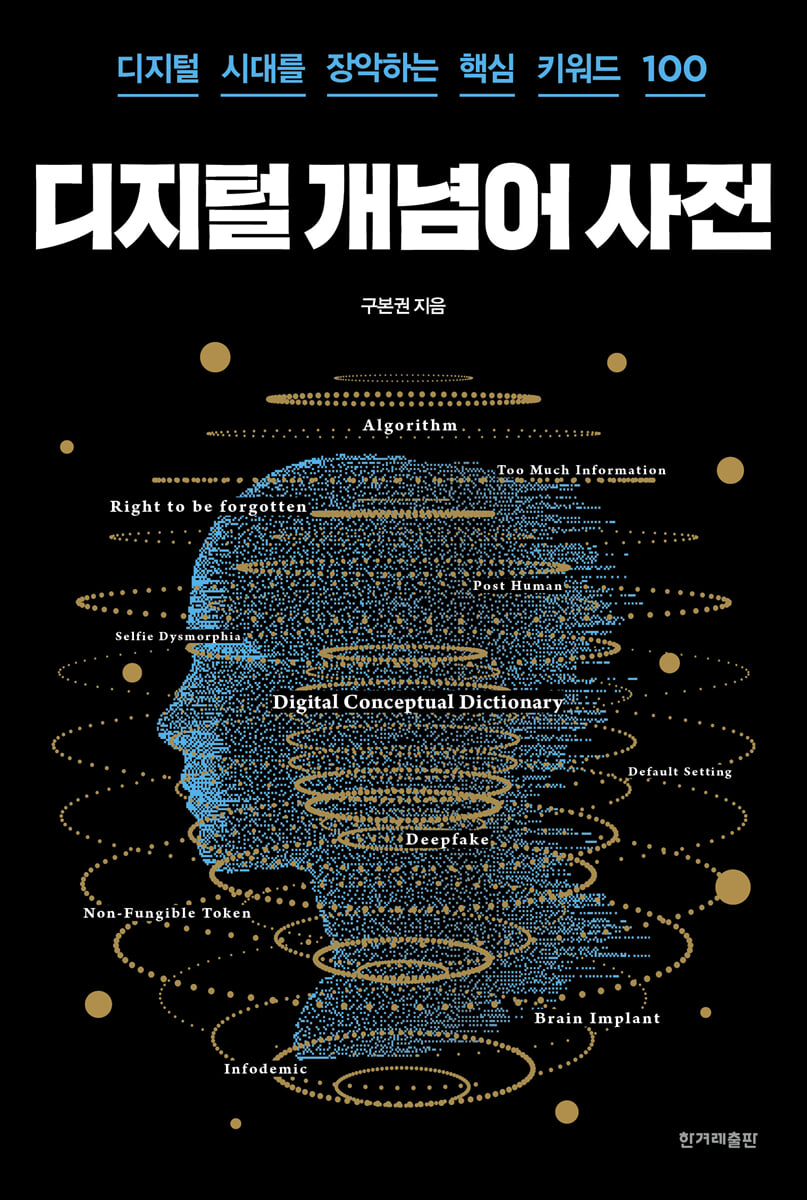
Digital Concept Dictionary
 |
Description
Book Introduction
- A word from MD
-
The minimum digital humanities needed nowAuthor Bon-Kwon Koo, who has keenly captured the near future in works such as "The Future of Study" and "The Age of Robots, Human Work," has compiled concepts that modern people must know in this rapidly changing era.
Analyze and predict the type of talent required by society, ethics, and changing relationship patterns.
July 2, 2021. Humanities PD Son Min-gyu
Wandering the world of artificial intelligence
A Guide for Immigrants
The minimum digital humanities required in a rapidly changing era
“I am the first knowledge worker to be pushed out by the new generation of thinking machines.
“But I won’t be the last person to give up their seat to a machine,” said Ken Jennings, the most-time winner of the American quiz show “Jeopardy” in 2011, after losing a quiz battle with the artificial intelligence “Watson.”
Ten years later, Ken Jennings' prediction has proven to be a resounding yes.
Not only did the artificial intelligence AlphaGo beat Lee Sedol, the world's best Go player, but it also evolved into AlphaZero, which requires no human assistance.
With technology and devices advancing so rapidly that it's difficult to keep up, we face a huge question.
How will digital technologies and devices transform the world we live in? What should humans prepare for, and how should they live amidst this immense change?
This book is the most sophisticated answer to these questions.
Koo Bon-kwon, author of "The Future of Study" and "Human Work in the Robot Age," and a leading digital humanist of our time, presents the essential keywords we need to know to understand and adapt to the changing world brought about by digital technology.
Let's embark on a journey toward the future with '100 Key Keywords Dominating the Digital Age,' including metacognition, non-fungible tokens (NFTs), Instagrammable, and Post-Human.
A Guide for Immigrants
The minimum digital humanities required in a rapidly changing era
“I am the first knowledge worker to be pushed out by the new generation of thinking machines.
“But I won’t be the last person to give up their seat to a machine,” said Ken Jennings, the most-time winner of the American quiz show “Jeopardy” in 2011, after losing a quiz battle with the artificial intelligence “Watson.”
Ten years later, Ken Jennings' prediction has proven to be a resounding yes.
Not only did the artificial intelligence AlphaGo beat Lee Sedol, the world's best Go player, but it also evolved into AlphaZero, which requires no human assistance.
With technology and devices advancing so rapidly that it's difficult to keep up, we face a huge question.
How will digital technologies and devices transform the world we live in? What should humans prepare for, and how should they live amidst this immense change?
This book is the most sophisticated answer to these questions.
Koo Bon-kwon, author of "The Future of Study" and "Human Work in the Robot Age," and a leading digital humanist of our time, presents the essential keywords we need to know to understand and adapt to the changing world brought about by digital technology.
Let's embark on a journey toward the future with '100 Key Keywords Dominating the Digital Age,' including metacognition, non-fungible tokens (NFTs), Instagrammable, and Post-Human.
- You can preview some of the book's contents.
Preview
index
Introduction: 100 Keyword Opening the Digital World 5
Chapter 1: The Qualities of a Smart Talent Who Can Beat Robots: Talent Theory in the Digital Age
Future Jobs 16
Coding 19
The Half-Life of Knowledge 22
25 Core Qualities of a Leader
Robo Advisor 28
Metacognition 31
Distributed Memory 34
News Summary Bot 37
Digital Education 40
Creativity is becoming scarce 43
Search Engine 46
Real-time search terms 49
TMI 52
Translator 55
Intuition 58
Digital Media Literacy 61
Digital Illiteracy 64
Infodemic 67
Solomon's Paradox 70
Chapter 2: The Light and Shadow of Technology: The Ethics of Algorithms
Right to be forgotten 74
Right to an explanation 77
Mobile New Testament Edition 80
Software-Dependent Society 83
Automation Dependence 86
Ghost Labor 89
Password 92
Civic Hacking 95
Privacy Divide 98
Digital Geneva Convention 101
Paradox of Time 104
Information Obesity 107
Upgrade Fatigue 110
Tim Cook's Apple 113
Selfie 116
Selfie stick 119
Google Glass 122
Wearable 125
3D Printer 128
Quantum Computer 131
Machine Vision 134
Deepfake 137
Autonomous Driving 140
Dark Pattern 143
Default setting 146
Googling 149
Macro 152
Taxi App 155
The End of the Internet 158
Non-Fungible Tokens (NFTs) 161
164 stars
Chapter 3: What's Lost in Overconnectivity: The Relationship Between Smartphones and Social Media
Right to be disconnected 168
Smartphone Addiction 171
New Ways to Use Your Smartphone 174
Spam Call Refusal Act 177
Comment Sticker 180
KakaoTalk receipt confirmation 183
Certified Mail Conversation 186
Messenger Conversation 189
Social Media Power 192
195 likes
Delete Facebook 198
Facebook's "Memories Selling" 201
How to Use Facebook 204
Clubhouse 207
Digital Detox 210
Leisure in the Digital Age 213
JOMO 216
Unplugged Travel 219
Dopamine Fasting 222
Instagrammable 225
Non-face-to-face service 228
Multitasking 231
Selfie Dysmorphia 234
Polite Indifference 237
Free service 240
Chapter 4: At the Borderline Between Robots, AI, and Humans: The Ontology of the Posthuman
Post Human 244
Centaur Human 247
Brain Implant 250
Robotization of Humans 253
Robot Real-Name System 256
Robot Tax 259
Robot Face 262
Death of a Robot 265
Killer Robot 268
Robot Heaven 271
Robot Wars 274
Smart Reply 277
Security Robot 280
The Robot Age: Human Vulnerabilities 283
Slave Girl Robot 286
Robot Fish 289
General Artificial Intelligence 292
Emotion-Reading Machine 295
Curiosity-Equipped AI 298
Wikipedia 301
AI Interviewer 304
AI CEO 307
Facial Recognition 310
Algorithmic Decision Making Manifesto 313
Driver 316 of autonomous driving
Chapter 1: The Qualities of a Smart Talent Who Can Beat Robots: Talent Theory in the Digital Age
Future Jobs 16
Coding 19
The Half-Life of Knowledge 22
25 Core Qualities of a Leader
Robo Advisor 28
Metacognition 31
Distributed Memory 34
News Summary Bot 37
Digital Education 40
Creativity is becoming scarce 43
Search Engine 46
Real-time search terms 49
TMI 52
Translator 55
Intuition 58
Digital Media Literacy 61
Digital Illiteracy 64
Infodemic 67
Solomon's Paradox 70
Chapter 2: The Light and Shadow of Technology: The Ethics of Algorithms
Right to be forgotten 74
Right to an explanation 77
Mobile New Testament Edition 80
Software-Dependent Society 83
Automation Dependence 86
Ghost Labor 89
Password 92
Civic Hacking 95
Privacy Divide 98
Digital Geneva Convention 101
Paradox of Time 104
Information Obesity 107
Upgrade Fatigue 110
Tim Cook's Apple 113
Selfie 116
Selfie stick 119
Google Glass 122
Wearable 125
3D Printer 128
Quantum Computer 131
Machine Vision 134
Deepfake 137
Autonomous Driving 140
Dark Pattern 143
Default setting 146
Googling 149
Macro 152
Taxi App 155
The End of the Internet 158
Non-Fungible Tokens (NFTs) 161
164 stars
Chapter 3: What's Lost in Overconnectivity: The Relationship Between Smartphones and Social Media
Right to be disconnected 168
Smartphone Addiction 171
New Ways to Use Your Smartphone 174
Spam Call Refusal Act 177
Comment Sticker 180
KakaoTalk receipt confirmation 183
Certified Mail Conversation 186
Messenger Conversation 189
Social Media Power 192
195 likes
Delete Facebook 198
Facebook's "Memories Selling" 201
How to Use Facebook 204
Clubhouse 207
Digital Detox 210
Leisure in the Digital Age 213
JOMO 216
Unplugged Travel 219
Dopamine Fasting 222
Instagrammable 225
Non-face-to-face service 228
Multitasking 231
Selfie Dysmorphia 234
Polite Indifference 237
Free service 240
Chapter 4: At the Borderline Between Robots, AI, and Humans: The Ontology of the Posthuman
Post Human 244
Centaur Human 247
Brain Implant 250
Robotization of Humans 253
Robot Real-Name System 256
Robot Tax 259
Robot Face 262
Death of a Robot 265
Killer Robot 268
Robot Heaven 271
Robot Wars 274
Smart Reply 277
Security Robot 280
The Robot Age: Human Vulnerabilities 283
Slave Girl Robot 286
Robot Fish 289
General Artificial Intelligence 292
Emotion-Reading Machine 295
Curiosity-Equipped AI 298
Wikipedia 301
AI Interviewer 304
AI CEO 307
Facial Recognition 310
Algorithmic Decision Making Manifesto 313
Driver 316 of autonomous driving
Into the book
The essence of the digital age is that it is a world where new changes are constantly coming.
If we don't keep up with cutting-edge technologies and tools, the resulting economic and industrial changes, and cultural phenomena, we will soon be unable to understand the world or proactively design our lives. ... ... To understand how digital technology is changing the structure and order of industry and society, the first step is to understand the specific concepts and application cases of related technologies.
That's the list of keywords covered in this book.
---From "Preface - 100 Keyword to Open the Digital World"
Two perspectives intersect regarding robots writing articles and providing investment advice "quickly and accurately."
One is the anxiety that robots will take over jobs that were considered human domains, and the other is the view that robots should be left to work that can be done by robots, and people should do work that robots cannot do.
This is similar to looking at a calculator or a formula management program like Excel.
If you try to compete with machines in mental arithmetic and calculation skills, you'll have no chance. But if you use calculators and Excel to improve existing tasks, those tools will become useful swords that you can use, not swords that threaten your job.
Instead of looking at things from a past perspective, we need to think about how we can use powerful tools to do things anew.
---From "005 Robo Advisor"
The function that only people can do and that computers cannot do is 'asking questions'.
Humans are creatures with a curiosity and cognitive dissatisfaction that no other living being has.
Whenever people asked Albert Einstein the secret to his genius, he would say, “I don’t have any special talents.
“I’m just very curious,” he replied.
Fortunately, in the smartphone environment, asking "Why is that? Why does it have to be that way?" can provide clues.
In an environment where we live with machines that instantly answer our questions, teaching people how to "ask smart questions" is becoming a new goal of education and human development.
---From "011 Search Engine"
Deep learning, an artificial intelligence technique that has recently gained attention, is characterized by its operation in the 'hidden layer'.
The structure of the technology is invisible and incomprehensible, but the results are incomparably efficient.
But it's not just technology that's hidden.
Technological advancements are making human existence invisible.
The convenience of artificial intelligence or automation technology often obscures human labor.
This kind of 'shadow labor' is called 'ghost labor' because it is not visible at all in the artificial intelligence environment. ... ... In 'The Little Prince', the desert fox reminds us that "what is essential is invisible to the eye."
The challenge ahead is to make visible the role of humans, which has been overshadowed by the convenience and brilliance of AI services and the platform economy.
---From "025 Ghost Labor"
Although data is input into artificial intelligence and results are output, deep learning cannot explain the process through which the artificial intelligence output the results.
But the result is so efficient and perfect, like AlphaGo, that people have no choice but to willingly adopt it.
A force that is powerful but whose working mechanism is invisible and whose principles are unknown, we call it magic. … … Technology that hides its existence may seem convenient to the user, but it puts those who use it without understanding its powerful properties or being aware of its existence at risk.
Because designers and those in power exploit information asymmetry to design and operate technology to dominate our daily lives.
.---From "048 The End of the Internet"
Eric Meyer, a renowned American web design consultant, lost his daughter Rebecca to brain cancer in June 2014, on her sixth birthday.
Facebook showed Meyer a photo of her daughter while she was still alive, saying, "It's been a happy year.
He kept sending the default message, 'Thank you for being with me,' and stimulated the painful wound.
On December 24th of that year, Meyer posted an article titled “Inadvertent Algorithmic Cruelty” on his blog http://meyerweb.com, exposing Facebook’s unintentional cruelty.
“Algorithms are inherently mindless,” Meyer said.
“Algorithms mimic a specific decision flow, but once they are in operation, there is no thought process,” he noted.
He said that our lives are being left to the mercy of mindless algorithms, and that developers and designers should design with the "worst case scenario" in mind.
---From "060 Likes"
There are many 'free' services on the Internet, but most of them make money through advertising.
Service companies always emphasize user convenience and satisfaction, but in reality, the pursuit of profit is the priority.
The various services on the Internet form huge platforms and often have great social influence, so it is not something that can be lightly dismissed as “if I don’t use it, that’s okay.” Douglas Rushkoff, a media scholar and author of “Program or Be Programmed,” says, “If you use it without paying, you are a product.”
In free services on the Internet, users are not customers but products.
---From "075 Free Service"
Watching the match between Lee Sedol and AlphaGo, we were overwhelmed and terrified by AI's fast calculations, infinite information storage and retrieval capabilities, and logical reasoning, but the human brain has advantages over AI.
It is plasticity and flexibility that changes according to learning and experience.
Several studies have shown that the adult brain also constantly creates new neuronal connections.
Brain researchers say that the most difficult thing is to teach artificial intelligence to have plasticity similar to that of the human brain.
It's ironic.
Posthumanism involves science fiction imagining the connection of the human brain to a computer.
However, it is a very difficult task for artificial intelligence to catch up with the plasticity and flexibility of the human brain.
In a posthuman society, we will become increasingly reliant on electronic brains and tools, but as we do, our unique flexibility and plasticity will become the core of our humanity.
---From "078 Brain Implant"
According to the International Federation of Robotics, in 2019, South Korea ranked second in the world in terms of industrial robots per 10,000 workers, following Singapore.
AI-powered algorithms are also being widely adopted to allocate tasks for platform workers, including delivery, service, and driving.
However, the revelation that an 'AI boss' is behind the platform labor that has led to a series of deaths of delivery workers is shocking.
The delivery platform's "AI-based dispatch recommendation" instructs riders to "go in 15 minutes" for a 25-minute trip, but the "AI CEO" is nowhere to be seen giving these instructions.
You can complain or protest to a human task manager, but there is no way to fight back against an invisible algorithm.
There's no way an AI algorithm could empathize with the desperate plight of platform workers who gasp for breath as they climb stairs.
---From "097 Artificial Intelligence President"
“We tend to trust algorithms because we think they’re objective, but because they’re created by humans, they can be infiltrated by various biases and perspectives,” says Daniele Citron, a legal scholar at Boston University.
Software algorithms, which were expected to increase fairness and efficiency compared to human judgment, are now being criticized as they are actually exacerbating discrimination based on gender, race, and income.
Additionally, machine learning, in which computers learn from data on their own, cannot overcome the limitations of the given data.
This is because the structure reflects the scale and characteristics of existing data and the attributes of the people who created the data.
The international intelligence watchdog group Algorithm Watch has published the Algorithmic Decision Making Manifesto (ADM Manifesto).
The first clause is “Algorithms are never neutral,” and the second clause is “Those who make algorithmic decisions must be responsible for the consequences.”
If we don't keep up with cutting-edge technologies and tools, the resulting economic and industrial changes, and cultural phenomena, we will soon be unable to understand the world or proactively design our lives. ... ... To understand how digital technology is changing the structure and order of industry and society, the first step is to understand the specific concepts and application cases of related technologies.
That's the list of keywords covered in this book.
---From "Preface - 100 Keyword to Open the Digital World"
Two perspectives intersect regarding robots writing articles and providing investment advice "quickly and accurately."
One is the anxiety that robots will take over jobs that were considered human domains, and the other is the view that robots should be left to work that can be done by robots, and people should do work that robots cannot do.
This is similar to looking at a calculator or a formula management program like Excel.
If you try to compete with machines in mental arithmetic and calculation skills, you'll have no chance. But if you use calculators and Excel to improve existing tasks, those tools will become useful swords that you can use, not swords that threaten your job.
Instead of looking at things from a past perspective, we need to think about how we can use powerful tools to do things anew.
---From "005 Robo Advisor"
The function that only people can do and that computers cannot do is 'asking questions'.
Humans are creatures with a curiosity and cognitive dissatisfaction that no other living being has.
Whenever people asked Albert Einstein the secret to his genius, he would say, “I don’t have any special talents.
“I’m just very curious,” he replied.
Fortunately, in the smartphone environment, asking "Why is that? Why does it have to be that way?" can provide clues.
In an environment where we live with machines that instantly answer our questions, teaching people how to "ask smart questions" is becoming a new goal of education and human development.
---From "011 Search Engine"
Deep learning, an artificial intelligence technique that has recently gained attention, is characterized by its operation in the 'hidden layer'.
The structure of the technology is invisible and incomprehensible, but the results are incomparably efficient.
But it's not just technology that's hidden.
Technological advancements are making human existence invisible.
The convenience of artificial intelligence or automation technology often obscures human labor.
This kind of 'shadow labor' is called 'ghost labor' because it is not visible at all in the artificial intelligence environment. ... ... In 'The Little Prince', the desert fox reminds us that "what is essential is invisible to the eye."
The challenge ahead is to make visible the role of humans, which has been overshadowed by the convenience and brilliance of AI services and the platform economy.
---From "025 Ghost Labor"
Although data is input into artificial intelligence and results are output, deep learning cannot explain the process through which the artificial intelligence output the results.
But the result is so efficient and perfect, like AlphaGo, that people have no choice but to willingly adopt it.
A force that is powerful but whose working mechanism is invisible and whose principles are unknown, we call it magic. … … Technology that hides its existence may seem convenient to the user, but it puts those who use it without understanding its powerful properties or being aware of its existence at risk.
Because designers and those in power exploit information asymmetry to design and operate technology to dominate our daily lives.
.---From "048 The End of the Internet"
Eric Meyer, a renowned American web design consultant, lost his daughter Rebecca to brain cancer in June 2014, on her sixth birthday.
Facebook showed Meyer a photo of her daughter while she was still alive, saying, "It's been a happy year.
He kept sending the default message, 'Thank you for being with me,' and stimulated the painful wound.
On December 24th of that year, Meyer posted an article titled “Inadvertent Algorithmic Cruelty” on his blog http://meyerweb.com, exposing Facebook’s unintentional cruelty.
“Algorithms are inherently mindless,” Meyer said.
“Algorithms mimic a specific decision flow, but once they are in operation, there is no thought process,” he noted.
He said that our lives are being left to the mercy of mindless algorithms, and that developers and designers should design with the "worst case scenario" in mind.
---From "060 Likes"
There are many 'free' services on the Internet, but most of them make money through advertising.
Service companies always emphasize user convenience and satisfaction, but in reality, the pursuit of profit is the priority.
The various services on the Internet form huge platforms and often have great social influence, so it is not something that can be lightly dismissed as “if I don’t use it, that’s okay.” Douglas Rushkoff, a media scholar and author of “Program or Be Programmed,” says, “If you use it without paying, you are a product.”
In free services on the Internet, users are not customers but products.
---From "075 Free Service"
Watching the match between Lee Sedol and AlphaGo, we were overwhelmed and terrified by AI's fast calculations, infinite information storage and retrieval capabilities, and logical reasoning, but the human brain has advantages over AI.
It is plasticity and flexibility that changes according to learning and experience.
Several studies have shown that the adult brain also constantly creates new neuronal connections.
Brain researchers say that the most difficult thing is to teach artificial intelligence to have plasticity similar to that of the human brain.
It's ironic.
Posthumanism involves science fiction imagining the connection of the human brain to a computer.
However, it is a very difficult task for artificial intelligence to catch up with the plasticity and flexibility of the human brain.
In a posthuman society, we will become increasingly reliant on electronic brains and tools, but as we do, our unique flexibility and plasticity will become the core of our humanity.
---From "078 Brain Implant"
According to the International Federation of Robotics, in 2019, South Korea ranked second in the world in terms of industrial robots per 10,000 workers, following Singapore.
AI-powered algorithms are also being widely adopted to allocate tasks for platform workers, including delivery, service, and driving.
However, the revelation that an 'AI boss' is behind the platform labor that has led to a series of deaths of delivery workers is shocking.
The delivery platform's "AI-based dispatch recommendation" instructs riders to "go in 15 minutes" for a 25-minute trip, but the "AI CEO" is nowhere to be seen giving these instructions.
You can complain or protest to a human task manager, but there is no way to fight back against an invisible algorithm.
There's no way an AI algorithm could empathize with the desperate plight of platform workers who gasp for breath as they climb stairs.
---From "097 Artificial Intelligence President"
“We tend to trust algorithms because we think they’re objective, but because they’re created by humans, they can be infiltrated by various biases and perspectives,” says Daniele Citron, a legal scholar at Boston University.
Software algorithms, which were expected to increase fairness and efficiency compared to human judgment, are now being criticized as they are actually exacerbating discrimination based on gender, race, and income.
Additionally, machine learning, in which computers learn from data on their own, cannot overcome the limitations of the given data.
This is because the structure reflects the scale and characteristics of existing data and the attributes of the people who created the data.
The international intelligence watchdog group Algorithm Watch has published the Algorithmic Decision Making Manifesto (ADM Manifesto).
The first clause is “Algorithms are never neutral,” and the second clause is “Those who make algorithmic decisions must be responsible for the consequences.”
---From the "099 Algorithm Decision-Making Declaration"
Publisher's Review
To cope with the digital chaos
Be true to the essence
“The more we learn, the faster the world changes, and because of that change, we know less and less about the world. … The best we can do is teach people how to deal with the state of chaos, the state of ignorance, the state of change.” - Yuval Harari, author of Sapiens
This book consists of four chapters, with the author selecting and significantly supplementing some of the columns he wrote for the Hankyoreh's "Eureka" and "Smart Magnifier" sections, which best illustrate the present and future of the digital age, and writing some new ones.
Chapter 1, "Qualities of Smart Talents Who Can Beat Robots: Talent Theory in the Digital Age," discusses the qualities needed to survive without being pushed out by robots.
People believe that adapting to the digital age requires being agile and learning constantly changing technologies.
A representative example is teaching coding as a compulsory subject in elementary and middle schools, and even teaching coding early in kindergartens.
However, the author quotes Yuval Harari, who said, “The furthest thing from what teachers should teach is more information,” and emphasizes that “the faster applied technology changes, the more education must remain faithful to its core and essence.”
In a world where new knowledge and technologies emerge every day, even the knowledge and technologies that emerge now quickly become outdated, so we should focus on the essential capabilities of human beings.
In fact, in the 'Oxygen Project', which analyzed data on employee hiring, leaving, and promotion, among the eight qualities required for success at Google, expertise in science, technology, engineering, and mathematics came in eighth, last, while being a good coach, being good at communicating and listening, and having insight into people with different perspectives and values ranked first, second, and third.
As digital technology rapidly changes, humanities and social skills that robots and artificial intelligence cannot imitate become increasingly important.
Chapter 2, “The Light and Shadow of Technology: The Ethics of Algorithms,” addresses the changes digital technology will bring to our daily lives and the new ethical issues that arise as a result.
One of the characteristics of digital technology is that it is difficult to understand how it works.
Artificial intelligence deep learning has the characteristic of operating in a 'hidden layer', so the structure of the technology is neither visible nor understandable.
“Neither the developers of AlphaGo, nor the professional Go player Aja Hwangdo, who placed the stone on AlphaGo’s behalf, nor the professional Go commentators could explain why AlphaGo placed that stone.”
This is also why the 'Dieselgate' scandal, in which the German automobile company Volkswagen was caught manipulating a software algorithm to reduce exhaust fumes from diesel-engine vehicles, was possible.
Volkswagen was able to carry out a massive, long-term deception, manipulating the software of 11 million vehicles by exploiting the fact that algorithms, due to their nature and operation, are unknown to anyone but their designers.
Through these examples, the book advises, “To avoid being dominated by hidden technologies, we must be aware of the structure and nature of technology and, as users, more actively request human needs from technology and services.”
No matter how much technology advances,
The truly important decisions are people's.
“We build talking machines, imbue inhuman objects with human qualities, and try to converse with them.” —Sherry Turkle, author of The Lost of Conversations
Chapter 3, “What We Lost in Hyperconnectivity: The Relationship Between Smartphones and SNS,” explains how smartphones and SNS have changed human relationships and communication methods.
Smartphones and social media have connected people to communicate 24/7, and have enabled them to access new information at any time through the network.
But this 'overconnectivity' also has side effects.
The fact that unwanted connections, such as after-work work calls, are unavoidable; the ability to empathize with others is gradually decreasing as we engage in non-face-to-face conversations where we only look at our smartphones instead of face-to-face conversations where we exchange eye contact; and the fact that we are losing our ability to focus and think deeply as we are constantly exposed to immediate stimuli in the digital environment.
The author reveals that rest and leisure are the driving force behind insight and achievement through examples such as Bill Gates, who has a “thinking week” where he stays in a cabin twice a year, and Yuval Harari, who disconnects from the outside world for one or two months a year and focuses solely on meditation. He also emphasizes that “as life becomes more and more hectic in the digital environment, we desperately need our own refuge and resting space, undisturbed by others or machines.”
Chapter 4, “At the Boundary of Robots, Artificial Intelligence, and Humans: The Ontology of the Posthuman,” shows the future of human existence brought about by the development of robots and artificial intelligence.
The advancement of digital technology is giving birth to posthumans, a fusion of robots, artificial intelligence, and humans, and is raising questions about the essence of human existence.
More than 140,000 people worldwide are participating in experiments that involve implanting electrodes in their brains, and there are even discussions about giving robots the status of "electronic persons" and imposing a "robot tax."
The US state of California implemented a 'robot real-name system' in July 2019.
With the emergence of artificial intelligence that mimics curiosity, once thought to be a uniquely human instinct, we are now faced with a new question: What is the uniqueness of humanity?
However, this book says that even if technology is advanced enough to threaten human status, it is ultimately human work to create and operate such technology.
No matter how advanced artificial intelligence and robots become, it is humans who will have to answer questions like, "If a self-driving car causes a traffic accident, who is responsible?" He raises his voice, saying, "Even in the age of automation, the truly important decisions will still be made by people."
Instead of trends that will disappear over time,
A guide to the 'essence' that remains relevant even after a long time
“We tend to trust algorithms because we think they are objective, but because they are created by humans, various biases and perspectives can seep into them.” —Danielle Citron, Professor of Law, Boston University
Although this book focuses on cutting-edge digital technologies and devices, it does not focus on scientific or engineering explanations of these technologies and devices, nor on trend analysis of how they will transform markets and industries.
Rather, it focuses on a humanistic question that we all must ponder together in the digital age: "What changes will such powerful and convenient tools bring to my life and social relationships?"
Instead of focusing on trends that quickly emerge and then disappear, it teaches us how to read and understand the larger flow underlying trends, and focuses on the inherent human abilities and characteristics that make us human even as technology changes.
So, this book is a "guide for immigrants wandering in the world of artificial intelligence," one that will remain relevant no matter how much time passes and digital technology advances.
Be true to the essence
“The more we learn, the faster the world changes, and because of that change, we know less and less about the world. … The best we can do is teach people how to deal with the state of chaos, the state of ignorance, the state of change.” - Yuval Harari, author of Sapiens
This book consists of four chapters, with the author selecting and significantly supplementing some of the columns he wrote for the Hankyoreh's "Eureka" and "Smart Magnifier" sections, which best illustrate the present and future of the digital age, and writing some new ones.
Chapter 1, "Qualities of Smart Talents Who Can Beat Robots: Talent Theory in the Digital Age," discusses the qualities needed to survive without being pushed out by robots.
People believe that adapting to the digital age requires being agile and learning constantly changing technologies.
A representative example is teaching coding as a compulsory subject in elementary and middle schools, and even teaching coding early in kindergartens.
However, the author quotes Yuval Harari, who said, “The furthest thing from what teachers should teach is more information,” and emphasizes that “the faster applied technology changes, the more education must remain faithful to its core and essence.”
In a world where new knowledge and technologies emerge every day, even the knowledge and technologies that emerge now quickly become outdated, so we should focus on the essential capabilities of human beings.
In fact, in the 'Oxygen Project', which analyzed data on employee hiring, leaving, and promotion, among the eight qualities required for success at Google, expertise in science, technology, engineering, and mathematics came in eighth, last, while being a good coach, being good at communicating and listening, and having insight into people with different perspectives and values ranked first, second, and third.
As digital technology rapidly changes, humanities and social skills that robots and artificial intelligence cannot imitate become increasingly important.
Chapter 2, “The Light and Shadow of Technology: The Ethics of Algorithms,” addresses the changes digital technology will bring to our daily lives and the new ethical issues that arise as a result.
One of the characteristics of digital technology is that it is difficult to understand how it works.
Artificial intelligence deep learning has the characteristic of operating in a 'hidden layer', so the structure of the technology is neither visible nor understandable.
“Neither the developers of AlphaGo, nor the professional Go player Aja Hwangdo, who placed the stone on AlphaGo’s behalf, nor the professional Go commentators could explain why AlphaGo placed that stone.”
This is also why the 'Dieselgate' scandal, in which the German automobile company Volkswagen was caught manipulating a software algorithm to reduce exhaust fumes from diesel-engine vehicles, was possible.
Volkswagen was able to carry out a massive, long-term deception, manipulating the software of 11 million vehicles by exploiting the fact that algorithms, due to their nature and operation, are unknown to anyone but their designers.
Through these examples, the book advises, “To avoid being dominated by hidden technologies, we must be aware of the structure and nature of technology and, as users, more actively request human needs from technology and services.”
No matter how much technology advances,
The truly important decisions are people's.
“We build talking machines, imbue inhuman objects with human qualities, and try to converse with them.” —Sherry Turkle, author of The Lost of Conversations
Chapter 3, “What We Lost in Hyperconnectivity: The Relationship Between Smartphones and SNS,” explains how smartphones and SNS have changed human relationships and communication methods.
Smartphones and social media have connected people to communicate 24/7, and have enabled them to access new information at any time through the network.
But this 'overconnectivity' also has side effects.
The fact that unwanted connections, such as after-work work calls, are unavoidable; the ability to empathize with others is gradually decreasing as we engage in non-face-to-face conversations where we only look at our smartphones instead of face-to-face conversations where we exchange eye contact; and the fact that we are losing our ability to focus and think deeply as we are constantly exposed to immediate stimuli in the digital environment.
The author reveals that rest and leisure are the driving force behind insight and achievement through examples such as Bill Gates, who has a “thinking week” where he stays in a cabin twice a year, and Yuval Harari, who disconnects from the outside world for one or two months a year and focuses solely on meditation. He also emphasizes that “as life becomes more and more hectic in the digital environment, we desperately need our own refuge and resting space, undisturbed by others or machines.”
Chapter 4, “At the Boundary of Robots, Artificial Intelligence, and Humans: The Ontology of the Posthuman,” shows the future of human existence brought about by the development of robots and artificial intelligence.
The advancement of digital technology is giving birth to posthumans, a fusion of robots, artificial intelligence, and humans, and is raising questions about the essence of human existence.
More than 140,000 people worldwide are participating in experiments that involve implanting electrodes in their brains, and there are even discussions about giving robots the status of "electronic persons" and imposing a "robot tax."
The US state of California implemented a 'robot real-name system' in July 2019.
With the emergence of artificial intelligence that mimics curiosity, once thought to be a uniquely human instinct, we are now faced with a new question: What is the uniqueness of humanity?
However, this book says that even if technology is advanced enough to threaten human status, it is ultimately human work to create and operate such technology.
No matter how advanced artificial intelligence and robots become, it is humans who will have to answer questions like, "If a self-driving car causes a traffic accident, who is responsible?" He raises his voice, saying, "Even in the age of automation, the truly important decisions will still be made by people."
Instead of trends that will disappear over time,
A guide to the 'essence' that remains relevant even after a long time
“We tend to trust algorithms because we think they are objective, but because they are created by humans, various biases and perspectives can seep into them.” —Danielle Citron, Professor of Law, Boston University
Although this book focuses on cutting-edge digital technologies and devices, it does not focus on scientific or engineering explanations of these technologies and devices, nor on trend analysis of how they will transform markets and industries.
Rather, it focuses on a humanistic question that we all must ponder together in the digital age: "What changes will such powerful and convenient tools bring to my life and social relationships?"
Instead of focusing on trends that quickly emerge and then disappear, it teaches us how to read and understand the larger flow underlying trends, and focuses on the inherent human abilities and characteristics that make us human even as technology changes.
So, this book is a "guide for immigrants wandering in the world of artificial intelligence," one that will remain relevant no matter how much time passes and digital technology advances.
GOODS SPECIFICS
- Publication date: June 16, 2021
- Page count, weight, size: 320 pages | 580g | 150*223*30mm
- ISBN13: 9791160406146
- ISBN10: 1160406146
You may also like
카테고리
korean


korean

![ELLE 엘르 스페셜 에디션 A형 : 12월 [2025]](http://librairie.coreenne.fr/cdn/shop/files/b8e27a3de6c9538896439686c6b0e8fb.jpg?v=1766436872&width=3840)


