

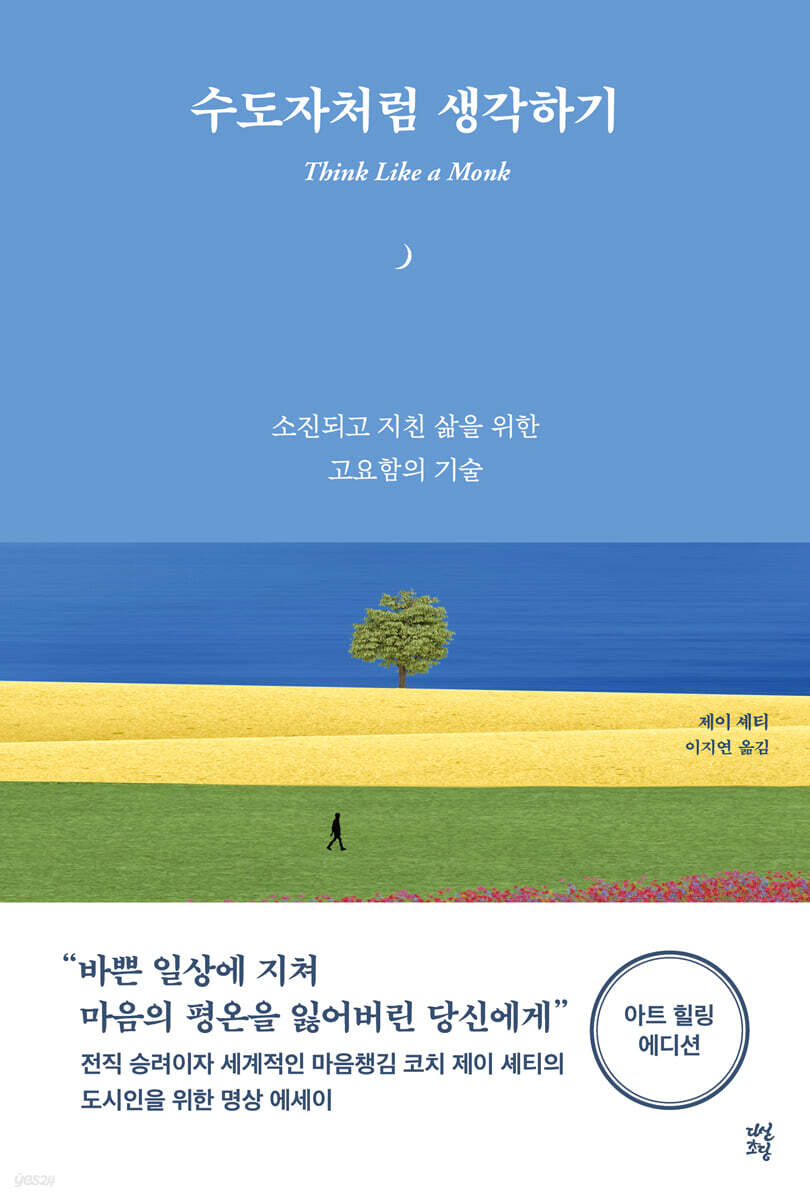
Thinking Like a Monk (Art Healing Edition)
 |
Description
Book Introduction
“I’m tired of my busy daily life “To you who have lost your peace of mind” Jay Shetty, a former monk and world-renowned mindfulness coach Meditation Essays for City People ★ 'Colorful Minimalist', loved by meditators around the world Art Healing Edition by artist Andika Ramadian ★ #1 Amazon New York Times Bestseller! #1 Bestseller in the UK's Sunday Times! Published in 45 countries worldwide, selling over 1 million copies! Amazon rating of 4.8 stars, 34,490 cumulative reviews! The book that brought about the ‘monk craze’ all over the world, ‘Thinking Like a Monk’ The new and improved work of the rising star, Antika Ramadian, is back! Never in human history has there been such an obsession with the pursuit of 'happiness' as in modern times. The media always presents images of happiness, but nothing like fame or money can satisfy us. Instead, we are trapped in an ever-growing vicious cycle, ultimately suffering from depression, disillusionment, dissatisfaction, unhappiness, and fatigue. The high suicide rate in modern society also attests to this. The author, a former monk, motivational philosopher, and global mindfulness coach, encourages "thinking like a monk" to lead a peaceful and meaningful life without chasing happiness. The monastic way of thinking that the author speaks of is a practical way of life devised based on the timeless wisdom of classics that originated thousands of years ago and still hold significant value today, as well as various ancient teachings that the author himself applies in his daily life. The author, who lived as a monk in India, refines the timeless wisdom he learned from his monastic life into practical ways to practice it daily, guiding us through the three steps of "letting go, growing, and sharing." The goal of 'thinking like a monk' is a life free from pride, jealousy, lust, anxiety, anger, resentment, and clinging. According to the author, it is not only possible but also 'necessary' for modern people to acquire the mindset of a monk. To become 'happy', you must ultimately find calm, tranquility and peace of mind within yourself. Ultimately, this book will help you find peace and purpose in life, achieve true happiness, and avoid suffering from anxiety, depression, and stress. Simply by reading this book, you can bring timeless wisdom for happiness to your home or work. On a personal level, this book is about strengthening your mental immunity by helping you train your mind to always be at peace and live a purposeful day. Meanwhile, this book is a valuable asset to humanity, as it supports ancient wisdom with solid research from modern science and psychology, and adopts a format and content suitable for modern people. This book, which contains wisdom that is one level deeper and more fundamental than the methodologies of brain science or psychology, yet is written in an accessible and relatable way, will remain a "life-changing book," as one million readers in 45 countries around the world have agreed. |
- You can preview some of the book's contents.
Preview
index
About the author
Praise poured in for this book
Introduction
■ PART 1 Sometimes you have to let go to be free
01 Identity_ I am who I think I am.
Is the Dust the Problem or Am I the Problem? | Where Do Values Come From? | Media Psychology | Observe Your Life | Tune Your Values | Filter, Don't Block
02 Negative Thoughts_ The evil king is hungry
Negative thoughts are everywhere | Negative thoughts are contagious | Types of negative people | Change your negative external environment | Change your negative thoughts within yourself | Forgiveness: Heal your anger | Forgiveness for change | Peace of mind | Forgiveness is a two-way street | Forgive yourself | Mental uplift
03 Fear_ Welcome to the 'Earth Hotel'
Fear of Fear | Stress Reaction | Dealing with Fear | Acknowledge Your Fear | Identifying Your Fear Patterns | The Cause of Fear is 'Attachment' and the Cure for Fear is 'Detachment' | Short-Term Fear Management
04 Intention_ If you are blinded by gold
Four Motivations | The Ladder of Reason | Seeds and Weeds | The Good Samaritan | Live by Intention | Do Your Homework | Role Models | Let Go and Grow
● Meditation for the Body: Breathing Techniques
■ PART 2 True change is only possible when it begins within you.
05 Purpose_ The nature of scorpions
Discovering the Dharma | Being Yourself | The Dharma of Others | Follow Your Passion | The Four Varnas | Test Drive Your Varnas | Embrace the Dharma | The Dharma is Physical | The Dharma is Responsibility | Expand the Dharma
06 Routine_ Place has energy, time has memory
Wake up early | Make time | Evening routine | Pebbles on the road | Chew your drink and inhale your food | Every moment of the day | Places have energy | Time has memories | One thing at a time | See it through
07 Mind_ The Coachman's Dilemma
Monkey Mind | Parents and Children | Drive the Chariot of the Mind | Overcome the Five Senses | The Stubborn Unconscious | Invest in the Conscious Mind | Reframe | Slow Down | Find Self-Compassion | Focus on the Present | Nothing Owns Me | Don't Try This at Home | How to Be Detachable | Mind Guard
08 Pride_ Catch it if you can
Pride is a mask | Pride makes us liars | Pride creates a false hierarchy | The reason for evaluation | Pride is an obstacle to growth | Pride in the system | Pride isolates us | Pride is a double-edged sword | Humility: The elixir to fix pride | Practice humility | Watch your pride | Be detached from pride | Break free from failure | Build confidence, not pride | Small victories | Ask for feedback | Don't fall for your own hype | True greatness
● Meditation for the mind: Reflection
■ PART 3 The more you share, the more your surroundings become filled with beauty and meaning.
09 Gratitude_ The most powerful drug in the world
The Benefits of Gratitude | The Ointment of Gratitude | The Art of Daily Gratitude | Gratitude Training | Express Gratitude | Kindness and Gratitude Are Symbiotic | The Kindness of a Stranger | Gratitude Through Service | Meaningful Gratitude | Gratitude After Forgiveness
10 Relationships_ Watch People
Setting Expectations | A Community of Love | A Network of Compassion | The Four Types of Trust | Build Your Own Family | The Family of Humanity | Trust is Earned | The Stages of Trust | Trust is a Daily Habit | A Life of Intentional Loving | Attraction vs. Relationships | Quality Over Quantity | Six Ways to Exchange Love | Preparing for Love | Don't Kill Love | Get Over a Breakup
11 Service_ Plant a tree, but do not expect shade.
The Noblest Purpose | Service is Good for the Body and Mind | The Mindset of Service | When Should You Serve? | Serve with Intention | Serve Within the Dharma | Suffering Belongs to Us All | Follow the Pain of Your Heart
● Meditation for the Mind: Mantra
Going out words
Appendix_ Vedic Personality Test
Author's Note
Acknowledgements
References
Next steps
Search
Praise poured in for this book
Introduction
■ PART 1 Sometimes you have to let go to be free
01 Identity_ I am who I think I am.
Is the Dust the Problem or Am I the Problem? | Where Do Values Come From? | Media Psychology | Observe Your Life | Tune Your Values | Filter, Don't Block
02 Negative Thoughts_ The evil king is hungry
Negative thoughts are everywhere | Negative thoughts are contagious | Types of negative people | Change your negative external environment | Change your negative thoughts within yourself | Forgiveness: Heal your anger | Forgiveness for change | Peace of mind | Forgiveness is a two-way street | Forgive yourself | Mental uplift
03 Fear_ Welcome to the 'Earth Hotel'
Fear of Fear | Stress Reaction | Dealing with Fear | Acknowledge Your Fear | Identifying Your Fear Patterns | The Cause of Fear is 'Attachment' and the Cure for Fear is 'Detachment' | Short-Term Fear Management
04 Intention_ If you are blinded by gold
Four Motivations | The Ladder of Reason | Seeds and Weeds | The Good Samaritan | Live by Intention | Do Your Homework | Role Models | Let Go and Grow
● Meditation for the Body: Breathing Techniques
■ PART 2 True change is only possible when it begins within you.
05 Purpose_ The nature of scorpions
Discovering the Dharma | Being Yourself | The Dharma of Others | Follow Your Passion | The Four Varnas | Test Drive Your Varnas | Embrace the Dharma | The Dharma is Physical | The Dharma is Responsibility | Expand the Dharma
06 Routine_ Place has energy, time has memory
Wake up early | Make time | Evening routine | Pebbles on the road | Chew your drink and inhale your food | Every moment of the day | Places have energy | Time has memories | One thing at a time | See it through
07 Mind_ The Coachman's Dilemma
Monkey Mind | Parents and Children | Drive the Chariot of the Mind | Overcome the Five Senses | The Stubborn Unconscious | Invest in the Conscious Mind | Reframe | Slow Down | Find Self-Compassion | Focus on the Present | Nothing Owns Me | Don't Try This at Home | How to Be Detachable | Mind Guard
08 Pride_ Catch it if you can
Pride is a mask | Pride makes us liars | Pride creates a false hierarchy | The reason for evaluation | Pride is an obstacle to growth | Pride in the system | Pride isolates us | Pride is a double-edged sword | Humility: The elixir to fix pride | Practice humility | Watch your pride | Be detached from pride | Break free from failure | Build confidence, not pride | Small victories | Ask for feedback | Don't fall for your own hype | True greatness
● Meditation for the mind: Reflection
■ PART 3 The more you share, the more your surroundings become filled with beauty and meaning.
09 Gratitude_ The most powerful drug in the world
The Benefits of Gratitude | The Ointment of Gratitude | The Art of Daily Gratitude | Gratitude Training | Express Gratitude | Kindness and Gratitude Are Symbiotic | The Kindness of a Stranger | Gratitude Through Service | Meaningful Gratitude | Gratitude After Forgiveness
10 Relationships_ Watch People
Setting Expectations | A Community of Love | A Network of Compassion | The Four Types of Trust | Build Your Own Family | The Family of Humanity | Trust is Earned | The Stages of Trust | Trust is a Daily Habit | A Life of Intentional Loving | Attraction vs. Relationships | Quality Over Quantity | Six Ways to Exchange Love | Preparing for Love | Don't Kill Love | Get Over a Breakup
11 Service_ Plant a tree, but do not expect shade.
The Noblest Purpose | Service is Good for the Body and Mind | The Mindset of Service | When Should You Serve? | Serve with Intention | Serve Within the Dharma | Suffering Belongs to Us All | Follow the Pain of Your Heart
● Meditation for the Mind: Mantra
Going out words
Appendix_ Vedic Personality Test
Author's Note
Acknowledgements
References
Next steps
Search
Detailed image

Into the book
Why should we think like monks? If you want to dominate the basketball court, it's wise to ask Michael Jordan.
If you want to learn about corporate innovation strategies, it's best to delve into Elon Musk.
If you want to put on a great show, you'd better study Beyoncé.
So, if you want to cultivate your mind to find peace, stability, and purpose, the experts are the monks.
David Steindlast, a Benedictine monk who co-founded Gratefulness, said:
“Even if you are not an expert, anyone who makes a conscious effort to constantly live in the ‘present’ is a monk.”
--- From "Introductory Remarks"
Once you filter out the noise of opinions, expectations, and obligations from the world around you, you will begin to see the world through different eyes.
The next step is to bring the world back in.
When I say to be free from outside influences, I don't mean to 'turn off' the entire world indefinitely.
Even if you have the mind of a monk, you can and must learn something from others.
The challenge here is that you have to 'consciously' learn something by asking yourself simple questions like:
--- 「01.
Identity/PART 1 Sometimes you have to let go to be free"
As you know, doctors get sick too.
There is no one who does not get sick.
The monks always told us that everyone has their own illness and that everyone is still learning.
Just as we do not blame others for their health problems, we should not blame others for having different sins than we do.
Gauranga Das repeated this advice through a short parable, and we tried to reflect on it and not harbor negative thoughts about others.
'Don't blame others for having different illnesses than you.' 'Don't expect anyone to be perfect.' 'Don't think you're perfect.'
--- 「02.
Negative Thoughts/PART 1 Sometimes you have to let go to be free
Imagine staying in an incredibly beautiful home through Airbnb.
It has an open-air bath, a luxurious kitchen, and an ocean view.
It's so beautiful and exciting.
There you won't spend every moment dreading the fact that you'll have to leave in a week.
If I could acknowledge that everything I have is like a fancy rental car or a beautiful place to stay, I would be free to enjoy them without having to live in constant fear of losing them.
We are all happy vacationers enjoying our stay at the 'Hotel called Earth'.
--- 「03.
Fear/PART 1 Sometimes you have to let go to be free"
Everyone has an innate psychophysical nature that determines where they shine and where they can demonstrate their abilities.
Dharma is about using your innate talents, what you excel at, and the conditions in which you can demonstrate your abilities to serve others.
When the process is enjoyable and the execution is smooth, you feel passionate.
If others react positively, it means my passion has purpose.
This is the magic formula for Dharma.
Passion + Expertise + Usefulness = Dharma
--- 「05.
From "Purpose/PART 2 True change is only possible when it begins within you"
Routines produce results that are different from what we commonly think.
Rather than becoming bored by repetition, doing the same thing in the same place, at the same time, creates room for creativity.
Consistently tapping into the energy of place and the memory of time makes it easier to focus on the present and deeply engage with one task rather than wandering or becoming frustrated.
By creating a routine and practicing like a monk, you can develop concentration and experience deep immersion.
--- 「06.
From Routine/PART 2: True change is only possible when it begins within you.
When I wake up in the morning, I feel tired and my breath smells.
We accept the fact that we have to brush our teeth and shower every morning.
I don't blame myself for having to wash.
No one says this when they are hungry.
'Oh my god, I'm the worst.
How could I be hungry again?' That kind of patience and understanding must be exercised even when motivation is low, concentration is lost, anxiety is high, confusion is high, or the horse is weak.
Waking up the groom is a daily chore, like showering or eating.
--- 「07.
From "Mind/Part 2 True change is only possible when it begins within you"
Confidence and high self-esteem help me accept myself as I am: humble, imperfect, and striving.
Inflated self-esteem should not be confused with healthy self-esteem.
Pride is wanting everyone to like you.
People with high self-esteem don't mind if others don't like them.
Pride is thinking that you know everything.
People with high self-esteem believe that they can learn from anyone.
Pride wants to prove itself.
Self-esteem wants to express itself.
--- 「08.
From Pride/PART 2 True change is only possible when it begins within you.
Don't judge the moment.
The moment we label something as bad, our minds begin to believe it.
Instead, be thankful when things go wrong.
Allow life's long journey to unfold at your own pace, along the winding paths of your choosing.
The universe may have other plans for you.
--- 「09.
Gratitude/PART 3 The more you share, the more your surroundings are filled with beauty and meaning.
At the ashram, instead of asking, “How was your work?” they would ask, “Did you serve today?”
It was like the monks' chatting in front of the water purifier.
Let's put aside all obstacles for a moment and imagine if everyone had a spirit of service.
We can ask new questions.
"How can this serve a greater purpose? How can I serve others at work, at home, in my community, and around me? How can I use my talents to serve others and change the world?"
If you want to learn about corporate innovation strategies, it's best to delve into Elon Musk.
If you want to put on a great show, you'd better study Beyoncé.
So, if you want to cultivate your mind to find peace, stability, and purpose, the experts are the monks.
David Steindlast, a Benedictine monk who co-founded Gratefulness, said:
“Even if you are not an expert, anyone who makes a conscious effort to constantly live in the ‘present’ is a monk.”
--- From "Introductory Remarks"
Once you filter out the noise of opinions, expectations, and obligations from the world around you, you will begin to see the world through different eyes.
The next step is to bring the world back in.
When I say to be free from outside influences, I don't mean to 'turn off' the entire world indefinitely.
Even if you have the mind of a monk, you can and must learn something from others.
The challenge here is that you have to 'consciously' learn something by asking yourself simple questions like:
--- 「01.
Identity/PART 1 Sometimes you have to let go to be free"
As you know, doctors get sick too.
There is no one who does not get sick.
The monks always told us that everyone has their own illness and that everyone is still learning.
Just as we do not blame others for their health problems, we should not blame others for having different sins than we do.
Gauranga Das repeated this advice through a short parable, and we tried to reflect on it and not harbor negative thoughts about others.
'Don't blame others for having different illnesses than you.' 'Don't expect anyone to be perfect.' 'Don't think you're perfect.'
--- 「02.
Negative Thoughts/PART 1 Sometimes you have to let go to be free
Imagine staying in an incredibly beautiful home through Airbnb.
It has an open-air bath, a luxurious kitchen, and an ocean view.
It's so beautiful and exciting.
There you won't spend every moment dreading the fact that you'll have to leave in a week.
If I could acknowledge that everything I have is like a fancy rental car or a beautiful place to stay, I would be free to enjoy them without having to live in constant fear of losing them.
We are all happy vacationers enjoying our stay at the 'Hotel called Earth'.
--- 「03.
Fear/PART 1 Sometimes you have to let go to be free"
Everyone has an innate psychophysical nature that determines where they shine and where they can demonstrate their abilities.
Dharma is about using your innate talents, what you excel at, and the conditions in which you can demonstrate your abilities to serve others.
When the process is enjoyable and the execution is smooth, you feel passionate.
If others react positively, it means my passion has purpose.
This is the magic formula for Dharma.
Passion + Expertise + Usefulness = Dharma
--- 「05.
From "Purpose/PART 2 True change is only possible when it begins within you"
Routines produce results that are different from what we commonly think.
Rather than becoming bored by repetition, doing the same thing in the same place, at the same time, creates room for creativity.
Consistently tapping into the energy of place and the memory of time makes it easier to focus on the present and deeply engage with one task rather than wandering or becoming frustrated.
By creating a routine and practicing like a monk, you can develop concentration and experience deep immersion.
--- 「06.
From Routine/PART 2: True change is only possible when it begins within you.
When I wake up in the morning, I feel tired and my breath smells.
We accept the fact that we have to brush our teeth and shower every morning.
I don't blame myself for having to wash.
No one says this when they are hungry.
'Oh my god, I'm the worst.
How could I be hungry again?' That kind of patience and understanding must be exercised even when motivation is low, concentration is lost, anxiety is high, confusion is high, or the horse is weak.
Waking up the groom is a daily chore, like showering or eating.
--- 「07.
From "Mind/Part 2 True change is only possible when it begins within you"
Confidence and high self-esteem help me accept myself as I am: humble, imperfect, and striving.
Inflated self-esteem should not be confused with healthy self-esteem.
Pride is wanting everyone to like you.
People with high self-esteem don't mind if others don't like them.
Pride is thinking that you know everything.
People with high self-esteem believe that they can learn from anyone.
Pride wants to prove itself.
Self-esteem wants to express itself.
--- 「08.
From Pride/PART 2 True change is only possible when it begins within you.
Don't judge the moment.
The moment we label something as bad, our minds begin to believe it.
Instead, be thankful when things go wrong.
Allow life's long journey to unfold at your own pace, along the winding paths of your choosing.
The universe may have other plans for you.
--- 「09.
Gratitude/PART 3 The more you share, the more your surroundings are filled with beauty and meaning.
At the ashram, instead of asking, “How was your work?” they would ask, “Did you serve today?”
It was like the monks' chatting in front of the water purifier.
Let's put aside all obstacles for a moment and imagine if everyone had a spirit of service.
We can ask new questions.
"How can this serve a greater purpose? How can I serve others at work, at home, in my community, and around me? How can I use my talents to serve others and change the world?"
--- 「11.
Service/PART 3 The more you share, the more your surroundings will be filled with beauty and meaning.
Service/PART 3 The more you share, the more your surroundings will be filled with beauty and meaning.
Publisher's Review
★ More than 50 million SNS followers, more than 10 billion cumulative SNS views
★ #1 Most Popular Video on Facebook, Recording 360 Million Views
★ Keynote speakers invited by global companies such as Google, Microsoft, and Netflix
★ Advisory to global companies including Accenture, Nasdaq, Bank of England, and EY
★ Host of the #1 rated podcast 'On Purpose'
★ 30 'Global Game Changers' Selected by Forbes
★ Streamy Award Winner
These are world famous and influential people.
Why I'm crazy about Jay Shetty
Jay Shetty grew up in a conservative, elite family where everyone in his family was either a doctor or a lawyer.
So in his family, when a child grew up, he could only choose one of three lives.
Doctor, lawyer or loser.
He broke the expectations and common sense of those around him and decided to become a monk after graduating from a business school at a first-class university.
Then he left for India, saying he would meditate for four to eight hours every day and dedicate his life to helping others.
His family was convinced that he had chosen to be a failure in life.
Three years later, his mentor told Shetty that he could have a greater impact on the world if he left the monkhood and shared the experiences and wisdom he had accumulated with others.
So, with $25,000 in debt and no skills to list on his resume, he returned to his hometown in North London, where his parents were, in search of his calling.
When I reconnected with my classmates, many of them were working at world-class companies like Google and Starbucks.
But surprisingly, they were suffering from stress, pressure, and unhappiness, and were wandering around, completely dissatisfied with the meaning and purpose of their lives.
He began coaching on health, happiness, life purpose, and mindfulness at the repeated request of many acquaintances, and word of his work began to spread through social media.
Since then, he has become a globally popular thought leader, sought after by opinion leaders.
He was selected as a person who changed the media landscape by the American business magazine Forbes in 2017, and in 2018, he won the Streami Award for being the most popular video on Facebook with over 360 million views.
Additionally, his content has garnered over 8 billion views on YouTube, and his podcast, On Purpose, has been hailed as the world's No. 1 happiness and health podcast, attracting a lot of attention with appearances from celebrities such as Oprah Winfrey, Ray Dalio, Will Smith, Deepak Chopra, Kobe Bryant, Tim Faris, and Jennifer Lopez.
Jay Shetty, the 'City's Capital'
How to reach your life's purpose without being swayed by the world's standards
Author Jay Shetty is a social media superstar with 40 million followers and host of the #1 podcast, On Purpose.
He distills the timeless wisdom he learned as a monk in India into a few practical ways anyone can apply every day.
In particular, we hope that through these practices, more people will be able to overcome their anxieties, achieve what they want in life, and live meaningful lives. We are carrying out various activities, including running coaching communities and online schools, giving lectures, providing counseling, and conducting interviews.
This book generously shares the author's know-how to help you approach life's various problems by learning to think like a monk.
We will guide you through three major steps to equip yourself with the monk's mindset.
First, we detach ourselves from external influences, internal obstacles, and fears that hold us back, and look at ourselves objectively (identify, let go of negative thoughts, become detached from fear, and live with intention).
This creates space for growth.
Second, make important life decisions with intention, purpose, and confidence (discover your purpose, change your routine, become conscious of your mind, and correct your self-esteem).
This is how life changes and grows.
Third, let go of self-centered thinking, look at the world, expand your gratitude, share your talents and passions with others, and discover the true joy and amazing benefits of service (be grateful, love, serve).
It deepens all the relationships in life.
The goal of the monastic way of thinking, reached through these three steps, is a life free from ego, jealousy, lust, anxiety, anger, bitterness, and burdens.
It is no exaggeration to say that this is a strategy that must be adopted to survive in the present age.
Not consumed, not shaken, not broken
Wisdom Learned from the Life of a Monk Living 'Today'
Author Jay Shetty wrote this book to inspire, encourage and empower many people.
In particular, he argues that modern people, in their daily lives that are filled with meaningless or noisy trivial matters, should always think about 'how would a monk think and what attitude would he have in such situations?'
As the author's life story shows, from outcast to monk, then unemployed to Forbes, thinking like a monk allows you to find and pursue purpose in life and lead a meaningful life.
Anyone who thinks like a monk can change their life and become happier right now, starting from their daily life.
Even when faced with various challenges in daily life, receiving guidance from eternal wisdom can help you make better decisions and achieve deeper self-awareness.
When you break up with a loved one, lose a lot of money, fail, or suffer from insomnia, you can ask yourself, "What would a monk think?" and make wise choices based on that.
The author has a remarkable talent for transforming abstract wisdom and lessons into practical advice and exercises that anyone can use.
Drawing on ancient wisdom and modern scientific knowledge about mindfulness, as well as the author's extensive experience in an ashram (a traditional Indian monastery), this book offers easy and practical methods to help anyone overcome negative thoughts and habits and connect with the inner peace and purpose of existence that already exists within.
By following the various training methods in this book, anyone can reduce stress, improve relationships, and unleash the talents they've discovered within themselves.
After reading the book, you will find yourself deeply empathizing with the author's insight that anyone, including you, can and should think like a monk.
★ #1 Most Popular Video on Facebook, Recording 360 Million Views
★ Keynote speakers invited by global companies such as Google, Microsoft, and Netflix
★ Advisory to global companies including Accenture, Nasdaq, Bank of England, and EY
★ Host of the #1 rated podcast 'On Purpose'
★ 30 'Global Game Changers' Selected by Forbes
★ Streamy Award Winner
These are world famous and influential people.
Why I'm crazy about Jay Shetty
Jay Shetty grew up in a conservative, elite family where everyone in his family was either a doctor or a lawyer.
So in his family, when a child grew up, he could only choose one of three lives.
Doctor, lawyer or loser.
He broke the expectations and common sense of those around him and decided to become a monk after graduating from a business school at a first-class university.
Then he left for India, saying he would meditate for four to eight hours every day and dedicate his life to helping others.
His family was convinced that he had chosen to be a failure in life.
Three years later, his mentor told Shetty that he could have a greater impact on the world if he left the monkhood and shared the experiences and wisdom he had accumulated with others.
So, with $25,000 in debt and no skills to list on his resume, he returned to his hometown in North London, where his parents were, in search of his calling.
When I reconnected with my classmates, many of them were working at world-class companies like Google and Starbucks.
But surprisingly, they were suffering from stress, pressure, and unhappiness, and were wandering around, completely dissatisfied with the meaning and purpose of their lives.
He began coaching on health, happiness, life purpose, and mindfulness at the repeated request of many acquaintances, and word of his work began to spread through social media.
Since then, he has become a globally popular thought leader, sought after by opinion leaders.
He was selected as a person who changed the media landscape by the American business magazine Forbes in 2017, and in 2018, he won the Streami Award for being the most popular video on Facebook with over 360 million views.
Additionally, his content has garnered over 8 billion views on YouTube, and his podcast, On Purpose, has been hailed as the world's No. 1 happiness and health podcast, attracting a lot of attention with appearances from celebrities such as Oprah Winfrey, Ray Dalio, Will Smith, Deepak Chopra, Kobe Bryant, Tim Faris, and Jennifer Lopez.
Jay Shetty, the 'City's Capital'
How to reach your life's purpose without being swayed by the world's standards
Author Jay Shetty is a social media superstar with 40 million followers and host of the #1 podcast, On Purpose.
He distills the timeless wisdom he learned as a monk in India into a few practical ways anyone can apply every day.
In particular, we hope that through these practices, more people will be able to overcome their anxieties, achieve what they want in life, and live meaningful lives. We are carrying out various activities, including running coaching communities and online schools, giving lectures, providing counseling, and conducting interviews.
This book generously shares the author's know-how to help you approach life's various problems by learning to think like a monk.
We will guide you through three major steps to equip yourself with the monk's mindset.
First, we detach ourselves from external influences, internal obstacles, and fears that hold us back, and look at ourselves objectively (identify, let go of negative thoughts, become detached from fear, and live with intention).
This creates space for growth.
Second, make important life decisions with intention, purpose, and confidence (discover your purpose, change your routine, become conscious of your mind, and correct your self-esteem).
This is how life changes and grows.
Third, let go of self-centered thinking, look at the world, expand your gratitude, share your talents and passions with others, and discover the true joy and amazing benefits of service (be grateful, love, serve).
It deepens all the relationships in life.
The goal of the monastic way of thinking, reached through these three steps, is a life free from ego, jealousy, lust, anxiety, anger, bitterness, and burdens.
It is no exaggeration to say that this is a strategy that must be adopted to survive in the present age.
Not consumed, not shaken, not broken
Wisdom Learned from the Life of a Monk Living 'Today'
Author Jay Shetty wrote this book to inspire, encourage and empower many people.
In particular, he argues that modern people, in their daily lives that are filled with meaningless or noisy trivial matters, should always think about 'how would a monk think and what attitude would he have in such situations?'
As the author's life story shows, from outcast to monk, then unemployed to Forbes, thinking like a monk allows you to find and pursue purpose in life and lead a meaningful life.
Anyone who thinks like a monk can change their life and become happier right now, starting from their daily life.
Even when faced with various challenges in daily life, receiving guidance from eternal wisdom can help you make better decisions and achieve deeper self-awareness.
When you break up with a loved one, lose a lot of money, fail, or suffer from insomnia, you can ask yourself, "What would a monk think?" and make wise choices based on that.
The author has a remarkable talent for transforming abstract wisdom and lessons into practical advice and exercises that anyone can use.
Drawing on ancient wisdom and modern scientific knowledge about mindfulness, as well as the author's extensive experience in an ashram (a traditional Indian monastery), this book offers easy and practical methods to help anyone overcome negative thoughts and habits and connect with the inner peace and purpose of existence that already exists within.
By following the various training methods in this book, anyone can reduce stress, improve relationships, and unleash the talents they've discovered within themselves.
After reading the book, you will find yourself deeply empathizing with the author's insight that anyone, including you, can and should think like a monk.
GOODS SPECIFICS
- Publication date: June 29, 2021
- Page count, weight, size: 487 pages | 862g | 154*225*30mm
- ISBN13: 9791130638201
- ISBN10: 1130638200
You may also like
카테고리
korean


korean

![GQ KOREA Mark (Monthly): December [2025]](http://librairie.coreenne.fr/cdn/shop/files/8ef265dbbfbf186523ed75ba7319009d.jpg?v=1765340328&width=3840)


