

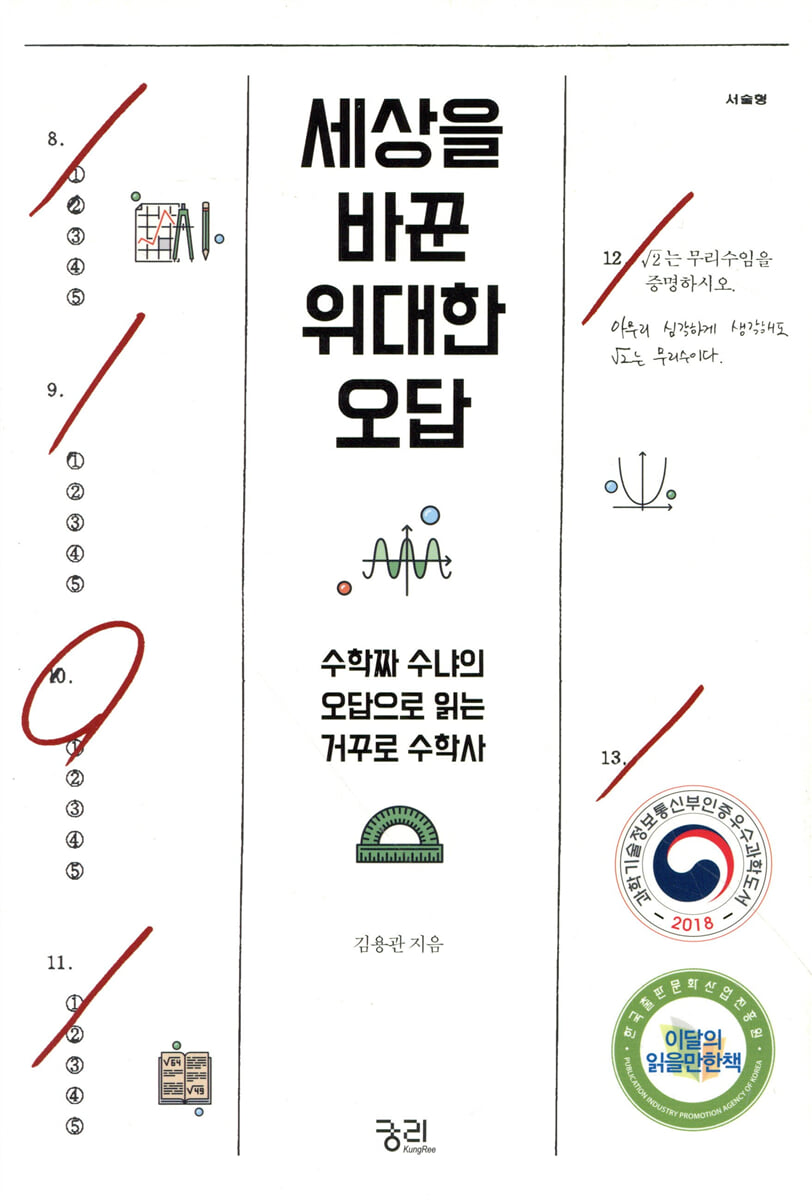
The Great Mistake That Changed the World
 |
Description
Book Introduction
Let's look at the wrong answers again! 80% of the great mathematics was made up of wrong answers!
The thrilling mathematics of right and wrong answers intertwined like a Möbius strip
"The Great Wrong Answer That Changed the World" is a book that features a wrong answer that doesn't receive much attention in the world of mathematics.
We often think of mathematics as a discipline of 'correct answers'.
I'm busy learning the correct answers and practicing to get used to them.
However, incorrect answers play a very important role in the process of mathematics.
Looking back at the history of mathematics, correct answers emerged from incorrect answers.
Even a wrong answer was once correct until it was revealed to be wrong.
There were many cases where incorrect answers were used as stepping stones to reach the correct answer.
By checking whether it was right or wrong, why it was wrong, and what errors there were in the original idea, I gradually got closer to the correct answer.
A book that features an incorrect answer that has not received much attention in the world of mathematics.
How do you find the area of a regular square or circle? What is the exact value of pi? Is the value of a negative number times a negative number positive or negative? What happens when you divide a number by zero? Even these seemingly simple math problems required thousands of years of human error and a massive intellectual adventure before the correct answer was found.
It conveys the message that the correct answer emerged from numerous incorrect answers, and emphasizes the 'power of incorrect answers' in the field of math education that forces only certain correct answers.
Through the inseparable relationship between correct and incorrect answers, which are intertwined like a Möbius strip, we come to realize that mathematics is a discipline that grows through the process of free and unhindered thinking.
It provides a different perspective on mathematics to students and teachers who are tired of the problem-solving method of studying mathematics that only seeks the correct answer, and to the general public who are interested in the history and history of mathematics.
The thrilling mathematics of right and wrong answers intertwined like a Möbius strip
"The Great Wrong Answer That Changed the World" is a book that features a wrong answer that doesn't receive much attention in the world of mathematics.
We often think of mathematics as a discipline of 'correct answers'.
I'm busy learning the correct answers and practicing to get used to them.
However, incorrect answers play a very important role in the process of mathematics.
Looking back at the history of mathematics, correct answers emerged from incorrect answers.
Even a wrong answer was once correct until it was revealed to be wrong.
There were many cases where incorrect answers were used as stepping stones to reach the correct answer.
By checking whether it was right or wrong, why it was wrong, and what errors there were in the original idea, I gradually got closer to the correct answer.
A book that features an incorrect answer that has not received much attention in the world of mathematics.
How do you find the area of a regular square or circle? What is the exact value of pi? Is the value of a negative number times a negative number positive or negative? What happens when you divide a number by zero? Even these seemingly simple math problems required thousands of years of human error and a massive intellectual adventure before the correct answer was found.
It conveys the message that the correct answer emerged from numerous incorrect answers, and emphasizes the 'power of incorrect answers' in the field of math education that forces only certain correct answers.
Through the inseparable relationship between correct and incorrect answers, which are intertwined like a Möbius strip, we come to realize that mathematics is a discipline that grows through the process of free and unhindered thinking.
It provides a different perspective on mathematics to students and teachers who are tired of the problem-solving method of studying mathematics that only seeks the correct answer, and to the general public who are interested in the history and history of mathematics.
- You can preview some of the book's contents.
Preview
index
Author's Note.
The beautiful theorems of mathematics are pearls created from wrong answers!
Chapter 1.
Can you find the area of a rectangle using only its length?
Chapter 2.
Can you accurately calculate the area of a circle?
Chapter 3.
How many times is the circumference of a circle equal to its diameter?
Chapter 4.
Can we calculate the probability of random events?
Chapter 5.
1÷0, 0÷0.
What number do you divide by 0?
Chapter 6.
Is a negative number times a negative number (+) or (-)?
Chapter 7.
Is 1 a prime number or not?
Chapter 8.
Infinity, does it really exist? Or does it not exist?
Chapter 9.
Can you construct a square with the same area as a circle?
Chapter 10.
Are there only one parallel line passing through a point?
Chapter 11.
How do you find the area of a cycloid?
Chapter 12.
How to define points, lines, and planes?
A Timeline of the History of Mathematics Through Wrong Answers
References
The beautiful theorems of mathematics are pearls created from wrong answers!
Chapter 1.
Can you find the area of a rectangle using only its length?
Chapter 2.
Can you accurately calculate the area of a circle?
Chapter 3.
How many times is the circumference of a circle equal to its diameter?
Chapter 4.
Can we calculate the probability of random events?
Chapter 5.
1÷0, 0÷0.
What number do you divide by 0?
Chapter 6.
Is a negative number times a negative number (+) or (-)?
Chapter 7.
Is 1 a prime number or not?
Chapter 8.
Infinity, does it really exist? Or does it not exist?
Chapter 9.
Can you construct a square with the same area as a circle?
Chapter 10.
Are there only one parallel line passing through a point?
Chapter 11.
How do you find the area of a cycloid?
Chapter 12.
How to define points, lines, and planes?
A Timeline of the History of Mathematics Through Wrong Answers
References
Into the book
“A wrong answer is not just a wrong answer.
Even the wrong answer was once the right answer before it was revealed to be wrong.
It was a 'different' answer.
The 'different' answer became the 'wrong answer', and that wrong answer became the 'correct answer'.
You have to go beyond the wrong answers to see the right answer.
Mathematics is a process of overcoming wrong answers, and beautiful theorems are pearls created through the dazzling performance of wrong answers.
“Countless wrong answers hold up mathematics.” - From the author’s note
Even the wrong answer was once the right answer before it was revealed to be wrong.
It was a 'different' answer.
The 'different' answer became the 'wrong answer', and that wrong answer became the 'correct answer'.
You have to go beyond the wrong answers to see the right answer.
Mathematics is a process of overcoming wrong answers, and beautiful theorems are pearls created through the dazzling performance of wrong answers.
“Countless wrong answers hold up mathematics.” - From the author’s note
--- From the text
Publisher's Review
The thrilling mathematics of right and wrong answers intertwined like a Möbius strip
You have to make a lot of mistakes to get the right answer.
However, these days, students do not have many opportunities to try and see if something is wrong.
There aren't many opportunities to come up with and test your own ideas.
As a result, we often study without knowing what we know and what we don't know.
They don't even know how important their wrong answers are, they feel ashamed of their wrong answers, and they only care about the right answers.
The author, who felt sorry while watching such a sight, wrote this book to encourage students to “make mistakes with a little more confidence.”
Author Yong-Kwan Kim is an eccentric mathematician who has facilitated encounters between mathematics and the fields of art, film, literature, philosophy, and history through his previous works, including “Su-Nya’s Math Cafe 1, 2” and “Su-Nya’s Math Cinema.”
This time, the history of mathematics is completely reconstructed and told as a huge historical product created by 'wrong answers'.
This book explores why incorrect answers are important in mathematics, a discipline that seems to demand only definitive answers, using 12 important yet common questions in mathematics as its subject matter.
If you turn math upside down, a new perspective on math opens up!
Reading backwards math with wrong answers
The formula for calculating the area of a circle (πr2) didn't fall from the sky. What happened before it was discovered? How did we arrive at answers before the formula existed? Why have we never asked this question? Even simple mathematical formulas and problems that we memorize and pass over in mathematics studies required thousands of years of struggle before we finally found the answers.
There are mathematical problems that mankind has struggled to find answers to for a long time.
How do you find the area of a regular rectangle? What is the exact value of pi? Is a negative number times a negative number positive or negative? What is the value of a number divided by zero? Is there only one parallel line passing through a point? How do you find the area of a cycloid? Is 1 a prime number or not? The question was the same, but the answer varied across time and place.
How did people of earlier times solve this problem? And what does the world of mathematics look like when viewed through incorrect answers? How does it differ from what we know?
What a wonderful mistake! A story of a mistake more beautiful than the correct answer.
Into the feast of great 'wrong answers' that created the 'right answer'!
The structure of this book is unique.
It tells how seemingly simple and ordinary mathematical problems, such as finding the area of a regular square, the area of a circle, the division by zero problem, and the area of a circle, have been solved differently from ancient times to the present.
The book is filled with historical examples of even so-called great mathematicians making ridiculously wrong answers.
In ancient Greece, numbers had to be expressible in terms of length.
Even if a negative number is found as a solution to an equation, it is ignored and not acknowledged.
Even the great 17th century mathematician Pascal said that subtracting 4 from 0 was complete nonsense.
It is also interesting to note that the process of calculating the area of a regular quadrilateral with four sides of different lengths is done by directly applying the area formula for a right triangle, parallelogram, or trapezoid.
After a long process of mathematical exploration, the formula for the area of a regular rectangle was finally presented in 1842.
John Wallace, active in the 17th century, argued that dividing any number by zero results in infinity.
It was also said that when a number is divided by a negative number, it is greater than infinity.
Why did he come up with this answer? He noticed that when a positive number is divided by a smaller number, its size increases.
10÷10=1, 10÷5=2, 10÷1=10, 10÷0.1=100.
He applied this pattern to zero and negative numbers.
If this pattern is followed, the value divided by 0 should be infinity.
However, a negative number is a number smaller than 0.
So, when you divide by a negative number, it must be greater than when you divide by 0.
It's a completely different answer than we know, but it's a fantastic idea that makes sense in its own way.
It's okay if it's wrong, it's okay if it takes a little longer
The beautiful theorems of mathematics are pearls created from wrong answers!
The book covers a variety of mathematical problems, including numbers, calculations, geometry, probability, and infinity, with each chapter covering one problem.
Each chapter is composed of six parts: problem explanation, examples of incorrect answers, wrong answer, ideas in incorrect answers, progress of incorrect answers, and from incorrect answers to correct answers.
A problem statement briefly explains what problem you are trying to address.
Incorrect answer examples introduce incorrect answers to the problem.
In Wrong!, we check why the wrong answers are wrong.
The idea behind the wrong answers is to think about the background of the wrong answers from the idea perspective.
Let's take a look at what led to such an incorrect answer.
The evolution of the wrong answer traces how the idea developed after that wrong answer.
From the last wrong answer to the correct answer, we introduce the final conclusion reached through the progression of wrong answers.
The flow of ideas is organized to show the thought process that led from an incorrect answer to the correct answer.
The history of mathematics is a series of processes that use wrong answers as stepping stones to reach the correct answer.
Even math problems that seem very simple and clear would not have had the correct answers if there had not been incorrect answers given by previous generations.
As you read this book, 'The History of Wrong Answers in Mathematics,' you will realize that the process of humans living in the era before mathematics and later generations playing a relay game, each solving a problem in their own way.
Among them, there are still problems for which we are struggling to find the correct answer.
After reading it, I thought, 'It's okay to be wrong.
This is a book that gives you comfort by saying, 'Even great mathematicians were like that.'
The author goes through the great mistakes in the history of mathematics and tells us not to be afraid of being wrong.
Think boldly and freely.
Even if it's the wrong answer.
The correct answer can only be seen beyond the incorrect answers.
You have to make a lot of mistakes to get the right answer.
However, these days, students do not have many opportunities to try and see if something is wrong.
There aren't many opportunities to come up with and test your own ideas.
As a result, we often study without knowing what we know and what we don't know.
They don't even know how important their wrong answers are, they feel ashamed of their wrong answers, and they only care about the right answers.
The author, who felt sorry while watching such a sight, wrote this book to encourage students to “make mistakes with a little more confidence.”
Author Yong-Kwan Kim is an eccentric mathematician who has facilitated encounters between mathematics and the fields of art, film, literature, philosophy, and history through his previous works, including “Su-Nya’s Math Cafe 1, 2” and “Su-Nya’s Math Cinema.”
This time, the history of mathematics is completely reconstructed and told as a huge historical product created by 'wrong answers'.
This book explores why incorrect answers are important in mathematics, a discipline that seems to demand only definitive answers, using 12 important yet common questions in mathematics as its subject matter.
If you turn math upside down, a new perspective on math opens up!
Reading backwards math with wrong answers
The formula for calculating the area of a circle (πr2) didn't fall from the sky. What happened before it was discovered? How did we arrive at answers before the formula existed? Why have we never asked this question? Even simple mathematical formulas and problems that we memorize and pass over in mathematics studies required thousands of years of struggle before we finally found the answers.
There are mathematical problems that mankind has struggled to find answers to for a long time.
How do you find the area of a regular rectangle? What is the exact value of pi? Is a negative number times a negative number positive or negative? What is the value of a number divided by zero? Is there only one parallel line passing through a point? How do you find the area of a cycloid? Is 1 a prime number or not? The question was the same, but the answer varied across time and place.
How did people of earlier times solve this problem? And what does the world of mathematics look like when viewed through incorrect answers? How does it differ from what we know?
What a wonderful mistake! A story of a mistake more beautiful than the correct answer.
Into the feast of great 'wrong answers' that created the 'right answer'!
The structure of this book is unique.
It tells how seemingly simple and ordinary mathematical problems, such as finding the area of a regular square, the area of a circle, the division by zero problem, and the area of a circle, have been solved differently from ancient times to the present.
The book is filled with historical examples of even so-called great mathematicians making ridiculously wrong answers.
In ancient Greece, numbers had to be expressible in terms of length.
Even if a negative number is found as a solution to an equation, it is ignored and not acknowledged.
Even the great 17th century mathematician Pascal said that subtracting 4 from 0 was complete nonsense.
It is also interesting to note that the process of calculating the area of a regular quadrilateral with four sides of different lengths is done by directly applying the area formula for a right triangle, parallelogram, or trapezoid.
After a long process of mathematical exploration, the formula for the area of a regular rectangle was finally presented in 1842.
John Wallace, active in the 17th century, argued that dividing any number by zero results in infinity.
It was also said that when a number is divided by a negative number, it is greater than infinity.
Why did he come up with this answer? He noticed that when a positive number is divided by a smaller number, its size increases.
10÷10=1, 10÷5=2, 10÷1=10, 10÷0.1=100.
He applied this pattern to zero and negative numbers.
If this pattern is followed, the value divided by 0 should be infinity.
However, a negative number is a number smaller than 0.
So, when you divide by a negative number, it must be greater than when you divide by 0.
It's a completely different answer than we know, but it's a fantastic idea that makes sense in its own way.
It's okay if it's wrong, it's okay if it takes a little longer
The beautiful theorems of mathematics are pearls created from wrong answers!
The book covers a variety of mathematical problems, including numbers, calculations, geometry, probability, and infinity, with each chapter covering one problem.
Each chapter is composed of six parts: problem explanation, examples of incorrect answers, wrong answer, ideas in incorrect answers, progress of incorrect answers, and from incorrect answers to correct answers.
A problem statement briefly explains what problem you are trying to address.
Incorrect answer examples introduce incorrect answers to the problem.
In Wrong!, we check why the wrong answers are wrong.
The idea behind the wrong answers is to think about the background of the wrong answers from the idea perspective.
Let's take a look at what led to such an incorrect answer.
The evolution of the wrong answer traces how the idea developed after that wrong answer.
From the last wrong answer to the correct answer, we introduce the final conclusion reached through the progression of wrong answers.
The flow of ideas is organized to show the thought process that led from an incorrect answer to the correct answer.
The history of mathematics is a series of processes that use wrong answers as stepping stones to reach the correct answer.
Even math problems that seem very simple and clear would not have had the correct answers if there had not been incorrect answers given by previous generations.
As you read this book, 'The History of Wrong Answers in Mathematics,' you will realize that the process of humans living in the era before mathematics and later generations playing a relay game, each solving a problem in their own way.
Among them, there are still problems for which we are struggling to find the correct answer.
After reading it, I thought, 'It's okay to be wrong.
This is a book that gives you comfort by saying, 'Even great mathematicians were like that.'
The author goes through the great mistakes in the history of mathematics and tells us not to be afraid of being wrong.
Think boldly and freely.
Even if it's the wrong answer.
The correct answer can only be seen beyond the incorrect answers.
GOODS SPECIFICS
- Date of publication: July 12, 2017
- Page count, weight, size: 281 pages | 522g | 153*225*20mm
- ISBN13: 9788958204695
- ISBN10: 8958204699
You may also like
카테고리
korean


korean

![ELLE 엘르 스페셜 에디션 A형 : 12월 [2025]](http://librairie.coreenne.fr/cdn/shop/files/b8e27a3de6c9538896439686c6b0e8fb.jpg?v=1766436872&width=3840)


