

Plot enhancement
 |
Description
Book Introduction
- A word from MD
-
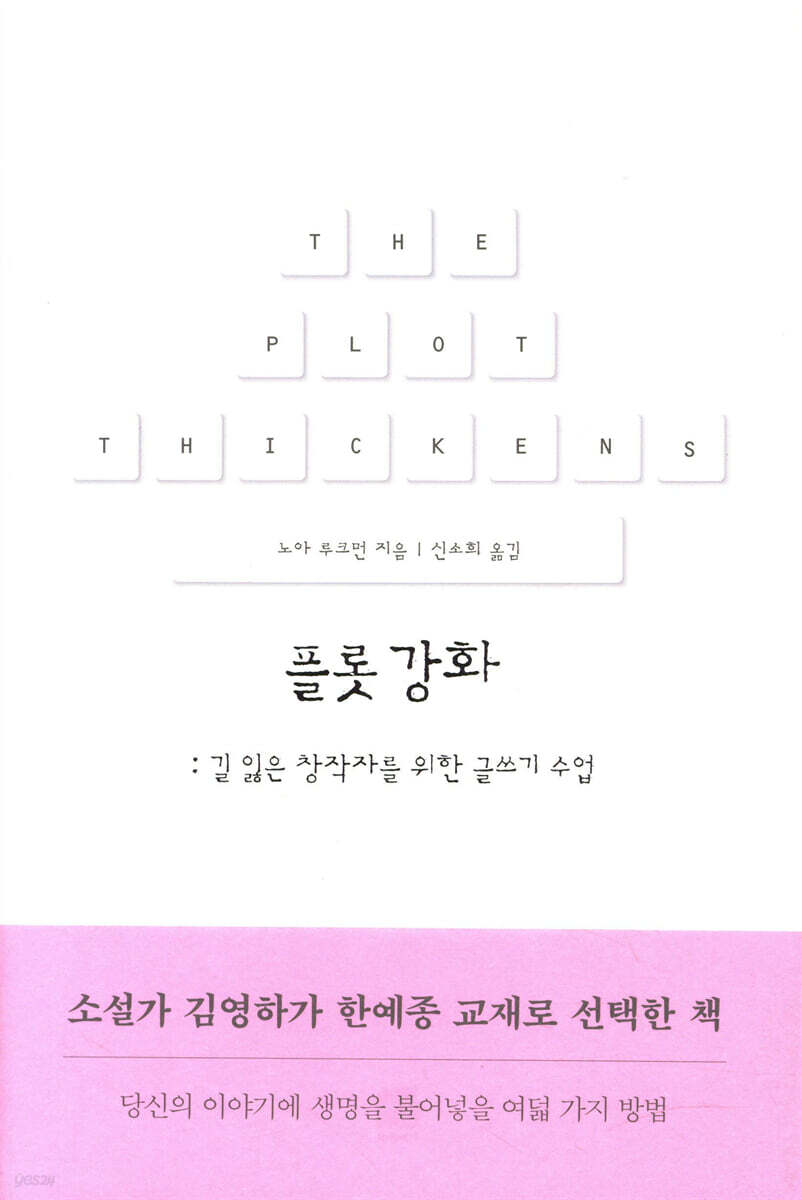
Storytelling techniques that stick to the basicsStorytelling secrets from renowned American publishing agent Noah Lukeman.
For 20 years, I have been writing my own articles and reading other authors' articles.
Based on this experience, I have summarized the conditions for an attractive piece of writing.
It guides you to skillfully use various elements such as characters, suspense, and conflict.
June 22, 2021. Humanities PD Son Min-gyu
Noah Lukeman says writers shouldn't rely solely on "big ideas."
He emphasizes that ideas are just ideas, and that readers will only open their hearts to a well-constructed story.
When writing a draft, writers tend to move forward like a racehorse with blinders on.
But the stories that have captivated humanity for thousands of years aren't made that way.
Readers are drawn to complex characters with many facets rather than simple, flat ones, and they are more drawn to the work of a storyteller who knows how to take appropriate detours and take ample time to tell a story rather than one that rushes straight toward a conclusion.
To achieve this, the writer must meticulously explore the characters in his work, like a detective or psychiatrist, to give them a three-dimensional feel. Even if they are not revealed at the forefront of the story, he must persuasively construct the character's growth process, family background, and beliefs about himself and the world.
The first half of "Plot Reinforcement" contains detailed questions about characters, which is what differentiates it from existing creative guidelines.
The character established through these overly detailed questions also reveals his true character through the conflicts and trials that are classified in such detail.
Noah Lukeman views this process as a "journey," and says that only when suspense and irony are organically combined with the context of this "journey" can readers enjoy the story and attain wisdom and insight.
The author clearly informs readers of the core principles of this plot structure through sharp questions and explanations.
Additionally, each chapter includes 'practical exercises' so that you can review what you learned in the text and apply it directly to the story you are currently writing.
He emphasizes that ideas are just ideas, and that readers will only open their hearts to a well-constructed story.
When writing a draft, writers tend to move forward like a racehorse with blinders on.
But the stories that have captivated humanity for thousands of years aren't made that way.
Readers are drawn to complex characters with many facets rather than simple, flat ones, and they are more drawn to the work of a storyteller who knows how to take appropriate detours and take ample time to tell a story rather than one that rushes straight toward a conclusion.
To achieve this, the writer must meticulously explore the characters in his work, like a detective or psychiatrist, to give them a three-dimensional feel. Even if they are not revealed at the forefront of the story, he must persuasively construct the character's growth process, family background, and beliefs about himself and the world.
The first half of "Plot Reinforcement" contains detailed questions about characters, which is what differentiates it from existing creative guidelines.
The character established through these overly detailed questions also reveals his true character through the conflicts and trials that are classified in such detail.
Noah Lukeman views this process as a "journey," and says that only when suspense and irony are organically combined with the context of this "journey" can readers enjoy the story and attain wisdom and insight.
The author clearly informs readers of the core principles of this plot structure through sharp questions and explanations.
Additionally, each chapter includes 'practical exercises' so that you can review what you learned in the text and apply it directly to the story you are currently writing.
- You can preview some of the book's contents.
Preview
index
preface
Chapter 1 Character Description: Appearance
Chapter 2 Character Description: Inner Life
Chapter 3: Character Description: Application
Chapter 4: The Journey
Chapter 5: Suspense
Chapter 6 Conflict
Chapter 7 Context
Chapter 8 Excellence
Conclusion
Acknowledgements
Appendix: Books and Movies to Consider
Chapter 1 Character Description: Appearance
Chapter 2 Character Description: Inner Life
Chapter 3: Character Description: Application
Chapter 4: The Journey
Chapter 5: Suspense
Chapter 6 Conflict
Chapter 7 Context
Chapter 8 Excellence
Conclusion
Acknowledgements
Appendix: Books and Movies to Consider
Into the book
Before even attempting to bring a figure on paper to life, there are certain tasks that must be accomplished.
It is about asking the most detailed and meticulous questions about the outer and inner aspects of the character you created.
Once you've got the details down, the seemingly impossible task of capturing a human being on paper will not only become possible, it will feel easy.
When you know the characters you create well, that knowledge will come through clearly in the text.
Your knowledge flows beneath the sentences, proving itself through every word, gesture, and action.
Without this knowledge you can never succeed.
---p.16
The purpose of all these questions is to make you think about the character you've created in a way you've never thought about before.
If you can come up with even one new idea, it will have been a worthwhile process.
But these questions are also useful in another way.
Since this book is about plot, we'll examine these details one by one to see how even the most trivial traits can influence, and sometimes even determine, the plot.
Ultimately, you will realize that plot ideas can come from characters.
---p.36
There is one thing that a writer realizes first when writing a story.
The point of the story is not to give information, but to postpone that point as much as possible.
The path through which the information is delivered is far more important than the information itself.
Readers and viewers feel satisfied as they travel this path.
Just as the joy of riding a bicycle lies not in reaching the destination and stopping the bicycle, but in the process of riding the bicycle.
The destination is never as important as the journey.
The writer's job is to create characters who can begin and continue this journey.
It can also be said that it is about creating a character who is on the verge of change and who has transformed in many ways by the end, that is, has matured.
---p.112
All of this discussion raises questions of the most fundamental level.
Why do we, as readers and audience members, desire a journey in the first place? Why do we long for, or even demand, characters to embark on a journey? Why do we feel dissatisfied and angry after viewing a work that lacks a journey? As writers, we can more effectively satisfy these human desires by understanding them from a philosophical and psychological perspective.
There are thousands of possible answers to this question, but let's look at four of the most obvious ones.
---p.144
Suspense is ultimately about 'anticipation'.
It's a question of what we don't have, what hasn't come into being yet, the process of watching events unfold.
(…) In a word, suspense can be said to be something that creates and prolongs anticipation.
However, how exactly this is done is a much more complex issue.
Suspense is made up of various elements that support and depend on each other.
First, let's start by building expectations (because once there are expectations, it will be possible to extend them).
Here are twelve ways to ensure your success.
---p.154
When writing, there are times when you need to step back from a beautiful word or phrase and consider its context within a sentence or paragraph.
In the end, you have to take a step back from each scene, situation, character, or setting and judge its context within the entire work.
Writing is like a symphony.
No element can shine alone, and every element must ultimately be evaluated based on how much it contributes to or detracts from the rest.
---p.209
We need stories.
Stories have always been as absolutely essential to humans as food.
Stories speak to us on a primal level and satisfy our desires.
Life can seem apathetic, chaotic, unfair, and hopeless.
Stories are the antidote to such a life, providing us with purpose, order, justice, and answers, as well as romance, suspense, conflict, and adventure.
Stories give meaning.
Our lives may be meaningless, but our stories always have meaning.
It is about asking the most detailed and meticulous questions about the outer and inner aspects of the character you created.
Once you've got the details down, the seemingly impossible task of capturing a human being on paper will not only become possible, it will feel easy.
When you know the characters you create well, that knowledge will come through clearly in the text.
Your knowledge flows beneath the sentences, proving itself through every word, gesture, and action.
Without this knowledge you can never succeed.
---p.16
The purpose of all these questions is to make you think about the character you've created in a way you've never thought about before.
If you can come up with even one new idea, it will have been a worthwhile process.
But these questions are also useful in another way.
Since this book is about plot, we'll examine these details one by one to see how even the most trivial traits can influence, and sometimes even determine, the plot.
Ultimately, you will realize that plot ideas can come from characters.
---p.36
There is one thing that a writer realizes first when writing a story.
The point of the story is not to give information, but to postpone that point as much as possible.
The path through which the information is delivered is far more important than the information itself.
Readers and viewers feel satisfied as they travel this path.
Just as the joy of riding a bicycle lies not in reaching the destination and stopping the bicycle, but in the process of riding the bicycle.
The destination is never as important as the journey.
The writer's job is to create characters who can begin and continue this journey.
It can also be said that it is about creating a character who is on the verge of change and who has transformed in many ways by the end, that is, has matured.
---p.112
All of this discussion raises questions of the most fundamental level.
Why do we, as readers and audience members, desire a journey in the first place? Why do we long for, or even demand, characters to embark on a journey? Why do we feel dissatisfied and angry after viewing a work that lacks a journey? As writers, we can more effectively satisfy these human desires by understanding them from a philosophical and psychological perspective.
There are thousands of possible answers to this question, but let's look at four of the most obvious ones.
---p.144
Suspense is ultimately about 'anticipation'.
It's a question of what we don't have, what hasn't come into being yet, the process of watching events unfold.
(…) In a word, suspense can be said to be something that creates and prolongs anticipation.
However, how exactly this is done is a much more complex issue.
Suspense is made up of various elements that support and depend on each other.
First, let's start by building expectations (because once there are expectations, it will be possible to extend them).
Here are twelve ways to ensure your success.
---p.154
When writing, there are times when you need to step back from a beautiful word or phrase and consider its context within a sentence or paragraph.
In the end, you have to take a step back from each scene, situation, character, or setting and judge its context within the entire work.
Writing is like a symphony.
No element can shine alone, and every element must ultimately be evaluated based on how much it contributes to or detracts from the rest.
---p.209
We need stories.
Stories have always been as absolutely essential to humans as food.
Stories speak to us on a primal level and satisfy our desires.
Life can seem apathetic, chaotic, unfair, and hopeless.
Stories are the antidote to such a life, providing us with purpose, order, justice, and answers, as well as romance, suspense, conflict, and adventure.
Stories give meaning.
Our lives may be meaningless, but our stories always have meaning.
---p.254
Publisher's Review
“What kind of writing moves people?”
There is a gateway that anyone who wants to become a writer in America must pass through.
The solution is to find a copyright agent.
That's why the thing aspiring writers are most interested in is agents.
The role of agents in the American publishing world is absolute.
That's why magazines for aspiring writers always include a list of agent addresses as an appendix.
Once an agent reviews an aspiring writer's manuscript and decides to take them on as their client, they've overcome the most difficult hurdle on the road to publication.
The agent carefully reviews the manuscript, then works with the aspiring writer to refine and revise it before sending it to an editor he or she trusts.
Editors at leading publishing houses also work closely with competent agents to secure quality authors, carefully reviewing the manuscripts they recommend before deciding to publish them.
Unlike Korea, the United States has few contests like the Spring Literary Contest, and it is rare for manuscripts submitted directly to publishers to be published as books.
Therefore, whether or not you meet a competent agent will determine whether or not you can survive as a writer, and further, whether or not you can become a writer loved by readers.
That is why winners of the Nobel Prize in Literature, the Pulitzer Prize, and the National Book Award, without exception, express gratitude to the agents who have grown with them in their acceptance speeches.
Noah Lukeman has lived his life as that agent.
His clients include Pulitzer Prize, American Book Award, and O. Henry Award winners.
For over 20 years, in an office where dozens of manuscripts are delivered every day, he has been judging which manuscripts have the potential to be selected by editors for publication and which will continue to be loved by readers.
A good agent looks at your manuscript from a different perspective than a critic or editor.
They regard the manuscript delivered to them as an unfinished work with only potential.
The first idea that comes to the writer's mind is not yet fully realized, so your role is to help the writer realize his full potential.
And this role is the most desired service not only for aspiring writers in the United States but also for writers who are already active in the world.
Few writers would not hope that before their manuscript reaches the readers' hands, someone well versed in the hidden laws of storytelling will read it and offer appropriate advice.
The mentor I wish was always by my side when creating stories!
The purpose of this book is to show that coming up with one great idea isn't the whole story of plot.
Quite the opposite.
A good plot is a fusion of many writing elements: ideas, characterization, journey, suspense, conflict, context, and more.
Of course, the idea is important, but without these supporting elements, it just ends there - from the preface
Noah Lukeman says writers shouldn't rely solely on "big ideas."
He emphasizes that ideas are just ideas, and that readers will only open their hearts to a well-constructed story.
When writing a draft, writers tend to move forward like a racehorse with blinders on.
But the stories that have captivated humanity for thousands of years aren't made that way.
Readers are drawn to complex characters with many facets rather than simple, flat ones, and they are more drawn to the work of a storyteller who knows how to take appropriate detours and take ample time to tell a story rather than one that rushes straight toward a conclusion.
To achieve this, the writer must meticulously explore the characters in his work, like a detective or psychiatrist, to give them a three-dimensional feel. Even if they are not revealed at the forefront of the story, he must persuasively construct the character's growth process, family background, and beliefs about himself and the world.
The first half of "Plot Reinforcement" contains detailed questions about the characters, which is what differentiates it from existing creative guidelines.
The character established through these overly detailed questions also reveals his true character through the conflicts and trials that are classified in such detail.
Noah Lukeman views this process as a "journey," and says that only when suspense and irony are organically combined with the context of this "journey" can readers enjoy the story and attain wisdom and insight.
The author clearly informs readers of the core principles of this plot structure through sharp questions and explanations.
Additionally, each chapter includes 'practical exercises' so that you can review what you learned in the text and apply it directly to the story you are currently writing.
In this age of "storytelling animals," where demand for compelling stories explodes across various platforms, including film, OTT, publishing, TV, web novels, and webtoons, Noah Lukeman's "Strengthening Plot" will be an invaluable guide for creators who want to create good stories but are unsure how to develop their ideas.
There is a gateway that anyone who wants to become a writer in America must pass through.
The solution is to find a copyright agent.
That's why the thing aspiring writers are most interested in is agents.
The role of agents in the American publishing world is absolute.
That's why magazines for aspiring writers always include a list of agent addresses as an appendix.
Once an agent reviews an aspiring writer's manuscript and decides to take them on as their client, they've overcome the most difficult hurdle on the road to publication.
The agent carefully reviews the manuscript, then works with the aspiring writer to refine and revise it before sending it to an editor he or she trusts.
Editors at leading publishing houses also work closely with competent agents to secure quality authors, carefully reviewing the manuscripts they recommend before deciding to publish them.
Unlike Korea, the United States has few contests like the Spring Literary Contest, and it is rare for manuscripts submitted directly to publishers to be published as books.
Therefore, whether or not you meet a competent agent will determine whether or not you can survive as a writer, and further, whether or not you can become a writer loved by readers.
That is why winners of the Nobel Prize in Literature, the Pulitzer Prize, and the National Book Award, without exception, express gratitude to the agents who have grown with them in their acceptance speeches.
Noah Lukeman has lived his life as that agent.
His clients include Pulitzer Prize, American Book Award, and O. Henry Award winners.
For over 20 years, in an office where dozens of manuscripts are delivered every day, he has been judging which manuscripts have the potential to be selected by editors for publication and which will continue to be loved by readers.
A good agent looks at your manuscript from a different perspective than a critic or editor.
They regard the manuscript delivered to them as an unfinished work with only potential.
The first idea that comes to the writer's mind is not yet fully realized, so your role is to help the writer realize his full potential.
And this role is the most desired service not only for aspiring writers in the United States but also for writers who are already active in the world.
Few writers would not hope that before their manuscript reaches the readers' hands, someone well versed in the hidden laws of storytelling will read it and offer appropriate advice.
The mentor I wish was always by my side when creating stories!
The purpose of this book is to show that coming up with one great idea isn't the whole story of plot.
Quite the opposite.
A good plot is a fusion of many writing elements: ideas, characterization, journey, suspense, conflict, context, and more.
Of course, the idea is important, but without these supporting elements, it just ends there - from the preface
Noah Lukeman says writers shouldn't rely solely on "big ideas."
He emphasizes that ideas are just ideas, and that readers will only open their hearts to a well-constructed story.
When writing a draft, writers tend to move forward like a racehorse with blinders on.
But the stories that have captivated humanity for thousands of years aren't made that way.
Readers are drawn to complex characters with many facets rather than simple, flat ones, and they are more drawn to the work of a storyteller who knows how to take appropriate detours and take ample time to tell a story rather than one that rushes straight toward a conclusion.
To achieve this, the writer must meticulously explore the characters in his work, like a detective or psychiatrist, to give them a three-dimensional feel. Even if they are not revealed at the forefront of the story, he must persuasively construct the character's growth process, family background, and beliefs about himself and the world.
The first half of "Plot Reinforcement" contains detailed questions about the characters, which is what differentiates it from existing creative guidelines.
The character established through these overly detailed questions also reveals his true character through the conflicts and trials that are classified in such detail.
Noah Lukeman views this process as a "journey," and says that only when suspense and irony are organically combined with the context of this "journey" can readers enjoy the story and attain wisdom and insight.
The author clearly informs readers of the core principles of this plot structure through sharp questions and explanations.
Additionally, each chapter includes 'practical exercises' so that you can review what you learned in the text and apply it directly to the story you are currently writing.
In this age of "storytelling animals," where demand for compelling stories explodes across various platforms, including film, OTT, publishing, TV, web novels, and webtoons, Noah Lukeman's "Strengthening Plot" will be an invaluable guide for creators who want to create good stories but are unsure how to develop their ideas.
GOODS SPECIFICS
- Publication date: June 16, 2021
- Page count, weight, size: 268 pages | 364g | 140*210*20mm
- ISBN13: 9791191114126
- ISBN10: 1191114120
You may also like
카테고리
korean


korean

![GQ KOREA Mark (Monthly): December [2025]](http://librairie.coreenne.fr/cdn/shop/files/8ef265dbbfbf186523ed75ba7319009d.jpg?v=1765340328&width=3840)


