

Lee Hwi-so's biography
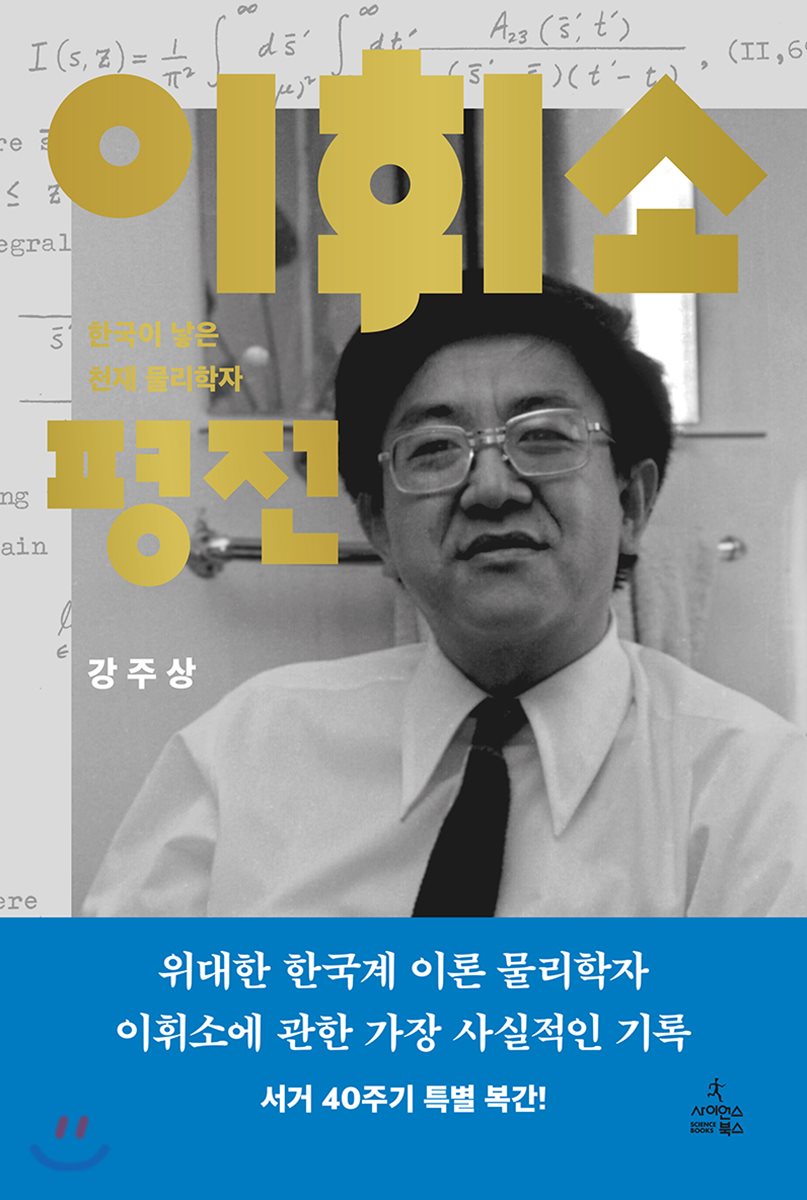 |
Description
Book Introduction
The 20th century's top theoretical physicist
The 'Nobel Prize Maker' who created numerous Nobel Prize winners
The most factual account of the great physicist Lee Hwi-so
It has already been 40 years since the death of Dr. Lee Hwi-so, who was recognized as one of the great figures who built the golden tower of 20th-century particle physics by completing the Standard Model.
He was called the 'Nobel Prize Maker' for his key contributions to numerous Nobel Prizes in Physics, and was not only a 'genius physicist born in Korea', but also a role model and example for the world's top physicists of the 20th century.
Recently, it was revealed that Dr. Lee Hwi-so was also the one who named the Higgs particle, which was discovered in 2012, giving us a sense of the extent of his influence in the academic world.
That is why his death was a global tragedy, and to this day, the physics community around the world, including Fermi National Accelerator Laboratory, honors his achievements.
『Lee Hwi-so Biography』 is the result of the efforts of Professor Kang Ju-sang of Korea University, the only Korean disciple of Dr. Lee Hwi-so, to dispel misunderstandings about his teacher through legal action against false novels and active media contributions.
The message the author wants to convey to readers through this objective biography of Lee Hwi-so is that, even without embellishment or dramatization, Lee Hwi-so was a great physicist who left a significant mark on the history of science.
Author Kang Ju-sang has drawn the most accurate portrait of Dr. Lee Whi-so through over 100 letters exchanged between Dr. Lee Whi-so and his mother, testimonies from his bereaved family and colleagues in the academic world, and anecdotes from renowned physicists who interacted academically with Dr. Lee Whi-so, including Steven Weinberg, Abdus Salam, Gerardus Toft, Yang Zhenning, and Robert Oppenheimer.
This masterpiece of a scientist biography, which not only tells the honorable personal story of a scientist but also encompasses the history and expertise of 20th-century science, as well as the ideology of scientists, has established itself as a must-read for Koreans.
The 'Nobel Prize Maker' who created numerous Nobel Prize winners
The most factual account of the great physicist Lee Hwi-so
It has already been 40 years since the death of Dr. Lee Hwi-so, who was recognized as one of the great figures who built the golden tower of 20th-century particle physics by completing the Standard Model.
He was called the 'Nobel Prize Maker' for his key contributions to numerous Nobel Prizes in Physics, and was not only a 'genius physicist born in Korea', but also a role model and example for the world's top physicists of the 20th century.
Recently, it was revealed that Dr. Lee Hwi-so was also the one who named the Higgs particle, which was discovered in 2012, giving us a sense of the extent of his influence in the academic world.
That is why his death was a global tragedy, and to this day, the physics community around the world, including Fermi National Accelerator Laboratory, honors his achievements.
『Lee Hwi-so Biography』 is the result of the efforts of Professor Kang Ju-sang of Korea University, the only Korean disciple of Dr. Lee Hwi-so, to dispel misunderstandings about his teacher through legal action against false novels and active media contributions.
The message the author wants to convey to readers through this objective biography of Lee Hwi-so is that, even without embellishment or dramatization, Lee Hwi-so was a great physicist who left a significant mark on the history of science.
Author Kang Ju-sang has drawn the most accurate portrait of Dr. Lee Whi-so through over 100 letters exchanged between Dr. Lee Whi-so and his mother, testimonies from his bereaved family and colleagues in the academic world, and anecdotes from renowned physicists who interacted academically with Dr. Lee Whi-so, including Steven Weinberg, Abdus Salam, Gerardus Toft, Yang Zhenning, and Robert Oppenheimer.
This masterpiece of a scientist biography, which not only tells the honorable personal story of a scientist but also encompasses the history and expertise of 20th-century science, as well as the ideology of scientists, has established itself as a must-read for Koreans.
- You can preview some of the book's contents.
Preview
index
While republishing the biography of Lee Hwi-so
While writing the biography of Lee Hwi-so
prolog
The genius' youth
Chapter 1: The Child with the Laboratory
Chapter 2 From Chemistry to Physics
When I was a student studying abroad in the US
Chapter 3: Miami University's Special Freshman
Chapter 4: Physics as a Student and Educator
Chapter 5: What is Particle Physics?
Chapter 6: Ivory Tower Man
During my time at the Advanced Research Institute
Chapter 7: The Man with Rotten Panties
Chapter 8: Love and Marriage
Chapter 9: Research and Research
Chapter 10 I am surprised by you too!
Stony Brook days
Chapter 11: The Stony Brook Years
Chapter 12 Gauge Theory
Chapter 13: The Nobel Prize Maker
Fermilab days
Chapter 14 From University to Research Institute
Chapter 15: Exploring True Particles
Chapter 16: For the Korean Scientific Community
sudden and tragic death
Chapter 17: A Tragic Traffic Accident
Chapter 18 After the Unlucky Day
Chapter 19: Rumors and Speculation
Epilogue
The author's (Kang Ju-sang) memoir
Lee Hwi-so Chronology
Drawing Lee Hwi-so and Kang Ju-sang
Kang Ju-sang's chronology
Glossary of Terms
Search
While writing the biography of Lee Hwi-so
prolog
The genius' youth
Chapter 1: The Child with the Laboratory
Chapter 2 From Chemistry to Physics
When I was a student studying abroad in the US
Chapter 3: Miami University's Special Freshman
Chapter 4: Physics as a Student and Educator
Chapter 5: What is Particle Physics?
Chapter 6: Ivory Tower Man
During my time at the Advanced Research Institute
Chapter 7: The Man with Rotten Panties
Chapter 8: Love and Marriage
Chapter 9: Research and Research
Chapter 10 I am surprised by you too!
Stony Brook days
Chapter 11: The Stony Brook Years
Chapter 12 Gauge Theory
Chapter 13: The Nobel Prize Maker
Fermilab days
Chapter 14 From University to Research Institute
Chapter 15: Exploring True Particles
Chapter 16: For the Korean Scientific Community
sudden and tragic death
Chapter 17: A Tragic Traffic Accident
Chapter 18 After the Unlucky Day
Chapter 19: Rumors and Speculation
Epilogue
The author's (Kang Ju-sang) memoir
Lee Hwi-so Chronology
Drawing Lee Hwi-so and Kang Ju-sang
Kang Ju-sang's chronology
Glossary of Terms
Search
Publisher's Review
Great Korean-American physicist
The most factual record of this command post
Putting an end to all the rumors and speculation surrounding the life and death of Lee Hwi-so
A masterpiece of biographies of Korean scientists!
★ Special reissue to commemorate the 40th anniversary of his death
★ Excellent science book certified by the Ministry of Science and Technology
★ Selected as one of the '50 Science Classics' by the Asia Pacific Centre for Theoretical Physics (APCTP)
Benjamin Lee, director of the Theoretical Physics Division at Fermi National Accelerator Laboratory and professor at the University of Chicago, was killed in a car accident near Kewanee, Illinois, on June 16.
He was traveling to attend a Fermilab advisory board meeting in Aspen, Colorado.
Benjamin Lee was a world-renowned physicist in the field of particle physics theory.”
This is the obituary for Dr. Lee Whi-so, published in Physics Today on June 16, 1977.
It has already been 40 years since the passing of Dr. Lee Hwi-so, who was recognized as one of the great figures who built the golden tower of 20th century particle physics by completing the Standard Model.
He was called the 'Nobel Prize Maker' for his key contributions to numerous Nobel Prizes in Physics, and was not only a 'genius physicist born in Korea', but also a role model and example for the world's top physicists of the 20th century.
Recently, it was revealed that Dr. Lee Hwi-so was also the one who named the Higgs particle, which was discovered in 2012, giving us a sense of the extent of his influence in the academic world.
That is why his death was a global tragedy, and to this day, the physics community around the world, including Fermi National Accelerator Laboratory, honors his achievements.
Unfortunately, in our country, due to a poorly written novel, all kinds of rumors and speculations ran wild, and he began to be mistakenly remembered as a 'nuclear weapons developer'.
Dr. Lee Hwi-so's only Korean disciple, former Korea University professor Kang Ju-sang, sought to dispel misunderstandings about his teacher through legal action against the false novel and active media contributions.
These efforts led to the publication of a biography of Dr. Lee Hwi-so in 2007, commemorating the 30th anniversary of his death.
This book received enthusiastic responses from the media and readers, establishing itself as a must-read for middle and high school students and science and engineering majors nationwide.
This book, which sheds new light on Dr. Lee Hwi-so as a role model for young people, science and engineering students, and scientists, is unfortunately out of print due to the publisher's circumstances. However, over the past several years, there have been consistent calls from academia and readers for its republication, including its selection as one of the Asia Pacific Center for Theoretical Physics (APCTP)'s "50 Science Classics."
In response to this, the author, Professor Emeritus Kang Ju-sang of Korea University, signed a contract with Science Books Co., Ltd. and has been preparing for republication despite suffering from old age.
He went into more detail about his efforts over the past decade to correct errors in the old version and to correct misconceptions about Dr. Lee Hwi-so.
However, he passed away in early January of this year and was unable to see the publication through to the end.
His bereaved family, disciples, and Science Books Co., Ltd. have carried on his legacy and republished 『Lee Hwi-so Biography』 to mark the 40th anniversary of his death, with supplementary content.
In addition to the author's previous revisions, this book includes the writings of Professor Choi Hae-rim, a bereaved family member, and additions such as "Kang Ju-sang's Chronology" and "Index."
Additionally, Professor Kim Seon-gi of Seoul National University, Professor Kang Ju-sang's first disciple, participated in this republication and wrote the appendix, "Drawing Lee Hwi-so and Kang Ju-sang," which was specially added.
You can enjoy a masterpiece of Korean scientist biographies that has become richer and more solid over the generations.
The 20th century's top theoretical physicist
The 'Nobel Prize Maker' who created numerous Nobel Prize winners
This command post must be properly understood.
It should not be understood as a distorted image of a hero to cater to the public's popularity.
For this reason, this biography of Lee Hwi-so was written.
― Kang Ju-sang
All sorts of rumors and speculations about Dr. Lee Hwi-so were created due to a poorly written novel.
This book is the result of a disciple's efforts to correct this misconception.
As befitting an author renowned for his excellent lectures, he has presented the potentially dry life and achievements of a physicist in an accessible and moving way.
― Kim Seon-gi (Professor, Seoul National University)
It was a stroke of luck that I met Lee Hwi-so, who was passionate about studying quantum mechanics.
He played a pivotal role in solving various problems related to renormalization methods in noncommutative gauge theories.
― Gerardus Toft (1999 Nobel Prize in Physics)
The author, Professor Kang Ju-sang, received his doctorate from the State University of New York at Stony Brook under the supervision of Dr. Lee Hwi-so.
Influenced by his mentor, who was leading particle experiments at Fermi National Accelerator Laboratory, he returned to Korea and majored in high-energy experimental physics, forming the second generation of Korean particle physicists after the death of Lee Hwi-so.
He also devoted his efforts to nurturing future generations by writing textbooks such as 『Quantum Physics』 and 『Mathematical Physics』, which most current science and engineering students have encountered at least once.
When the court ruled that “there was no reason” and the defamation of character in the poorly written novel was not recognized, he devoted all his energy to revealing the true life and achievements of his teacher on behalf of the bereaved family who chose to isolate themselves from the outside world.
This book, which covers the life of Lee Hwi-so, is largely divided into six parts.
Parts 1-3 cover Lee Hwi-so's growth as a physicist.
Born during the Japanese colonial period and spending his youth during the Korean War, Lee Hwi-so leaves Korea, where a career is impossible, and goes to the United States to study physics.
It contains the story of how he overcame economic and cultural difficulties and steadfastly walked the path of physics, ultimately becoming an 'ivory tower man.'
In particular, Chapter 5, “What is Particle Physics,” covers the basic knowledge of particle physics necessary to follow the life and achievements of Lee Hwi-so in the future.
Professor Kang Ju-sang, who has dedicated himself to nurturing future generations, provides friendly explanations, making it easy for even general readers to understand difficult specialized knowledge.
Throughout the first half, readers are given a glimpse into the unknown youth of Lee Hwi-so, who is considered a genius or a great man.
Part 4, "The Stony Brook Years," shows Lee Hwi-so, a strong Nobel Prize candidate and the "Nobel Prize Maker" who produced numerous Nobel Prize winners.
In Chapter 11, "The Stony Brook Years," Lee Hwi-so accepts a position as a professor at Stony Brook University at the recommendation of Yang Jin-ning, who won the Nobel Prize in Physics for his research on the breaking of spatial inversion symmetry.
This is where his research on gauge theory began.
Chapter 12, “Gauge Theory,” introduces an anecdote that provided a clue to a solution to the renormalization problem of gauge theory for Gerardus 'tHooft and Martinus Veltman, who were struggling with it, and won the Nobel Prize in Physics.
After attending Lee's lecture, graduate student Toft had the idea of applying the mathematical methods Lee used to his own research and, together with his teacher Feltman, solved the renormalization problem of gauge theory.
However, the academic community was skeptical, and Lee Hwi-so supported Toft with a paper titled "Renormalization of Noncommutative Gauge Theories."
Toft later received the Nobel Prize in Physics for this achievement.
In his acceptance speech, he revealed that Lee Hwi-so had made a key contribution to his research.
At this time, more than 20 years had already passed since Lee Hwi-so's death, and the author says that if Lee Hwi-so had survived, they would have shared the Nobel Prize in Physics.
Chapter 13, “The Nobel Prize Maker,” introduces another anecdote that led to him being called the “Nobel Prize Maker.”
The renormalization problem was one that had to be solved to complete the standard model.
Steven Weinberg's paper "The Lepton Model," which was considered just a hypothesis until the renormalization problem was solved, came to be recognized as the ultimate theory, the Standard Model, after Lee and Toft solved the problem.
Abdus Salam, who had reached the same level as Weinberg but was not recognized, was also brought back to light by Lee Hwi-so, and the standard model was soon called the 'Weinberg-Salam model'.
Salam's achievements were soon recognized, and he shared the 1979 Nobel Prize in Physics with Weinberg.
A strong Korean-American Nobel Prize candidate
The short but bold life and physics of Lee Hwi-so!
Lee Hwi-so is a genius who advanced modern physics by 10 years.
I'm ashamed that I'm where he should be.
Abdus Salam (1979 Nobel Prize in Physics)
I'm not very good at collaborative research.
But there was one person I really enjoyed working with.
This is the command post.
I have co-authored several papers with him, some of which are widely cited, including one on cosmology.
― Steven Weinberg (1979 Nobel Prize in Physics)
Afterwards, Salam became friendly with Lee Hwi-so and established a summer physics school in his home country of Pakistan, inviting Lee Hwi-so as a lecturer.
This gave Lee Hwi-so the motivation to lead the development of science education in Korea.
This is clearly shown in Part 5, “The Fermilab Days.”
This period, when he served as head of the Theoretical Physics Department at Fermi National Accelerator Laboratory, was the peak of Lee's academic career.
In Chapter 15, "The Search for True Particles," Lee predicts the existence of true particles, including true quarks, the existence of which was not yet proven, and predicts their mass range.
Just two months later, Burton Richter and Samuel Ting were awarded the Nobel Prize in Physics for their discovery of true particles in that mass range.
It was a moment when the academic world was once again amazed by Lee Hwi-so's insight.
Meanwhile, at the time, Lee Hwi-so was visiting Korea as a member of the review committee for the Seoul National University Science Education Innovation Support Project.
As can be seen in Chapter 16, “For the Korean Scientific Community,” we can confirm the will of Lee Hwi-so, who had pushed for the establishment of a summer physics school at the Korea Academy of Sciences but withdrew it due to the strengthening of the Yushin regime, to develop Korean science.
Given that this activity laid the foundation for the development of science education in Korea since the 1980s, his sudden death can be considered a great loss to the Korean scientific community.
On June 16, 1977, flags were flown at half-staff at Fermi National Accelerator Laboratory to mourn his death.
Readers who have followed Lee Hwi-so's life up to this point will truly feel sorrow at his unavoidable death in Part 6, "The Unfortunate Sudden Death."
But what is even more regrettable is the distorted image of Lee Hwi-so after his death.
In Chapter 19, “Rumors and Speculations,” the author refutes rumors and speculations that have been spread by misunderstandings and poorly written novels.
This part is also the author's purpose in writing 『Biography of Lee Hwi-so』.
This book logically corrects the misconceptions created by the public, such as the misconception that Lee Hwi-so's major, particle physics, is the same as nuclear engineering; the fact that Robert Oppenheimer, the director of the Institute for Advanced Study in Princeton, where he worked as a researcher, was in charge of the Manhattan Project; the fact that he worked at the Fermi National Accelerator Laboratory; and the lie that a handwritten letter from Park Chung-hee exists.
Lee Hwi-so was a theoretical physicist who had nothing to do with nuclear weapons, and was actually opposed to the South Korean government's push for nuclear development.
The Era of 21st Century Particle Physics
A role model for all scientists that modern people should remember
Lee Hwi-so was an outstanding physicist who pursued abstract and pure fundamental theories while possessing a special talent for analyzing and understanding experimental results.
He is one of the top 20 contemporary theoretical physicists.
— Robert Wilson (former director of Fermi National Accelerator Laboratory)
The paper that Dr. Lee Hwi-so had jointly researched and published with Weinberg just before his death ended up becoming his last work.
It is truly regrettable that his new challenge of applying particle physics to astrophysics and proposing the WIMP particle, currently considered a leading candidate for the identity of dark matter, was not continued.
The reason the author has continuously highlighted Dr. Lee Hwi-so through this book and established the 'Ben Lee Scholarship Foundation' to donate all royalties is probably because of his special sorrow, which must have been felt more deeply than anyone else's.
The message the author wants to convey to readers through this objective biography of Lee Hwi-so is that, even without embellishment or dramatization, Lee Hwi-so was a great physicist who left a significant mark on the history of science.
Now that even Professor Kang Ju-sang, the author, has passed away before this one sentence could be accepted by the public, the task of remembering Lee Hwi-so has fallen entirely on us, the public.
Through over 100 letters exchanged between Dr. Lee and his mother, testimonies from his family and colleagues in the academic world, and anecdotes with prominent physicists who interacted academically with Dr. Lee, including Steven Weinberg, Abdus Salam, Gerardus Toft, Yang Chenning, and Robert Oppenheimer, the author has created the most accurate portrait of Dr. Lee.
This masterpiece of a scientist biography, which not only tells the honorable personal story of a scientist but also encompasses the history and expertise of 20th-century science, as well as the ideology of scientists, has established itself as a must-read for Koreans.
While republishing 『Biography of Lee Hwi-so』
Professor Kang passed away in January of this year, 40 years after Professor Lee Hwi-so passed away.
A week before Mr. Kang passed away, he decided to republish the biography of Lee Hwi-so with Science Books, Inc., and three days before, over dinner, he repeatedly asked me whether I had fully repaid the $100,000 he had pledged to the Ben Lee Scholarship Foundation.
It seems that Professor Lee Hwi-so always had a place in his heart.
Mr. Kang was always proud of his teachers and students, saying that he acted as a bridge between the famous professor and his outstanding students.
In the 1980s, when research funding was scarce, he worked hard to provide for his students' tuition and living expenses through international joint research, but he was also very happy that his students were doing well.
Sometimes, when old disciples came and went, it was nice to see them happily talking about episodes related to them.
If I had to say one thing while observing Mr. Kang's life, I would say he was a person who lived his life doing his best.
To my students, to my brothers, and to our families.
The way he worried about how to help his students develop their abilities, the way he tried to help his siblings with their difficulties to the best of his ability, the way he took the time he didn't have to play with his daughter, joke with her, and teach her math. He never got angry at me even once in my entire life, even though I was always busy and had many shortcomings.
When something difficult happened in his life, he always slept deeply for more than 10 hours and then said, “We are on the right track.
He said, “Everything will be okay,” and continued doing what he was doing as if nothing had happened.
It breaks my heart to think of the last two years of my life spent battling illness and suffering many hardships, yet trying to do everything on my own without any help from others.
As his cheerful funeral photo shows, he lived a simple and honest life for 76 years, teaching and researching.
He wanted to express his gratitude to the school he had attended by asking that condolence money be donated to the Department of Physics at Korea University until the end.
In commemoration of the author, Kang Ju-sang, on the occasion of the second publication of 『Biography of Lee Hwi-so』… … .
- Choi Hae-rim (Kang Ju-sang's bereaved family member, former professor at Sogang University)
The most factual record of this command post
Putting an end to all the rumors and speculation surrounding the life and death of Lee Hwi-so
A masterpiece of biographies of Korean scientists!
★ Special reissue to commemorate the 40th anniversary of his death
★ Excellent science book certified by the Ministry of Science and Technology
★ Selected as one of the '50 Science Classics' by the Asia Pacific Centre for Theoretical Physics (APCTP)
Benjamin Lee, director of the Theoretical Physics Division at Fermi National Accelerator Laboratory and professor at the University of Chicago, was killed in a car accident near Kewanee, Illinois, on June 16.
He was traveling to attend a Fermilab advisory board meeting in Aspen, Colorado.
Benjamin Lee was a world-renowned physicist in the field of particle physics theory.”
This is the obituary for Dr. Lee Whi-so, published in Physics Today on June 16, 1977.
It has already been 40 years since the passing of Dr. Lee Hwi-so, who was recognized as one of the great figures who built the golden tower of 20th century particle physics by completing the Standard Model.
He was called the 'Nobel Prize Maker' for his key contributions to numerous Nobel Prizes in Physics, and was not only a 'genius physicist born in Korea', but also a role model and example for the world's top physicists of the 20th century.
Recently, it was revealed that Dr. Lee Hwi-so was also the one who named the Higgs particle, which was discovered in 2012, giving us a sense of the extent of his influence in the academic world.
That is why his death was a global tragedy, and to this day, the physics community around the world, including Fermi National Accelerator Laboratory, honors his achievements.
Unfortunately, in our country, due to a poorly written novel, all kinds of rumors and speculations ran wild, and he began to be mistakenly remembered as a 'nuclear weapons developer'.
Dr. Lee Hwi-so's only Korean disciple, former Korea University professor Kang Ju-sang, sought to dispel misunderstandings about his teacher through legal action against the false novel and active media contributions.
These efforts led to the publication of a biography of Dr. Lee Hwi-so in 2007, commemorating the 30th anniversary of his death.
This book received enthusiastic responses from the media and readers, establishing itself as a must-read for middle and high school students and science and engineering majors nationwide.
This book, which sheds new light on Dr. Lee Hwi-so as a role model for young people, science and engineering students, and scientists, is unfortunately out of print due to the publisher's circumstances. However, over the past several years, there have been consistent calls from academia and readers for its republication, including its selection as one of the Asia Pacific Center for Theoretical Physics (APCTP)'s "50 Science Classics."
In response to this, the author, Professor Emeritus Kang Ju-sang of Korea University, signed a contract with Science Books Co., Ltd. and has been preparing for republication despite suffering from old age.
He went into more detail about his efforts over the past decade to correct errors in the old version and to correct misconceptions about Dr. Lee Hwi-so.
However, he passed away in early January of this year and was unable to see the publication through to the end.
His bereaved family, disciples, and Science Books Co., Ltd. have carried on his legacy and republished 『Lee Hwi-so Biography』 to mark the 40th anniversary of his death, with supplementary content.
In addition to the author's previous revisions, this book includes the writings of Professor Choi Hae-rim, a bereaved family member, and additions such as "Kang Ju-sang's Chronology" and "Index."
Additionally, Professor Kim Seon-gi of Seoul National University, Professor Kang Ju-sang's first disciple, participated in this republication and wrote the appendix, "Drawing Lee Hwi-so and Kang Ju-sang," which was specially added.
You can enjoy a masterpiece of Korean scientist biographies that has become richer and more solid over the generations.
The 20th century's top theoretical physicist
The 'Nobel Prize Maker' who created numerous Nobel Prize winners
This command post must be properly understood.
It should not be understood as a distorted image of a hero to cater to the public's popularity.
For this reason, this biography of Lee Hwi-so was written.
― Kang Ju-sang
All sorts of rumors and speculations about Dr. Lee Hwi-so were created due to a poorly written novel.
This book is the result of a disciple's efforts to correct this misconception.
As befitting an author renowned for his excellent lectures, he has presented the potentially dry life and achievements of a physicist in an accessible and moving way.
― Kim Seon-gi (Professor, Seoul National University)
It was a stroke of luck that I met Lee Hwi-so, who was passionate about studying quantum mechanics.
He played a pivotal role in solving various problems related to renormalization methods in noncommutative gauge theories.
― Gerardus Toft (1999 Nobel Prize in Physics)
The author, Professor Kang Ju-sang, received his doctorate from the State University of New York at Stony Brook under the supervision of Dr. Lee Hwi-so.
Influenced by his mentor, who was leading particle experiments at Fermi National Accelerator Laboratory, he returned to Korea and majored in high-energy experimental physics, forming the second generation of Korean particle physicists after the death of Lee Hwi-so.
He also devoted his efforts to nurturing future generations by writing textbooks such as 『Quantum Physics』 and 『Mathematical Physics』, which most current science and engineering students have encountered at least once.
When the court ruled that “there was no reason” and the defamation of character in the poorly written novel was not recognized, he devoted all his energy to revealing the true life and achievements of his teacher on behalf of the bereaved family who chose to isolate themselves from the outside world.
This book, which covers the life of Lee Hwi-so, is largely divided into six parts.
Parts 1-3 cover Lee Hwi-so's growth as a physicist.
Born during the Japanese colonial period and spending his youth during the Korean War, Lee Hwi-so leaves Korea, where a career is impossible, and goes to the United States to study physics.
It contains the story of how he overcame economic and cultural difficulties and steadfastly walked the path of physics, ultimately becoming an 'ivory tower man.'
In particular, Chapter 5, “What is Particle Physics,” covers the basic knowledge of particle physics necessary to follow the life and achievements of Lee Hwi-so in the future.
Professor Kang Ju-sang, who has dedicated himself to nurturing future generations, provides friendly explanations, making it easy for even general readers to understand difficult specialized knowledge.
Throughout the first half, readers are given a glimpse into the unknown youth of Lee Hwi-so, who is considered a genius or a great man.
Part 4, "The Stony Brook Years," shows Lee Hwi-so, a strong Nobel Prize candidate and the "Nobel Prize Maker" who produced numerous Nobel Prize winners.
In Chapter 11, "The Stony Brook Years," Lee Hwi-so accepts a position as a professor at Stony Brook University at the recommendation of Yang Jin-ning, who won the Nobel Prize in Physics for his research on the breaking of spatial inversion symmetry.
This is where his research on gauge theory began.
Chapter 12, “Gauge Theory,” introduces an anecdote that provided a clue to a solution to the renormalization problem of gauge theory for Gerardus 'tHooft and Martinus Veltman, who were struggling with it, and won the Nobel Prize in Physics.
After attending Lee's lecture, graduate student Toft had the idea of applying the mathematical methods Lee used to his own research and, together with his teacher Feltman, solved the renormalization problem of gauge theory.
However, the academic community was skeptical, and Lee Hwi-so supported Toft with a paper titled "Renormalization of Noncommutative Gauge Theories."
Toft later received the Nobel Prize in Physics for this achievement.
In his acceptance speech, he revealed that Lee Hwi-so had made a key contribution to his research.
At this time, more than 20 years had already passed since Lee Hwi-so's death, and the author says that if Lee Hwi-so had survived, they would have shared the Nobel Prize in Physics.
Chapter 13, “The Nobel Prize Maker,” introduces another anecdote that led to him being called the “Nobel Prize Maker.”
The renormalization problem was one that had to be solved to complete the standard model.
Steven Weinberg's paper "The Lepton Model," which was considered just a hypothesis until the renormalization problem was solved, came to be recognized as the ultimate theory, the Standard Model, after Lee and Toft solved the problem.
Abdus Salam, who had reached the same level as Weinberg but was not recognized, was also brought back to light by Lee Hwi-so, and the standard model was soon called the 'Weinberg-Salam model'.
Salam's achievements were soon recognized, and he shared the 1979 Nobel Prize in Physics with Weinberg.
A strong Korean-American Nobel Prize candidate
The short but bold life and physics of Lee Hwi-so!
Lee Hwi-so is a genius who advanced modern physics by 10 years.
I'm ashamed that I'm where he should be.
Abdus Salam (1979 Nobel Prize in Physics)
I'm not very good at collaborative research.
But there was one person I really enjoyed working with.
This is the command post.
I have co-authored several papers with him, some of which are widely cited, including one on cosmology.
― Steven Weinberg (1979 Nobel Prize in Physics)
Afterwards, Salam became friendly with Lee Hwi-so and established a summer physics school in his home country of Pakistan, inviting Lee Hwi-so as a lecturer.
This gave Lee Hwi-so the motivation to lead the development of science education in Korea.
This is clearly shown in Part 5, “The Fermilab Days.”
This period, when he served as head of the Theoretical Physics Department at Fermi National Accelerator Laboratory, was the peak of Lee's academic career.
In Chapter 15, "The Search for True Particles," Lee predicts the existence of true particles, including true quarks, the existence of which was not yet proven, and predicts their mass range.
Just two months later, Burton Richter and Samuel Ting were awarded the Nobel Prize in Physics for their discovery of true particles in that mass range.
It was a moment when the academic world was once again amazed by Lee Hwi-so's insight.
Meanwhile, at the time, Lee Hwi-so was visiting Korea as a member of the review committee for the Seoul National University Science Education Innovation Support Project.
As can be seen in Chapter 16, “For the Korean Scientific Community,” we can confirm the will of Lee Hwi-so, who had pushed for the establishment of a summer physics school at the Korea Academy of Sciences but withdrew it due to the strengthening of the Yushin regime, to develop Korean science.
Given that this activity laid the foundation for the development of science education in Korea since the 1980s, his sudden death can be considered a great loss to the Korean scientific community.
On June 16, 1977, flags were flown at half-staff at Fermi National Accelerator Laboratory to mourn his death.
Readers who have followed Lee Hwi-so's life up to this point will truly feel sorrow at his unavoidable death in Part 6, "The Unfortunate Sudden Death."
But what is even more regrettable is the distorted image of Lee Hwi-so after his death.
In Chapter 19, “Rumors and Speculations,” the author refutes rumors and speculations that have been spread by misunderstandings and poorly written novels.
This part is also the author's purpose in writing 『Biography of Lee Hwi-so』.
This book logically corrects the misconceptions created by the public, such as the misconception that Lee Hwi-so's major, particle physics, is the same as nuclear engineering; the fact that Robert Oppenheimer, the director of the Institute for Advanced Study in Princeton, where he worked as a researcher, was in charge of the Manhattan Project; the fact that he worked at the Fermi National Accelerator Laboratory; and the lie that a handwritten letter from Park Chung-hee exists.
Lee Hwi-so was a theoretical physicist who had nothing to do with nuclear weapons, and was actually opposed to the South Korean government's push for nuclear development.
The Era of 21st Century Particle Physics
A role model for all scientists that modern people should remember
Lee Hwi-so was an outstanding physicist who pursued abstract and pure fundamental theories while possessing a special talent for analyzing and understanding experimental results.
He is one of the top 20 contemporary theoretical physicists.
— Robert Wilson (former director of Fermi National Accelerator Laboratory)
The paper that Dr. Lee Hwi-so had jointly researched and published with Weinberg just before his death ended up becoming his last work.
It is truly regrettable that his new challenge of applying particle physics to astrophysics and proposing the WIMP particle, currently considered a leading candidate for the identity of dark matter, was not continued.
The reason the author has continuously highlighted Dr. Lee Hwi-so through this book and established the 'Ben Lee Scholarship Foundation' to donate all royalties is probably because of his special sorrow, which must have been felt more deeply than anyone else's.
The message the author wants to convey to readers through this objective biography of Lee Hwi-so is that, even without embellishment or dramatization, Lee Hwi-so was a great physicist who left a significant mark on the history of science.
Now that even Professor Kang Ju-sang, the author, has passed away before this one sentence could be accepted by the public, the task of remembering Lee Hwi-so has fallen entirely on us, the public.
Through over 100 letters exchanged between Dr. Lee and his mother, testimonies from his family and colleagues in the academic world, and anecdotes with prominent physicists who interacted academically with Dr. Lee, including Steven Weinberg, Abdus Salam, Gerardus Toft, Yang Chenning, and Robert Oppenheimer, the author has created the most accurate portrait of Dr. Lee.
This masterpiece of a scientist biography, which not only tells the honorable personal story of a scientist but also encompasses the history and expertise of 20th-century science, as well as the ideology of scientists, has established itself as a must-read for Koreans.
While republishing 『Biography of Lee Hwi-so』
Professor Kang passed away in January of this year, 40 years after Professor Lee Hwi-so passed away.
A week before Mr. Kang passed away, he decided to republish the biography of Lee Hwi-so with Science Books, Inc., and three days before, over dinner, he repeatedly asked me whether I had fully repaid the $100,000 he had pledged to the Ben Lee Scholarship Foundation.
It seems that Professor Lee Hwi-so always had a place in his heart.
Mr. Kang was always proud of his teachers and students, saying that he acted as a bridge between the famous professor and his outstanding students.
In the 1980s, when research funding was scarce, he worked hard to provide for his students' tuition and living expenses through international joint research, but he was also very happy that his students were doing well.
Sometimes, when old disciples came and went, it was nice to see them happily talking about episodes related to them.
If I had to say one thing while observing Mr. Kang's life, I would say he was a person who lived his life doing his best.
To my students, to my brothers, and to our families.
The way he worried about how to help his students develop their abilities, the way he tried to help his siblings with their difficulties to the best of his ability, the way he took the time he didn't have to play with his daughter, joke with her, and teach her math. He never got angry at me even once in my entire life, even though I was always busy and had many shortcomings.
When something difficult happened in his life, he always slept deeply for more than 10 hours and then said, “We are on the right track.
He said, “Everything will be okay,” and continued doing what he was doing as if nothing had happened.
It breaks my heart to think of the last two years of my life spent battling illness and suffering many hardships, yet trying to do everything on my own without any help from others.
As his cheerful funeral photo shows, he lived a simple and honest life for 76 years, teaching and researching.
He wanted to express his gratitude to the school he had attended by asking that condolence money be donated to the Department of Physics at Korea University until the end.
In commemoration of the author, Kang Ju-sang, on the occasion of the second publication of 『Biography of Lee Hwi-so』… … .
- Choi Hae-rim (Kang Ju-sang's bereaved family member, former professor at Sogang University)
GOODS SPECIFICS
- Date of publication: June 12, 2017
- Page count, weight, size: 336 pages | 466g | 146*220*20mm
- ISBN13: 9788983718495
- ISBN10: 8983718498
You may also like
카테고리
korean


korean

![ELLE 엘르 스페셜 에디션 A형 : 12월 [2025]](http://librairie.coreenne.fr/cdn/shop/files/b8e27a3de6c9538896439686c6b0e8fb.jpg?v=1766436872&width=3840)


