

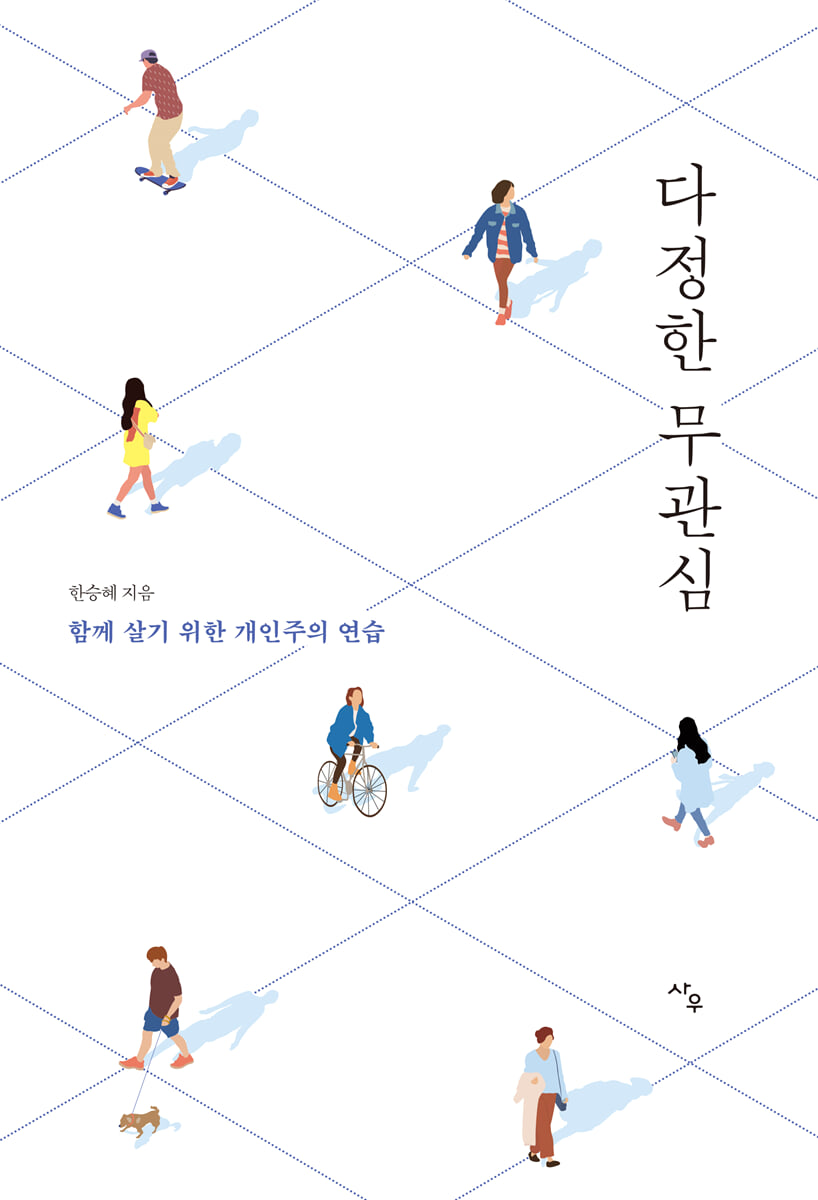
affectionate indifference
 |
Description
Book Introduction
- A word from MD
-
Thinking of a better Republic of KoreaAn observation of South Korea by Seunghye Han, a columnist who is attracting attention these days.
The individual themes in the book, such as No Kids Zone, Delivery Man, Kim Ji-young, Born 1982, and Nth Room, may seem unrelated at first glance, but they are connected by a single theme.
These are the minimum manners and attitudes required to live together.
June 1, 2021. Humanities PD Son Min-gyu
Beyond division, hatred, and exclusion
Towards a better world
About the attitude toward life we need now
“We must all become individualists!”
Pointing out structural problems in everyday trivial stories
Columnist Han Seung-hye's sharp perspective!
A book that lets us see things we haven't seen before!
The author of this book, Seunghye Han, emphasizes that 'individualism' is necessary to move beyond the hatred, discrimination, and bullying prevalent in our society and toward a slightly better world.
The author is known as a columnist who observes any issue three-dimensionally and maintains a sense of balance.
His writing begins with very personal stories or stories about movies and books, and then naturally reveals the structures and contradictions of society.
Through rich stories, the author demonstrates how individualism can be useful in living authentically and in acknowledging the individuality of others.
It's not easy to be an individualist.
First, I need to know who I am, and others need to accept me for who I am.
I too must learn to respect the identities of others.
So most people who are accustomed to collectivism need to practice individualism.
After reading the 42 sharp and warm essays in this book, you will come to see the world and people through the eyes of an individualist.
When we all exist as 'individuals' and live together in solidarity, we will be able to move forward toward a better world.
Towards a better world
About the attitude toward life we need now
“We must all become individualists!”
Pointing out structural problems in everyday trivial stories
Columnist Han Seung-hye's sharp perspective!
A book that lets us see things we haven't seen before!
The author of this book, Seunghye Han, emphasizes that 'individualism' is necessary to move beyond the hatred, discrimination, and bullying prevalent in our society and toward a slightly better world.
The author is known as a columnist who observes any issue three-dimensionally and maintains a sense of balance.
His writing begins with very personal stories or stories about movies and books, and then naturally reveals the structures and contradictions of society.
Through rich stories, the author demonstrates how individualism can be useful in living authentically and in acknowledging the individuality of others.
It's not easy to be an individualist.
First, I need to know who I am, and others need to accept me for who I am.
I too must learn to respect the identities of others.
So most people who are accustomed to collectivism need to practice individualism.
After reading the 42 sharp and warm essays in this book, you will come to see the world and people through the eyes of an individualist.
When we all exist as 'individuals' and live together in solidarity, we will be able to move forward toward a better world.
- You can preview some of the book's contents.
Preview
index
Prologue: We Must All Be Individualists
Chapter 1: Standing as an Individual Beyond Inclusion and Exclusion
Pink might be nice
Women's universities are not places where you are told to be.
Women in politics
How old are you?
A life of censorship
Don't show off
The Art of Praise
An Apology for Honorable Men
Chapter 2: Still, We Need to Talk More About Women
Do you want to increase your birth rate?
Kim Ji-young is not a spokesperson for all women.
I am a housewife who writes columns for newspapers.
The temperature difference of life
Did she dream of a dangerous escape when she went to Burning Sun?
There is no 'monster'
We need new sex education
The perfect victim who doesn't exist
The double standards of foodism
Is 'abuse' of abortion possible?
Masculine writer, feminine writer
Who throws stones at 'the woman who reads books'?
Chapter 3: How to Live Together While Alone
Memories of a 'bad' delivery man
Hemingway knew everything
Platforms, Systems, and Individuals
The dead end of the here and now that we cannot ignore
When life becomes hell
Some comforts hurt more
Things to consider before talking about no-kids zones
Children who want to go to school
Please protect the surviving children.
Are neglected children solely the mother's fault?
It was wrong then and it's wrong now
A very small consideration
The better angel of our nature
Chapter 4: Individualism Practice
Why did they fall into a cult?
How Passion Becomes the Raw Material of Exploitation
Why are we always drawn to black-and-white logic?
Beyond the Battle of Misfortune
So, you must also become a hypocrite.
The golden age of fake news
Hyde within me
Self-portrait of hate
Chapter 1: Standing as an Individual Beyond Inclusion and Exclusion
Pink might be nice
Women's universities are not places where you are told to be.
Women in politics
How old are you?
A life of censorship
Don't show off
The Art of Praise
An Apology for Honorable Men
Chapter 2: Still, We Need to Talk More About Women
Do you want to increase your birth rate?
Kim Ji-young is not a spokesperson for all women.
I am a housewife who writes columns for newspapers.
The temperature difference of life
Did she dream of a dangerous escape when she went to Burning Sun?
There is no 'monster'
We need new sex education
The perfect victim who doesn't exist
The double standards of foodism
Is 'abuse' of abortion possible?
Masculine writer, feminine writer
Who throws stones at 'the woman who reads books'?
Chapter 3: How to Live Together While Alone
Memories of a 'bad' delivery man
Hemingway knew everything
Platforms, Systems, and Individuals
The dead end of the here and now that we cannot ignore
When life becomes hell
Some comforts hurt more
Things to consider before talking about no-kids zones
Children who want to go to school
Please protect the surviving children.
Are neglected children solely the mother's fault?
It was wrong then and it's wrong now
A very small consideration
The better angel of our nature
Chapter 4: Individualism Practice
Why did they fall into a cult?
How Passion Becomes the Raw Material of Exploitation
Why are we always drawn to black-and-white logic?
Beyond the Battle of Misfortune
So, you must also become a hypocrite.
The golden age of fake news
Hyde within me
Self-portrait of hate
Detailed image
.jpg)
Into the book
In an all-female university, gender as a criterion for judging others completely disappears.
The reasons we have heard countless times throughout our lives, such as “how can a woman be like that,” “because she is a woman,” or “because she is a woman,” become meaningless.
In this world, women naturally break free from stereotypes about their own gender.
You will be able to think more freely without being bound by limitations.
Women's universities can also play a role in helping women realize the various layers they possess.
People often believe that all of society's problems will be solved if gender differences disappear, but in reality, even after removing the curtain of "women," various discriminations remain, whether economic, physical, or cultural.
Therefore, women who experience this world learn that personal identity is a very complex fabric, and that while they may be relatively weak, this is not always the case.
---From "Women's universities are not places to be like that"
If my child made even the slightest noise in front of others, played a prank, or threw a tantrum, my heart sank.
I was always on edge, worried that I might be labeled as a 'thoughtless parent' or a 'mom-chung'.
I was always censoring myself, wondering if I had done something wrong.
Because if I do something wrong, it's not my mistake, it's the mothers' mistake.
Because my mistakes are not just my fault, but the fault of all women.
Perhaps some people live with even more harsh censorship than I do, simply because I am a mother to a woman.
Because censorship tends to be more severe the more minority you are.
---From "A Censored Life"
I live braless about 364 days out of 365.
As I started having children and staying at home more, I started meeting people less often, and naturally, I started spending more days without a bra.
Sometimes I have to be extra careful when I meet someone.
Check carefully to see if it is obvious that you are not wearing a bra.
And when it gets cold, I change my clothes and put on a cardigan even though it's not cold.
It's a case of self-censorship, so to speak, and as you know, all forms of censorship, no matter how trivial, consume mental and physical energy.
If I, who censors things like bras, am this tired, it is not hard to imagine that people who have more to censor than me will suffer even more.
There will surely be people who say, "If you're that tired, don't censor! Who would censor?"
But we all already know what happened to those who resisted that censorship.
---From "Don't Show Off Your Teeth"
There seems to have been a lot of talk about this scene in “Kim Ji-young, Born 1982.”
The reason is that it alienates mothers who have not graduated from college.
Not all citizens of the Republic of Korea are college graduates, but that aspect is not taken into consideration at all.
In other words, it is a criticism that it only deals with the lives of 'college-educated middle-class women.'
When the drama "Misaeng" dealt with the issue of irregular workers, focusing on the character Jang Geu-rae, no one said anything about the subtle discrimination or sad episodes Jang Geu-rae experienced as a contract worker.
"Even so, that's just the story of office workers who studied a little! Even at this very moment, there are so many marginalized young people who are dying without even being guaranteed a safe work environment, who didn't even graduate from college! Even while watching "Misaeng," I feel alienated!"
This is probably because Jang Geu-rae, the main character of “Misaeng,” was acquiring individuality in his own right.
Because everyone already knows that Jang Geu-rae doesn't represent the lives of all men, all poor youth, and all irregular and contract workers.
Jang-geu-rae is just Jang-geu-rae.
---From "Kim Ji-young, Born 1982, is not a representative of all women"
We must acknowledge that sexual violence can be committed by anyone, not just horned monsters.
We must accept that sexual violence is not only committed by 'monsters' but also by ordinary people, even my good child.
Only when we accept that it is something that anyone can easily do can we create stronger accountability.
We know what happens when we drive drunk and hurt someone.
You face a lot of responsibility, including going to jail, being morally reprehensible, having to pay damages, losing your job, and having your life ruined.
There is no case where drunk driving is accepted as a 'mistake'.
That's why, even if we have the opportunity to drink and drive or feel the urge to do so, ordinary people like us live our lives restraining ourselves.
We need to make people think this way about sexual violence.
We need to recognize that anyone can do it, that the distance between us all is not that far, and that we all have a strong responsibility to follow through.
If you do so, you can prevent yourself from making a mistake due to a moment of curiosity or impulse, even if an opportunity arises.
So we must protect our children from becoming perpetrators.
---From "There Are No Monsters"
Many people cited the fact that Kim Ji-eun tolerated the sexual assault for so long, on four separate occasions, as evidence that her story was not true.
Their arguments at the time provided a kind of awakening: people still did not formally recognize women as workers or professionals.
---From "The Double Standards of Eating and Living"
My anger, which was about to flare up again as the memory of that time was summoned, subsided like a deflated balloon the moment I saw the knight coming out of the common hallway, because I realized that he had still been working at that hour, that is, until two in the morning.
He was working all day, just like he told me then.
Until 2 am.
I felt like I understood a little bit what he meant when he said he worked himself to the bone all day, and my anger subsided a little.
Kindness comes from physical strength.
Kindness comes from health.
Perhaps it was inevitable that someone who was tired from working all day would lose his temper.
---From "Memories of a Wicked Delivery Man"
An ordinary person would not stand by and watch someone suffer right in front of them.
Even the most level-headed person cannot stand by and watch a person hanging from a cliff or a child exposed defenselessly in front of an oncoming car.
However, humans can only demonstrate altruism when such situations are visible.
Therefore, we can be insensitive.
About the young man who was torn apart by an oncoming train while repairing a broken subway safety door, about the man who was caught in a conveyor belt and stopped breathing, about the man who lost his life after being exposed to pollutants in a factory.
Although accidents are unfortunate, they are not happening right before my eyes.
---From "The Crisis of the Here and Now That Cannot Be Ignored"
Haruki Murakami reveals that he felt a sense of dread several times while interviewing believers.
This is because I felt that my desire to write a novel to know my 'inner self' was somewhat connected to the desire that led them to join Aum Shinrikyo.
It is truly ironic that the stronger the desire for 'self-reflection' or 'inner exploration', and the more diligently a person makes efforts to resolve such desire, the more likely it is that once they step foot into such a religion, they will become uncontrollable.
The fact is that the more good and righteous one is, the more easily one falls into the path of evil.
---From "Why Did They Fall Into a Cult?"
There are no absolutely evil people in the world, nor are there any absolutely good people.
Most of them are neither good nor evil.
It just moves differently each time.
Even in unexpected situations, I always hesitate and worry.
At this time, what other people are thinking has an influence.
If everyone is evil, then I have no reason or need to be good anymore.
Just live like the wild, each fighting for their own survival.
However, when we think that good hearts might be hiding somewhere far away, somewhere unseen, humans hesitate.
And I worry.
I wonder about the goodness that may be within me.
Therefore, in order for us to become good, we need to trust each other.
But humans are weak, so this trust is easily broken, and someone must constantly remind people that there is still some will deep down inside, so that they can trust each other.
Good stories are just such evidence.
To struggle with the possibility of becoming evil, to be swayed by temptation, to worry and agonize, and then ultimately to try to resist—that is what I consider a "good" story.
The reasons we have heard countless times throughout our lives, such as “how can a woman be like that,” “because she is a woman,” or “because she is a woman,” become meaningless.
In this world, women naturally break free from stereotypes about their own gender.
You will be able to think more freely without being bound by limitations.
Women's universities can also play a role in helping women realize the various layers they possess.
People often believe that all of society's problems will be solved if gender differences disappear, but in reality, even after removing the curtain of "women," various discriminations remain, whether economic, physical, or cultural.
Therefore, women who experience this world learn that personal identity is a very complex fabric, and that while they may be relatively weak, this is not always the case.
---From "Women's universities are not places to be like that"
If my child made even the slightest noise in front of others, played a prank, or threw a tantrum, my heart sank.
I was always on edge, worried that I might be labeled as a 'thoughtless parent' or a 'mom-chung'.
I was always censoring myself, wondering if I had done something wrong.
Because if I do something wrong, it's not my mistake, it's the mothers' mistake.
Because my mistakes are not just my fault, but the fault of all women.
Perhaps some people live with even more harsh censorship than I do, simply because I am a mother to a woman.
Because censorship tends to be more severe the more minority you are.
---From "A Censored Life"
I live braless about 364 days out of 365.
As I started having children and staying at home more, I started meeting people less often, and naturally, I started spending more days without a bra.
Sometimes I have to be extra careful when I meet someone.
Check carefully to see if it is obvious that you are not wearing a bra.
And when it gets cold, I change my clothes and put on a cardigan even though it's not cold.
It's a case of self-censorship, so to speak, and as you know, all forms of censorship, no matter how trivial, consume mental and physical energy.
If I, who censors things like bras, am this tired, it is not hard to imagine that people who have more to censor than me will suffer even more.
There will surely be people who say, "If you're that tired, don't censor! Who would censor?"
But we all already know what happened to those who resisted that censorship.
---From "Don't Show Off Your Teeth"
There seems to have been a lot of talk about this scene in “Kim Ji-young, Born 1982.”
The reason is that it alienates mothers who have not graduated from college.
Not all citizens of the Republic of Korea are college graduates, but that aspect is not taken into consideration at all.
In other words, it is a criticism that it only deals with the lives of 'college-educated middle-class women.'
When the drama "Misaeng" dealt with the issue of irregular workers, focusing on the character Jang Geu-rae, no one said anything about the subtle discrimination or sad episodes Jang Geu-rae experienced as a contract worker.
"Even so, that's just the story of office workers who studied a little! Even at this very moment, there are so many marginalized young people who are dying without even being guaranteed a safe work environment, who didn't even graduate from college! Even while watching "Misaeng," I feel alienated!"
This is probably because Jang Geu-rae, the main character of “Misaeng,” was acquiring individuality in his own right.
Because everyone already knows that Jang Geu-rae doesn't represent the lives of all men, all poor youth, and all irregular and contract workers.
Jang-geu-rae is just Jang-geu-rae.
---From "Kim Ji-young, Born 1982, is not a representative of all women"
We must acknowledge that sexual violence can be committed by anyone, not just horned monsters.
We must accept that sexual violence is not only committed by 'monsters' but also by ordinary people, even my good child.
Only when we accept that it is something that anyone can easily do can we create stronger accountability.
We know what happens when we drive drunk and hurt someone.
You face a lot of responsibility, including going to jail, being morally reprehensible, having to pay damages, losing your job, and having your life ruined.
There is no case where drunk driving is accepted as a 'mistake'.
That's why, even if we have the opportunity to drink and drive or feel the urge to do so, ordinary people like us live our lives restraining ourselves.
We need to make people think this way about sexual violence.
We need to recognize that anyone can do it, that the distance between us all is not that far, and that we all have a strong responsibility to follow through.
If you do so, you can prevent yourself from making a mistake due to a moment of curiosity or impulse, even if an opportunity arises.
So we must protect our children from becoming perpetrators.
---From "There Are No Monsters"
Many people cited the fact that Kim Ji-eun tolerated the sexual assault for so long, on four separate occasions, as evidence that her story was not true.
Their arguments at the time provided a kind of awakening: people still did not formally recognize women as workers or professionals.
---From "The Double Standards of Eating and Living"
My anger, which was about to flare up again as the memory of that time was summoned, subsided like a deflated balloon the moment I saw the knight coming out of the common hallway, because I realized that he had still been working at that hour, that is, until two in the morning.
He was working all day, just like he told me then.
Until 2 am.
I felt like I understood a little bit what he meant when he said he worked himself to the bone all day, and my anger subsided a little.
Kindness comes from physical strength.
Kindness comes from health.
Perhaps it was inevitable that someone who was tired from working all day would lose his temper.
---From "Memories of a Wicked Delivery Man"
An ordinary person would not stand by and watch someone suffer right in front of them.
Even the most level-headed person cannot stand by and watch a person hanging from a cliff or a child exposed defenselessly in front of an oncoming car.
However, humans can only demonstrate altruism when such situations are visible.
Therefore, we can be insensitive.
About the young man who was torn apart by an oncoming train while repairing a broken subway safety door, about the man who was caught in a conveyor belt and stopped breathing, about the man who lost his life after being exposed to pollutants in a factory.
Although accidents are unfortunate, they are not happening right before my eyes.
---From "The Crisis of the Here and Now That Cannot Be Ignored"
Haruki Murakami reveals that he felt a sense of dread several times while interviewing believers.
This is because I felt that my desire to write a novel to know my 'inner self' was somewhat connected to the desire that led them to join Aum Shinrikyo.
It is truly ironic that the stronger the desire for 'self-reflection' or 'inner exploration', and the more diligently a person makes efforts to resolve such desire, the more likely it is that once they step foot into such a religion, they will become uncontrollable.
The fact is that the more good and righteous one is, the more easily one falls into the path of evil.
---From "Why Did They Fall Into a Cult?"
There are no absolutely evil people in the world, nor are there any absolutely good people.
Most of them are neither good nor evil.
It just moves differently each time.
Even in unexpected situations, I always hesitate and worry.
At this time, what other people are thinking has an influence.
If everyone is evil, then I have no reason or need to be good anymore.
Just live like the wild, each fighting for their own survival.
However, when we think that good hearts might be hiding somewhere far away, somewhere unseen, humans hesitate.
And I worry.
I wonder about the goodness that may be within me.
Therefore, in order for us to become good, we need to trust each other.
But humans are weak, so this trust is easily broken, and someone must constantly remind people that there is still some will deep down inside, so that they can trust each other.
Good stories are just such evidence.
To struggle with the possibility of becoming evil, to be swayed by temptation, to worry and agonize, and then ultimately to try to resist—that is what I consider a "good" story.
---From "So, you have to be a hypocrite"
Publisher's Review
Beyond division, hatred, and exclusion
Towards a better world
About the attitude toward life we need now
“If you want to live most like yourself,
To understand the invisible suffering of others
“We must all become individualists!”
Korean society is increasingly becoming more extreme, with conflicts between genders and generations, hate speech, and fake news.
People with similar thoughts form groups, and conflicts between groups take the form of 'war'.
In the meantime, those who suffer the most damage and are marginalized are inevitably the weak and minorities.
The author argues that 'individualism' is necessary to move beyond the hatred, discrimination, and bullying prevalent in our society and toward a slightly better world.
The author of this book, Seunghye Han, is a columnist known for observing any issue from a three-dimensional perspective and maintaining a sense of balance.
His writing begins with very personal stories or stories from movies and books, and then naturally reveals the structures and contradictions of society.
Through a rich narrative, the author demonstrates how useful individualism is for us to exist as individuals and to acknowledge the individuality of others.
The book begins by discussing how individualism differs from egoism and what positive functions true individualism has.
Individualism recognizes that others are human beings with complex emotions and desires just like us.
Because your rights are precious, you also respect the rights of others.
Do not simplify or prejudice others based on gender, place of origin, education, age, etc.
Individualists value a community where 'individuals' live in solidarity with one another.
A community is different from a group.
The community serves to protect me and others so that we can exist as individuals.
Yet, we are always pressured to belong to a group and to take sides.
One person's mistake is magnified to the fault of the group to which he belongs, and the group is held responsible for it.
Why do we have such a strong collectivist sentiment?
“Humans are inherently anxious beings, and anxious individuals often seek out objects of immersion to distract themselves from the energies and impulses that well up within them.
Once you find your target, you entrust everything to it or turn devotedly to it in order to forget your anxiety and worries.
When the subject is art or academics, it can produce positive results, but when it is religion, politics, or ideology, it can cause big problems.
Excessive self-belief can lead to self-destruction, and self-loathing and hatred often spill outward.
“Ultimately, people who lose their sense of self and rely on groups tend to feel blind loyalty to their own group and intense rejection and disgust toward other groups.”
The author diagnoses that as the number of people relying on groups increases, social conflict and division are bound to intensify.
In other words, he emphasizes that if we can stand tall as individuals, free from the impulse to rely on others to forget our anxiety and lack, many things can be improved.
“The world is complex, no one is perfect, and it is impossible to make the world a flawless space.
Yet, if we all strive to be individualists, there is a 'possibility' of getting a little closer to such a world.”
A fresh perspective from an individualist that shows us what we've been missing
It's not easy to be an individualist.
I need to know who I am, and others need to accept me for who I am.
I too must respect the identities of others.
So most people who are accustomed to collectivism need to practice individualism.
This book also records the questions the author asked himself in order to stand as an 'individual' and the process of finding answers to those questions.
The process of getting to know yourself leads to understanding others.
As a mother, the author censors herself to avoid becoming a "mom-chung" or "inconsiderate parent," and through this, she realizes the suffering that minorities in this society are experiencing. She also recognizes the process of growing hatred toward others as she sees herself getting angry over trivial remarks.
For the author, everything in the world becomes text.
My seven-year-old son and I explore ageism in our society through conversations, dissect the power of platform companies like Kakao Taxi through conversations with taxi drivers, and discuss the dangers of early morning delivery through Hemingway's short story "A Clean and Well-Lighted Place."
This book contains the fruits of my efforts and the fruits of my diligent reading and writing to broaden my perspective in order to understand the alienation and suffering of a world I was unaware of.
In this way, the author constantly asks and answers questions about our prejudices, discrimination, and group consciousness through everyday scenes and various works, allowing us to see what we have not yet seen.
In the process, we maintain a cautious and objective attitude without rashly taking sides or getting caught up in dichotomies.
Regarding this, Kim Gyul-wool, the operator of the YouTube channel 'Winter Bookstore', said, "I always feel a sense of security in the writing of author Han Seung-hye, and that comes from the belief that I can have a conversation with her that is filled with respect and consideration.
“That is probably why his writings are loved by many people.”
The author describes the attitude toward life that an individualist should have as 'affectionate indifference.'
This is the affectionately indifferent world the author portrays.
“A society of moderate indifference, where we do not interfere or meddle with each other, and where we accept the individuality of others as they are.
“A society that is kind to one another, that does not ignore those in need, and actively reaches out to the weak and minorities.”
Towards a better world
About the attitude toward life we need now
“If you want to live most like yourself,
To understand the invisible suffering of others
“We must all become individualists!”
Korean society is increasingly becoming more extreme, with conflicts between genders and generations, hate speech, and fake news.
People with similar thoughts form groups, and conflicts between groups take the form of 'war'.
In the meantime, those who suffer the most damage and are marginalized are inevitably the weak and minorities.
The author argues that 'individualism' is necessary to move beyond the hatred, discrimination, and bullying prevalent in our society and toward a slightly better world.
The author of this book, Seunghye Han, is a columnist known for observing any issue from a three-dimensional perspective and maintaining a sense of balance.
His writing begins with very personal stories or stories from movies and books, and then naturally reveals the structures and contradictions of society.
Through a rich narrative, the author demonstrates how useful individualism is for us to exist as individuals and to acknowledge the individuality of others.
The book begins by discussing how individualism differs from egoism and what positive functions true individualism has.
Individualism recognizes that others are human beings with complex emotions and desires just like us.
Because your rights are precious, you also respect the rights of others.
Do not simplify or prejudice others based on gender, place of origin, education, age, etc.
Individualists value a community where 'individuals' live in solidarity with one another.
A community is different from a group.
The community serves to protect me and others so that we can exist as individuals.
Yet, we are always pressured to belong to a group and to take sides.
One person's mistake is magnified to the fault of the group to which he belongs, and the group is held responsible for it.
Why do we have such a strong collectivist sentiment?
“Humans are inherently anxious beings, and anxious individuals often seek out objects of immersion to distract themselves from the energies and impulses that well up within them.
Once you find your target, you entrust everything to it or turn devotedly to it in order to forget your anxiety and worries.
When the subject is art or academics, it can produce positive results, but when it is religion, politics, or ideology, it can cause big problems.
Excessive self-belief can lead to self-destruction, and self-loathing and hatred often spill outward.
“Ultimately, people who lose their sense of self and rely on groups tend to feel blind loyalty to their own group and intense rejection and disgust toward other groups.”
The author diagnoses that as the number of people relying on groups increases, social conflict and division are bound to intensify.
In other words, he emphasizes that if we can stand tall as individuals, free from the impulse to rely on others to forget our anxiety and lack, many things can be improved.
“The world is complex, no one is perfect, and it is impossible to make the world a flawless space.
Yet, if we all strive to be individualists, there is a 'possibility' of getting a little closer to such a world.”
A fresh perspective from an individualist that shows us what we've been missing
It's not easy to be an individualist.
I need to know who I am, and others need to accept me for who I am.
I too must respect the identities of others.
So most people who are accustomed to collectivism need to practice individualism.
This book also records the questions the author asked himself in order to stand as an 'individual' and the process of finding answers to those questions.
The process of getting to know yourself leads to understanding others.
As a mother, the author censors herself to avoid becoming a "mom-chung" or "inconsiderate parent," and through this, she realizes the suffering that minorities in this society are experiencing. She also recognizes the process of growing hatred toward others as she sees herself getting angry over trivial remarks.
For the author, everything in the world becomes text.
My seven-year-old son and I explore ageism in our society through conversations, dissect the power of platform companies like Kakao Taxi through conversations with taxi drivers, and discuss the dangers of early morning delivery through Hemingway's short story "A Clean and Well-Lighted Place."
This book contains the fruits of my efforts and the fruits of my diligent reading and writing to broaden my perspective in order to understand the alienation and suffering of a world I was unaware of.
In this way, the author constantly asks and answers questions about our prejudices, discrimination, and group consciousness through everyday scenes and various works, allowing us to see what we have not yet seen.
In the process, we maintain a cautious and objective attitude without rashly taking sides or getting caught up in dichotomies.
Regarding this, Kim Gyul-wool, the operator of the YouTube channel 'Winter Bookstore', said, "I always feel a sense of security in the writing of author Han Seung-hye, and that comes from the belief that I can have a conversation with her that is filled with respect and consideration.
“That is probably why his writings are loved by many people.”
The author describes the attitude toward life that an individualist should have as 'affectionate indifference.'
This is the affectionately indifferent world the author portrays.
“A society of moderate indifference, where we do not interfere or meddle with each other, and where we accept the individuality of others as they are.
“A society that is kind to one another, that does not ignore those in need, and actively reaches out to the weak and minorities.”
GOODS SPECIFICS
- Date of issue: June 3, 2021
- Page count, weight, size: 304 pages | 392g | 140*205*30mm
- ISBN13: 9791187332657
- ISBN10: 1187332658
You may also like
카테고리
korean


korean

![GQ KOREA Mark (Monthly): December [2025]](http://librairie.coreenne.fr/cdn/shop/files/8ef265dbbfbf186523ed75ba7319009d.jpg?v=1765340328&width=3840)


