

Max Tegmark's Universe
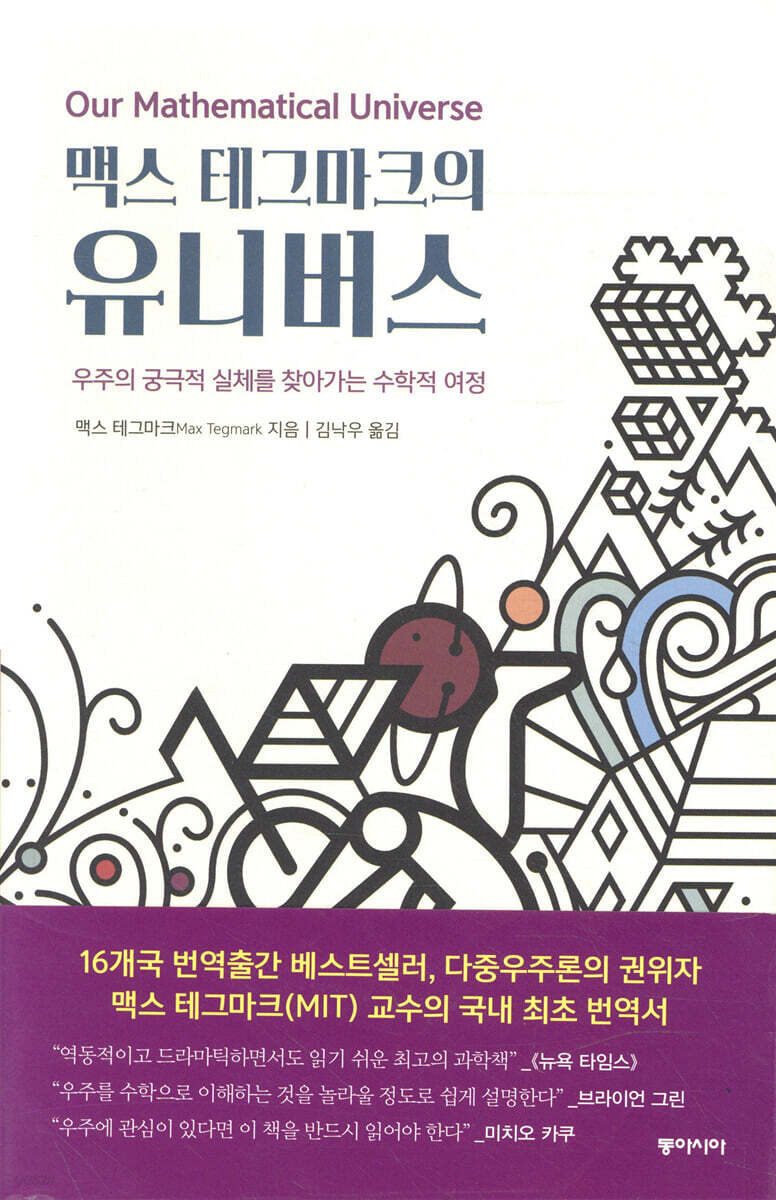 |
Description
Book Introduction
Revealing that the reality of the universe is mathematics and introducing a 4-level multi-universe
Max Tegmark's cosmology that shook up the paradigm of modern cosmology
Translated and published in 16 countries worldwide, he is an authority on multi-universe theory.
The first Korean translation by Professor Max Tegmark (MIT)
"Max Tegmark's Universe" is a "scientific autobiography" written 25 years after the author became interested in physics and began exploring the ultimate reality. It honestly contains scientific knowledge as well as the successes and failures he experienced as a scientist.
He himself confesses that physics was his least favorite subject in high school.
He says that while studying economics in college, he happened to read Richard Feynman's book and became completely absorbed in physics, realizing that it was the ultimate intellectual exploration to understand the universe.
Afterwards, the author began to study physics in earnest and gradually grew into a world-renowned cosmologist.
Max Tegmark's cosmology that shook up the paradigm of modern cosmology
Translated and published in 16 countries worldwide, he is an authority on multi-universe theory.
The first Korean translation by Professor Max Tegmark (MIT)
"Max Tegmark's Universe" is a "scientific autobiography" written 25 years after the author became interested in physics and began exploring the ultimate reality. It honestly contains scientific knowledge as well as the successes and failures he experienced as a scientist.
He himself confesses that physics was his least favorite subject in high school.
He says that while studying economics in college, he happened to read Richard Feynman's book and became completely absorbed in physics, realizing that it was the ultimate intellectual exploration to understand the universe.
Afterwards, the author began to study physics in earnest and gradually grew into a world-renowned cosmologist.
- You can preview some of the book's contents.
Preview
index
preface
1.
What is reality?
Part 1 Zoom Out
2.
Our position in space
3.
Our position in time
4.
Our Universe in Numbers
5.
Our cosmic origins
6.
Welcome to the multiverse
Part 2 Zoom In
7.
Lego of the Universe
8.
Level 3 Multiverse
Part 3: Stepping Back and Looking
9.
Internal reality, external reality, and consensual reality
10.
Physical and mathematical entities
11.
Is time an illusion?
12.
Level 4 Multiverse
13.
Life, Our Universe, and Everything
Acknowledgements
Translator's Note
Further Reading
Search
1.
What is reality?
Part 1 Zoom Out
2.
Our position in space
3.
Our position in time
4.
Our Universe in Numbers
5.
Our cosmic origins
6.
Welcome to the multiverse
Part 2 Zoom In
7.
Lego of the Universe
8.
Level 3 Multiverse
Part 3: Stepping Back and Looking
9.
Internal reality, external reality, and consensual reality
10.
Physical and mathematical entities
11.
Is time an illusion?
12.
Level 4 Multiverse
13.
Life, Our Universe, and Everything
Acknowledgements
Translator's Note
Further Reading
Search
Into the book
As a physicist, I have come to know that Plato was right.
Modern physics has made it abundantly clear that the ultimate nature of reality is not what it appears to be.
But if our thoughts and reality are different, then what is reality? What is the relationship between the inner reality of our minds and the outer reality? What is everything ultimately made of? How does it work? Why does it work? Does reality have meaning? If so, what is it? … This book (and my career as a scientist) is a personal effort to answer these questions.
--- pp.22-23
But I found the problem of information theory and numerical analysis surprisingly interesting, because it required such extreme effort from me.
After many sleepless nights, eating muesli in my postdoctoral lab in Munich, I finally managed to complete the Saskatoon map in Figure 3.5 just in time for my presentation at a major cosmology conference in the French Alps.
Although I've given hundreds of presentations, there are a few magical moments that always make me smile when I recall them.
This was one of those times.
My heart pounded as I walked up to the podium and looked around the conference hall.
It was full of people, many of whom I knew from reading their papers, but most of whom had no idea who I was.
The reason they attended the conference was probably not to hear a presentation from a complete beginner like me, but rather for the amazing ski course.
But I felt not only excitement but also tremendous energy in that hall.
People were excited about all the new developments in the field of cosmic microwave background radiation, and I felt both honored and thrilled to have even a small part to play.
--- p.90
Traditionally, the laws of thermodynamics are explained by ignoring the agent.
When I published my professional paper on this, I included a mathematical proof of the second point (how decoherence increases entropy), but I was unable to provide a rigorous proof of the first point (that observations on average decrease entropy), even though computer simulations supported the results.
Then something amazing happened that reminded me how lucky I was to be working at MIT.
Hrant Garivian, a passionate twenty-year-old undergraduate from Armenia, asked me if I had any interesting problems to research.
We hit it off, and he worked incredibly hard on my problems, devouring math books like popcorn, and mastering mathematical techniques like Schur products and spectral advances, which were largely unknown to physicists and which I had only learned from my mathematician father.
And one day, when I met Hrant, I could tell from his triumphant smile that he had solved the problem! We published his proof in a paper.
--- p.311
Although the known family of mathematical structures is large and diverse, and more are likely to be discovered in the future, any mathematical structure can be analyzed to determine its symmetries, and indeed many have been found to have interesting symmetries.
Interestingly, one of the most important discoveries in physics is that symmetry is inherent in our physical reality.
…we cannot tell the difference between the space and time dimensions by performing a generalized rotation, and Einstein proved that this explains why time appears to pass slowly when moving close to the speed of light, as mentioned in the last chapter.
Many more subtle symmetries in nature have been discovered in the past century, and these symmetries form the basis of Einstein's theory of relativity, quantum mechanics, and the Standard Model of particle physics.
--- pp.388-389
Interestingly, within the context of the mathematical cosmological hypothesis, the existence of a four-level multiverse is inevitable.
As detailed in the previous chapter, the mathematical cosmological hypothesis holds that mathematical structures are not merely descriptive; they are external physical entities.
This equivalence of physical and mathematical existence means that if mathematical structures contain self-aware substructures, then just as you and I are aware of ourselves, so too are mathematical structures themselves aware of themselves as existing in a physical universe of reality (albeit a universe of generally different properties from our own).
Modern physics has made it abundantly clear that the ultimate nature of reality is not what it appears to be.
But if our thoughts and reality are different, then what is reality? What is the relationship between the inner reality of our minds and the outer reality? What is everything ultimately made of? How does it work? Why does it work? Does reality have meaning? If so, what is it? … This book (and my career as a scientist) is a personal effort to answer these questions.
--- pp.22-23
But I found the problem of information theory and numerical analysis surprisingly interesting, because it required such extreme effort from me.
After many sleepless nights, eating muesli in my postdoctoral lab in Munich, I finally managed to complete the Saskatoon map in Figure 3.5 just in time for my presentation at a major cosmology conference in the French Alps.
Although I've given hundreds of presentations, there are a few magical moments that always make me smile when I recall them.
This was one of those times.
My heart pounded as I walked up to the podium and looked around the conference hall.
It was full of people, many of whom I knew from reading their papers, but most of whom had no idea who I was.
The reason they attended the conference was probably not to hear a presentation from a complete beginner like me, but rather for the amazing ski course.
But I felt not only excitement but also tremendous energy in that hall.
People were excited about all the new developments in the field of cosmic microwave background radiation, and I felt both honored and thrilled to have even a small part to play.
--- p.90
Traditionally, the laws of thermodynamics are explained by ignoring the agent.
When I published my professional paper on this, I included a mathematical proof of the second point (how decoherence increases entropy), but I was unable to provide a rigorous proof of the first point (that observations on average decrease entropy), even though computer simulations supported the results.
Then something amazing happened that reminded me how lucky I was to be working at MIT.
Hrant Garivian, a passionate twenty-year-old undergraduate from Armenia, asked me if I had any interesting problems to research.
We hit it off, and he worked incredibly hard on my problems, devouring math books like popcorn, and mastering mathematical techniques like Schur products and spectral advances, which were largely unknown to physicists and which I had only learned from my mathematician father.
And one day, when I met Hrant, I could tell from his triumphant smile that he had solved the problem! We published his proof in a paper.
--- p.311
Although the known family of mathematical structures is large and diverse, and more are likely to be discovered in the future, any mathematical structure can be analyzed to determine its symmetries, and indeed many have been found to have interesting symmetries.
Interestingly, one of the most important discoveries in physics is that symmetry is inherent in our physical reality.
…we cannot tell the difference between the space and time dimensions by performing a generalized rotation, and Einstein proved that this explains why time appears to pass slowly when moving close to the speed of light, as mentioned in the last chapter.
Many more subtle symmetries in nature have been discovered in the past century, and these symmetries form the basis of Einstein's theory of relativity, quantum mechanics, and the Standard Model of particle physics.
--- pp.388-389
Interestingly, within the context of the mathematical cosmological hypothesis, the existence of a four-level multiverse is inevitable.
As detailed in the previous chapter, the mathematical cosmological hypothesis holds that mathematical structures are not merely descriptive; they are external physical entities.
This equivalence of physical and mathematical existence means that if mathematical structures contain self-aware substructures, then just as you and I are aware of ourselves, so too are mathematical structures themselves aware of themselves as existing in a physical universe of reality (albeit a universe of generally different properties from our own).
--- p.464
Publisher's Review
From quantum mechanics, quantum physics, and particle physics, which lay the foundation for cosmology,
Inflation theory, parallel universe theory, and even a four-stage multi-universe
Everything you need to know about the latest cosmology, which delves into the mathematical nature of the universe.
The effort to uncover the ultimate reality of the universe in which we live is the ultimate goal of all scientific fields, including physics.
Max Tegmark, a physicist and cosmologist and the author of the new book Our Mathematical Universe: My Quest for the Ultimate Nature of Reality, MIT professor, arrives at the ultimate conclusion that the universe can be interpreted 'mathematically' after a physical exploration to find the essence of reality.
Our material world is not only described by mathematics, but is itself mathematics, and we are conscious parts of a vast mathematical object.
For a long time, scientists have been thinking that the physical reality of the universe is mathematical.
Astronomer Galileo Galilei referred to nature as “a great book written in the language of mathematics” in the 17th century, and Nobel laureate in physics Eugene Wigner spoke of “the incomprehensible efficiency of mathematics in natural science” in the 1960s.
So why does our physical world exhibit such extreme mathematical regularities?
The book contains the author's personal journey to discover the essence of ultimate reality, from the macroscopic world beyond galaxies to the microscopic world smaller than an atom, and encountering the vast and wonderful reality of four levels of parallel universes where everything is made up of mathematical structures.
Chapter 1 introduces the meaning of the ultimate 'reality', the theme of this book, from scientific, philosophical, and religious perspectives.
In Part 1 (Chapters 2–6), we embark on a journey into the macroscopic world to find the answer to the question, "How big is our universe?" We explore the origins of our universe and two types of parallel universes, and find hints that space is, in a sense, mathematical.
In Part 2 (Chapters 7-8), we journey into the microscopic world of subatomic particles to find the answer to the question, "What is everything made of?" We investigate a third kind of parallel universe, and find hints that the ultimate constituents of matter are, in some sense, mathematical.
Lastly, in Part 3 (Chapters 9-13), as Professor Nam Soon-geon (Department of Physics, Kyung Hee University) mentioned in his recommendation, “This journey of exploration will ultimately experience the direction toward the ultimate goal of the macroscopic universe and the direction toward uncovering the reality of the microscopic world meeting in mathematical structure,” we will examine the process in which the journeys to find reality, which began in the macroscopic and microscopic worlds respectively, meet in the single realm of ‘mathematical structure’ and arrive at the fourth parallel universe.
As Professor Kim Hang-bae (Department of Physics, Hanyang University) explained in his recommendation, “Beyond the current standard cosmology and the multiverse by eternal inflation, the multiverse by superstring topography, and even the multiverse based on the many-worlds interpretation of quantum mechanics and the multiverse by mathematical structure, this book contains surprising proposals for the multiverse and a journey that crosses science and philosophy to reveal the ultimate reality through them.” This book contains all the knowledge of cosmology that has developed until it revealed the reality of the mathematical multiverse.
Max Tegmark lays out a solid foundation for readers who might find cosmology difficult, from the most fundamental knowledge of astronomy, quantum mechanics, quantum physics, particle physics, and relativity necessary for understanding cosmology, to the theory of inflation, parallel universes, and the four-stage multiverse.
Additionally, we included various photos, pictures, and tables to help readers understand more easily and intuitively.
"Max Tegmark's Universe" has been translated and published in 16 countries around the world, and has garnered explosive interest from numerous media outlets, including The New York Times, The Wall Street Journal, The Guardian, Nature, and New Scientist, as well as from many readers.
This is evidence that the multiverse is no longer a fantasy but is now recognized as a science in the physics community through recent scientific discoveries.
Is there another me somewhere in the infinite universe?
The multi-universe theory that went from imagination to reality
What is the multiverse and why do we need to know about it?
Until recently, multiverses were considered a fantasy only found in science fiction novels and movies.
However, world-renowned cosmologist Max Tegmark introduces the book by citing an anecdote about a person who was hit by a truck while riding a bicycle as an example, and makes the groundbreaking argument that although he is dead in our universe, he may have narrowly avoided the truck in another universe.
Currently, world-renowned quantum physics researchers are debating whether this simultaneous existence of life and death actually occurs, whether our world will be divided into parallel universes with different histories each time, and whether the Schrödinger equation, the fundamental principle of quantum mechanics, will need to be revised.
So what is a multiverse? The author divides the multiverse into four stages, revolutionizing the modern cosmological paradigm.
Levels 1-3 multi-universes correspond to parallel universes that cannot communicate with each other within the same mathematical structure.
Level 1 is the distant realm where light from our origin has not had time to reach us, level 2 is the realm we will never be able to reach due to the newly created space created by the cosmic inflation, and level 3, 'Everett's many worlds', is related to the incommunicable part of the quantum mechanical Hilbert space.
All parallel universes on levels 1-3 follow fundamentally the same mathematical equations, but level 4 parallel universes follow different equations corresponding to different mathematical structures.
In the 2014 film Interstellar, which swept the world, depicting a disastrous future Earth caused by environmental destruction and the process of traveling to space to find a new Earth as a solution, there is a scene where dozens of images overlap behind a bookshelf.
Hundreds and tens of millions of universes coexist, to the point where the protagonist's past, present, and future cannot be distinguished.
Is it possible for countless times and spaces to coexist in an infinite universe, like in a movie scene? Tegmark asserts that it is scientifically possible.
According to the theory of cosmological inflation, the universe is not only so huge, but in fact infinite, so there could be infinite copies of me, and countless copies of me that are exactly like me, in the universe.
In fact, the idea of a multi-universe has traditionally been rejected by the establishment.
Giordano Bruno, who argued for an infinite space multiverse, was burned at the stake in 1600, and Hugh Everett, who argued for a quantum multiverse, was humiliated in the physics job market and driven out of academia in 1957.
Even author Max Tegmark has been told that his papers on multiverses are nonsense and that his career will be ruined.
Tegmark acknowledges that the concept of a multiverse is still controversial in academic circles.
However, with the development of various cosmological theories such as general relativity, inflation theory, cosmic landscape, quantum mechanics, decoherence, wave function, Everett's many worlds theory, external reality hypothesis, and mathematical universe hypothesis, which are the basis of the multiverse, many scientists now support the multiverse.
Professor Kim Nak-woo, who translated the book, said, “Just looking at the title, you might think that this book was written by a professional mathematician studying abstract modern mathematics, or a string theorist studying the geometry of 10-dimensional space.
However, it is a surprising twist that the author, Max Tegmark, specializes in analyzing galaxy cluster observation data.
… He said, “Since the claims are made by scholars who have actually encountered the universe through observational data, rather than just theoretically, they carry a weight that makes it difficult to easily dismiss even controversial claims.”
The mathematical reality of the universe, or multi-universe, as the author sees it, may seem very novel and difficult at first.
However, it is now difficult to deny that the multiverse is accepted in the physics community based on solid scientific evidence.
In search of the ultimate reality of the universe
Professor Max Tegmark's 25-year journey: A scientific autobiography
A must-read for anyone who dreams of becoming a scientist!
"Max Tegmark's Universe" is a "scientific autobiography" written 25 years after the author became interested in physics and began exploring the ultimate reality. It honestly contains scientific knowledge as well as the successes and failures he experienced as a scientist.
He himself confesses that physics was his least favorite subject in high school.
He says that while studying economics in college, he happened to read Richard Feynman's book and became completely absorbed in physics, realizing that it was the ultimate intellectual exploration to understand the universe.
Afterwards, the author began to study physics in earnest and gradually grew into a world-renowned cosmologist.
Therefore, through this book, readers can experience the life of a scientist today from a very realistic perspective.
Tegmark vividly recounts the various successes, failures, and moving anecdotes he experienced as a scientist: how he eagerly awaited the results of the WMAP team's research like a child waiting for Santa Claus; how he created a map of the universe that was so difficult that it was actually interesting to study; how he solved a mathematical problem he had scribbled on a napkin at a cafe with a friend after years; how he stayed up all night writing a program to draw a quadrupole while his wife and child were asleep; how he solved a research problem that had failed for four years with the help of an undergraduate student he met by chance; how he was embarrassed when he uploaded an unfinished paper to a website in order to rank first in a list of papers; how he was amazed by the overwhelming sight of the Milky Way streaking across the night sky in the Arizona desert; how he took his mother's surname, Tegmark, because there were many father's surname, Shapiro, in a physics paper database; how he wanted to name it the "Tegmark effect," thinking he was the first to make a discovery, but was disappointed when he realized another scientist had already discovered it; how his scientific research was attacked in emails and articles.
Gone are the days of scientists exploring alone in laboratories and astronomers gazing at the stars from observatories.
With the advancement of modern science and technology, the methods of research by scientists have become very complex and multi-layered.
Collaboration and smooth communication among scientists with expertise in each field have become essential qualities for scientists.
Additionally, as a scientist, you must now constantly keep an eye on what new scientific discoveries are being made around the world.
In the book, the author also tells the fascinating story of the inspiration and respect he felt when he was a novice physics student and encountered the lives and scientific achievements of famous physicists who left their mark on the history of physics.
The author adds to the fun by introducing the lives and achievements of physics giants that he learned about while studying physics, such as the thrill of meeting physics giant John Wheeler for the first time, being amazed by the fact that Erwin Schrödinger's 1926 paper, which he discovered by chance in the library, contained the essential content of quantum mechanics, and learning about his life while serving as an advisor for a documentary about the unfortunate physicist Hugh Everett.
As BBC Focus Magazine noted, “Max Tegmark is the closest successor to Richard Feynman,” Tegmark’s life, sometimes staying up all night and sometimes cheerfully conducting research, is a testament to the pure and passionate life of a scientist.
The passionate scientist's honest experiences will not only resonate deeply with current scientists, professors, and researchers in science and engineering, but also provide aspiring scientists with an opportunity to experience the life of a scientist indirectly.
Inflation theory, parallel universe theory, and even a four-stage multi-universe
Everything you need to know about the latest cosmology, which delves into the mathematical nature of the universe.
The effort to uncover the ultimate reality of the universe in which we live is the ultimate goal of all scientific fields, including physics.
Max Tegmark, a physicist and cosmologist and the author of the new book Our Mathematical Universe: My Quest for the Ultimate Nature of Reality, MIT professor, arrives at the ultimate conclusion that the universe can be interpreted 'mathematically' after a physical exploration to find the essence of reality.
Our material world is not only described by mathematics, but is itself mathematics, and we are conscious parts of a vast mathematical object.
For a long time, scientists have been thinking that the physical reality of the universe is mathematical.
Astronomer Galileo Galilei referred to nature as “a great book written in the language of mathematics” in the 17th century, and Nobel laureate in physics Eugene Wigner spoke of “the incomprehensible efficiency of mathematics in natural science” in the 1960s.
So why does our physical world exhibit such extreme mathematical regularities?
The book contains the author's personal journey to discover the essence of ultimate reality, from the macroscopic world beyond galaxies to the microscopic world smaller than an atom, and encountering the vast and wonderful reality of four levels of parallel universes where everything is made up of mathematical structures.
Chapter 1 introduces the meaning of the ultimate 'reality', the theme of this book, from scientific, philosophical, and religious perspectives.
In Part 1 (Chapters 2–6), we embark on a journey into the macroscopic world to find the answer to the question, "How big is our universe?" We explore the origins of our universe and two types of parallel universes, and find hints that space is, in a sense, mathematical.
In Part 2 (Chapters 7-8), we journey into the microscopic world of subatomic particles to find the answer to the question, "What is everything made of?" We investigate a third kind of parallel universe, and find hints that the ultimate constituents of matter are, in some sense, mathematical.
Lastly, in Part 3 (Chapters 9-13), as Professor Nam Soon-geon (Department of Physics, Kyung Hee University) mentioned in his recommendation, “This journey of exploration will ultimately experience the direction toward the ultimate goal of the macroscopic universe and the direction toward uncovering the reality of the microscopic world meeting in mathematical structure,” we will examine the process in which the journeys to find reality, which began in the macroscopic and microscopic worlds respectively, meet in the single realm of ‘mathematical structure’ and arrive at the fourth parallel universe.
As Professor Kim Hang-bae (Department of Physics, Hanyang University) explained in his recommendation, “Beyond the current standard cosmology and the multiverse by eternal inflation, the multiverse by superstring topography, and even the multiverse based on the many-worlds interpretation of quantum mechanics and the multiverse by mathematical structure, this book contains surprising proposals for the multiverse and a journey that crosses science and philosophy to reveal the ultimate reality through them.” This book contains all the knowledge of cosmology that has developed until it revealed the reality of the mathematical multiverse.
Max Tegmark lays out a solid foundation for readers who might find cosmology difficult, from the most fundamental knowledge of astronomy, quantum mechanics, quantum physics, particle physics, and relativity necessary for understanding cosmology, to the theory of inflation, parallel universes, and the four-stage multiverse.
Additionally, we included various photos, pictures, and tables to help readers understand more easily and intuitively.
"Max Tegmark's Universe" has been translated and published in 16 countries around the world, and has garnered explosive interest from numerous media outlets, including The New York Times, The Wall Street Journal, The Guardian, Nature, and New Scientist, as well as from many readers.
This is evidence that the multiverse is no longer a fantasy but is now recognized as a science in the physics community through recent scientific discoveries.
Is there another me somewhere in the infinite universe?
The multi-universe theory that went from imagination to reality
What is the multiverse and why do we need to know about it?
Until recently, multiverses were considered a fantasy only found in science fiction novels and movies.
However, world-renowned cosmologist Max Tegmark introduces the book by citing an anecdote about a person who was hit by a truck while riding a bicycle as an example, and makes the groundbreaking argument that although he is dead in our universe, he may have narrowly avoided the truck in another universe.
Currently, world-renowned quantum physics researchers are debating whether this simultaneous existence of life and death actually occurs, whether our world will be divided into parallel universes with different histories each time, and whether the Schrödinger equation, the fundamental principle of quantum mechanics, will need to be revised.
So what is a multiverse? The author divides the multiverse into four stages, revolutionizing the modern cosmological paradigm.
Levels 1-3 multi-universes correspond to parallel universes that cannot communicate with each other within the same mathematical structure.
Level 1 is the distant realm where light from our origin has not had time to reach us, level 2 is the realm we will never be able to reach due to the newly created space created by the cosmic inflation, and level 3, 'Everett's many worlds', is related to the incommunicable part of the quantum mechanical Hilbert space.
All parallel universes on levels 1-3 follow fundamentally the same mathematical equations, but level 4 parallel universes follow different equations corresponding to different mathematical structures.
In the 2014 film Interstellar, which swept the world, depicting a disastrous future Earth caused by environmental destruction and the process of traveling to space to find a new Earth as a solution, there is a scene where dozens of images overlap behind a bookshelf.
Hundreds and tens of millions of universes coexist, to the point where the protagonist's past, present, and future cannot be distinguished.
Is it possible for countless times and spaces to coexist in an infinite universe, like in a movie scene? Tegmark asserts that it is scientifically possible.
According to the theory of cosmological inflation, the universe is not only so huge, but in fact infinite, so there could be infinite copies of me, and countless copies of me that are exactly like me, in the universe.
In fact, the idea of a multi-universe has traditionally been rejected by the establishment.
Giordano Bruno, who argued for an infinite space multiverse, was burned at the stake in 1600, and Hugh Everett, who argued for a quantum multiverse, was humiliated in the physics job market and driven out of academia in 1957.
Even author Max Tegmark has been told that his papers on multiverses are nonsense and that his career will be ruined.
Tegmark acknowledges that the concept of a multiverse is still controversial in academic circles.
However, with the development of various cosmological theories such as general relativity, inflation theory, cosmic landscape, quantum mechanics, decoherence, wave function, Everett's many worlds theory, external reality hypothesis, and mathematical universe hypothesis, which are the basis of the multiverse, many scientists now support the multiverse.
Professor Kim Nak-woo, who translated the book, said, “Just looking at the title, you might think that this book was written by a professional mathematician studying abstract modern mathematics, or a string theorist studying the geometry of 10-dimensional space.
However, it is a surprising twist that the author, Max Tegmark, specializes in analyzing galaxy cluster observation data.
… He said, “Since the claims are made by scholars who have actually encountered the universe through observational data, rather than just theoretically, they carry a weight that makes it difficult to easily dismiss even controversial claims.”
The mathematical reality of the universe, or multi-universe, as the author sees it, may seem very novel and difficult at first.
However, it is now difficult to deny that the multiverse is accepted in the physics community based on solid scientific evidence.
In search of the ultimate reality of the universe
Professor Max Tegmark's 25-year journey: A scientific autobiography
A must-read for anyone who dreams of becoming a scientist!
"Max Tegmark's Universe" is a "scientific autobiography" written 25 years after the author became interested in physics and began exploring the ultimate reality. It honestly contains scientific knowledge as well as the successes and failures he experienced as a scientist.
He himself confesses that physics was his least favorite subject in high school.
He says that while studying economics in college, he happened to read Richard Feynman's book and became completely absorbed in physics, realizing that it was the ultimate intellectual exploration to understand the universe.
Afterwards, the author began to study physics in earnest and gradually grew into a world-renowned cosmologist.
Therefore, through this book, readers can experience the life of a scientist today from a very realistic perspective.
Tegmark vividly recounts the various successes, failures, and moving anecdotes he experienced as a scientist: how he eagerly awaited the results of the WMAP team's research like a child waiting for Santa Claus; how he created a map of the universe that was so difficult that it was actually interesting to study; how he solved a mathematical problem he had scribbled on a napkin at a cafe with a friend after years; how he stayed up all night writing a program to draw a quadrupole while his wife and child were asleep; how he solved a research problem that had failed for four years with the help of an undergraduate student he met by chance; how he was embarrassed when he uploaded an unfinished paper to a website in order to rank first in a list of papers; how he was amazed by the overwhelming sight of the Milky Way streaking across the night sky in the Arizona desert; how he took his mother's surname, Tegmark, because there were many father's surname, Shapiro, in a physics paper database; how he wanted to name it the "Tegmark effect," thinking he was the first to make a discovery, but was disappointed when he realized another scientist had already discovered it; how his scientific research was attacked in emails and articles.
Gone are the days of scientists exploring alone in laboratories and astronomers gazing at the stars from observatories.
With the advancement of modern science and technology, the methods of research by scientists have become very complex and multi-layered.
Collaboration and smooth communication among scientists with expertise in each field have become essential qualities for scientists.
Additionally, as a scientist, you must now constantly keep an eye on what new scientific discoveries are being made around the world.
In the book, the author also tells the fascinating story of the inspiration and respect he felt when he was a novice physics student and encountered the lives and scientific achievements of famous physicists who left their mark on the history of physics.
The author adds to the fun by introducing the lives and achievements of physics giants that he learned about while studying physics, such as the thrill of meeting physics giant John Wheeler for the first time, being amazed by the fact that Erwin Schrödinger's 1926 paper, which he discovered by chance in the library, contained the essential content of quantum mechanics, and learning about his life while serving as an advisor for a documentary about the unfortunate physicist Hugh Everett.
As BBC Focus Magazine noted, “Max Tegmark is the closest successor to Richard Feynman,” Tegmark’s life, sometimes staying up all night and sometimes cheerfully conducting research, is a testament to the pure and passionate life of a scientist.
The passionate scientist's honest experiences will not only resonate deeply with current scientists, professors, and researchers in science and engineering, but also provide aspiring scientists with an opportunity to experience the life of a scientist indirectly.
GOODS SPECIFICS
- Date of publication: April 26, 2017
- Page count, weight, size: 600 pages | 815g | 145*224*30mm
- ISBN13: 9788962621815
- ISBN10: 8962621819
You may also like
카테고리
korean


korean

![ELLE 엘르 스페셜 에디션 A형 : 12월 [2025]](http://librairie.coreenne.fr/cdn/shop/files/b8e27a3de6c9538896439686c6b0e8fb.jpg?v=1766436872&width=3840)


