

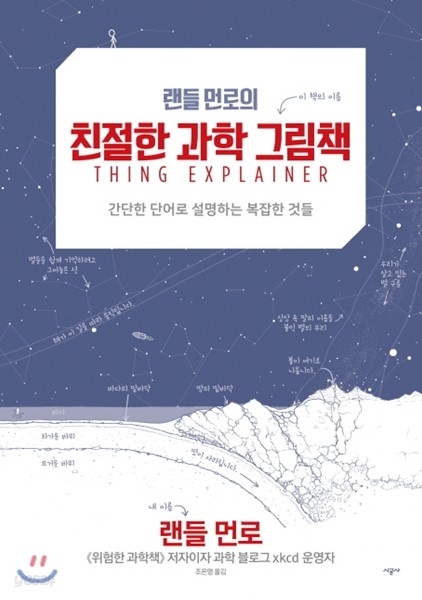
Randall Munroe's Friendly Science Picture Book
 |
Description
Book Introduction
Nuclear power plants and the International Space Station, From human organs to the periodic table! He is the operator of xkcd, America's top science blog. Author of the popular science book "Dangerous Science" Randall Munroe is all around us Ingenious and simple explanation! Have you ever wanted to learn about fascinating things or interesting phenomena, but found yourself frustrated by the wall of technical jargon you couldn't understand? Then listen to Randall Munroe's story right now. In this book, he uses simple line drawings and very easy words to explain complex things in an easy and friendly way. For example, things like this. · A home in space we share (International Space Station) · The sacs of matter inside our bodies (human organs) · The large rock plates we walk on (tectonic plates) · The pieces that make up everything in the world (Periodic Table) · Radio box for heating food (microwave oven) · The world surrounding the sun (solar system) · Rotary-wing sky boat (helicopter) · Tall road (bridge) · A box that makes clothes smell good (washing machine and dryer) How do these things work? Where did they come from? How would we live without them? What happens when you open them, heat them, cool them, turn them in different directions, or press a button? This book not only provides helpful answers to these simple questions, but also tells many fascinating stories. Funny, entertaining, and, above all, accessible, this book will be a wonderful and friendly science teacher for anyone from five-year-olds to centenarians, who is curious about how things work and why they move the way they do. |
- You can preview some of the book's contents.
Preview
index
Pages before starting the book (Preface)
A Space Home We Share (International Space Station)
The tiny bundles of water that make up our bodies (animal cells)
A building that generates electricity with heavy iron (nuclear power plant)
A space car that roams the world of fire (the Mars rover Curiosity)
The sacs of matter inside our bodies (human organs)
Clothes Scenting Box (Washer and Dryer)
Earth's surface (Earth's topography)
I opened the front cover of the car (car engine)
rotary wing sky boat (helicopter)
The 'Law of the Land' (the U.S. Constitution)
A boat with the same name as the USS Constitution, the US Navy's "Law of the Land"
Radio box (microwave oven) for heating food
A device (lock) that distinguishes between real and fake shapes
Up and down room (elevator)
Boat (submarine) running on the sea
Dishwasher box
The large rock plates (tectonic plates) on which we walk
Cloud map (weather map)
tree (tree)
Machine that burns cities (nuclear bomb)
Room with running water (toilet and sink)
computer building (data center)
The US space team's soaring vehicle, Saturn V
Machine that pushes sky boats (jet engines)
What you touch when driving a sky boat (airplane cockpit)
A very large machine that hits very small objects (the Large Hadron Collider)
Energy Box (Battery)
City on a Drilling Boat (Drilling Ship)
Burnable materials in the Earth (coal mines)
tall road (bridge)
Folding computer (laptop)
The world surrounding the sun (solar system)
photo taking machine (camera)
Writing sticks (pen and pencil)
Computer in your hand (smartphone)
Color of light (electromagnetic spectrum)
The sky seen at night (night sky)
The pieces that make up everything in the world (the periodic table)
Our star (sun)
How to count (units of measurement)
A room to help sick people (hospital bed)
playground (stadium)
Earth's past (geological timeline)
Tree of Life (Evolutionary Tree)
People who helped
Acknowledgements
Translator's Note
Appendix_A House Touching the Sky (High-rise Building)
A Space Home We Share (International Space Station)
The tiny bundles of water that make up our bodies (animal cells)
A building that generates electricity with heavy iron (nuclear power plant)
A space car that roams the world of fire (the Mars rover Curiosity)
The sacs of matter inside our bodies (human organs)
Clothes Scenting Box (Washer and Dryer)
Earth's surface (Earth's topography)
I opened the front cover of the car (car engine)
rotary wing sky boat (helicopter)
The 'Law of the Land' (the U.S. Constitution)
A boat with the same name as the USS Constitution, the US Navy's "Law of the Land"
Radio box (microwave oven) for heating food
A device (lock) that distinguishes between real and fake shapes
Up and down room (elevator)
Boat (submarine) running on the sea
Dishwasher box
The large rock plates (tectonic plates) on which we walk
Cloud map (weather map)
tree (tree)
Machine that burns cities (nuclear bomb)
Room with running water (toilet and sink)
computer building (data center)
The US space team's soaring vehicle, Saturn V
Machine that pushes sky boats (jet engines)
What you touch when driving a sky boat (airplane cockpit)
A very large machine that hits very small objects (the Large Hadron Collider)
Energy Box (Battery)
City on a Drilling Boat (Drilling Ship)
Burnable materials in the Earth (coal mines)
tall road (bridge)
Folding computer (laptop)
The world surrounding the sun (solar system)
photo taking machine (camera)
Writing sticks (pen and pencil)
Computer in your hand (smartphone)
Color of light (electromagnetic spectrum)
The sky seen at night (night sky)
The pieces that make up everything in the world (the periodic table)
Our star (sun)
How to count (units of measurement)
A room to help sick people (hospital bed)
playground (stadium)
Earth's past (geological timeline)
Tree of Life (Evolutionary Tree)
People who helped
Acknowledgements
Translator's Note
Appendix_A House Touching the Sky (High-rise Building)
Detailed image

Into the book
I learned about space boats in school.
And we were taught to use a lot of difficult words when describing the shape of the Earth.
Sometimes we use difficult words because they explain things that cannot be expressed in simple words.
But more often than not, I use difficult words because I'm afraid people will think I'm using easy words because I don't know the difficult ones.
[…] Some people say that there is no need to learn difficult words at all.
When understanding an object or phenomenon, what matters is what it does, not what name it is called.
Of course, I don't think that's entirely true.
To learn something properly, you need the help of someone who knows it well.
But to understand that person, you need to know the language he uses.
Also, you need to know what it is called so you can ask questions.
But there are already books out there explaining what something is called.
This book tries to explain what that thing does.
--- p.7
These irons are always hot.
Even when I'm still, I get feverish.
There are two types of this column:
One is a fiery heat, and the other is a very special kind of strange heat.
Strange heat is a light that cannot be seen with our eyes.
(Generally speaking, this is true, but when this heat gathers in large enough quantities to kill a person in an instant, it appears blue.) Strange heat hurts us in a completely different way than burning heat does.
If you stay near this heat for a long time, your body will start to grow strangely.
Some of the first people to study the strange heat-generating iron lost their lives.
When a very small piece of heavy metal breaks, a strange heat is generated.
The heat produced at this time is much more than that produced by normal fire.
However, many types of metal break very slowly.
So, even the iron, which is as old as the Earth, is now only about half broken.
[…] People place heavy pieces of iron close together to heat them up quickly, and then use that heat to create electricity.
But if you put it too close, it will move around on its own and eventually explode.
Finding the right distance isn't easy, but the sheer amount of heat and energy available from heavy metal objects keeps people trying anyway.
--- p.11
It is the only space boat that has allowed humans to set foot on other worlds in space, not Earth.
People have been to the moon six times thanks to this space boat.
All of this happened half a century before this book was written.
After visiting the moon, people no longer took these space boats to go to other worlds.
Instead, the US space team used this space boat to finally send up their first space home.
And after people visited that space home several times, the space boat fell back to Earth.
When the spaceship burns and the remaining pieces fall into a small village, the townspeople tell the American space team that they must pay them for dropping things on the ground.
--- p.36
When a living being dies, some of its energy remains in the body they leave behind.
Thanks to this, we can burn dead trees to get energy.
Living things that die without being burned or eaten are buried in the ground, still retaining energy within their bodies.
And after enduring the weight and heat of the Earth for a long time, they eventually turn into various types of rocks, water, or air.
But there is still energy left.
People seek out these altered waters and airs and burn them with fire to extract all the energy within them.
In the blink of an eye, we use up all the energy we have accumulated over a very long time, obtained from the sun.
When people first created machines that moved with fire, they burned trees growing in the forest to get the fire they needed.
And when the trees were all gone, they began to burn the forests of the past.
--- p.43
Here's one way to think about how much life has lived on Earth so far.
The Earth's land is surrounded by oceans.
There is sand on the beach where the sea and land meet.
One day, you are walking along the beach and you pick up a grain of sand and look at it.
And let's think of each grain of sand under our feet as a world.
They say that each of them has seas and beaches like Earth.
The entire tree of life, in all those sandy worlds, is made up of as many lives as there are grains of sand on the shores of those worlds.
In this world we speak of, every word we speak is smaller than a speck of dust.
And we were taught to use a lot of difficult words when describing the shape of the Earth.
Sometimes we use difficult words because they explain things that cannot be expressed in simple words.
But more often than not, I use difficult words because I'm afraid people will think I'm using easy words because I don't know the difficult ones.
[…] Some people say that there is no need to learn difficult words at all.
When understanding an object or phenomenon, what matters is what it does, not what name it is called.
Of course, I don't think that's entirely true.
To learn something properly, you need the help of someone who knows it well.
But to understand that person, you need to know the language he uses.
Also, you need to know what it is called so you can ask questions.
But there are already books out there explaining what something is called.
This book tries to explain what that thing does.
--- p.7
These irons are always hot.
Even when I'm still, I get feverish.
There are two types of this column:
One is a fiery heat, and the other is a very special kind of strange heat.
Strange heat is a light that cannot be seen with our eyes.
(Generally speaking, this is true, but when this heat gathers in large enough quantities to kill a person in an instant, it appears blue.) Strange heat hurts us in a completely different way than burning heat does.
If you stay near this heat for a long time, your body will start to grow strangely.
Some of the first people to study the strange heat-generating iron lost their lives.
When a very small piece of heavy metal breaks, a strange heat is generated.
The heat produced at this time is much more than that produced by normal fire.
However, many types of metal break very slowly.
So, even the iron, which is as old as the Earth, is now only about half broken.
[…] People place heavy pieces of iron close together to heat them up quickly, and then use that heat to create electricity.
But if you put it too close, it will move around on its own and eventually explode.
Finding the right distance isn't easy, but the sheer amount of heat and energy available from heavy metal objects keeps people trying anyway.
--- p.11
It is the only space boat that has allowed humans to set foot on other worlds in space, not Earth.
People have been to the moon six times thanks to this space boat.
All of this happened half a century before this book was written.
After visiting the moon, people no longer took these space boats to go to other worlds.
Instead, the US space team used this space boat to finally send up their first space home.
And after people visited that space home several times, the space boat fell back to Earth.
When the spaceship burns and the remaining pieces fall into a small village, the townspeople tell the American space team that they must pay them for dropping things on the ground.
--- p.36
When a living being dies, some of its energy remains in the body they leave behind.
Thanks to this, we can burn dead trees to get energy.
Living things that die without being burned or eaten are buried in the ground, still retaining energy within their bodies.
And after enduring the weight and heat of the Earth for a long time, they eventually turn into various types of rocks, water, or air.
But there is still energy left.
People seek out these altered waters and airs and burn them with fire to extract all the energy within them.
In the blink of an eye, we use up all the energy we have accumulated over a very long time, obtained from the sun.
When people first created machines that moved with fire, they burned trees growing in the forest to get the fire they needed.
And when the trees were all gone, they began to burn the forests of the past.
--- p.43
Here's one way to think about how much life has lived on Earth so far.
The Earth's land is surrounded by oceans.
There is sand on the beach where the sea and land meet.
One day, you are walking along the beach and you pick up a grain of sand and look at it.
And let's think of each grain of sand under our feet as a world.
They say that each of them has seas and beaches like Earth.
The entire tree of life, in all those sandy worlds, is made up of as many lives as there are grains of sand on the shores of those worlds.
In this world we speak of, every word we speak is smaller than a speck of dust.
--- p.63
Publisher's Review
"Ingenious! The ultimate guide for those curious about things!"
Another Randall Munroe science book lauded by Bill Gates
Randall Munroe, author of "The Dangerous Science Book," which gained worldwide popularity for its unique humor and easy explanations of complex and difficult scientific concepts, reveals one fact before starting his new book, "Randall Munroe's Friendly Science Picture Book."
It's about 'technical terminology'.
He confesses that until now, he has been unable to break free from the stereotype that people will recognize his knowledge only if he uses technical terms, and the framework of university education that taught him to use a lot of technical terms when explaining things, so he often ended up explaining things in difficult terms that could have been explained in simple terms.
As if reflecting on a kind of confession, he sets out one of his own rules in this book.
Describe objects using only a thousand simplest (English) words, based on simple drawings! This seemingly reckless rule allows him to tackle a vast range of topics, from cutting-edge technologies like the International Space Station, nuclear power plants, and the Large Hadron Collider to everyday objects like smartphones, laptops, microwave ovens, and elevators, and even purely scientific concepts like human organs, animal cells, the periodic table, and the solar system.
Bill Gates, who also praised Randall Munroe's previous work, "Dangerous Science," once again praised this attempt by Randall Munroe.
This book also received a great response, becoming a bestseller on Amazon in the US and around the world as soon as it was published.
Oil is “burning water,” airplanes are “sky boats,” and smartphones are “computers in your hand.”
If you can explain it easily, then you really know it!
The author's determination to "explain what things do" rather than "what something is called" has resulted in a variety of ingenious names for things.
For example, the heart becomes a “blood-pumping sac,” oil becomes “burning water,” an airplane becomes a “sky boat,” a smartphone becomes a “computer in your hand,” an elevator becomes a “room that goes up and down,” and a battery becomes an “energy box.”
Anyone familiar with scientific terminology will be amazed by the creativity, and those new to science or students will be impressed by the author's clear and easy-to-understand explanations.
Thanks to this, this book will not only be a friendly science teacher for elementary, middle, and high school students and those just beginning to learn science, but for those who are well-versed in science, it will also feel like a collection of fun puzzles posed by Randall Munroe.
Also included in American high school science textbooks,
Scientific concepts explained in large, detailed, and beautiful illustrations
This book, which started out as a series of large drawings to easily explain the Saturn V rocket to people, contains a total of forty-five drawings of objects in a large format that is over 20 and 30 centimeters wide and tall respectively.
Among them, there are objects that we do not have a chance to look closely at in our daily lives, such as 'computer buildings (data centers)' or 'machines that burn down cities (nuclear bombs)', and there are also objects that we frequently encounter and use in our daily lives, such as 'computers in our hands (smartphones)', 'houses touching the sky (skyscrapers)' or 'radio boxes that heat food (microwave ovens)', but whose structures or principles we do not know well. These simple yet beautiful pictures allow us to look at objects that we have never properly encountered before as they are, without being caught up in any preconceptions or stereotypes.
Randall Munroe, who says he wanted to break free from monotonous explanations through his illustrations and add elements of fun and the unexpected, has had the opportunity to publish this book and have his work included in a science high school textbook in the United States.
Houghton Mifflin Hartcourt (HMH), which published Randall Munro's book, including the previous book, "Dangerous Science," is a major textbook publisher in the United States. Since the fall of 2016, some of the contents of this book have been included in American high school science textbooks, receiving positive responses from students ('Rising and Falling Room (Elevator),' 'The U.S. Space Team's Soaring Vehicle No. 5 (Saturn V),' 'Our Body's Stuff Bag (Human Organs)').
One last thing.
Randall Munroe's signature stick figures, who were a staple of his science blog xkcd and his book The Book of Dangerous Science, once again add witty humor throughout the book.
This book will make an excellent gift for students who are interested in science and want to study it in a fun way, beginners who want to approach scientific knowledge without feeling burdened, and even Randall Munroe 'geeks'.
* The media reviews pouring in for Randall Munro's Friendly Science Picture Book
"Ingenious! The ultimate guide for those curious about things!"
- Bill Gates
“Like all good science books, this one is clear, entertaining, and surprising.”
- American weekly news magazine [The New Yorker]
“Thanks to the witty and playful illustrations, you'll understand what a nuclear power plant (a building that generates electricity from heavy metal) is like the moment you open the book.”
- One of the best books of 2015, selected by NPR.org
“Randall Munroe’s masterpiece is an antidote to scientific jargon.
It skillfully demonstrates that not knowing the exact name of something doesn't mean you don't know how it works.
The same goes for descriptions of things.
There is no need to use difficult words to convey your meaning.
Difficult words are just a distraction."
- American IT magazine [Gizmodo]
“A funny, accurate, and beautiful book.”
- British daily newspaper [The Guardian]
“A must-read for anyone with a curious mind.”
- American science magazine [Popular Science]
“This book is a feast for the eyes and a feast for the brain.
“It would make a great gift for yourself, a science 'geek', or anyone who simply enjoys beautiful art.”
- American science magazine [Scientific American]
“The appeal of this book is that it allows us to experience a childlike, unpretentious joy in the intellectual achievements of mankind.”
- Tor.com, a website specializing in science fiction and fantasy novels
“It is unrivaled in both clarity and fun.
Randall Munroe challenges readers to reexamine their own preconceptions and think about things in new ways.”
- American Scientist, an American science magazine
“A delightful and informative book, brimming with Randall Munroe’s signature humor and solid knowledge of science and engineering.”
- [Science] Magazine
“It is a comfortable and engaging book.
Every page tempts readers with gorgeous, blueprint-like illustrations.
Randall Munroe uses his curiosity to expand his readers' knowledge.”
?American technology media website CNET
“Clever and sophisticated.”
- [New York] Magazine
“Many people will find this book enjoyable.
Even if it's a concept you already know, it's still fun to look at the details.
Even when it comes to how things work, this book presents the big concepts without overwhelming us with difficult words.
This book will also provide good ideas on how to write a book.”
- American podcast [Nerdist]
Another Randall Munroe science book lauded by Bill Gates
Randall Munroe, author of "The Dangerous Science Book," which gained worldwide popularity for its unique humor and easy explanations of complex and difficult scientific concepts, reveals one fact before starting his new book, "Randall Munroe's Friendly Science Picture Book."
It's about 'technical terminology'.
He confesses that until now, he has been unable to break free from the stereotype that people will recognize his knowledge only if he uses technical terms, and the framework of university education that taught him to use a lot of technical terms when explaining things, so he often ended up explaining things in difficult terms that could have been explained in simple terms.
As if reflecting on a kind of confession, he sets out one of his own rules in this book.
Describe objects using only a thousand simplest (English) words, based on simple drawings! This seemingly reckless rule allows him to tackle a vast range of topics, from cutting-edge technologies like the International Space Station, nuclear power plants, and the Large Hadron Collider to everyday objects like smartphones, laptops, microwave ovens, and elevators, and even purely scientific concepts like human organs, animal cells, the periodic table, and the solar system.
Bill Gates, who also praised Randall Munroe's previous work, "Dangerous Science," once again praised this attempt by Randall Munroe.
This book also received a great response, becoming a bestseller on Amazon in the US and around the world as soon as it was published.
Oil is “burning water,” airplanes are “sky boats,” and smartphones are “computers in your hand.”
If you can explain it easily, then you really know it!
The author's determination to "explain what things do" rather than "what something is called" has resulted in a variety of ingenious names for things.
For example, the heart becomes a “blood-pumping sac,” oil becomes “burning water,” an airplane becomes a “sky boat,” a smartphone becomes a “computer in your hand,” an elevator becomes a “room that goes up and down,” and a battery becomes an “energy box.”
Anyone familiar with scientific terminology will be amazed by the creativity, and those new to science or students will be impressed by the author's clear and easy-to-understand explanations.
Thanks to this, this book will not only be a friendly science teacher for elementary, middle, and high school students and those just beginning to learn science, but for those who are well-versed in science, it will also feel like a collection of fun puzzles posed by Randall Munroe.
Also included in American high school science textbooks,
Scientific concepts explained in large, detailed, and beautiful illustrations
This book, which started out as a series of large drawings to easily explain the Saturn V rocket to people, contains a total of forty-five drawings of objects in a large format that is over 20 and 30 centimeters wide and tall respectively.
Among them, there are objects that we do not have a chance to look closely at in our daily lives, such as 'computer buildings (data centers)' or 'machines that burn down cities (nuclear bombs)', and there are also objects that we frequently encounter and use in our daily lives, such as 'computers in our hands (smartphones)', 'houses touching the sky (skyscrapers)' or 'radio boxes that heat food (microwave ovens)', but whose structures or principles we do not know well. These simple yet beautiful pictures allow us to look at objects that we have never properly encountered before as they are, without being caught up in any preconceptions or stereotypes.
Randall Munroe, who says he wanted to break free from monotonous explanations through his illustrations and add elements of fun and the unexpected, has had the opportunity to publish this book and have his work included in a science high school textbook in the United States.
Houghton Mifflin Hartcourt (HMH), which published Randall Munro's book, including the previous book, "Dangerous Science," is a major textbook publisher in the United States. Since the fall of 2016, some of the contents of this book have been included in American high school science textbooks, receiving positive responses from students ('Rising and Falling Room (Elevator),' 'The U.S. Space Team's Soaring Vehicle No. 5 (Saturn V),' 'Our Body's Stuff Bag (Human Organs)').
One last thing.
Randall Munroe's signature stick figures, who were a staple of his science blog xkcd and his book The Book of Dangerous Science, once again add witty humor throughout the book.
This book will make an excellent gift for students who are interested in science and want to study it in a fun way, beginners who want to approach scientific knowledge without feeling burdened, and even Randall Munroe 'geeks'.
* The media reviews pouring in for Randall Munro's Friendly Science Picture Book
"Ingenious! The ultimate guide for those curious about things!"
- Bill Gates
“Like all good science books, this one is clear, entertaining, and surprising.”
- American weekly news magazine [The New Yorker]
“Thanks to the witty and playful illustrations, you'll understand what a nuclear power plant (a building that generates electricity from heavy metal) is like the moment you open the book.”
- One of the best books of 2015, selected by NPR.org
“Randall Munroe’s masterpiece is an antidote to scientific jargon.
It skillfully demonstrates that not knowing the exact name of something doesn't mean you don't know how it works.
The same goes for descriptions of things.
There is no need to use difficult words to convey your meaning.
Difficult words are just a distraction."
- American IT magazine [Gizmodo]
“A funny, accurate, and beautiful book.”
- British daily newspaper [The Guardian]
“A must-read for anyone with a curious mind.”
- American science magazine [Popular Science]
“This book is a feast for the eyes and a feast for the brain.
“It would make a great gift for yourself, a science 'geek', or anyone who simply enjoys beautiful art.”
- American science magazine [Scientific American]
“The appeal of this book is that it allows us to experience a childlike, unpretentious joy in the intellectual achievements of mankind.”
- Tor.com, a website specializing in science fiction and fantasy novels
“It is unrivaled in both clarity and fun.
Randall Munroe challenges readers to reexamine their own preconceptions and think about things in new ways.”
- American Scientist, an American science magazine
“A delightful and informative book, brimming with Randall Munroe’s signature humor and solid knowledge of science and engineering.”
- [Science] Magazine
“It is a comfortable and engaging book.
Every page tempts readers with gorgeous, blueprint-like illustrations.
Randall Munroe uses his curiosity to expand his readers' knowledge.”
?American technology media website CNET
“Clever and sophisticated.”
- [New York] Magazine
“Many people will find this book enjoyable.
Even if it's a concept you already know, it's still fun to look at the details.
Even when it comes to how things work, this book presents the big concepts without overwhelming us with difficult words.
This book will also provide good ideas on how to write a book.”
- American podcast [Nerdist]
GOODS SPECIFICS
- Date of publication: March 13, 2017
- Format: Hardcover book binding method guide
- Page count, weight, size: 68 pages | 817g | 238*338*18mm
- ISBN13: 9788952785220
- ISBN10: 8952785223
You may also like
카테고리
korean


korean

![ELLE 엘르 스페셜 에디션 A형 : 12월 [2025]](http://librairie.coreenne.fr/cdn/shop/files/b8e27a3de6c9538896439686c6b0e8fb.jpg?v=1766436872&width=3840)


