

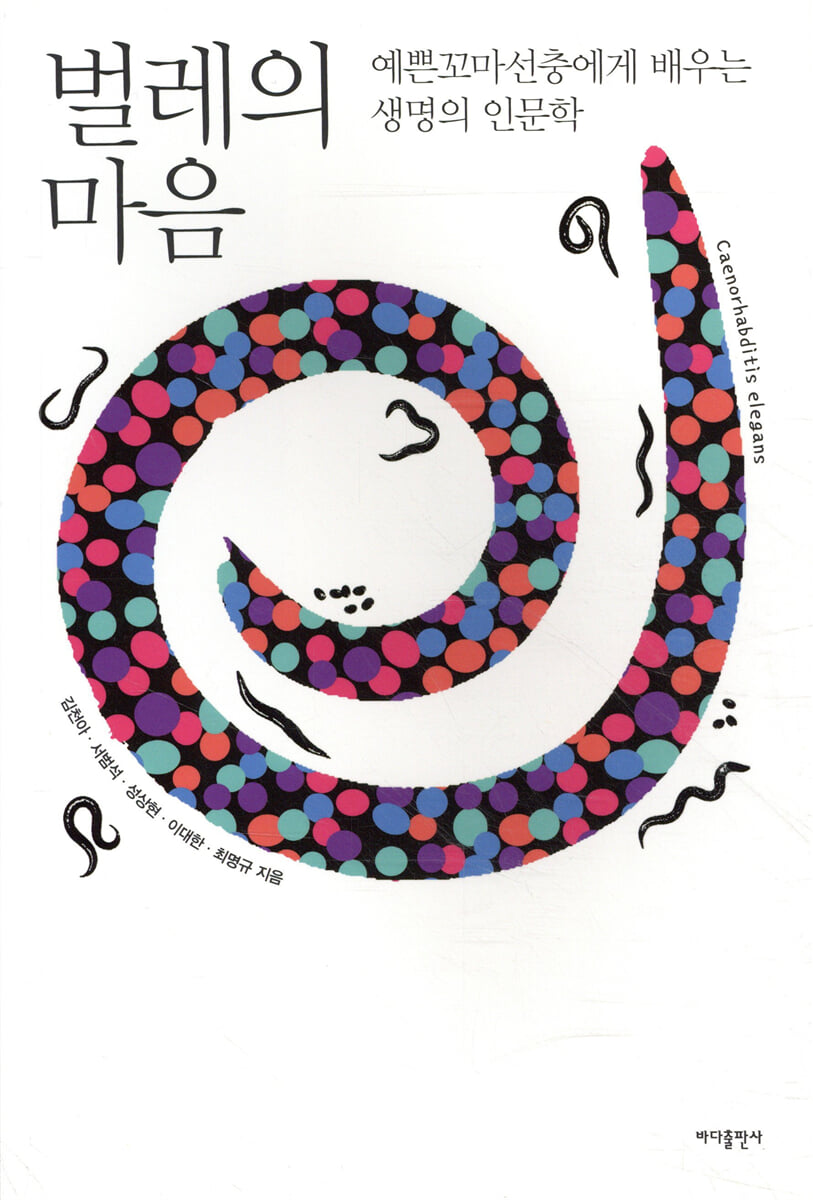
The mind of a bug
 |
Description
Book Introduction
The story of C. elegans, a worm exploring the frontiers of modern biology.
C. elegans is a tiny, transparent worm, measuring only 1 mm in size, that lives in the soil.
This insect, unknown to the general public, is a star in the world of biology and the most 'well-understood' multicellular organism on Earth.
This insect, which does not resemble humans in any way, surprisingly has more than half of its genes similar to human genes, and many of its functions are also similar.
To express the characteristics of these nematodes in the words of Jacques Monod, 'what is true for worms is true for humans.'
Modern biology is on a journey to understand the universality of life and humanity through the pretty worm C. elegans under this banner.
"The Mind of a Bug" contains the serious reflections of five C. elegans scientists who seek to share and communicate this cutting-edge journey of modern biology with the public.
C. elegans is a tiny, transparent worm, measuring only 1 mm in size, that lives in the soil.
This insect, unknown to the general public, is a star in the world of biology and the most 'well-understood' multicellular organism on Earth.
This insect, which does not resemble humans in any way, surprisingly has more than half of its genes similar to human genes, and many of its functions are also similar.
To express the characteristics of these nematodes in the words of Jacques Monod, 'what is true for worms is true for humans.'
Modern biology is on a journey to understand the universality of life and humanity through the pretty worm C. elegans under this banner.
"The Mind of a Bug" contains the serious reflections of five C. elegans scientists who seek to share and communicate this cutting-edge journey of modern biology with the public.
- You can preview some of the book's contents.
Preview
index
introduction
Entering: Hitchhiker C. elegans, Becoming a Cosmopolitan
Part 1: How the Mind Works: From Neurons to Behavior
1. Seeing the Mind in Action - The Current State of Neural Network Visualization Techniques
The Nerve That Feels 2 Hours - The Link Between Aging and Nerve Regeneration
3 How is the blueprint of the mind maintained? - Glial cells and epithelial cells, the guardians of synapses
4 Can we manipulate the human mind with light? - Optogenetics: activating neurons with light
5 Sleeping C. elegans: Do They Dream? - The Biology of Sleep
6 Where Do Cupid's Arrows Come From? - The Mysterious 'Magic of Love' Powered by Oxytocin
7.
A lonely solo from the UK and a party animal from Hawaii - the genes that shape social behavior
Part 2: The Universality of Life: From DNA to Cells
1 Why Twins Aren't Identical - Gene Expression and Noise in the Expression Process
2 Repairing or Rebuilding Proteins? - Two Approaches to Cellular Homeostasis
3 'Running Genes', Chasing Little RNAs - The Struggle of Little RNAs to Stop Dangerous Running Genes
4 The Strange Cohabitation of Viruses and Humans - The Secrets of Viruses Hidden in the Human Genome
5 Where Did My Father's Mitochondria Go? - The Secret of Mitochondrial Maternal Inheritance
6. Why Foods That Balance the Liver Taste So Good - A Molecular Biological Look at Saltiness
7. How to Live Together - The Symbiotic Relationship with Gut Microbes
Part 3: Growing Old: A Life's Work: From Nematodes to Humans
1. Short-lived somatic cells and immortal germ cells - The difference between germ cells and somatic cells
2. Can telomeres, the "cellular timers," truly be considered the individual's timer? - The Current State of Telomere Research
3 The Mystery of Dissonance - Mitochondrial and Nuclear Imbalance Increases Lifespan
4 Secrets of Longevity in Castrated Men: The Link Between Reproduction and Lifespan
5 Can Widowers Live Longer Than Women? - Differences in Men's and Women's Behavior and Lifespan
6. Should I Eat or Intermittent Fast? - The Life-Extending Effects of Dieting and Intermittent Fasting
7. You Shine So Much, You're Dangerous - The Link Between Mitochondrial Flash and Longevity
Appendix: Real-World Case Studies of Elegance Fan Clubs
The Secret of the Hungry Dancing C. elegans: 'Nictation', the Dance of Dauer Larvae
References
Search
Entering: Hitchhiker C. elegans, Becoming a Cosmopolitan
Part 1: How the Mind Works: From Neurons to Behavior
1. Seeing the Mind in Action - The Current State of Neural Network Visualization Techniques
The Nerve That Feels 2 Hours - The Link Between Aging and Nerve Regeneration
3 How is the blueprint of the mind maintained? - Glial cells and epithelial cells, the guardians of synapses
4 Can we manipulate the human mind with light? - Optogenetics: activating neurons with light
5 Sleeping C. elegans: Do They Dream? - The Biology of Sleep
6 Where Do Cupid's Arrows Come From? - The Mysterious 'Magic of Love' Powered by Oxytocin
7.
A lonely solo from the UK and a party animal from Hawaii - the genes that shape social behavior
Part 2: The Universality of Life: From DNA to Cells
1 Why Twins Aren't Identical - Gene Expression and Noise in the Expression Process
2 Repairing or Rebuilding Proteins? - Two Approaches to Cellular Homeostasis
3 'Running Genes', Chasing Little RNAs - The Struggle of Little RNAs to Stop Dangerous Running Genes
4 The Strange Cohabitation of Viruses and Humans - The Secrets of Viruses Hidden in the Human Genome
5 Where Did My Father's Mitochondria Go? - The Secret of Mitochondrial Maternal Inheritance
6. Why Foods That Balance the Liver Taste So Good - A Molecular Biological Look at Saltiness
7. How to Live Together - The Symbiotic Relationship with Gut Microbes
Part 3: Growing Old: A Life's Work: From Nematodes to Humans
1. Short-lived somatic cells and immortal germ cells - The difference between germ cells and somatic cells
2. Can telomeres, the "cellular timers," truly be considered the individual's timer? - The Current State of Telomere Research
3 The Mystery of Dissonance - Mitochondrial and Nuclear Imbalance Increases Lifespan
4 Secrets of Longevity in Castrated Men: The Link Between Reproduction and Lifespan
5 Can Widowers Live Longer Than Women? - Differences in Men's and Women's Behavior and Lifespan
6. Should I Eat or Intermittent Fast? - The Life-Extending Effects of Dieting and Intermittent Fasting
7. You Shine So Much, You're Dangerous - The Link Between Mitochondrial Flash and Longevity
Appendix: Real-World Case Studies of Elegance Fan Clubs
The Secret of the Hungry Dancing C. elegans: 'Nictation', the Dance of Dauer Larvae
References
Search
Publisher's Review
What is true for insects is true for humans.
Growth, Aging, the Mind, and the Universality of Life: A Look at C. elegans
Sydney Brenner, winner of the 2002 Nobel Prize in Physiology or Medicine, brought the little-known worm C. elegans back to the world of biology in the 1960s.
This was a bold challenge, given that no one was studying this bug at the time.
But he had a hunch that C. elegans would play a significant role in modern genetics, embryology, and especially neurobiology.
And that intuition was spot on.
What began as a single researcher has now grown to encompass thousands of researchers worldwide, providing humanity with tremendous intellectual progress on life phenomena.
Modern biology studies only a small number of species.
If each researcher studies different animals or species, they cannot share their research results or experimental know-how.
On the other hand, if researchers work together to establish a standard species, they can accumulate research results in an efficient manner.
For this reason, modern biology studies 'model organisms' through a strategy of selection and concentration.
These model organisms are not intended to be research objects in themselves, but rather are used as a 'means' to understand universal biological phenomena and, by extension, humans.
Among these model organisms, the one that has shown outstanding performance is C. elegans.
The most notable characteristic of C. elegans is its simplicity.
The nematode C. elegans is composed of about 900 somatic cells, 300 nerve cells, and 20,000 genes.
This is a very simple structure compared to other multicellular animals.
Because of this simplicity, the cell lineage map, neural network, and genetic network map of this organism have already been elucidated in detail, which has great advantages in embryology and neurobiology research.
Additionally, it has a transparent body and a short life cycle of three weeks, making it ideal for genetic research that studies mutations.
But what's amazing is that studying this simple insect reveals so much about us humans, who seem so different from us.
Although these tiny insects appear to have no organs like eyes or brains, let alone limbs, they are quite capable of studying many biological phenomena that occur in humans.
It is known that the genomes of C. elegans and humans share about 40% similarity.
And if we consider only the known human genes, about 70% of those genes are also found in C. elegans.
This means that more than two-thirds of human genes can be studied using C. elegans.
Jacques Monod, the great biologist and philosopher of life, expressed the universality that appears in life phenomena as follows:
'What is true of E. coli is true of elephants.' If we were to borrow Jacques Monod's expression to characterize modern biological research, we could say the following.
“What is true for bugs is true for humans!” 《The Mind of a Bug》 is a vivid journey of modern biology that explores the universality of life and the truth about humanity through the beautiful nematode C. elegans.
The "Human Heart" as told by the "Bug's Mind"
What can the nervous system of the nematode C. elegans, a simple worm with no brain and only 302 neurons, tell us about our own minds? In the 1960s, Sydney Branner commissioned a grand project called "The Mind of a Worm," using C. elegans as a subject of biological research.
This project was to visualize the entire nervous system of C. elegans.
This project aimed to visualize the entire nervous system of C. elegans.
Using a little technique to inject fluorescent proteins into the transparent nematode C. elegans, we can see its nerves directly with our own eyes.
Moreover, as techniques for observing the minds of worms have developed, allowing for more microscopic studies, it has become possible to identify the neural connections between individual cells.
Based on this research, biologists have obtained a map of the mind of the worm C. elegans, which consists of 302 neurons and the 8,000 neural networks they form.
Since then, scholars have published surprising research results on the mind based on this map of the mind.
A representative example of this is optogenetics, which uses light, and it holds the promise that in the future the human mind may be able to be manipulated with light.
The ability to control individual neurons using light-responsive channelrhodopsin using genetic techniques was first realized in studies of the worm Caenorhabditis elegans.
Georg Nagel and Dr. Alexander Gottschalk manipulated the tactile nerves of C. elegans, a worm with damaged tactile nerves, by expressing channelrhodopsin and using light.
When the tactile nerves are activated by light, the nematodes react by running away as if their heads had been hit, even though they had not been hit on the head.
The mind of the nematode was manipulated through light.
These experiments have significant implications.
This is because optogenetics holds the potential to be used in humans as well.
This story is not just a fantasy, as optogenetics is already being actively used in experiments using mice.
Of course, there is still a long way to go, but the day we overcome various technological hurdles and our neural circuits become as well-defined as those of C. elegans, this possibility will be realized.
In addition, studies of sleep, love, and sociability in C. elegans have identified specific genes associated with these mental traits, and have shown that these genes are conserved in humans and are used in quite similar functions.
Discovering the universality of life in a tiny insect
Evolution is a tinkering that uses existing phenomena rather than creating new ones.
This is because it is more cost-effective to use something that already exists rather than create something new.
This characteristic is particularly evident in the fundamental mechanisms of life phenomena that appear at the microscopic level.
As Jacques Monod said, the mechanisms of DNA that operate in E. coli and those that operate in elephants are almost identical.
Genetic studies using molecular biological techniques on C. elegans are providing important answers to these fundamental mechanisms.
One prime example is research into how genomes work.
There are no two identical objects in the world.
Of course, one could say that this phenomenon occurs because DNA is different.
But even if we just look at the twins around us, this objection does not hold.
They have the same DNA, but are identifiable.
Of course, these differences may be attributed to the environment.
It's a subtle difference, but it's one that exists in their environments, and it's that difference that creates the difference between the twins.
But what if the environment itself is the same? Peter Swain conducted this experiment using E. coli.
E. coli clones with completely identical genetic information were cultured in a completely controlled environment.
And the gene expression pattern of this E. coli was observed using red and green fluorescent proteins.
The results were surprisingly similar, showing that differences emerged even among individuals with identical genetic information raised in the same environment.
Alexander van Oudenaarden showed, through the worm C. elegans, that this phenomenon is due to the 'noise' created by genes under equal conditions.
Using nematodes, he showed that noise is an inherent feature of genetic networks.
The pretty little nematode provides an answer to the obvious question of why identical life forms do not exist.
In addition, research in C. elegans is shedding light on fascinating questions about the fundamental phenomena of life, such as how do cells maintain homeostasis?, how do cells suppress dangerous factors?, why do traces of viruses remain in the genome?, and why do male mitochondria disappear during fertilization?
Aging, it's a part of life
Research on aging has been growing explosively recently.
Among these, research using C. elegans has made a great contribution to elucidating the detailed mechanisms of aging.
What would happen if somatic cells were transformed into germ cells, allowing them to continue dividing? If telomeres in somatic cells didn't shorten, as in germ cells, would aging stop? Are mitochondrial reactive oxygen species, often cited as the primary culprit in aging, truly the culprit? Why do women live longer than men? What is the correlation between reproduction and longevity? Do fasting and intermittent fasting extend lifespan, and what are the specific mechanisms? We aim to provide answers to fundamental questions about aging at the molecular level.
As a representative example, a study on the effects of 'eating less' and 'intermittent fasting', which recently became an issue after being broadcast, on C. elegans revealed that although the effects of the two fasting methods are the same in that they suggest feeding and thus extend lifespan to some extent, different genes are involved in the detailed mechanisms.
In this way, research on aging through nematodes is revealing the secrets of aging in a rigorous manner from various angles.
But as research increases, so does media interest in aging.
The British daily newspaper [Indinpendert] published an article of the following quality:
“A €400 checkup could tell you how long you have left to live.” The article claims that measuring telomere length, a key factor in aging, can help predict your remaining lifespan.
Other companies also say that the drug TA-65, which activates telomerase, an enzyme used to maintain telomere length, may slow aging.
And other media and advertisements are actively promoting products that claim to help increase longevity, using the authority of science.
In this flood of information, we are led to believe that the elixir of life of Qin Shi Huang is within our grasp.
But research on aging in C. elegans warns that these stories are riddled with exaggerations and misunderstandings.
Aging does not occur due to a single cause.
The nine indicators of aging announced by the scientific journal [Cell] are genomic instability, telomere shortening, epigenetic changes, loss of protein homeostasis, irregular nutrient supply, mitochondrial dysfunction, cellular senescence, stem cell exhaustion, and altered intracellular communication.
And when we consider the lifespan differences resulting from gender differences, dietary differences, and behavioral differences, it can be said that the aging phenomenon is caused by complex factors.
For example, if we could maintain the length of telomeres, which determine the number of cell divisions mentioned above, without shortening, would we be able to live forever without aging? However, experiments using animals have shown that, contrary to expectations, a large number of cancer cells develop.
The result was that cells that should have died did not die but instead proliferated innumerable times.
Rigorous scientific studies using C. elegans encourage us to approach research on aging with a more rigorous and critical perspective.
Growth, Aging, the Mind, and the Universality of Life: A Look at C. elegans
Sydney Brenner, winner of the 2002 Nobel Prize in Physiology or Medicine, brought the little-known worm C. elegans back to the world of biology in the 1960s.
This was a bold challenge, given that no one was studying this bug at the time.
But he had a hunch that C. elegans would play a significant role in modern genetics, embryology, and especially neurobiology.
And that intuition was spot on.
What began as a single researcher has now grown to encompass thousands of researchers worldwide, providing humanity with tremendous intellectual progress on life phenomena.
Modern biology studies only a small number of species.
If each researcher studies different animals or species, they cannot share their research results or experimental know-how.
On the other hand, if researchers work together to establish a standard species, they can accumulate research results in an efficient manner.
For this reason, modern biology studies 'model organisms' through a strategy of selection and concentration.
These model organisms are not intended to be research objects in themselves, but rather are used as a 'means' to understand universal biological phenomena and, by extension, humans.
Among these model organisms, the one that has shown outstanding performance is C. elegans.
The most notable characteristic of C. elegans is its simplicity.
The nematode C. elegans is composed of about 900 somatic cells, 300 nerve cells, and 20,000 genes.
This is a very simple structure compared to other multicellular animals.
Because of this simplicity, the cell lineage map, neural network, and genetic network map of this organism have already been elucidated in detail, which has great advantages in embryology and neurobiology research.
Additionally, it has a transparent body and a short life cycle of three weeks, making it ideal for genetic research that studies mutations.
But what's amazing is that studying this simple insect reveals so much about us humans, who seem so different from us.
Although these tiny insects appear to have no organs like eyes or brains, let alone limbs, they are quite capable of studying many biological phenomena that occur in humans.
It is known that the genomes of C. elegans and humans share about 40% similarity.
And if we consider only the known human genes, about 70% of those genes are also found in C. elegans.
This means that more than two-thirds of human genes can be studied using C. elegans.
Jacques Monod, the great biologist and philosopher of life, expressed the universality that appears in life phenomena as follows:
'What is true of E. coli is true of elephants.' If we were to borrow Jacques Monod's expression to characterize modern biological research, we could say the following.
“What is true for bugs is true for humans!” 《The Mind of a Bug》 is a vivid journey of modern biology that explores the universality of life and the truth about humanity through the beautiful nematode C. elegans.
The "Human Heart" as told by the "Bug's Mind"
What can the nervous system of the nematode C. elegans, a simple worm with no brain and only 302 neurons, tell us about our own minds? In the 1960s, Sydney Branner commissioned a grand project called "The Mind of a Worm," using C. elegans as a subject of biological research.
This project was to visualize the entire nervous system of C. elegans.
This project aimed to visualize the entire nervous system of C. elegans.
Using a little technique to inject fluorescent proteins into the transparent nematode C. elegans, we can see its nerves directly with our own eyes.
Moreover, as techniques for observing the minds of worms have developed, allowing for more microscopic studies, it has become possible to identify the neural connections between individual cells.
Based on this research, biologists have obtained a map of the mind of the worm C. elegans, which consists of 302 neurons and the 8,000 neural networks they form.
Since then, scholars have published surprising research results on the mind based on this map of the mind.
A representative example of this is optogenetics, which uses light, and it holds the promise that in the future the human mind may be able to be manipulated with light.
The ability to control individual neurons using light-responsive channelrhodopsin using genetic techniques was first realized in studies of the worm Caenorhabditis elegans.
Georg Nagel and Dr. Alexander Gottschalk manipulated the tactile nerves of C. elegans, a worm with damaged tactile nerves, by expressing channelrhodopsin and using light.
When the tactile nerves are activated by light, the nematodes react by running away as if their heads had been hit, even though they had not been hit on the head.
The mind of the nematode was manipulated through light.
These experiments have significant implications.
This is because optogenetics holds the potential to be used in humans as well.
This story is not just a fantasy, as optogenetics is already being actively used in experiments using mice.
Of course, there is still a long way to go, but the day we overcome various technological hurdles and our neural circuits become as well-defined as those of C. elegans, this possibility will be realized.
In addition, studies of sleep, love, and sociability in C. elegans have identified specific genes associated with these mental traits, and have shown that these genes are conserved in humans and are used in quite similar functions.
Discovering the universality of life in a tiny insect
Evolution is a tinkering that uses existing phenomena rather than creating new ones.
This is because it is more cost-effective to use something that already exists rather than create something new.
This characteristic is particularly evident in the fundamental mechanisms of life phenomena that appear at the microscopic level.
As Jacques Monod said, the mechanisms of DNA that operate in E. coli and those that operate in elephants are almost identical.
Genetic studies using molecular biological techniques on C. elegans are providing important answers to these fundamental mechanisms.
One prime example is research into how genomes work.
There are no two identical objects in the world.
Of course, one could say that this phenomenon occurs because DNA is different.
But even if we just look at the twins around us, this objection does not hold.
They have the same DNA, but are identifiable.
Of course, these differences may be attributed to the environment.
It's a subtle difference, but it's one that exists in their environments, and it's that difference that creates the difference between the twins.
But what if the environment itself is the same? Peter Swain conducted this experiment using E. coli.
E. coli clones with completely identical genetic information were cultured in a completely controlled environment.
And the gene expression pattern of this E. coli was observed using red and green fluorescent proteins.
The results were surprisingly similar, showing that differences emerged even among individuals with identical genetic information raised in the same environment.
Alexander van Oudenaarden showed, through the worm C. elegans, that this phenomenon is due to the 'noise' created by genes under equal conditions.
Using nematodes, he showed that noise is an inherent feature of genetic networks.
The pretty little nematode provides an answer to the obvious question of why identical life forms do not exist.
In addition, research in C. elegans is shedding light on fascinating questions about the fundamental phenomena of life, such as how do cells maintain homeostasis?, how do cells suppress dangerous factors?, why do traces of viruses remain in the genome?, and why do male mitochondria disappear during fertilization?
Aging, it's a part of life
Research on aging has been growing explosively recently.
Among these, research using C. elegans has made a great contribution to elucidating the detailed mechanisms of aging.
What would happen if somatic cells were transformed into germ cells, allowing them to continue dividing? If telomeres in somatic cells didn't shorten, as in germ cells, would aging stop? Are mitochondrial reactive oxygen species, often cited as the primary culprit in aging, truly the culprit? Why do women live longer than men? What is the correlation between reproduction and longevity? Do fasting and intermittent fasting extend lifespan, and what are the specific mechanisms? We aim to provide answers to fundamental questions about aging at the molecular level.
As a representative example, a study on the effects of 'eating less' and 'intermittent fasting', which recently became an issue after being broadcast, on C. elegans revealed that although the effects of the two fasting methods are the same in that they suggest feeding and thus extend lifespan to some extent, different genes are involved in the detailed mechanisms.
In this way, research on aging through nematodes is revealing the secrets of aging in a rigorous manner from various angles.
But as research increases, so does media interest in aging.
The British daily newspaper [Indinpendert] published an article of the following quality:
“A €400 checkup could tell you how long you have left to live.” The article claims that measuring telomere length, a key factor in aging, can help predict your remaining lifespan.
Other companies also say that the drug TA-65, which activates telomerase, an enzyme used to maintain telomere length, may slow aging.
And other media and advertisements are actively promoting products that claim to help increase longevity, using the authority of science.
In this flood of information, we are led to believe that the elixir of life of Qin Shi Huang is within our grasp.
But research on aging in C. elegans warns that these stories are riddled with exaggerations and misunderstandings.
Aging does not occur due to a single cause.
The nine indicators of aging announced by the scientific journal [Cell] are genomic instability, telomere shortening, epigenetic changes, loss of protein homeostasis, irregular nutrient supply, mitochondrial dysfunction, cellular senescence, stem cell exhaustion, and altered intracellular communication.
And when we consider the lifespan differences resulting from gender differences, dietary differences, and behavioral differences, it can be said that the aging phenomenon is caused by complex factors.
For example, if we could maintain the length of telomeres, which determine the number of cell divisions mentioned above, without shortening, would we be able to live forever without aging? However, experiments using animals have shown that, contrary to expectations, a large number of cancer cells develop.
The result was that cells that should have died did not die but instead proliferated innumerable times.
Rigorous scientific studies using C. elegans encourage us to approach research on aging with a more rigorous and critical perspective.
GOODS SPECIFICS
- Date of issue: January 20, 2017
- Page count, weight, size: 368 pages | 548g | 152*225*30mm
- ISBN13: 9788955619072
- ISBN10: 8955619073
You may also like
카테고리
korean


korean

![ELLE 엘르 스페셜 에디션 A형 : 12월 [2025]](http://librairie.coreenne.fr/cdn/shop/files/b8e27a3de6c9538896439686c6b0e8fb.jpg?v=1766436872&width=3840)


