

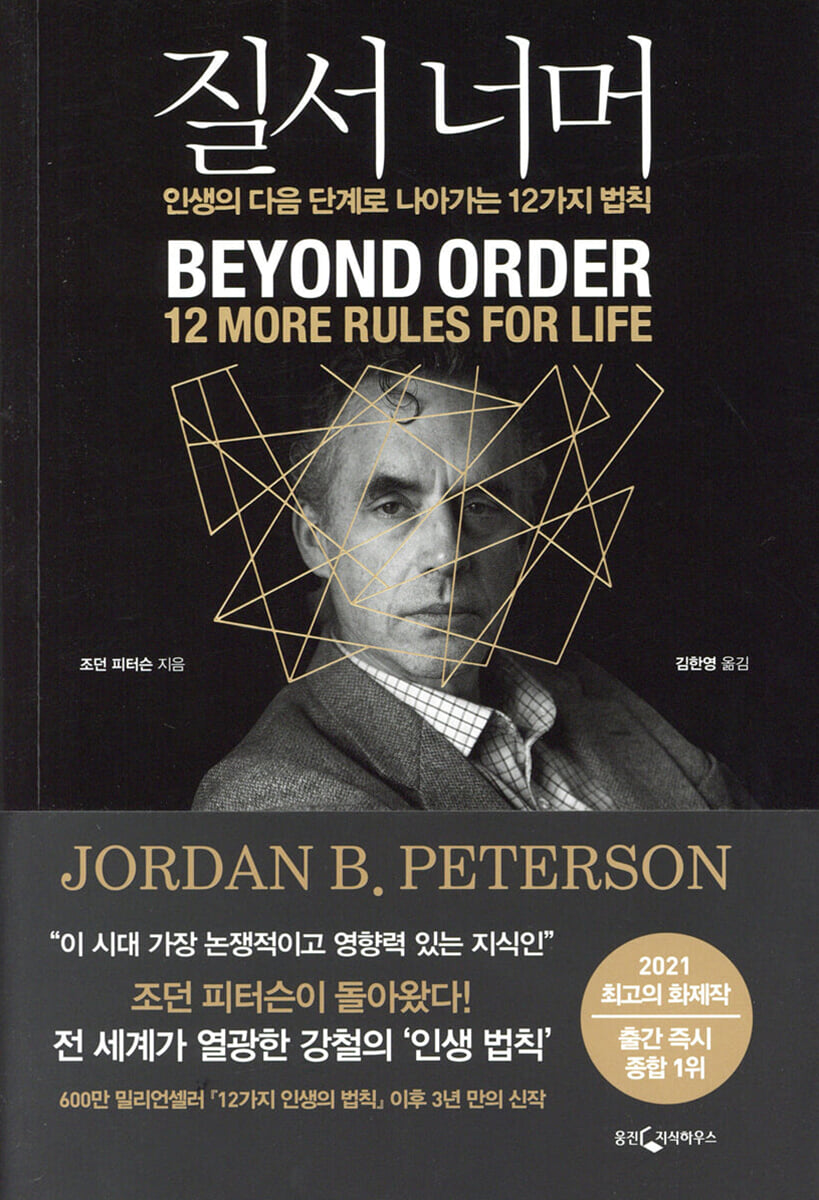
Beyond Order
 |
Description
Book Introduction
Peterson is back The final installment of "The Laws of Life," which captivated young people around the world. Jordan Peterson, a former Harvard psychology professor who sold 5 million copies worldwide with his book "12 Rules for Life," which contains clear advice such as "Before you blame the world, tidy up your room first" and "Stand up straight with your shoulders back," has returned after three years with his new book, "Beyond Order." Why "Beyond Order"? You should imagine and pursue your best self, who you can be (Law 2). Because that's real life. Order can be an antidote to chaos, but it is not perfect. In a world of constant change, if you become complacent with what you already know and have, that order, no matter how hard you worked to achieve it, will become rigid and fixed. Originally, it is impossible to say which is better between order and chaos, and all things endlessly move between them. You must keep one foot in the realm of order and the other foot outside it into the unknown. In chaos there is danger, but there is also opportunity and possibility for improvement. Beyond Order goes beyond simply calming chaos, and instead warms readers' hearts by presenting 12 more powerful laws that break through the shell of cynicism and fear, encouraging them to embrace chaos and the possibilities within. |
- You can preview some of the book's contents.
Preview
index
Rule 1.
Don't arbitrarily disparage existing systems or creative changes.
Rule 2.
Imagine who you could be and aim for that.
Rule 3.
Don't bury what you don't want in the fog.
Rule 4.
Recognize that opportunities lie where others neglect responsibility.
Rule 5.
Don't do what you don't want to do
Rule 6.
Abandon ideology
Rule 7.
Dig deep into at least one thing and see what happens.
Rule 8.
Decorate one room as beautifully as you can.
Rule 9.
If there's a memory that still bothers you, write it down in great detail.
Rule 10.
Plan and manage diligently to maintain the romance of your relationship.
Rule 11.
Do not be resentful, false, or arrogant.
Rule 12.
Be grateful even when it hurts
Don't arbitrarily disparage existing systems or creative changes.
Rule 2.
Imagine who you could be and aim for that.
Rule 3.
Don't bury what you don't want in the fog.
Rule 4.
Recognize that opportunities lie where others neglect responsibility.
Rule 5.
Don't do what you don't want to do
Rule 6.
Abandon ideology
Rule 7.
Dig deep into at least one thing and see what happens.
Rule 8.
Decorate one room as beautifully as you can.
Rule 9.
If there's a memory that still bothers you, write it down in great detail.
Rule 10.
Plan and manage diligently to maintain the romance of your relationship.
Rule 11.
Do not be resentful, false, or arrogant.
Rule 12.
Be grateful even when it hurts
Detailed image

Into the book
I hope this second set of 12 rules is presented a little more wisely than the first set of 12 rules.
As I've been organizing my thoughts, readers around the world have given me great feedback, in person, on YouTube, and through podcasts and blogs.
Thanks to this, I was able to not only more clearly address some topics that were left unexplored in the previous work, but also present many original ideas.
Finally, I hope people find this book as useful as I did when I discovered the 12 Laws.
---p.21
It's useful to experience the bottom of the hierarchy.
Because it helps to cultivate the seeds of gratitude and humility.
Why "Thank You"? There are people whose expertise is superior to yours.
If you are wise, you should be glad of that fact.
There are countless positions in the world that need to be filled to solve complex and serious problems.
It is truly a blessing that those positions are filled by people with reliable skills and experience.
What does "humility" mean? It's better to pretend you don't know and ask for guidance than to become a closed-minded person who thinks they know everything.
… … When we are cornered and stuck, what helps us is always the things we have not yet learned.
---p.43
Everything was going smoothly, but when the topic turned to politics, the conversation started to go awry.
She raised her voice, saying that the overall state of the world is deplorable.
He argued that human activity was negatively impacting the environment and that disaster was imminent.
Of course, in this day and age, it is not wrong to express concern about the global environment.
But it would be a mistake for a young person in his early twenties, who has no positive experiences in life and struggles even to get out of bed, to overestimate his knowledge on such matters.
In such a situation, it is necessary to clarify priorities.
The first button you need to sew is to have the humility to solve your own problems.
---p.58
Who am I, and what kind of person can I become? We are part of an eternal force that constantly and voluntarily confronts the terrifying unknown, part of an eternal force that transcends naiveté to understand evil while still preventing it from emerging from its dark den, part of an eternal force that confronts chaos, transforms it into productive order, or captures an overly restrictive order, reduces it to chaos, and then transforms it back into productive order.
---p.82
The problem is this.
When a hundred or a thousand of these things pile up, your life becomes miserable and your marriage falls apart.
So if you're not happy, don't pretend to be.
If you can come up with an appropriate solution through mutual consultation, please do so.
Don't be afraid of fighting.
Even if it is unpleasant at the moment, you must remove the small rag stuck to the camel's back.
This advice is especially important when it comes to everyday events that everyone considers trivial.
Life is a repetition, and it is well worth correcting the mistakes that are repeated.
---p.115
Without purpose, positive emotions disappear.
The strength we have to move forward with hope comes largely from the experience of reaching out for something we truly want and need.
Without a purpose, we are constantly plagued by unbearable anxiety.
There are so many possibilities around us that we have so many choices.
We can suppress unbearable chaos by focusing on our purpose.
---p.129
The attractive potential of a twenty-five-year-old with no goals and only talent seems hopeless and pathetic at thirty, and completely expires at forty.
You have to sacrifice your multi-layered potential to get the real substance.
---p.145
Just because something makes you momentarily happy doesn't mean it's the best thing for you.
If only life were that simple, but just as there is the you of today, there is the you of tomorrow, the you of next week, the you of next year, the you of five years from now, the you of ten years from now, so harsh as it may be, you have to consider all of the 'yous'.
This curse is related to man's discovery of the future and the subsequent realization of the need for work.
Working means sacrificing present pleasures for the potential improvement of what lies ahead.
---p.155
There are many things in the world that we can forget everything and devote ourselves to.
There is some truth to the argument that the system that demands effort is corrupt, that the alternatives are plentiful, and that dedicating oneself to something is arbitrary and even pointless.
But there is equally a point to being dedicated to something.
He who does not choose a direction is lost.
It is much better to actually become something than to remain everything and become nothing.
Despite all the limitations and disappointments that come with the process.
Cynics lament that the world is full of bad decisions.
But someone who has transcended such cynicism raises the following counterargument:
The worst decision is not to make a decision.
---p.220
Often, the question, “Why is this happening to me?” contains a sense of resentment about injustice.
So they say, “There are bad people in the world, yet they commit evil deeds and get away with it,” or “Everyone in the world is lucky and healthy, but I’m not. How unfair is that?”
When we ask ourselves, "Why me?", we are imbued with a sense of victimization and unfairness.
---p.391
Turning future potential into present reality is something we can do with our individual abilities.
How the world will change is determined by our ethical and conscious choices.
We wake up in the morning and face the day with all its possibilities, all its fears.
And whether it's good or bad, we gauge the direction and set the course.
We know full well that terrible things can happen as a result of evil actions.
But I also know that I can do good things, even if it's not a big deal.
The best way to increase your chances of success is to act responsibly and appropriately, and to maintain an attitude of sincerity, humility, and gratitude.
As I've been organizing my thoughts, readers around the world have given me great feedback, in person, on YouTube, and through podcasts and blogs.
Thanks to this, I was able to not only more clearly address some topics that were left unexplored in the previous work, but also present many original ideas.
Finally, I hope people find this book as useful as I did when I discovered the 12 Laws.
---p.21
It's useful to experience the bottom of the hierarchy.
Because it helps to cultivate the seeds of gratitude and humility.
Why "Thank You"? There are people whose expertise is superior to yours.
If you are wise, you should be glad of that fact.
There are countless positions in the world that need to be filled to solve complex and serious problems.
It is truly a blessing that those positions are filled by people with reliable skills and experience.
What does "humility" mean? It's better to pretend you don't know and ask for guidance than to become a closed-minded person who thinks they know everything.
… … When we are cornered and stuck, what helps us is always the things we have not yet learned.
---p.43
Everything was going smoothly, but when the topic turned to politics, the conversation started to go awry.
She raised her voice, saying that the overall state of the world is deplorable.
He argued that human activity was negatively impacting the environment and that disaster was imminent.
Of course, in this day and age, it is not wrong to express concern about the global environment.
But it would be a mistake for a young person in his early twenties, who has no positive experiences in life and struggles even to get out of bed, to overestimate his knowledge on such matters.
In such a situation, it is necessary to clarify priorities.
The first button you need to sew is to have the humility to solve your own problems.
---p.58
Who am I, and what kind of person can I become? We are part of an eternal force that constantly and voluntarily confronts the terrifying unknown, part of an eternal force that transcends naiveté to understand evil while still preventing it from emerging from its dark den, part of an eternal force that confronts chaos, transforms it into productive order, or captures an overly restrictive order, reduces it to chaos, and then transforms it back into productive order.
---p.82
The problem is this.
When a hundred or a thousand of these things pile up, your life becomes miserable and your marriage falls apart.
So if you're not happy, don't pretend to be.
If you can come up with an appropriate solution through mutual consultation, please do so.
Don't be afraid of fighting.
Even if it is unpleasant at the moment, you must remove the small rag stuck to the camel's back.
This advice is especially important when it comes to everyday events that everyone considers trivial.
Life is a repetition, and it is well worth correcting the mistakes that are repeated.
---p.115
Without purpose, positive emotions disappear.
The strength we have to move forward with hope comes largely from the experience of reaching out for something we truly want and need.
Without a purpose, we are constantly plagued by unbearable anxiety.
There are so many possibilities around us that we have so many choices.
We can suppress unbearable chaos by focusing on our purpose.
---p.129
The attractive potential of a twenty-five-year-old with no goals and only talent seems hopeless and pathetic at thirty, and completely expires at forty.
You have to sacrifice your multi-layered potential to get the real substance.
---p.145
Just because something makes you momentarily happy doesn't mean it's the best thing for you.
If only life were that simple, but just as there is the you of today, there is the you of tomorrow, the you of next week, the you of next year, the you of five years from now, the you of ten years from now, so harsh as it may be, you have to consider all of the 'yous'.
This curse is related to man's discovery of the future and the subsequent realization of the need for work.
Working means sacrificing present pleasures for the potential improvement of what lies ahead.
---p.155
There are many things in the world that we can forget everything and devote ourselves to.
There is some truth to the argument that the system that demands effort is corrupt, that the alternatives are plentiful, and that dedicating oneself to something is arbitrary and even pointless.
But there is equally a point to being dedicated to something.
He who does not choose a direction is lost.
It is much better to actually become something than to remain everything and become nothing.
Despite all the limitations and disappointments that come with the process.
Cynics lament that the world is full of bad decisions.
But someone who has transcended such cynicism raises the following counterargument:
The worst decision is not to make a decision.
---p.220
Often, the question, “Why is this happening to me?” contains a sense of resentment about injustice.
So they say, “There are bad people in the world, yet they commit evil deeds and get away with it,” or “Everyone in the world is lucky and healthy, but I’m not. How unfair is that?”
When we ask ourselves, "Why me?", we are imbued with a sense of victimization and unfairness.
---p.391
Turning future potential into present reality is something we can do with our individual abilities.
How the world will change is determined by our ethical and conscious choices.
We wake up in the morning and face the day with all its possibilities, all its fears.
And whether it's good or bad, we gauge the direction and set the course.
We know full well that terrible things can happen as a result of evil actions.
But I also know that I can do good things, even if it's not a big deal.
The best way to increase your chances of success is to act responsibly and appropriately, and to maintain an attitude of sincerity, humility, and gratitude.
---p.405
Publisher's Review
“The most controversial and influential intellectual of our time.”
Jordan Peterson's new book, "12 Rules for Life," is out now.
A life lecture by a former Harvard professor who captivated young people around the world.
Jordan Peterson returns with his new book, Beyond Order: 12 Rules for Moving to the Next Level of Your Life, after three years.
Peterson is a world-renowned psychologist who is causing the biggest syndrome of the 21st century.
He is known for his blunt criticism of apathetic youth.
“Grow up! Become stronger to be recognized and succeed.
“Take on as much responsibility as possible.” Young people around the world respect and follow him, calling him the ‘Father of the Internet.’
Reactions like "Peterson's lectures completely changed my life" and "One Peterson a day! I start my morning with the professor's lectures" are lined up.
As popular as it is, the controversy is also great.
Some criticize him as an anachronistic figure, calling him a conservative, anti-feminist, and white supremacist.
On the other hand, they say that feminism, political correctness, and radicalism are causing greater chaos in society, and they praise Peterson, who speaks out against them, as an intellectual and conscience of the times.
However, this dichotomous framework cannot properly capture the essence of the 'Peterson phenomenon' that has heated up the world.
He is an intellectual who cannot be classified into any of today's theoretical or ideological categories.
Peterson, who is extremely wary of being caught up in a single dogma, delves into the question of "what do humans live for?" in a multi-layered way, crossing over Jung and Freud, Nietzsche and Dostoevsky, mythology and religion, literature and art, evolutionary theory and neuroscience.
His previous work, "12 Rules for Life," sold nearly 6 million copies in over 50 countries around the world, and over 300,000 copies in Korea.
The lecture tour, which took place in over 160 cities, sold out every day and attracted an audience of approximately 500,000 people.
As of March 2021, his YouTube channel has over 3.57 million subscribers and 220 million cumulative views.
Content reproducing his lectures and interviews is widely distributed across the internet, and the total number of views is incalculable.
In 2021, for young people still thirsting for certainty and meaning, "Beyond Order," which broke the three-year wait and returned, is once again sparking a "Peterson craze" around the world.
Why "Beyond Order"? A World Turned Upside Down After the Pandemic
“A new era requires new rules!”
Rule 1.
Don't arbitrarily disparage existing systems or creative changes.
Rule 2.
Imagine who you could be and aim for that.
Rule 3.
Don't bury what you don't want in the fog.
Rule 4.
Recognize that opportunities lie where others neglect responsibility.
Rule 5.
Don't do what you don't want to do
Rule 6.
Abandon ideology
Rule 7.
Dig deep into at least one thing and see what happens.
Rule 8.
Decorate one room as beautifully as you can.
Rule 9.
If there's a memory that still bothers you, write it down in great detail.
Rule 10.
Plan and manage diligently to maintain the romance of your relationship.
Rule 11.
Do not be resentful, false, or arrogant.
Rule 12.
Be grateful even when it hurts
Since I presented '12 Rules for Life' three years ago, the world has changed rapidly, if not completely.
The COVID-19 pandemic has shaken the world order and plunged us into chaos.
At the same time, it has also become an opportunity to tolerate excessive control under the goal of quarantine and safety, and anxiety and fear have further fueled partisanship and nihilistic cynicism.
Even after the pandemic passes, its aftereffects can still oppress us in many parts of society.
We need a new law that redefines the meaning of chaos and order, which are like two sides of a coin.
Peterson's new rules for life are sobering and inspiring.
He advises not to fear chaos, but rather to embrace the opportunities and possibilities that lie dormant within it.
He commands them not to be afraid of fighting if necessary.
It is a warning to take responsibility before demanding rights.
It sharply examines how miserable a life can become when we pursue immediate gain and are swayed by momentary happiness and satisfaction.
In an age where chaos overwhelms us, the author's vision, which instead focuses on the possibilities within, offers readers new insights.
Mentors vs. Mentors of the MZ Generation
“Drug addict” hypocrite?
The Complete Edition of "The Laws of Life," Made Even More Powerful in the Face of Death
Peterson has been out of the public eye since the fall of 2019 due to health issues.
The root of the problem was that he had gradually increased the amount of benzodiazepine tranquilizers he had been taking for medical reasons to reduce the extreme anxiety and stress that his wife Tammy was battling with cancer.
By the time I realized something was wrong, I was already addicted to benzodiazepines.
Benzodiazepine withdrawal symptoms were horrible.
He suffered from severe anxiety, depression, agitation, and suicidal thoughts.
Treatment continued for over a year, traveling between the United States, Canada, Russia, and Serbia.
When he woke up in Moscow, nearly a month after being in a coma, he was so badly damaged that he had to relearn how to walk, lie down, climb stairs, and button his buttons.
I can barely remember anything from almost a year ago.
But instead of despairing or giving in, Peterson decided to fight the misfortune that had befallen him.
“The love between me and my family, the courage my friends gave me, and the work that was meaningful to me” were the pillars of support that allowed me to complete “Beyond Order” in hellish circumstances.
The new 12 Laws, honed in the face of actual death, convey to readers life wisdom that is more truthful, humane, and wise than ever before.
Imagine what kind of person I could be
Stop this meaningless life right now and take responsibility.
Where can we find the courage to face life's trials and tribulations, and the strength to alleviate its inevitable suffering? Peterson finds the answer in the great stories that have been passed down through generations (Rule 2).
Imagine who you could be and aim for that).
The heroes in such stories have one thing in common: they take on as much responsibility as possible and try to alleviate the suffering of reality, even if only a little.
According to Peterson, 'happiness' cannot be the true goal of life.
Rather, it is the 'responsibility' that people hate that gives meaning to life.
That meaning makes life's suffering worthwhile (Rule 4.
Recognize that opportunities hide where others neglect their responsibilities.
Peterson likens an irresponsible life to a "sled dog without a sled."
“A sled dog without a sled will bite its own legs.
Why? Because I'm bored.
“Ordinary people who have nothing to carry eat themselves.” (From the YouTube lecture “Maps of Meaning 11: The Flood and the Tower”)
True self-esteem also grows in proportion to the responsibility one willingly takes on.
The message of 'love yourself just as you are' alone won't solve real problems.
We need to delve deeply into meaningful and valuable work, even if it is difficult and challenging (Rule 7.
(Dig deep into at least one thing and see what happens).
Even if there are sacrifices along the way, if you avoid making choices, you will remain an 'adult child' forever.
The first thing you must do to escape from this aimless and hopeless life is to become a true adult who takes responsibility for yourself.
Don't be swayed by fear and cynicism
Go beyond the rigid order and encounter a higher life.
Order gives us certainty, stability, and predictability.
But if order forces a certain direction on an individual's thoughts and actions, it loses the momentum to change to fit the new flow and becomes rigid.
The result is a startlingly dogmatic dichotomy that fuels hatred and cynicism and divides society.
People blame others and the world before looking back on themselves, easily despair of human malice and limitations, deny the value of all existence, and fall into cynicism.
Everyone has a dark side, and the order we establish cannot be perfect.
However, if you only focus on the negative elements, you can get lost in the chaos.
We must not denigrate the value of the existing order, but we must keep one foot in the realm of order and the other in the world of chaos (Rule 1.
(Do not arbitrarily disparage existing systems and creative changes.)
By maintaining a proper balance between the two forces, we can learn new knowledge and attempt creative change without panic or fear when unexpected tragedies disrupt the familiar order.
The fate of all existence is harsh, but it is each person's choice that makes the difference.
Do you resolve to improve your tomorrow every day, yet keep putting it off? Do you find yourself pacing in circles, resenting the fact that this is happening to you? Do you cynically question the meaning of dedicating yourself to something, yet are you consumed by guilt and consumed by the urge to kill yourself every night? The 12 new rules for life in "Beyond Order" will serve as a meaningful guide, breaking through those temptations, limitations, fears, and cynicism and guiding you to a higher life.
Jordan Peterson's new book, "12 Rules for Life," is out now.
A life lecture by a former Harvard professor who captivated young people around the world.
Jordan Peterson returns with his new book, Beyond Order: 12 Rules for Moving to the Next Level of Your Life, after three years.
Peterson is a world-renowned psychologist who is causing the biggest syndrome of the 21st century.
He is known for his blunt criticism of apathetic youth.
“Grow up! Become stronger to be recognized and succeed.
“Take on as much responsibility as possible.” Young people around the world respect and follow him, calling him the ‘Father of the Internet.’
Reactions like "Peterson's lectures completely changed my life" and "One Peterson a day! I start my morning with the professor's lectures" are lined up.
As popular as it is, the controversy is also great.
Some criticize him as an anachronistic figure, calling him a conservative, anti-feminist, and white supremacist.
On the other hand, they say that feminism, political correctness, and radicalism are causing greater chaos in society, and they praise Peterson, who speaks out against them, as an intellectual and conscience of the times.
However, this dichotomous framework cannot properly capture the essence of the 'Peterson phenomenon' that has heated up the world.
He is an intellectual who cannot be classified into any of today's theoretical or ideological categories.
Peterson, who is extremely wary of being caught up in a single dogma, delves into the question of "what do humans live for?" in a multi-layered way, crossing over Jung and Freud, Nietzsche and Dostoevsky, mythology and religion, literature and art, evolutionary theory and neuroscience.
His previous work, "12 Rules for Life," sold nearly 6 million copies in over 50 countries around the world, and over 300,000 copies in Korea.
The lecture tour, which took place in over 160 cities, sold out every day and attracted an audience of approximately 500,000 people.
As of March 2021, his YouTube channel has over 3.57 million subscribers and 220 million cumulative views.
Content reproducing his lectures and interviews is widely distributed across the internet, and the total number of views is incalculable.
In 2021, for young people still thirsting for certainty and meaning, "Beyond Order," which broke the three-year wait and returned, is once again sparking a "Peterson craze" around the world.
Why "Beyond Order"? A World Turned Upside Down After the Pandemic
“A new era requires new rules!”
Rule 1.
Don't arbitrarily disparage existing systems or creative changes.
Rule 2.
Imagine who you could be and aim for that.
Rule 3.
Don't bury what you don't want in the fog.
Rule 4.
Recognize that opportunities lie where others neglect responsibility.
Rule 5.
Don't do what you don't want to do
Rule 6.
Abandon ideology
Rule 7.
Dig deep into at least one thing and see what happens.
Rule 8.
Decorate one room as beautifully as you can.
Rule 9.
If there's a memory that still bothers you, write it down in great detail.
Rule 10.
Plan and manage diligently to maintain the romance of your relationship.
Rule 11.
Do not be resentful, false, or arrogant.
Rule 12.
Be grateful even when it hurts
Since I presented '12 Rules for Life' three years ago, the world has changed rapidly, if not completely.
The COVID-19 pandemic has shaken the world order and plunged us into chaos.
At the same time, it has also become an opportunity to tolerate excessive control under the goal of quarantine and safety, and anxiety and fear have further fueled partisanship and nihilistic cynicism.
Even after the pandemic passes, its aftereffects can still oppress us in many parts of society.
We need a new law that redefines the meaning of chaos and order, which are like two sides of a coin.
Peterson's new rules for life are sobering and inspiring.
He advises not to fear chaos, but rather to embrace the opportunities and possibilities that lie dormant within it.
He commands them not to be afraid of fighting if necessary.
It is a warning to take responsibility before demanding rights.
It sharply examines how miserable a life can become when we pursue immediate gain and are swayed by momentary happiness and satisfaction.
In an age where chaos overwhelms us, the author's vision, which instead focuses on the possibilities within, offers readers new insights.
Mentors vs. Mentors of the MZ Generation
“Drug addict” hypocrite?
The Complete Edition of "The Laws of Life," Made Even More Powerful in the Face of Death
Peterson has been out of the public eye since the fall of 2019 due to health issues.
The root of the problem was that he had gradually increased the amount of benzodiazepine tranquilizers he had been taking for medical reasons to reduce the extreme anxiety and stress that his wife Tammy was battling with cancer.
By the time I realized something was wrong, I was already addicted to benzodiazepines.
Benzodiazepine withdrawal symptoms were horrible.
He suffered from severe anxiety, depression, agitation, and suicidal thoughts.
Treatment continued for over a year, traveling between the United States, Canada, Russia, and Serbia.
When he woke up in Moscow, nearly a month after being in a coma, he was so badly damaged that he had to relearn how to walk, lie down, climb stairs, and button his buttons.
I can barely remember anything from almost a year ago.
But instead of despairing or giving in, Peterson decided to fight the misfortune that had befallen him.
“The love between me and my family, the courage my friends gave me, and the work that was meaningful to me” were the pillars of support that allowed me to complete “Beyond Order” in hellish circumstances.
The new 12 Laws, honed in the face of actual death, convey to readers life wisdom that is more truthful, humane, and wise than ever before.
Imagine what kind of person I could be
Stop this meaningless life right now and take responsibility.
Where can we find the courage to face life's trials and tribulations, and the strength to alleviate its inevitable suffering? Peterson finds the answer in the great stories that have been passed down through generations (Rule 2).
Imagine who you could be and aim for that).
The heroes in such stories have one thing in common: they take on as much responsibility as possible and try to alleviate the suffering of reality, even if only a little.
According to Peterson, 'happiness' cannot be the true goal of life.
Rather, it is the 'responsibility' that people hate that gives meaning to life.
That meaning makes life's suffering worthwhile (Rule 4.
Recognize that opportunities hide where others neglect their responsibilities.
Peterson likens an irresponsible life to a "sled dog without a sled."
“A sled dog without a sled will bite its own legs.
Why? Because I'm bored.
“Ordinary people who have nothing to carry eat themselves.” (From the YouTube lecture “Maps of Meaning 11: The Flood and the Tower”)
True self-esteem also grows in proportion to the responsibility one willingly takes on.
The message of 'love yourself just as you are' alone won't solve real problems.
We need to delve deeply into meaningful and valuable work, even if it is difficult and challenging (Rule 7.
(Dig deep into at least one thing and see what happens).
Even if there are sacrifices along the way, if you avoid making choices, you will remain an 'adult child' forever.
The first thing you must do to escape from this aimless and hopeless life is to become a true adult who takes responsibility for yourself.
Don't be swayed by fear and cynicism
Go beyond the rigid order and encounter a higher life.
Order gives us certainty, stability, and predictability.
But if order forces a certain direction on an individual's thoughts and actions, it loses the momentum to change to fit the new flow and becomes rigid.
The result is a startlingly dogmatic dichotomy that fuels hatred and cynicism and divides society.
People blame others and the world before looking back on themselves, easily despair of human malice and limitations, deny the value of all existence, and fall into cynicism.
Everyone has a dark side, and the order we establish cannot be perfect.
However, if you only focus on the negative elements, you can get lost in the chaos.
We must not denigrate the value of the existing order, but we must keep one foot in the realm of order and the other in the world of chaos (Rule 1.
(Do not arbitrarily disparage existing systems and creative changes.)
By maintaining a proper balance between the two forces, we can learn new knowledge and attempt creative change without panic or fear when unexpected tragedies disrupt the familiar order.
The fate of all existence is harsh, but it is each person's choice that makes the difference.
Do you resolve to improve your tomorrow every day, yet keep putting it off? Do you find yourself pacing in circles, resenting the fact that this is happening to you? Do you cynically question the meaning of dedicating yourself to something, yet are you consumed by guilt and consumed by the urge to kill yourself every night? The 12 new rules for life in "Beyond Order" will serve as a meaningful guide, breaking through those temptations, limitations, fears, and cynicism and guiding you to a higher life.
GOODS SPECIFICS
- Publication date: March 23, 2021
- Page count, weight, size: 460 pages | 826g | 152*225*30mm
- ISBN13: 9788901249599
- ISBN10: 8901249596
You may also like
카테고리
korean


korean

![GQ KOREA Mark (Monthly): December [2025]](http://librairie.coreenne.fr/cdn/shop/files/8ef265dbbfbf186523ed75ba7319009d.jpg?v=1765340328&width=3840)


